Summary: DataMentors has launched a low-cost marketing database product with limited functionality. It's an interesting test of what marketers really want.
Marketing database software and service vendor DataMentors last week tossed its hat into the ever-more-crowded ring of marketing automation for small(ish) businesses. The new product, DataPoint, is a limited version of the company’s flagship PinPoint system. Like PinPoint, it combines DataMentor’s DataFuse data cleansing and matching software with a private-label version of SmartFocus campaign management and analysis. The difference is that PinPoint scales to tens of millions of customer records, while DataPoint is limited to 100,000 customers, one million prospects, fifty data fields and quarterly file updates. Pricing is $2,000 per month, probably less than half what most marketing automation vendors charge for a 100,000 name installation.
Wait. Back up. Did I just write quarterly updates? Fifty fields? Warm up the eight track and fluff out my mullet, modern marketing automation products don’t have those types of limits. Nor does DataMentor’s own PinPoint. What's going on here?
Even though DataPoint includes the quite sophisticated campaign management features of SmartFocus, it’s really less a marketing system than a tool for data analysis. Marketers without any access to their customer data will be happy to load their files into DataPoint and do all the cool slicing and dicing that the SmartFocus engine makes easy. They might produce some outbound campaigns as well, but lack of fresh data means these are going to be pretty generic.
It’s tempting to relate this old-school approach to the origins of DataMentors itself: it was co-founded by industry veteran Bob Orf , the “O” is OKRA Marketing, a pioneer marketing database vendor founded in 1987 when small records and infrequent updates were the rule. But DataMentors has kept up with the times: Orf says that most PinPoint systems are updated daily or weekly, and the company even offers real-time, Web service access to its data quality system. And of course DataPoint users can upgrade to a more powerful version if they’re willing to pay.
That being the case, it’s probably more useful to think of DataPoint as part of the market for on-demand business intelligence – competing in some ways with companies like Birst, PivotLink and Oco. Although those systems are more flexible than DataPoint, they share its low deployment cost and focus on analytics rather than marketing execution.
One key advantage DataPoint has over those systems is integration with DataFuse, a highly sophisticated matching engine that was DataMentor’s original product and remains the cornerstone of its business. Another difference is that DataMentors has recently licensed consumer and business databases for its clients to use as prospect lists or to enhance their own files. DataFuse users can access these for an extra $1,000 per month – another highly competitive rate. DataPoint clients will also benefit from the deep expertise of DataMentors staff, particularly in the banking industry.
A configuration like DataPoint is not something I would have expected in today’s market, where continuous updates, flexible data models and near-real-time customer interactions are standard operating procedure. But I have tremendous respect for the DataMentors team and trust them to know their market. It will certainly be interesting to see how well DataPoint works out for them.
Thursday, August 26, 2010


Wednesday, August 18, 2010
LeadForce1 Adds Mind Reading to Marketing Automation
Summary: LeadForce1 infers Web visitors' intent and sales stage from the contents they read. It combines this with standard B2B marketing automation features to provide better-qualified leads to sales people.
The B2B marketing automation industry has reached the stage where product features are similar and companies compete primarily on business and marketing savvy. This intrigues me in its own way although it's not as much fun as looking at cool new technologies. Of course, if you’re a vendor offering a cool new technology, the stakes are higher.
Such is my take on LeadForce1. The company’s product touches the standard marketing automation bases: outbound email, landing pages and forms, lead nurturing, scoring and integration with Salesforce.com. It adds some less typical features for telephone lead qualification, which makes sense for reasons we’ll get to later. But its most intriguing claim is that it supplements the usual Web behavior tracking with reports on visitors’ intent and sales stages.
LeadForce1 does this by capturing the text that visitors hover over, click on, highlight or copy, and comparing it with keywords that indicate intent and sales stage. The system starts with a standard list of keywords which clients can modify to match their business. “Intent” is usually related to customer interests, such as a particular problem or product line. “Sales stage” uses a standard progression of research, consideration, trial and purchase, which clients can change if they wish. Because B2B purchases are often made by a team of specialists, the system assigns interests separately to each individual but assigns a single sales stage to everyone from the same company.
Intent and sales stage reporting are not merely random cool features. They help rank leads and send alerts as part of a larger focus on delivering qualified names to sales people. Related capabilities include reverse IP lookup of the company of anonymous visitors, connections to Jigsaw to provide contact names of those companies, and the aforementioned telephone lead qualification. In fact, LeadForce1 is targeted in part at Web publishers who collect leads and resell them to other businesses. Its ability to enhance these leads with intent and sales stage makes them more targeted and, thus, more valuable. This is why LeadForce1 sometimes refers to itself as being in the “lead exchange” business, although it currently seems to prefer the label “marketing automation 2.0”.
Sales people would certainly benefit from knowing the intent and sales stage of their leads. Of course, you do have to wonder about the accuracy of the information. LeadForce1 currently does some response tracking but mostly relies on clients to decide for themselves which keywords are effective. It does plan to add more rigorous analysis using the data it already collects. The same data will also be used to measure the impact of marketing contacts on changes in intent and sales stage and to forecast movement of leads from one stage to the next. The results will be interesting and, assuming the system proves reasonably accurate, should be quite valuable.
LeadForce1 was launched about two years ago and currently has 224 customers. Pricing is based on the modules purchased, number of users and number of leads. Monthly cost can be as low as $500 although a typical clients spends about $3,000 per month.
With so many customers, and growing quickly, LeadForce1 may survive the marketing automation industry consolidation as an independent firm. If not, its technology is useful enough that there's a good chance it will find its way into other systems.
Friday, August 13, 2010
IBM Buys Unica: Will Acquisitions Now Shift to B2B Marketing Automation?
IBM announced this morning that it was purchasing enterprise marketing automation leader Unica for $480 million, more than double the company’s current stock market valuation. This is wholly unsurprising: as the last and only big independent left in its space, Unica was obvious acquisition bait. It was also a motivated seller, since it faced an increasingly impossible struggle to fund the product enhancements necessary to compete with the likes of SAS, Teradata and Siebel / Oracle. Conversely, IBM is on a customer intelligence acquisition spree that has already included Coremetrics Web analytics, Sterling Commerce B2B integration and Cognos and SPSS business analytics.
There’s been some comment (I’m looking at you, Jonathan Block of SiriusDecisions) relating the IBM/Unica deal to consolidation with the B2B marketing automation industry. Sorry, but I don’t see a connection. As I discussed in my own post on industry consolidation, Unica belongs to the class of marketing systems that serve consumer marketers. Its acquisition is basically the completion of the consolidation of that space, not the start of consolidation among B2B marketing automation vendors. (I’m overstating a bit: there are a couple of B2C vendors left including Neolane, Alterian and SmartFocus, although the latter two use proprietary database engines that would make them difficult to integrate into a larger enterprise suite. Probably the most prominent survivor is Aprimo, but they’re more B2B.)
If there’s any connection at all, it’s that this acquisition may spur Web content management vendors to accelerate their own acquisition of marketing automation capabilities. I discussed this a bit in my post on Adobe’s acquisition of Day Software and in the industry consolidation post. Given that there are so few B2C marketing automation vendors left, the Web content management players are almost forced to consider buying a B2B marketing automation system. (The other option would be email vendors like ExactTarget and Responsys.)
This isn’t really a bad thing: the B2B marketing automation products have pretty much all the capabilities of the B2C systems and then some. On the other hand, most B2B systems are designed for smaller data volumes and have less flexible data structures.
The bottom line is probably that the upper tier B2B marketing automation vendors (Eloqua, Silverpop, Aprimo, possibly Marketbright) are next in line to be bought. But you already knew that.
Thursday, August 12, 2010
Genius.com Offers Free Edition: How Much Does It Lower True Cost of Entry?
Summary: Genius.com has added a free version of its system. But I think its strategy of offering an intermediate product between email marketing and full marketing automation may actually be more useful in attracting new customers.
On Monday, Genius.com announced “the first free, instant-on demand generation solution”, a description carefully crafted to distinguish their offering from the free version announced by LoopFuse in June. The key term here is “instant-on”, which Genius defines to mean “instantly integrated website tracking, email marketing and social media campaign tracking” along with fully automated integration with Salesforce.com, including custom fields in standard objects. LoopFuse also provides automated Salesforce.com integration, but doesn’t have Genius’s Web tracking technology.
Since Genius has highlighted the issue, let's dive into its Web tracking. How it works it this: Genius creates URLs that send visitors to a proxy server, which in turn forwards their page calls to the client’s actual Web site. The proxy server continues as an intermediary through the entire visit, so it can track all pages the visitor sees. The same method is used in Web advertising, email links and linked embedded within social media messages. Because the tracking is done by the proxy server, there’s no need to make changes (i.e., add a tracking tag) to the Web site itself. This is what makes the tracking truly “instant”.
So far so good, but let’s be clear: the proxy server only captures visits that begin with a Genius-generated URL. So if I respond to a Genius-generated email, all the details of my initial visit are captured. But if I come back later by typing www.genius.com into my browser or searching for Genius on Google, the proxy server isn’t involved and Genius won’t know about me unless a traditional tag has been added to the Web pages. Genius does support such tags but now we’re beyond the realm of “instant on” and, indeed, of the free Genius system.
Genius' tracking technology is clever and unique enough that they’ve been able to patent it. But conventional marketing automation systems automatically track their own emails, landing pages and Web forms, also without touching the corporate Web site. This is not quite as powerful (or cool) as the Genius approach, but does reduce practical difference.
I wouldn’t have gotten into this had Genius not made “first free, instant-on” the focus of its announcement. What really matters is that they have a free offering, which implies two things about the system itself:
- they can provide fully automated, instant provisioning, which means their technology is sophisticated and their operating costs are low.
- the system is easy enough that new clients can use it with a minimum of support. Genius Marketing Vice President Scott Mersy told me yesterday that the company expects most users will learn what they need from a sequence of educational emails and online materials. He did add – and this and this is important – that limited phone support will be available to free users.
What does the free offering mean from an industry standpoint? I discussed this at some length in my June post on the Loopfuse’s free product. Bottom line: a free version will gain vendors some customers they wouldn’t get otherwise, but probably not create a huge difference in their market share or growth of the market itself. A marketing automation system is a highly considered purchase. Buyers recognize they will make a substantial investment in time and materials, so an extended free trial (which is what most free versions boil down to) is just one of many factors they weigh in selecting a starter system. Free systems may also attract companies so small that the free system is all they need. But those companies will never be a source of much revenue, even if the vendors manage to sell them some additional services.
In other words, the true purpose of a free system is to lower buyers' full cost of entry enough to attract a large number of new customers. This cost includes not just the software, but also the time spent to learn and operate the system, to develop new campaigns, and to design new business processes. This is why automated provisioning and self-service support really matter: they imply time savings for the users as well as the vendor.
In terms of entry costs, it's significant that Genius’ free version is based on their “Demand Generation” system, which occupies a middle ground between their “Email Marketing” and “Marketing Automation” products. The company provides a handy comparison table which shows that Demand Generation includes social media and Web tracking, triggered actions, Web forms and progressive profiling, but not drip campaigns, automated lead nurturing, lead scoring and landing pages. That is, it captures and tracks leads but doesn’t do sophisticated lead nurturing. This greatly lowers entry costs by asking users to start with a smaller, simpler set of tasks.
Although competitors will no doubt cite the limits of Genius Demand Generation as a weakness of Genius’ free offering, Mersy said the company will actually make the full Marketing Automation version available to free users who want it. He said they chose to start free users on the simpler system only to simplify their initial deployment.
That’s probably a very clever move – as is offering the Demand Generation version. Many marketing automation vendors have a “lite” system that is similar to the Genius Email Marketing, which includes Web behavior tracking and Salesforce.com integration as well as outbound email. But the next leap is typically to full marketing automation. An intermediate product provides a smoother growth path for marketers who want to start small and slowly expand their marketing automation efforts. This addresses two key obstacles to first-time purchase:
- it lets Genius offer a substantially lower entry price than competitors, without dropping the price of its full system. Starting price of Demand Generation is around $800 per month, slightly higher than the $600 per month of Email Marketing but significantly below $1,100 per month for Marketing Automation.
- it lets marketers grow into the complete system at their own pace, rather than purchasing something that requires extensive campaign development and process redesign to use fully. Of course, marketers could also just not deploy these features in another system, but the psychology of that is quite negative.
It remains to be seen whether having an intermediate Demand Generation product really gives Genius a substantial competitive advantage. If it does, it won't last long because the approach could be easily copied. Still, Demand Generation represents a creative approach to a fundamental challenge in the market. For that reason alone, it’s worth watching.
Wednesday, August 11, 2010
Day Software Acquisition Adds Some Marketing Features to Adobe, But Gaps Remain
Summary: Adobe added Web content management, digital asset management and social media features to its arsenal when it purchased Day Software last month. But it still lacks key pieces of a complete marketing solution.
Last month, Adobe announced their $240 million acquisition of Web content management vendor Day Software. Adobe was already a major force in Web development through its Dreamweaver, Flash and ColdFusion products, not to mention Omniture for Web analytics. But Day fills out its line by adding enterprise-class content management, digital asset management and social (blog, Wiki, etc.) publishing. In fact, the fit is so obvious that it doesn’t seem to have generated much comment, at least among the marketing gurus I read.
But the significance to marketers may be greater than they think. Back in February, Day released its 5.3 version, which specifically aimed at letting marketers manage their Web promotions without help from technical specialists. Of course, this is a goal shared by so many vendors that it verges on cliché. In particular, it’s also one of the main benefits offered by the landing page, Web form and microsite features of marketing automation systems.
Still, as I’ve argued many times, it ultimately makes more sense for marketers to build their pages in the company’s core content management system than in separate marketing automation tools. This can only happen if the content management system provides the features that marketers need to do their jobs.
Day’s 5.3 release attempted to do this by adding targeting capabilities, including segmentation and segment-driven personalization. Segments can be based on anonymous visitor characteristics such as referring site, search keywords and geolocation; on history captured in a registered visitor’s profile; and on attributes of the pages viewed. Profiles can also be enhanced with non-Web data, such as purchase history.
As you might expect, Day does a particularly good job of tracking visitor activities within the Web site. The system uses Javascript on each page to track cursor movements and capture the details of what each visitors has looked at within the page. It can also read the visitor’s browser cache to check for visits to specified external sites, a technique that’s legal although many privacy advocates think it shouldn’t be. The system also supports multi-variate content testing, which can be related to customer segments or operate independently. Tests are judged on click-throughs, which are captured within the system.
Are these features really enough to replace a dedicated marketing automation system? Surely not: marketers still need to maintain a marketing database, send emails, respond to trigger events, score leads, and integrate with CRM. In fact, Day itself expects clients to integrate with marketing automation products for campaign execution. The system does have connectors that let marketers create their emails and Web pages within Day and use an external system to deliver them.
Day’s Chief Marketing Officer Kevin Cochrane told me yesterday that he sees marketing automation as separate from Day’s business of building “customer facing solutions”. But companies that want to integrate all their online (and ultimately offine) marketing will want to combine both sets of features. Although Adobe already owns many tools used in marketing departments, it lacks the campaign management features at the heart of marketing automation. I expect that Adobe and other major Web content management leaders will eventually acquire email and/or marketing automation vendors to fill the remaining gaps.
Tuesday, August 10, 2010
Don't Fix Your Marketing Process
Summary: In a constantly changing world, flexibility is more important than optimization. Marketers need people, processes and technology that allow them to react quickly to new opportunities.
The always-insightful Adam Needles is running a series of blog posts this week that summarize the “real state” of B2B demand generation. So far, his main points have been that the role of B2B marketing has expanded to cover the entire buying cycle from initial lead generation through closed deals and that new technology must be accompanied by changes in people, process and content to have an impact. Tomorrow’s post will apparently discuss the need to tie marketing efforts to revenue.
This is good stuff and well articulated, but industry gurus have been making similar points for a long time. The real question is what to do about it. HOW can marketers adjust their staffing and processes, given the practical constraints of time and budget? And can systems provide specific capabilities that will make the adjustment easier?
The conventional wisdom is that marketers need to become more efficient, more attuned to individual buyers’ movement through the purchase cycle, and better coordinated with sales departments. But although these are certainly valid goals, I think they understate the problem.
Specifically, they make an implicit assumption that marketers are facing a stable situation. This is what allows them to design a new set of processes and techniques optimized for that situation.
I’d argue that the situation is highly unstable. Marketers face continued rapid change in the methods and media they have available. In this situation, any optimized process will rapidly become obsolete. So, the key requirement is flexibility itself. The most successful organizations will be those whose people, processes and technology can most effectively exploit new opportunities as they appear.
(The classic example of the conflict between stability and flexibility is the competition between Ford and General Motors in the 1920’s. Henry Ford relentlessly, even obsessively, optimized his company to make Model T’s more efficiently. But even though Ford kept driving down his costs, he ultimately lost to a General Motors that was able to change its products more quickly. Just thought I’d throw that in there.)
What does an organization optimized for flexibility look like? I think it keeps its processes simple, so they can be easily adjusted. This may mean they’re broken down into many small, connected processes that can be changed individually without affecting the other processes around them. (“Modular” and “loosely coupled” are better terms for this but sound too geeky.)
It certainly means that results are measured closely and frequently, so successes and failures are identified quickly and exploited or discarded as appropriate. It also means the organization makes experimentation easy, in terms of funding, staff time and tolerance for mistakes. It probably suggests that staff members should be more generalists than specialists, which implies greater willingness to pay for training and perhaps wider use of outside resources to provide particular skills on demand.
From a technology standpoint, flexibility implies ease of integration with new data sources, marketing methods and external systems. That’s very different from one vendor trying to include as many functions as possible. (On the other hand, multi-function suites always do seem to win in the market, precisely because they require less integration. Perhaps this will change if integration itself becomes easy enough.)
Flexibility also implies greater ease of use, particularly in terms of setting up and modifying marketing programs and processes. The need for many small, loosely connected processes has some specific implications for interface design. The need for measurement also implies better reporting technologies – a topic that several marketing automation vendors have recently begun to address.
Circling back for a moment to staff skills, all this integration, process coupling and analysis seems to mean that those "generalists" are going to be more technically adept than today's marketers, even if they are not as specialized in terms of the particular media. I'd like to believe that really great technology and interfaces can reduce the level of technical skill required, but suspect that won't happen any time soon.
I’ll admit these are somewhat half-baked notions, since they were largely triggered by Adam’s posts this week. On the other hand, I’ve been thinking for quite some time that we need to move beyond just telling marketers to nail down their processes. Perhaps a recognition that we must manage in a period of continuous change is a good next step.
Tuesday, August 03, 2010
Marketo's Enterprise Edition and Revenue Cycle Management: Looking Under the Hood
Summary: Marketo continues to follow its own path. Enterprise Edition adds the complex security needed by large organizations but sticks to simple campaign flows. Revenue Cycle Management blazes an important new trail for others to follow.
I finally caught up with Marketo for a briefing on their Enterprise Edition (announced in March) and Revenue Cycle Analytics (announced in May). Since both are somewhat old news, and Marketo describes them in detail on its Web site, I’ll just make a few comments.
Executive Edition shows what Marketo believes is needed to service large marketing organizations. The most extensive enhancements provide finer-grained control over user rights. This is critical in large organizations, where regional and product groups may be responsible for different market segments and where users will have different functional specialties and approval authorities. Enterprise Edition supports these by adding user roles, “lead partitions” to control access to database segments and “workspaces” to make Marketo objects (contents, campaigns, lists, etc.) available to different user groups. User roles (but not lead partitions or workspaces) are now available in Marketo’s Professional Edition as well.
These changes are a big advance over earlier versions of Marketo, which distinguished only between users and administrators and let all users access pretty much everything. Enterprise Edition also adds a “sandbox” environment for training, testing and development – the sort of things that small companies might do on a live system, but large organizations cannot safely allow.
The other major big-company need that Enterprise addresses is more sophisticated integration with other corporate systems. Related features include LDAP integration with enterprise security systems and a Web services API to call Marketo functions and access its data.
Perhaps most interesting is that Marketo did NOT expand the complexity of its actual campaign flows. These remain fundamentally linear: that is, all leads follow the same flow from step 1 to step 2 to step 3, etc. Rules within each step can deliver different treatments to different segments, but everyone still moves to the same next step unless they leave the campaign altogether. Other enterprise-level marketing automation systems can create different branches within their campaigns, so different segments follow entirely separate paths. This makes it easier to design and visualize fundamentally different treatments for different types of leads, something that matters more in a large enterprise with many different lead types. I’ve always considered branching campaign flows to be one of the key requirements for an enterprise-level marketing automation system. It seems that Marketo disagrees.
(Actually, Marketo disagrees with much of the preceding paragraph. Everything in it is factually accurate, but I'm happy to clarify that (1) several campaigns can run simultaneously, sending leads through different flows and (2) steps within Marketo campaigns can remove leads or send them to other campaigns (3) Marketo can connect several campaigns to produce the same flows as single branching campaign in other systems.)
Revenue Cycle Analytics breaks some important new ground. As I commented in an earlier post on purchase funnel measurement, Marketo’s approach is not conceptually unique. The basic idea is to track leads through stages in a purchase funnel, which is similar to pipeline reporting in many sales automation systems. It just starts earlier in the process.
However, Marketo's implementation brings this reporting to a new level. Most specifically, Marketo has introduced a star-schema reporting database, which I’m pretty sure no other marketing automation system currently offers. (Market2Lead had something similar but is no longer sold.) This is important because the structure of an operational marketing database, which most B2B marketing automation systems also use for reporting, makes it hard or impossible to do the necessary time-based analysis.
Other components are similarly sophisticated. These include graphical models that track movement of leads through the stages, detailed analytics with specialized measures such as conversion rates and speeds, statistical projections based on current inventory and historical flow rates, and executive dashboards. The models capture more than a simple linear pipeline: they support skipping and backwards flows among stages, splits within flows for different lead types, complex stage definitions, and transitional stages where leads are processed and reassigned.
Marketo is also tackling the difficult issue of allocating revenue to multiple individuals and marketing touches. Its methods are not particularly advanced: credit can be spread evenly or based on marketing-assigned weights. But no one else has found a much better solution, particularly at the low volumes of most B2B marketing programs.
My only real complaint is that you can't actually buy it all today. Marketo is releasing Revenue Cycle Analytics in stages. The database itself was available for the May announcement and the modeling engine was released in July. Initial analytics are set for delivery this month (August), with the really cool projections and dashboards out during the first half of next year. This delay could prove costly, since funnel-based marketing measurement is a hot topic and other vendors could well build or partner to deploy something similar in the interim.
Pricing of Revenue Cycle Analytics starts at $1,500 per month and grows with database size. Incidentally, I don’t think they’ve published that figure anywhere before, so there’s a bit of news in this post after all. Huzzah.
Wednesday, July 28, 2010
Manticore Technology Sees Expertise as Key to Success as a Demand Generation Vendor
Summary: Manticore Technology released some modest enhancements to its demand generation platform today. The company takes a conservative approach to marketing automation, stressing the importance of process over flashy software. I’m not sure this will be enough to thrive as the market develops, but customers will benefit regardless.
Manticore Technology today released the latest version of its marketing automation system. Changes include a drag-and-drop design tool (similar to Microsoft Powerpoint); integration of opportunities and custom objects from Salesforce.com; better reporting on Web site visitors; and, real time sales alerts on Web activity.
Each of these makes Manticore a bit more useful but none breaks new ground for the industry. So rather than review them in depth (you can read Manticore’s press release for details), I’ll look at Manticore’s broader business approach as outlined by Marketing Vice President Christopher Doran.
First some background. Manticore launched its B2B marketing automation system in 2003, making it one of the older vendors in the industry. With a $2,000 per month starting price and a solid mix of features, it sits squarely in the middle of the market. The firm has grown steadily but slowly, reaching just under 125 active clients. These include a few very large firms but mostly mid-size businesses and divisions of larger companies. Unlike faster-growing competitors, Manticore has been largely self-funded.
In a stable industry, this would be a comfortably conservative position. But the marketing automation space is changing rapidly. A mid-tier company which is neither growing quickly nor dominating a particular niche could easily be left behind. At least, that's my opinion.
Manticore doesn’t see it this way. According to Doran, the company has found that the real key to success is guiding clients through successful execution of demand generation programs. Manticore wants clients to understand that demand generation is a business process. It positions itself as a "trusted advisor" that sells based on its expertise, not on technology.
Part of this approach is to give clients a methodology. Manticore offers a straightforward one: define the stages in your marketing funnel; benchmark performance at each stage and identify bottlenecks; create transitional content to move prospects into new stages; define nurture programs to reduce bottlenecks; execute the programs; measure the results and compare them with your goals. The product supports this methodology but does not insist on it.
Doran sees Manticore's customer support group as playing a key role in delivering its expertise. Support staff are trained to help clients address their business issues. This fills a key gap between buying the software and hiring an actual marketing consultant. Manticore relies on business partners for such consulting services.
Of course, Manticore recognizes that it cannot succeed unless the product itself remains competitive. As the latest round of enhancements illustrates, Manticore remains focused on the core demand generation features of email, landing pages, lead nurturing and sales integration. The company is avoiding extensive investments in “inbound marketing” technologies such as search engine optimization and paid search advertising. Nor will it expand into marketing resource management features for planning and budgeting. Doran did say he expected to add some social media features and deeper reporting. And the company will continue to stress its traditional message of ease of use – although at this point, most other demand generation vendors make a similar claim.
I remain skeptical about Manticore's approach. It's true that process is more important than technology and that services to new users were the key to success in earlier marketing automation generations. But today there are plenty of consultants and agencies to provide that support, so it's probably not necessary for vendors to do it themselves. As a practical matter, I think most buyers will prefer systems with a broader scope, flashier presentation and more aggressive marketing. But so long as Manticore and similar firms remain financially sound, they can sell to the minority of buyers who understand the value of expert service. Perhaps that's all Manticore really needs.
Thursday, July 22, 2010
Marketing Automation Vendor Consolidation: Lessons from History
Summary: consolidation isn't new among marketing software vendors. When campaign management systems consolidated in the late 1990's and early 2000's, most were bought by enterprise software companies. The pattern will likely repeat itself.
As I wrote in my June 30 post on consolidation among marketing automation vendors, I expect the number of competitors to shrink fairly quickly as new buyers concentrate their purchases among a handful of leading vendors. This is a natural result of a maturing market, as technology-oriented pioneers are replaced by buyers less likely to research their options in depth.
But what, exactly, will the consolidation look like? Will weaker marketing automation vendors merge with each other to establish a larger market presence? Will they merge with complementary firms to offer a broader range of capabilities? Will they specialize in particular industries to establish a small but profitable niche? Or will they simply be crushed as giants from related industries introduce their own products?
Let’s look at a similar consolidation about ten years ago, among the original marketing automation vendors.* These were campaign management systems including Exchange Applications, Recognition Systems/Protagona, Prime Response, Intrinsic, Unica, Aprimo, Decision Software TopDog/MarketWide, Alterian and SmartFocus.
The rest of the competitors, including the original market leaders, were nearly all purchased as line extensions by much larger firms. Exchange Applications went to Amdocs, Prime Response went to Chordiant (itself recently purchased by Pegasystems), Protagona was purchased by DoubleClick (now part of Google), Ceres ended up with Teradata, Intrinsic was bought by SAS, Epiphany became part of Infor, Paragren was bought by Siebel (now Oracle). Other, less successful vendors simply vanished. There were no mergers of equals and no one thrived as a specialist in a particular industry. Although Unica, Alterian and SmartFocus have purchased complementary products, these were extensions around the campaign management core.
Although the world has certainly changed since the late 1990’s, I see no reason to expect a different pattern among demand generation vendors. A few might survive as independents serving the most sophisticated clients. Eloqua and Silverpop are the obvious candidates. Of the remainder, the stronger firms will probably be purchased by companies seeking enter the demand generation space, and the weaker firms will quietly go out of business or be purchased for their client lists.
The more interesting question is who will be the buyers. The obvious candidates are CRM vendors. Of course, Oracle has already made its move by purchasing Market2Lead's intellectual assets. Salesforce.com is the big question and no one would be surprised to see them make an acquisition. Enterprise software vendors like SAP and Infor are also likely buyers. Microsoft is another possibility, although its Dynamics CRM is sold mostly to smaller businesses than the typical marketing automation system. Speaking of small business suppliers, Google and Intuit are long-shot contenders.
Email marketing is another obvious adjacent space. Again, there was already one transaction: Silverpop/Vtrenz in 2007. The potential margins from marketing automation probably look relatively attractive to email vendors. The problem here may be that the independent email service providers (ExactTarget, Responsys, Vertical Response) are relatively small companies themselves, so it might be hard for them to make a substantial investment. On the other hand, as the consolidation proceeds, small marketing automation companies may get pretty cheap.
Finally, we come to Web marketing companies. These include content management systems (Autonomy Interwoven, EMC Documentum, OpenText, etc.) and Web analytics (Adobe Omniture, IBM Coremetrics, WebTrends). Note that many of these are already part of larger suites whose owners could easily afford a marketing automation acquisition. A couple of smaller Web content management firms (Marqui, SiteCore) have already moved towards marketing automation. One challenge faced by the smaller Web marketing companies is that their customers (Web site managers and analysts) are generally not the buyers for marketing automation. Even “inbound marketing” (search engine optimization, keyword advertising, Web display ads) is often done by someone other than the marketing automation user. This is less of an issue for larger firms, who have relationships throughout their clients’ organizations.
Incidentally, not everyone agrees that smaller marketing automation vendors must vanish. I had a conversation today with one vendor who argued that success still depends mostly on helping new users get value from their systems. In this view, small vendors can succeed by providing excellent service and support, as well as by linking with marketing agencies and consultancies. This could certainly be a niche – remember that Alterian and SmartFocus survived by working through service providers. Still, I ultimately expect that most mid- and large-size firms will purchase marketing automation as part of a larger software suite, and thus that independent marketing automation vendors will find it increasingly tough to survive.
_______________________________________________________________
*Actually, there was a previous class of “database marketing” systems including Customer Insight Company, OKRA Marketing, Harte-Hanks P/CIS, Max$ell and RTMS. These used proprietary, non-SQL database engines. Most were purchased by larger companies and then discarded when adequate systems using standard SQL databases became available. Alterian and SmartFocus, both descended from Brann Viper, still survive.
As I wrote in my June 30 post on consolidation among marketing automation vendors, I expect the number of competitors to shrink fairly quickly as new buyers concentrate their purchases among a handful of leading vendors. This is a natural result of a maturing market, as technology-oriented pioneers are replaced by buyers less likely to research their options in depth.
But what, exactly, will the consolidation look like? Will weaker marketing automation vendors merge with each other to establish a larger market presence? Will they merge with complementary firms to offer a broader range of capabilities? Will they specialize in particular industries to establish a small but profitable niche? Or will they simply be crushed as giants from related industries introduce their own products?
Let’s look at a similar consolidation about ten years ago, among the original marketing automation vendors.* These were campaign management systems including Exchange Applications, Recognition Systems/Protagona, Prime Response, Intrinsic, Unica, Aprimo, Decision Software TopDog/MarketWide, Alterian and SmartFocus.
The pattern is quite clear. A handful of vendors managed to survive as independent firms. The big winner has been Unica, which competes successfully among high-end buyers. Decision Software has remained a small company while Aprimo is most successful in B2B marketing resource management. Alterian and SmartFocus are also still independent, but are sold largely via marketing service agencies.
The rest of the competitors, including the original market leaders, were nearly all purchased as line extensions by much larger firms. Exchange Applications went to Amdocs, Prime Response went to Chordiant (itself recently purchased by Pegasystems), Protagona was purchased by DoubleClick (now part of Google), Ceres ended up with Teradata, Intrinsic was bought by SAS, Epiphany became part of Infor, Paragren was bought by Siebel (now Oracle). Other, less successful vendors simply vanished. There were no mergers of equals and no one thrived as a specialist in a particular industry. Although Unica, Alterian and SmartFocus have purchased complementary products, these were extensions around the campaign management core.
Although the world has certainly changed since the late 1990’s, I see no reason to expect a different pattern among demand generation vendors. A few might survive as independents serving the most sophisticated clients. Eloqua and Silverpop are the obvious candidates. Of the remainder, the stronger firms will probably be purchased by companies seeking enter the demand generation space, and the weaker firms will quietly go out of business or be purchased for their client lists.
The more interesting question is who will be the buyers. The obvious candidates are CRM vendors. Of course, Oracle has already made its move by purchasing Market2Lead's intellectual assets. Salesforce.com is the big question and no one would be surprised to see them make an acquisition. Enterprise software vendors like SAP and Infor are also likely buyers. Microsoft is another possibility, although its Dynamics CRM is sold mostly to smaller businesses than the typical marketing automation system. Speaking of small business suppliers, Google and Intuit are long-shot contenders.
Email marketing is another obvious adjacent space. Again, there was already one transaction: Silverpop/Vtrenz in 2007. The potential margins from marketing automation probably look relatively attractive to email vendors. The problem here may be that the independent email service providers (ExactTarget, Responsys, Vertical Response) are relatively small companies themselves, so it might be hard for them to make a substantial investment. On the other hand, as the consolidation proceeds, small marketing automation companies may get pretty cheap.
Finally, we come to Web marketing companies. These include content management systems (Autonomy Interwoven, EMC Documentum, OpenText, etc.) and Web analytics (Adobe Omniture, IBM Coremetrics, WebTrends). Note that many of these are already part of larger suites whose owners could easily afford a marketing automation acquisition. A couple of smaller Web content management firms (Marqui, SiteCore) have already moved towards marketing automation. One challenge faced by the smaller Web marketing companies is that their customers (Web site managers and analysts) are generally not the buyers for marketing automation. Even “inbound marketing” (search engine optimization, keyword advertising, Web display ads) is often done by someone other than the marketing automation user. This is less of an issue for larger firms, who have relationships throughout their clients’ organizations.
Incidentally, not everyone agrees that smaller marketing automation vendors must vanish. I had a conversation today with one vendor who argued that success still depends mostly on helping new users get value from their systems. In this view, small vendors can succeed by providing excellent service and support, as well as by linking with marketing agencies and consultancies. This could certainly be a niche – remember that Alterian and SmartFocus survived by working through service providers. Still, I ultimately expect that most mid- and large-size firms will purchase marketing automation as part of a larger software suite, and thus that independent marketing automation vendors will find it increasingly tough to survive.
_______________________________________________________________
*Actually, there was a previous class of “database marketing” systems including Customer Insight Company, OKRA Marketing, Harte-Hanks P/CIS, Max$ell and RTMS. These used proprietary, non-SQL database engines. Most were purchased by larger companies and then discarded when adequate systems using standard SQL databases became available. Alterian and SmartFocus, both descended from Brann Viper, still survive.
Friday, July 09, 2010
HiveFire Curata Cuts the Work in Content Aggregation
Summary: HiveFire Curata makes it easy to assemble and republish content on specialized topics, attracting visitors to your company’s Web site.
Here’s an irony for you: the world is awash with content, but marketers struggle to find enough of it. It’s like a sailor dying of thirst.
Of course, sailors really do die of thirst. It happens when they’re surrounded by salt water they can’t drink. Marketers have the same problem: they can’t use most of the content that’s available.
HiveFire Curata aims to solve this problem by making it easier for marketers to extract usable content from the surrounding ocean. In fact, Curata provides a complete system to not just locate the right content but also to organize and present it to the marketer’s target audience. The goal is to make finding and repurposing existing content easier than creating new content on your own.
More specifically, Curata lets marketers build Web sites that republish content on selected topics, such as news of a particular industry. This attracts the marketer’s target customers and positions the marketer’s firm as an authority in the field. Once the audience is assembled, the site can also deliver the company’s own content and advertisements.
The trick to making this work is efficiency. You don’t need a special tool to scan the Internet: a simple Google Alert or Twitter search will do that for free. But you’d still need to read each article, tag it with keywords, and post it to your site. The work adds up so quickly that most marketers can’t afford to do it.
Curata reduces this effort by using natural language processing to automatically identify, classify and tag potential articles. It then presents them for manual review before being posted to a Curata Web site, which automatically adds them to appropriate indexes for future reference. The result is an organized archive that offers real value to someone interested in a topic. Because the search and tagging are highly automated, Curata says a typical client processes 40 to 80 articles each day in about 20 minutes.
Setting up a Curata site requires little technical skill. Users choose a format and then use a page designer to place widgets for articles, blog posts, lists of articles by category, author or entity, news streams, site search, media galleries, subscriptions and user registration. They also define the sources and search terms and exclusions the system will use to find content. Sources can include social media, news feeds, patent registrations and RSS subscriptions. Content on the Web site can also be published through RSS subscriptions, email newsletters, Twitter, Facebook and LinkedIn.
Because the system is hosted by Curata, it can be set up and maintained without help from the corporate IT department or Web team. This is a critical advantage for many marketers who lack priority access to those resources.
This is all good, and many companies should find Curata well worth the $1,500 per month ($1,200 with an annual contract). But I did see a number of features I’d like added. These include:
- screening the selected articles. Currently the system presents the articles in the sequence they are found, without identifying redundancies or even removing exact duplicates. Intelligent screening could remove some articles and present similar ones together, saving considerable labor when large volumes are involved.
- ranking the selected articles. The system currently reports the traffic attracted by each article, but it doesn’t use this to predict the popularity of new articles. Such predictions should be well within the capabilities of the natural language engine. Nor does the system rank articles on other criteria such as the authority of the source. Ranking could let editors review the most important articles first and discard the others once they had reached their daily quota.
- more subscriber information. Visitors register with the system to post comments and subscribe the email newsletters. But the profile cannot be extended beyond name, password and email address. This is missing an obvious opportunity to capture more information about potential leads.
- subscriber behavior tracking. Curata doesn’t report on the behavior of individual visitors, such as which items they view or how often they visit. This is another bundle of information that marketers and salespeople could use to understand visitor interests and to identify hot prospects.
HiveFire was open to these ideas when we discussed them, so I’d expect to see some appear in the future. But it's worth noting that Curata already has about 40 clients, who are presumably satisfied enough the existing features to pay for them. So even in its current state, Curata is worth a look if you want to sail the seas of content aggregation.
Wednesday, June 30, 2010
LoopFuse Offers Free Marketing Automation System: Another Step Towards Industry Consolidation
Summary: LoopFuse has launched a free entry-level version of its marketing automation system. It's one example of how vendors are now competing to attract new users. Only the winners will survive industry consolidation, which may be here sooner than you think.
LoopFuse today promised to “transform” the marketing automation industry by offering a free version of its system. Although LoopFuse and others already provide free trials, this is indeed different: while most free trials expire after 30 days and often have limited functionality, LoopFuse’s FreeView can be used for as long as you like and provides pretty much the same features as the paid version of the system. The critical constraint is that volume is limited to 2,500 prospect names, 5,000 emails and 100,000 page views per month. In practice, this means that only very small companies will actually be able to use the free system as their primary long-term marketing system.
LoopFuse knows that, of course. When they briefed me last week, they said the main purpose of the new system is really to entice trial among companies just starting with marketing automation. They’ll make their money when users see the value they gain and pay for higher volumes and add-on features.
Personally, I’d argue that the really significant news out of LoopFuse is their newly tiered pricing structure. The entry point of $350 per month (for up to 10,000 prospects with unlimited emails and page views) is much lower than the $1,000 to $2,000 starting price of most full-function marketing automation systems. Prices at higher volumes are also much lower than competitors. This will put substantial pricing pressure on vendors who, in many cases, are already struggling to reach sustainable margins.
Here’s where the free system comes back into play. To make a free product viable, LoopFuse needed to engineer as much cost as possible out of the entire client life cycle. This means it had to be possible for clients to purchase and configure the system, learn how to use it and resolve support issues with next to no involvement by LoopFuse staff. Once this was accomplished, LoopFuse was in a position to charge lower fees to its paying clients as well. Other vendors – notably Pardot – have followed a similar cost-removal strategy. But LoopFuse may have been more focused than anyone else.
This doesn’t mean that LoopFuse’s success is guaranteed. Other vendors have similar price points for the small business market (see my list of demand generation vendors) although I suspect their internal costs are higher.
More important, price is just one factor in picking a system. Features, ease of use, and support from the vendor and business partners are usually (and rightly) the main considerations. The free product should increase the number of companies that try LoopFuse first, which will gain it paying customers down the road. But I think that most buyers will recognize that they are likely to stay with their first system and conduct a careful evaluation before they start.
For evidence that a free entry-level product does not automatically drive out higher priced systems, consider the hosted CRM market. Salesforce.com easily dominates despite the presence of surprisingly capable free products like ZohoCRM and FreeCRM .
Whatever the result for LoopFuse, the new offering is part of a larger pattern within the industry. Marketing automation (more precisely, B2B marketing automation) has now passed beyond the pioneer stage where fundamentally different approaches compete for acceptance. At this point, we all pretty much know what a marketing automation system does and, truth be told, the major systems are functionally quite similar.
Competition now shifts from building a technically better system to surviving the inevitable industry consolidation. This requires finding ways to attract masses of new customers as they enter the market.
LoopFuse’s price-driven approach is one such strategy. But many vendors have recently taken others:
- Eloqua, Silverpop, True Influence and at least one other vendor I can’t name are planning new interfaces that they believe will substantially improve ease of use, which they see as the critical barrier blocking many potential buyers. I’m skeptical that truly radical improvements are possible but am certainly eager to see what they come up with.
- LeadLife has embedded best practice hints throughout its system, another way to support adoption by users who lack marketing automation knowledge.
- Infusionsoft has repositioned itself as “email 2.0” rather than marketing automation. They believe this makes it easier for their target customers (under 25 employees) to see them as the next logical step beyond standard email.
- Genius.com added a new Demand Generation edition that falls between its basic Email Marketing and full-blown Marketing Automation products. This is another way of easing the transition from basic email marketing.
- LeadForce1 launched a solution that uses advanced text analysis to measure user intent, and thus provide much better guidance to salespeople than conventional behavioral analysis. Although their approach is based on superior technology, it's still a way to attract customers by offering radically greater value than competitors.
- Marketo now calls itself a “the revenue cycle management company”, giving equal public weight to lead management, sales insight and analytics. They still haven’t briefed me on this or their features to support large enterprises, but they seem to be seeking larger, more sophisticated clients who will presumably provide higher profit margins. Given how many other vendors are targeting small businesses, this certainly makes sense. But Marketo will also find itself competing with established marketing automation vendors like Aprimo, Neolane and Unica. who are entering this market from a different direction. It will also be competing with Eloqua, Silverpop and, perhaps most dangerously, the Market2Lead technology recently purchased by Oracle.
The Market2Lead-Oracle deal raises the other major question facing marketing automation vendors: what role CRM vendors will play? In addition to Oracle, CDC Software (owner of Pivotal CRM and MarketFirst) recently invested in Marketbright.
Of course, the really big question is whether Salesforce.com will make a similar move. There have been off-and-on rumors along those lines for months, followed by stout (if not necessarily credible) denial from Salesforce.com that it has any interest in that direction. I’ve tended to take them at their word, but Oracle and Salesforce.com are blood rivals, so Oracle’s move could easily prompt a Salesforce.com reaction.
Oddly enough, no seems to consider whether Microsoft will enter the game. That's surely a possibility, and would move towards a certainty if its two big on-demand CRM rivals both added marketing automation products. We might even see Google and Intuit participate: both already sell to small business marketers.
My fundamental conclusion is that the B2B marketing automation industry is about to enter the long-predicted stage of vendor consolidation, and that this will move quite quickly. The survivors will serve particular market segments: primarily small vs. large businesses, plus possibly some vertical industry specialization. The window for new entrants is rapidly closing, so any new player will need a major differentiator that creates a clear advantage and distinct identity.
Monday, June 28, 2010
Saffron Technology Organizes Data into Memories
Summary: Saffron Technology provides an analytical database that explores relationships among entities and their attributes. It can explore networks, find similarities and guide decisions. Saffron is considerably more flexible than standard semantic engines.
As I was preparing my June 3 review of link analysis vendor Centrifuge Systems, Centrifuge introduced me to their business partners at Saffron Technology. This is an interesting product in its own right.
Saffron describes itself as an “associative memory base product,” a phrase that definitely takes some explaining. In simplest terms, Saffron organizes information into sets of three or four related items.
More specifically, it stores pairs of items in the context of an entity. For example, “Jack-climb-hill”, “Jack-plant-beanstalk”, “Jack-jump-candlestick” and “Jack-build-house” are all part of what Saffron calls Jack’s “memory”.
Related sets can be grouped into "matrices" that share another item. Thus, one matrix could contain “Jack-Jill-up-hill”, “Jack-Jill-fetch-water”, “Jack-Jill-fall-down” and “Jack-Jill-break-crown”, while “Jack-beanstalk-plant-seed”, “Jack-beanstalk-climb-up”, “Jack-beanstalk-steal-harp” and “Jack-beanstalk-kill-giant” form a separate matrix.
Saffron physically prejoins the data in Jack’s memory so it can be accessed easily and shared elements can be stored only once. Jill’s memory is stored separately from Jack’s even though some sets contain the same data. Jill’s memory may also contain sets without Jack (but let’s not tell him). Depending on how the system is configured, the hill could have its own memory as well.
Saffon’s approach lets it handle the subject-verb-object triples used in semantic analysis. But unlike standard semantic triplestores, Saffron is not limited to this structure. Sets could contain all nouns (Jack-Jill-hill), which can be useful even if the precise relationship among the items isn’t known. Or one of the items could be a time dimension. The system also counts of how often each item pair occurs in the source data, supporting statistical as well as semantic analysis.
These features make Saffron substantially more flexible than a semantic system. They also let it work with many more data sources, since reliable subject-verb-object relationships are often unavailable.
This may sound pretty dry, but Saffron's actual applications have been cloak-and-dagger stuff like looking for terrorists and finding roadside bombs. Remember that I was introduced to Saffron by Centrifuge, whose link analysis system is used primarily for law enforcement and security investigations. Saffron’s approach works particularly well with the Centrifuge front-end.
The fundamental advantage of Saffron is that associations among different items are directly accessible for analysis. This lets the system support different types of queries including:
- connections (identifying relationships among items)
- networks (showing how entities connect with each other)
- analogies (finding entities with similar connections)
- classifications (placing similar entities into groups)
- trends (reporting how connections change over time)
- episodes (finding patterns that repeat over time)
Real-world applications extend beyond link analysis to classifications and decisions. For example, the system can select medical treatments for a particular patient or assign suspended loans to different collection processes. These are complex processes. The system must identify entities with similar characteristics, identify the treatments and outcomes for those entities and estimate the likely outcomes of applying different treatments to the current entity.
Saffron's advantage with such applications is that the characteristics, treatments and outcomes are all just items in the data store. There's no need to load them differently or build a causal model of how they interact. In other words, the system needs no inherent assumptions about how the world works. This lets it effortlessly incorporate new data, uncover hidden relationships and react to new situations.
Well, “effortlessly” is a bit of an exaggeration. Saffron does some pretty complicated calculations to decide which entities are most similar and which treatments have the highest expected value (i.e., outcome value x outcome probability). Users have to review results and make judgments to tune the system. But this is still much less work than conventional statistical modeling or rule-based systems.
Saffron’s technology lets users define the types of data to will store, load data into the system, and execute API calls for the different types of analysis (connections, networks, analogies, etc.) Saffron generally relies on external systems to identify entities within source data, classify them into the specified categories, and report their associations to Saffron. Saffron can load structured data as well.
Saffron runs on a 64 bit “soft appliance” that distributes its data over clusters of server drives. The company claims world-record performance at ingesting, storing and accessing triplestore data, as well as compression to about 20 bytes per triple compared with 50 to 150 bytes per triple in other triplestore systems.
But let’s not get too carried away: Saffron works with large but not gigantic databases. Customer systems have been in the one-terabyte range.
Pricing for Saffron is starts at $125,000 per server, where a standard server is an eight core machine with 16 gigabytes of RAM per core. A trial version of the system is also available on the Amazon EC2 cloud as SaffronSierra.
Tuesday, June 22, 2010
Privacy: Does Anybody Care?
To paraphrase HL Mencken, no one ever went broke underestimating the American public's commitment to privacy. "Quit Facebook Day" reportedly generated 31,000 account closings, compared with the roughly 500,000 new accounts that Facebook adds each day.
This lack of interest in privacy is a tremendous pity, because privacy violations can cause many types of real harm:
- identity theft
- physical violations including stalking and burglary when people are known to be out
- unjustified commercial treatment (e.g. denial of credit or employment) based on irrelevant or incorrect information
- unjustified government activity (e.g., placement on a No Fly list) based on irrelevant or incorrect information
Ironically, such problems seem to generate less public concern than techniques such as "behavioral targeting", even though the consequence of that is...um...receiving a relevant advertisement. I fully understand the real issue is people feel creepy to know that someone is sort-of watching them. But it's probably a good thing to remind them because the watching will continue whether behavioral targeting is regulated or not.
As the Facebook example shows, most people really don't care enough about privacy to protect it at the cost of other benefits, even minor ones like participating in Facebook. Similarly, many Americans seem downright eager to sacrifice their privacy from government surveillance in the name of national security.
The pity is that it's not an either/or choice. In many cases, technology can be designed to preserve privacy and still give the desired benefits. As a good example of what privacy-consciousness looks like when someone really cares, consider how the gun buyers are protected: gun dealers must check buyers' names against a database of felons, but the buyers' names are erased after a few days. (Of course, loopholes apply to "gun shows" but that's another discussion.) Another example -- never implemented so far as I know -- is that instead of reading drivers license information to prove patrons are old enough to drink, bars could have devices that simply scan the license and flash a green or red light depending on whether the person is old enough.
The point in both cases is that systems can be designed to access and retain the minimum amount of information necessary to fulfill their function. Many behavioral targeting systems already work this way -- capturing relevant data but not the actual identity of an individual. These principles could be applied more broadly and more systematically, but only if the people designing and regulating these systems made them a priority.
In practice it seems that other, less rational approaches are being adopted because they are more popular. To quote Mencken again, “For every problem there is a solution which is simple, clean and wrong.”
Without being excessively cynical, I think it's relevant to point out that privacy doesn't have much of a lobby, at least compared with, say, the National Rifle Association. Businesses want to collect data for marketing purposes. Consumer-friendly government officials are the natural opponents of this collection, but are constrained because many government agencies want the data for their own social and security purposes. The only organized opposition comes from a small set of privacy activists who themselves vary considerably in their priorities and capabilities. This means that, as a marketer, I don't spend much energy worrying about seriously restrictive privacy regulations -- even though I'd actually like to see some intelligent restrictions on data gathering by both business and government.
Wednesday, June 16, 2010
Checklists for Selecting a Marketing Automation System
Summary: here are some checklists to help select a marketing automation system. For more details, attend my Focus Webinar on June 29.
On June 29, I'll be giving a Webinar on “Matching a Marketing Automation System to Your Needs”, part of a day-long set of all-star lead management presentations organized by the Focus online business community. (Click here to register; it’s free.) Here's a bit of a preview.
My message boils down to two words: "use case". That is, prepare detailed use cases for the tasks you need and then have each potential vendor demonstrate how their system would execute them. The point is to focus on your actual requirements and not a generic list of capabilities or vendor rankings.
Another way to put it is: eat your vegetables. Don’t try to avoid the hard work of figuring out what you need the system to do. You’ll have to do that anyway, during implementation. But if you wait until then, you may find out too late that you selected the wrong system.
Even buyers who assess their needs may need some help figuring out what features those needs imply. Here are five tables extracted from the Webinar with some useful details.
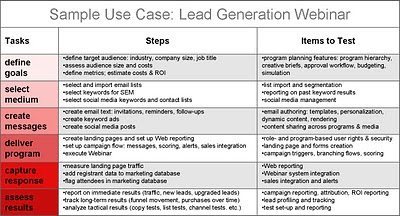
The first table shows a sample use case for a Webinar program. (Click on the image to enlarge it.) It illustrates the need for the use case to be specific, both in terms of describing a specific marketing program and of describing the steps to execute the program. Most marketers could put together the first two columns, Tasks and Steps, from their own knowledge. The remaining column, Items to Test, lists system features that may be unfamiliar to marketers who have not previously worked with a marketing automation system. You may need some help (say, from consultants like Raab Associates Inc.) with adding this column to your own use cases.
The second table looks at functions for different types of marketing programs. The premise is that you need different marketing programs for each step in the customer life cycle, starting with awareness generation and ending with retention. Ideally you’ll have programs in each category, but in practice some categories are more important than others. To help focus your selection process on those high-priority categories, the table describes when each category is likely to be important. It then lists the key system function for each category and the specific features related to those functions.

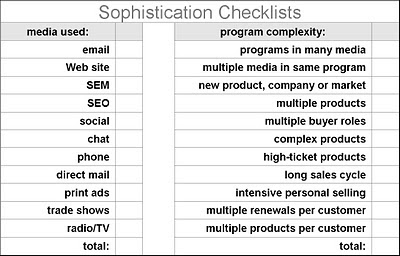
The third table helps to assess the complexity of your needs. The first column describes the media you'll use and the second lists business characteristics contributing to program complexity. Required media can be directly compared with the media supported by potential vendors. Program complexity is a little trickier, but I’d consider your needs complex if more than three or four of the factors are present.
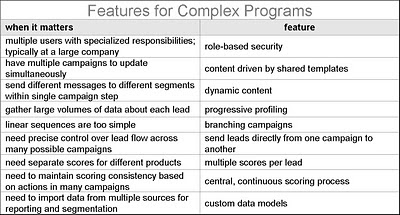
The fourth table is aimed at companies with complex programs. It lists specific requirements you may have and the features needed to meet them. Marketers who don’t need these features may be able to save some time and money by purchasing a system that doesn’t have them built in. On the other hand, some (but not all!) systems do a good job of hiding their advanced features when they’re not being used. So don't automatically rule out an advanced system without looking at it more closely. And bear in mind that you may need the more advanced features in the future.
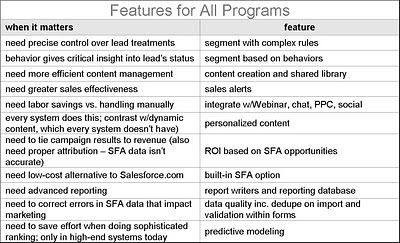
The fifth table applies to all companies regardless of complexity. It lists features that are present in nearly all systems, but vary widely in their details. For each one, you’ll have to think carefully about your specific needs and see how well each vendor can handle them.
These tables don't list all the features you might need in a marketing automation system. Nor do they address other important considerations such as ease of use, support, partners and stability. I'll talk about all those in the Webinar, so be sure to tune in.
On June 29, I'll be giving a Webinar on “Matching a Marketing Automation System to Your Needs”, part of a day-long set of all-star lead management presentations organized by the Focus online business community. (Click here to register; it’s free.) Here's a bit of a preview.
My message boils down to two words: "use case". That is, prepare detailed use cases for the tasks you need and then have each potential vendor demonstrate how their system would execute them. The point is to focus on your actual requirements and not a generic list of capabilities or vendor rankings.
Another way to put it is: eat your vegetables. Don’t try to avoid the hard work of figuring out what you need the system to do. You’ll have to do that anyway, during implementation. But if you wait until then, you may find out too late that you selected the wrong system.
Even buyers who assess their needs may need some help figuring out what features those needs imply. Here are five tables extracted from the Webinar with some useful details.
The first table shows a sample use case for a Webinar program. (Click on the image to enlarge it.) It illustrates the need for the use case to be specific, both in terms of describing a specific marketing program and of describing the steps to execute the program. Most marketers could put together the first two columns, Tasks and Steps, from their own knowledge. The remaining column, Items to Test, lists system features that may be unfamiliar to marketers who have not previously worked with a marketing automation system. You may need some help (say, from consultants like Raab Associates Inc.) with adding this column to your own use cases.

The second table looks at functions for different types of marketing programs. The premise is that you need different marketing programs for each step in the customer life cycle, starting with awareness generation and ending with retention. Ideally you’ll have programs in each category, but in practice some categories are more important than others. To help focus your selection process on those high-priority categories, the table describes when each category is likely to be important. It then lists the key system function for each category and the specific features related to those functions.

The third table helps to assess the complexity of your needs. The first column describes the media you'll use and the second lists business characteristics contributing to program complexity. Required media can be directly compared with the media supported by potential vendors. Program complexity is a little trickier, but I’d consider your needs complex if more than three or four of the factors are present.

The fourth table is aimed at companies with complex programs. It lists specific requirements you may have and the features needed to meet them. Marketers who don’t need these features may be able to save some time and money by purchasing a system that doesn’t have them built in. On the other hand, some (but not all!) systems do a good job of hiding their advanced features when they’re not being used. So don't automatically rule out an advanced system without looking at it more closely. And bear in mind that you may need the more advanced features in the future.

The fifth table applies to all companies regardless of complexity. It lists features that are present in nearly all systems, but vary widely in their details. For each one, you’ll have to think carefully about your specific needs and see how well each vendor can handle them.

These tables don't list all the features you might need in a marketing automation system. Nor do they address other important considerations such as ease of use, support, partners and stability. I'll talk about all those in the Webinar, so be sure to tune in.
Wednesday, June 09, 2010
Using a Purchase Funnel to Measure Marketing Effectiveness: Better than Last-Click Attribution But Far From Perfect
Summary: Many vendors are now proposing to move beyond "last click" attribution to measure the impact of advertising on movement of customers through a sequence of buying stages. This is a definite improvement but not a complete solution.
Marketers have long struggled to measure the impact of individual promotions. Even online marketing, where every click can be captured, and often tracked back to a specific person, doesn’t automatically solve the problem. Merely tracking clicks doesn’t answer the deeper question of the causal relationships among different marketing contacts.
Current shorthand for the issue is “last click attribution” – as in, “why last click attribution isn’t enough”. Of course, vendors only start pointing out a problem when they’re ready to sell you a solution. So it won’t come as a surprise that a new consensus seems to be emerging on how to measure the value of multiple marketing contacts.
The solution boils down to this: classify different contacts as related to the different stages in the buying process and then measure their effectiveness at moving customers from one stage to the next. This is no different from the “sales funnel” that sales managers have long measured, nor from the AIDA model (awareness, interest, desire, action) that structures traditional brand marketing. All that’s new, if anything, is the claim to assign a precise value to individual messages.
Examples of vendors taking this approach include:
- Marketo recently announced new "Revenue Cycle Analytics" marketing measurement features with its customary hoopla. The conceptual foundation of Marketo’s approach is that it tracks the movement of customers through the buying stages. Although this itself isn’t particularly novel, Marketo has added some significant technology in the form of a reporting database that can reconstruct the status of a given customer at various points in the time. Although this is pretty standard among business intelligence systems, few if any of Marketo's competitors offer anything similar.
- Clear Saleing bills itself as an “advertising analytics platform”. Its secret sauce is defining a set of advertising goals (introducer, influencer, or closer) and then specifying which goal each promotion supports. Marketers can then calculate their spending against the different goals and estimate the impact of changes in the allocation. Credit within each goal can be distributed equally among promotions or allocated according to user-defined weights. While such allocation is a major advance for most marketers, it’s still far from perfect because the weights are not based on directly measuring each ad's actual impact.
- Leadforce1 offers a range of typical B2B marketing automation features, but its main distinction is to infer each buyer's position in a four-stage funnel (discovery, evaluation, use, and affinity) based on Web behaviors. The specific approach is to link keywords within Web content to the stages and then track which content each person views. The details are worth their own blog post, but the key point, again, is that the contents are assigned to sales stages and the system tracks each buyer’s progress through those stages. Although the primary focus of LeadForce1 is managing relationships with individuals, the vendor also describes using the data to assess campaign ROI.
Compared with last click attribution, use of sales stages is a major improvement. But it’s far from the ultimate solution. So far as I know, none of the current products does any statistical analysis, such as a regression model, to estimate the true impact of messages at either the individual or campaign level. They either rely on user-specified weights or simply treat all messages within each stage as a group. This lack of detail makes campaign optimization impossible: at best, it allows stage optimization.
Even more fundamentally, stage analysis assumes that each message applies to a single marketing stage. This is surely untrue. As brand marketers constantly remind us, a well-designed message can increase lifetime purchases among all recipients, whether or not they are current customers. It’s equally true that some messages affect certain stages more than others. But to ignore the impact on all stages except one is an oversimplification that can easily lead to false conclusions and poor marketing decisions.
Stage-based attribution has its merits. It gives marketers a rough sense of how spending is balanced across the purchase stages and lets them measure movement and attrition from one stage to the next. Combined with careful testing, it could give insight into the impact of individual marketing programs. But marketers should recognize its limits and keep pressing for solutions that measure the full impact of each program on all their customers.
Thursday, June 03, 2010
Centrifuge Systems Offers Powerful, Flexible Link Analysis
Summary: Centrifuge Systems offers powerful, server-based link analysis and data visualization. It lets non-technical users load their own data, allowing them to work with minimal external support.
Centrifuge Systems offers data visualization software with a specialty in link analysis (that is, finding relationships among entities such as members of a social network). It isn’t the only vendor in the field – a quick search brought up this list of link analysis systems, which itself is not complete. Centrifuge tells me they are unique in offering link analysis that doesn’t require client software (only a browser with Adobe Flash) and works without a predefined data model. I can't personally confirm this, but was intrigued enough by Centrifuge that its uniqueness is not a prime concern.
Like other link analysis systems, Centrifuge has been used primarily for criminal and intelligence investigations. However, it is currently looking for additional applications such as marketing analysis to understand relationships between customers, locations and products. Since it does conventional data visualization in addition to the link analysis, Centrifugre is at least a potential replacement for visualization tools like Tableau and TIBCO Spotfire.
I had a briefing from Centrifuge a few months ago and recently downloaded their free trial system to play with it a bit. Not surprisingly, it was harder to use by myself than when a salesman was showing it to me. But the basic interface made sense and I can see that with a bit of practice, this would be a pretty effective system for a business analyst even if they lacked deep technical skills.
Setting up a project involves uploading data to the server, connecting to it, and then dragging data elements into position as dimensions and measures. Links between data elements are also defined by dragging fields into place. Users can refine their views by creating filters, derived values and bundles to combine selected items. Results can then be displayed from multiple perspectives including tables, link maps, charts (bar, line, pie, etc.), geographic and bubble maps, timeline, geospatial and drill-down charts.
The dragging itself wasn't as smooth as a typical desktop application, but it was perfectly serviceable and pretty impressive for working within a browser. Charts rendered almost instantly using the small sample data set. A larger volume might slow things down, but the heavy lifting is done on the server, so the system should scale well if the server is adequate. Centrifuge says its largest installations involve thousands of users and many millions of database rows.
The most important feature of Centrifuge is probably its ability to upload and link pretty much any type of data. External connections use JDBC drivers, which support sources including spreadsheets, XML and live feeds as well as conventional databases. The latest release lets analysts add new data sources by themselves, letting them work quickly with minimal technical support.
The system also lets users extract a subset of data and analyze it independently, reducing the load on the server. They can share their work by publishing it to a server as a PDF or live asset available to others. Newly published assets can be listed in an RSS feed.
Centrifuge was founded in 2007 and has multiple government clients, plus a few in private industry. Pricing starts at $4,000 for a single user perpetual license plus 18% annual maintenance.
Wednesday, May 26, 2010
Customer Worthy (The Book) Offers Methodology for Customer Experience Management
My friend and former business partner Michael Hoffman of ClientXClient recently sent a copy of his new book Customer Worthy, which explores use of his customer experience management tool, the CxC Matrix. I’ve long been a big fan of the Matrix*, which visualizes all the ways a customer can interact with a business. The new book provides a detailed explanation of Matrix concepts and applications.
The core concept is to “Think Like a Customer” (a favorite Hoffman catch phrase), meaning to understand each contact from the customer’s point of view. The book explains how to use the Matrix to document contacts throughout the customer life cycle, allowing companies to systematically visualize, analyze, monetize, prioritize and ultimately optimize each interaction. It shows how to extend the Matrix to the departmental and system view of each contact, giving companies a roadmap of the steps they must take to execute on Matrix concepts.
Other sections address privacy concerns and highlight the cost of poor service. A final section explains how each department throughout the company can use the Matrix to organize its internal work and coordinate with the rest of the organization.
Customer Worthy provides a good mix of inspiration, theory and practical examples. I’m pleased he’s taken the time to work through Matrix concepts at length, since it’s a rich topic that repays detailed examination. Even if you don’t deploy the Matrix in the forms that Hoffman describes, it’s worth reading to reinforce the broader points that (a) the customer comes first and (b) there are systematic ways to make that thought a reality.
_________________
*This blog, which started when Hoffman and I were partners, was named for it.
Tuesday, May 25, 2010
Oracle Buys Market2Lead Intellectual Assets
Oracle tersely announced today that it had purchased the intellectual assets of demand generation vendor Market2Lead. This is an excellent fit for Oracle in that Market2Lead is a sophisticated product that is best suited to large, demanding marketing operations. Those are presumably the firms in Oracle's target market.
Market2Lead CEO Geoff Rego explained some of the mechanics of the deal to me in a private conversation, but the details were not for publication. However, a blog post by Eloqua's Joe Payne confirms that existing Market2Lead customers will remain clients of Market2Lead, while Oracle itself will be purchasing the technology itself. The effect is that those customers will have the option to stay with Market2Lead or migrate elsewhere over time. Payne's post says that Eloqua and Market2Lead have been discussing a path for Market2Lead clients who prefer Eloqua to an Oracle relationship.
The entry of Oracle into the demand generation space certainly reflects growing interest in the field. Note that Oracle's Seibel group already had a robust marketing automation solution for consumer marketers, so this does clarify that B2B marketing automation is different from B2C marketing automation. (This is why I prefer the term "demand generation" for B2B marketing automation, although it's been a losing battle.) If there's a single major distinction between the two types of systems, it's the heavy reliance of B2B marketing automation on sales automation data, which in practical terms means reliance on Salesforce.com. Part of the reason the deal was structured as a purchase of assets may be that Oracle is a major rival to Salesforce.com, and thus neither firm is all that interested in cooperating with the other.
I've been arguing for some time that we can expect an eventual merger of CRM and demand generation systems. The Oracle / Market2Lead deal seems a step in this direction: at the ownership level, those systems will now be integrated, even though they may remain fairly distinct technically. This would actually mirror the structure of Siebel's own merger of CRM and marketing automation components, which also used separate-though-synchronized databases the last time I looked.
A related question is whether this deal also heralds the start of consolidation among demand generation vendors. I do think the industry is overcrowded, but growth rates are still so high that I don't see that consolidation happening quite yet. Most of the activity has been among smaller businesses, who are not the primary clients for Oracle or Market2Lead. So I don't see other vendors as feeling much pressure as a result of this deal. Of course, this could change if Oracle pursues small business marketers directly, but I'd guess that it will take some time before they have a major impact.
Thursday, May 20, 2010
Omniture Study Suggests Marketers Doubt Value of Analytics Investment
Not to beat a dead horse, but Wednesday’s eMarketer reported on yet another survey that touched on the question of why marketers don’t measure. Although the Omniture 2010 Online Analytics Survey is obviously limited to Web analytics, the answers probably apply to other types of measurement as well.
I wasn’t able to get a copy of the full survey results, despite two requests to Omniture and even filling it out myself, which was supposed to yield a copy that compared my answers with my peers'. Perhaps I’m peerless. But the snippets published in eMarketer are enough for now.

Specifically, eMarketer reported that the leading challenge in Web analytics was “talent”, cited by 58.4% of respondents. Assuming that “talent” is really a polite way of saying “skilled staff”, this suggests that lack of education, not lack of time, is the critical roadblock to better measurement. I’ve been betting the reason is time, but would reconsider in the face of new evidence.
But wait.
When I took the survey, the question about “talent” actually defined it as "lack of skill/time". So it’s perfectly possible that marketers picking "talent" really saw lack of time as the most important challenge.
My position is arguably strengthened by the relatively low ranking of "support/training" (37.6%) and "budget" (31.7%) in the answers. Those can certainly improve skills but they can’t expand the manager's available time. Even hiring more staff wouldn't do that.
On the other hand, the second- and third-ranked challenges were "actionability" (47.3%) and "finding insights" (41.5%) which both suggest doubts that Web analytics can deliver real value. This would show a need for education – but, as I wrote in my comment on the original Why Marketers Don't Measure post, it's a need for education in the fundamental utility of measurement, not education in specific techniques.
Bottom line: the Omniture survey confirms that marketers won’t invest in analytics until they’re convinced it’s the best use of their limited resources. Efforts to expand adoption of analytics should start with that.
Wednesday, May 19, 2010
DemandBase Adds Real-Time Access to Web Visitor Identities
Summary: DemandBase has added real-time access to its data identifying Web site visitors, enabling Web sites to deliver customized pages. It's another step in the company's systematic expansion.
It’s more than a year since my original post about DemandBase. At the time, they had just extended their product beyond basic IP-address-based Web visitor identification to provide company details and contact names. Last week they announced their next leap forward, an API to return detailed company information quickly enough to use it to tailor visitor treatments.
Specifically, ABR returns data within 10 milliseconds of the initial page request, in time to customize even the first page served. According to DemandBase, this compares with one to two seconds for conventional IP address look-ups.
ABR gains its speed by querying DemandBase’s own database rather than querying external directories. This is one of those things that is harder than it sounds. DemandBase built its database by monitoring which IP addresses most often visit its 2,000-plus clients, parsing multiple external IP directories for the owners and geo-locations of the servers at those addresses, and adding attributes from business directories including D&B, Hoovers and JigSaw. The company says it can associate three times as many visitors with U.S. business addresses as a conventional IP lookup.
Once it finds a match, ABR will return 15-20 client-selected company attributes including size, industry and corporate parent. The system can also apply and return a client’s own data, such as the salesperson assigned to a company and custom classifications for size or industry. These features were already available from DemandBase: what's new with ABR is exposing the data to other applications through a real time API.
One use for the data is to feed rules that send different messages to different sets of customers and prospects. DemandBase is also working to use the data to route chat requests to appropriate agents. Another benefit is sending shorter registration forms to system-identified visitors, improving completion rates while still capturing complete profile data. The system also improves Web analytics by flagging responses from specific companies and market segments, even when visitors fail to identify themselves, delete cookies, or reach the site without clicking on email links.
ABR is still a bit rough around the edges. In particular, there are no prebuilt connectors for specific application systems (Web site engines, CRM systems or analytics tools), so clients are on their own when it comes to integrating the information they receive. The first connectors are due shortly. Similarly, client data such as customers and sales people must currently be loaded by DemandBase staff. This will also change, first with a self-service file upload and eventually with a direct API connection.
Pricing for ABR is set at $2,500 per month for unlimited use. This is beyond the reach of many small businesses, but affordable for companies with the technical savvy and visitor volume to benefit from the system.
Beyond its intrinsic merits, ABR is an interesting illustration of DemandBase’s continuing effort to separate itself from the commodity businesses of IP lookup and compiled data. The company started by giving away its basic service, identification of company visitors to Web sites, to quickly build a large base of clients and partners. It then added value by enhancing the data with business directory information and making it easy to buy the names of individual contacts. ABR further expands the company’s footprint by using its data to enhance other systems, moving it beyond the business of selling stand-alone software. Clever folks.
Subscribe to:
Posts (Atom)