Oracle announced this morning that it is buying BlueKai, a leading Data Management Platform (DMP) technology vendor and operator of one of the largest data marketplaces. Since I just wrote last Friday about how DMPs integrate with marketing automation to unify customer treatments in Web advertising and direct channels, I’m tempted to just point you to that post for an explanation of how this works and why it matters. I’m also tempted to remind you that I predicted this convergence as an industry trend back in December. But instead I’ll expand a bit on the fundamental significance of this deal – which is that it promises a serious step toward solving the fundamental problem that increasingly hobbles advanced marketing technology: lack of a solid underlying customer database.
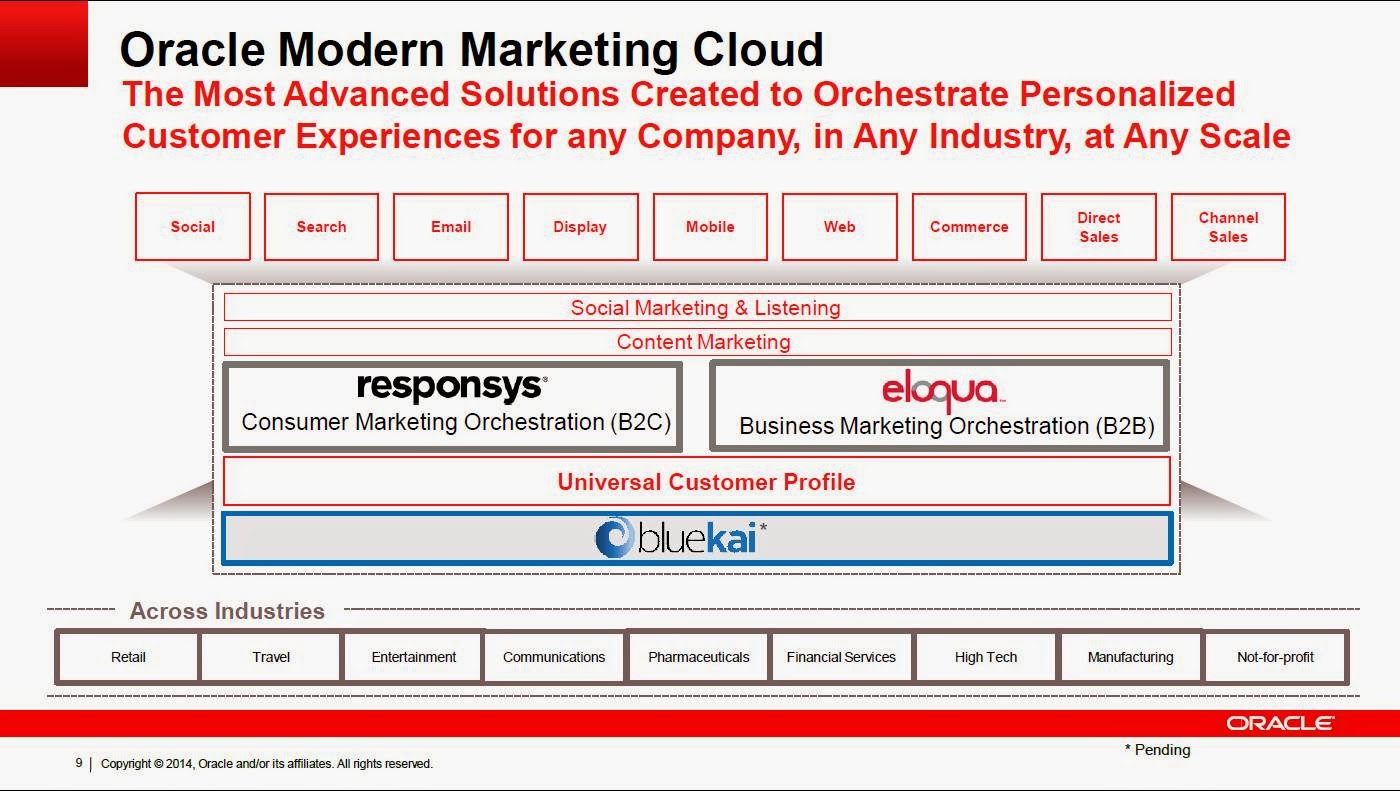
If you look at Oracle’s diagram of their newly expanded Marketing Cloud, you’ll see BlueKai sitting beneath Responsys and Eloqua, providing a “universal customer profile” that allows them to act as “marketing orchestration” systems which, in turn, support programs across all channels – social, search, email, display, mobile, web, commerce, direct sales, and channel sales.
“Marketing orchestration” is a considerable jump beyond the traditional role of “marketing automation”, but I’ll save that analysis for another day. What matters right now is that Oracle places BlueKai exactly where I’ve been placing the Customer Data Platform: as a multi-source database that feeds unified customer data to marketing applications.
This is the first time we’ve seen a major enterprise software vendor draw that picture quite so clearly. More typically, they just do some hand waving around the customer database without explaining how it magically appears. Deep in their hearts, what they really hope is that the database for their core application – CRM, email, Web site management, whatever – will be that central, shared database. They hope this even though their application doesn’t really provide the database management tools needed to make it happen, and their database itself is often tailored too narrowly to the specific application to support the full range of other uses.
BlueKai, on the other hand, is all about the data. Like other DMPs, it is still mostly organized around cookies and advertising audiences, but it does offer the ability to import other types of data and can certainly track identified individuals if the user wants. The fact that it can combine anonymous and identified profiles is extremely important if marketers are to build a single unified customer data repository and use it to support all contact channels, including Web advertising. The fact that it’s a distinct, named product gives that central customer database the prominence that it deserves.
In short – and I don’t use this term loosely – the BlueKai acquisition could truly be a “game changer” that forces other enterprise software vendors to also give marketers the CDP-style database building tools they’ve needed so desperately. As of this morning, Oracle’s competitors have a new gap in their product lines. It will be interesting to see how they fill it.
Showing posts with label oracle. Show all posts
Monday, February 24, 2014
Wednesday, February 27, 2013
Yesterday's News: Marketo Plans IPO, Eloqua Eyes B2C
There were two bits of news from Marketing Automation Land yesterday: Marketo announced it has filed a draft registration statement for an initial public offering, and Eloqua CEO Joe Payne was quoted as saying his company plans to expand into business-to-consumer marketing.
The Marketo news is long-expected. CEO Phil Fernandez said last September that the company planned an IPO for first half of 2013, so they are pretty much on schedule. Of course, it’s still possible that someone would purchase the company instead, but the asking price is probably too high, and the prospect of an IPO just made it higher. No word on timing of the actual filing. Hopefully this means we soon get to see a filing statement with lots of juicy financial details…my mouth is already watering.
I have little doubt that Marketo can manage a successful IPO. But it's less clear it can survive long-term as an independent company. Previous marketing automation leaders including Eloqua, Unica, and Aprimo all ended up as part of larger organizations. The fundamental reason is that marketing is ever-more-closely related to other business activities, as companies strive to provide an integrated customer experience. Clients prefer to buy complete, integrated suites for all customer-management functions. They good news for marketing automation vendors is that they can plug a gap that many big vendors need to fill.
This makes Eloqua's plan to pursue B2C marketers even more interesting. Perhaps it they aren't really plans -- it was just a comment in a phone call, which I didn't hear myself. But my immediate reaction is that Oracle already has a B2C marketing system, cleverly called Oracle Marketing and derived from its Siebel acquisition. I've never heard an enthusiastic comment about the system, but as I recall from the last time I looked at it -- many years ago -- it was reasonably capable. The only reason I can see for Oracle to use Eloqua as a B2C product is that Eloqua is a true SaaS offering, while Siebel was originally engineered for on-premise deployment and is still largely oriented that way.
This is pretty much consistent with a presentation last week by Oracle CEO Mark Hurd, along with Payne and Oracle EVP for Product Development Thomas Kuria. They set out a broad vision of customer experience management that included content management, social relationships, marketing, e-commerce, sales, and customer service, with Eloqua as the marketing component.
I wholly agree with the theory. As I wrote recently in Why is B2B Marketing Automation Growing So Slowly?, today's marketing automation manages just one slice of the customer life cycle, and indeed just one slice of the acquisition cycle. Marketers need a broader system that itself fits into a larger puzzle. Oracle’s presentation showed they understand this quite clearly, and see exactly how Eloqua contributes to a solution. In this context, using Eloqua for B2C makes sense, since there’s no distinction between a B2B marketing cloud and B2C marketing cloud.
But the real world is more complicated than the picture suggests. B2B and B2C marketers have different requirements. Eloqua is more flexible than most B2B marketing automation systems but still can't match a good B2C system. The biggest issue is data structure: Eloqua is built around a standard model based on CRM systems. It does let users add auxiliary tables but even those are subject to some constraints. A true B2C system can accommodate any data model. There are also issues of scalability and of specialized needs such as programs with hundreds or thousands of segments. It’s hard to imagine Eloqua competing in the top tier of B2C. It might be able to support mid-size B2C systems, but that doesn’t seem to be Oracle’s intent.
Oracle’s diagram might make you think they have actually addressed this issue by replacing Eloqua’s own database with a “customer experience foundation” that includes data management and integration, along with automation, decisioning, collaboration, and business intelligence. That would be really great: one database to serve all the customer experience business functions, including marketing. But, alas, that’s not how Oracle does it. Each component of its customer experience cloud is a separate software application, many of which were purchased. Oracle does some data synchronization and sharing of certain functions, but that’s it.
So we're back to where we started: with an essentially separate Eloqua that is is engineered for B2B marketing automation. Oracle has the money and engineering talent to rebuild Eloqua to meet B2C needs, but their track record for enhancing acquired products isn't good. If Oracle wants a serious B2C cloud marketing product, it will probably need to buy something else.
The Marketo news is long-expected. CEO Phil Fernandez said last September that the company planned an IPO for first half of 2013, so they are pretty much on schedule. Of course, it’s still possible that someone would purchase the company instead, but the asking price is probably too high, and the prospect of an IPO just made it higher. No word on timing of the actual filing. Hopefully this means we soon get to see a filing statement with lots of juicy financial details…my mouth is already watering.
I have little doubt that Marketo can manage a successful IPO. But it's less clear it can survive long-term as an independent company. Previous marketing automation leaders including Eloqua, Unica, and Aprimo all ended up as part of larger organizations. The fundamental reason is that marketing is ever-more-closely related to other business activities, as companies strive to provide an integrated customer experience. Clients prefer to buy complete, integrated suites for all customer-management functions. They good news for marketing automation vendors is that they can plug a gap that many big vendors need to fill.
This makes Eloqua's plan to pursue B2C marketers even more interesting. Perhaps it they aren't really plans -- it was just a comment in a phone call, which I didn't hear myself. But my immediate reaction is that Oracle already has a B2C marketing system, cleverly called Oracle Marketing and derived from its Siebel acquisition. I've never heard an enthusiastic comment about the system, but as I recall from the last time I looked at it -- many years ago -- it was reasonably capable. The only reason I can see for Oracle to use Eloqua as a B2C product is that Eloqua is a true SaaS offering, while Siebel was originally engineered for on-premise deployment and is still largely oriented that way.
This is pretty much consistent with a presentation last week by Oracle CEO Mark Hurd, along with Payne and Oracle EVP for Product Development Thomas Kuria. They set out a broad vision of customer experience management that included content management, social relationships, marketing, e-commerce, sales, and customer service, with Eloqua as the marketing component.
I wholly agree with the theory. As I wrote recently in Why is B2B Marketing Automation Growing So Slowly?, today's marketing automation manages just one slice of the customer life cycle, and indeed just one slice of the acquisition cycle. Marketers need a broader system that itself fits into a larger puzzle. Oracle’s presentation showed they understand this quite clearly, and see exactly how Eloqua contributes to a solution. In this context, using Eloqua for B2C makes sense, since there’s no distinction between a B2B marketing cloud and B2C marketing cloud.
But the real world is more complicated than the picture suggests. B2B and B2C marketers have different requirements. Eloqua is more flexible than most B2B marketing automation systems but still can't match a good B2C system. The biggest issue is data structure: Eloqua is built around a standard model based on CRM systems. It does let users add auxiliary tables but even those are subject to some constraints. A true B2C system can accommodate any data model. There are also issues of scalability and of specialized needs such as programs with hundreds or thousands of segments. It’s hard to imagine Eloqua competing in the top tier of B2C. It might be able to support mid-size B2C systems, but that doesn’t seem to be Oracle’s intent.
Oracle’s diagram might make you think they have actually addressed this issue by replacing Eloqua’s own database with a “customer experience foundation” that includes data management and integration, along with automation, decisioning, collaboration, and business intelligence. That would be really great: one database to serve all the customer experience business functions, including marketing. But, alas, that’s not how Oracle does it. Each component of its customer experience cloud is a separate software application, many of which were purchased. Oracle does some data synchronization and sharing of certain functions, but that’s it.
So we're back to where we started: with an essentially separate Eloqua that is is engineered for B2B marketing automation. Oracle has the money and engineering talent to rebuild Eloqua to meet B2C needs, but their track record for enhancing acquired products isn't good. If Oracle wants a serious B2C cloud marketing product, it will probably need to buy something else.
Labels:
eloqua,
marketing automation,
marketing suites,
marketo,
marketo ipo,
oracle
Thursday, December 20, 2012
Oracle Buys Eloqua: Winners and Losers for B2B Marketing Automation
Oracle announced today that it has agreed to purchase B2B marketing automation leader Eloqua for $23.50 per share, which comes to $871 million. This was a bit of a surprise, given that Eloqua just went public in August. The stock had been hovering around $17.50 recently, so $23.50 is a 34% premium: reasonable but not exciting. It suggests that neither Oracle nor Eloqua management felt the company was substantially undervalued.
The deal makes obvious sense, in that it gives Oracle a much stronger position in the fast-growing B2B marketing automation industry*. Oracle does have an existing B2B marketing automation product, based on the technology it acquired from Market2Lead in 2010. Market2Lead was very good system, but it lacked the huge market presence that Oracle gains from Eloqua. Oracle may also be gaining a more sophisticated “cloud native” platform, since other Oracle products grew largely from on-premise roots.**
So that’s all fine, but what industry observers really want to know is how Salesforce.com will react. Before addressing that, let’s acknowledge that it’s an "inside the Beltway" concern. Working marketers care more about how this affects the products and services they’ll get as current or potential Eloqua customers.
The jury on that is very much still out. Eloqua’s press release promises that Oracle will “significantly increase engineering investments in Eloqua products” and “make Eloqua the centerpiece of its Oracle Marketing Cloud”. But that’s what they all say, eh? It seems more likely that Oracle will slow down Eloqua enhancements as it evaluates the product’s direction and decides how to best integrate existing Oracle technologies. Indeed, the company says as much in its FAQ on the deal: “Oracle plans to integrate several of its key technology assets, such as Big Data and Business Intelligence, to deliver enhanced value to Eloqua’s products.” That may be the best for Eloqua’s customers in the long run, but the changes will take time to deliver and necessarily distract from near-term product enhancements.
The impact on customer service is likely to be even more negative. Eloqua’s culture is very focused on customer success, and it has been a clear leader in areas like marketer training. Oracle is less customer-focused and generally less nimble (I'm being polite here). It will be Oracle’s culture that dominates the combined organization.
Small businesses in particular can expect little love from an Oracle-ized Eloqua. The company had already been pulling away from that market and now will almost surely give it even less attention. One very specific reason is that B2B marketing automation vendors have always touted client counts as a competitive success metric, which encouraged them to sell to a lot of small clients to inflate that number. Oracle doesn’t report client counts, so that motivation will be gone.
What if you're an enterprise marketer? In that case, this might well be a good thing. If you look back at my earlier post this week on the industry future, I argued that the major marketing automation systems will become platforms that support a range of independently developed applications, similar to the Apple and Android app stores or the Salesforce.com AppExchange. As part of the Oracle “Customer Experience Cloud”, Eloqua itself will plug into a larger platform: so it’s pretty much the same model but on a larger scale.
The advantage is that this platform (shown in Oracle’s diagram as the “Customer Experience Foundation”) is unequivocally designed to span all customer-facing activities in the company. A marketing automation platform can't do this because it bumps up against the competing platform of CRM. A platform that truly includes all customer-facing activities can be more powerful than one limited to marketing automation. This applies especially to the data structures, which are limited for different reasons in both marketing automation and cloud-based CRM systems. (The reasons: marketing automation databases are constrained by the need to synchronize the CRM data structures; CRM databases are limited by the challenges of delivering adequate performance at reasonable cost for operational processing.)
Of course, a platform that serves all customer life stages also by definition contains all information about each customer. This is another Good Thing, since it provides a truly complete customer view and thus enables the best possible coordination of customer treatments across systems and throughout the relationship.
I’m not saying Oracle is guaranteed to fulfill this potential (see my earlier comments under "nimbleness, lack of"). But at least it’s possible. And, just maybe, Oracle managers will see the value of Eloqua’s “appcloud” marketplace and expand rather than kill it. Wouldn’t that be nice?
Okay, now we can talk about Salesforce.com. There’s a case to be made that this whole purchase is just a way for Oracle’s Larry Ellison to annoy Salesforce’s Marc Benioff: after all, Eloqua isn’t costing that much more than the Hawaiian island that Ellison bought himself not long ago and it might give Ellison greater pleasure. It’s certainly worth a chuckle at Oracle headquarters that Eloqua was recently selected as Salesforce’s own marketing automation tool.
More significantly, the Eloqua purchase poses an awkward dilemma for Salesforce, which wouldn’t let Market2Lead continue to integrate with Salesforce after Oracle bought it. Taking the same line with an Oracle-owned Elqoua isn’t quite as easy, and in fact is probably impossible. So now Salesforce finds itself forced to give Oracle access to prime customers, which cannot be a pleasant prospect. We’ll see how they handle it.
The Eloqua purchase certainly exposes the downside of relying on AppExchange partners to provide significant functionality needed by Salesforce clients. Yes, Salesforce.com gets to leverage those partners’ efforts, saving its own funds for other, more strategic investments. But if a big partner like Eloqua goes away, there’s some danger it could take Salesforce clients with it. This doesn’t matter when there are plenty of alternative partners to provide Salesforce clients with similar capabilities, which has been the case with marketing automation. The calculus changes when a few large vendors start to dominate the marketing automation space – especially among enterprise clients, who have special needs that only a few vendors can meet. More concretely, Salesforce now has to think long and hard about Marketo’s future. The expectation has always been that Marketo would remain independent, eventually as a public company. But what if they get bought by potentially serious competitor like SAP or IBM, either before or after a public offering? Salesforce might well decide to buy them itself just as a defensive measure.
As I say, this is really just inside gossip that's not terribly relevant to most working marketers. But who doesn’t like a good soap opera? Stay tuned…
_____________________________________________________________________
* Raab Associates estimates the industry grew about 50% this year, to $525 million. I haven’t come up with a considered estimate for next year, but suspect the rate will fall a bit on a percentage basis, even though absolute dollar growth will be about the same or higher.
** In fact, Oracle has two B2B marketing automation products, the other being Oracle Fusion Marketing.
The deal makes obvious sense, in that it gives Oracle a much stronger position in the fast-growing B2B marketing automation industry*. Oracle does have an existing B2B marketing automation product, based on the technology it acquired from Market2Lead in 2010. Market2Lead was very good system, but it lacked the huge market presence that Oracle gains from Eloqua. Oracle may also be gaining a more sophisticated “cloud native” platform, since other Oracle products grew largely from on-premise roots.**
So that’s all fine, but what industry observers really want to know is how Salesforce.com will react. Before addressing that, let’s acknowledge that it’s an "inside the Beltway" concern. Working marketers care more about how this affects the products and services they’ll get as current or potential Eloqua customers.
The jury on that is very much still out. Eloqua’s press release promises that Oracle will “significantly increase engineering investments in Eloqua products” and “make Eloqua the centerpiece of its Oracle Marketing Cloud”. But that’s what they all say, eh? It seems more likely that Oracle will slow down Eloqua enhancements as it evaluates the product’s direction and decides how to best integrate existing Oracle technologies. Indeed, the company says as much in its FAQ on the deal: “Oracle plans to integrate several of its key technology assets, such as Big Data and Business Intelligence, to deliver enhanced value to Eloqua’s products.” That may be the best for Eloqua’s customers in the long run, but the changes will take time to deliver and necessarily distract from near-term product enhancements.
The impact on customer service is likely to be even more negative. Eloqua’s culture is very focused on customer success, and it has been a clear leader in areas like marketer training. Oracle is less customer-focused and generally less nimble (I'm being polite here). It will be Oracle’s culture that dominates the combined organization.
Small businesses in particular can expect little love from an Oracle-ized Eloqua. The company had already been pulling away from that market and now will almost surely give it even less attention. One very specific reason is that B2B marketing automation vendors have always touted client counts as a competitive success metric, which encouraged them to sell to a lot of small clients to inflate that number. Oracle doesn’t report client counts, so that motivation will be gone.
What if you're an enterprise marketer? In that case, this might well be a good thing. If you look back at my earlier post this week on the industry future, I argued that the major marketing automation systems will become platforms that support a range of independently developed applications, similar to the Apple and Android app stores or the Salesforce.com AppExchange. As part of the Oracle “Customer Experience Cloud”, Eloqua itself will plug into a larger platform: so it’s pretty much the same model but on a larger scale.
The advantage is that this platform (shown in Oracle’s diagram as the “Customer Experience Foundation”) is unequivocally designed to span all customer-facing activities in the company. A marketing automation platform can't do this because it bumps up against the competing platform of CRM. A platform that truly includes all customer-facing activities can be more powerful than one limited to marketing automation. This applies especially to the data structures, which are limited for different reasons in both marketing automation and cloud-based CRM systems. (The reasons: marketing automation databases are constrained by the need to synchronize the CRM data structures; CRM databases are limited by the challenges of delivering adequate performance at reasonable cost for operational processing.)
Of course, a platform that serves all customer life stages also by definition contains all information about each customer. This is another Good Thing, since it provides a truly complete customer view and thus enables the best possible coordination of customer treatments across systems and throughout the relationship.
I’m not saying Oracle is guaranteed to fulfill this potential (see my earlier comments under "nimbleness, lack of"). But at least it’s possible. And, just maybe, Oracle managers will see the value of Eloqua’s “appcloud” marketplace and expand rather than kill it. Wouldn’t that be nice?
Okay, now we can talk about Salesforce.com. There’s a case to be made that this whole purchase is just a way for Oracle’s Larry Ellison to annoy Salesforce’s Marc Benioff: after all, Eloqua isn’t costing that much more than the Hawaiian island that Ellison bought himself not long ago and it might give Ellison greater pleasure. It’s certainly worth a chuckle at Oracle headquarters that Eloqua was recently selected as Salesforce’s own marketing automation tool.
More significantly, the Eloqua purchase poses an awkward dilemma for Salesforce, which wouldn’t let Market2Lead continue to integrate with Salesforce after Oracle bought it. Taking the same line with an Oracle-owned Elqoua isn’t quite as easy, and in fact is probably impossible. So now Salesforce finds itself forced to give Oracle access to prime customers, which cannot be a pleasant prospect. We’ll see how they handle it.
The Eloqua purchase certainly exposes the downside of relying on AppExchange partners to provide significant functionality needed by Salesforce clients. Yes, Salesforce.com gets to leverage those partners’ efforts, saving its own funds for other, more strategic investments. But if a big partner like Eloqua goes away, there’s some danger it could take Salesforce clients with it. This doesn’t matter when there are plenty of alternative partners to provide Salesforce clients with similar capabilities, which has been the case with marketing automation. The calculus changes when a few large vendors start to dominate the marketing automation space – especially among enterprise clients, who have special needs that only a few vendors can meet. More concretely, Salesforce now has to think long and hard about Marketo’s future. The expectation has always been that Marketo would remain independent, eventually as a public company. But what if they get bought by potentially serious competitor like SAP or IBM, either before or after a public offering? Salesforce might well decide to buy them itself just as a defensive measure.
As I say, this is really just inside gossip that's not terribly relevant to most working marketers. But who doesn’t like a good soap opera? Stay tuned…
_____________________________________________________________________
* Raab Associates estimates the industry grew about 50% this year, to $525 million. I haven’t come up with a considered estimate for next year, but suspect the rate will fall a bit on a percentage basis, even though absolute dollar growth will be about the same or higher.
** In fact, Oracle has two B2B marketing automation products, the other being Oracle Fusion Marketing.
Wednesday, June 22, 2011
Dueling Strategies: Adobe and Oracle Take Opposite Paths to Customer Experience Management
Adobe on Monday announced a new “Digital Enterprise Platform for Customer Experience Management”. The platform fills the center of Adobe’s three-part corporate mission to “make, manage, and measure” digital content and experiences. The other two pieces were already in place: “make” is Adobe’s original content creation business, while “measure” is Omniture Web analytics.
The strategic significance of the announcement seems more important than the actual product enhancements. These include improved integration of the company’s Web content management system (formerly Day C5) with Scene 7 dynamic content and Omniture Survey and Test & Target; features for salespeople and customer service agents to customize standard documents in a controlled fashion; integrated content reviews and workflows; and a platform to build and share content in multiple formats. The announcement also included beta versions of tools for social engagement, online enrollment, and agent workspaces. Good stuff but nothing earth-shaking.
Adobe's strategy itself is a curious mixture of broad ambition and narrow execution. Adobe describes its scope as nothing less than optimizing customer experience and marketing spend across the entire customer journey, from first learning about a company through validation, purchase decision, product use, and commitment. But Adobe also explicitly limits its scope to digital channels, and implicitly limits its concern to content creation, delivery, and evaluation. In fact, the only customer-facing technology Adobe offers is Web site management. Otherwise, Adobe expects even digital content such as emails to be delivered by third party products. Offline interactions, such as telephone and retail, are definitely out of the picture. Nor does Adobe manage the underlying customer database, marketing campaigns, or deep analytics. The only exceptions are customer profiles, segmentation, and content to support Web personalization.
The company argues the tools it does provide, combined with the cross-channel content sharing, are enough to build a unified digital customer experience. I’m not so sure that’s correct, and even if it is, I question whether customers will be happy to have only their digital experiences be unified. Either way, marketers will certainly need other vendors' products to manage their full customer relationships.
On the other hand, I do agree with Adobe’s argument that its approach lets clients create a unified digital experience without replacing their entire enterprise infrastructure. This is certainly an advantage.
Adobe’s announcement was released on Monday, but I didn’t get around to writing about it until today. The delay is unfortunate, since the attention of the enterprise marketing automation world has already shifted to yesterday’s announcement that Oracle is acquiring Web “experience” management vendor FatWire Software. I’m not sure I accept “Web experience management” as a legitimate software category, but FatWire does combine conventional Web content management with unusually strong targeting, personalization, content analytics, digital asset management, mobile, and social features. Perhaps that justifies calling it more than plain old Web content management.
The strategic purpose of the FatWire acquisition is self-evident: to fill a gap in Oracle’s customer-facing technologies, which already had ATG ecommerce and general Enterprise Content Management for Web sites, as well as Oracle CRM and Oracle Loyalty. (Oracle isn’t very creative with product names.) FatWire will allow much richer, more personalized and targeted Web site interactions. It also provides some Web analytics, although I still think Oracle has a gap to fill there.
The Oracle and Adobe announcements do highlight a clear strategic contrast. Adobe has largely limited itself to digital interactions, and has largely avoided customer-facing systems except for Web sites. Oracle has embraced the full range of online and offline interactions, including customer-facing systems in every channel. Oracle has also hedged its bets a bit with Real Time Decisions, which can coordinate customer treatments delivered by non-Oracle systems and powered by non-Oracle data sources. Of the other enterprise-level marketing automation vendors, IBM, SAS and Teradata share Adobe's focus on digital channels and its avoidance of customer-facing systems, although they resemble Oracle in offering deep analytics and customer database management.
Based on my fundamental rule that “suites win”, I think Oracle’s strategy is more likely to succeed. But only time will tell.
The strategic significance of the announcement seems more important than the actual product enhancements. These include improved integration of the company’s Web content management system (formerly Day C5) with Scene 7 dynamic content and Omniture Survey and Test & Target; features for salespeople and customer service agents to customize standard documents in a controlled fashion; integrated content reviews and workflows; and a platform to build and share content in multiple formats. The announcement also included beta versions of tools for social engagement, online enrollment, and agent workspaces. Good stuff but nothing earth-shaking.
Adobe's strategy itself is a curious mixture of broad ambition and narrow execution. Adobe describes its scope as nothing less than optimizing customer experience and marketing spend across the entire customer journey, from first learning about a company through validation, purchase decision, product use, and commitment. But Adobe also explicitly limits its scope to digital channels, and implicitly limits its concern to content creation, delivery, and evaluation. In fact, the only customer-facing technology Adobe offers is Web site management. Otherwise, Adobe expects even digital content such as emails to be delivered by third party products. Offline interactions, such as telephone and retail, are definitely out of the picture. Nor does Adobe manage the underlying customer database, marketing campaigns, or deep analytics. The only exceptions are customer profiles, segmentation, and content to support Web personalization.
The company argues the tools it does provide, combined with the cross-channel content sharing, are enough to build a unified digital customer experience. I’m not so sure that’s correct, and even if it is, I question whether customers will be happy to have only their digital experiences be unified. Either way, marketers will certainly need other vendors' products to manage their full customer relationships.
On the other hand, I do agree with Adobe’s argument that its approach lets clients create a unified digital experience without replacing their entire enterprise infrastructure. This is certainly an advantage.
Adobe’s announcement was released on Monday, but I didn’t get around to writing about it until today. The delay is unfortunate, since the attention of the enterprise marketing automation world has already shifted to yesterday’s announcement that Oracle is acquiring Web “experience” management vendor FatWire Software. I’m not sure I accept “Web experience management” as a legitimate software category, but FatWire does combine conventional Web content management with unusually strong targeting, personalization, content analytics, digital asset management, mobile, and social features. Perhaps that justifies calling it more than plain old Web content management.
The strategic purpose of the FatWire acquisition is self-evident: to fill a gap in Oracle’s customer-facing technologies, which already had ATG ecommerce and general Enterprise Content Management for Web sites, as well as Oracle CRM and Oracle Loyalty. (Oracle isn’t very creative with product names.) FatWire will allow much richer, more personalized and targeted Web site interactions. It also provides some Web analytics, although I still think Oracle has a gap to fill there.
The Oracle and Adobe announcements do highlight a clear strategic contrast. Adobe has largely limited itself to digital interactions, and has largely avoided customer-facing systems except for Web sites. Oracle has embraced the full range of online and offline interactions, including customer-facing systems in every channel. Oracle has also hedged its bets a bit with Real Time Decisions, which can coordinate customer treatments delivered by non-Oracle systems and powered by non-Oracle data sources. Of the other enterprise-level marketing automation vendors, IBM, SAS and Teradata share Adobe's focus on digital channels and its avoidance of customer-facing systems, although they resemble Oracle in offering deep analytics and customer database management.
Based on my fundamental rule that “suites win”, I think Oracle’s strategy is more likely to succeed. But only time will tell.
Thursday, June 02, 2011
Oracle Integrates On Demand Marketing with On Demand CRM
Summary: Oracle has integrated marketing automation with its on-demand CRM product. Will competitors do the same?
If I were more on the ball, I would have noticed that May 25 marked a full year since Oracle bought the intellectual property* of high-end B2B marketing automation vendor Market2Lead. I was actually briefed on May 17 by the Oracle team handling the resulting product but hadn’t noticed that the anniversary was approaching. I wonder if they had cake?
I hope so, since they’ve clearly been working hard. In February they released the first “Oraclized” version of the product, now Oracle CRM On Demand Marketing. This included a redesigned user interface that matches the look, feel, and terminology of Oracle’s on-demand CRM product, is available in the same 20 languages, and allows unified user IDs and log-ins.
The new system uses the same data structures as the rest of Oracle CRM On Demand. It shares many physical tables as well, but keeps the major contact tables separate yet synchronized. This is largely because Marketing systems typically contain many more leads than Sales wants in CRM. Marketing systems also run large, complex queries that would interfere with CRM performance if both systems used the same physical files.
The unified data structure allows unified reporting across the customer buying process. Although Oracle doesn’t use the term, this is very consistent with the revenue management concepts described by other B2B marketing automation vendors. Oracle’s new Marketing system supports this with a separate analytical database, which is essential for advanced revenue reporting such as time-series analysis.
Except for improved reporting, the features of the new Oracle product are pretty much the same as the old Market2Lead, which I last reviewed two years ago. This was, and remains, one of the most powerful in the industry. Important capabilities include “adaptive” program flows, which vary depending on customer behavior; advanced Web pages and forms; automated content recommendations; and several types of asset templates. These are mostly relevant to large companies, which fits nicely with Oracle’s customer base.
In fact, most On Demand Marketing sales are part of an Oracle CRM On Demand installation, either at current Oracle CRM users or at clients buying both CRM and marketing automation simultaneously. It doesn’t hurt that On Demand Marketing is the only choice for companies who want a Software-as-a-Service marketing system from Oracle. The company’s other big marketing automation product, Siebel Marketing, is on-premise software.
All this makes Oracle a poster child of sorts for the proposition that CRM and marketing automation should be part of a single system. I’ve argued this for a long time but it’s still a minority view, especially (and for obvious reasons) among the vendors of stand-alone marketing automation products. Oracle itself has announced an initiative for “cross channel customer experience management” which incorporates its products for CRM, marketing, loyalty, real-time decisions, and ecommerce.
It will be interesting to see whether Oracle’s integrated marketing-plus-sales product leads its not-so-friendly competitors at Salesforce.com to respond with an integrated solution of their own. Or, more broadly, whether IBM sticks to its position that it doesn’t need a CRM product to dominate the integrated marketing world. The B2B marketing automation vendors are definitely mice at an elephant dance. It’s a dangerous but exciting position.
____________________________________________________
* It wasn’t an outright acquisition because Salesforce.com wouldn’t permit integration with an Oracle-owned product. So existing Market2Lead clients remained with the old company until it could migrate them to other marketing platforms. Once this is done, Market2Lead will complete its shutdown.
If I were more on the ball, I would have noticed that May 25 marked a full year since Oracle bought the intellectual property* of high-end B2B marketing automation vendor Market2Lead. I was actually briefed on May 17 by the Oracle team handling the resulting product but hadn’t noticed that the anniversary was approaching. I wonder if they had cake?
I hope so, since they’ve clearly been working hard. In February they released the first “Oraclized” version of the product, now Oracle CRM On Demand Marketing. This included a redesigned user interface that matches the look, feel, and terminology of Oracle’s on-demand CRM product, is available in the same 20 languages, and allows unified user IDs and log-ins.
The new system uses the same data structures as the rest of Oracle CRM On Demand. It shares many physical tables as well, but keeps the major contact tables separate yet synchronized. This is largely because Marketing systems typically contain many more leads than Sales wants in CRM. Marketing systems also run large, complex queries that would interfere with CRM performance if both systems used the same physical files.
The unified data structure allows unified reporting across the customer buying process. Although Oracle doesn’t use the term, this is very consistent with the revenue management concepts described by other B2B marketing automation vendors. Oracle’s new Marketing system supports this with a separate analytical database, which is essential for advanced revenue reporting such as time-series analysis.
Except for improved reporting, the features of the new Oracle product are pretty much the same as the old Market2Lead, which I last reviewed two years ago. This was, and remains, one of the most powerful in the industry. Important capabilities include “adaptive” program flows, which vary depending on customer behavior; advanced Web pages and forms; automated content recommendations; and several types of asset templates. These are mostly relevant to large companies, which fits nicely with Oracle’s customer base.
In fact, most On Demand Marketing sales are part of an Oracle CRM On Demand installation, either at current Oracle CRM users or at clients buying both CRM and marketing automation simultaneously. It doesn’t hurt that On Demand Marketing is the only choice for companies who want a Software-as-a-Service marketing system from Oracle. The company’s other big marketing automation product, Siebel Marketing, is on-premise software.
All this makes Oracle a poster child of sorts for the proposition that CRM and marketing automation should be part of a single system. I’ve argued this for a long time but it’s still a minority view, especially (and for obvious reasons) among the vendors of stand-alone marketing automation products. Oracle itself has announced an initiative for “cross channel customer experience management” which incorporates its products for CRM, marketing, loyalty, real-time decisions, and ecommerce.
It will be interesting to see whether Oracle’s integrated marketing-plus-sales product leads its not-so-friendly competitors at Salesforce.com to respond with an integrated solution of their own. Or, more broadly, whether IBM sticks to its position that it doesn’t need a CRM product to dominate the integrated marketing world. The B2B marketing automation vendors are definitely mice at an elephant dance. It’s a dangerous but exciting position.
____________________________________________________
* It wasn’t an outright acquisition because Salesforce.com wouldn’t permit integration with an Oracle-owned product. So existing Market2Lead clients remained with the old company until it could migrate them to other marketing platforms. Once this is done, Market2Lead will complete its shutdown.
Tuesday, November 02, 2010
Oracle Buys ATG: Bad News for Marketing Automation?
So…Oracle bought ATG today for $6.00 per share or, as the press release puts it with charming nonchalance, “approximately $1.0 billion”. I can’t exactly say I told you so, since this particular pairing never crossed my mind. But if you look back at my “doughnuts and pizza slices” post on software acquisitions, it does make perfect sense. ATG is a specialist in e-commerce (the ERM doughnut in the online operations pizza slice), an area where Oracle’s traditional ERM products are weak. As my model suggests it should, ATG also encompasses online CRM and online marketing, where Oracle’s Siebel line is also a little thin.
Since Oracle is already strong in offline ERM and offline analytics, ATG leaves Oracle just one slice short of a pie. In other words, Oracle needs a Web analytics product. With Omniture, CoreMetrics and Unica already gone, only Webtrends is an option…unless Oracle gobbles up Adobe. ‘nuff said.
So much for the obvious. What I really care about is the implications for marketing systems. I’d say the ATG purchase lessens the odds of Oracle buying a marketing automation vendor. The logic is this: buying ATG suggests that Oracle, like IBM (which put Unica in its WebSphere organization), is focusing on online marketing rather than marketing automation in general. Since ATG itself provides substantial online marketing functionality, there’s a smaller gap for Oracle to fill with a separate marketing automation purchase. Nor have I forgotten that Oracle already bought marketing automation vendor Market2Lead, plugging a different set of holes.
If anything, Oracle (and IBM) need to strengthen their position in online advertising. I'd look for them to buy tools to manage banner ads, search ads, and search engine optimization. This in turn could point towards investments in content management and digital asset management systems. That also leads further away from standard marketing automation.
The day-to-day impact of all this on marketers is slight. They still need marketing automation tools to do their jobs. If anything, they’re better served by having some marketing automation vendors remain independent, since this keeps prices down and encourages competitive innovation. A less-helpful result may be to further isolate digital marketing from other channels, when what we need is to integrate them more closely. Perhaps digital marketing systems will grow to the point that they take over offline marketing as well. I hadn't expected such a role reversal, but it’s certainly possible. Just ask Oedipus. Not that that turned out so well.
Since Oracle is already strong in offline ERM and offline analytics, ATG leaves Oracle just one slice short of a pie. In other words, Oracle needs a Web analytics product. With Omniture, CoreMetrics and Unica already gone, only Webtrends is an option…unless Oracle gobbles up Adobe. ‘nuff said.
So much for the obvious. What I really care about is the implications for marketing systems. I’d say the ATG purchase lessens the odds of Oracle buying a marketing automation vendor. The logic is this: buying ATG suggests that Oracle, like IBM (which put Unica in its WebSphere organization), is focusing on online marketing rather than marketing automation in general. Since ATG itself provides substantial online marketing functionality, there’s a smaller gap for Oracle to fill with a separate marketing automation purchase. Nor have I forgotten that Oracle already bought marketing automation vendor Market2Lead, plugging a different set of holes.
If anything, Oracle (and IBM) need to strengthen their position in online advertising. I'd look for them to buy tools to manage banner ads, search ads, and search engine optimization. This in turn could point towards investments in content management and digital asset management systems. That also leads further away from standard marketing automation.
The day-to-day impact of all this on marketers is slight. They still need marketing automation tools to do their jobs. If anything, they’re better served by having some marketing automation vendors remain independent, since this keeps prices down and encourages competitive innovation. A less-helpful result may be to further isolate digital marketing from other channels, when what we need is to integrate them more closely. Perhaps digital marketing systems will grow to the point that they take over offline marketing as well. I hadn't expected such a role reversal, but it’s certainly possible. Just ask Oedipus. Not that that turned out so well.
Tuesday, May 25, 2010
Oracle Buys Market2Lead Intellectual Assets
Oracle tersely announced today that it had purchased the intellectual assets of demand generation vendor Market2Lead. This is an excellent fit for Oracle in that Market2Lead is a sophisticated product that is best suited to large, demanding marketing operations. Those are presumably the firms in Oracle's target market.
Market2Lead CEO Geoff Rego explained some of the mechanics of the deal to me in a private conversation, but the details were not for publication. However, a blog post by Eloqua's Joe Payne confirms that existing Market2Lead customers will remain clients of Market2Lead, while Oracle itself will be purchasing the technology itself. The effect is that those customers will have the option to stay with Market2Lead or migrate elsewhere over time. Payne's post says that Eloqua and Market2Lead have been discussing a path for Market2Lead clients who prefer Eloqua to an Oracle relationship.
The entry of Oracle into the demand generation space certainly reflects growing interest in the field. Note that Oracle's Seibel group already had a robust marketing automation solution for consumer marketers, so this does clarify that B2B marketing automation is different from B2C marketing automation. (This is why I prefer the term "demand generation" for B2B marketing automation, although it's been a losing battle.) If there's a single major distinction between the two types of systems, it's the heavy reliance of B2B marketing automation on sales automation data, which in practical terms means reliance on Salesforce.com. Part of the reason the deal was structured as a purchase of assets may be that Oracle is a major rival to Salesforce.com, and thus neither firm is all that interested in cooperating with the other.
I've been arguing for some time that we can expect an eventual merger of CRM and demand generation systems. The Oracle / Market2Lead deal seems a step in this direction: at the ownership level, those systems will now be integrated, even though they may remain fairly distinct technically. This would actually mirror the structure of Siebel's own merger of CRM and marketing automation components, which also used separate-though-synchronized databases the last time I looked.
A related question is whether this deal also heralds the start of consolidation among demand generation vendors. I do think the industry is overcrowded, but growth rates are still so high that I don't see that consolidation happening quite yet. Most of the activity has been among smaller businesses, who are not the primary clients for Oracle or Market2Lead. So I don't see other vendors as feeling much pressure as a result of this deal. Of course, this could change if Oracle pursues small business marketers directly, but I'd guess that it will take some time before they have a major impact.
Market2Lead CEO Geoff Rego explained some of the mechanics of the deal to me in a private conversation, but the details were not for publication. However, a blog post by Eloqua's Joe Payne confirms that existing Market2Lead customers will remain clients of Market2Lead, while Oracle itself will be purchasing the technology itself. The effect is that those customers will have the option to stay with Market2Lead or migrate elsewhere over time. Payne's post says that Eloqua and Market2Lead have been discussing a path for Market2Lead clients who prefer Eloqua to an Oracle relationship.
The entry of Oracle into the demand generation space certainly reflects growing interest in the field. Note that Oracle's Seibel group already had a robust marketing automation solution for consumer marketers, so this does clarify that B2B marketing automation is different from B2C marketing automation. (This is why I prefer the term "demand generation" for B2B marketing automation, although it's been a losing battle.) If there's a single major distinction between the two types of systems, it's the heavy reliance of B2B marketing automation on sales automation data, which in practical terms means reliance on Salesforce.com. Part of the reason the deal was structured as a purchase of assets may be that Oracle is a major rival to Salesforce.com, and thus neither firm is all that interested in cooperating with the other.
I've been arguing for some time that we can expect an eventual merger of CRM and demand generation systems. The Oracle / Market2Lead deal seems a step in this direction: at the ownership level, those systems will now be integrated, even though they may remain fairly distinct technically. This would actually mirror the structure of Siebel's own merger of CRM and marketing automation components, which also used separate-though-synchronized databases the last time I looked.
A related question is whether this deal also heralds the start of consolidation among demand generation vendors. I do think the industry is overcrowded, but growth rates are still so high that I don't see that consolidation happening quite yet. Most of the activity has been among smaller businesses, who are not the primary clients for Oracle or Market2Lead. So I don't see other vendors as feeling much pressure as a result of this deal. Of course, this could change if Oracle pursues small business marketers directly, but I'd guess that it will take some time before they have a major impact.
Subscribe to:
Posts (Atom)