Showing posts with label marketing automation industry. Show all posts

Thursday, April 10, 2014

Marketo Conference: Small Changes, Big Picture

Marketo wrapped up its three day Marketing Nation conference yesterday, having once more displayed its own marketing prowess by attracting national media attention (see here and here) with an appearance by Hillary Clinton. Still, the real focus was on Marketo’s own announcements, which included several product changes and a new positioning. (I wasn’t at the conference but Marketo briefed me on their plans.)


The product changes were quite modest: new search engine optimization features for entry level users; a global marketing calendar; and relabeling of InsightEra, which Marketo purchased in December, as Marketo Real Time Personalization. The SEO and calendar features are still in beta and will be rolled out this spring and summer. Real Time Personalization already exists, obviously, and will remain a separate product that can work with any marketing automation system.

The company also announced a deal to use Acxiom data for personalization and, somewhat more interesting, to coordinate advertising messages purchased through Acxiom with email and Web site messages delivered by Marketo. This borders on integration of Web display with marketing automation, an extremely important trend. But it's Acxiom, not Marketo, doing the hard part of matching advertising audiences with identified individuals.

Marketo placed these changes in the context of unveiling itself as “customer engagement platform”. Ordinarily, I don’t pay much attention to these announcements: after all, Marketo has pivoted more than Ben Franklin dancing a gavotte. But Marketo had the hype-blasters turned to 11, so the news is impossible to ignore.

My main reaction was, what’s new? Marketo has described itself as a platform for at least a year now (see this press release, for example) and I’ve been talking about marketing systems as platforms for even longer. More important, the value of platforms has been widely recognized through the tech industry for decades: classic examples include Salesforce.com’s own AppExchange, Apple’s iPhone AppStore, Microsoft’s operating system software, and, going way back, the original IBM System 360. The appeal of the platform model is obvious: platform systems are quasi-monopolies (or actual monopolies), so their owners can charge high prices while the app developers compete brutally with each other and must keep prices low. Consumers are intuitively reluctant to accept the monopoly relationship, but usually trade away their freedom because no other choice available or in exchange for convenience and low total cost. App developers make a similar calculation, trading lower margins and less control for the larger marketplace and less development expense.

The trick to winning these benefits is becoming a platform in the first place. This requires a large customer base, easy access by app developers, enough power to be useful, and a barrier that keeps the monopoly intact. Salesforce.com, Oracle, IBM, Adobe, Microsoft, and other contenders to own “customer experience platforms” all did it the hard way, by first building up a big customer base for their conventional systems and then opening that universe as a platform to app developers.

Every major marketing automation vendor has tried to do the same.  But their customer bases are nowhere near as large, so what’s actually happened in most cases is that app developers have integrated their systems with multiple “platforms”.  One of the more subtle tricks in the platform playbook is to prevent this by making your system different enough from others that it isn't easy to support them as well.  This is usually done by means of a uniquely structured application program interface. But developers won’t put up with this unless a platform offers a big enough audience or other benefits to make it worthwhile. It’s doubtful that Marketo, or any other remaining independent marketing automation vendor, has the market power to do this.

Let me be clear. I’m not saying the platform approach is a bad one for Marketo.  I’m saying they lack the market strength to erect barriers to collect monopoly rents. They’ll have to keep their APIs simple enough that app developers can integrate with other marketing automation systems as well.  This means Marketo will be competing with other platforms for app developer relationships and can’t rely on Marketo-exclusive apps to attract new customers or prevent old ones from leaving. This is good news for app developers and marketers, if not for Marketo investors.

But it’s not enough to decide to be a platform. You have to decide whom the platform will serve and what functions it will include. In the case of customer management, the big question is whether the marketing system should be separate from sales and service systems. The obvious answer is they should be the same: after all, we want a unified customer experience across the entire life cycle, so all departments delivering those experiences should be on the same platform. Indeed, Marketo seems to imply as much with the term “customer experience platform”.

But in an excellent blog post describing the new positioning, Marketo VP Marketing and co-founder Jon Miller makes clear that Marketo believes marketers alone are in charge: “marketers are responsible for an all-consuming process that starts with attracting initial buyer attention and continues all the way to locking in customer loyalty and advocacy.” To remove any doubt, he later clarifies that the “customer engagement platform is the core system of record for marketing, just like CRM is the system for sales and Human Capital Management is the system for HR.”

I’d say this approach is debatable.  It will probably be harder for a marketing-owned system to integrate with customer-facing systems in other departments. Certainly other “marketing cloud” providers like Salesforce.com and Oracle would argue otherwise – that, at the least, there should be a shared customer database, and probably some shared processes to select customer treatments, even if those treatments are delivered by channel- or department-specific systems.

Marketo’s conclusion does position them as the best choice for marketing buyers, since they are the only marketing platform vendor with such a limited scope. To quote Miller again: “The marketing platform provider should be a partner to marketing, a company that truly understands what’s happening in marketing and that 'has marketing’s back'. Your marketing platform is not an add-on to sales technology, or a component of an IT solution. It’s the core foundation to all aspects of marketing success. That’s why at Marketo, we think that a marketing platform should come from a company 100% focused on marketing.” Fair enough.

The second big question is what’s included in the core platform and what’s provided by partners. In many ways, this is where the discussion moves from theory to reality, since there are specific choices to be made. Marketo’s published diagram lists three major functions at the platform layer – decisioning (a.k.a. “the brain”), database (“marketing system of record”) and analytics. They put an application layer on top of that, including marketing automation, interactions (real time personalization, search engine optimization, social marketing), and operations (marketing management). The third layer includes delivery in different channels (email, social, landing pages, sales, web/mobile personalization, search). APIs are available to connect each layer to third party applications.

My own definition of the platform layer is pretty much the same as Marketo’s. But Miller’s post lists six components of a marketing platform, corresponding to both the platform and application layers. And Marketo actually delivers functionality across all three layers. In other words, Marketo is not actually selling the platform by itself: it sells the platform in combination with applications and delivery systems, some of which are included and some of which are optional.

At first I thought this violated the platform concept, since the vendor’s own tools will likely have tighter integration with the rest of the system than the APIs make available to third parties. But, on reflection, there’s no requirement for a platform to be fully “application neutral”. Marketo seems to be proposing to sell a basic set of applications and delivery systems and let clients supplement them with third party applications as needed. APIs are an escape hatch for emergency use only, not Lego blocks that let users build a custom collection of products from scratch.

There’s a good case to be made for bundling the platform with applications and execution systems, boiling down to that it saves marketers from having to make a lot of choices before they get started. It also justifies a much higher price than the platform alone, especially if the monopoly position is unavailable. Of course, this ends up looking an awful lot like a traditional marketing software suite, which is exactly what Marketo was and remains under the hood. Marketers excited by the platform vision should look very closely at the reality before assuming that Marketo, or anyone else, can deliver the benefits they expect.

Wednesday, April 09, 2014

Vocus Purchased by Private Equity Firm GTCR: This Could Be Interesting

Vocus announced on Monday that they were being acquired by private equity firm GTCR  for $446.5 million in cash, a premium of 48% over their stock market price. It’s still a modest multiple of 2.4 x revenue, compared with the 6 to 7 x multiples paid for ExactTarget and Responsys by Salesforce.com and Oracle and the 14 x that Marketo commands in the stock market. I can think of several reasons for the discrepancy: GTCR isn’t a big software company looking to fill out an existing marketing suite; Vocus sells mostly to small business, not enterprises; Vocus hasn't created enough buzz.  But the main reason is probably that under 15% of Vocus' 2013 revenue came from its marketing automation products.  .

Vocus has been working hard to change its profile. When I wrote about them last July,
they had already created a Marketing Suite separate from their PR Suite. At that time, the marketing product was missing key marketing automation features including lead scoring, multi-step workflows, and integration with Salesforce.com. Those were all added last month.  Based on a preview the company provided me in February, the implementations are more than adequate for the small marketing departments that are Vocus’ core customers.  To give a flavor for the implementation: 
  • lead scoring holds separate scores for attributes and engagement activities; can assign activity points based on recency and frequency of email, Web visits, landing pages, and news release activity; and automatically recalculates scores over time.  But it only allows one score per customer.
  • workflows are built on a graphical flow chart; support yes/no branching on attributes and activities; can execute next steps immediately, after a specified period, or after an action is completed; and support actions including send emails, add the customer to another workflow, update a list, update a contact record, and remove the customer from the current workflow.  But it doesn't support a/b splits within the flows.
  • Salesforce.com synch is bi-directional and works with lead and contact records.  But it doesn't (yet) synchronize opportunities or custom objects.

Email, landing pages, behavior tracking, and reporting were already available in Vocus Marketing Suite, so the new features mean that Vocus now ticks all the major marketing automation boxes. It also still provides the advanced social media monitoring and influencer identification, press release posting, and local directory submission services that most competitors do not.  Plans include an expanded partner marketplace to make third party integration easier, expanded social marketing including social sign-on and social media campaigns, and anonymous visitor tracking without relying on cookies.  The vendor will also increase the sophistication of its core marketing automation functions, adding features such progressive forms, dynamic content, a/b testing for landing pages, and synchronization with additional Salesforce.com objects.

Beyond all that, my February notes include some vague but intriguing mention of automated analytics to help marketers do more effective lead scoring, segmentation, and workflow design. That kind of automation could be the key to expanding the number of marketing departments who can take full advantage of marketing automation opportunities.

To sum things up, GTCR has bought itself a very competitive marketing automation product for small to mid-size companies.  It will still mostly sell the business marketers but the social media, directory listings, and press release functions give Vocus more opportunity to serve consumer marketers than usual. The company now reports more than 8,000 marketing automation users,. expected to yield $40 million in bookings in 2014.  This easily makes it one of the largest stand-alone vendors in the industry. If GTCR allows Vocus to spend more freely on marketing and to continue improving its product, there is a good chance that Vocus can elbow its way to a top position in the hyper-crowded SMB marketing automation universe.


Thursday, December 20, 2012

Oracle Buys Eloqua: Winners and Losers for B2B Marketing Automation

Oracle announced today that it has agreed to purchase B2B marketing automation leader Eloqua for $23.50 per share, which comes to $871 million. This was a bit of a surprise, given that Eloqua just went public in August. The stock had been hovering around $17.50 recently, so $23.50 is a 34% premium: reasonable but not exciting. It suggests that neither Oracle nor Eloqua management felt the company was substantially undervalued.

The deal makes obvious sense, in that it gives Oracle a much stronger position in the fast-growing B2B marketing automation industry*.   Oracle does have an existing B2B marketing automation product, based on the technology it acquired from Market2Lead in 2010.  Market2Lead was very good system, but it lacked the huge market presence that Oracle gains from Eloqua. Oracle may also be gaining a more sophisticated “cloud native” platform, since other Oracle products grew largely from on-premise roots.**

So that’s all fine, but what industry observers really want to know is how Salesforce.com will react. Before addressing that, let’s acknowledge that it’s an "inside the Beltway" concern.  Working marketers care more about how this affects the products and services they’ll get as current or potential Eloqua customers.

The jury on that is very much still out.  Eloqua’s press release promises that Oracle will “significantly increase engineering investments in Eloqua products” and “make Eloqua the centerpiece of its Oracle Marketing Cloud”.  But that’s what they all say, eh? It seems more likely that Oracle will slow down Eloqua enhancements as it evaluates the product’s direction and decides how to best integrate existing Oracle technologies. Indeed, the company says as much in its FAQ on the deal: “Oracle plans to integrate several of its key technology assets, such as Big Data and Business Intelligence, to deliver enhanced value to Eloqua’s products.” That may be the best for Eloqua’s customers in the long run, but the changes will take time to deliver and necessarily distract from near-term product enhancements.

The impact on customer service is likely to be even more negative.  Eloqua’s culture is very focused on customer success, and it has been a clear leader in areas like marketer training. Oracle is less customer-focused and generally less nimble (I'm being polite here).  It will be Oracle’s culture that dominates the combined organization.

Small businesses in particular can expect little love from an Oracle-ized Eloqua.  The company had already been pulling away from that market and now will almost surely give it even less attention. One very specific reason is that B2B marketing automation vendors have always touted client counts as a competitive success metric, which encouraged them to sell to a lot of small clients to inflate that number. Oracle doesn’t report client counts, so that motivation will be gone.

What if you're an enterprise marketer?  In that case, this might well be a good thing.  If you look back at my earlier post this week on the industry future, I argued that the major marketing automation systems will become platforms that support a range of independently developed applications, similar to the Apple and Android app stores or the Salesforce.com AppExchange. As part of the Oracle “Customer Experience Cloud”, Eloqua itself will plug into a larger platform: so it’s pretty much the same model but on a larger scale.


The advantage is that this platform (shown in Oracle’s diagram as the “Customer Experience Foundation”) is unequivocally designed to span all customer-facing activities in the company.  A marketing automation platform can't do this because it bumps up against the competing platform of CRM. A platform that truly includes all customer-facing activities can be more powerful than one limited to marketing automation. This applies especially to the data structures, which are limited for different reasons in both marketing automation and cloud-based CRM systems. (The reasons: marketing automation databases are constrained by the need to synchronize the CRM data structures; CRM databases are limited by the challenges of delivering adequate performance at reasonable cost for operational processing.)


Of course, a platform that serves all customer life stages also by definition contains all information about each customer.  This is another Good Thing, since it provides a truly complete customer view and thus enables the best possible coordination of customer treatments across systems and throughout the relationship.

I’m not saying Oracle is guaranteed to fulfill this potential (see my earlier comments under "nimbleness, lack of"). But at least it’s possible. And, just maybe, Oracle managers will see the value of Eloqua’s “appcloud” marketplace and expand rather than kill it. Wouldn’t that be nice?

Okay, now we can talk about Salesforce.com.  There’s a case to be made that this whole purchase is just a way for Oracle’s Larry Ellison to annoy Salesforce’s Marc Benioff: after all, Eloqua isn’t costing that much more than the Hawaiian island that Ellison bought himself not long ago and it might give Ellison greater pleasure.  It’s certainly worth a chuckle at Oracle headquarters that Eloqua was recently selected as Salesforce’s own marketing automation tool.

More significantly, the Eloqua purchase poses an awkward dilemma for Salesforce, which wouldn’t let Market2Lead continue to integrate with Salesforce after Oracle bought it. Taking the same line with an Oracle-owned Elqoua isn’t quite as easy, and in fact is probably impossible. So now Salesforce finds itself forced to give Oracle access to prime customers, which cannot be a pleasant prospect. We’ll see how they handle it.

The Eloqua purchase certainly exposes the downside of relying on AppExchange partners to provide significant functionality needed by Salesforce clients.  Yes, Salesforce.com gets to leverage those partners’ efforts, saving its own funds for other, more strategic investments. But if a big partner like Eloqua goes away, there’s some danger it could take Salesforce clients with it. This doesn’t matter when there are plenty of alternative partners to provide Salesforce clients with similar capabilities, which has been the case with marketing automation.  The calculus changes when a few large vendors start to dominate the marketing automation space – especially among enterprise clients, who have special needs that only a few vendors can meet. More concretely, Salesforce now has to think long and hard about Marketo’s future. The expectation has always been that Marketo would remain independent, eventually as a public company. But what if they get bought by potentially serious competitor like SAP or IBM, either before or after a public offering? Salesforce might well decide to buy them itself just as a defensive measure.

As I say, this is really just inside gossip that's not terribly relevant to most working marketers. But who doesn’t like a good soap opera? Stay tuned…

_____________________________________________________________________
* Raab Associates estimates the industry grew about 50% this year, to $525 million.  I haven’t come up with a considered estimate for next year, but suspect the rate will fall a bit on a percentage basis, even though absolute dollar growth will be about the same or higher.

** In fact, Oracle has two B2B marketing automation products, the other being Oracle Fusion Marketing.

Thursday, September 27, 2012

Three Ways to Dominate the Marketing Automation Industry

I wrote last August that it’s still possible for new B2B marketing automation vendors to challenge the industry leaders. This was based on the observation that several of the smaller vendors have quickly reached the 1,000 client benchmark. But it didn’t answer the more interesting question of what it would take for a new vendor to really bypass the current leaders.

That particular question came up repeatedly during Dreamforce last week. The answer may not matter to marketers who don’t themselves work for a marketing automation vendor. But I think it’s worth pondering anyway, if only as an interesting case study in business strategy.

My own answer is: at stage of the industry, the basic features of marketing automation are pretty much set, so radically different features are not likely to emerge as a major competitive advantage. (That’s not to say new features won’t be important, particularly extensions into areas like social and mobile. But new features won’t be enough because they can be copied too quickly if they're really popular.) Rather, a new industry leader would have to remove the critical bottleneck to industry growth: the shortage of marketers with the skills needed to fully use marketing automation capabilities.

I don’t think I need to spend too much time defending that particular premise: if you want a data point, how about the widely quoted Sirius Decisions figure that 85% of marketers do not believe they are using their marketing automation platform to the fullest. Let's move onto the more important question: how could a vendor change the situation?

It seems to me there are three ways to approach this:

- make the systems radically easier to use. This is by far my preferred solution. It may seem an unobtainable goal: after all, ease of use has been a top priority of marketing automation vendors for years, and you’d think that by now all those smart people would have made things about as easy as they can be. But I think the right basis of comparison is Google AdWords, which made entry-level search engine marketing so incredibly simple that pretty much anyone can do it with no training at all.

As with AdWords, a radically simpler marketing automation system would just ask users to make a handful of basic decisions about content and target audience, and would build everything else automatically. Again like AdWords, the system would automatically optimize the programs based on results. This implies a degree of automation well beyond today’s marketing automation products, although increasingly common features like dynamic content and integrated predictive modeling offer a hint at how it could happen.

You could argue that marketers don’t want to delegate so much responsibility to a system, but many seem to have delegated to AdWords quite happily. Of course, AdWords also lets more sophisticated marketers make more decisions for themselves, and I’d expect any marketing automation system to provide that option as well. And, again as with search engine marketing, I’d expect the most sophisticated marketers to adopt more specialized systems than AdWords itself—but those will marketers will remain a minority.


- make it radically easier for marketers to use existing functions. This is not about making the functions themselves simpler: per my earlier comment, I’ll accept that all those smart folks have done about as much as possible in that direction. But I think more can be done to help marketers learn to use those functions more quickly and with less work.

What I have in mind specifically is “just in time” approaches that make it very easy for marketers to learn how to do a new task once they've started it, rather than taking separate training classes or looking up detailed instructions. This means context-sensitive help functions that can guess what you’re trying to do and offer advice when you seem to be having trouble. It also means lots of little instructional snippets instead of monolithic tutorials that have to be consumed all at once. This is standard stuff in the software industry, although some companies do it much better than others.

I think a marketing automation vendor who really focused on this would have a major advantage among new users, who are exactly the key audience.  If you want a specific benchmark for this approach, it’s that people can perform tasks with zero advance training.

- provide services so marketers don’t need to use the systems themselves. Quite a number of vendors have taken the services-based approach. In a way, it’s an admission of defeat: no, we really can’t make the systems simple enough for mere mortals. But I'd be happy to trade pride for success.

 The trick to this approach is to keep the service cost low enough that you can actually make money.  That comes down to things like prepackaged templates for creative materials and campaign flows, highly automated processes so the service staff can work efficiently, and standardized methodologies so inexperienced (ok, that's a euphemism for low cost) individuals can be easily trained to provide adequate service. Again, these are pretty standard things but I don’t think any vendor has really designed their system and business model around them.

Note that a system designed for efficient use by highly trained service people would look quite different from one designed for easy use and learning by lightly trained end-users. So this approach would really imply fundamental change in how vendors build their products.

As I said earlier, my preferred option is the first one, making systems radically simpler. But I’m guessing the more practical one is the middle choice of providing more effective help using systems similar to today’s. It’s possible that middle option isn’t viable: maybe vendors can’t provide enough additional help to make a difference. But I don’t think I’ve seen any vendor really focus on that option – and won’t concede I’m wrong until I have.

Thursday, August 23, 2012

Raab Report: Act-On, Eloqua, Pardot, and Marketo Vie to Lead in Mid-Size B2B Marketing Automation Segment

Today I’ll present the third and (mercifully?) final installment in my series of posts on leaders in the different B2B marketing automation sectors, as determined by the ratings in our VEST report. I’ve saved the best for last, in the sense that the small to mid-size sector is the heart of the industry and its most complicated arena.

We define small to mid-size business as companies with $5 million to $500 million revenue. This covers a broad range of marketing users with widely varied needs. Most require the full set of marketing automation functions but apply these in simple ways. They have one to fifteen marketing automation users. This sector generates nearly 60% of 2012 revenue ($200 million) from 33% of the installations (9,400 as of mid-2012). The VEST report provides separate client counts for small business ($5 million to $20 million revenue) and mid-size business ($20 million to $500 million). These account for 16% and 41% of revenue and 16% and 17% of installations, respectively. Although small businesses generally buy lower-priced systems, they have largely the same requirements as mid-size companies.


The leaders quadrant in this sector is quite crowded, with Act-On, Eloqua, Pardot, and Marketo all jostling for position. Silverpop, Neolane, and Genius are all lurking nearby. In case you haven’t caught on to my color coding, blue type indicates that Eloqua and Neolane are leaders in the large company segment, while red type shows the others have their strongest position in this sector.

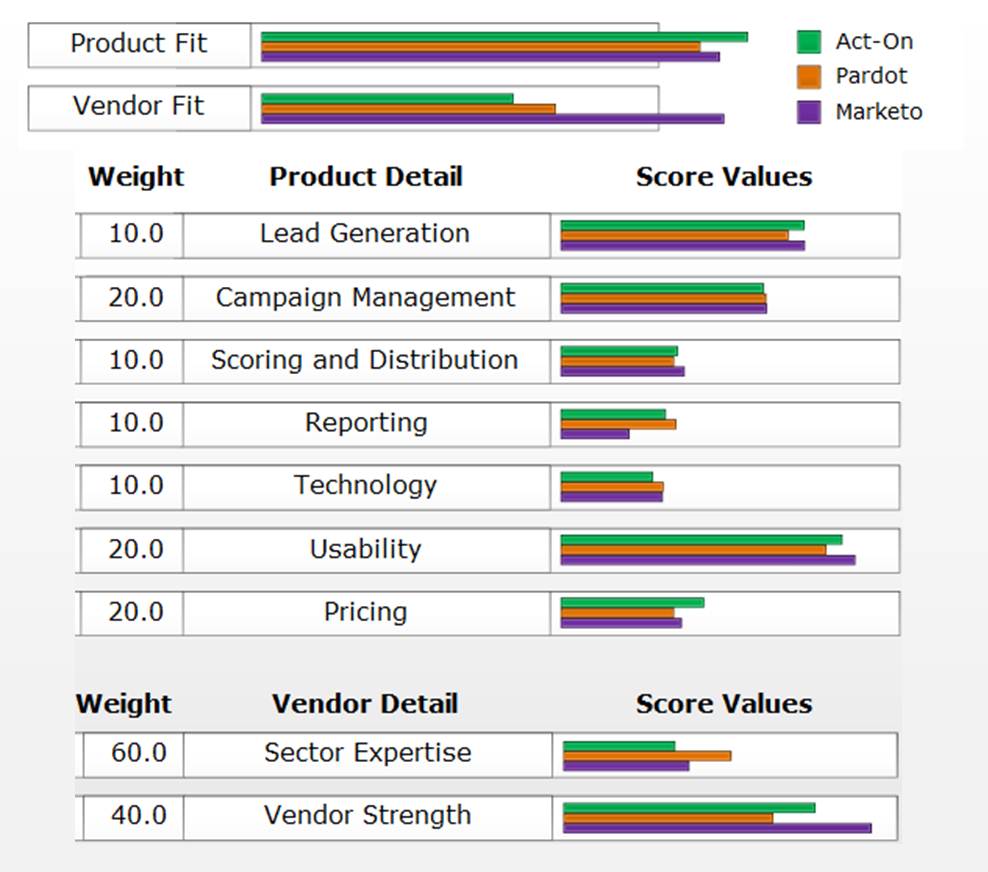
The variety of users within this segment is reflected by the differences among the leaders. Act-On, Pardot, and Genius specialize in smaller companies than Marketo or Silverpop, which in turn serve generally smaller clients than Eloqua or Neolane.  Act-On’s position on top of the product fit range is a bit misleading: when you look at the components of that score (see below; this comparison chart is another VEST feature), the vendors are all very close.  In fact, the only category where Act-On scores higher than everyone else is pricing.


This isn’t at all to say that the products are equivalent.  Rather, it means they each have different strengths and weaknesses that balance each other out when measured with generic scoring weights. For actual buyers with clear priorities, the difference among these vendors’ scores will almost always be much larger.


As with the other sector charts, the vendors in the upper left are also worth considering: they have strong product fit but relatively low market position.  SalesFusion appears here as it did in the micro- and large-business charts: what can I say, they have rich features at a good price. (And, no, they’re not my client.) eTrigue is the other noteworthy contender; it and LeadFormix are both close to the leader quadrant based on their vendor fit.

If there’s any one lesson from all these charts, it’s that picking the “leading” vendor is no guarantee of making a good choice. Our three sets of weights yield different sets of leaders, and even those vendors have different strengths and weaknesses. I’ve said it a million times but I’ll say it again: there’s no substitute for understanding your own needs and finding out which vendors match them best.


Tuesday, June 05, 2012

Salesforce.com and Oracle Buy Social Marketing Systems: Not the End of Marketing As We Know It

Salesforce.com yesterday announced agreement to buy social media publishing vendor Buddy Media for $689 million, thereby adding another big fluffy piece to its “marketing cloud”. Oracle followed suit this morning  with an acquisition of social media monitoring and semantic analysis vendor Collective Intellect. This followed Oracle’s $300 million acquisition last month  of social publishing system Vitrue. Just for symmetry, it’s worth pointing out that Salesforce.com acquired its own social monitoring system, Radian6, in March 2011.

What are marketers to make of all this activity, not to mention Marketo’s acquisition in April  of social marketing vendor Cloud Factory? Is this the death of marketing as we know it?

In a word, no. Social media are certainly a new way to hear what buyers are saying and send them marketing messages. But only the most besotted booster would argue that it will replace, rather than supplement, traditional methods. Every serious marketer already recognizes this, so I’m not even being boldly contrarian by saying it out loud.

The more interesting question is whether social media can be the foundation of a company’s marketing infrastructure. Both Marketo and Oracle already offer robust marketing platforms, so they presumably see social media as a supplement rather than a replacement. (It’s possible that Marketo hopes to reinvent itself as a social media specialist, which is surely more attractive to investors than marketing automation. The key positions taken by Cloud Factory executives might even support the theory.  But Marketo hasn’t hinted at this approach.)

Salesforce.com is another story.  They’ve always avoided traditional marketing automation, so perhaps they feel a complete “marketing cloud” can be built without it.

The gaps in this approach are obvious to anyone familiar with standard marketing automation systems: no Web behavior tracking, no multi-step nurture campaigns, no marketing resource management. But Salesforce.com could close those gaps by gradually extending its existing products. This might actually be easier than acquiring a separate marketing automation system and shoe horning it into other Salesforce.com components.

One thing I don’t see is social media systems themselves expanding to be marketing automation platforms. So far as I know, the data structures within the social media systems are simple contact profiles – little more than flat files – which can’t easily be extended to store and analyze detailed activity histories across multiple channels. Nor does a standard social media publishing or monitoring platform have the multi-step, branching campaign flows that are the heart of marketing automation. It’s probably easier to add social marketing functions to a marketing automation platform than the other way around. Indeed, many marketing automation vendors have already started.

So, back to the original question: what do these acquisitions mean? I’d say they’re good news for marketers, who will increasingly find social marketing functions available within core marketing platforms, ending the need to integrate separate products. The acquisitions are more problematic for marketing automation vendors, who now need to build, buy, or connect with social marketing systems to remain competitive. This will make it still harder for smaller vendors to compete, hastening the industry consolidation we all know is coming anyway. Nothing boldly contrarian about that prediction either, but it’s still worth bearing in mind.

Friday, March 16, 2012

Salesforce.com Announces Site.com Web Site Management: Will Marketing Automation Features Follow?

Salesforce.com yesterday announced the launch of Site.com, an enterprise-class Web site management system. The news didn’t seem to get much attention, perhaps because Salesforce.com itself pretty much buried it. But Salesforce.com VP of Product Management Anshu Sharma did post a detailed explanation of the rationale on a Salesforce.com blog.

My original reaction was “I told you so”, since I’ve been talking about the convergence of CRM and Web site management for years. (Here’s a piece from 2009.)  Sharma’s reaches a similar conclusion although he puts it in a larger context of social media (people expect to interact with a company Web site like they interact on social media), cloud,  and mobile computing (marketers need content that can be presented on all types of devices). So far so good, especially since multi-channel content is another trend I’ve been toying with for some time.  (Not that I'm bragging or anything.)

Just to clarify my argument, the case for convergence between CRM and Web site management boils down to the fact those are the two main systems that companies use to interact with consumers. The move closer as Web sites capture more individual-level information and present more personalized treatments. And, as the two giants converge, the marketing automation industry stands between them like a mushroom, waiting to be crushed or gobbled up (if giants eat mushrooms).

Some of that gobbling has already begun.  Web site management vendor SDL purchased Alterian last November and sales enablement vendor CallidusCloud bought LeadFormix in January. Ironically, speculation about Salesforce.com itself buying a marketing automation system had pretty much died down since last August’s Dreamforce conference, when the firm made it pretty clear they didn’t have plans in that direction (notwithstanding their earlier HubSpot investment).

That’s why I was greatly intrigued by Sharma’s statement that the transformations created by social, cloud and mobile technologies “can only bear long-term fruit and deliver on the full promise of a 'digital marketing platform' when marketing and IT are a true partners.”

 That’s the first Salesforce.com reference I can find to a “digital marketing platform”.  It certainly implies something that includes marketing automation functionality. Maybe the reason Salesforce.com decided not to purchase marketing automation system because they figured same functions would evolve organically from a combination of CRM and Web site management. That’s probably correct, although it would take longer than adding those features directly.

In any event, the combination of CRM and Web site management gives Salesforce.com an integrated database containing all the information needed for effective marketing automation. Building marketing automation features to exploit that information then becomes a lot easier than building a complete marketing automation system.  This applies whether the system providing those features comes from Salesforce.com or an AppExchange partner, and it means the barrier to entry is lower than ever.  In short, the Site.com announcement is big news for the marketing automation industry, whether people recognize it or not.

Wednesday, November 16, 2011

Marketo Raises Another $50 Million: Where Does the Money Go?


Marketo this morning announced a new $50 million funding round, almost exactly one year to the day after raising $25 million in November 2010.  In accompanying commentary, the company also revealed its 2010 revenue was $14 million, that it expects 140% revenue growth in 2011 (meaning about $34 million), and that it has about $70 million remaining of its total $107 million raised to date.

All this new information begs for an update of the analysis of Marketo’s finances that I prepared last year. I won’t go into the same details, but the key figures for 2010 and 2011 are:


This is good news, in that Marketo has managed to increase the all-important Revenue per Client figure by 20%, from $24,900 to $30,900. As I wrote last year, this is a critical problem for the company. (By comparison, arch-rival Eloqua will earn about $70 million this year on 1,000 clients, or $70,000 per client.)

Ah, but there’s a fly in that honey. Remember that Marketo said it has $70 million cash on hand? (Actually, it said “in excess of $70 million” but we’ll assume the excess isn’t large.) Well, last year at this time it had raised $57 million and spent $20 million, so it had about $37 million. That means the company burned about $17 million in the past year. ($37 million + $50 million = $87 million; if $70 million remains then $17 million was spent.)

That $17 million cash loss in 2011 compares with $7 million I estimated that Marketo lost in 2010. (Marketo has never confirmed this figure, although they’ve never offered an alternative, either.) If total costs equal the reported revenues plus cash loss, the company’s costs actually grew even faster than its client count, and, thus, both cost per client and loss per client increased substantially:


Now, Marketo would surely point out that much of the added expense related to sales and marketing costs to acquire new clients (and, thus, future revenues), so “loss per client” isn’t an important measure. There’s some truth to that.  But Marketo has said that it earns back the acquisition cost in less than one year. So that loss per client seems awfully large even allowing for future revenues and timing differences.

Something doesn't add up here.  Marketo began the year with 140 employees and ended with 240, for an average of 190.  Using my rule-of-thumb $200,000 per employee, this gives $38 million in expected costs.  That would put them close to break-even (a good thing), but it raises the question of why actual costs were $51 million.  In particular, was the $13 million difference spent on recurring operational costs (suggesting continued margin problems, at least until growth slows), or a one-time outlay like payments to early investors or staff.

I have no way to know, and Marketo isn't talking, other than to point out that people with access to the answers chose to invest $50 million.  The rest of us will learn more when Marketo files for its initial public offering, which they said could happen in 2012. I’m looking forward to it.