Showing posts with label customer data platforms. Show all posts

Sunday, December 08, 2024

Uniphore Buys ActionIQ: What We Can Learn


Acquisitions of, or by, major CDP vendors have been vanishingly rare in recent years.  So news that ActionIQ  had been purchased by Uniphore generated an especially large amount of interest.  Let’s look at it from three perspectives.

1.    Significance for ActionIQ.  Although ActionIQ has been a significant CDP since its founding in 2014, the company was always a bit different from most other CDPs.  Rather than starting as a tag manager or messaging platform, ActionIQ’s roots were in big data technology: co-founders Tasso Argyros and Nitay Joffe were, respectively, the founder of big data engine Aster Data (purchased by Teradata in 2011) and a leading data engineer at Facebook.  Not surprisingly, the company’s approach to CDP was also driven by data technology: in particular, it used in-memory storage to support high volume, real time use cases.  In recent years, the company evolved its technology to offer component-based and warehouse-native options in addition to a conventional integrated CDP.

The company’s business results were less stellar than its technology.  It primarily targeted large enterprises that could most benefit from its sophisticated approach, and had reasonable success in that market.  But, despite raising a hefty $144 million (per Crunchbase), growth stalled in recent years.  Headcount, which stood at 208 in mid-2021 (per LinkedIn) has declined steadily since then and last week was 161.  We don’t know whether sales also fell; it’s likely that the headcount reductions reflected preemptive belt-tightening as new funding became less available, rather than tracking an actual revenue decline.  

Either way, it doesn’t seem that ActionIQ was on a path for substantial growth as an independent company.  So a sale to a friendly buyer like Uniphore makes good sense.  I’m told that the ActionIQ product itself will continue to be sold, supported, and developed, so it’s a good outcome for ActionIQ customers as well.

2.    Significance for Uniphore.  I’ll admit I wasn’t familiar with Uniphore before this deal, even though they are in fact a well-established, fairly large company (founded in 2008, 800+ employees, $621 million in funding).  Their specialty has been speech-related customer experience tech, such as self-service, phone agent and sales assistance and conversational analytics.  Like others in that industry, they are currently focusing on enhancing their products with AI to improve worker productivity and business results.  

What’s more interesting is where they differ with the competitors, which is a greater focus on the data infrastructure needed to support AI.  This is where the ActionIQ acquisition makes sense, since it will help to support what Uniphore calls the “Zero Data AI Cloud”.  As the name suggests, Uniphore’s vision is to provide AI systems with data without first exporting that data into a separate database.  This is the “zero copy” or “warehouse-native” approach that’s increasingly popular in CDP circles.  It’s also something that ActionIQ has evolved to support, so the acquisition is strategically sound.  As you’re probably aware, Uniphore also announced its acquisition of Infoworks at the same time as the ActionIQ acquisition.  Infoworks is an even more technical vendor, dedicated to managing cloud data migrations.  At 75 employees and $71 million in funding since it was founded in 2014, it's smaller than ActionIQ but still a substantial business.  Like ActionIQ, its head count has also fallen in recent years, from a recent peak of 112 in early 2023.

Uniphore’s pivot to AI data infrastructure seems like a good move, at least compared with the hugely overcrowded AI-based CX marketplace.  I think “pivot” is a fair term here, since Uniphore’s earlier acquisitions – Hexagone and RedBox in 2023, Colabor in 2023, and Emotion Research Labs in 2021 – all firms applied AI to more conventional CX use cases, such as emotion detection and conversation analysis.  Of course, the data infrastructure space itself is the playground of major cloud companies like Google and Amazon, as well as cloud data firms like Snowflake and Databricks.  Whether Uniphore can carve out a unique niche for itself as a tooling provider to connect those systems is uncertain but it seems worth a try.

As an aside -- I don't think a true "zero copy" approach to AI data is really possible.  We had this debate in the early years of the CDP industry, when companies including Salesforce and Adobe argued they could assemble customer profiles on the fly without a persistent database.  They ultimately learned that didn't work.  This doesn't invalidate Uniphore's strategy, even though the actual implementation will almost surely involve extracting, cleaning, and reorganizing data and storing the results somewhere that AI systems can use it.  That "somewhere" could in fact be a data warehouse -- the approach favored by composable CDP vendors.  This might more accurately be called "one copy" than "zero copy," although it wouldn't sound as appealing.

3.    Significance for the CDP Industry.  ActionIQ’s decision to sell to Uniphore obviously says something about the prospects for independent CDP vendors, but the implications are limited because ActionIQ’s technology was atypical.  In fact, since ActionIQ already supported the “composable” and “warehouse-native” approaches that are often touted as successors to traditional CDP systems, you could argue the deal indicates that prospects for firms taking those directions are more limited than their advocates believe.  

Given ActionIQ’s unique situation, I don’t think this deal presages a sudden burst of exits by mid-tier CDP vendors.  Even though growth has largely stalled for those firms, I think most can keep afloat long enough to find their footing in a new world.  This footing may well differ for different firms: for example, we’ve seen Lytics attempt to simplify CDP deployment enough to make it accessible to smaller businesses, while mParticle is moving more in the direction of combining customer data with analytics.  All need to dodge the giant cloud, cloud database, marketing cloud, and messaging vendors who are trampling the heart of traditional CDP territory.  Some will indeed take shelter within larger organizations like Uniphore.  Others may stay independent but retreat to niches such as data management tools or serving specific industries.  So even though the market for traditional, integrated CDP products is likely to shrink, I believe most of the vendors will survive in some form or another.  This is because the fundamental need driving CDPs – the need for unified, accessible customer data – will only grow stronger.  Companies that find a profitable way to meet that need will be able to thrive over time.

Thursday, December 30, 2021

Game of Thrones Meets Big Bang Theory: Welcome to CDP Industry's Next Phase

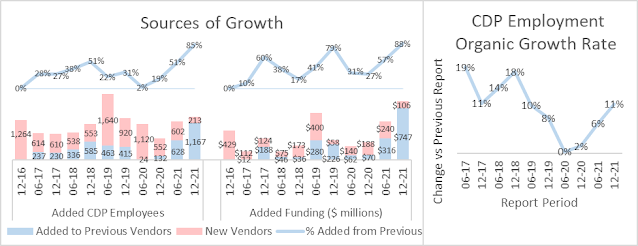
The CDP Institute just published its latest Industry Update, our semi-annual overview of CDP vendors with data on employment, funding, locations, and more. (Download here.)  There were three pieces of information that stood out:

  • Only four new vendors were added, compared with an average of fifteen in past reports.

  • four companies reported funding rounds over $100 million, compared with one round that size across all past reports

  • nearly all employment growth (85%) came from previously listed vendors, compared with just 36% in past reports


Of course, it makes sense that most growth would come from existing vendors if we added few new ones. But industry growth over-all was in line with past trends, and actually a bit stronger: up 12% over the past six months. This meant that the growth rate of existing vendors was high enough to compensate for the “loss” of new vendors. In fact, the existing vendor growth of 11% was the highest since 2018, when the industry was just taking off.

Connecting these dots reveals a clear picture: an industry that has stopped attracting new entrants but is now growing strongly on its own – with leading vendors stockpiling funds to compete against each other an elimination round where only a few can emerge as winners. Think Survivor meets Game of Thrones with a dash of Big Bang Theory.

It’s a picture that makes a lot of sense. Customer Data Platforms are now widely accepted as an essential component of a modern data architecture, so it’s a market worth fighting for. But the situation facing potential entrants is daunting:

  • the leading independent CDP vendors now have mature products, big customer bases, high brand recognition, and lots of funding. 

  • enterprise software companies, including Salesforce, Adobe, Oracle, Microsoft, and SAP, are chipping away at the market by selling CDPs as part of their packages. 

  • marketing automation, customer support, ecommerce, and other vendors increasingly offer CDP modules baked into their own systems

  • IT teams show growing interest in building their own CDP equivalent, supported by a growing array of components that make the job easier.

Some mid-tier CDP vendors have already given up the fight and been acquired, most often by firms needing a CDP to anchor a multi-channel customer experience suite. The acquisition wave may have peaked, since there were just three acquisitions in the latest report, compared with a dozen over the previous two. 

Among the remaining firms, some may compete successfully as generalists.  But the more promising path in most cases will be to offer specialized products that can be the best in a particular niche. Those niches might be defined by a particular industry, region, company size, or CDP function.

The functional niches are most intriguing because they serve the growing market for CDP components. We’ve seen some movement in that direction, as vendors offer parts of their CDP as stand-alone modules for identity resolution, data collection, data distribution (“reverse ETL”), and campaign management. Those vendors see their modules as a point of entry into clients who will later buy more of their products. They may be right, but I wonder how many companies that buy best-of-breed components will reverse course by favoring components from a single source. What’s certain is that this approach exposes the CDP vendors to competition from point-solution specialists in each area while discarding the advantage of that comes from purchasing a CDP with a full range of pre-integrated functions.  Here's a sampling of that competitive landscape:

I also suspect that companies like Snowflake, Amazon Web Services, and Google Cloud Services, which now position themselves as providing one piece of a “composable” solution, will eventually add features that match what the independent component providers now offer. Actually, that’s already happening, so I don’t get much credit for predicting it. It’s a dynamic we’ve seen repeatedly in other markets: primary vendors expand their features to secure their position with clients by adding more value (hooray!) and increasing the cost of switching (boo!).

Let’s be clear: both the added value and the switching costs are the result of integration cost. No matter how many promises are made about easy integration, the fact remains that any non-trivial connection between two systems takes skill to plan, deploy, and maintain. Integration is often the top-ranked vendor selection criterion in surveys, which some see as showing that problem is well understood. I draw the opposite conclusion: people list integration as a consideration because they know it’s poorly understood.  This forces them to invest time in trying to avoid integration problems and even sacrifice other benefits to achieve it. If integration were really easy, no one would worry about it.

Right now, someone reading this is saying, “Ah, but no-code changes everything”. I don’t think so. No-code works best when automating simple processes with a few users where flaws are acceptable. The more complex, widely-deployed, and mission-critical a process is, the more important it is to deploy professional-grade design and quality control. Prebuilt components doesn’t change this: configuring those components and connecting them to each other still takes great care and understanding.

This isn’t (just) a cranky-old-man digression. CDP functions rank high in complexity, scale, and risk, so they are poor candidates for no-code development. CDPs certainly can have no-code interfaces that empower business users to do things that might otherwise require a developer. But those interfaces will control carefully defined and constrained tasks, not create core functionality. Assembling CDP-equivalent systems from composable functions is a different matter, and, yes, that should become increasingly possible for people with the right integration skills. What I doubt is that selling modules with those functions will be good business for CDP vendors: they are likely to commoditize their products and ultimately to be pushed aside by platform developers who integrate key functions directly.

I'm not saying that CDP vendors who can’t raise several hundred million dollars are doomed.  I am saying that most will have to pick a niche to succeed. One promising option is building customer data profiles, especially for big enterprises. It’s a single function that incorporates enough separate components for CDP vendors to provide value by avoiding integration costs.

The other big niche, or set of niches, is integrated customer experience solutions. Our latest report already shows systems that campaign and delivery CDPs, our name for systems that do this, account for two-thirds of the industry vendor count and funding, and nearly three-quarters of employment. Their actual share may be greater still: immediately after completing the latest report, I happened to glance at G2 Crowd’s list of CDPs and found our reports doesn't include several large, fast-growing retail marketing automation or messaging specialists (Insider, Listrak, SALESmanago, Klaviyo, and Ometria) that offer what looks like CDP-grade multi-source profile building.

Whether those vendors are true CDPs depends on whether they make those profiles available to other systems. Either way, the point is that there’s a large and growing market for cross-channel retail marketing systems with unified customer profiles at their core. There are similar markets outside of retail, where we already see specialist campaign and delivery CDPs in hospitality, financial services, telecommunications, healthcare, education, and elsewhere.

The value of industry-specific systems is, once again, reduced integration cost. In this case, the key integration is with industry-specific operational systems such as airline reservations, core banking, phone billing, health records, and student management. Vendors in these niches compete primarily on the marketing functions they offer, which makes them more departmental than enterprise solutions and pushes them to add marketing features tailored to their particular industry. Systems like this are hard to dislodge once they’re deployed because they are populated with many complex, difficult-to-replicate campaigns, reports, predictive models, and content libraries. This stickiness is what enables many successful vendors to co-exist in each niche, and what makes it hard for non-specialists to enter.

The division of the CDP industry into enterprise-level data CDPs and industry-specific, department-level campaign and delivery CDPs is not a new trend. What is new is the maturity of the competitors within many niches, which will make it increasingly difficult for new entrants to succeed. What’s also new is that building CDP-style customer profiles is increasingly common, making it a standard feature rather than a product differentiator. This encourages vendors to position themselves as something other than a CDP, even though they need to show buyers that their CDP features are first-rate.

My final conclusion is this: the CDP industry will continue grow, and it will remain important for buyers to find the right CDP, even as the CDP itself slips from the spotlight.

Monday, June 17, 2019

It's CDP Time for Marketing Cloud Vendors

Adobe, Salesforce and Oracle all made announcements regarding Customer Data Platform products this week. None are world-changing: Salesforce described a planned extension of Customer 360; Abobe announced triggered journey campaigns that draw on its “real time CDP”, and Oracle described CDP services from systems integrators.  But the fact that all three vendors are addressing the topic raises some interesting questions.

Why does this matter to technology and marketing professionals? Customer Data Platforms have been a hot topic for the past three years. The reason is simple: they promise to solve a pressing problem that has not been solved by anything else. That problem is the need of marketers (and others) to combine data from all sources into easily accessible customer profiles. Those profiles are needed for accurate targeting and consistent, satisfying customer experiences.

The problem is unsolved because alternate solutions fall short in different areas.  Data warehouses are largely limited to structured data.  Data lakes are not unified or easily accessible to non-technical users.  Data Management Platforms are limited to summary data about mostly anonymous individuals.  CRM and marketing automation systems don’t easily combine data from external sources.

By contrast, CDPs promise to ingest all data sources, retain all details, and share the resulting profiles with any system that needs them.  But CDPs have been developed by relatively small specialist vendors, which many enterprise buyers are reluctant to consider. So having Salesforce, Adobe, and Oracle promote CDPs will prompt more enterprise buyers to give the category serious consideration.

It also doesn’t hurt that Forrester issued its first CDP wave this week, that Dun & Bradstreet just bought CDP Lattice Engines, and that Martech Advisor’s Talking Stack podcast devoted an entire session to the topic  (humble-brag disclosure: I’m a panelist on Talking Stack).

So, yeah, CDP is getting a lot of attention right now.

What’s new in these announcements and what’s not? Adobe, Salesforce and Oracle have all previously announced something that they positioned as addressing the needs met by a CDP.

• Adobe’s original approach was to map a single customer ID across all its systems and create transient customer profiles by pulling together data on demand. It changed direction in March 2018 with news that its Experience Platform would create persistent profiles.  It released this a year later and described it as including a "Real-Time CDP".  Nothing about that changed with yesterday’s announcement, which described an Adobe Campaign application using the CDP data.  All this is separate from the Open Database Initiative, a still-undelivered project announced last September to build shared database model with Microsoft and SAP.

• Oracle announced CX Unity last October. It included a persistent data store from the start but is just now starting beta deployments. The latest Oracle announcement describes collaboration with Accenture and Capgemini to provide services around CX Unity projects.  It doesn’t include anything new about the product.


• Salesforce’s Customer 360, also announced last September, was another master customer ID used to access source system data on demand. Salesforce now says they’ll release that product this November. The bigger news is they’re developing a next-generation Customer 360 that will store its own data, bringing them in line with Adobe and Oracle. There’s no release date although they hope to start pilot projects this fall.

It's taken a while but all three vendors now acknowledge that a CDP must store its own data. That will remove some confusion from the CDP market.  Cynics might say it also confirms that software vendors define user requirements based on what their systems currently do, not what users actually need. It’s hard to interpret the CDP story in any other way, since the need for a persistent data store has always been clear to anyone who tried to support core CDP use cases such as attribution, prediction, and journey analysis.

What benchmarks should these CDP products be measured against? The CDP Institute (which I head) believes that buyers expect a CDP to ingest all types of data, capture the full detail of the ingested data, retain that data as long as the user wants, assemble unified customer profiles, and make the profiles available to any external system. We codify those as requirements in our RealCDPTM certification program. The original Adobe and Salesforce approaches certainly didn’t store the data and had other limits about the types and detail they captured. On the other hand, they did include real-time access to current source data, which is not part of RealCDP but is important for many CDP use cases. Many other CDPs also provide real-time access as well as segmentation, predictive modeling, personalized message creation, and sometimes even message distribution. Oracle, Salesforce, and Adobe have separate products for most of those functions so they are not part of their CDPs.

What should we look for next from these vendors? The main thing to watch is how quickly the announcements turn into released products. Only then will buyers be able to judge the details of how well these vendors deliver on their promises and how their offerings compare with other, more mature CDPs. In particular, pay close attention to how easily each system connects with other products. Because the marketing clouds are built from acquisitions that remain technically separate, integrations for each component are developed and delivered in whatever sequence the vendor thinks best.  Connections to other vendors’ systems are an even lower priority. Buyers will often be left to develop their own connectors using a CDP API – which should itself be examined closely to see what it does and how hard it is to use.

Once the vendors flesh out the core CDP capabilities of their offerings, the focus will shift to improvements in user experience. This includes end-user functions such as segmentation and more technical capabilities for connecting to data sources and destinations. Reducing the technical work required to set up and maintain a CDP can have a significant impact on time to value and operating cost.  More important, it can help the CDP achieve its mission of including all data and sharing it with all other systems. Also expect the vendors to create industry-specific packages with prebuilt data models, connectors, predictive models, workflows, and reporting. These will further ease deployment and help the vendors to compete with industry-specialist CDPs.

In most of the CDP market, vendors are extending their systems by adding more activation functions such as marketing campaigns, personalized message selection, and message delivery. Many users are eager to buy one system that combines as many functions as possible. But because the marketing clouds offer these functions as separate modules, they are unlikely to expand their CDPs in that direction.  This will probably reduce their competitiveness in the mid-market.

Who else might toss their hat into the CDP ring? There have been four significant CDP acquisitions to date: Datalicious/Veda by Equifax (2016); Datorama by Salesforce (2018); Treasure Data by Arm (2018), and Lattice Engines by Dun & Bradstreet (2019). Salesforce is the only marketing cloud vendor on this list and they've positioned Datorama as a campaign analytics product, not a CDP.  Since Oracle and Adobe are far along in their CDP development, neither is likely to purchase an independent CDP vendor – although that might happen if they feel pressure to deliver a mature CDP more quickly. That Equifax and Dun & Bradstreet have bought CDPs suggests other data compilers might do the same, with the goal of adding more value than just their data.

Other potential acquirers include ad agency holding groups and consultancies who want to bulk up their data management capabilities. Moving from the other direction, companies that offer message delivery and interactions, such as email delivery, Web site personalization, mobile app development, call center, and customer support systems, might add a CDP to expand their footprint, make their products harder to replace, and ultimately let them add delivery in other channels. Case in point: unified marketing, sales and support vendor Freshworks recently purchased Natero, a customer success system with CDP capabilities.

But the big clouds looming over the entire customer data ecosystem are, literally, the big clouds: Amazon Web Services, Google Cloud, and Microsoft Azure. So far, none has shown much interest in selling customer data management tools, although they already host plenty of CDP data.  There’s a reasonable chance these vendors will eventually enter the CDP market.  But that would be a few steps up the value chain from their current offerings, which still focus primarily on data storage. The cloud services vendors are starting that climb, adding cloud connectors, data transformations, in-database analytics, machine learning, and reporting tools. Google Cloud’s purchase of Looker is a recent step in this direction. Data quality services such as address standardization and master data management could be next.  There's a way to go before these vendors are ready to add the specialized features needed for a CDP. They may also find themselves constrained by anti-trust and privacy issues. But don’t rule it out.

What do these announcements mean for current CDP vendors? At a fundamental level, these announcements confirm that there’s a real need for CDPs and that the CDP model of building a separate, persistent database is correct. That’s no small thing, given the fear, uncertainty and doubt that the marketing cloud vendors have previously spread about both. The result is to expand the market, since more potential buyers will now accept CDP as a valid option.

This does not mean the cloud vendors have given up their efforts to shape the conversation. They are now trying to redefine CDP as part of a larger integrated package – that is, of systems like their own. This isn’t likely to be successful, given how few enterprises actually limit themselves to one vendor’s products. So the ability of the current CDP vendors to work equally well with systems from any provider is likely to be even more appealing.

Still, it would be unrealistic to ignore the fact that many buyers would rather buy from the marketing cloud vendors. The long lead times between preannouncement of the marketing cloud CDPs and their actual delivery will lead some buyers to delay their purchases, which is exactly the cloud vendors’ intent. But the interval will also give potential buyers more time to think carefully about what they need in a CDP, making them smarter consumers when they do start an acquisition project. A rigorous, requirements-based acquisition process will often favor the existing CDP vendors, whose products are proven and mature.

How do these announcements relate to other developments in the CDP market? The CDP market is evolving rapidly. From its initial base in retail and media, it has spread to new industries including travel, financial services, B2B, telecommunications, healthcare, and education. Industry-specialist vendors are appearing with prebuilt data models, integrations with industry systems (such as point of sale in retail or reservations for hospitality), and staff expertise. Other specialists now focus on mid-size or small businesses and in particular geographic regions.

There’s also an increasingly clear split between CDP vendors who focus on data collection, unification, and access functions and those with marketing functions for analytics and personalization. One result is that some clients deploy one CDP for data unification and another for marketing applications. Some CDPs have extended their marketing features to include delivery systems such as email engines, Web site messaging, and even DMPs.  These were previously beyond the scope of CDP products. Vendors with delivery capabilities still allow clients to use other delivery systems – otherwise they would not meet the definition of a CDP. You can see where this leads: CDPs with a full set of marketing applications become direct competitors of the marketing clouds. It also means that CDP becomes one feature among many in these products -- a change that may lead some to deemphasize their CDP capabilities and instead partner with data unification specialists.  (See this post for a deeper exploration of that scenario.)

On the buyer side, CDPs are increasingly used beyond marketing to support sales, service, and business operations. This often means the CDP becomes a shared resource managed by corporate IT rather than marketing.  Enterprise-wide digital transformation projects and increasing concern over compliance with privacy regulations have further increased involvement of central IT and compliance teams.  In general, greater familiarity with CDPs has meant that buyers have a better understanding of what they do and what to look for, making them more sophisticated consumers and helping them to navigate the growing number of products in the market.

Entry of the big cloud vendors may accelerate the trend to industry-specific CDPs by pushing smaller vendors into niches where they can better compete with general purpose systems. The big cloud vendors may push also independent CDPs to deliver comprehensive marketing functions to the mid-market where they can be more integrated and more economical than the marketing clouds. CDPs that focus primarily on data management will probably face the greatest competition from the marketing cloud CDPs, since they compete for enterprise clients where the big cloud vendors are the strongest. But those CDP vendors also have the greatest technical lead and will find it easiest to support enterprise-wide use cases.

In short, entry of the marketing cloud CDPs will accelerate industry growth and reinforce current industry trends, not change the over-all direction. For CDP vendors and buyers alike, that is good news.


Saturday, June 01, 2019

What's Next for the Customer Data Platform Industry?

Customer success platform Gainsight recently released a Customer Data Platform module for its system. This followed Freshworks’ acquisition of Natero, another customer success platform that builds a unified customer database. Totango, another customer success platform, also positions itself as CDP

There's nothing questionable about these claims.  Customer success platforms were among the earliest classes of systems identified as CDPs. Like predictive modeling systems, they originally built a unified database to support their primary application and later recognized that the database had even more value if it was shared with other systems. So a CDP positioning makes sense.

But the Gainsight announcement did prompt an industry colleague to ask me whether classifying products like Gainsight as CDPs would lead to each department building its own CDP, creating “CDP silos” and ultimately requiring a “CDP of CDPs” to unify them all.  That contains enough irony to meet your minimum daily requirement for a week.  But it’s a fair question that’s often posed by CDP buyers who don't want another silo in their server farm. 

My first answer is that not all systems claiming to have a CDP are true CDPs, particularly when it comes to sharing their data with any external system. We’ve been trying clarify that with the RealCDP project, which includes data sharing as one of the five qualification requirements.  But many vendors like Gainsight and Totango pass that test. So it doesn’t really address the question.

My second answer is to respond with another question: If a system meets the definition of a CDP, should we NOT call it one?  That seems silly. Of course, it begs the question of the CDP definition itself: should we define a CDP as a system that only builds the unified database?  This would exclude products that also provide integrated applications such as customer success management, predictive modeling, campaign management, personalization, and more.  The narrow definition would certainly reduce confusion.  But it doesn’t address the real-word situation, which is that many buyers want a CDP that includes some or even all of those applications.  My response has been to suggest the “CDP Inside” concept, which says CDP is a function, not a software category.  This function could be provided by a single-purpose system or by a system that offers other functions as well.  The concept  hasn’t been as widely adopted as I'd like but I think the world is moving in that direction regardless.

My third answer builds on the second.  Companies can buy multiple products with a CDP capability and still not deploy all of them.  This comes down to management: a company with several CDP-capable products can make one its primary CDP and push profiles from that system to the rest.  That would be the best choice in most cases, I think.  But a company might also build several complete CDPs by feeding the same data into each of them.  Or it might build siloed CDPs that only connect to their associated applications. Those sound like bad ideas. But it’s not the CDP's fault if someone deploys it ineffectively.

Let’s game this out. 
  • Application vendors are incented to add CDP capabilities to their systems because some clients want them. Foolish clients may build several separate CDPs, especially in organizations where different groups prefer to function independently. So, yes, there’s some potential harm in making that easy by putting a possible CDP inside each system. 
  • Smart clients will avoid this mistake by choosing one system as their primary CDP. Each vendor will hope to play that role, since it adds value to their product and makes clients less likely to switch to another system.
  • Over time, the smart clients will learn what they need in a CDP and push vendors to compete to build the best product. As this happens, vendors with limited resources will drop out of the competition to focus on their core applications.  They'll still provide some data unification features but won't promote them as a CDP. 
  • Other vendors will double down on their CDP investment so they can win the competition. As these vendors develop best-in-class products, they’re likely to offer their CDPs as separate modules. 
  • The most demanding buyers will want the best possible CDP and will buy best-in-class products whether they come from specialist CDP vendors or application developers.  As a result, best-in-class CDPs will be increasingly distinguished from lightweight CDPs embedded in application systems.

A reasonable analogy might be reporting systems. In the early days of the packaged software industry, application vendors competed to offer the best custom report builders within their products. Later, general-purpose reporting tools like Tableau came to dominate the market. Most application vendors then stopped presenting their report builder as a differentiator. They still deliver specialized reports as part of their systems but expect users to integrate with third party reporting tools for other needs.

I think the CDP industry will follow a similar trajectory. Many applications need unified customer profiles. Some will rely entirely on an external CDP to create those profiles and share them. Most will offer a lightweight CDP so customers without a separate CDP can still use their application. A few will build best-in-class CDPs that can be sold on their own. These best-in-class CDP modules will often be spun off as separate products.

Some of this is already happening.* CDP vendors themselves are increasingly distinguishing between CDPs that focus on building and sharing the unified database and CDPs that also deliver analytical, personalization, and other application capabilities. Some in the latter group position their CDP features as best-in-class but most will admit (with varying degrees of reluctance) that they are often deployed in combination with a separate CDP that specializes in data unification. So, just as companies often have a shared standard reporting tool that complements the reports built into applications, we can expect to see one shared CDP that complements specialist CDPs within applications.

It will take some time to sort this out, as vendors decide what kind of CDP to offer and buyers decide what they need. But I think the future of the industry is coming into focus.


__________________________________________________
*A little-cited corollary to the famous aphorism that predictions about the future are hard is that predicting the past is easy.


Tuesday, January 02, 2018

What's Next for Customer Data Platforms? New Report Offers Some Clues.

The Customer Data Platform Institute released its semi-annual Industry Update today. (Download it here).  It’s the third edition of this report, which means we now can look at trends over time. The two dozen vendors in the original report have grown about 25% when measured by employee counts in LinkedIn, which is certainly healthy although not the sort of hyper growth expected from an early stage industry. On the other hand, the report has added two dozen more vendors, which means the measured industry size has doubled. Total employee counts have doubled too. Since many of the new vendors were outside the U.S., LinkedIn probably misses a good portion of their employees, meaning actual growth was higher still.

The tricky thing about this report is that the added vendors aren’t necessarily new companies. Only half were founded in 2014 or later, which might mean they’ve just launched their products after several years of development. The rest are older. Some of these have always been CDPs but just recently came to our attention. This is especially true of companies from outside the U.S. But most of the older firms started as something else and reinvented themselves as CDPs, either through product enhancements or simply by adopting the CDP label.

Ultimately it’s up to the report author (that would be me) to decide which firms qualify for inclusion.   I’ve done my best to list only products that actually meet the CDP definition.*   But I do  give the benefit of the doubt to companies that adopted the label. After all, there’s some value in letting the market itself decide what’s included in the category.

What’s most striking about the newly-listed firms is they are much more weighted towards customer engagement systems than the original set of vendors. Of the original two dozen vendors, eleven focused primarily on building the CDP database, while another six combined database building with analytics such as attribution or segmentation. Only the remaining seven offered customer engagement functions such as personalization, message selection, or campaign management. That’s 29%.**

By contrast, 18 of the 28 added vendors offer customer engagement – that’s 64%. It’s a huge switch. The added firms aren’t noticeably younger than the original vendors, so this doesn’t mean there’s a new generation of engagement-oriented CDPs crowding out older, data-oriented systems. But it does mean that more engagement-oriented firms are identifying themselves as CDPs and adding CDP features as needed to support their positioning. So I think we can legitimately view this as validation that CDPs offer something that marketers recognize they need.

What we don’t know is whether engagement-oriented CDPs will ultimately come to dominate the industry. Certainly they occupy a growing share. But the data- and analysis-oriented firms still account for more than half of the listed vendors (52%) and even higher proportions of employees (57%), new funding (61%) and total funding (74%).  So it’s far from clear that the majority of marketers will pick a CDP that includes engagement functions.

So far, my general observation has been that engagement-oriented CDPs appeal more to mid-size firms while data and analysis oriented CDPs appeal most to large enterprises. I think the reason is that large enterprises already have good engagement systems or prefer to buy such systems separately. Smaller firms are more likely to want to replace their engagement systems at the same time they add a CDP and want to tie the CDP directly to profit-generating engagement functions. Smaller firms are also more sensitive to integration costs, although those should be fairly small when CDPs are concerned.

There’s nothing in the report to support or refute this view, since it doesn’t tell us anything about the numbers or sizes of CDP clients. But assuming it’s correct, we can expect engagement-oriented vendors to increase their share as more mid-size companies buy CDPs. We can also expect engagement-oriented systems to be more common outside the U.S., where companies are generally smaller. For what it’s worth, the report does confirm that’s already the case.

If the market does move towards engagement-oriented systems, will the current data and analytics CDPs add those features? That’s another unknown. There’s already been some movement: four of the original eleven data-only CDPs have added analytics features over the past year.  But it’s a much bigger jump to add customer engagement features, and sophisticated clients won’t accept a stripped-down engagement system. We might see some acquisitions if the large data and analytics vendors want to add those features quickly. But those firms must also be careful about competing with the engagement vendors they currently connect with. Nor are they necessarily eager to lose their differentiation from the big marketing clouds.  Nor is there much attraction to entering the most crowded segment of the market with a me-too product.

So most data and analytics vendors may well limit their themselves to their current scope and invest instead in improving their data and analytics functions. That will limit them to the upper end of the market but it's where they sell now and offers plenty of room for growth.  Certainly there’s a great deal of room for improved machine learning, attribution, scalability, speed, and automated data management. If I had to bet, I’d expect most data and analytics vendors to focus on those areas.

But I don’t have to bet and neither do you. So we’ll just wait to see what comes next. It will surely be interesting.


_________________________________________________________________________
*CDP is defined as a marketer-controlled system that builds a persistent, unified customer database that is accessible by other systems.

**To further clarify, customer engagement systems select messages for individuals or segments.  Analytics systems may create segments but don't decide which messages go to which segment.  And execution systems, such as email engines, Web content management, or mobile app platforms, deliver the selected messages. 

Sunday, May 14, 2017

Will Privacy Regulations Favor Internet Giants?

Last week’s MarTech Conference in San Francisco came and went in the usual blur of excellent presentations, interesting vendors, and private conversations. I’m sure each attendee had their own experience based on their particular interests. The two themes that appeared the most in my own world were:

- data activation. This reflects recognition that customer data delivers most of its value when it is used to personalize customer treatments. In other words, it’s not enough to simply assemble a complete customer view and use it for analytics.  “Activation” means taking the next step of making the data available to use during customer interactions, ideally in real time and across all channels. It’s one of the advantages of a Customer Data Platform, which by definition makes unified customer data available to other systems. This is a big differentiator compared with conventional data warehouses, which are designed primarily to support analytical projects through batch updates and extracts.  Conventional data warehouse architectures load data into a separate structure called an “operational data store” when real-time access is needed. Many CDP systems use a similar technical approach but it’s part of the core design rather than an afterthought. This is part of the CDPs’ advantage of providing a packaged system rather than a set of components that users assemble for themselves. CDP vendors exhibiting at the show included Treasure Data, Tealium, and Lytics.

- orchestration. This is creating a unified customer experience by coordinating contacts across all channels. It’s not a new goal but is standing out more clearly from approaches that manage just one channel. More precisely, orchestration requires a decision system that uses activated customer data to find best messages and then distributes them to customer-facing systems for delivery. Some Customer Data Platforms include orchestration features and others don’t; conversely, some orchestration systems are Customer Data Platforms and some are not. (Only orchestration systems that assemble a unified customer view and expose it to other systems qualify as CDPs.) Current frontiers for orchestration systems are journey orchestration, which is managing the entire customer experience as a single journey (rather than disconnected campaigns), and adaptive orchestration, which is using automated processes to find and deliver the optimal message content, timing, and channels for each customer. Orchestration vendors at the show included UserMind, Pointillist, Thunderhead, and Amplero.

Of course, it wouldn’t be MarTech if the conference didn’t also provoke Deeper Thoughts. For me, the conference highlighted three long-term trends:

- continued martech growth. The highlight of the opening keynote was unveiling of martech Uber-guru Scott Brinker’s latest industry landscape, which clocked in at 5,300 products compared with 3,500 the year before. You can read Brinker’s in-depth analysis here, so I’ll just say that industry growth shows no signs of slowing down.

- primacy of data. Only a few presentations or vendors at the conference were devoted specifically to data, but nearly everything there depends on customer data in one way or another. And, as you know from my last blog post, the main story in customer data today is the increasing control exerted by Google and Facebook, and to a lesser degree Amazon, Apple, and Microsoft. If those firms succeed in monopolizing access to customer information, then many martech systems won’t have the inputs they need to work their magic. That could be the pin that bursts the martech bubble.

- new privacy regulations. As Doc Searles (co-author of The Cluetrain Manifesto) pointed out in the second-day keynote , new privacy regulations also threaten to cut off the data supply of marketing and advertising systems, creating an “extinction level event”. Searles announced a “customer commons” that lets consumers share data on their own terms . It’s an interesting concept but I suspect few consumers will put that much work into personal data management.

My initial inclination was to agree with Searles about the implications of new privacy rules, but I’ve since adjusted my view.  It’s just inconceivable that an economic force as powerful as Internet marketing will let regulations put it out of business. It's much more likely that companies like Google and Facebook will learn to work within the new regulations, which after all don’t ban personal data collection but merely require consumer consent. Surely firms with products that are literally addictive can gain consumer consent in ways that will satisfy even the most determined regulators. More broadly, big companies in general should be able to make the investments needed to comply with privacy regulations with minimal harm to their business.

Small businesses are another matter.  Many will lack the resources needed to understand and comply with new privacy regulations.  In other words, privacy regulations will have the unintended consequence of favoring big businesses – which can afford to find ways to comply – over small businesses – which won’t.   Google and Facebook will spend whatever they must to protect their businesses, in the same way that auto manufacturers found ways to comply with safety and pollution regulations. Indeed, as the auto industry illustrates, the actual cost of compliance is likely to be slight and may even result in better, more profitable products. The impact on small businesses will be to push them to use packaged software – yes, including Customer Data Platforms – that have regulatory compliance built in by experts. The analogy here is with financial and human resources packaged software, which similarly provides built-in compliance with government and industry standards.

Of course, if Google, Facebook, and a handful of others take near-total control over access to customers, there won’t be much data for anyone else to manage. But it seems likely that companies will find ways around those toll booths, especially when dealing with customers who have already purchased their products. Ironically, this would return marketers to the situation that existed before the Internet, when data on prospects was limited but customers could be reached directly. That might put a small crimp in martech growth but would still leave plenty of room for innovation.

Thursday, March 16, 2017

Is MarTech Too Important To Leave To The Marketers?

I’m still pondering the relationship between marketing and IT: what it is, will be, and should be. A few new ingredients have kept the pot boiling:

- a chat with Abhi Yadav, founder of Zylotech, a MIT-bred, artificial intelligence-driven Customer Data Platform and message selection engine.  Those roots made it seem a likely candidate for IT-driven purchases, but Yadav told me his primary buyers are marketing operations staff.  In fact, he hasn’t even run into those marketing technology managers everyone (including me) keeps talking about. On reflection, it makes sense that marketers would be the buyers since Zylotech includes analytical and message selection features only used in marketing.  A system that only did data unification would appeal more to IT as a shared resource. Still, Yaday's comments are one point for the marketer-control team.

- a survey from the Association of National Advertisers that found marketers who control their technology strategy, vendors, and enterprise standards are more likely to have a strong return on martech investment. (The study is only available to ANA members but they gave permission to publish the table below. You can see a public infographic here).  That’s two points for Team MarTech.


- a study by IT staffing and services provider TEKsystems that found senior marketers with more advanced strategy were more likely to control their own technology.  The difference wasn’t terribly pronounced but it’s still the same pattern. MarTech is now ahead 3-0.  (I was actually more impressed that 65% of departments with no strategy were in charge. Yikes!)


So far, the game’s a blow out. Marketing is usually in charge of its technology and does better when it is.  A doubter might question if marketers really make better choices or are just happier when they’re in control. I do suspect that IT people would be less confident that marketers are making optimal decisions. Still, there’s no real reason to doubt that marketers are the best judges of what they need.

But the game’s not over. Let's call in a recent Ad Week article about global tech consultancies buying marketing agencies. The article cites Accenture, Deloitte, IBM, KPMG, McKinsey and PricewaterhouseCoopers and notes that each already has huge agency operations.  To the extent that these firms are working with marketing departments, it’s still more evidence of marketing being in charge. But the real story, at least as I read it, is these firms are getting involved because they see a need to integrate marketing technology with over-all corporate technology, just as marketing strategy needs to support corporate strategy.

“The consultants’ bread and butter has traditionally been large IT and business-transformation projects,” says Julie Langley, a partner at fundraising, merger and acquisitions advisor Results International, in the article. “But, increasingly, these types of projects have ‘customer experience’ at their center.”

To me, this is the key. As every aspect of customer experience becomes technology-driven, technology must be integrated across the corporation to deliver a satisfactory experience. Marketing may be the captain, but it’s still part of a larger team. If marketing can be a true team player, it gets to call the plays. But if marketing is selfish, then a coach needs to step in for the good of the whole.

I’ll spare you the extended sports analogy. In concrete terms, if marketing picks systems that only meet marketing needs, then the integrated customer experience will suffer. Worse still, some new tech-driven offerings may be impossible. This could be fatal if other, nimbler competitors deliver them instead. Tech-based disruption is a real threat in many industries. Companies can’t just hope that each department working on its own will yield an optimal solution for the business as a whole.  In fact, they can be quite sure it won't.

That’s why I’m not convinced by surveys showing marketers are happier or get better return on investment when they control their own technology. It’s possible for that to be true and for the corporate to miss larger opportunities that require cooperation across departments. If marketing can take that broader perspective, there’s no problem. If it can’t, IT or another department with enterprise-wide perspective will need to enter the game.

Tuesday, March 14, 2017

CrossEngage Orchestrates Customer Journeys Using Events

It feels like forever since I first wrote about Journey Orchestration Engines (JOEs), although it is just one year. Orchestration was already a hot term when I started, so I take neither credit nor blame for its continued popularity. I will say that I’ve now seen enough orchestration systems to start making subtle distinctions among them.

Subtle distinctions are needed because the systems are basically similar. They all ingest data from multiple sources; convert it into unified customer profiles; apply rules and analytics to find the best message for each customer in each situation; and, send those messages to external systems for delivery. Unified customer profiles make these products look like Customer Data Platforms. JOEs that expose their profiles for external access really are CDPs; JOEs that keep the profiles for their own use, are not. In theory, a JOE could connect to an external customer database rather than building its own, but I haven’t seen that configuration in practice.

The main ways that JOEs differ include:
  • Channel scope. Some systems are largely limited to online interactions, while others are built to combine online and offline channels. Some systems that look like JOEs work with only Web or email. But orchestration pretty much implies multiple channels so I’d probably exclude those from the JOE tribe.
  • Decision methods. JOEs can work with conventional, rule-driven campaign structures or use automated techniques to customize the path followed by each customer. There’s also considerable variation in exactly what gets automated: some automate campaign assignments but use static content; some automatically run a/b tests and pick the winners; some automatically create customer segments that receive different content; some use machine learning to dynamically generate custom content. 
  • Journey framework. My original definition of JOE was quite rigorous: journey orchestration meant all campaigns were defined relative to a master model of the customer journey. This really means that stages in the journey are “states” that customers flow between, and campaigns are chosen in part based on each customer’s current state. I still think of JOEs that way and definitely see some systems organized along those lines. But when you start looking at some of the more automated decision methods, it’s harder to apply concepts of fixed states or journey flows. So I still check whether a system has a journey framework but don’t necessarily require a JOE to use it. I realize this means you could have a journey orchestration system without journeys. If that’s the silliest thing you’ve been asked to accept recently, you haven’t been watching the news.
This is all a very long-winded introduction to CrossEngage, a Berlin-based firm that released its product about six months ago. CrossEngage works in online channels, using its own tags to capture Web interactions and API connections to ingest data from email providers, mobile apps, and other sources. It can also load CSV files if necessary.

CrossEngage treats most data as either a customer attribute or event, using big data technologies that store inputs and to allow data access with minimal schema design. The system also stores some information that’s neither attribute nor event, such as products and locations. The vendor maps new sources into the system and can define logic to create custom events. (A self-service event builder is planned by July.) Customer data from different sources is stitched together using deterministic matching only (that is, CrossEngage will only connect different identifiers to the same person if an external source provides the relationship).

A dashboard lets users see Web site events as they stream into the system. Users can apply filters to see only certain events. Campaigns also make heavy use of events, referencing them as entry and exclusion conditions, in combination with user-defined segments; as campaign goals (which may be one or several events); and, as campaign steps (each step being a different event). Event definitions can reference other events and can include brain-bending logic such as checking whether a second train fare request specified the same departure city as the first request and happened within ten minutes. In that example, the first request would be first event in the campaign. This is tremendously powerful and, as the vendor points out with some understatement, poses a substantial technical challenge to do in real time.

Each event in a campaign can be assigned a message, which will be delivered by an external system such as an email vendor. CrossEngage can map its data to delivery systems so they can use the data in their own message templates. Alternatively, messages can be created in CrossEngage’s own templates, which can include conditional scripts for dynamic content generation. The system has external integrations for email, direct mail, mobile push, text messages, and Facebook Customer Audiences, with more on the way. It has its own connectors for Web site and Web browser messages, Web hooks, and file extracts. Users can also attach discount coupons to messages.

Campaigns can be assigned frequency caps that limit the number of messages each person receives in different time periods (per minute, per hour, per day, per week, or per month). Caps are defined separately for each campaign. Another set of caps applies across all campaigns on a per channel basis. Campaigns that generate transactional messages can be exempted from the frequency caps to ensure their messages are always sent. People can also be excluded from campaigns based on whether they were recently in that same campaign or a different one.

CrossEngage also has user journeys, which involve a set of related events. Journeys can exist within a campaign or be used outside a campaign to analyze customer behavior. If you’re keeping track, this is a different use of the term “journey” from the one I described earlier.


This is a pretty mature set of features, especially for such a young system. But nuances also include noticing what CrossEngage doesn’t do. There is no machine learning to recommend the right campaign, right message, or right message timing, although the system does support a/b tests. There’s also no visual flow chart to lay out campaigns. This is a choice made by CrossEngage based on its designers’ previous experience that flow charts quickly become too complicated to be understood or maintained over time.

Speaking of nuance, CrossEngage also has a mature approach to user rights management, allowing administrators to specify which users can perform which actions on each object. Team-based rights are on the roadmap.

CrossEngage currently has about fifteen major clients, spread across travel, ecommerce, fashion, dataing, and other industries. Pricing is based on the number of events tracked in the system, not the number of messages sent. It starts as low as $2,500 per month although average client pays about twice that. 

Thursday, December 08, 2016

Can Customer Data Platforms Make Decisions? Discuss.

I’ve had at four conversations in the past twenty four hours with vendors who build a unified customer database and use it to guide customer treatments. The immediate topic has been whether they should be considered Customer Data Platforms but the underlying question is whether Customer Data Platforms should include customer management features.

That may seem pretty abstract but bear with me because this isn’t really about definitions. It’s about what systems do and how they’re built.  To clear the ground a bit, the definition of CDP, per the CDP Institute, is “a marketer-managed system that creates a persistent, unified customer database that is accessible to other systems". Other people have other definitions but they are pretty similar. You’ll note there’s nothing in that definition about doing anything with data beyond making it available.  So, no, a CDP doesn’t need to have customer management features.

But there’s nothing in the definition to prohibit those features, either. So a CDP could certainly be part of a larger system, in the same way that a motor is part of a farm tractor. But most farmers would call what they’re buying a tractor, not a motor. For the same reasons, I generally don’t to refer to systems as CDPs if their primary purpose is to deliver an application, even though they may build a unified customer database to support that application.

The boundary gets a little fuzzier when the system makes that unified database available to external systems – which, you’ll recall, is part of the CDP definition. Those systems could be used as CDPs, in exactly the same way that farm tractors have “power take off” devices that use their motor to run other machinery.  But unless you’re buying that tractor primarily as a power source, you’re still going to think of it as a tractor. The motor and power take off will simply be among the features you consider when making a choice.*

So much for definitions. The vastly more important question is SHOULD people buy "pure" CDPs or systems that contain a CDP plus applications. At the risk of overworking our poor little tractor, the answer is the same as the farmer’s: it depends it on how you’ll use it. If a particular system offers the only application you need, you can buy it without worrying about access by other applications. At the other extreme, if you have many external applications to connect, then it almost doesn’t matter whether the CDP has applications of its own. In between – which is where most people live – the integrated application is likely add value but you also want to with connect other systems. So, as a practical matter, we find that many buyers pick CDPs based on both integrated applications and external access.  From the CDP vendor’s viewpoint, this connectivity is helpful because it makes their system more important to their clients.

The tractor analogy also helps show why data-only CDPs have been sold almost exclusively to large enterprises. Those companies have many existing systems that can all benefit from a better database.  In tractor terms, they need the best motor possible for power applications and have other machines for tasks like pulling a plow. A smaller farm needs one tractor that can do many different tasks.

I may have driven the tractor metaphor into a ditch.  Regardless, the important point is that a system optimized for a single task – whether it’s sharing customer data or powering farm equipment – is designed differently from a system that’s designed to do several things. I’m not at all opposed to systems that combine customer data assembly with applications.  In fact, I think Journey Orchestration Engines (JOEs), which often combine customer data with journey orchestration, make a huge amount of sense. But most JOE databases are not designed with external access in mind.  A JOE database designed for open access would be even better -- although maybe we shouldn't call it a CDP.

To put this in my more usual terms of Data, Decision, and Delivery layers: a CDP creates a unified Data layer, while most JOEs create a unified Data and Decision layer. There’s a clear benefit to unifying decisions when our goal is a consistent customer treatment across all delivery systems. What’s less clear is the benefit of having the same system combine the data and decision functions. The combination avoids integration issues.  But it also means the buyer must use both components, even though she might prefer a different tool for one or the other.

Remember that there’s nothing inherent in JOEs that requires them to provide both layers. A JOE could have only the decision function and connect to a separate CDP. The fact that most JOEs create a database is just the matter of necessity: most companies don’t have a database in place, so the JOE must build one in order to do the fun stuff (orchestration).  Many other tools, such as B2B predictive analytics and customer success systems, create their own database for exactly the same reason. In fact, I originally classified those systems as CDPs although I’ve now narrowed my definition since the database is not their focus.

So I hope this clarifies things: CDPs can have decision functions but if decisions are the main purpose of the system, it’s confusing to call it a CDP.  And CDPs are certainly not required to have decision functions, although many do include them to give buyers a quick return on their investment. If that seems like waffling, then so be it: what matters is helping marketers to understand what they’re getting so they get what they really need.


_________________________________________________________________
*I’ll guess few of my readers are very familiar with farm tractors. Maybe the more modern analogy is powering apps with your smartphone. For the record, I did work on a farm when I was a lad, and drove a tractor.

Monday, June 13, 2016

Microsoft Buys LinkedIn for $26.2 Billion: Get Ready for Software Vendors as Data Owners

Microsoft surprised pretty much everyone today by announcing a $26.2 billion acquisition of LinkedIn. This is fascinating since Microsoft intersects with LinkedIn in several areas: Dynamics CRM software, Office productivity software, and Bing online advertising. It gives Microsoft access to a rich trove of personal and company information, something it didn’t have before (although Microsoft probably collected more personal and company data than most of us realize).

LinkedIn is primarily a social network with revenue from subscriptions, recruiting services, and advertising. But Microsoft’s announcement suggests it is primarily interested in using LinkedIn’s data for other purposes, such as enhancing the effectiveness of Office and CRM users by showing information about their contacts and potential contacts. This puts Microsoft at the center of the “third party data revolution” (a term I just made up and will probably never use again) that makes detailed information about everyone easily available from commercial sources. This is a trend that’s been clear for some time; it’s a big part of the intent data and predictive data excitement of the past year or two. It's also one foundation of the MadTech vision I offered last year.

It still feels odd to think of a software company owning a data business, although Salesforce.com bought Jigsaw (now Data.com) in 2010 and Oracle purchased the BlueKai and Datalogix in 2014. The prospect of seamlessly integrating third party data with a company’s own sales and marketing products is intriguing, although neither Salesforce nor Oracle has done much with it. Other vendors like Nimble and HubSpot have done a better job of simplifying access to third party data about an individual or company. Those features are immensely appealing and become even more important in the world of Account Based Marketing, where knowing who to reach at your target customers is everything. Done correctly, integration of LinkedIn with Dynamics CRM could provide a major boost to that product’s utility while creating a new barrier to competition.

We’ll see what happens next: Microsoft might be able to reset expectations among CRM (and Outlook) users for having prospect and company data immediately available. That would force other CRM and marketing automation vendors to follow suit, although it's hard to imagine them matching the depth of LinkedIn's data.

If nothing else, this confirms the foundational role of data and data management in marketing and sales technologies.  That's important because companies that start by planning a stable data layer are best positioned to manage the accelerating changes in decision and delivery systems.


Wednesday, May 25, 2016

CRM Evolution Conference: Mobile Really Does Change Everything About Marketing

I snuck down to Washington DC yesterday for a few hours at the CRM Evolution conference, where a critical mass of industry experts triggered a chain reaction of interesting thoughts. 


The first was that customer systems should read most data directly from the system that created it rather than loading that data into a master database. This isn’t really a new idea – it’s called federated access and has been around for decades.  But I’ve always considered it problematic because source systems might not be easily accessible and source system owners often worry that direct external access would slow their systems’ performance. Moreover, operational source systems often don’t keep old versions of important data that changes over time (such as lead scores or contract expiration dates), making historical analysis difficult if that data isn’t stored elsewhere. Despite these issues, several practitioners and vendors at the conference said they were using the approach and had found it more practical than moving all customer data into a central repository.

I’ll guess that more open system designs and higher performance technology have made direct access to source systems more practical than it used to be.  It’s certainly true that the sheer volume of customer-related data has increased to the point where replicating it all into a central system would be a massive project. Indeed, I’ve been telling clients for some time now that they will need a mix of consolidated and federated sources, with federation clearly the right choice for contextual information that is only relevant in a small number of situations. For example, you wouldn’t store the minute-by-minute history of weather in every location if it were only relevant at times and places of customer interactions. Instead, you’d look up the weather in the customer’s location when an interaction began and store it as part of the interaction history. It’s true you might miss some interesting patterns – perhaps raincoat sales spike the weekend after a big storm, which you wouldn’t know if you hadn’t tracked weather during the preceding week. But such insights are probably uncommon and there would be other ways to find most of those patterns without storing massive quantities of largely-irrelevant detail.

But the argument I heard this week was stronger than that.  It was that even information core customer information such as purchases should be referenced rather than copied. The ultimate expression of this would be a central customer record that only stores the identifiers needed to find customer data in external systems. I heard at least one vendor say her system worked this way and it's just fine, although I suspect it may have a little more central storage than she described. Other people took a more moderate approach, stating they will copy data into a central system but only if there's specific use for it. But treating replication as an exception is still a reversal from the traditional approach of treating replication as the default.  In practical terms, it means marketers need to look more closely at the federated access capabilities of systems they consider and at how those systems will deal with history data and cross-channel identity matching, which often relies heavily on historical information. So a bit of attitude adjustment may be in order.

A more profound (or, at least, less technical) chain of thought started with an “influencer panel” observation that mobile devices are now the standard tool for doing everything.  That doesn’t sound too controversial until you realize it means that mobile is no longer a “channel” or a “trend”.  Instead, mobile is simply how things work whether the interaction is on the Web, in email, in social media, by text message, or, for the Luddites among us, by voice.

This matters because mobile interactions are inherently different.  The small screen means they must be simple and on-the-go use means they must be quick. Further reinforcing these trends is the customers’ increasing expectation for personalization.  This expectation also means that mobile (and, implicitly, all other) interactions must exactly match the customer’s needs of the moment.

Put these together and you come with a goal that might be called “precision”: interaction designs and interfaces that give the customer what they want and nothing else. Imagine a painting that’s covered with a sheet of paper with one tiny hole cut out.  The paper hides most of big picture but lets the user see the one detail she cares about at the moment.  She can also move the paper to see different details at different times. The customer’s experience is made simple and direct – at its best, she sees one choice (the thing she really wants or needs) and a button to accept it. Yet the picture behind the paper can be immensely complex.

This vision has (at least) two implications. The more obvious is that it takes incredibly powerful technology to anticipate the customer’s needs.  This is where things like context and machine intelligence will come into play. The location- and situation-aware nature of mobile technology, especially when it’s connected with other devices through Internet of Things, will provide the information needed to understand the customer’s precise situation. Machine intelligence will provide the processing power to interpret this data correctly, continuously, and for millions of customers at a time.

As I said, that implication is important but it's not exactly news. The second implication has been less discussed.  It's that when you strip away everything except what meets the customer’s present need, you lose the opportunity to communicate other messages that might serve your long term purposes. Metaphorically, the hole in that piece of paper is so small that the customer sees only one button, and not whatever advertising might have previously surrounded it. So there’s no opportunity for branding or nurturing or educating the customer – and, perhaps most frightening for a marketer – no way at all to reach potential new customers.

It's as if the Mona Lisa were presented in personalized parts – with geologists shown only the mountains, hairdressers shown only her hair, ophthalmologists shown only her eyes, and plastic surgeons shown only her nose.  Each might come away satisfied with their Mona Lisa Experience, and perhaps even delighted. But I think we'd all agree that something would still be lost.*


Conversely – and this is a third implication – those narrow interactions provide less information about the customer. (The marketer is looking back at the customer through that same small hole in the paper.)  This makes personalization even harder. 

Maybe you think I'm overreacting.  After all, operational interactions where the customer has specific goal within an established relationship are not the only thing people do. But think how time-starved most people are today and how little attention they have for anything beyond their immediate agenda. “Interruptive” messages like display advertising and most marketing emails are already easy to ignore.  They'll be even easier to avoid as screens get smaller and automated assistants get better at screening out things their masters don’t want to see. And even when people are purposely searching for new information, they will rely on ever-smarter systems to many of the preliminary choices.  The days of buyers leisurely gathering a wide variety of information, slowly forming opinions about their options, and interacting with your marketing materials and sales people along the way are already gone. The buyer’s journey isn’t a stroll through the garden smelling the flowers and picking whatever fruit looks ripe: it’s a dash to the store pick-up counter where she grabs a package that someone else has already assembled. If there’s any good news here at all, it’s that journey mapping just got very, very easy.

I’ve covered some of this territory before in my discussions of trust-based relationships and marketing to machines. But even before we get to the point where humans are completely cut out of the buying process,  we'll have the problem of how to optimize the customer journey. The trick will be to deliver value during every interaction – to optimize the journey from the customer’s perspective, not the company’s.

Customers who haven’t bought yet (okay, they’re really prospects) still have a specific intention when interacting with us – presumably to learn something about our company or products so they can decide whether they want to do business.  They’ll presumably be a little more understanding than current customers if we can’t guess exactly what they want, but they’ll still have high expectations and little patience. So marketers and their systems will need to gather as much information as possible, both directly and from external sources such as intent data.**  And we’ll need to use every scrap of information as fully as possible to deliver as much value as we can.

Specifically, we want to keep prospects engaged so that each offer they accept leads to another offer they also accept.  Beyond building our own relationship, this will consume their limited time so they can't use it to research competitors. This leads towards materials like interactive content (which both is engaging and gathers information to tailor the next offer) and metrics like engagement.

In this world, the traditional view of the buyer’s journey as a sequence of steps is almost wholly irrelevant.  Our job as marketers is to meet the customer’s needs in whatever sequence she presents them, not to push her down a predetermined path. The measure of success is the ability to keep someone engaged – following the simplistic but (I think) irrefutable logic that prospects who stop being engaged never become customers.  It would be easy to base an optimization methodology on this approach.

Of course, a goal beyond avoiding disengagement would be encouraging purchase.  In addition to meeting the customer's needs with each interaction, we want to shape the evolution of those needs in the customer’s mind, so at some point her "need" will be buy our product. This provides another, more conventional metric to guide optimization.  But even the purchase need, and the resulting interaction, is just one step among many: marketing in this world is seamlessly integrated with the rest of the customer experience – and all customer experiences are part of marketing.

_____________________________________________________________________________

*Since marketing technologists have their own tunnel vision, my next thought is finding a technical solution, perhaps presenting a thumbnail of the full image linked to underlying videos.  What's scary is this approach, which I intended as joke, has probably been applied by museum curators as a serious solution.

**Which happened to be my topic at CRM Evolution. You can download my "Understanding Intent Data" slides here.)


Tuesday, October 06, 2015

Marketers Are Struggling to Keep Up With Customer Expectations: Here's Proof

How pitiful is this: My wife left me alone all last weekend and the most mischief I could get into was looking for research about cross-channel customer views. The only defense I can make is I did promise a client a paper on the topic, which I finished Sunday night. But then I decided it was way too wonky and wrote a new, data-free version that people might actually read.

But you, Dear Reader, get the benefit of my crazy little binge. Here’s a fact-filled blog post that uses some my carefully assembled information. (Yes, there was actually much more. I’m so ashamed.) 

Customer Expectations are Rising

Let's start with a truth universally acknowledged – that customers have rising expectations for personalized treatment. Unlike Jane Austen, I have facts for my assertion: e-tailing group's 7th Annual Consumer Personalization Survey found that 52% of consumers believe most online retailers can recognize them as the same person across devices and personalize their shopping experience accordingly. An even higher proportion (60%) want their past behaviors used to expedite the shopping experience, and one-third (37%) are frustrated when companies don’t take that data into account.

Switching to customer service, Microsoft’s 2015 Global State of Multichannel Customer Service Report  found that 68% of U.S. consumers had stopped doing business with a brand due to a poor customer service experience and 56% have higher expectations for customer service than a year ago. So, yes, customer expectations are rising and failing to meet them has a price.


Marketers Know They Need Data

Marketers certainly see this as well. In a Harris Poll conducted for Lithium Technologies, 82% of 300 executives agreed that customer expectations have gotten higher in the past three years.  Focusing more specifically on data, Experian's 2015 Data Quality Benchmark Report, which had 1200 respondents, found that 99% agreed some type of customer data is essential for marketing success. Marketers are backing those opinions with money: when Winterberry Group asked a select set of senior marketers what was driving their investments in data-driven marketing and advertising, the most commonly cited reason was the need to deliver more relevant communications and be more customer-centric. .


Few Have the Data They Need

But marketers also recognize that they have a long way to go. In Experian’s 2015 Digital Marketer study, 89% of marketers reported at least one challenge with creating a complete customer view.


Econsultancy’s 2015 The Multichannel Reality study for Adobe found that just 29% had succeeded in creating such a view, 15% could access the complete view in their campaign manager, 14% integrate all campaigns across all channels, and 8% were able to adapt the customer experience based on context in real time.  In other words, the complete view is just the beginning.  In other words, marketers are nowhere near as good at personalizing experiences as consumers think.


Real-Time Isn't a Luxury

Given the challenges in building any complete view, is real-time experience coordination too much to ask? Customers don’t think so; in fact, as we've already seen, they assume it’s already happening. Marketers, of course, are more aware of the challenges, but they too see it as the goal. In a survey of their own clients, marketing data analysis and campaign software vendor Apteco Ltd found that 12% of respondents were already using real-time data, 31% were sure they needed it and 37% felt it might be useful. Just 17% felt daily updates were adequate.


Real-Time Must Also Be Cross-Channel

It’s important to not to confuse real-time personalization with tracking customers across channels or even identifying customers at all.  In a survey by personalization vendor Evergage, respondents who were already doing real-time personalization were most often basing it on immediately observable, potentially anonymous data including type of content viewed, location, time on site, and navigation behavior.  Yet the marketers in that same study gave the highest importance ratings to identity-based information including customer value, buying/shopping patterns, and buyer persona. It’s clear that marketers recognize the need for a complete customer view even if they haven't built one.


Summary

What are we to make of all this, other than the fact that I need to get out more?  I'd summarize this in three points:

- customer expectations are truly rising and you'll be penalized if you don't meet them
- marketers know that meeting expectations requires a complete customer view but few have built one
- the complete view has to be part of a real-time integrated, real-time to deliver the necessary results

None of this should be news to anyone. But perhaps this data will help build your business case for investments to solve the problem.  If so, my lost weekend will not have been in vain.
.