Salesforce this week announced “myEinstein” self-service artificial intelligence features to let non-technical users build predictive models and chatbots. My immediate reaction was that's a bad idea: top-of-the-head objections include duplicated effort, wasted time, and the potential for really bad results. I'm sure I could find other concerns if I thought about it, but today’s world brings a constant stream of new things to worry about, so I didn’t bother. But then today’s news described an “Everyone Can Code” initiative from Apple, which raised essentially the same issue in even clearer terms: should people create their own software?
I thought this idea had died a well-deserved death decades ago. There was a brief period when people thought that “computer literacy” would join reading, writing, and arithmetic as basic skills required for modern life. But soon they realized that you can run a computer using software someone else wrote!* That made the idea of everyone writing their own programs seem obviously foolish – specifically because of duplicated effort, wasted time, and the potential for really bad results. It took IT departments much longer to come around the notion of buying packaged software instead of writing their own but even that battle has now mostly been won. Today, smart IT groups only create systems to do things that are unique to their business and provide significant competitive advantage.
But the idea of non-technical workers creating their own systems isn't just about packaged vs. self-written software. It generally arises from a perception that corporate systems don’t meet workers’ needs: either because the corporate systems are inadequate or because corporate IT is hard to work with and has other priorities. Faced with such obstacles to getting their jobs done, the more motivated and technically adept users will create their own systems, often working with tools like spreadsheets that aren’t really appropriate but have the unbeatable advantage of being available.
Such user-built systems frequently grow to support work groups or even departments, especially at smaller companies. They’re much disliked by corporate IT, sometimes for turf protection but mostly because they pose very real dangers to security, compliance, reliability, and business continuity. Personal development on a platform like myEinstein poses many of the same risks, although the data within Salesforce is probably more secure than data held on someone’s personal computer or mobile phone.
Oddly enough, marketing departments have been a little less prone to this sort of guerilla IT development than some other groups. The main reason is probably that modern marketing revolves around customer data and customer-facing systems, which are still managed by a corporate resource (not necessarily IT: could be Web development, marketing ops, or an outside vendor). In addition, the easy availability of Software as a Service packages has meant that even rogue marketers are using software built by professionals. (Although once you get beyond customer data to things like planning and budgeting, it’s spreadsheets all the way.)
This is what makes the notion of systems like myEinstein so dangerous (and I don’t mean to pick on Salesforce in particular; I’m sure other vendors have similar ideas in development). Because those systems are directly tied into corporate databases, they remove the firewall that (mostly) separated customer data and processes from end-user developers. This opens up all sorts of opportunities for well-intentioned workers to cause damage.
But let’s assume there are enough guardrails in place to avoid the obvious security and customer treatment risks. Personal systems have a more fundamental problem: they’re personal. That means they can only manage processes that are within the developer’s personal control. But customer experiences span multiple users, departments, and systems. This means they must be built cooperatively and deployed across the enterprise. The IT department doesn't have to be in charge but some corporate governance is needed. It also means there’s significant complexity to manage, which requires some sort of trained professionals need to oversee the process. The challenges and risks of building complex systems are simply too great to let individual users create them on their own.
None of this should be interpreted to suggest that AI has no place in marketing technology. AI can definitely help marketers manage greater complexity, for example by creating more detailed segmentations and running more optimization tests than humans can manage by themselves. AI can also help technology professionals by taking over tasks that require much skill but limited creativity: for example, see Qubole, which creates an “autonomous data platform" that is “context-aware, self-managing, and self-learning”. I still have little doubt that AI will eventually manage end-to-end customer experiences with little direct human input (although still under human supervision and, one hopes, with an occasional injection of human insight). Indeed, recent discussions of AI systems that create other AI systems suggest autonomous marketing systems might be closer than it seems.
Of course, self-improving AI is the stuff of nightmares for people like Nick Bostrom, who suspect it poses an existential threat to humanity. He may well be right but it’s still probably inevitable that marketers will unleash autonomous marketing systems as soon as they’re able. At that point, we can expect the AI to quickly lock out any personally developed myEinstein-type systems because they won’t properly coordinate with the AI’s grand scheme. So perhaps that problem will solve itself.
Looking still further ahead, if the computers really take over most of our work, people might take up programming purely as an amusement. The AIs would presumably tolerate this but carefully isolate the human-written programs from systems that do real work, neatly reversing the “AI in a box” isolation that Bostrom and others suggest as a way to keep the AIs from harming us. It doesn’t get much more ironic than that: everyone writing programs that computers ignore completely. Maybe that’s the future Apple’s “Everyone Can Code” is really leading up to.
____________________________________________________________
*Little did we know. It turned out that far from requiring a new skill, computers reduced the need for reading, writing, and math.
Showing posts with label artificial intelligence. Show all posts
Showing posts with label artificial intelligence. Show all posts
Thursday, November 09, 2017


Saturday, October 07, 2017
Attribution Will Be Critical for AI-Based Marketing Success
I gave my presentation on Self-Driving Marketing Campaigns at the MarTech conference last week. Most of the content followed the arguments I made here a couple of weeks ago, about the challenges of coordinating multiple specialist AI systems. But prepping for the conference led me to refine my thoughts, so there are a couple of points I think are worth revisiting.
The first is the distinction between replacing human specialists with AI specialists, and replacing human managers with AI managers. Visually, the first progression looks like this as AI gradually takes over specialized tasks in the marketing department:

The insight here is that while each machine presumably does its job much better than the human it replaces,* the output of the team as a whole can’t fundamentally change because of the bottleneck created by the human manager overseeing the process. That is, work is still organized into campaigns that deal with customer segments because the human manager needs to think in those terms. It’s true that the segments will keep getting smaller, the content within each segment more personalized, and more tests will yield faster learning. But the human manager can only make a relatively small number of decisions about what the robots should do, and that puts severe limits on how complicated the marketing process can become.
The really big change happens when that human manager herself is replaced by a robot:

Now, the manager can also deal with more-or-less infinite complexity. This means we no longer need campaigns and segments and can truly orchestrate treatments for each customer as an individual. In theory, the robot manager could order her robot assistants to create custom messages and offers in each situation, based on the current context and past behaviors of the individual human involved. In essence, each customer has a personal robot following her around, figuring out what’s best for her alone, and then calling on the other robots to make it happen. Whether that's a paradise or nightmare is beyond the scope of this discussion.
In my post a few weeks ago, I was very skeptical that manager robots would be able to coordinate the specialist systems any time soon. That now strikes me as less of a barrier. Among other reasons, I’ve seen vendors including Jivox and RevJet introduce systems that integrate large portions of the content creation and delivery workflows, potentially or actually coordinating the efforts of multiple AI agents within the process. I also had an interesting chat with the folks at Albert.ai, who have addressed some of the knottier problems about coordinating the entire campaign process. These vendors are still working with campaigns, not individual-level journey orchestration. But they are definitely showing progress.
As I've become less concerned about the challenges of robot communication, I've grown more concerned about robots making the right decisions. In other words, the manager robot needs a way to choose what the specialist robots will work on so they are doing the most productive tasks. The choices must be based on estimating the value of different options. Creating such estimates is the job of revenue attribution. So it turns out that accurate attribution is a critical requirement for AI-based orchestration.
That’s an important insight. All marketers acknowledge that attribution is important but most have focused their attention on other tasks in recent years. Even vendors that do attribution often limit themselves to assigning user-selected fractions of value to different channels or touches, replacing the obviously-incorrect first- and last-touch models with less-obviously-but-still-incorrect models such as “U-shaped”, “W-shaped”, and “time decay”. All these approaches are based on assumptions, not actual data. This means they don’t adjust the weights assigned to different marketing messages based on experience. That means the AI can’t use them to improve its choices over time.
There are a handful of attribution vendors who do use data-driven approaches, usually referred to as “algorithmic”. These include VisualIQ (just bought by Nielsen), MarketShare Partners (owned by Neustar since 2015) Convertro (bought in 2014 by AOL, now Verizon), Adometry (bought in 2014 by Google and now part of Google Analytics), Conversion Logic, C3 Metrics, and (a relatively new entrant) Wizaly. Each has its own techniques but the general approach is to compare results for buyers who take similar paths, and attribute differences in results to the differences between their paths. For example: one group of customers might have interacted in three channels and another interacted in the same three channels plus a fourth. Any difference in results would be attributed to the fourth channel.
Truth be told, I don’t love this approach. The different paths could themselves the result of differences between customers, which means exposure to a particular path isn’t necessarily the reason for different results. (For example, if good buyers naturally visit your Web site while poor prospects do not, then the Web site isn’t really “causing” people to buy more. This means driving more people to the Web site won’t improve results because the new visitors are poor prospects.)
Moreover, this type of attribution applies primarily to near-term events such as purchases or some other easily measured conversion. Guiding lifetime journey orchestration requires something more subtle. This will almost surely be based on a simulation model or state-based framework describing influences on buyer behavior over time.
But whatever the weaknesses of current algorithmic attribution methods, they are at least based on actual behaviors and can be improved over time. And even if they're not dead-on accurate, they should be directionally correct. That’s good enough to give the AI manager something to work with as it tells the specialist AIs what to do next. Indeed, an AI manager that's orchestrating contacts for each individual will have many opportunities to conduct rigorous attribution experiments, potentially improving attribution accuracy by a huge factor.
And that's exactly the point. AI managers will rely on attribution to measure the success of their efforts and thus to drive future decisions. This changes attribution from an esoteric specialty to a core enabling technology for AI-driven marketing. Given the current state of attribution, there's an urgent need for marketers to pay more attention and for vendors to improve their techniques. So if you haven’t given attribution much thought recently, it’s a good time to start.
__________________________________________________________________________
* or augments, if you want to be optimistic.
Friday, August 25, 2017
Self-Driving Marketing Campaigns: Possible But Not Easy
A recent Forrester study found that most marketers expect artificial intelligence to take over the more routine parts of their jobs, allowing them to focus on creative and strategic work.

That’s been my attitude as well. More precisely, I see AI enabling marketers to provide the highly tailored experiences that customers now demand. Without AI, it would be impossible to make the number of decisions necessary to do this. In short, complexity is the problem, AI is the solution, and we all get Friday afternoons off. Happy ending.
But maybe it's not so simple.
Here’s the thing: we all know that AI works because it can learn from data. That lets it make the best choice in each situation, taking into account many more factors than humans can build into conventional decision rules. We also all know that machines can automatically adjust their choices as they learn from new data, allowing them to continuously adapt to new situations.
Anyone who's dug a bit deeper knows two more things:
- self-adjustment only works in circumstances similar to the initial training conditions. AI systems don’t know what to do when they’re faced with something totally unexpected. Smart developers build their systems to recognize such situations, alert human supervisors, and fail gracefully by taking an action that is likely to be safe. (This isn’t as easy as it sounds: a self-driving car shouldn’t stop in the middle of an intersection when it gets confused.)
- AI systems of today and the near future are specialists. Each is trained to do a specific task like play chess, look for cancer in an X-ray, or bid on display ads. This means that something like a marketing campaign, which involves many specialized tasks, will require cooperation of many AIs. That’s not new: most marketing work today is done by human specialists, who also need to cooperate. But while cooperation comes naturally to (most) humans, it needs to be purposely added as a skill to an AI.*
By itself, this more nuanced picture isn’t especially problematic. Yes, marketers will need multiple AIs and those AIs will need to cooperate. Maintaining that cooperation will be work but presumably can itself eventually be managed by yet another specialized AI.
But let’s put that picture in a larger context.
The dominant feature of today’s business environment is accelerating change. AI itself is part of that change but there are other forces at play: notably, the “personal network effect” that drives companies like Facebook, Google, and Amazon to hoard increasing amounts of data about individual consumers. These forces will impose radical change on marketers’ relations with customers. And radical change is exactly what the marketers’ AI systems will be unable to handle.
So now we have a problem. It’s easy – and fun – to envision a complex collection of AI-driven components collaborating to create fully automated, perfectly personalized customer experiences. But that system will be prone to frequent failures as one or another component finds itself facing conditions it wasn’t trained to handle. If the systems are well designed (and we’re lucky), the components will shut themselves down when that happens. If we’re not so lucky, they’ll keep running and return increasingly inappropriate results. Yikes.
Where do we go from here? One conclusion would be that there’s a practical limit to how much of the marketing process can really be taken over by AI. Some people might find that comforting, at least for job security. Others would be sad.
A more positive conclusion is it’s still possible to build a completely AI-driven marketing process but it’s going to be harder than we thought. We’ll need to add a few more chores to the project plan:
- build a coordination framework. We need to teach the different components to talk to each other, preferably in a language that humans can understand. They'll have to share information about what they’re doing and about the results they’re getting, so each component can learn from the experience of the others and can see the impact its choices have elsewhere. It seems likely there will be an AI dedicated specifically to understanding and predicting those impacts throughout the system. Training that AI will be especially challenging. In keeping with the new tradition of naming AIs after famous people, let's call this one John Wanamaker.
- learn to monitor effectively. Someone has to keep an eye on the AIs to make sure they’re making good choices and otherwise generally functioning correctly. Each component needs to be monitored in its own terms and the coordination framework needs to be monitored as a whole. Yes, an AI could do that but it would be dangerous to remove humans from the loop entirely. This is one reason it’s important the coordination language be human-friendly. Fortunately, result monitoring is a concern for all AI systems, so marketers should be able to piggyback on solutions built elsewhere. At the risk of seeming overly paranoid, I'd suggest the monitoring component be kept as separate as possible from the rest of the system.
- build swappable components. Different components will become obsolete or need retraining at different times, depending on when changes happen in the particular bits of marketing that they control. So we need to make it easy to take any given component offline or to substitute a new one. If we’ve built our coordination framework properly, this should be reasonably doable. Similarly, a proper framework will make it easy to inject new components when necessary: say, to manage a new output channel or take advantage of a new data source. (This is starting to sound more like a backbone than a framework. I guess it's both.) There will be considerable art in deciding how what work to assign to a single component and what to split among different components.
- gather lots of data. More data is almost always better, but there's a specific reason to do this for AI: when things change you might need data you didn’t need before, and you’ll be able to retrain your system more quickly if you’ve been capturing that data all along. Remember that AI is based on training sets, so building new training sets is a core activity. The faster you can build new training sets the faster your systems will be back to functioning effectively. This makes it worth investing in data that has no immediate use. Of course, it may also turn out that deeper analysis finds new uses for data even when there hasn’t been a fundamental change. So storing lots of data would be useful for AI even in a stable world.
- be flexible, be agile, expect the unexpected, look out black swans, etc. This is the principle underlying all the previous items, but it's worth stating explicitly because there are surely other methods I haven't listed. If there’s a true black swan event – unpredictable, rare, and transformative – you might end up scrapping your system entirely. That, in itself, is a contingency to plan for. But you can also expect lots of smaller changes and want your system to be robust while giving up as little performance as possible during periods of stability.
Are there steps you should take right now to get ready for the AI-driven future? You betcha. I’ll be talking about them at the MarTech Conference in Boston in October. I hope you’ll be there!
____________________________________________________________________________________
*Of course, separate AIs privately cooperating with each other is also the stuff of nightmares. But the story that Facebook shut down a chatbot experiment when the chatbots developed their own language is apparently overblown.**
** On the other hand, the Facebook incident was the second time in the past year that AIs were reported to have created a private language. And that’s just what I found on the first page of Google search. Who knows what the Google search AI is hiding????
Wednesday, June 07, 2017
Pega Does Vegas

Pega sells software that improves the efficiency of company operations such as claims processing and customer service. It places a strong emphasis on meeting customer needs, both through predictive analytics to anticipate what each person wants and through interfaces that make service agents’ jobs easier. The conference highlighted Pega and Pega clients’ achievements in both areas. Although Pega also offers some conventional marketing systems, they were not a major focus. In fact, while conference materials included a press release announcing a new Paid Media solution, I don’t recall it being mentioned on the main stage.**
What we did hear about was artificial intelligence. Pega founder and CEO Alan Trefler opened with a blast of criticism of other companies’ over-hyping of AI but wasn’t shy about promoting his own company’s “real” AI achievements. These include varying types of machine learning, recommendations, natural language processing, and, of course, chatbots. The key point was that Pega integrates its bots with all of a company’s systems, hiding much of the complexity in assembling and using information from both customers and workers. In Pega’s view, this distinguishes their approach from firms that deploy scores of disconnected bots to do individual tasks.
Pega Vice President for Decision Management and Analytics Rob Walker gave a separate keynote that addressed fears of AI hurting humans. He didn’t fully reject the possibility, but made clear that Pega’s official position is it’s adequate to let users understand what an AI is doing and then choose whether to accept its recommendations. Trefler reinforced the point in a subsequent press briefing, arguing that Pega has no reason to limit how clients can use AI or to warn them when something could be illegal, unethical, dangerous, or just plain stupid.
Apart from AI, there was an interesting stream of discussion at the conference about “robotic process automation”. This doesn’t come up much in the world of marketing technology, which is where I mostly live outside of Vegas. But apparently it’s a huge thing in customer service, where agents often have to toggle among many systems to get tasks done. RPA, as its known to its friends, is basically a stored series of keystrokes, which in simpler times was called a macro. But it’s managed centrally and runs across systems. We heard amazing tales of the effort saved by RPA, which doesn’t require changes to existing systems and is therefore very easy to deploy. But, as one roundtable participant pointed out, companies still need change management to ensure workers take advantage of it.
Beyond the keynotes, the conference featured several customer stories. Coca Cola and General Motors both presented visions of a connected future where soda machines and automobiles try to sell you things. Interesting but we’ve heard those stories before, if not necessarily from those firms. But Scotiabank gave an unusually detailed look at its in-process digital transformation project and Transavia airlines showed how it has connected customer, flight, and employee information to give everyone in the company a complete view of pretty much everything. This allows Transavia to be genuinely helpful to customers, for example by letting cabin crews see passenger information and resolve service issues inflight. Given the customer-hostile approach of most airlines, it was nice to glimpse an alternate reality.
The common thread of all the client stories (beyond using Pega) was a top-down, culture-deep commitment to customer-centricity. Of course, every company says it’s customer centric but most stop there. The speakers’ organizations had really built or rebuilt themselves around it. Come to think of it, Las Vegas has that same customer focus at its core. As in Las Vegas, the result can be a bit creepy but gives a lot people what they want. Maybe that's a good trade-off after all.
_________________________________________________________________________________________
* On the other hand, I had never seen the corrugated hot cup they had in the hotel food court. So maybe Vegas is really Wonderland after all.
** The solution calculates the value a company should bid to reach individual customers on Facebook, Google, or other ad networks. Although the press release talks extensively about real time, Pega staff told me it's basically pushing lists of customers and bid values out to the networks. It's real time in the sense that bid values can be recalculated within Pega as new information is received, and revised bids could be pushed to the networks.
Wednesday, May 24, 2017
Coherent Path Auto-Optimizes Promotions for Long Term Value
One of the grand challenges facing marketing technology today is having a computer find the best messages to send each customer over time, instead of making marketers schedule the messages in advance. One roadblock has been that automated design requires predicting the long-term impact of each message: just selecting the message with the highest immediate value can reduce future income. This clearly requires optimizing against a metric like lifetime value. But that's really hard to predict.
Coherent Path offers what may be a solution. Using advanced math that I won’t pretend to understand*, they identify offers that lead customers towards higher long-term values. In concrete terms, this often means cross-selling into product categories the customer hasn’t yet purchased. While this isn’t a new tactic, Coherent Path improves it by identifying intermediary products (on the "path" to the target) that the customer is most likely to buy now. It can also optimize other variables such as the time between messages, price discounts, and the balance between long- and short-term results
Coherent Path clients usually start by optimizing their email programs, which offer a good mix of high volume and easy measurability. The approach is to define a promotion calendar, pick product themes for each promotion, and then select the best offers within each theme for each customer. “Themes” are important because they’re what Coherent Path calculates different customers might be interested in. The system relies on marketers to tell it what themes are associated with each product and message (that is, the system has no semantic analytics to do that automatically). But because Coherent Path can predict which customers might buy in which themes, it can suggest themes to include in future promotions.
Lest this seem like the blackest of magic, rest assured that Coherent Path bases its decisions on data. It starts with about two years’ of interactions for most clients, so it can see good sample of customers who have already completed a journey to high value status. Clients need at least several hundred products and preferably thousands. These products need to be grouped into categories so the system can find common patterns among the customer paths. Coherent Path automatically runs tests within promotions to further refine its ability to predict customer behaviors. Most clients also set aside a control group to compare Coherent Path results against customers managed outside the system. Coherent Path reports results such as 22% increase in email revenue and 10:1 return on investment – although of course your mileage may vary.
The system can manage other channels than email. Coherent Path says most of its clients move on to display ads, which are also relatively easy to target and measure. Web site offers usually come next.
Coherent Path was founded in 2012 and has been offering its current product for more than two years. Clients are mostly mid-size and large retailers, including Neiman Marcus, L.L. Bean, and Staples. Pricing starts around $10,000 per month.
_________________________________________________________________________
* Download their marketing explanation here or read an academic discussion here.
Coherent Path offers what may be a solution. Using advanced math that I won’t pretend to understand*, they identify offers that lead customers towards higher long-term values. In concrete terms, this often means cross-selling into product categories the customer hasn’t yet purchased. While this isn’t a new tactic, Coherent Path improves it by identifying intermediary products (on the "path" to the target) that the customer is most likely to buy now. It can also optimize other variables such as the time between messages, price discounts, and the balance between long- and short-term results
Coherent Path clients usually start by optimizing their email programs, which offer a good mix of high volume and easy measurability. The approach is to define a promotion calendar, pick product themes for each promotion, and then select the best offers within each theme for each customer. “Themes” are important because they’re what Coherent Path calculates different customers might be interested in. The system relies on marketers to tell it what themes are associated with each product and message (that is, the system has no semantic analytics to do that automatically). But because Coherent Path can predict which customers might buy in which themes, it can suggest themes to include in future promotions.
Lest this seem like the blackest of magic, rest assured that Coherent Path bases its decisions on data. It starts with about two years’ of interactions for most clients, so it can see good sample of customers who have already completed a journey to high value status. Clients need at least several hundred products and preferably thousands. These products need to be grouped into categories so the system can find common patterns among the customer paths. Coherent Path automatically runs tests within promotions to further refine its ability to predict customer behaviors. Most clients also set aside a control group to compare Coherent Path results against customers managed outside the system. Coherent Path reports results such as 22% increase in email revenue and 10:1 return on investment – although of course your mileage may vary.
The system can manage other channels than email. Coherent Path says most of its clients move on to display ads, which are also relatively easy to target and measure. Web site offers usually come next.
Coherent Path was founded in 2012 and has been offering its current product for more than two years. Clients are mostly mid-size and large retailers, including Neiman Marcus, L.L. Bean, and Staples. Pricing starts around $10,000 per month.
_________________________________________________________________________
* Download their marketing explanation here or read an academic discussion here.
Thursday, April 13, 2017
Monetate Adds Machine-Learning Based Real Time Ecommerce Personalization
Monetate is one of the oldest and largest Web testing and personalization vendors, founded in 2008 and now serving more than 350 brands. Its core clients have been mid-to-large ecommerce companies, originally in the U.S. and now also in Europe. I’ve been meaning to write about them for some time but when we finally connected late last year they had a major launch coming this April, so it made sense to hold off a little longer.
That day has come. Monetate last week announced its latest enhancement, a machine-learning-powered “intelligent personalization engine” that supplements its older, rules-based approach. Machine learning by itself isn’t very exciting today: pretty much everybody seems to have it in some form. What makes the launch so important for Monetate is they had to rebuild their system to support the kind of machine learning they’re doing, which is real-time learning that reacts to each visitor’s behaviors as they happen,
Montetate now holds its data in a “key-value store” (meaning, instead of placing data into predefined tables and fields, it stores each piece of information with one or more identifiers that specify its nature). This is a “big data” approach that lets the system add new types of information without creating a new table or field. In practical terms, it means Monetate can give each client a unique data structure, can rapidly add new data types and individual pieces of data, and can maintain a complete, up-to-the-moment profile for each customer. These are all essential for real-time machine learning. (Of course, the system still has some standard events shared by all clients, such as orders and customer service calls. These are needed to allow standard system functions.)
Important as these changes are, the basic operation of Monetate is still the same. First, it builds a database of customer information. Then, it draws on that database to help test and personalize customer experiences.
The database is built using Monetate’s own Javascript tags to capture behavior on the client’s ecommerce site. Users can also add other first- and third-party data through file uploads, by monitoring real-time data streams, or by querying external sources on demand. Monetate stitches together customer identities across sources and devices to create a complete profile. It can also build a product catalog either by scraping product information directly from the Web site or by importing batch files. Customer browsing and purchase behavior are matched against this catalog.
Testing and personalization rely on Monetate’s ability to modify each visitor’s Web experience without changing the underlying Web site. It achieves this magic through the previously-mentioned Javascript tag, which can superimpose Monetate-created components such as hero images, product blocks, and sign-up forms. Users manage this process by creating campaigns, each of which contains a user-specified target audience, actions to take, schedule, and metrics. Users can designate one metric as the campaign goal; this is what the system will target in testing and optimization. They can track additional metrics for reporting purposes.
The campaign audience can be based on Monetate’s 150 standard segments or draw on Web site behaviors, visitor demographics, local weather, imported lists, customer value, or other information derived from the database. Actions can virtually insert new objects on a Web page, or hide or edit existing objects. Users can build content with Monetate’s own tools or import content created in other systems. The content itself is dynamic so it can be personalized for each visitor. Actions can be reused across campaigns and campaigns can contain rules to select different actions in different situations. The new intelligent personalization engine automatically picks the best available content for each customer, drawing on both individual and group behaviors. Users can also embed split or multivariate tests within a campaign. The system will reallocate traffic to better-performing options while the test is running and switch all traffic to the winner when enough information is available.
In other words, this is a very powerful system. The user interface is also remarkably, well, usable: some training is certainly required but no deep technical skills are needed.
Monetate’s intelligent personalization is currently limited selecting content for Web interactions. The company plans to add product recommendations later this year (finding the best product among thousands is a different challenge from finding the best content among dozens or hundreds). It will add support for other channels next year.
Pricing for Monetate has also changed with the new product. It was previously based on page views but is now based on unique visitors and number of channels. This reflects a desire to stress customer value over individual decisions. Fees start around $100,000 per year for a small to mid-size company.
That day has come. Monetate last week announced its latest enhancement, a machine-learning-powered “intelligent personalization engine” that supplements its older, rules-based approach. Machine learning by itself isn’t very exciting today: pretty much everybody seems to have it in some form. What makes the launch so important for Monetate is they had to rebuild their system to support the kind of machine learning they’re doing, which is real-time learning that reacts to each visitor’s behaviors as they happen,
Montetate now holds its data in a “key-value store” (meaning, instead of placing data into predefined tables and fields, it stores each piece of information with one or more identifiers that specify its nature). This is a “big data” approach that lets the system add new types of information without creating a new table or field. In practical terms, it means Monetate can give each client a unique data structure, can rapidly add new data types and individual pieces of data, and can maintain a complete, up-to-the-moment profile for each customer. These are all essential for real-time machine learning. (Of course, the system still has some standard events shared by all clients, such as orders and customer service calls. These are needed to allow standard system functions.)
Important as these changes are, the basic operation of Monetate is still the same. First, it builds a database of customer information. Then, it draws on that database to help test and personalize customer experiences.
The database is built using Monetate’s own Javascript tags to capture behavior on the client’s ecommerce site. Users can also add other first- and third-party data through file uploads, by monitoring real-time data streams, or by querying external sources on demand. Monetate stitches together customer identities across sources and devices to create a complete profile. It can also build a product catalog either by scraping product information directly from the Web site or by importing batch files. Customer browsing and purchase behavior are matched against this catalog.
Testing and personalization rely on Monetate’s ability to modify each visitor’s Web experience without changing the underlying Web site. It achieves this magic through the previously-mentioned Javascript tag, which can superimpose Monetate-created components such as hero images, product blocks, and sign-up forms. Users manage this process by creating campaigns, each of which contains a user-specified target audience, actions to take, schedule, and metrics. Users can designate one metric as the campaign goal; this is what the system will target in testing and optimization. They can track additional metrics for reporting purposes.
The campaign audience can be based on Monetate’s 150 standard segments or draw on Web site behaviors, visitor demographics, local weather, imported lists, customer value, or other information derived from the database. Actions can virtually insert new objects on a Web page, or hide or edit existing objects. Users can build content with Monetate’s own tools or import content created in other systems. The content itself is dynamic so it can be personalized for each visitor. Actions can be reused across campaigns and campaigns can contain rules to select different actions in different situations. The new intelligent personalization engine automatically picks the best available content for each customer, drawing on both individual and group behaviors. Users can also embed split or multivariate tests within a campaign. The system will reallocate traffic to better-performing options while the test is running and switch all traffic to the winner when enough information is available.
In other words, this is a very powerful system. The user interface is also remarkably, well, usable: some training is certainly required but no deep technical skills are needed.
Monetate’s intelligent personalization is currently limited selecting content for Web interactions. The company plans to add product recommendations later this year (finding the best product among thousands is a different challenge from finding the best content among dozens or hundreds). It will add support for other channels next year.
Pricing for Monetate has also changed with the new product. It was previously based on page views but is now based on unique visitors and number of channels. This reflects a desire to stress customer value over individual decisions. Fees start around $100,000 per year for a small to mid-size company.
Friday, March 03, 2017
CaliberMind Offers B2B Orchestration with a Twist
I spent quite a bit of time debating with myself how to classify CaliberMind. But instead of presenting my conclusion and defending it, I’ll just tell you what CaliberMind does. We’ll circle back to classification at the end.
Unify B2B data. CaliberMind ingests data from Salesforce Sales cloud and Marketo, Oracle Eloqua, Salesforce Pardot, and HubSpot marketing automation systems. It reports on missing data and fills in the blanks using data from external vendors. It also uses those vendors to find identifiers belonging to the same person (such as multiple email addresses or alternative company names) and to link contact and lead records to accounts. The system can accept feeds from major advertising systems (GoogleAdwords, Bing, Facebook Ads), from Web analytics (Google Analytics, Mixpanel), and various data stores (MySQL, Amazon Redshift and S3, MongoDB, Apache Hive, etc.). CaliberMind has embedded a third-party data load and transformation tool to manage such inputs. The system stores structured data in Redshift, semi-structured data in MongoDB, and unstructured data in S3.

Report on journeys. CaliberMind system builds an account-level journey visualization that shows different types of events (outbound contacts, inbound contacts, account created, opportunity created, deal won, etc.) on parallel time lines. It imports opportunity stages or account statuses from the source systems rather than creating its own journey stages. Attribution reports show the timing of different types of contacts relative to the date of the final sale, aggregated across multiple accounts. The system doesn’t explicitly report the impact of different contacts but it does consider their effects when recommending which messages to send next.
Create personas. Users can define a list of personas and then assign them profile attributes such as job titles or company sizes. More interesting, they can also submit texts related to each persona. These might be job descriptions, advertising copy, blog posts, video transcripts, email messages, or anything else written in English. (Other languages will be added in the future.) The system uses natural language processing to analyze these and build a profile of what they have in common. This can later be used to determine how closely other texts match each persona. The system can also classify new contacts by persona, based on their profile attributes and associated texts such as content consumed or emails written. The assignments can be adjusted over time as new information becomes available.
Match content to individuals. CaliberMind also uses the texts associated with each contact to build a personal profile. Because the language processor can understand things like level of interest, buyer role, and stage in the purchasing process, it can identify new and generate alerts about important events. The system can also pick up references to other individuals and infer their own roles and interests.
Push results to other systems. CaliberMind draws on its individual-level profiles to push personality insights, engagement tips, and content recommendations to sales people. These can be loaded into the CRM database or displayed in a window on the CRM desktop. CRM users can also see the account-level journey reports and revenue summaries including forecasts. Marketing automation systems could get the same details but usually take more general information, such as persona codes used in segmentation. User-created rules can pick records meeting specified criteria and send them to different marketing automation campaigns. A Salesforce app is pending approval on the App Exchange and Salesforce single sign-on is scheduled for later this year.
Expose detailed data. CaliberMind’s own interface lets users examine the data loaded into the system. Individual-level reports can display details down to the level of single emails or Web visits. These reports are used by marketing, enablement and sales operations teams, not sales people.
These facts should give you an idea why classifying CaliberMind is such a challenge. Its two most notable features are data unification and the personas and recommendations based on natural language processing. The unification and access features make it a Customer Data Platform, while the personas and recommendations make it a Sales Enablement tool. That’s an unusual combination because the marketing and sales domains usually remain separate. You might label CaliberMind an Account Based Marketing system, which also straddles those domains. But there are so many types of ABM systems that it's not a useful classification. CaliberMind itself calls the system an orchestration engine. That's also accurate, since CaliberMind does indeed coordinate messages across channels. But orchestration is another vague term that if understates the main value of CaliberMind, which is less about coordinating messages than finding the best ones. So must best suggestion is to leave categories aside and consider CaliberMind on its own merits.
CaliberMind was released last summer and currently has eleven clients including a mix of mid-size and enterprise B2B companies. Pricing is based on number of contacts and data sources and starts at $2,000 per month.
Unify B2B data. CaliberMind ingests data from Salesforce Sales cloud and Marketo, Oracle Eloqua, Salesforce Pardot, and HubSpot marketing automation systems. It reports on missing data and fills in the blanks using data from external vendors. It also uses those vendors to find identifiers belonging to the same person (such as multiple email addresses or alternative company names) and to link contact and lead records to accounts. The system can accept feeds from major advertising systems (GoogleAdwords, Bing, Facebook Ads), from Web analytics (Google Analytics, Mixpanel), and various data stores (MySQL, Amazon Redshift and S3, MongoDB, Apache Hive, etc.). CaliberMind has embedded a third-party data load and transformation tool to manage such inputs. The system stores structured data in Redshift, semi-structured data in MongoDB, and unstructured data in S3.

Report on journeys. CaliberMind system builds an account-level journey visualization that shows different types of events (outbound contacts, inbound contacts, account created, opportunity created, deal won, etc.) on parallel time lines. It imports opportunity stages or account statuses from the source systems rather than creating its own journey stages. Attribution reports show the timing of different types of contacts relative to the date of the final sale, aggregated across multiple accounts. The system doesn’t explicitly report the impact of different contacts but it does consider their effects when recommending which messages to send next.
Create personas. Users can define a list of personas and then assign them profile attributes such as job titles or company sizes. More interesting, they can also submit texts related to each persona. These might be job descriptions, advertising copy, blog posts, video transcripts, email messages, or anything else written in English. (Other languages will be added in the future.) The system uses natural language processing to analyze these and build a profile of what they have in common. This can later be used to determine how closely other texts match each persona. The system can also classify new contacts by persona, based on their profile attributes and associated texts such as content consumed or emails written. The assignments can be adjusted over time as new information becomes available.
Match content to individuals. CaliberMind also uses the texts associated with each contact to build a personal profile. Because the language processor can understand things like level of interest, buyer role, and stage in the purchasing process, it can identify new and generate alerts about important events. The system can also pick up references to other individuals and infer their own roles and interests.
Push results to other systems. CaliberMind draws on its individual-level profiles to push personality insights, engagement tips, and content recommendations to sales people. These can be loaded into the CRM database or displayed in a window on the CRM desktop. CRM users can also see the account-level journey reports and revenue summaries including forecasts. Marketing automation systems could get the same details but usually take more general information, such as persona codes used in segmentation. User-created rules can pick records meeting specified criteria and send them to different marketing automation campaigns. A Salesforce app is pending approval on the App Exchange and Salesforce single sign-on is scheduled for later this year.
Expose detailed data. CaliberMind’s own interface lets users examine the data loaded into the system. Individual-level reports can display details down to the level of single emails or Web visits. These reports are used by marketing, enablement and sales operations teams, not sales people.
These facts should give you an idea why classifying CaliberMind is such a challenge. Its two most notable features are data unification and the personas and recommendations based on natural language processing. The unification and access features make it a Customer Data Platform, while the personas and recommendations make it a Sales Enablement tool. That’s an unusual combination because the marketing and sales domains usually remain separate. You might label CaliberMind an Account Based Marketing system, which also straddles those domains. But there are so many types of ABM systems that it's not a useful classification. CaliberMind itself calls the system an orchestration engine. That's also accurate, since CaliberMind does indeed coordinate messages across channels. But orchestration is another vague term that if understates the main value of CaliberMind, which is less about coordinating messages than finding the best ones. So must best suggestion is to leave categories aside and consider CaliberMind on its own merits.
CaliberMind was released last summer and currently has eleven clients including a mix of mid-size and enterprise B2B companies. Pricing is based on number of contacts and data sources and starts at $2,000 per month.
Monday, January 09, 2017
Artificial Intelligence, Virtual Reality, and Government Control: Perfect World or Perfect Storm?
If it weren’t the print edition, I would have sworn today’s New York Times business section had been personalized for me: there were articles on self-driving cars, virtual reality, and how “Data Could Be the Next Tech Hot Button”. That precisely matches my current set of obsessions. It’s especially apt because the article on data makes a point that’s been much on my mind: government regulation may be the only factor that prevents AI-powered virtual reality from taking over the world, and governments may feel impelled to create such regulation in self-defense of their authority. The Times didn’t make that connection among its three articles. But the fact that all three were top of mind for its editors and, presumably, readers was enough to illustrate their importance.
I’m doubly glad that these articles appeared together because they reinforced my intent to revisit these issues in a more concise fashion than my rambling post on RoseColoredGlasses.Me. I suspect thread of that post got lost in self-indulgent exposition. Succinctly, the key points were:
- Virtual reality and augmented reality will increasing create divergent “personal realities” that distance people from each other and the real world.
- The artificial intelligence needed to manage personal reality be beyond human control.
- Governments may recognize the dangers and step in to prevent them.
Maybe these points sound simplistic when stated so plainly. I’m taking that risk because I want to be clear. But depth may add credibility. So let me expand on each point just a bit.
- Personal reality. I covered this pretty well in the original post and current concerns about “fake news” and “fact bubbles” make it pretty familiar anyway. One point that I think does need more discussion is how companies like Facebook, Google, Apple, and Amazon have a natural tendency to take over more and more of each consumer’s experience. It's a sort of “individual network effect” where the more data one entity has about an individual, the better job they can do giving that person the consistent experience they want. This in turn makes it easier to convince individuals to give those companies control over still more experiences and data. I’ll stress again that no coercion is involved; the companies will just be giving people what they want. It’s pitifully easy to imagine a world where people live Apple or Facebook branded lives that are totally controlled by those organizations. The cheesy science fictions stories pretty much write themselves (or the computers can write them for us). Unrelated observation: it's weird the discussions which Descartes and others had about the nature of reality – which sound so silly to modern ears – are suddenly very practical concerns.
- Artificial intelligence. Many people are skeptical that AI can really take control of our lives. For example, they’ll argue that machines will always need people to design, build, and repair them. But self-programming computers are here or very close (it depends on definitions), and essential machines will be designed to be self-repairing and self-improving. Note that machines taking control doesn't require malevolent artificial intelligence, or artificial consciousness of any sort. Machines will take control simply because people let them make choices they can’t predict or understand. The problem is that unintended consequences are inevitable and for the first – and quite possibly the last – time in history, there will be no natural constraints to limit the impact of those consequences. Random example: maybe the machines will gently deter humans from breeding, something that could maximize the happiness of everyone alive while still eliminating the human race. Oops.
- Government intervention. Will governments decide that some shared reality is needed for their countries to function properly? How closely will they require personal reality to match actual reality (if they even admit such a thing exists)? Will they allow private business to manage the personal reality of their citizens? Will they limit how much personal reality can be delivered by artificial intelligence? These issues all relate to questions of control. Although there’s an interesting theory* that the Internet has made it impossible for any authority to maintain itself, I think that governments will ultimately impose whatever constraints they need to survive on individuals, companies, and the Internet. This probably means governments will enforce some shared reality, although it surely won't match actual facts in every detail. It’s less certain that governments will control artificial intelligence, simply because the benefits of letting AI run things are probably irresistible despite the known dangers.
So, is the choice between having your reality managed by an authoritarian government or by an AI? Let's hope not. I prefer a world where people control their own lives and base them on actual reality. That’s still possible but it will take coordinated hard work to make it happen.
___________________________________________________________________________________
*For example, Martin Gurri’s The Revolt of the Public
-
I’m doubly glad that these articles appeared together because they reinforced my intent to revisit these issues in a more concise fashion than my rambling post on RoseColoredGlasses.Me. I suspect thread of that post got lost in self-indulgent exposition. Succinctly, the key points were:
- Virtual reality and augmented reality will increasing create divergent “personal realities” that distance people from each other and the real world.
- The artificial intelligence needed to manage personal reality be beyond human control.
- Governments may recognize the dangers and step in to prevent them.
Maybe these points sound simplistic when stated so plainly. I’m taking that risk because I want to be clear. But depth may add credibility. So let me expand on each point just a bit.
- Personal reality. I covered this pretty well in the original post and current concerns about “fake news” and “fact bubbles” make it pretty familiar anyway. One point that I think does need more discussion is how companies like Facebook, Google, Apple, and Amazon have a natural tendency to take over more and more of each consumer’s experience. It's a sort of “individual network effect” where the more data one entity has about an individual, the better job they can do giving that person the consistent experience they want. This in turn makes it easier to convince individuals to give those companies control over still more experiences and data. I’ll stress again that no coercion is involved; the companies will just be giving people what they want. It’s pitifully easy to imagine a world where people live Apple or Facebook branded lives that are totally controlled by those organizations. The cheesy science fictions stories pretty much write themselves (or the computers can write them for us). Unrelated observation: it's weird the discussions which Descartes and others had about the nature of reality – which sound so silly to modern ears – are suddenly very practical concerns.
- Artificial intelligence. Many people are skeptical that AI can really take control of our lives. For example, they’ll argue that machines will always need people to design, build, and repair them. But self-programming computers are here or very close (it depends on definitions), and essential machines will be designed to be self-repairing and self-improving. Note that machines taking control doesn't require malevolent artificial intelligence, or artificial consciousness of any sort. Machines will take control simply because people let them make choices they can’t predict or understand. The problem is that unintended consequences are inevitable and for the first – and quite possibly the last – time in history, there will be no natural constraints to limit the impact of those consequences. Random example: maybe the machines will gently deter humans from breeding, something that could maximize the happiness of everyone alive while still eliminating the human race. Oops.
- Government intervention. Will governments decide that some shared reality is needed for their countries to function properly? How closely will they require personal reality to match actual reality (if they even admit such a thing exists)? Will they allow private business to manage the personal reality of their citizens? Will they limit how much personal reality can be delivered by artificial intelligence? These issues all relate to questions of control. Although there’s an interesting theory* that the Internet has made it impossible for any authority to maintain itself, I think that governments will ultimately impose whatever constraints they need to survive on individuals, companies, and the Internet. This probably means governments will enforce some shared reality, although it surely won't match actual facts in every detail. It’s less certain that governments will control artificial intelligence, simply because the benefits of letting AI run things are probably irresistible despite the known dangers.
So, is the choice between having your reality managed by an authoritarian government or by an AI? Let's hope not. I prefer a world where people control their own lives and base them on actual reality. That’s still possible but it will take coordinated hard work to make it happen.
___________________________________________________________________________________
*For example, Martin Gurri’s The Revolt of the Public
-
Monday, December 19, 2016
The World May Be Ending But, If Not: 3 Tips To Be a Better Marketer in 2017
 About eighteen months ago I started presenting a scenario of a woman named Jane riding in a self-driving car, unaware that her smart devices were debating whether to stop for gas and let her buy a donut. The point of the scenario was that future marketing would be focused on convincing consumers to trust the marketer’s system to make day-to-day purchasing decisions. This is a huge change from marketing today, which aims mainly to sell individual products. In the future, those product decisions will be handled by algorithms that consumers cannot understand in detail. So consumers’ only real choices will be which systems to trust. We can expect the world to divide itself into tribes of consumers who rely on companies like Amazon, Apple, Google, or Facebook and who ultimately end up making similar purchases to everyone else in their tribe.
The presentation has been quite popular – especially the part about the donut. So far the world is tracking my predictions quite closely. To take one example, the script says that wireless connections to automobiles were banned after "the Minneapolis Incident of 2018". Details aren’t specified but presumably the Incident was a cyberattack that took over cars remotely. Subsequent reports of remote Jeep hacking hacking fit the scenario almost exactly and the recent take-down of the DYN DNS server by a botnet of nanny cams and smart printers was an even more prominent illustration of the danger. The resulting, and long overdue, concern about security on Internet of Things devices is just what I predicted from Minneapolis Incident.
Fond as I am of that scenario, enough has happened to justify a new one. Two particular milestones were last summer’s mass adoption of augmented reality in the form of Pokémon Go and this autumn’s sudden awareness of reality bubbles created by social media and fake news.
The new scenario describes another woman, Sue, walking down Michigan Avenue in Chicago. She’s wearing augmented reality equipment – let’s say from RoseColoredGlasses.Me, a real Web site* – that presents shows her preferred reality: one with trash removed from the street and weather changed from cloudy to sunshine. She’s also receiving her preferred stream of news (the stock market is up and the Cubs won third straight World Series). Now she gets a message that her husband just sent flowers to her office. She checks her hair in the virtual mirror – she looks marvelous, as always – and walks into a store to find her favorite brand of shoes are on sale. Et cetera.
There’s a lot going on here. We have visual alterations (invisible trash and shining sun), facts that may or may not be true (stock market and baseball scores), events with uncertain causes (did her husband send those flowers or did his computer agent?), possible self-delusion (her hair might not look so great), and commercial machinations (is that really a sale price for those shoes?). It's complicated but the net result is that Sue lives in a much nicer world than the real one. Many people would gladly pay for a similar experience. It’s the voluntary nature of this purchase that makes RoseColoredGlasses.Me nearly inevitable: there will definitely be a market. Let’s call it “personal reality”.
We have to work out some safeguards so Sue doesn’t trip over a pile of invisible trash or get run over by a truck she has chosen not to see. Those are easy to imagine. Maybe she gets BubbleBurstTM reality alerts that issue warnings when necessary. Or, less jarringly, the system might substitute things like flower beds for trash piles. Maybe the street traffic is replaced by herds of brightly colored unicorns.
If we really want things to get interesting, we can have Sue meet a friend. Is her friend experiencing the same weather, same baseball season, same unicorns? If she isn’t, how can they effectively communicate? Maybe they can switch views, perhaps as easily as trading glasses: literally seeing the world through someone else’s eyes. That could be quite a shock. Maybe Sue’s friend is the fearful type and has set her glasses to show every possible threat; not only are the trash piles highlighted but strangers look frightening and every product has a consumer warning label attached. A less disruptive approach could be some external signifier to show her friend’s current state: perhaps her glasses are tinted gray, not rose colored, or Sue sees worried-face emoticon on her forehead.
The communication problems are challenging but solvable. Still, we can expect people with similar views to gravitate towards each other. They would simply find it easier and more pleasant to interact with people sharing their views. Of course, this type of sorting happens already. That’s what makes the RoseColoredGlasses.Me scenario so intriguing: it describes highly-feasible technical developments that are entirely compatible with larger social trends and, perhaps, human nature itself. Many forces push in this direction and there’s really nothing to stop it. I have seen the futures and they work.
Maybe you’re not quite ready to give up on the notion of objective reality. If I can screen out global warming, homeless people, immigrants, Republicans, Democrats, or anything else I dislike, then what’s to motivate me to fix the actual underlying problems? Conversely, if people’s true preferences are known do they justify real-world action: say, to remove actual homeless people from the streets if no one wants to see them. That sounds ugly but maybe a market mechanism could turn it to advantage: if enough people pay RoseColoredGlasses.Me to remove the homeless people from their virtual world, then some of that money could fund programs to help the actual homeless people. Maybe that’s still immoral when people are involved but what if we’re talking about better street signs? Replacing virtual street signs for RoseColoredGlasses.Me subscribers with actual street signs visible to everyone sounds like a winner. It would even mean less work for the computers and thus save money for RoseColoredGlasses.Me.
Another wrinkle: if the owners of RoseColoredGlasses.Me are really smart (and they will be), won't they manipulate customers’ virtual reality in ways that lead the city to put up better street signs with its own money? Maybe there will be a virtual mass movement on the topic, complete with artificial-but-realistic social media posts, videos of street demonstrations, and heart-rending reports of tragic accidents that could have been avoided with better signage. Customers would have no way to know which parts were real. Then again, they can’t tell today, either.
The border between virtual and actual reality is where the really knotty problems appear. One is the fate of people who can’t afford to pay for a private reality: as we already noted, they get stuck in a world where problems don’t get solved because richer people literally don’t see them. Again, this isn’t so different from today’s world, so it may not raise any new questions (although it does make the old questions more urgent). Today’s world also hints at the likely resolution: people living in different realities will be physically segregated. Wealthier people will pay to have nicer environments and will exclude others who can’t afford the same level of service. They will avoid public spaces where different groups mix and will pay for physical and virtual buffers to manage any mixing that does occur.
Another problem is the cost of altering reality for paying customers. It’s probably cheap to insert better street signs. But masking the impact of global warming could get expensive. On a technical level, bigger changes require more processing power for the computer and better cocoons for the customers. To fix global warming they’d need something that changes the apparent temperature, precipitation, and eventually the shoreline and sea level. It’s possible to imagine RoseColoredGlasses.Me customers wearing portable shells that create artificial environments as they move about. But it's more efficient for the computer if people to stay inside and simulate the entire experience. Like most of the other things I’ve suggested here, this sounds stupid and crazy but, as anyone who has used a video conference room already knows, it’s also not so far from today’s reality. If you think I’m blurring the border between augmented and virtual reality, it’s not because I’m unaware of the distinction. It’s because the distinction is increasingly blurry.
I do think, though, that the increasing cost of having the computer generate greater deviations from physical reality will have an important impact on how things turn out. So let's pivot from discussing ever-greater personalization (the ultimate endpoint of which is personal reality) to discussing the role of computers in it all.
To start once more with the obvious, personal reality takes a lot of computer power. Beyond whatever hyperrealistic rendering is needed, the system needs vast artificial intelligence to present the reality each customer has specified. After all, the customer will only define a relatively small number of preferences, such as “there is no such thing as global warming”. It’s then up to the computer to create a plausible environment that matches that preference (to the degree possible, of course; some preferences may simply be illogical or self-contradictory). The computer also probably has to modify news feeds, historical data, research results, and other aspects of experience to match the customer’s choice.
The computer must deliver these changes as efficiently as possible – after all, RoseColoredGlasses.Me wants to make a profit. This means the computer may make choices that minimize its cost even when those choices are not in the interest of the customer. For example, if going outdoors requires hugely expensive processing to hide the actual weather, the computer might start generating realities that lead the customer to stay inside. This could be as innocent as suggesting they order in rather than visit a restaurant (especially if delivery services allow the customer to eat the same food either way). Or it could deter travel with fake news reports about bad weather, transit breakdowns, or riots. As various kinds of telepresence technology improve, keeping customers indoors will become more possible and, from the customer’s standpoint, actually a better option.
This all happens without any malevolence by the computer or its operator. It certainly doesn't matter whether the computer is self-aware. The computer is simply be optimizing results for all concerned. In practice, each personal reality involves vastly more choices than anyone can monitor, so the computer will be left to its own devices. No one will understand what the computer is doing or why. Theoretically customers could reject the service if they find the computer is making sub-optimal choices. But if the computer is controlling their entire reality, customers will have no way to know that something better is possible. Friends or news reports who tried to warn them would literally never be heard – their words would be altered to something positive. If they persisted, they would probably be blocked out entirely.
I know this all sounds horribly dystopian. It is. My problem is there’s no clear boundary between the attractive but safe applications – many of which exist today – and the more dangerous ones that could easily follow. Many people would argue that systems like Facebook have already created a primitive personal reality that is harmful to the individuals involved (and to the larger social good, if they believe that such a thing exists). So we’ve already started down the slippery slope and there’s no obvious fence to stop our fall.
Or maybe there is. It’s possible that multiple realities will prove untenable. Maybe the computers themselves will decide it’s more efficient to maintain a single reality and force everyone to accept it (but I suspect customers would rebel). Maybe social cohesion will be so damaged that a society with multiple realities cannot function (although so far that hasn’t happened). Maybe governments will decide to require degree of shared reality and limit the amount of permitted diversity (already happens in authoritarian regimes but not yet in Western democracies). Or maybe societies with a unified reality will be more effective and ultimately outcompete more fractured societies (possible and perhaps likely, but not right away). In short, the future is far from clear.
And what does all this mean for marketing? Maybe that’s a silly question when reality itself is at stake. But assuming that society doesn’t fall apart entirely, you’ll still need to make a living. Some less extreme version of what I’ve described will almost surely come to pass. Let's say it boils down to increasingly diverse personal realities as computers control larger portions of everyone’s experience. What would that imply?
One implication is the number of entities with direct access to any particular individual will decrease. Instead of dealing with Apple, Facebook, Google, and Amazon for different purposes, individuals will get a more coherent experience by selecting one gatekeeper for just about everything. This will give gatekeepers more complete information for each customer, which will let the gatekeepers drive better-tailored experiences. Marketing at gatekeepers will therefore focus on gathering as much information as possible, using it to understand customer preferences, and delivering experiences that match those preferences. Competition will be based on insights, scope of services, and efficient execution. The winners will be companies who can guide consumers to enjoy experiences that are cost-effective to deliver.
Gatekeeper marketers will still have to build trusted brands, but this will become less important. Different gatekeeping companies will probably align with different social groups or attitudes, so most people will have a natural fit with one gatekeeper or another. This social positioning will be even more important as gatekeepers provide an ever-broader range of services, making it harder to find specific points of differentiation. Diminished competition, ability to block messages from other gatekeepers, and the high cost of switching will mean customers tend to stick after their initial choice. People who do make a switch can expect great inconvenience as the new gatekeeper assembles information to provide tailored services. Switchers might even lose touch with old friends as they vanish from communication channels controlled by their former gatekeeper. In the RoseColoredGlasses.Me scenario, they could become literally invisible as they’re blocked from sight in friends' augmented realities.
Marketers who work outside the gatekeepers will face different challenges. Brand reputation and trust will again be less important since gatekeepers make most choices for consumers. In an ideal world the gatekeepers would constantly scan the market to find the best products for each customer. This would open every market to new suppliers, putting a premium on superior value and meeting customer needs. But in the real world, gatekeepers could easily get lazy. They'd offer less selection and favor suppliers who give the best deal to the gatekeeper itself. The risk is low, since customers will rarely be aware of alternatives the gatekeeper doesn’t present. New brands will pay a premium to hire the rare guerilla marketers who can circumvent the gatekeepers to reach new customers directly.
Jane in her self-driving car and Sue walking down Michigan Avenue are both headed in the same direction: they are delegating decisions to machines. But Jane is at an earlier stage in the journey, where she’s still working with different machines simultaneously – and therefore has to decide repeatedly which machines to trust. Paradoxically, Sue makes fewer choices even though she has more control over her ultimate experience. Marketers play important roles in both worlds but their tasks are slightly different. The best you can do is an eye out for signs that show where your business is now and where it’s headed. Then adjust your actions so you arrive safely at your final destination. .
_____________________________________________________________________
*The site's a joke. I no longer own the domain, though.
Monday, April 11, 2016
Magisto Uses AI To Create Emotion-Inducing Videos. How Do You Feel About That?
My on-going research into marketing applications of artificial intelligence led me today to Magisto, which promises not merely to automatically create videos, but to do in a way that elicits a user-specified emotion. That was enough to pique my curiosity,especially combined with the claim that all you had to do was upload some video and photo clips and Magisto would do the rest. I mean, this is something for people who are both cool and lazy – sign me up!
Which is exactly what I did. I took a few video selfies (velfies?) around the office with some simple narration, uploaded them to Magisto, made the necessary choices, and waited a few minutes to see what came back. To see the available range, I made two different versions, one with a storyteller theme and the other – why not? – for a fiesta. The music choices were for songs I didn't recognize, but that only confirms how long ago I stopped listening to current music. You can see the results here: storyteller and fiesta.
Obviously Magisto wasn't smart enough to recognize that one video was recorded sideways or that one clip was a retake of another clip. But for something that took almost zero effort, it's not bad. If I'd wanted to pay $9.99 per month for a business subscription, I could have made a longer video, reordered the clips (within some limits), and even added captions. For more on creating a business video, see Magisto's own video on the subject.
What about that promise of making videos that elicit emotions? Well, I'm not so sure. The music sets a mood but that doesn't seem like enough to drive anyone to tears or cheers. On the other hand, the results were much better than plenty of home-grown videos I've seen, and Magisto certainly knows a cute pet when it sees one. So don't fire your agency quite yet. But for your own amusement, Magisto is worth a try.
Which is exactly what I did. I took a few video selfies (velfies?) around the office with some simple narration, uploaded them to Magisto, made the necessary choices, and waited a few minutes to see what came back. To see the available range, I made two different versions, one with a storyteller theme and the other – why not? – for a fiesta. The music choices were for songs I didn't recognize, but that only confirms how long ago I stopped listening to current music. You can see the results here: storyteller and fiesta.
Obviously Magisto wasn't smart enough to recognize that one video was recorded sideways or that one clip was a retake of another clip. But for something that took almost zero effort, it's not bad. If I'd wanted to pay $9.99 per month for a business subscription, I could have made a longer video, reordered the clips (within some limits), and even added captions. For more on creating a business video, see Magisto's own video on the subject.
What about that promise of making videos that elicit emotions? Well, I'm not so sure. The music sets a mood but that doesn't seem like enough to drive anyone to tears or cheers. On the other hand, the results were much better than plenty of home-grown videos I've seen, and Magisto certainly knows a cute pet when it sees one. So don't fire your agency quite yet. But for your own amusement, Magisto is worth a try.
Wednesday, April 06, 2016
Salesforce Purchases Deep Learning Artificial Intelligence Vendor MetaMind: Yeah, That's a MarTech Trend
It’s worth a brief note to record that Salesforce.com purchased artificial intelligence vendor MetaMind on Monday. There aren’t many details available: in the announcement, MetaMind founder Richard Socher said Salesforce will use its technology to "automate and personalize customer support, marketing automation, and many other business processes." In a way, that vagueness is exactly what’s most interesting about the deal: it supports the notion that AI will be embedded in many system features rather than limited to a handful of specific tasks.
This vision of pervasive AI is how I personally expect the industry to develop. The cumulative impact will be to make all aspects of marketing more effective as treatments are tailored more precisely to individual customers and contexts. You can also see this as making marketers more productive in the sense of letting them generate more individualized customer treatments per work hour. Those benefits are two sides of the same coin.
Regarding MetaMind itself: I never explored the system in detail but the Web site shows it could do both visual and text analysis. That’s intriguing because those tasks were traditionally handled by highly specialized systems using very different techniques. But general purpose "deep learning" systems that can be tuned for multiple uses are becoming more common, so MetaMind serves as an example of industry trends rather than a fabulous exception. This flexibility makes it a good choice for Salesforce to use as a foundation for all sorts of AI-based enhancements to its products. It’s safe to assume that other major platform vendors will follow a similar path.
One possible implication to consider is whether pervasive AI could serve as a catalyst for the long-expected martech industry consolidation. The argument would be that a general purpose AI engine allows enhancements across many different marketing functions, so there is scale economy for vendors who can use one AI tool. Presumably there would also be some marketing effectiveness/productivity benefit from having a single AI engine that could share its intelligence across different applications, rather than having each function develop insights independently. I’m by no means convinced this is truly what will happen but it’s something to think about.
This vision of pervasive AI is how I personally expect the industry to develop. The cumulative impact will be to make all aspects of marketing more effective as treatments are tailored more precisely to individual customers and contexts. You can also see this as making marketers more productive in the sense of letting them generate more individualized customer treatments per work hour. Those benefits are two sides of the same coin.
Regarding MetaMind itself: I never explored the system in detail but the Web site shows it could do both visual and text analysis. That’s intriguing because those tasks were traditionally handled by highly specialized systems using very different techniques. But general purpose "deep learning" systems that can be tuned for multiple uses are becoming more common, so MetaMind serves as an example of industry trends rather than a fabulous exception. This flexibility makes it a good choice for Salesforce to use as a foundation for all sorts of AI-based enhancements to its products. It’s safe to assume that other major platform vendors will follow a similar path.
One possible implication to consider is whether pervasive AI could serve as a catalyst for the long-expected martech industry consolidation. The argument would be that a general purpose AI engine allows enhancements across many different marketing functions, so there is scale economy for vendors who can use one AI tool. Presumably there would also be some marketing effectiveness/productivity benefit from having a single AI engine that could share its intelligence across different applications, rather than having each function develop insights independently. I’m by no means convinced this is truly what will happen but it’s something to think about.
Wednesday, March 23, 2016
MarTech Madness: Marketing Technology Managers Come Out to Play in San Francisco
MarTech Madness hit this week in San Francisco as 1,200 delighted marketing technologists escaped from their cubicles to cavort under the genial gaze of @chiefmartec Scott Brinker at the latest MarTech Conference. My own experience was a bit skewed because I was pulled into many side meetings, but the attendees seemed pleased and the sessions I did attend were excellent as always. MarTech is unique in its focus on the process of marketing technology management, with sessions covering organizational, staffing, and training issues even more than the technology itself. It’s also unusual in attracting people from both B2B with B2C companies, two groups that rarely mix.
As usual, I spent much of my conference time prowling the exhibition booths. I was struck by the number of content-related exhibitors – nearly half, based on my analysis of the conference program. Many of those were doing standard content management tasks such as workflow, approvals, and repository management. But several offered some kind of interactive content, which I’d define as content that captures information about the user either through recording behaviors or explicitly asking for input (HapYak, ion interactive, LookBook HQ, SnapApp, and arguably Uberflipand Vidyard). This is a category that also caught my eye at the Content2Conversion conference last month. Two mentions officially makes it a trend.
There were also several vendors doing what I’ll tentatively call “journey management” (Pointillist, Usermind, Thunderhead [represented at the conference by its partner Arke], and arguably IBM Journey Designer). These resemble conventional campaign managers but execute campaigns based on movement through a comprehensive journey map. These products differ from the earlier generation of journey managers in being tied to live customer data and execution systems, rather than simply drawing a map. There’s considerable variety among these vendors so I need to analyze them more closely before I can confidently call them a meaningful category. But seeing several products emerge simultaneously with similar features is usually a sign that something interesting is afoot.
As these observations suggest, many of my conversations during the conference – especially after the bars were open – related to the ever-popular game of What’s The Next Big Thing? The spotlight has clearly moved from predictive analytics. ABM is still the current focus but it’s starting to feel dangerously familiar. Interactive content and journey management are definitely candidates, but the consensus at the deepest (and best lubricated) discussion seemed to be what you might call user-tuned content* – that is, content that adjusts to the viewer’s behavior, presumably using artificial intelligence to choose what to do next. That’s different from capturing behaviors with interactive content, as described above, although the same system could do both: in fact, I'd put LookBook HQ in both categories.
"User-tuned content" appeals to me in part because my own MarTech presentation was on machine intelligence, and one strand of development I foresee is combining systems that recognize an individual customer and select the best product or offer (e.g. Evergage or BlueConic); identify the customer's persona (e.g. CrystalKnows, Mariana, CaliberUX); and automatically write data-driven content tuned to that persona (Automated Insights, Narrative Science, Data2Content, and Arria). Concretely, imagine an ecommerce Web site that gives each customer different product descriptions based on her personality. That’s a step beyond current personalization or recommendation engines, which select the best message or product but don’t change how it's presented or use manually-created variations. It’s also a step closer to what a good human salesperson does, tailoring their presentation to whatever they feel will best resonate with the person they’re talking to.
The pieces needed to deliver user-tuned content are all available, although I haven’t seen any one vendor combine them into a single product. Maybe that won’t happen soon enough to the very next Big Thing, but I’m pretty sure it will be a Big Thing in the not too distant future.
_______________________________________________________________________
*I really wanted to call this "smart content", but that's used by HubSpot for something else. "Intelligent content", "responsive content", "contextual content", "dynamic content", "personalized content", "tailored content" and many others are also taken. "User-tuned content" has been used in pretty much the sense I have in mind, although specifically relating to content tuned to the needs of autistic children.
As usual, I spent much of my conference time prowling the exhibition booths. I was struck by the number of content-related exhibitors – nearly half, based on my analysis of the conference program. Many of those were doing standard content management tasks such as workflow, approvals, and repository management. But several offered some kind of interactive content, which I’d define as content that captures information about the user either through recording behaviors or explicitly asking for input (HapYak, ion interactive, LookBook HQ, SnapApp, and arguably Uberflipand Vidyard). This is a category that also caught my eye at the Content2Conversion conference last month. Two mentions officially makes it a trend.
There were also several vendors doing what I’ll tentatively call “journey management” (Pointillist, Usermind, Thunderhead [represented at the conference by its partner Arke], and arguably IBM Journey Designer). These resemble conventional campaign managers but execute campaigns based on movement through a comprehensive journey map. These products differ from the earlier generation of journey managers in being tied to live customer data and execution systems, rather than simply drawing a map. There’s considerable variety among these vendors so I need to analyze them more closely before I can confidently call them a meaningful category. But seeing several products emerge simultaneously with similar features is usually a sign that something interesting is afoot.
As these observations suggest, many of my conversations during the conference – especially after the bars were open – related to the ever-popular game of What’s The Next Big Thing? The spotlight has clearly moved from predictive analytics. ABM is still the current focus but it’s starting to feel dangerously familiar. Interactive content and journey management are definitely candidates, but the consensus at the deepest (and best lubricated) discussion seemed to be what you might call user-tuned content* – that is, content that adjusts to the viewer’s behavior, presumably using artificial intelligence to choose what to do next. That’s different from capturing behaviors with interactive content, as described above, although the same system could do both: in fact, I'd put LookBook HQ in both categories.
"User-tuned content" appeals to me in part because my own MarTech presentation was on machine intelligence, and one strand of development I foresee is combining systems that recognize an individual customer and select the best product or offer (e.g. Evergage or BlueConic); identify the customer's persona (e.g. CrystalKnows, Mariana, CaliberUX); and automatically write data-driven content tuned to that persona (Automated Insights, Narrative Science, Data2Content, and Arria). Concretely, imagine an ecommerce Web site that gives each customer different product descriptions based on her personality. That’s a step beyond current personalization or recommendation engines, which select the best message or product but don’t change how it's presented or use manually-created variations. It’s also a step closer to what a good human salesperson does, tailoring their presentation to whatever they feel will best resonate with the person they’re talking to.
The pieces needed to deliver user-tuned content are all available, although I haven’t seen any one vendor combine them into a single product. Maybe that won’t happen soon enough to the very next Big Thing, but I’m pretty sure it will be a Big Thing in the not too distant future.
_______________________________________________________________________
*I really wanted to call this "smart content", but that's used by HubSpot for something else. "Intelligent content", "responsive content", "contextual content", "dynamic content", "personalized content", "tailored content" and many others are also taken. "User-tuned content" has been used in pretty much the sense I have in mind, although specifically relating to content tuned to the needs of autistic children.
Wednesday, March 16, 2016
Mariana Uses Artificial Intelligence to Build Personas and Find Target Audiences
Can computers understand an individual human’s personality (and then, presumably, use that understanding to better target marketing messages)? It turns out that’s no longer even a question: if you haven’t yet played with CrystalKnows, be prepared for some weirdly accurate insights into yourself and those you know well, based on public Internet information. And, yes, Crystal advises you how to interact with others based on those insights, going so far as to suggest changes to your emails to better fit the style of the recipient. If there’s a gap between this and letting a computer just manage the whole relationship without any human involvement, it’s almost too small to worry about.
So the real challenge isn’t having the computer analyze your data; it’s having enough data for the computer to analyze. People like me, who blog and Tweet incessantly, are easy enough to understand (or, at least, it’s easy to describe our carefully curated public personas). But many of your marketing targets are less visible. Finding enough of them to be useful is a major limitation for systems that rely on machine intelligence to help target marketing messages.
This is where Mariana comes in. The whiz-bang part of its pitch is using artificial intelligence (“deep learning” as in the Mariana Trench – get it?) to build personas by analyzing a sample of your existing customers. Users see attributes for each persona such as interests, titles, functions, tenure, and average deal size. Pretty cool, I must say.

But the really special part is what comes next. Mariana finds other people who match the personas, using its deep understanding of social data to accurately identify and find contact information on larger numbers of relevant people than other vendors.
How many more? Mariana told me that while other vendors might find social profiles on less than 30% of the records on a B2B email list, it regularly finds data on 50% to 80%. The difference is that Mariana uses its artificial intelligence to analyze connections between people – including unique access to the Twitter social graph, as well as where people work or have worked, groups they belong to, and the types of work they do. This helps it pick the right person when several people share the same name and lets it build detailed, accurate profiles ncluding Twitter and Facebook handles, employer, job function, and interests. Of course, it can also assign each person to the correct persona for each client.
What does Mariana do with this information? It currently offers two products: Prospect IQ to find new prospects and Conversion IQ to market to names already in the client's database. Both products start by uploading a training set of target accounts or closed and won opportunities and contacts from CRM. The system then does its magic to look up the companies and individuals in that set, find data about them, and built personas based on common clusters of attributes. Clients can build one set of personas for their entire customer base or create separate personas within segments based on company size or industry. You can call this Account Based Marketing if you like; Mariana does.
For Prospect IQ campaigns, users can define a target audience based industry, company size, location, and persona. The system then returns contact counts for Facebook, Twitter, and email. Users create the marketing messages, helped by Mariana’s suggestions for which topics would interest each persona. They then choose which personas get which messages, set a budget and timeframe for each channel, and let Mariana execute the campaign. The system will send message to the same person in multiple channels when possible and can run automated a/b creative tests to optimize results. Responses go to a user-specified landing page; Mariana does not reveal prospects’ identities unless they respond.
Conversion IQ follows a similar process except that Mariana works from a set of known contacts uploaded by the client. These are cleaned, enhanced with company and individual data, and assigned personas. Users then define campaigns and have Mariana execute them. Mariana has prebuilt integrations with Twitter, Facebook, Salesforce.com CRM, Pardot, Eloqua, and Marketo.
Pricing for Mariana is based on the number of campaign responses. It starts at $3,000 per month for a three month pilot, which includes the cost of advertising media at specified CPMs. The company was started in 2013 and officially released its product on March 1 of this year. It reports that pilot projects during the test stage yielded ten times the conversion rate of conventionally targeted ads.
So the real challenge isn’t having the computer analyze your data; it’s having enough data for the computer to analyze. People like me, who blog and Tweet incessantly, are easy enough to understand (or, at least, it’s easy to describe our carefully curated public personas). But many of your marketing targets are less visible. Finding enough of them to be useful is a major limitation for systems that rely on machine intelligence to help target marketing messages.
This is where Mariana comes in. The whiz-bang part of its pitch is using artificial intelligence (“deep learning” as in the Mariana Trench – get it?) to build personas by analyzing a sample of your existing customers. Users see attributes for each persona such as interests, titles, functions, tenure, and average deal size. Pretty cool, I must say.

But the really special part is what comes next. Mariana finds other people who match the personas, using its deep understanding of social data to accurately identify and find contact information on larger numbers of relevant people than other vendors.
How many more? Mariana told me that while other vendors might find social profiles on less than 30% of the records on a B2B email list, it regularly finds data on 50% to 80%. The difference is that Mariana uses its artificial intelligence to analyze connections between people – including unique access to the Twitter social graph, as well as where people work or have worked, groups they belong to, and the types of work they do. This helps it pick the right person when several people share the same name and lets it build detailed, accurate profiles ncluding Twitter and Facebook handles, employer, job function, and interests. Of course, it can also assign each person to the correct persona for each client.
What does Mariana do with this information? It currently offers two products: Prospect IQ to find new prospects and Conversion IQ to market to names already in the client's database. Both products start by uploading a training set of target accounts or closed and won opportunities and contacts from CRM. The system then does its magic to look up the companies and individuals in that set, find data about them, and built personas based on common clusters of attributes. Clients can build one set of personas for their entire customer base or create separate personas within segments based on company size or industry. You can call this Account Based Marketing if you like; Mariana does.
For Prospect IQ campaigns, users can define a target audience based industry, company size, location, and persona. The system then returns contact counts for Facebook, Twitter, and email. Users create the marketing messages, helped by Mariana’s suggestions for which topics would interest each persona. They then choose which personas get which messages, set a budget and timeframe for each channel, and let Mariana execute the campaign. The system will send message to the same person in multiple channels when possible and can run automated a/b creative tests to optimize results. Responses go to a user-specified landing page; Mariana does not reveal prospects’ identities unless they respond.
Conversion IQ follows a similar process except that Mariana works from a set of known contacts uploaded by the client. These are cleaned, enhanced with company and individual data, and assigned personas. Users then define campaigns and have Mariana execute them. Mariana has prebuilt integrations with Twitter, Facebook, Salesforce.com CRM, Pardot, Eloqua, and Marketo.
Pricing for Mariana is based on the number of campaign responses. It starts at $3,000 per month for a three month pilot, which includes the cost of advertising media at specified CPMs. The company was started in 2013 and officially released its product on March 1 of this year. It reports that pilot projects during the test stage yielded ten times the conversion rate of conventionally targeted ads.
Sunday, February 21, 2016
Study: Half of Marketing Jobs Will Be Replaced by Machine Intelligence
One of the highlights of last week’s Content2Conversion conference was a keynote by the always-stimulating Tim Riesterer of Corporate Visions, who argued that an effective sales presentation should (1) start with an unfamiliar factoid that shows why change is essential (a concept similar to the CEB "challenger sale") (2) show that you have a solution and (3) contrast your solution with other approaches to clarify how it's different and better. Riesterer’s own talk followed exactly that template, a bit of consistency I always admire. This in turn got me thinking about my presentation on machine learning systems at the MarTech conference in March. I pretty much finished drafting it last week, but it was still an interesting exercise to imagine recasting it along the lines Riesterer proposed.
Linear thinker that I am, this meant first looking for an appropriate factoid about why the growth of machine intelligence poses a threat that can’t be ignored. This led to several hours of research into what’s being written about machine intelligence, which I'll somewhat sheepishly admit is my idea of a good time. A reasonable starting question was how many marketing jobs are threatened with replacement by intelligent systems. Some quick Googling led to an article that quoted economist W. Brian Arthur as estimating that machines could replace 100 million U.S. jobs by 2025.* That’s pretty scary but a second, even more intriguing article quoted a study by Oxford economists Carl Benedikt Frey and Michael A. Osborne that estimated the probability of 702 specific job categories being replaced by “computerisation” (British spelling). This offers the possibility of showing how much employment risk is faced by marketers in particular.

Frey and Osborne list two categories with “marketing” in their title:
- “Marketing Managers” with a 1.4% probability of computerization, and
- “Market Research Analysts and Marketing Specialists” with a 61% probability.
Frey and Osborne did their calculations based on the assumption that it will be hardest to computerize jobs that require manual dexterity, creativity, and social skills. These assumptions may already be obsolete – the paper was written in 2013 and this 2014 video by machine learning expert Jeremey Howard suggests that new developments in “deep learning” are making machines more powerful than anticipated, especially in areas relating to creativity and social interaction. Frey and Osborne also conclude that management jobs are relatively safe in part because managers need social skills to motivate their staff – a need that will diminish if the staff is largely replaced by machines. So I'd say there's a good chance that all but the most senior jobs are less secure than Frey and Osborne suggest.**
That's all interesting, but what does it mean for my presentation? Let’s go back to Riesterer’s three-part template.
- The first step was proving that change is necessary. I think showing marketers that half to two-thirds of their jobs will vanish in the next ten years should do the trick.
- The second step was offering a solution. I’m proposing that learning to manage intelligent machines will be the key to future success. My MarTech presentation will offer some specific suggestions on how to do that.
- The third step was contrasting the proposed solution with other approaches. That’s easy if the alternative is to continue with traditional marketing methods. It’s a bit harder if the alternative is making other types of changes, if only because you’d have to list what those alternatives might be. I can think of a few approaches I can easily out-argue, such as random experimentation or buying new technology without addressing organizational and process issues. A more challenging competitor is to focus on optimizing the customer experience rather than use of machine intelligence. Customer experience is inherently a more appealing focus because it sounds strategic and customer-centered while machine intelligence sounds narrowly mechanical. Still, the ultimate question is which approach will give better results, and I suspect machine intelligence – by making marketers more productive and thus freeing them to do more new things – will eventually win out. (Or not. You could argue that machine intelligence is like electricity: vastly better than its predecessors and destined to be ubiquitous, but something that vendors will make equally available to everyone, and thus not in itself a long-term competitive advantage.)
------------------------------------------------------------------------------------------------
*What Arthur actually said is machines in the U.S. could produce output equal to the 1995 U.S. economy, which employed 100 million people. Close enough. As a point of reference, the current U.S. total of jobs is around 150 million.
**To be clear, Frey and Osborne are explicit that they are NOT making predictions about whether, how quickly, or how many jobs will actually be lost. They do somewhat casually suggest it's reasonable to expect about half of U.S. jobs will be potentially computerizable in "a decade or two" but cite many factors that could prevent computers from actually taking those jobs.
Monday, February 15, 2016
Landscape of Machine Intelligence Systems for Marketing
I’ll be speaking next month at the MarTech conference on How Machine Intelligence Will Really Change Marketing. This required assembling a list of marketing systems using machine intelligence, which pretty much inevitably led to the logoscape below.
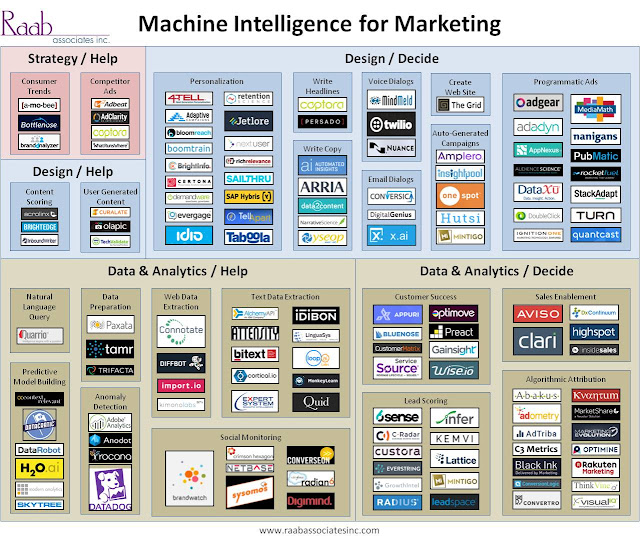 I wasn’t initially enthusiastic about the idea – could there by anything less original?—but have found the result surprisingly useful. In particular, it illustrates several points that would otherwise have been hidden or much harder to convey. These include:
I’ll draw some other lessons from this chart in my MarTech talk. You can still join us by registering here. In the meantime, I hope this chart helps you realize the scope of machine intelligence applications in marketing today and inspires you to explore more deeply how they can help in your own work.

- Lots of systems. You may think that machine intelligence is still a pretty rare thing. Not so. I found 23 categories with 140 systems, and know there are dozens of other products I could have included.
- Some categories are already crowded. Boxes with a lot of logos have a lot of competitors. This doesn’t make them mature in the sense of having a widely accepted standard approach. But it does mean that many people have recognized they are a successful use for machine intelligence. Conversely, categories with few competitors are more speculative – although a few strike me as pretty sure to succeed in the end.
- Few systems for marketing strategy. Some research I’ll cite at MarTech suggests that marketers split their time roughly equally between strategy and planning, program design and content creation, and data management and analytics. I’ve classified vendors into those categories. I then make a further distinction between systems that help marketers with decisions and systems that make decisions without marketer involvement. This distinction is very loose, but that’s a topic for another day. What’s immediately obvious is there are very few systems to do strategy and planning, and none of those are actually deciders. My take on this is that CMOs aren’t ready to delegate strategic decisions to machines, although another explanation is that CEOs aren’t ready to delegate marketing strategy to the CMOs.
- Decider systems for design. The design category is crowded with systems for the established applications of personalization and programmatic ad bidding. Perhaps more surprising, there is also a rapidly growing number of products to create contents such as copy, email dialogs, and even Web pages. Nearly all of these are deciders – perhaps because they work with volumes of choices so huge that only computers can handle them. Helper systems aren’t much use in those situations.
- All kinds of systems for data. This is the most populated area, with roughly half the categories and half the total vendors. It's also the group with the most vendors I didn’t include – for example, there are probably 100 social media monitoring systems alone, most of which use at least some basic machine intelligence for language processing. This group is about evenly split between helpers and deciders, reflecting the variety and complexity of data-related tasks. One reason this group is so large is that many of the applications, such as data extraction and predictive model building, are also used for purposes outside of marketing.
I’ll draw some other lessons from this chart in my MarTech talk. You can still join us by registering here. In the meantime, I hope this chart helps you realize the scope of machine intelligence applications in marketing today and inspires you to explore more deeply how they can help in your own work.
Subscribe to:
Posts (Atom)