One of the grand challenges facing marketing technology today is having a computer find the best messages to send each customer over time, instead of making marketers schedule the messages in advance. One roadblock has been that automated design requires predicting the long-term impact of each message: just selecting the message with the highest immediate value can reduce future income. This clearly requires optimizing against a metric like lifetime value. But that's really hard to predict.
Coherent Path offers what may be a solution. Using advanced math that I won’t pretend to understand*, they identify offers that lead customers towards higher long-term values. In concrete terms, this often means cross-selling into product categories the customer hasn’t yet purchased. While this isn’t a new tactic, Coherent Path improves it by identifying intermediary products (on the "path" to the target) that the customer is most likely to buy now. It can also optimize other variables such as the time between messages, price discounts, and the balance between long- and short-term results
Coherent Path clients usually start by optimizing their email programs, which offer a good mix of high volume and easy measurability. The approach is to define a promotion calendar, pick product themes for each promotion, and then select the best offers within each theme for each customer. “Themes” are important because they’re what Coherent Path calculates different customers might be interested in. The system relies on marketers to tell it what themes are associated with each product and message (that is, the system has no semantic analytics to do that automatically). But because Coherent Path can predict which customers might buy in which themes, it can suggest themes to include in future promotions.
Lest this seem like the blackest of magic, rest assured that Coherent Path bases its decisions on data. It starts with about two years’ of interactions for most clients, so it can see good sample of customers who have already completed a journey to high value status. Clients need at least several hundred products and preferably thousands. These products need to be grouped into categories so the system can find common patterns among the customer paths. Coherent Path automatically runs tests within promotions to further refine its ability to predict customer behaviors. Most clients also set aside a control group to compare Coherent Path results against customers managed outside the system. Coherent Path reports results such as 22% increase in email revenue and 10:1 return on investment – although of course your mileage may vary.
The system can manage other channels than email. Coherent Path says most of its clients move on to display ads, which are also relatively easy to target and measure. Web site offers usually come next.
Coherent Path was founded in 2012 and has been offering its current product for more than two years. Clients are mostly mid-size and large retailers, including Neiman Marcus, L.L. Bean, and Staples. Pricing starts around $10,000 per month.
_________________________________________________________________________
* Download their marketing explanation here or read an academic discussion here.
Showing posts with label optimization. Show all posts
Showing posts with label optimization. Show all posts
Wednesday, May 24, 2017


Saturday, May 20, 2017
Dynamic Yield Offers Flexible Omni-Channel Personalization
There are dozens of Web personalization tools available. All do roughly the same thing: look at data about a visitor, pick messages based on that data, and deploy those messages. So how do you tell them apart?
The differences fall along several dimensions. These include what data is available, how messages are chosen, which channels are supported, and how the system is implemented. Let’s look at how Dynamic Yield stacks up.
Data: Dynamic Yield can install its own Javascript tag to identify visitors and gather their information, or it can accept an API call with a visitor ID. It can also build profiles by ingesting data from email, CRM, mobile apps, or third party sources. It will stitch data together when the same personal identifier is used in different source systems, but it doesn’t do fuzzy or probabilistic cross-device matching. Data is ingested in real time, allowing the system to react to customer behaviors as they happen.
Message selection: this is probably where personalization systems vary the most. Dynamic Yield largely relies on users to define selection rules. Specifically, users create “experiences” that usually relate to a single position on a Web page or single message in another channel. Each experience has a list of associated promotions and each promotion has its own target audience, content, and related settings. When a visitor engages with an experience, the system finds the first promotion audience the visitor matches and delivers the related content.
This is a pretty basic approach and doesn’t necessarily deliver the best message to visitors who qualify for several audiences. But dynamic content rules, machine-learning, and automated recommendations can improve results by tailoring the final message to each individual. In addition, the system can test different messages within each promotion and optimize the results against a user-specified goal. This lets it send different messages to different segments within the audience.
Product recommendations are especially powerful. Dynamic Yield supports multiple recommendation rules, including similarity, bought together, most popular, user affinity, and recently viewed. One experience can return multiple products, with different products selected by different rules. In other words, the system present a combination of recommendations including some that are similar to the current product, some that are often purchased with it, and some that are most popular over all.
Channels: this is a particular strength for Dynamic Yield, which can personalize Web pages, emails, landing pages, mobile apps, mobile push, display ads, and offline channels. Most personalization options are available in most channels, although there are some exceptions: you can’t do multi-product recommendations within a display ad and system-hosted landing pages can’t include dynamic content.
Implementation: this also varies by channel. Web site personalization is especially flexible: the Javascript tag can read an existing Web page and either replace it entirely or create a version with a Dynamic Yield object inserted, without changing the page code itself. Users who do control the page code can insert a call the Dynamic Yield API. Email personalization can also be done by inserting an API call, which lets Dynamic Yield reselect the message each time the email is rendered. The system has direct integration with major ad servers and networks, letting it send targeting rules with different ad versions for each target.
Dynamic Yield’s multi-channel scope and easy deployment options will be appealing to many marketers. The company has more than 100 customers, primarily in ecommerce and media. Pricing is based on the number of unique user profiles managed and on system components. A small client might pay as little as $25,000 per year, although larger companies can pay much more.
Thursday, July 25, 2013
Marketo's Engagement Engine Simplifies Complex Marketing Automation Campaigns

It’s probably just as well that no vendor has ever built a system based on my design. But the good folks at Marketo have taken a step in that direction with their latest enhancement, which they call an “engagement program”. It has more than one step but does get away from the idea of a rigid, branching campaign flow. Instead, it is organized in terms of “streams” that contain pools of content. Once a customer is added to a stream, the system will offer the next piece of content whenever a contact is due according to the campaign cadence. What’s next is set by the order of content within the stream: users just drag content into the container and put on top the ones they want sent first. The system will go through the content in this order during each execution (which Marketo calls a “cast”), and send each person the first item they have not already received. This avoids duplicate messages and lets the system deliver a defined series of messages without explicitly setting up a sequence. It also makes it almost effortless to insert a high priority message that goes to everyone or to swap out contents as new materials become available.

As you’ll immediately notice, sending the next thing isn’t quite the same as sending the best next thing. In my ideal world, the content would be selected by calculating the value of each item for each individual and taking the highest. This would only take a small tweak in the current approach, which is one reason I like what Marketo has done. Marketo does in fact plan to apply predictive modeling to the system, although I think they're trying to find the most effective content sequence for all customers, rather than scoring content at the individual level.
There’s quite a bit more to the new Marketo feature than I’ve described so far. Content can actually be a multi-step program of its own, such as a sequence of messages to promote and manage a Webinar. Content can also have availability dates that are enforced automatically, so future messages can be added at any time and obsolete messages are automatically discontinued. One thing that’s missing is eligibility rules on content, to let users specify who is allowed to receive it. This is a key feature in traditional decision management systems, permitting customer-level customization within a fixed priority sequence. But Marketo users can achieve the same thing by embedding content within programs, which do have such rules, and adding the programs to the stream instead of the content itself. This is Marketo’s recommended approach because it also provides better data for reporting.
Users can further tailor treatments to customers by setting up multiple streams within one engagement program. Each stream has “transition rules” that pull in qualified customers from other streams. This is less rigid than having selection rules in one stream push customers to another stream. It's not quite clear what happens if someone qualifies for more than one stream: Marketo's position is that would only happen if you make a mistake. I think reality is not so tidy. Marketo is considering letting marketers prioritize the transitions based on the position of the streams, just as they prioritize contents within a stream.
In any event, customers can only be in one stream at a time, so they won’t receive multiple messages from the same engagement program. Whether they receive messages from multiple programs is controlled by Marketo’s standard communication limit features, which can set a maximum number of messages per day and per week. Users can decide whether those limits apply to any particular program. The system also lets salespeople or other programs pause messages from an engagement program to an individual customer.

The new package includes a good set of reports that track content usage and results. They also provide an “engagement score” that combines several success metrics into a single value. Other reports show how many people in the program have run out of content – a good way to ensure the company doesn’t lose touch with them. Surprisingly, there's no report on movement from one stream to the next. But Marketo says this can be set up using their revenue performance management module, which tracks movement of customers across other types of stages.
The engagement engine is included in all Marketo versions, although lower-level versions have some limits. Adding a more powerful version to the Standard edition of Marketo starts at $295 per month.
Added Thought: Marketo engagement programs are a type of state-based system, an idea that has been tried from time to time in marketing systems and is currently the basis of Whatsnexx. As the name implies, state-based systems assign customers to categories and then define treatment rules within each category. Unlike the sequential flow of a traditional multi-step campaign, customers in a state-based system remain in the same category so long as they meet its membership conditions. State-based systems typically reclassify all members at the start of each cycle, which is different from Marketo's approach of relying on transition rules to pull customers from one stream to the next. This means that someone could remain in a stream even though they no longer met its entry criteria. This is something Marketo might want to reconsider.
Thursday, February 21, 2013
VisualIQ Connects Attribution to Media Buys
As I threatened – I mean, promised – a couple of weeks ago, I’ll be writing about marketing measurement systems over the next month or two. The hottest topic within this segment is probably algorithmic attribution, which uses advanced statistics to calculate the incremental impact of each marketing contact on final results. Unlike marketing mix models, which work with aggregated data such as total TV spend per month, the algorithmic systems start with individual ad impressions. The systems build a history of impressions for each person, identify groups of people with similar histories, and then attribute different results to differences in those histories. For example, there might be two groups of people, one having received three impressions and the other having received the same three plus a fourth. Any difference in outcomes would be attributed to that fourth impression. The actual details are more complicated, but you get the idea.
The advantage of algorithmic attribution is it is based on actual data, rather than arbitrary fractional weights based on someone’s opinion. (I wrote a more detailed critique of fractional attribution back in 2010; I’m pleased to see that algorithmic attribution has become more common since then.) It goes without saying that algorithmic attribution makes more sense than assigning all value to either the first or last marketing touch.
VisualIQ was one of the pioneers of algorithmic attribution, dating back to its founding as Connexion.a in 2005. The company has grown rapidly in recent years. This reflects both greater market interest and, perhaps even more important, expansion of the product to connect directly with ad buying platforms. This makes it easier to convert the system’s findings into profitable marketing results.
Like other attribution systems, VisualIQ must start by assembling data about the client's advertising programs. The system gathers individual level data either by embedding its own pixel in Web ads, emails, and landing pages, or by importing impression history from other sources. It can stitch together impressions from several different sources to create a unified individual history. It can also import non-individual-level data, such as TV spend, weather, and competitive conditions.
The system can use this data to build two different types of models.
The IQ Envoy module builds “top down” models based on aggregate data; these are similar to traditional marketing mix models but also show the impact of one channel on another (for example, the effect of TV ads on direct mail response). This lets the system estimate the true net contribution to final results of spending in each channel.

Top down models are fairly customized, but Visual IQ has streamlined its process so it can build a new one in six to eight weeks, which is quick for a mix model. and make regular updates. Once the model is built, marketers can easily see the impact of different budget allocations by moving on-screen sliders. Constraints built into the model prevent users from creating scenarios that are unrealistic.
The IQ Sage module builds “bottoms up” models, which use individual-level data. Users can include real-world constraints such as minimum or maximum spend by channel and diminishing returns from higher spending levels. Once the parameters are set, the system generates a graph showing the best possible results for each spending level. Users can pick the level they prefer and have the system generate an optimal media plan. This can be exported to Excel for manual refinement. Or, users can send the plan directly to real time bidding platforms and online ad exchanges for automated execution.

VisualIQ has two additional modules. Insight IQ allows users to explore the data loaded into the system. This is important because marketers may have never seen it all loaded and correlated. Audience IQ shows the demographics of best customers and results for different segments.
As you might imagine, algorithmic attribution needs a large volume of data to build an effective model. VisualIQ has found that clients need an ad budget of at least $5 million per year. Those companies typically gain a 15 to 20% increase in media efficiency.
Cost for VisualIQ depends on the modules used, data volume, number of channels and other variables. Pricing for a system including IQ Sage and IQ Envoy starts around $150,000 per year.
The advantage of algorithmic attribution is it is based on actual data, rather than arbitrary fractional weights based on someone’s opinion. (I wrote a more detailed critique of fractional attribution back in 2010; I’m pleased to see that algorithmic attribution has become more common since then.) It goes without saying that algorithmic attribution makes more sense than assigning all value to either the first or last marketing touch.
VisualIQ was one of the pioneers of algorithmic attribution, dating back to its founding as Connexion.a in 2005. The company has grown rapidly in recent years. This reflects both greater market interest and, perhaps even more important, expansion of the product to connect directly with ad buying platforms. This makes it easier to convert the system’s findings into profitable marketing results.
Like other attribution systems, VisualIQ must start by assembling data about the client's advertising programs. The system gathers individual level data either by embedding its own pixel in Web ads, emails, and landing pages, or by importing impression history from other sources. It can stitch together impressions from several different sources to create a unified individual history. It can also import non-individual-level data, such as TV spend, weather, and competitive conditions.
The system can use this data to build two different types of models.
The IQ Envoy module builds “top down” models based on aggregate data; these are similar to traditional marketing mix models but also show the impact of one channel on another (for example, the effect of TV ads on direct mail response). This lets the system estimate the true net contribution to final results of spending in each channel.

The IQ Sage module builds “bottoms up” models, which use individual-level data. Users can include real-world constraints such as minimum or maximum spend by channel and diminishing returns from higher spending levels. Once the parameters are set, the system generates a graph showing the best possible results for each spending level. Users can pick the level they prefer and have the system generate an optimal media plan. This can be exported to Excel for manual refinement. Or, users can send the plan directly to real time bidding platforms and online ad exchanges for automated execution.

VisualIQ has two additional modules. Insight IQ allows users to explore the data loaded into the system. This is important because marketers may have never seen it all loaded and correlated. Audience IQ shows the demographics of best customers and results for different segments.
As you might imagine, algorithmic attribution needs a large volume of data to build an effective model. VisualIQ has found that clients need an ad budget of at least $5 million per year. Those companies typically gain a 15 to 20% increase in media efficiency.
Cost for VisualIQ depends on the modules used, data volume, number of channels and other variables. Pricing for a system including IQ Sage and IQ Envoy starts around $150,000 per year.
Monday, March 29, 2010
thinkAnalytics Helps Marketers Optimize Customer Treatments
Summary: thinkAnalytics provides a robust decision engine to help make optimal recommendations across channels. Too bad more people don't use it.
As I mentioned in my post on PegaSystems’ acquisition of Chordiant, I’ve been planning for months to write about the thinkAnalytics recommendation system. The delay had nothing to do with any reservations about the product, which I find extremely impressive. It was more because I've been giving the topic low priority because the market for such systems seems to be moving slowly despite the clear benefits they provide.
The history of thinkAnalytics itself illustrates my point nicely. The company was founded in 1996 to offer K.wiz data mining software and had reached pretty much its current form by the early 2000’s. Indeed, the briefing slides the company showed me in mid-2009 were nearly identical its slides from 2007. The company also reported about twenty installations in both sessions. This isn’t to say that product itself has not evolved: it’s now up to version 8.0 and release notes on the company Web site show a steady stream of enhancements. But the fundamental approach has not changed.
This approach uses an “Intelligent Enterprise Server” to connect company touchpoints and data sources to thinkAnalytics’ data mining, recommendations and business rules engines. That is, thinkAnalytics sits outside of the individual touchpoint systems, allowing it to deliver consistent recommendations across all channels. These recommendations in turn are based information from on all data sources, not only those captured within a particular touchpoint system.
The advantages of consistent treatment and access to all company are self-evident. Of course, they do require identifying individuals across channels, so that, say, behavior during Web visits is linked to behavior at a call center. thinkAnalytics doesn’t directly solve this problem, but can make use of whatever linkages the company has built elsewhere. Its most common applications, churn reduction for telecommuncations companies and content recommendations for video-on-demand services, are in situations where customers explicitly identify themselves, so this is not an issue.
The technical hub of thinkAnalytics is the enterprise server, which needs to handle traffic among touchpoints, data sources, and the analytical components. The main issues with such servers are flexibility and scalability. thinkAnalytics addresses these by deploying a component-based architecture that lets it connect with virtually any external systems and can easily be distributed across platforms and servers to scale as necessary. The company says existing installations have scaled to thousands of decisions per second. Its client list is weighted towards very large firms – Vodafone, Virgin Media, Sky, orange, Lloyds TSB, and Alcatel-Lucent among them – who require this sort of volume.
But while the server may be the technical hub of the system, its heart is the analytic components: data mining, recommendations and rules engines. Data mining includes a wide variety of predictive modeling and data visualization capabilities, some fully automated, which feed into the recommendations themselves. The system can also import external predictive models from vendors such as SAS and SPSS. The system includes several specialized capabilities related to video content selection, including automated text analysis to create metadata and classify new content; capture of user preference ratings; handling of social recommendations; maintenance of personal profiles; and user-initiated search. The component-based architecture makes it relatively easy for thinkAnalytics to add specialized features in general, so the system could be adopted to other applications fairly easily.
The rules engine complements the recommendation rankings by letting managers apply constraints such as limiting the number of recommendations within any particular category. However, the system doesn’t provide sophisticated optimization tools, so it’s still up to marketers to manually discover the most effective rule sets.
Although the multi-channel capability of thinkAnalytics is highly impressive, the vendor says that most clients start using it in a single channel and add others a year or two later. This suggests that clients are primarily interested in the quality of the recommendations, and just secondarily in the cross-channel treatment coordination. thinkAnalytics reports that its telecommuncations clients have seen churn rates of 20% drop to 12%, while video-on-demand clients have increased sales between 30% and 55%.
Pricing for thinkAnalytics real-time components depends on the nature of the application. Factors can include the channels and applications, number of data mining users, and customer volume. A minimum installation for the recommendation engine starts around $250,000. The system is licensed for on-premise operation by the client.
The four components of thinkAnalytics (predictive modeling, recommendations, rules and a server to connect with the outside world) make it the very model of what is sometimes called a “decision engine”. As I noted in the Chordiant post mentioned earlier, most companies use the decisioning capabilities built into their touchpoint systems rather than buying a stand-alone product. But it’s still worth keeping the model in mind when assessing whether your touchpoint systems’ capabilities are truly adequate.
Friday, March 12, 2010
Matching Social Media to Your Needs and Resources
Summary: Marketers face so many choices that just deciding what to test is a major challenge in itself. Here are some ways to match social media to your business objectives and resources.
 I’ll be giving a Webinar on March 23 (register here) with Neolane about cross channel marketing. At least that’s the official topic. In my mind, it’s really about helping marketers choose among the ever-increasing media options available today and in the future.
I won’t go into the details of the presentation, but thought I’d share this chart for selecting among social media.
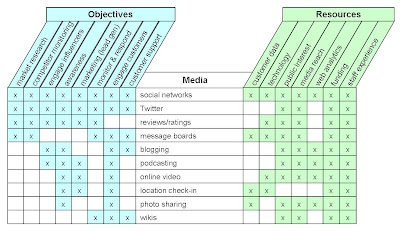 The chart makes two major points:
- different social media meet different business objectives. I suppose this is self-evident, but it still helps to think about this systematically when you’re trying to decide which to explore. As the chart indicates, most social media can in fact serve more than one objective. Incidentally, the chart lists the objectives in roughly the sequence of the customer life cycle, starting with market preparation activities at the left and moving through purchase and post-purchase support, which further helps you visualize where a particular project fits into your larger customer treatment strategy. You may disagree with particular details on this chart, but that’s less the point than thinking about putting each medium into a larger context.
- media must be matched to your resources. This is also pretty obvious, but, again, it’s easy to ignore it when considering your options. It's also worth pointing out that resources include more than data, technology and experience. My list also includes public interest in your topic and media reach (i.e., your firm’s ability to attract attention to its program, largely by paid advertising). Both make possible social programs that would otherwise fail because no one would participate. It's worth noting that funding can make up for shortfalls in other areas and that strengths in other areas reduce the need for funds.
An Example
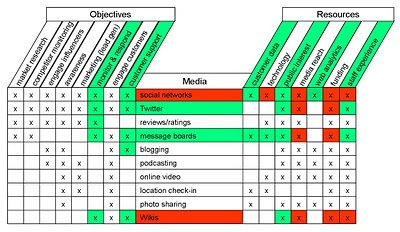
The table below gives a simple example of these ideas in action. It analyzes the situation of a hypothetical company facing a major product recall. Objectives in this case are “monitor and respond” to public opinion and provide “customer support” to previous buyers. Highlighting these shows that social networks, Twitter, message boards and Wikis are appropriate options. But let’s assume it’s a small company, with limited media reach and funding, and that it also lacks technology and experience for social networks and Wikis. This leaves Twitter and message boards as the best candidates -- Twitter because there's very little technology involved, and message boards because we assume that company has the necessary resources in place.
Although this example is limited to social media, the same approach can be applied to other media as well. Tune into the Webinar for more details.
 I’ll be giving a Webinar on March 23 (register here) with Neolane about cross channel marketing. At least that’s the official topic. In my mind, it’s really about helping marketers choose among the ever-increasing media options available today and in the future.
I won’t go into the details of the presentation, but thought I’d share this chart for selecting among social media.
 The chart makes two major points:
- different social media meet different business objectives. I suppose this is self-evident, but it still helps to think about this systematically when you’re trying to decide which to explore. As the chart indicates, most social media can in fact serve more than one objective. Incidentally, the chart lists the objectives in roughly the sequence of the customer life cycle, starting with market preparation activities at the left and moving through purchase and post-purchase support, which further helps you visualize where a particular project fits into your larger customer treatment strategy. You may disagree with particular details on this chart, but that’s less the point than thinking about putting each medium into a larger context.
- media must be matched to your resources. This is also pretty obvious, but, again, it’s easy to ignore it when considering your options. It's also worth pointing out that resources include more than data, technology and experience. My list also includes public interest in your topic and media reach (i.e., your firm’s ability to attract attention to its program, largely by paid advertising). Both make possible social programs that would otherwise fail because no one would participate. It's worth noting that funding can make up for shortfalls in other areas and that strengths in other areas reduce the need for funds.
An Example
The table below gives a simple example of these ideas in action. It analyzes the situation of a hypothetical company facing a major product recall. Objectives in this case are “monitor and respond” to public opinion and provide “customer support” to previous buyers. Highlighting these shows that social networks, Twitter, message boards and Wikis are appropriate options. But let’s assume it’s a small company, with limited media reach and funding, and that it also lacks technology and experience for social networks and Wikis. This leaves Twitter and message boards as the best candidates -- Twitter because there's very little technology involved, and message boards because we assume that company has the necessary resources in place.

Although this example is limited to social media, the same approach can be applied to other media as well. Tune into the Webinar for more details.
Tuesday, July 14, 2009
SiteCore Adds Analytics and Marketing To Web Content Management
Summary: SiteCore has added extensive analytical and marketing features to its Web content management system. The integrated analytics should save considerable effort for marketers. Channel-specific marketing automation is less appealing but should help to keep marketing automation vendors on their toes.
I commented last month that more Web content management system (CMS) vendors are adding marketing automation features. One of my examples was SiteCore, so I can’t point to them again as further proof of that assertion. But I did have a good talk last week with SiteCore VP Marketing Darren Guarnaccia, who clarified why this is happening and made a strong case for the integrated approach.
For those of you who (like me) are unfamiliar with SiteCore: it is an eight year old provider of Microsoft .NET-based Web content management systems, with over 1,600 mid-to-large sized customers running more than 20,000 dynamic Web sites including Sara Lee, Toshiba, Omni Hotels and Dollar Rent-a-Car/Thrifty. In other words, it is a substantial player in a crowded market.
According to Guarnaccia, the company has seen control over the CMS selection process steadily migrate from IT departments to marketers over the past four years. The trend is most pronounced at mid-sized firms, where IT is generally less powerful than at very large companies. During this time, it’s become clear that marketers need features that go beyond editing Web pages, to helping them do a better job of understanding and reacting to customers. SiteCore describes this as closing an “actionability chasm” between analytics and execution.
The chasm is created by the traditional approach of using analytical systems (often sold as externally hosted services) that are separate from the underlying content management system. Capturing detailed information with such systems involves much more than adding one code snippet to a shared page template. At a minimum, each page must be given its own ID and, more realistically, pages must be given multiple tags to facilitate analysis. Companies running several separate analytical systems may need several sets of tags.
The practical result of such an arrangement is that marketers and their Web teams quickly fall behind in their tagging, and end up with incomplete and unreliable analytics. Building analytics into the CMS allows users to avoid some tags altogether and makes it easier to reuse the rest. Integrated analytics also allow the system to track visitors with first-party cookies, which are less likely to be erased than the third-party cookies used by some stand-alone analytical products.
Integration also makes it easier to coordinate activities such as personalization, behavior-based targeting, and tests. The logic for these potentially overlapping functions can be all managed as part of one Web page definition, rather than separately.
For example, SiteCore supports lead scoring by assigning content scores (for technology, marketing, sales, pricing, tech support, etc.) to each Web page or, potentially, to components within a page. The lead score for each visitor’s interest in each category is the sum of the category scores for all the pages that person has visited. The same information can be used to identify the visitor’s business role or assign a persona.
The advantage of page-based scoring is that the scores adjust automatically to new Web contents. Otherwise, the company must rely on one team of workers to add new content and a separate team to incorporate the new content into the scoring rules.
Guarnaccia offered a Web site marketing maturity model that started with traffic statistics and extended to user experience statistics, content profiling, segmentation, conversion tracking, campaign management, sales enablement (using the IP address to identify visitor location and company), testing and optimization, and real time personalization. He said these are all present at no extra charge within the latest version of SiteCore, which was released at the end of June as the SiteCore Online Marketing Suite. An online demonstration confirmed they are indeed available, and at an impressively high level of sophistication.
SiteCore organizes these features around the individual Web pages. Attributes for each page include interest scores already mentioned, plus goals and other events that are logged to the visitor's history profile when the page is viewed. A page view can also trigger actions including test execution, personalization, data updates, parameter setting, sales alerts, and calls to external scripts. The system also captures the usual Web analytics data such as traffic volume, referring and exit pages, and on-site search terms. It can also use the visitor history to play back the sequence of pages viewed during a Web session.
This page-centric view of the world makes sense for a CMS vendor, but it's a pretty big switch from the campaign-centric view of most marketers and most marketing automation systems. In fact, the biggest objection to CMS-based marketing automation may be that it assumes everything is centered on the Web site.
Guarnaccia didn’t see it that way. He suggested that marketers will use separate systems for each channel. I think that SiteCore’s main goal is to replace stand-alone Web analytics and personalization systems, not to provide cross-channel marketing automation. Still, the company does plan move beyond Web marketing by adding outbound email campaigns in a few weeks. It will also support emails triggered by Web page visits.
My own take is that building analytics into the CMS makes sense, but I doubt marketers want new silos in the form of channel-specific marketing systems. If so, SiteCore’s marketing features will be most appealing to companies that interact with customers primarily through the Web. For those firms, the Web site could reasonably be the core customer management system. Systems for other channels then would connect with the Web database in the same way that auxiliary channels are (sometimes) now integrated with a central Customer Relationship Management (CRM) system.
The CMS-based model relates to other industry trends: integration between marketing automation and sales systems, and, more broadly, absorption of marketing automation into operational systems. For companies where the Web site is the primarily operational system, these are exactly the same thing. For companies where the Web and CRM are both important independent systems, marketing automation is an ally they may both wish to annex.
For now, though, SiteCore is working to cooperate with CRM rather than replace it. The system can scan IP address registries to identify a visitor’s geographic location and company, and then use the results to route leads, alert sales people, and aggregate data at the company level. SiteCore has built data synchronization for Salesforce.com and Microsoft Dynamics and will add other systems as clients request them. If further integration is needed, other systems can access the SiteCore databases directly.
This access is simplified because SiteCore is traditional on-premise software, not an externally hosted service. Pricing is based on the number of concurrent users and servers. A single server license starts as low as $15,000, although an average installation runs about $90,000. The vendor provides several days of classes, including about two days for marketing users.
The reasons for CMS vendors to add marketing automation functions are clear: to differentiate themselves and to capture budget now spent on analytical and marketing systems. It makes perfect sense for companies selecting a new CMS to prefer integrated analytics, and in some cases to add integrated marketing automation. It’s less likely that companies will discard an otherwise-satisfactory existing CMS just to get these features. But the normal replacement cycle runs three to five years, according to Guarnaccia, so it won't be long before most marketers find themselves with integrated analytical features and new marketing automation options. Even if marketers don't use all of those features, the possibility will encourage stand-alone marketing automation vendors to improve their own products to keep pace.
Subscribe to:
Posts (Atom)