Thursday, March 26, 2015

Terminus Offers Targeted Display Ads for B2B

Tuesday’s post on the Adobe Marketing Cloud illustrated the complexity of solutions that combine many marketing and advertising components. Despite my best efforts, and much cooperation from Adobe, I’m sure it still misses many nuances of how Adobe components do or don’t work together. Nor does it address the challenges that users face in making sense of it all. Coincidentally, yesterday's FierceCMO blog indirectly quotes Lenovo’s Michael Ballard on this very point: “Adobe is not a solution for everyone because it requires a lot of expertise and attention. To help the system run smoothly, Lenovo has both dedicated internal Adobe teams, as well as full-time support people on Adobe's payroll, which means the company spends equal amounts on both products and support services.” And Lenovo uses just only two of Adobe’s eight solutions.


For many smaller companies, a suite like Adobe, Oracle, IBM, Salesforce.com, SAS, or Teradata isn’t an option and would be overkill if it were. Those firms will generally do better with a simpler solution that was built as an integrated whole, such as a StrongView (recently reviewed here) or SiteCore (reviewed here not so recently).

But such integrated solutions are rarely comprehensive. This means that meeting a full range of needs requires connecting with external systems.  Some vendors do this better than others. A good foundational system also needs a robust customer database that can integrate data from all the channels, whether it supports them directly or via partners.

One area where partners are especially common is ad management. Although martech and adtech are on the path to merging into madtech, they’re still largely separate, especially outside the big enterprise suites. This means that integration has largely meant sharing audiences defined in a marketing automation system with demand side platforms (DSPs), so the DSPs can bid on audience members when they appear on ad networks. For B2B marketers, this has happened mostly through Demandbase and what was formerly Bizo (now part of LinkedIn). Vendemore (reviewed here) is another option.

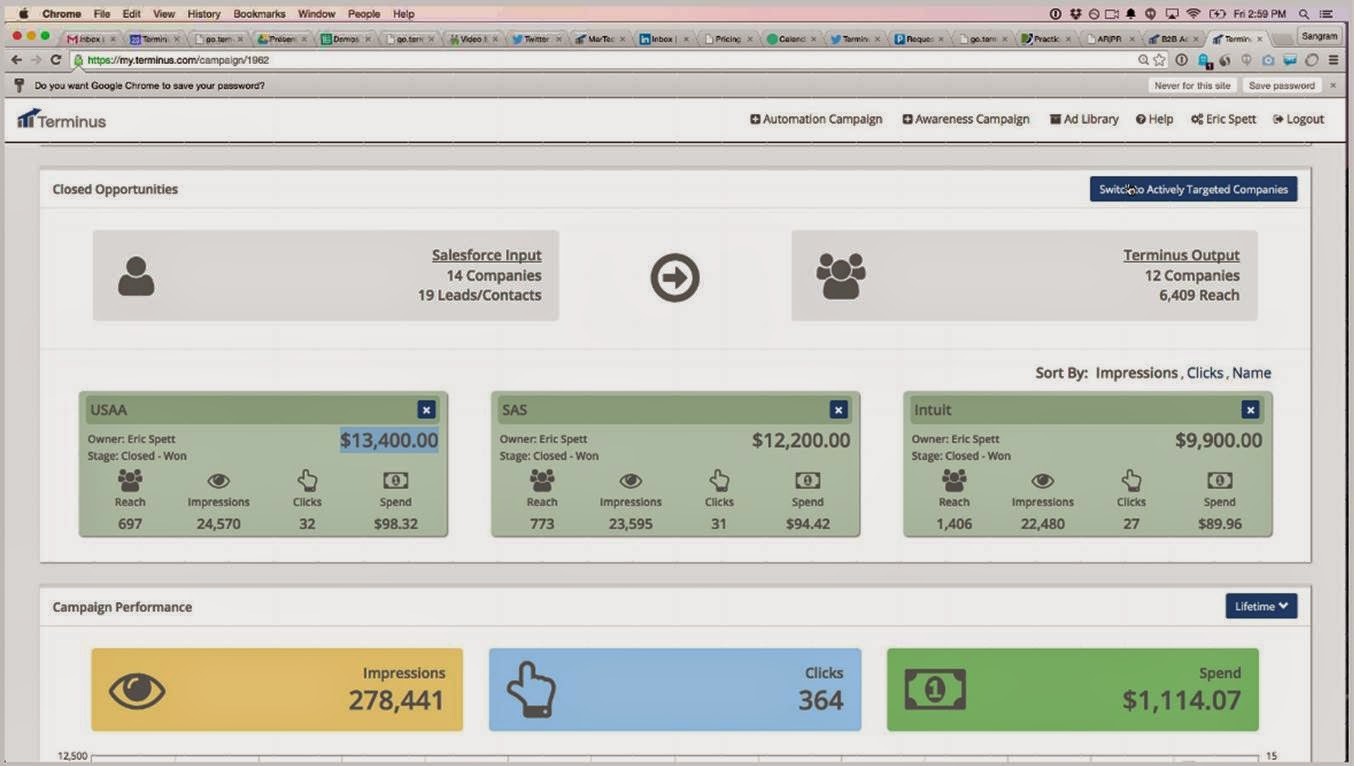
Terminus, which officially launched in February, is new alternative. The system imports lists of target accounts from a company’s CRM or marketing automation system, or lets clients build their own lists from Terminus’ own B2B company database. Users can then specify the corporate roles they want to target. Terminus uses third party data partners to identify cookies belonging to people in the specified roles at the selected companies and connects to ad exchanges, Facebook, and mobile apps to bid on them. The system automatically monitors response and optimizes its bids to get the best results within a company’s campaign budget.

Here are a few features to consider when comparing Terminus with other B2B advertising solutions:

- self-service. The system provides users with a multi-step process to import their data, select target segments, assign creative materials, set daily and/or total campaign budgets, define campaign end dates, and start executing campaigns. During campaign set-up, the system shows how many companies and contacts match the segmentation criteria within the imported CRM or marketing automation data and how many Terminus can find in its cookie pool.

- email-based targeting. Terminus selects cookies by using LiveRamp and other data partners to match them against email addresses from the CRM or marketing automation system. The company says this is more accurate than targeting based on IP address. (The company can also use its own database to reach people not in the clients' systems.)  Integration is currently available for Salesforce.com CRM, Marketo, and HubSpot, with plans to add Salesforce.com Pardot and Oracle Eloqua shortly.

- ad inventory.
Terminus currently integrates with well over fifty ad networks and exchanges. It is adding programmatic premium inventory and direct deals to the base programmatic impressions.

- sales stages. Terminus imports opportunity stage from the CRM system and can use this in segmentation. This lets it build separate campaigns to serve different creative to companies in different stages. But the system isn’t tracking messages to specific individuals, so it can’t avoid showing the same message multiple times to the same person.

- automated optimization. Terminus adjusts bids based on twenty variables such as ad size and time of day without asking marketers to make any decisions. Like most real time bidding systems, it typically aims to optimize click through rate or cost per click. The system will automatically serve alternative creatives and pick the best one; true a/b testing and reporting is planned for future release.

- reporting: the system shows spend, reach, impressions, and clicks for each account, giving marketers a precise view of how each account has been treated. Opportunity value can be imported to add return on investment analysis. Reports can be filtered by opportunity status, for example to show only closed deals. Reports can also summarize results by device, ad format, creative version, and other variables. Marketers can change creative from within the reporting screen if they spot something that isn’t performing well.

- pricing. Terminus charges a fixed platform fee and passes through the advertising expenses at cost. The company considers this among its most important innovations, compared with other firms that make their profit by marking up advertising expenses. The Terminus approach provides greater clarity and lets the company optimize its clients’ ad purchases without affecting its own profits. The platform fee is currently about $500 per month although Terminus expects to offer several tiers starting from $725 to $1,000 per month later this year.

Tuesday, March 24, 2015

Adobe Marketing Cloud Marches Towards Martech and Adtech Integration


At pretty much the same moment I was publishing my post on the merger of martech and adtech into madtech, Adobe was announcing its latest marketing products, including a press release on uniting “Data-driven Marketing and Ad Tech” . Naturally, this caught my attention.

As you might expect, Adobe’s reality is considerably more complicated than the simplicity of the “madtech” vision. Like the other enterprise software vendors who offer broad martech and adtech solutions, Adobe has built its marketing cloud by buying specialist systems. And, again like its competitors, it has only integrated them to a limited degree.

In Adobe’s case, the various products remain as distinct “solutions” served by a common set of “core services”. The current set of eight solutions includes Analytics (Web, video and mobile analytics, née Omniture Site Catalyst), Social (social publishing, based on Context Optional), Target (Web optimization and personalization, derived from Omniture Test & Target/Offermatica), Experience Manager (Web content management , originally Day Software), Media Optimizer (based on Efficient Frontier and Demdex), Campaign (formerly Neolane); Primetime (addressable TV) and Audience Manager (data management platform, formerly Demdex). Of course, the products have all been modified to some degree since their acquisitions.  But each still has its own data store, business logic and execution components.

Rather than replacing these components with common systems, Adobe has enabled a certain amount of sharing through its core services. In the case of customer data, the “profiles and audiences” core service maintains a common ID that is mapped to identities in the different solutions. This means that even though most customer data stays in the solutions’ own databases, the core service can use that data to build audience segments. There's also an option to load some attributes into the core services profiles themselves.   Audiences, which are lists of IDs, can either be defined in solutions and sent to the core service or built within the core service itself.  Either way, they can then be shared with other solutions. Data from external systems can also be imported to the core service in batch processes and used in segmentation.

Adobe says that data stored in the solutions can be accessed in real time.  I'm skeptical about performance of such queries, but the ability to store key attributes within the core service profiles should give marketers direct access when necessary.  There’s certainly a case to be made that digital volumes are so huge and change so quickly that it would be impractical to copy data from the solutions to a central database. Where external data is concerned, marketers will increasingly have no choice but to rely on distributed data access.

But here’s the catch: Adobe's approach only works if all your systems are actually tied into the central system. Adobe recognizes this and is working on it, but so far has only integrated five of its solutions with the profiles and audiences core service. These are Analytics, Target, Campaign, Audience Manager, and Media Optimizer. The rest will be added over time.

The second big limit to Adobe’s current approach is sharing with external systems. Only Adobe solutions can access other solutions’ data through core services. This makes it difficult to substitute an external product if you already have one in place for a particular function or don’t like Adobe’s solution.

Adobe does connect with non-Adobe systems through Audience Manager, its data management platform, which can exchange data with a company’s own CRM or operational databases, business partners, and external data pools and ad networks. Audience Manager can hold vast amounts of detailed data, but does not store personally identifiable information such as names or email addresses. Audience Manager can also copy Web behavior information directly from Analytics, the one instance (so far as I know) where detailed data is shared between Adobe solutions.


So far, I’ve only been discussing data integration. The various Adobe components also have their own tools for segmentation, decision logic, content creation, and other functions. These are also slowly converging across products: for example, there is an “assets” core service that provides a central asset library whose components can be uploaded to at least some of the individual solutions. The segmentation interface is also being standardized product-by-product. There’s no point in trying to list exactly what is and isn't standard today, since this will only change over time.

The lesson here is that suites are not simple. Marketers considering Adobe or any other Marketing Cloud need to examine the details of the architectures, integration, and consistency among the components they plan on using. The differences can be subtle and the vendors often don’t explain them very clearly. But it pays to dig in: the answers have a big impact on whether the system you choose will deliver the results you expect.

Thursday, March 19, 2015

Everstring Offers Fast, Flexible, Account-based Predictive Models for B2B Sales and Marketing

Remember how much simpler life was back in 2010? Among our quaint notions, we thought that B2B companies couldn’t build predictive models because they didn’t have enough data about their customers and prospects. The Internet has changed that, providing oceans of relevant detail from company Web sites, social media, job boards, and other sources. Today, at least a dozen vendors are offering predictive models for B2B lead scoring, sales intelligence, and customer success management.

Many of the original scoring vendors specialized in a single application.  But today, most are broadening their products to serve multiple purposes. This lets the vendor charge more to each client and blocks out potential competitors. Marketers also benefit since they only have to buy, learn, and integrate a single system.

Everstring is relative newcomer to the B2B predictive modeling arena, founded in 2012 but only seriously entering the market after it received $12 million in Series A funding last August. The late start has let it adopt a broader scope from the beginning, offering both lead scoring and new prospect identification. The company plans to extend its offerings later this year to include real-time treatment recommendations.

But what really sets Everstring apart are two other factors: it works at the account rather than individual level, and it builds models really, really fast – as in, six minutes for a new model once data connections are in place. The two factors are related: Everstring can work quickly because it only imports a client’s account list and sales activities, saving complicated data mapping and analysis, and because it has preclassified its master database of six million U.S. businesses into clusters based on similarities in products, technologies used, hiring patterns, news events, social data, and other factors. This means that building a new model only requires using activity history to identify the client’s responsive accounts and finding which segments have the highest concentrations of those accounts.

That’s pretty light work compared with loading individual level data and identifying which attributes are most predictive for each client’s business. Matching against six million companies rather than 100 million individuals speeds things up too. The approach also lets clients score anonymous leads if IP address or similar information can identify their company. Models for different products can be based built by selecting only accounts that purchased that product.

Once a model is built, Everstring can score any new leads by just by identifying the segment their company belongs to and applying that segment’s score. Lists of new prospects require simply taking names from the highest-scoring segments.

Sounds pretty simple, eh? That’s because I’ve over-simplified. The data gathering and actual math are actually quite complicated.  Beyond that, Everstring does more than provide segment scores, which  measure the fit between a new account and the client’s previously responsive prospects. Specifically, it also measures purchase intent by based on more than 1 billion clicks per day on third party Web sites and emails. And it measures engagement by analyzing visitor behaviors on the client’s own Web site, gathered through a tracking pixel, plus other data imported from marketing automation. The combination of fit, intent, and engagement will guide the real-time treatment recommendations and can support additional scoring applications.  Fit scores alone are much more limited..

So, how do you deploy all this? Everstring has standard integrations with Salesforce.com, Marketo and Oracle Eloqua, which can send data for the initial model building and score new accounts as they are added to those systems. A real-time API can integrate with other CRM and marketing automation systems.

Pricing for Everstring is based on the types of models and volume. Lead scoring usually runs from $60,000 to $100,000 per year. New prospect names is additional. Pricing for real-time message selection isn’t yet set. The system currently has about 25 clients, nearly all added since last August.


Monday, March 09, 2015

Marketing Technology of the Future: Beyond the Customer Data Platform


The last three minutes of my MarTech Conference presentation are driving me crazy.

The preceding portions cover the current state of Customer Data Platforms. I have no trouble talking about that. But it somehow got into my head that the last section should look at how CDPs will fit into the long-term future of marketing technology. I have some fuzzy notions that this future martech will be radically different from today.  But to cover it succinctly I must first think it through in detail. That has been considerably harder than I expected. Here’s what I have so far.

Current Trends

These are developments happening now that will provide the context for industry changes. Some will be the topic of other MarTech presentations.

• Convergence of Adtech with Martech. These have until recently been largely separate: Adtech deals with messages to audiences whose members may share common characteristics but are not individually identified. Martech deals with known individuals. As anonymity becomes increasingly unavailable, marketers will know exactly who is receiving their advertising messages. Martech targeting techniques will therefore be used in adtech as well. Conversely, some adtech features will become standard martech practice.  More about that later.

• Contextual data. Social networks, mobile devices including phones and wearables, and the Internet of Things will provide ever-more details about the precise situation of each customer during each interaction.  Location is an obvious data point, but marketers will also know your local weather, your mood and physical condition, what you’re wearing, when and what you last ate, and whether your car needs gas. This may sound seriously creepy but the good news is you’ll get better-targeted messages.  I’d love to call this “contextual marketing” but that term is taken.

• Marketing to machines. I’m not talking about marketing with machine-generated data (e.g., your running shoes telling Nike how many miles you’ve logged) or marketing through messages on your machine (your washer suggesting you buy Tide-brand detergent).  I’m talking marketing to machines that are making purchase decisions on their own.  I discussed this last year in Do Self-Driving Cars Pick Their Own Gas Stations? and More on Marketing To Things.  Frankly, I've been surprised to see little else written on the topic. Trust me, this will be big: imagine convincing Siri to recommend your restaurant every time someone asks where they should go to lunch.

Implications for Martech

Given the trends I’ve just listed, I see martech changing significantly.

• Data synergy. I just made that term up but the idea is old: related bits of data are worth more when they’re combined. So knowing you just booked a trip to Alaska and knowing you just walked into a department store are each marginally useful by themselves, but together they let you offer me a great deal on a warm coat. It helps even more if I know you don’t already have one. The implication of this is that there’s a lot of value gained from combining data from different sources into shared repositories. It also implies there’s a lot of value in “identity association” technologies that link related data to the same person.  If you've been wondering why companies like Oracle, Acxiom, and Nielsen have been buying big data aggregators, you can stop.

• Everything is biddable. Another implication of data synergy is that each opportunity to communicate with an individual will be much more valuable to some people than others. Let’s stick with that Alaska trip: selling you a coat might be worth less than selling you a hotel room. So, when you walk into the store, the hotel chain might be willing to pay more for the chance to send you a message than the store itself. Having all the messaging devices connected to a central database and bidding system makes this possible – in fact, it already happens with real time bidding on Web ads. Now Martech platforms get to do the same. And oh, to make this work well, Martech has to hugely improve its ability to measure the actual impact of each message – so advanced, predictive attribution also plays a leading role in the martech world of the tomorrow.

• Campaigns are dead but the customer journey lives on. If each interaction is bid separately, then the notion of campaigns that lead the customer through a sequence of contacts on a flow chart is irrelevant. Honestly, I’m glad to see it go: the very first campaign management system I saw, more than twenty years ago, had exactly that sort of interface and it’s well past time for a change. But this doesn’t mean we can stop thinking about customer journeys. Any model that supports bidding on individual messages must understand where each customer is in her journey and how the message will influence the result.  Of course, different marketers will be tracking different journeys.

• Automation takes over. It’s obvious that mass data consolidation, real time bidding, optimized messaging, and omnichannel execution require near-total automation of the entire process. This has to be really intelligent automation that finds patterns, notices when they change, and optimizes treatments with minimal human guidance. And where will all that highly tailored content come from? You guessed it: automated content creation systems, which are more common and further advanced than you may realize. See Paul Roetzer’s recent post on artificial intelligence in marketing automation for an introduction to the topic  and watch Humans Need Not Apply if you want to get really scared.

• Machines buy martech. If the over-all trend is machines selling to other machines, why should  martech be left out? In fact, testing the huge number of new martech options (or even generating Scott Brinker's martech landscape supergraphic) is something machines could do really well. Once suitably open architectures are in place, it should be easy to plug in new components like a better predictive modeling system, new type of video promotion, or the latest social media app. Even if those components are less than fully automated, they could be identified, screened, integrated, and assessed with minimal human intervention.  Machines would almost surely assess results better than humans, since they’d be more objective and better able to look for subtle effects on customer behavior than human analysts.

• Humans keep things running. It’s possible that machines will eventually control every aspect of our marketing.  But I think humans will have a role to play at least for a while. This won’t necessarily be the traditional “creative” work such as copywriting and design, which machines already do better than we care to admit. But they’ll still need people to come up with non-incremental products, non-obvious insights, and deals with other organizations. Even things that machines could do better than people won’t be wholly machine-run for a while, just due to the normal lags in technology and organizational development. This may sound like a dark view of humanity’s future, but I’m more optimistic than it seems. Technology never works quite as well as promised, so I figure humans will still be needed to keep things running.

Implications for Marketers

If Martech moves in the directions I’m proposing, marketers need to do certain things to prepare.

• Expect imperfection. Sure we’ll have vastly more data than ever, but don’t assume it will be perfectly complete, accurate, or integrated. In fact, you can guarantee it won't.  Predictive models make mistakes as well. Look for systems that are designed to accommodate incomplete information, check for differences between actual and expected performance, and adapt gracefully to failures. Above all, demand transparency so you can see what the automated systems are doing and have some idea of why. This will probably require help from other systems, but make sure the monitors are as independent as possible so they’re not fooled by shared mistakes. If you’re really feeling clever, examine imperfections for opportunities – you may find bargains in bidding on messages to customers that other systems have rejected because their data is unavailable or contradictory.

• Plan for change. As anyone who has tried to modify a complex campaign workflow already knows, sophisticated systems can be brittle. High performance automated systems are likely to optimize themselves for specific conditions, which is great until those conditions change. Be sure you can easily introduce new data sources, components, objectives, and execution channels. And be sure you can always revert to a simpler, more manual mode of operation if things really go bad.

• Focus on the analytics layer.  One implication of data synergy is that the richest databases will live outside of your company’s own data center: they’ll be too big, too complicated, and updated too frequently to maintain a copy in-house. Similarly, if companies are bidding to deliver messages everywhere a customer appears, they won’t own the touchpoints. So the only piece the company can expect to own is the analytical layer – the bidding and content engines. Those engines should be freely swappable as well. What’s left to hold things together is a core of profile data shared by the analytical and content engines. This is connected to the external data store on one end and the touchpoint systems on the other. All told, it’s a rather wispy little framework, but it should be enough to provide the glue needed to link all the other components.

So, where does that leave us?  Gigantic external data pools linked to personal identities, real time bidding, messages delivered through paid channels: it's "adtech without the privacy" if you want to put it in a nutshell.  That isn't where I expected to end up, but that's exactly why I needed to write this. I can’t guarantee I won’t change my mind after further reflection, but for now I think this gives a reasonable picture of what martech might look like five or ten years from now.  In the shorter term, I still expect the central role will be played by Customer Data Platforms or (more likely) by Marketing Platforms that combine the data parts of a CDP with a multi-purpose analytical and decision layer.

Now all I have to do is figure out how to cram this into three minutes. 

...hmm...

On further reflection, it comes down to a hybrid of martech plus adtech, which is inevitably named madtech:


Monday, March 02, 2015

Reborn AutoPilot Aims to Simplify Multi-Channel Marketing

Autopilot*, formerly AutopilotHQ and Bislr before that, relaunched itself today. I wrote about Bislr in November 2013.  Back then, they positioned themselves as a “marketing operating system” that provided core functions but would ultimately let users connect with third party apps. The latest incarnation describes itself as “software for multi-channel marketing” but still provides core functions and connects with third party apps.  So what has changed?


The difference is in the details. AutoPilot has spent much of the past 18 months making the system easier to use and now has handful of actual integrations available. These include Salesforce.com for CRM, InsideView and FullContact for data enhancement, Twilio for text messaging, Lob for postcards, Segment for event tracking, and GoodData for reporting. Email and landing pages are still native to the product but the vendor has added tools to import, edit, and reuse HTML from external Web sites and email systems. This allows marketers to adopt Autopilot without discarding their current tools, easing the transition.

If there’s a substantive difference between the earlier Autopilot vision and the latest edition, it’s that the vendor spoke in 2013 of making it easy to build custom apps for Autopilot, while today they speak of integrating with existing best-of-breed systems. The current approach makes Autopilot easier to adopt although it also reduces the difference between Autopilot and other “marketing platforms” that have their own app stores.

But from Autopilot’s own perspective, its real differentiator is simplicity. It sees itself as filling the gap between simple email systems and enterprise marketing automation products. That space is plenty crowded, although Autopilot may be a bit easier to use than most of its competitors. The drag-and-drop campaign builder is attractive; more important, actions in external apps appear as icons, making them as accessible the vendor's own features.  Autopilot also provides a library of prebuilt campaign “guidebooks” that give new users an easy way to get started. The library is expected to grow as Autopilot users contribute their own guidebooks to the list.

The company’s other differentiator is a seriously aggressive pricing model.  This starts at $4 per month (you read that right) for up to 500 names in the database. A more realistic 10,000 contacts is still just $160 per month including unlimited email.  In comparison, mid-market stalwart Act-On charges $1,150 per month for 10,000 names. The vendor expects to survive at such low prices by minimizing sales and support costs, allowing almost total self-service in both areas. (There’s no phone support although users can submit questions by email during West Coast business or look in the community forums and knowledgebase.)  Whether this can satisfy new small business users remains to be seen.

I know you're wondering by now whether I’ll classify AutoPilot as a Customer Data Platform. (Rumor has it, there’s a drinking game that involves reading my blog posts aloud and taking a shot every time the phrase comes up. Get a life, people.) In fact, I do not: AutoPilot doesn’t do the complex data management a CDP requires. But the system does integrate with Segment, an expanded tag management system that qualifies as a CDP quite nicely. So you might consider AutoPilot as part of a complete CDP package.

AutoPilot was founded in 2011 and introduced the first version of its system in 2013. The company has accrued more than 100 clients, Most are small businesses but some are bigger.


_______________________________________________________________________
* The Web site is www.autopilothq.com. The domain autopilot.com belongs to a firm selling salt chlorine generators. So far as I know, there’s no connection.

Wednesday, February 25, 2015

Will New Marketing Automation Tools Let Sales Climb Back Up The Funnel?

Trends are signposts to the future: they point to where we’re headed. But the signposts are unreliable because trends are often interrupted – the classic example being the “Great Horse Manure Crisis of 1894”, when experts predicted that major cities would soon be buried beneath horse droppings. I’m beginning to suspect the much-cited trend of marketing playing a larger role deeper into the sales funnel has reached a similar peak. If the pendulum is really swinging the other way, then sales people will be taking a more active role earlier in the buying process.

This particular thought emerged quite unexpectedly during a vendor briefing yesterday. The talk had turned to the industry in general and I was ticking through my usual list of trends – external data, predictive modeling, sales enablement, advanced attribution, adtech and martech integration, local/partner marketing systems, all-in-one systems, content creation support, and of course customer data platforms. But I also had in mind another system I had just seen, MDCDOT, which gives marketing automation functions to sales people. For some reason, I suddenly saw a connection of this to external data: if vendors like NetProspex and InsideView could provide sales people with prospects and vendors like MDC provide tools to nurture those prospects, then sales people really don’t need marketing to do either of those things. Sales could then push marketing back to its traditional narrow role of generating promotional materials and doing research. That's pendulum swinging with a vengeance.

Once an idea like that pops up, supporting arguments quickly fall into place.  Integration of advertising with marketing technology potentially gives sales people another route for generating their own prospects. Advanced data enhancement and lead scoring make it easier for sales people to automate lead nurture processes without becoming marketing automation experts. All-in-one systems and customer data platforms both unify marketing and CRM technologies, making it easier to shift boundaries between marketing and sales responsibilities.  Those shifts could be permanent or vary dynamically based on fluctuations in needs, resources, and individual interests. Sales enablement tools like Velocify and Clari help salespeople pick the right treatment for each prospect, which can include sending them to automated campaigns.

In short, the conditions may be ripe for a counter-revolution: a sort of Terminator 2-style conversion where some machines defend the humans instead of trying to replace them. It even dawns on me that having marketers restrict their focus to content creation has some advantages, given how much more content is needed these days.

Let me be clear: this is a shiny new idea which could quickly lose its luster. It only applies in B2B and considered-purchase B2C relationships where actual salespeople are involved in the buying process. And it may be that most salespeople are happy to let marketers handle the lead generation and nurturing, which they never enjoyed in the first place. Or perhaps corporate management will decide it’s more effective and safer for marketing to handle those tasks, regardless of what sales people want.

On the other hand, sales departments are usually much larger, more powerful, and better funded than marketing departments, so it could be in the marketing automation vendors’ interest to serve sales people directly. This leads to the long-expected assimilation of marketing automation into CRM, a trend that has never quite happened but might finally take place.

Or maybe the future is really about machines selling to other machines, and the whole distinction between sales and marketing will no longer matter. Only time will tell. In the meantime, bear in mind that you never know whether a signpost is correct until you’ve passed it.*
__________________________________________________________________________________________
*I don’t know what that means, either, but it sounds pretty deep, don’t you think? I can definitely see the motivational poster.

Thursday, February 19, 2015

Ensighten Transforms Web Tags into Rich Customer Data


Looking back once more at last month’s post on the future of marketing data, you may recall that I briefly mentioned the intriguing rise of Web tag management systems as platforms to integrate customer data. Tealium highlighted the topic on Tuesday with $30.7 million in new funding, bringing the total to $77.9 million to support its stated mission of “capturing and serving up real-time, 360-degree customer insight to all of their [customers’] enterprise applications.” Sounds like a Customer Data Platform to me.


But I'll get back to Tealium some other time.  Today I'm writing about Ensighten, another major player in the tag management space, and one that is also pursuing a much grander vision: to be an “open marketing platform” that lets clients build a “custom marketing cloud”.

If origin stories count, and I think they do, then it’s worth noting that Ensighten’s started in 2009 as a digital analytics agency. Frustrated by the limits that traditional tagging methods placed on clients’ ability to move quickly, the firm developed an engine to generate custom sets of tags for each Web site visitor. This differs from the more common approach of serving one container that holds all possible tags.  (The problem both solutions address is that many Web pages contain a large number of tags from different systems; tag managers consolidate those tags so load more efficiently and are easier to control.) Ensighten’s method meant that only the tags that would actually fire for a particular visitor were loaded, while a container serves all tags and lets the Web page figure out which to fire. Ensighten studies have found it reduces page load time by 40% and tag deployment time by 75%.

Whatever the relative merits of Ensighten’s approach to tag management, the company’s focus today is on the data itself.  In particular, Ensighten wants to ensure data from the tags is available for the client’s own use. This regains control that is lost when partners place their own tags on company Web pages and don’t necessarily share the resulting information.

As I’m sure you see coming, Ensighten’s next step is to assemble the tag data into detailed individual profiles for personalization, testing, attribution, and other purposes. Ensighten added these capabilites a year ago, just after taking a $40 million investment (bringing its own total to $55.5 million if you're keeping score). These features go beyond Web page tags to capture data from mobile apps, from ad pixels served on external Web sites, and from other systems via batch data imports. They also include processes to merge profiles using customer IDs, cross-reference tables for IDs from different systems, probabilistic matching of shared data elements, correlated behaviors, and links between individuals and devices.  This kind of identity association is arguably the hardest part of building an effective customer database and many systems don't do it.

Ensighten can deliver rule-driven personalized messages along with the custom page tags. It also provides services including Web site performance monitoring and privacy management and will apply machine learning to personalization and recommendations later this year.  But such applications are peripheral to the company’s long-term strategy of letting external systems use the data for their own purposes.  This is what puts the  “open” in “open marketing platform” and the “custom” in “custom marketing cloud”.

This approach means the company’s real competitors are other marketing suites and customer data management systems. Since last year’s funding, Ensighten has supported its strategy with acquisitions of tag management competitor TagMan in March 2014 and cloud analytics and predictive marketing vendor Anametrix in October 2014.  The TagMan deal put Ensighten's foot inside many new corporate doors, while Anametrix provided advanced technology for customer database management and analytics.

So far, it all seems to be working. Ensighten reported 150% revenue growth last year and says it now has “a few hundred” global clients, mostly very large enterprises. Pricing is based on volume, which could be Web traffic or audience size depending on the situation. The company doesn't release details but this is enteprise software: you can safely assume it’s not cheap.

I’ll end where I started: what Ensighten (and Tealium and others) are doing is remarkably clever: take a mundane service (tag management) that places them in a strategic position (touching all digital interactions) and use it to build a strategic service. Their starting point gives them a shorter path to building a company’s primary customer database than applications like lead scoring or customer success management, which must create new data flows before they can build the database they need to support their service.  The tag management vendors' position also lets them give equal access to all applications without worrying about competition with their own application services. And, from a purely practical stand point, it also gives them an initial relationship with many potential clients. This advantage alone is probably why Ensighten has so many more clients than the “pure play” CDP vendors Aginity or NGData I wrote about earlier this week.

Of course, the tag managers' success is not guaranteed. Building an integrated, persistent customer database is quite different from managing Web tags.  But it's always a good thing when marketers have more options.  Companies looking for help in building their core customer database should definitely take a look in the tag managers’ direction.


Tuesday, February 17, 2015

NGData Gives Enterprise Marketers a Customer Data Platform of Their Own

If you read my recent post on Customer Data Platforms Revisited very, very closely, you might have noticed it listed a category of data vendors who “store unified profiles and expose to other systems”, which is pretty much the core definition of a Customer Data Platform. You would also have noticed that category had only two members, Aginity and NGData. I reviewed Agnity back in November 2013 and when I spoke with them more recently, found they were still doing pretty much the same thing and growing nicely. But, until today, I’ve never discussed NGData.


I wish I could come up with a really cool reason for that, but it’s only because NGData just recently came to my attention. The company itself has been serving clients in late 2012. As my classification suggests, they are in the business of assembling client data from multiple systems, using it to build detailed customer profiles, and making the results available to execution systems like campaign management, call centers, Web sites, and mobile apps.

The technology involved is Hadoop as the primary data store and HBase to expose the profiles to external systems. Data is unified mostly with customer IDs supplied by the source systems, although NGData can also build cross reference tables to associate related IDs and do some probabilistic matching to link related devices. The profiles include both raw data and calculated metrics such as trends, exceptions, signals, affinities, predictions of fraud risk, churn likelihood, and next product to buy.  The predictions can be based on conventional predictive methods like regression or on integrated machine learning. Often the company is able to use regression models that the client has built already for other data sources. The base version of the company’s system, called Lily Enterprise, has about 700 such metrics, and clients can add their own. (There’s also an open source version of Lily, which has only the data management components of Lily Enterprise.)  External systems access profiles via SQL queries against HBase, API calls, or file transfers.

This may all sound pretty straightforward and should be familiar to readers of this blog. But out there is the real world, most companies are still struggling with the challenges of assembling customer data and making it accessible.  Those firms will find this is pretty novel stuff. NGData stresses its ability to easily add new data sources and to retain huge amounts of detail, something it inherits from Hadoop. Complex metrics like exceptions and trends are also relatively unusual.  They make it much easier for execution systems to act intelligently, since the hard work of surfacing opportunities and selecting responses is largely done in advance.  Predefining those metrics as part of the base system speeds initial deployment.   One proof point: NGData says clients can typically start running programs based on its system in four to five months, and sometimes as quickly as three months. Conventional data warehouse projects usually take more than one year and many are never delivered.*

NGData stresses that marketers get better results when they can look at all the data associated with each individual, rather than treating people as members of broad segments. Again, no reader of this blog will disagree.  But I did still like their example of using behaviors to identify people who are likely to call customer support with a particular problem, and then preempting those calls with personalized messages about how to solve the problem. Everybody wins: the customer appreciates the proactive service, and company fields fewer phone calls. The underlying point, which NGData stresses often, is that they're going beyond insight to producing an actionable result.

NGData also highlights the value of responding to customer behaviors in real time or near real time.  It can do this because it immediately updates its metrics in Hbase whenever it receives new information. Still is more old news, but conventional solutions often update their scores and recommendations nightly or even less often. To be fair, NGData can only update in real time if the source systems are providing immediate updates – which often isn't the case.  The vendor does have its own Web tags to capture real time information about Web visits, which lets it use in-session behavior to drive product and page recommendations.

The one thing you may not expect about Lily is that it’s old-style on-premise software, not software-as-a-service. That’s mostly because current clients are big companies in financial services, telecommunications, and media, industries that have been reluctant to let precious company data outside their walls (although plenty of hackers still manage to get it, he added snarkily). It’s also not clear how much SaaS would benefit NGData, since each client’s data store would remain separate in any case and the software needs to be installed on relatively few desktops. For what it's worth, Aginity is also on-premise and also serves primarily enterprise clients. 

I suspect it's no coincidence that the two "pure" Customer Data Platform vendors both focus on enterprises.  Smaller firms need to justify a CDP by combining it with a specific application, but big companies can afford a separate CDP project that they'll later tie to separate execution systems.  Perhaps this will change as CDPs get cheaper, the model is better understood, and integration with execution systems becomes easier.

NGData has about 25 current paying clients in Europe and the U.S. Pricing is based on volume of data and/or number of customers. Total cost for software and services starts around $150,000 to $200,000 and can go much higher. As I said, this is enterprise software.

________________________________________________________________________________
*This is one of those things that “everybody knows” but few cab document. Here’s one paper that says data warehouses “usually” take 12 to 36 months, cost $1 to $1.5 million, and have a 70% failure rate. It’s not clear where the author got his data but it all sounds about right.


Thursday, February 05, 2015

VEST Report: Latest Trends in Marketing Automation, and Where's My Hoverboard?

I just finished the latest release of the B2B Marketing Automation Vendor Selection Tool, a.k.a. VEST Report. The new version includes a big technical change: instead of the interactive Flash document that was very cool but people often had trouble running, it’s now a combination of PDF for the core document and Excel spreadsheet for the detailed vendor scores. That’s a technical step backwards but will actually make it easier for buyers to access the detailed vendor information, and in particular to screen for vendors with particular capabilities. Less is more, I suppose. The good news is that this format lets me expand beyond 25 vendors, which was the maximum the old system allowed before running out of memory.

Of course, none of this is your concern, Dear Reader. What’s you'll find more interesting is that the VEST provides an opportunity to see new patterns emerging in the industry. Usually I do this by taking a close look at which features have become more common since the last report. But this time there were a few more obvious changes that stood out. Here’s what struck me.

- more micro-business vendors. All six of the vendors new to this report sell primarily to small businesses, and most are “all-in-one” systems that combine marketing automation with integrated CRM. They join another six vendors from previous editions who also serve this market. I'm also aware of several other vendors, not yet in the VEST, who also compete for this business. Many of these firms are new while others have been around for a few years but just hit my radar. What this says to me is that the all-in-one segment is more crowded and more mature than it has seemed. Of course, there’s still a huge opportunity – hundreds of thousands if not millions of potential clients have yet to buy their first system. But anyone planning to enter this business had better realize they will be fighting for new customers.*

- agency relationships. It seems that just about every vendor in the VEST now touts special features to support marketing agencies that resell the system to their clients or operate the system on the clients’ behalf. This isn’t exactly new but what once seemed like a niche strategy now looks more like a standard approach. It’s always been obvious that agencies were a sensible channel for marketing automation vendors to pursue, but I’m beginning to wonder whether agencies might turn out to be the primary channel for such systems, excepting only direct sales to large enterprises. If this happens, the reason will be that agencies provide the missing skills that have prevented so many companies from taking full advantage of marketing automation systems by themselves. Vendors have been knocking themselves out for the past five years trying to educate marketers to run their systems.  Perhaps having agencies run them is the real solution instead.

- social data. Maybe my biggest surprise was finding that many if not most vendors have now added features to automatically look up new contacts in social networks and add that data to their marketing automation or CRM profile. This seemed like magic three years ago when I first saw John Ferrara's Nimble do it; but now it’s commonplace. In fact, any vendor that hasn’t developed their own technology can just integrate FullContact to do it for them. So the competitive advantage is now precisely zero. (Okay, not zero: some companies surely do it better than others.  But that’s a much weaker selling point than being one of the few firms to do it at all.)

- ad tech integration. This one isn’t so common yet, although Oracle Eloqua, Marketo, HubSpot and some others have announced some ad retargeting partnerships. Google Adwords integration and advertising through Facebook, Twitter, and LinkedIn audiences are more widely available but I don’t include them here. But despite the slow growth, there’s no question that serious integration between Web display ads and marketing automation programs will become much more widely available. What I won't do is predict how quickly that will happen. But I’ll certainly add it to the list of VEST questions so I can track it more closely in the future.

- dogs that didn’t bark. That’s a Sherlock Holmes reference, not an insult to technologies that haven’t been as widely adopted as the industry seemed to expect. Okay, maybe it’s a bit of both. In any event, I didn’t commute to work today on my hoverboard, and you probably didn’t sit down to do advanced mobile marketing, predictive modeling or revenue analytics in your marketing automation system. Those three – mobile, predictive, and revenue analytics – are all technologies that should take off, but so far are not deeply integrated with most marketing automation platforms. Maybe mobile has become so ubiquitous that I don’t even notice it, but, so near as I can tell, few vendors have done more than make it easier to create emails and Web pages that look good on mobile devices. Surely mobile can do more than that. Predictive analytics are growing quickly but so far are still done by specialized vendors rather than built into the marketing automation platform. (Yes, there are a few exceptions like the machine learning features of dbSignals and RedPoint. But they’re exceptions.) Revenue analytics is only discussed by a couple of companies; although important, it doesn’t seem to have captured the industry’s imagination. I haven’t given up hope for any of these, but no longer expect them to quickly become part of the mainstream.

So those are my impressions while the VEST updates are fresh in mind. The report is well worth buying if you want do to your own industry analysis, or (its primary purpose) are searching for a new system. As I say, the new format does make finding vendors with specific features much easier. You can find more information or place an order at www.raabguide.com/vest. Let me know what you think.


__________________________________________________________________________________
*In fact, the micro-business segment is even more complicated than I’ve suggested. The real competitors are companies like ConstantContact who are providing a broad range of services, such as local advertising, that extend well beyond marketing automation and CRM. There are also many vendors with specialized services for vertical markets such as plumbers and funeral homes. Come to think of it, I recently noticed that one of my many plumbers (don’t ask) uses a system developed by a funeral home website firm. If there’s a logical connection between those businesses, I don’t want to know about it.

Saturday, January 24, 2015

New Marketing Automation Options for Small Business in the VEST Report

I’m revving up for the next edition of our B2B Marketing Automation Vendor Selection Tool (VEST) report, which will include six first-time entries. I’ve already written about two of those, Inbox25 and AutopilotHQ (formerly Bislr). Here are thumbnails of the others.
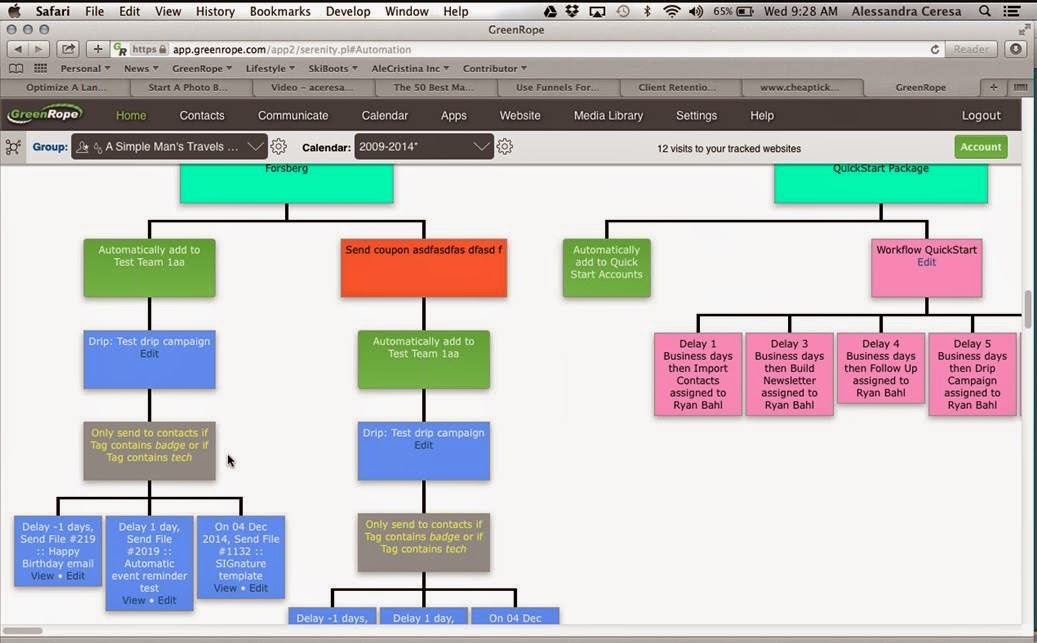
GreenRope workflow

GreenRope is all-in-one software sold primarily to very small businesses such as lawyers, real estate agents, consultant, coaches and membership organizations. That puts it firmly in Infusionsoft territory, and perhaps even towards the lower end of that. The system has an impressively broad scope, adding full Web site creation to the usual all-in-one mix of email, lead scoring, landing pages, and CRM. The features within these functions are unusually sophisticated for a micro-business system: email includes dynamic content and a/b tests; Web pages also support a/b testing; Web forms allow progressive profiling; email and Web responses can automatically trigger a follow-up action.  CRM includes opportunity tracking, unlimited user defined fields, and automatic search of Facebook and LinkedIn when new contacts are added; algorithms can automatically estimate the right number of points for different events to build a predictive lead score.  The media library supports images, files, articles, and videos (through Vimeo integration); the calendar provides full event management; surveys can change questions based on previous answers and include automated follow-up actions.


The system also extends beyond sales and marketing functions to include customer forums, Wikis, support tickets, project schedules with tasks assigned to individuals, and coupons. Workflows can manage both marketing campaigns and internal projects. Additional functions are provided through integration with other systems, including Olark for chat, Twilio for voice and text messages, VoiceBase for transcription, Magento for ecommerce, Quickbooks for accounting, and Microsoft Outlook for email.

In other words, although GreenRope describes itself as “CRM and marketing automation,” it actually extends beyond those functions to manage activities throughout the business. This is very desirable for small organizations that want to automate their operations while running as few systems as possible.

GreenRope is also small-business-friendly, starting at $149 per month for up to 1,000 contacts and costing $199 per month for 5,000 contacts.  All plans include unlimited users and unlimited emails, which isn’t always the case with small business systems.

While GreenRope is new to the VEST report, the company itself was founded in 2008.  It currently has about 4,500 end users at a somewhat smaller number of companies.
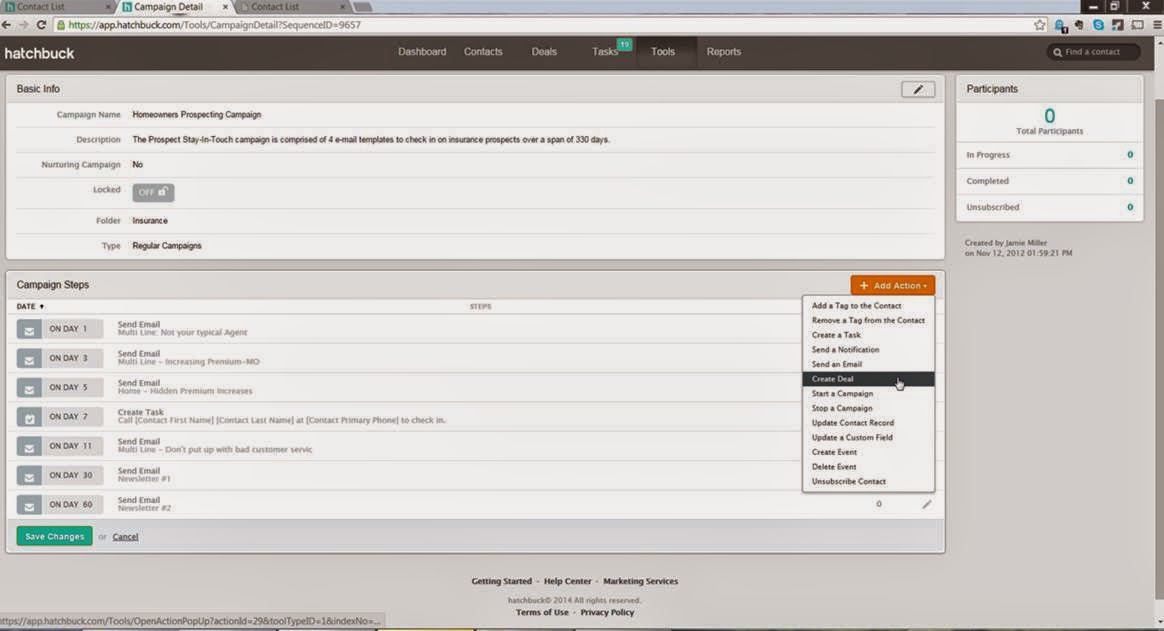
Hatchbuck workflow

Hatchbuck is another all-in-one product for very small businesses. It has taken the approach of providing only core features and making them as easy to use as possible. This scope covers email, Web forms, multi-step campaign flows, and CRM. The system integrates via Zapier with ecommerce products. It recently added lead scoring and the ability to look up individuals on social networks. The company serves a mix of clients, with the largest segments including technology and manufacturing companies, travel, and professional services. Most clients have fewer than ten employees.

As the company’s strategy suggests, Hatchbuck provides basic capabilities for its core features but skips the more advanced options. It creates email templates with personalization and embedded links but no dynamic content. CRM captures activity history, tasks, deals, purchases and events but doesn’t integrate with a phone dialer. Forms can be associated with actions but there is no specialized survey builder. You get the idea. Instead of adding more features, Hatchbuck’s developers rigorously benchmark the number of clicks it takes to perform system functions in Hatchbuck and competitive products and track how customers use each feature to identify problems. The company also provides extensive training and support materials, including a required three hour Quickstart package to help new clients use the system effectively.

Hatchbuck was founded in 2011 and launched its product in 2013. It now has about 700 customers with over 2,000 end-users. Pricing starts at $99 per month for one user and 2,500 contacts and reaches $199 per month for three users and 10,000 contacts. All plans include unlimited emails. The Quickstart package costs $199 but the fee is waived for clients who sign a six month contract. The company also has special features for marketing agencies who use the system for their clients. Such agencies account for about one quarter of the Hatchbuck business.
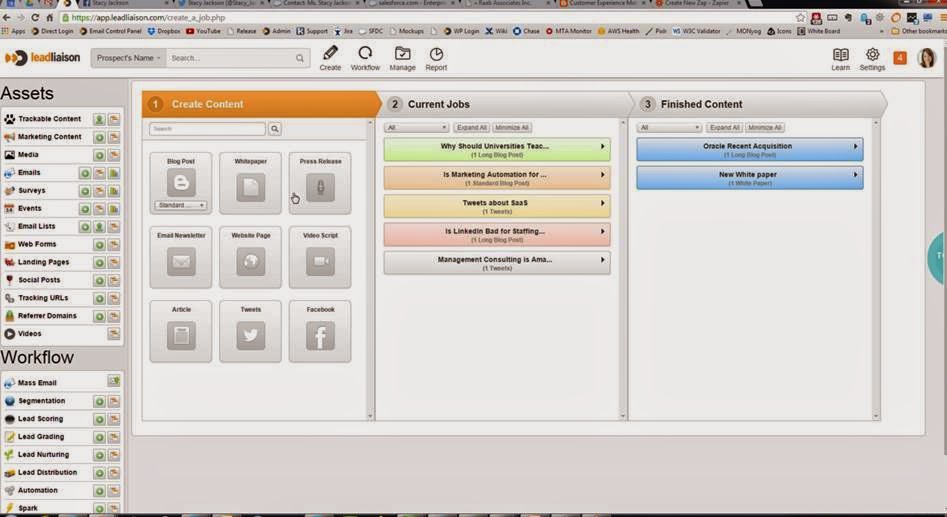
Lead Liaison content creation

Lead Liaison calls itself “revenue generation software” to indicate that it provides more than a standard B2B marketing automation product. Additional features include lead distribution and buying signal alerts, but don’t extend to full CRM or the other operational functions. With a $500 per month starting price, it is targeted at small to mid-size businesses but not at the most tiny. Pricing is based on the number of contacts in the database, with unlimited users, emails, and page views.  The company doesn’t publicly state how many contacts that $500 gets you.

The system offers advanced versions of the usual marketing automation functions: email, landing pages, Web forms and surveys, lead scoring, multi-step nurture flows, media hosting, and CRM integration with Salesforce.com, Microsoft Dynamics CRM, and Sugar CRM. It also goes beyond these in several directions, including:

- company-level Web visitor identification based on IP address, which can be tied to Data.com or LinkedIn to pull back the names of individual contacts at the identified companies (although these are not necessarily the actual visitors).

- matching of contacts against social networks to add their social identifiers to the Lead Liaison record

- phone dialer with scripts, call notes, and a payment widget

- option to send emails from LeadLiaison’s own servers or through third party services including Mandrill, SendGrid, and SMTP Inc.

- social media posting to Facebook, LinkedIn, and Twitter, including an option to store posts in a queue that will release them on a regular schedule

- a nifty Web page scanner that can copy an existing Web page or form from any source into a version that the marketing automation user can edit by, say, inserting a Lead Liasison form or link

- agency-friendly features including single log-in to multiple accounts.

Perhaps the most interesting feature of LeadLiaison is a content creation wizard that connects to a network of prequalified writers for blog posts, white papers, press releases, newsletters, Web pages, social media posts, and other materials. This is directly integrated with the system: users fill out a form specifying their requirements, which Lead Liaison submits to the network.  Once a writer (whose identity is hidden from the user) accepts the project, the system tracks the material through production states and eventually loads it into the Lead Liaison asset library.  Assets are automatically coded so users can track consumption.  The system can also limit distribution based on date range, number of downloads, and whether visitors are asked or required to provide an email address to receive it. Pricing is modest: a blog post costs $50 with five day turnaround. Although the writers are anonymous, LeadLiaison plans to let users favor authors of specific pieces for future assignments.

LeadLiasison was launched in 2013. It has under 200 clients and serves a mix of B2B and B2C marketers.

dbSignals workflow

dbSignals is brand new: the system was formally launched just last week. (Full disclosure: I’ve consulted for them.) The system straddles B2B and B2C marketing automation, using a flexible data structure typical of B2C products but also providing Salesforce.com integration, the B2B hallmark. It also includes its own lightweight CRM.

The marketing automation functions themselves are quite sophisticated: dynamic content, multi-step branching campaign flows, multivariate testing, fine-grained user rights management, option to use internal or external email services, and integration with external HTML templates. Supported channels include email, SMS, direct mail, surveys, landing pages, and social media. There are also options to support marketing agency users, including an ability to rebrand the system with the agency or client’s own identity. 

And, yes, the system also can look up the social profiles of individual contacts and add them to its database.  That feature has quickly become a new standard.

But what really distinguishes dbSignals are two features beyond the normal scope of marketing automation. The first is prospect data: the company has negotiated deals to let its clients access detailed files with 235 million consumer names and 60 million B2B names. These are selectable within the normal system interface, along with whatever names a client loads on its own.

The second feature is machine learning.  This is initially being deployed to identify the most responsive list segments within the prospect data. The process is wholly automated: the only choice users make is whether to turn it on.  Once they do, the system analyzes the client's customer list or past campaigns, builds a predictive model, runs test campaigns to validate and refine the model, and then runs a roll-out campaign once the model is stable. Models are further adjusted after later campaigns. dbSignals will soon add other uses for machine learning including churn prediction, lifetime value prediction, and attribution of the incremental impact of marketing programs.

Prospect data and machine learning are closely integrated.  Indeed, one of the reasons machine learning can be so fully automated is that the system can rely on the prospect data elements to be available -- including up to 2,000 variables on a consumer profile. Beyond that, dbSignals uses the machine learning results to “reserve” the best prospect names for each client in advance of campaign selection.  This is needed because dbSignals limits the number of promotions sent to any name within a specified time period.

Both the prospect data and machine learning are in turn made possible by dbSignals' underlying technology, which uses the Cassandra data store instead of a standard relational database.  Few marketers will care, but, trust me, it really matters for speed, scale, and flexibility.

dbSignals also offers an unusual pricing model, basing charges on the number of users and/or message volume rather than database size. This makes it easier for clients to take full use of the prospect data. Fees start as low as $500 per month.

The initial version of dbSignals was introduced in 2014. The company currently has about two dozen clients including a mix of B2B and B2C organizations.





Sunday, January 18, 2015

Customer Data Platforms Revisited: The Future of Marketing Data


It’s nearly two years since I introduced the concept of a Customer Data Platform, defined as a marketer-controlled system that builds a multi-source customer database and exposes it to external execution systems.  You may recall that I listed several sets of products as CDPs: B2B predictive lead scoring and customer success management; campaign management with an integrated customer database; and data management platforms to support online advertising. Systems were included only if their data (or derived data such as model scores) was available to other systems for campaigns and messaging.

All those categories have done well since my original posts on the topic. Established vendors have grown quickly and attracted funding; new vendors have joined the mix, also often with substantial funding. So I suppose I could pat myself on the back for spotting an important trend and let it go at that.

But things aren’t quite so simple. A look at the entire CDP ecosystem uncovers important patterns that are hidden when you look at individual vendors or vendor categories. Here's a summary of what I've seen.

Customer Management Functions

CDPs exist because marketers need to coordinate customer (and prospect) interactions across channels. That coordination involves three basic tasks: gathering and unifying customer data from all sources; using that data to select the best treatment for each interaction; and delivering those treatments through the appropriate channel systems. Each of those three tasks has several subtasks. These layers are illustrated by the following diagram, which includes a unified data layer – the classic CDP.


Vendor Categories

So far so good, but it’s really just theory. Things get interesting when you look for specific systems that perform the subtasks. It turns out that there are several categories of specialist systems within each subtask, each doing similar or complementary things in slightly different ways. Connecting the logical flow to actual systems is important because looking at real products tells you what the market is saying: that is, what buyers are willing to pay for and where change is concentrated.

The following table shows what I found when I did this analysis. The list of vendors in each section isn't necessarily comprehensive, especially in crowded segments like B2B marketing automation. I should also stress that I’ve only included Decision-layer vendors who also build their own database. This makes them potential CDPs and means they have many Data-layer functions. In a sublimely liberating act of inconsistency, I have NOT limited the Delivery layer to vendors who build their own database. In fact, most do not.


Investment

The right-most column on the previous table shows the level and types of investment being made in each vendor class. I haven’t collected precise details but the general patterns are pretty strong. The major observation is that current investment is heavily concentrated on the Decision layer, with interest in predictive modeling and message selection (which could also be labeled as personalization). There’s some investment on the Data layer in data gathering vendors, especially along the lines of acquisitions by big companies (Oracle/Datalogix, D&B/NetProspex, etc.). This is a general sign of maturity. Similarly, most recent investment on the Delivery layer has been acquisitions (IBM/Silverpop, Oracle/Responsys, Teradata/Appoxee, etc.), which is a sharp contrast from the heavy venture capital funding a couple of years back. Again, this shows the relative maturity of the space.

(Caveats: although it doesn’t show up in this analysis, I do still see some interesting investment in marketing automation niches such as app marketing, distributed marketing, and agency systems. I’m also increasingly intrigued at the “tag management” vendors on the Data layer (Tealium, Signal, Ensighten, etc.), which are reinventing themselves as data integration hubs. I didn’t see that one coming.)

Implications

It’s tempting to interpret these results are showing that data assembly is a solved problem, allowing marketers to invest Decision systems on the next layer down. But any marketer can tell you, and every survey I’ve seen confirms, that most companies are nowhere near having fully integrated their customer data.

What I think is really going on is that people are investing in Decision systems that build their own multi-source databases, providing both Data and Decision functions in one package. Remember that my original CDP categories included B2B predictive vendors and campaign management vendors who did exactly that. So it seems the proper way to look at things is more along the lines of the following diagram, which shows there are several different ways to solve the customer data integration challenge: you can buy a stand-alone CDP that has only data-level functions; buy a Decision system that also builds an integrated database; or buy a Delivery system that does data, decisions, and execution. As the diagram indicates, most of the Decision vendors do incorporate the CDP functions, while only a few of the Delivery vendors do.


The diagram labels the Data + Decision combination as a “Marketing Platform”.  I think this is reasonably consistent with how most people use the term, since the key feature of a “platform” is its ability to integrate with external systems for delivery and other purposes. I’ve labeled the Data + Decision + Delivery combination as an “Integrated Suite” and used question marks to show that not all suites provide a complete Data solution. This is because many suites aren’t very good at bringing in external data or letting external systems access the data they’ve assembled.

As I noted in the previous section, most of the industry funding and excitement is centered on the Decision layer, which is where the Marketing Platforms live. The practical advantage of those systems over Data-only solutions is obvious: Decision systems deliver a revenue generating application while Data-only systems do not.

But think about that for a moment.  Each Decision system builds its own multi-source database and each integrates separately with the Delivery systems.  Having multiple Decision systems is a nightmare of redundancy:


It seems pretty clear that the better solution is to have a single Decision system controlling everything, which is arguably what most people (and vendors) have in mind when they describe a Marketing Platform. Indeed, this is exactly the direction that most Decision-layer CDPs are headed, by expanding the scope of their products from an initial point solution, such as B2B lead scoring, to encompass other applications. It’s safe to say that the people who built these systems always planned, or at least hoped, to grow in this direction.


Does the growth of Decision-layer CDPs mean that Data-only CDPs will fail? I’ll admit that only a few such systems have appeared in the past two years. But I’m not quite ready to give up on the concept.

Why?  Well, as Tolstoy never said, all good customer databases look alike, but every decision system is different. This means it’s hard to support all types of decisions within a single product. So it does seem that multiple decision systems will appeal to marketers who have the skills to use them and the scale to justify the added expense. Those marketers would benefit from a Data-layer CDP, which would make it easier to deploy best-of-breed decision tools even when those tools lack data unification functions.


The stumbling block for this approach is still the cost of integrating multiple systems: as the diagram shows, there are still plenty of connections in this model. But there’s at least some hope (although I remain skeptical) that newer technologies will make the integration easier. The other bright spot for the Data-only CDPs is that they should be attractive as partners or acquisitions for Decision and Delivery systems that haven’t built their own CDP functions.


And what about the suites? I’ve said for years that the first law of software market development is “suites win”, precisely because most companies will sacrifice best of breed functionality to avoid the costs of integration. Indeed, the big marketing clouds from Oracle, Salesforce.com, IBM, Adobe, and others all include extensive Delivery layer functions. I think it’s fair to say that while their commitment to being “open platforms” is genuine, they see that as a way of letting clients supplement the core functions the suites provide internally.  This is quite different from the idea of a shared Data and Decision platform that specifically avoids offering Delivery services. Still, there’s a  very good chance that a suite which can easily integrate supplementary functions will give marketers enough freedom to overcome the problems of lock-in, while still delivering the convenience of pre-integrated core functions. So I’m not quite ready to abandon “suites win” as a rule, although I’m a bit less certain than previously.


Looking Ahead

It’s fun to handicap the horse race among vendors and categories, but what really matters is the contest itself.   All these smart people and money are finally giving marketers the unified customer databases they so desperately need.  This removes a fundamental obstacle to the cross-channel integrated marketing that everyone recognizes is increasingly important. So let’s look at the view once we've climbed that mountain.

I’d like to tell you I see a new and perfect world, but what's actually there is more mountains.  Once unified databases become available, marketers will face a new set of challenges including:

- more need for predictive models and external data. I only lump those together because they’re already getting a lot of attention. Having a powerful database just makes them even more important.

- new focus on automated content creation and campaign design. Lack of skilled users and adequate content are already huge barriers to effective multi-channel marketing.  Removing the database barrier will only make them stand out even more. So we can expect smart people to address them through technology. Indeed, there is already plenty of activity in these areas but I think it’s fair to say that so far none of vendors have had a major impact. This is arguably the next exciting frontier for marketing technology.

- more developments in cross-channel customer tracking. Again, the need for this has been obvious and some major investments have already been made. Cookies are becoming increasingly inadequate as cookie-hostile channels like mobile become more important. Marketers will soon reach a tipping point (or maybe they already have) where they realize they must abandon cookies and move on to other approaches such as device identification or external identity databases. A new standard will eventually emerge, although I can’t even guess what it might be.

- tighter integration between advertising and marketing technology. These two realms are now largely separate with a few exceptions such as retargeting. But as personalized ad messages become increasingly possible, marketers will have ever-greater incentive to target and, ultimately, coordinate messages across channels using shared data. This is highly dependent on the improved customer tracking, so it might have to wait a bit.

- better marketing attribution. If there’s a last stop on the road to marketing Nirvana, attribution might be it. Once marketers have assembled all that data and associated everything with the right customer, they’ll finally be able to deploy advanced analytical methods to really understand the long- and short-term incremental impact of their marketing efforts. Then, and this itself would be heavenly, we’ll never again hear anyone quote John Wanamaker about not knowing which half of his advertising is wasted.

Recommendations for Marketers

Nirvana is still far distant.  Marketers face immediate choices in how to spend their time and budgets. The trends I’ve just described do have some immediate practical implications. Here are my suggestions:

- Experiment like crazy. The various Decision-layer vendors currently offer different specialties, such as lead scoring vs. product recommendations vs. churn predictions. Vendors in each area are expanding their scope so there’s a good chance you’ll eventually pick one to do almost everything. To have the best odds of making a good selection, you’ll want to learn about as many vendors as possible in advance. So run tests to build an understanding of the applications, technologies, and corporate culture. The good news is that each approach can probably pay for itself in improved performance, so these tests should be more or less self-financing.

- Keep an eye out for new data. Many of the Decision-layer vendors bring their own data to the party, and evaluating that data is one part of understanding what they offer. But there are also other data sources that are not tied to a Decision system. You’ll want to explore these to understand what value they provide value and whether to make them part of your long-term data foundation.

- Plan for integration. You may not have shared customer data or decisions today, but it’s increasingly likely they’re in your future. So every new marketing system should be evaluated in part on its ability to integrate with other systems. This involves sending data to the central database and reading data from it, as well as integrating with Decision-layer systems for predictive models, rules-based selections, optimization, recommendations, personalization, and more. Even if you’re going to use an integrated suite, you’ll want to assess how easily you can supplement its functions by tying into external products, and what kinds of products are already available for integration.

Summary

The stand-alone Customer Data Platform is one solution to the challenge of providing a multi-source, shared marketing database, but it isn't the only option.  Whichever solution marketers ultimately find most appealing, they will benefit from gaining control of their data and moving on to new opportunities that database makes possible..