 |
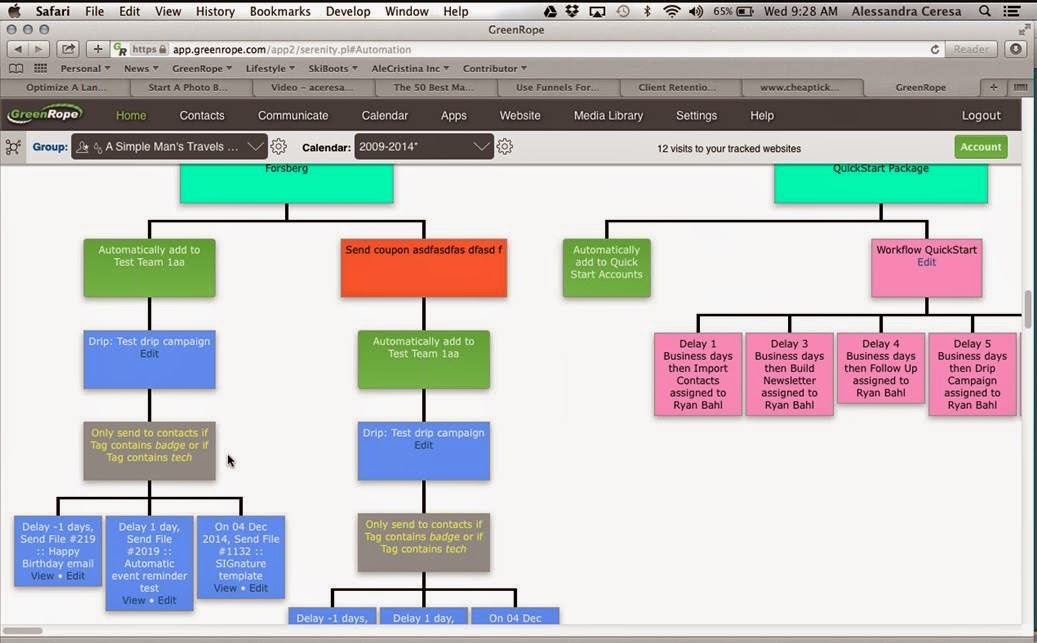
| GreenRope workflow |
GreenRope is all-in-one software sold primarily to very small businesses such as lawyers, real estate agents, consultant, coaches and membership organizations. That puts it firmly in Infusionsoft territory, and perhaps even towards the lower end of that. The system has an impressively broad scope, adding full Web site creation to the usual all-in-one mix of email, lead scoring, landing pages, and CRM. The features within these functions are unusually sophisticated for a micro-business system: email includes dynamic content and a/b tests; Web pages also support a/b testing; Web forms allow progressive profiling; email and Web responses can automatically trigger a follow-up action. CRM includes opportunity tracking, unlimited user defined fields, and automatic search of Facebook and LinkedIn when new contacts are added; algorithms can automatically estimate the right number of points for different events to build a predictive lead score. The media library supports images, files, articles, and videos (through Vimeo integration); the calendar provides full event management; surveys can change questions based on previous answers and include automated follow-up actions.
The system also extends beyond sales and marketing functions to include customer forums, Wikis, support tickets, project schedules with tasks assigned to individuals, and coupons. Workflows can manage both marketing campaigns and internal projects. Additional functions are provided through integration with other systems, including Olark for chat, Twilio for voice and text messages, VoiceBase for transcription, Magento for ecommerce, Quickbooks for accounting, and Microsoft Outlook for email.
In other words, although GreenRope describes itself as “CRM and marketing automation,” it actually extends beyond those functions to manage activities throughout the business. This is very desirable for small organizations that want to automate their operations while running as few systems as possible.
GreenRope is also small-business-friendly, starting at $149 per month for up to 1,000 contacts and costing $199 per month for 5,000 contacts. All plans include unlimited users and unlimited emails, which isn’t always the case with small business systems.
While GreenRope is new to the VEST report, the company itself was founded in 2008. It currently has about 4,500 end users at a somewhat smaller number of companies.
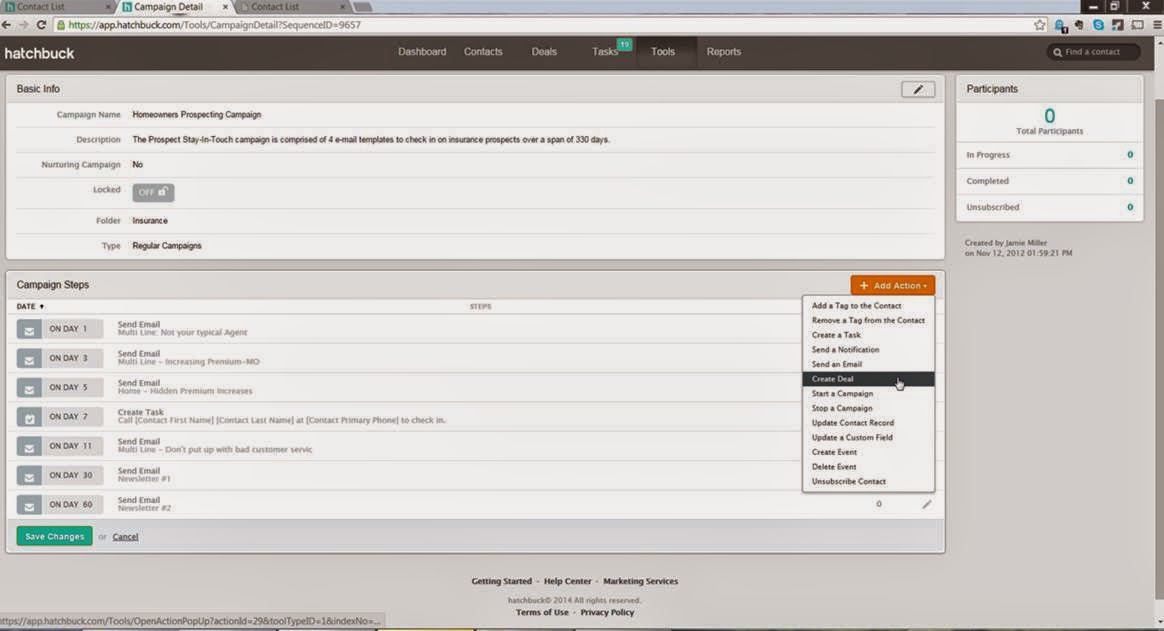 |
| Hatchbuck workflow |
Hatchbuck is another all-in-one product for very small businesses. It has taken the approach of providing only core features and making them as easy to use as possible. This scope covers email, Web forms, multi-step campaign flows, and CRM. The system integrates via Zapier with ecommerce products. It recently added lead scoring and the ability to look up individuals on social networks. The company serves a mix of clients, with the largest segments including technology and manufacturing companies, travel, and professional services. Most clients have fewer than ten employees.
As the company’s strategy suggests, Hatchbuck provides basic capabilities for its core features but skips the more advanced options. It creates email templates with personalization and embedded links but no dynamic content. CRM captures activity history, tasks, deals, purchases and events but doesn’t integrate with a phone dialer. Forms can be associated with actions but there is no specialized survey builder. You get the idea. Instead of adding more features, Hatchbuck’s developers rigorously benchmark the number of clicks it takes to perform system functions in Hatchbuck and competitive products and track how customers use each feature to identify problems. The company also provides extensive training and support materials, including a required three hour Quickstart package to help new clients use the system effectively.
Hatchbuck was founded in 2011 and launched its product in 2013. It now has about 700 customers with over 2,000 end-users. Pricing starts at $99 per month for one user and 2,500 contacts and reaches $199 per month for three users and 10,000 contacts. All plans include unlimited emails. The Quickstart package costs $199 but the fee is waived for clients who sign a six month contract. The company also has special features for marketing agencies who use the system for their clients. Such agencies account for about one quarter of the Hatchbuck business.
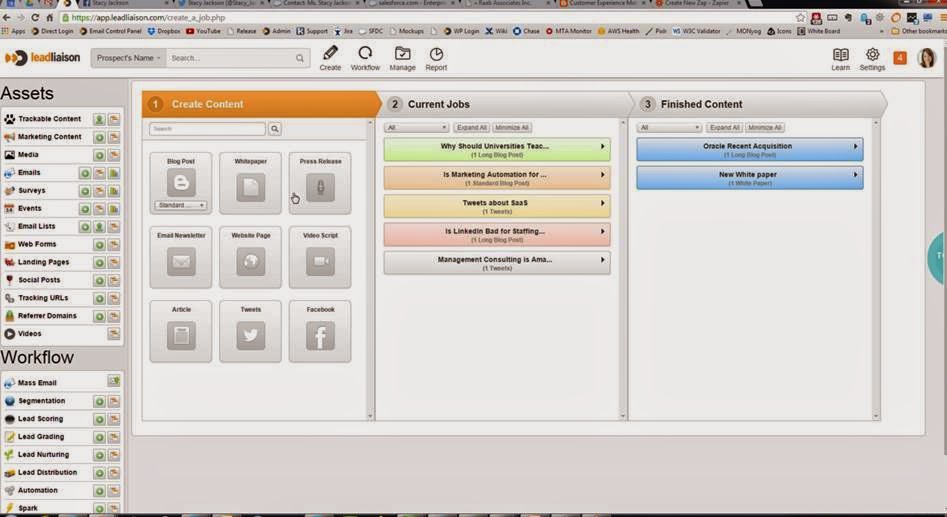 |
| Lead Liaison content creation |
Lead Liaison calls itself “revenue generation software” to indicate that it provides more than a standard B2B marketing automation product. Additional features include lead distribution and buying signal alerts, but don’t extend to full CRM or the other operational functions. With a $500 per month starting price, it is targeted at small to mid-size businesses but not at the most tiny. Pricing is based on the number of contacts in the database, with unlimited users, emails, and page views. The company doesn’t publicly state how many contacts that $500 gets you.
The system offers advanced versions of the usual marketing automation functions: email, landing pages, Web forms and surveys, lead scoring, multi-step nurture flows, media hosting, and CRM integration with Salesforce.com, Microsoft Dynamics CRM, and Sugar CRM. It also goes beyond these in several directions, including:
- company-level Web visitor identification based on IP address, which can be tied to Data.com or LinkedIn to pull back the names of individual contacts at the identified companies (although these are not necessarily the actual visitors).
- matching of contacts against social networks to add their social identifiers to the Lead Liaison record
- phone dialer with scripts, call notes, and a payment widget
- option to send emails from LeadLiaison’s own servers or through third party services including Mandrill, SendGrid, and SMTP Inc.
- social media posting to Facebook, LinkedIn, and Twitter, including an option to store posts in a queue that will release them on a regular schedule
- a nifty Web page scanner that can copy an existing Web page or form from any source into a version that the marketing automation user can edit by, say, inserting a Lead Liasison form or link
- agency-friendly features including single log-in to multiple accounts.
Perhaps the most interesting feature of LeadLiaison is a content creation wizard that connects to a network of prequalified writers for blog posts, white papers, press releases, newsletters, Web pages, social media posts, and other materials. This is directly integrated with the system: users fill out a form specifying their requirements, which Lead Liaison submits to the network. Once a writer (whose identity is hidden from the user) accepts the project, the system tracks the material through production states and eventually loads it into the Lead Liaison asset library. Assets are automatically coded so users can track consumption. The system can also limit distribution based on date range, number of downloads, and whether visitors are asked or required to provide an email address to receive it. Pricing is modest: a blog post costs $50 with five day turnaround. Although the writers are anonymous, LeadLiaison plans to let users favor authors of specific pieces for future assignments.
LeadLiasison was launched in 2013. It has under 200 clients and serves a mix of B2B and B2C marketers.
 |
| dbSignals workflow |
dbSignals is brand new: the system was formally launched just last week. (Full disclosure: I’ve consulted for them.) The system straddles B2B and B2C marketing automation, using a flexible data structure typical of B2C products but also providing Salesforce.com integration, the B2B hallmark. It also includes its own lightweight CRM.
The marketing automation functions themselves are quite sophisticated: dynamic content, multi-step branching campaign flows, multivariate testing, fine-grained user rights management, option to use internal or external email services, and integration with external HTML templates. Supported channels include email, SMS, direct mail, surveys, landing pages, and social media. There are also options to support marketing agency users, including an ability to rebrand the system with the agency or client’s own identity.
And, yes, the system also can look up the social profiles of individual contacts and add them to its database. That feature has quickly become a new standard.
But what really distinguishes dbSignals are two features beyond the normal scope of marketing automation. The first is prospect data: the company has negotiated deals to let its clients access detailed files with 235 million consumer names and 60 million B2B names. These are selectable within the normal system interface, along with whatever names a client loads on its own.
The second feature is machine learning. This is initially being deployed to identify the most responsive list segments within the prospect data. The process is wholly automated: the only choice users make is whether to turn it on. Once they do, the system analyzes the client's customer list or past campaigns, builds a predictive model, runs test campaigns to validate and refine the model, and then runs a roll-out campaign once the model is stable. Models are further adjusted after later campaigns. dbSignals will soon add other uses for machine learning including churn prediction, lifetime value prediction, and attribution of the incremental impact of marketing programs.
Prospect data and machine learning are closely integrated. Indeed, one of the reasons machine learning can be so fully automated is that the system can rely on the prospect data elements to be available -- including up to 2,000 variables on a consumer profile. Beyond that, dbSignals uses the machine learning results to “reserve” the best prospect names for each client in advance of campaign selection. This is needed because dbSignals limits the number of promotions sent to any name within a specified time period.
Both the prospect data and machine learning are in turn made possible by dbSignals' underlying technology, which uses the Cassandra data store instead of a standard relational database. Few marketers will care, but, trust me, it really matters for speed, scale, and flexibility.
dbSignals also offers an unusual pricing model, basing charges on the number of users and/or message volume rather than database size. This makes it easier for clients to take full use of the prospect data. Fees start as low as $500 per month.
The initial version of dbSignals was introduced in 2014. The company currently has about two dozen clients including a mix of B2B and B2C organizations.