Anyone who has chatted with me in recent months knows that I’ve added the impending domination of humans by intelligent machines to my usual list of obsessions. This most definitely applies to marketing, where I found many artificial intelligence-based solutions once I began looking for them. After accumulating a list, I’ve decided it’s time to pull together an overview of the topic.
My thesis was that AI-based systems already exist for most tasks that marketers perform, but are not yet connected into a single robo-marketer that (or is it who?) could do the job from start to finish. To test this, I listed the tasks that go into building a marketing program and matched these against my list of AI-based products.
Quite to my surprise, the machines haven’t risen so far after all. Of the three broad tasks I defined – planning, content creation, and execution – only content creation is served by what I consider to be strong AI* solutions. Some AI options are available for execution, but most are conventional predictive modeling products that I don’t count as strong AI because they still require humans to deploy their results. Marketing planning, which includes the all-important task of campaign design, is almost wholly untouched by AI.
Let’s look at each task in turn.
Planning
The lack of AI-driven planning solutions is especially surprising since so many planning tasks lend themselves to an AI approach. These tasks include market analysis (identifying potential buyers for a product, defining the needs and interests of potential buyers, identifying competitors, calculating potential market size and adoption rates), selecting marketing strategy, and selecting tactics (which can be defined as campaigns, experiences, or – if you’re cool enough – stages in the customer journey).
It seems well within the capabilities of current technology to find people who indicate a specific need, based on their Web searches or social comments, and then to understand who those people are in terms of demographics, behaviors, and other attributes. But the closest I could find were a couple of products that build profiles of groups the marketer defines in advance, such as brandAnalyzer by
brandAnalyzer from Global Science Research and
Empirical Insights from SG360. The one system that does look like strong AI is
Bottlenose. It performs the relatively common function of identifying trends but uses enough advanced technology, including natural language processing, topic discovery, and sentiment analysis, to impress me.
Similarly, competitor analysis should be well within the capabilities of companies like
Radius,
Everstring and
Growth Intelligence, which already ingest the contents of corporate Web sites to understand each company’s business. But those vendors focus on finding prospects for B2B sellers. If any of them offers a competitor identification service, I’m not aware of it.
Business and marketing strategies are often compared to chess, a game that AI systems can famously play better than humans. I think the analogy is sound: like chess, business and marketing strategy involves a relatively limited number of moves with easily predicted short term consequences and large databases of past competitions which computers can study to predict longer term results. Strategic planning can also be supported by a rich treasury of simulation and optimization techniques that are very familiar to AI developers. Yet the closest I can find to strategic planning is optimization of media plans by media mix model vendors like
MMA ,
Analytic Partners ,
Nielsen and
IRI. But that is so tactical I classify it as part of execution. Otherwise, I haven’t seen anyone use AI to recommend a marketing strategy.
Nor has anyone really promised to design marketing campaigns using an AI system. This is another area that seems a natural application: computers can certainly use past results to predict the short- and long-term results of individual messages and, with a bit less certainty, of streams of messages. But while there are plenty of systems that predict the “next best message” or recommend what content the user is most likely to select, no one seems to have taken the obvious next step of using AI to design the best message sequence and refine it over time through automated testing. The closest I’ve seen are
Amplero and
Insightpool. But they both start with individual data, so I'll discuss them in the section on execution.
Content Creation
Ironically, the most common reaction when I bring up machine-based marketing seems to be “well, they'll never write copy”. In fact, writing is one task where machines have already demonstrated huge success. General purpose writing programs including Wordsmith from
Automated Insights , Quill from
Narrative Insights and
Arria NLG already write over one billion newspaper articles and reports each year, specializing in data-rich topics like sports and financial reports. Wordsmith also writes other sorts of reports, including summaries of marketing campaign performance.
Still closer to home for marketers,
InboundWriter and
Acrolinx score marketing content for effectiveness before it is released.
Most impressive of all from an AI perspective,
Persado and
Captora actually create content on their own. Persado does this by selecting and then testing content derived from a huge database of marketing language, classified by emotional, descriptive, and formatting categories. It works across email, landing pages, text messages, social posts,
Facebook ads, app notifications, and other media. Captora automatically analyzes the topics and performance of content from the client and its competitors, finds opportunities for new campaigns, and creates appropriate landing pages to attract search traffic.
I consider Persado and Captora to be true AI-based marketing because they can actually replace work done by humans. But, as both vendors would probably rush to point out, what they really do is expand the volume of work that gets done, enabling marketers to execute hundreds of campaigns with the same human effort as it previously took to do dozens. So they are less about reducing the number of marketers than expanding marketer productivity.
Execution
While planning and content are arguably the most strategically important tasks that marketers do, there’s no question that they spend most of their time on execution. This is especially true since my definition of execution includes measurement and optimization because all three are so closely intertwined.
I broadly divide execution into audience development, message selection, and attribution. Audiences include paid media (purchased ads and lists), earned media (public relations and social influencers), and owned media (company Web sites and email lists, in-store promotion, call centers, etc.). Message selection includes content recommendations and personalization. Attribution includes everything that measures the results of marketing efforts – although, in practice, much message selection also relies on simple attribution to improve selection results.
Each execution category is served by advanced technology. Paid audiences are built with predictive modeling for list selection, programmatic media buys for advertising, and automated content analysis to understand intent. Earned audiences are built through influencer identification and predictions of who will cover which stories. Owned audiences are refined through more predictive models and behavior analysis. Message selection also relies on advanced analytics to recommend the right content for each individual and to find the best-performing messages for groups. Likewise, attribution systems apply sophisticated methods to isolate the incremental impact of individual marketing actions on long-term results. This long-term perspective is what distinguishes attribution from the measurement built into message selection systems, which instead chase immediate results such as email click-through or Web page conversion.
These technologies are certainly impressive, but few of them actually remove marketers from the process – which you’ll recall is my definition of marketing AI. Predictive model scores, for example, are usually plugged into marketer-created rules that decide who receives which treatments. Even the recommendation engines rarely do more than predict which messages an individual is most likely to select. Human-built rules still determine which messages are available and when messages will be presented.
There’s a lot of gray in this picture. Model scores and recommendation engines often replace complex segmentation rules even though some other rules remain. They may not replace marketers altogether but they do enable marketers to run larger numbers of more refined programs. And they're a supporting technology for true AI marketing systems even if they are not AI themselves.
On the other hand, I think programmatic media buying does rise to the level of true AI. Again, the critical distinction is whether they replace human marketers – and I think that media buyers are pretty much not needed to execute programmatic programs. Obviously a human still has to set up the programs and provide the creative, but the programmatic systems then make complex judgements on their own. Are these “judgements” significantly more advanced than the “judgements” that go into a lead scoring predictive model or personalized content recommendation? I’m not really sure. Maybe I’m misled by the fact that “media buyer” is an established profession while “lead scorer” or “content personalizer” are not job titles that people had before computers were available.
There are a few execution products that approach the border of true AI and may actually cross it. These include:
-
Amplero, a newly released system that uses tree analysis to find very small market segments and then identifies the best content for each segment. What separates it from other personalization tools is that it optimizes against long-term value, such as revenue over the 14 days following each message, and its decisions take into account messages previously presented. I’d definitely consider Amplero true AI if it could plan sequences of messages, which would be pretty much the same as building multi-step campaigns. The system doesn’t do this yet but the vendor tells me they’re working on it.
-
Insightpool, which identifies social media influencers, predicts how likely they are to take a user-specified action, and then recommends multi-step campaigns to encourage that result. Influencer identification and activity prediction are impressive but not unique; what makes me classify Insightpool as AI is its ability to select campaigns. This is something that you’d ordinarily expect a human marketer to do, even if the marketer was working with lists that the other functions had prepared.
-
OneSpot converts existing pieces of content into multiple ad formats to permit reuse, classifies them (automatically, so near as I can tell) by purpose, and then delivers them to precisely targeted or retargeted individuals through programmatic ad exchanges in the optimal sequence to meet long-term goals. The reformatting, classification, and sequencing all strike me as things that humans would otherwise do manually, and of course I’ve already argued that programmatic media buying itself qualifies as marketing AI.
Final Thoughts
I know this post is too long to be effective but I wanted all to get this information down in one place. Artificial intelligence is an important topic in our general society and seems to attracting increased attention, even though Google Trends suggests otherwise. Marketers in particular are thinking about it as they adjust to rapidly changing technologies that increasingly rely on predictive analytics and other automation for effective management.
Given the hype that accompanies pretty much every new technical development, it’s helpful to see that AI-based marketing isn’t as far along as one might expect. But don't take that as a reason to relax: while it’s not time to panic, it’s definitely time to prepare. AI marketing systems already present some significant opportunities and their scope can only grow – perhaps exponentially as key techniques become more widely distributed. Now is the time to start building a realistic understanding of how these systems work, what they can and can’t do, and how they’ll fit into your future.
_________________________________________________________________________
* “strong AI” is used by AI experts to mean systems match or exceed human intelligence. I’m using it in that roughly sense, although with the more specific meaning of “systems that perform tasks that otherwise require human marketers”.
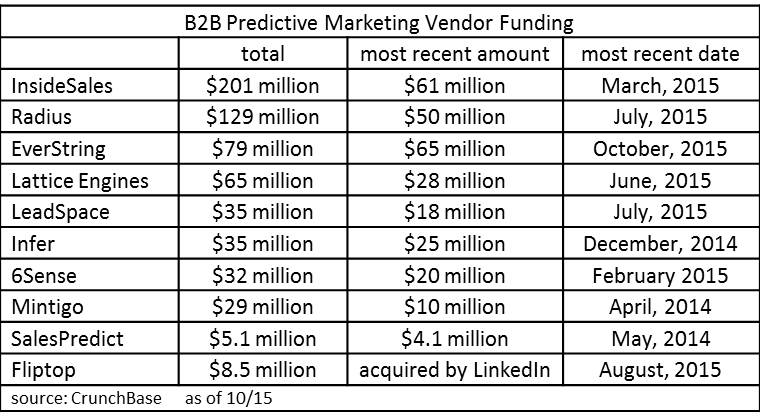


 I've written about this sort of thing many times, as recently as this July and as far back as 2013. Mintigo’s approach is to first instrument the client’s marketing efforts across all channels to track promotion response; then run automated a/b tests to see how each offer performs in different channels for different prospects; use the results to build automated, self-adjusting predictive response models; and then set up a process to automatically select the best offer, channel, and message timing for each customer, execute it, wait for response, and repeat the cycle. Execution happens by setting up separate marketing automation campaigns for the different offers. These campaigns execute Mintigo’s instructions for the right channel and timing for each prospect, capture the response, and alert Mintigo to start again. The initial deployment is limited to Oracle Eloqua, which had the best APIs for the purpose, although Mintigo plans to add other marketing automation partners in the future.