Showing posts with label predictive marketing. Show all posts

Wednesday, December 02, 2015

Automated Marketing Campaigns: An Immodest Proposal

I wrote last June about replacing traditional multi-step campaigns with a system that tracks customers through journey stages and executes short sequences of actions, called “plays”, at each stage.  The goal was to approach the perfect campaign design of “do the right thing, wait, and do the right thing again”.

I still think approach makes sense but it suffers from a major flaw: someone has to define all those stages and all those plays. This limits the number of actions available since it takes considerable human time, effort, and insight to create each stage and play. Ideally, you’d let machines evolve the stages and plays autonomously. But while it’s easy for conventional predictive models to find the “next best action” in a particular situation, it’s much harder to find the best sequence of actions. This is why you can find dozens of automated products to personalize Web sites but none to automate multi-step campaign design.

The problem with multi-step campaigns is the number of options to test.  These have to cover all possible actions in all possible sequences at all possible time intervals. Few companies have enough customer activity to test all the possibilities, and, even if they did, it would take unacceptably long to stumble upon the best combinations and cost unacceptable amounts of lost revenue from customers in losing test cells.  In any case, available actions and customer behaviors are constantly changing, so the best approach will change over time – meaning the system would need to be constantly retesting, with all the resulting costs.

I’ve recently begun to imagine what I think is a solution. Let’s start with the problem that’s already solved, of finding the single next best action. You can conceive of my perfect campaign as a collection of next best actions. But a solution that merely executed the next best action for each customer every day would almost surely produce too many messages. One solution is a model that predicts the value* of each potential action, rather than simply ranking the actions against each other. This lets you set a minimum value for outbound messages. On days when no action meets this threshold, the system would simply do nothing. A still better approach is to explicitly consider “no action” as an option to test and build a model that gives it a value – presumably, the value being higher response to future promotions. Now you have a system that is organically evolving the timing of multi-step campaigns – and, better still, adapting that timing to behavior of each individual.

But what about sequences of related actions (i.e.,“plays”)? Let’s assume for a moment that the action sequences already exist, even if humans had to create them. This turns out to be a non-issue: if the best action to take with a customer is the second step in a sequence, the system should find that and choose it.  If some other action would be more productive, we’d want to system to pick that anyway. The only caveat is the predictions must take into account previous actions, so any benefit from being part of a sequence is properly reflected in the value calculations. But a good model should consider previous actions anyway, whether or not they’re part of a formal sequence. At most, marketers might want to stop customers from receiving messages out of order.  This is easy enough to design – it just becomes part of the eligibility rules that limit the actions available for a given customer.  Such rules must exist for any number of reasons, such as location, products owned, or credit limit, so adding sequence constraints is little additional work.  In practice, the optimal sequence for different customers is likely to be different, so imposing a fixed sequence is often actively harmful.

So far so good, but we haven’t really solved the problem of too many combinations. This requires another level of abstraction to reduce the number of options that need to be tested. When it comes to timing, initial tests of waiting for random intervals between actions should pretty quickly uncover when it’s too soon for any new action and when it’s too long to wait. This can be abstracted from results across all actions, so the learning should come quite quickly. Once reliable estimates are available, they can be used in prediction models for all possible actions. Future tests can be then limited to refining the timing within the standard range, with only a few tests outside the range to make sure nothing has changed.

The same approach could reduce other types of testing to keep the number of combinations within reason. For example, actions can be classified by broad types (cross sell, upsell, retention, winback, price level, product line, customer support, education, etc.) to quickly understand which types of actions are most productive in given situations. Testing can then focus on the top-ranked alternatives. This is relatively straightforward once actions are properly tagged with such attributes – or machine learning discovers the relevant attributes without tagging. Again, the system will still test some occasional outliers to find any new patterns that might appear.

Incidentally, this approach also helps to solve the problem of sequence creation. Category-level predictions would show when a customer is likely to respond to another action within a given category. If the system is consistently running out of fresh actions in one category, that’s a strong hint that more should be created. Thus, a sequence (or play) is born.

So – we’ve found a way for machines to design multi-step sequences and to reduce testing to a reasonable number of combinations. You might be thinking this is interesting but impractical because it requires running hundreds or thousands of models against each customer every day or possibly more often. But it turns out that’s not necessary. If we return to our concept of a value threshold and assume that time plays a role in every model score, then it’s possible to calculate in advance when the value of each action for each customer will reach the threshold. The system can then find whichever action will reach the threshold first and schedule that action to execute at that time. No further calculations are needed unless the model changes or you get new information about the customer – most likely because they did something. Of course, you’d want to recalculate the scores at that time anyway. In most businesses, such changes happen relatively rarely, so the number of customers with recalculated scores on any given day is a tiny fraction of the full base.

None of the concepts I’ve introduced here – value thresholds, explicitly testing “no action”, sharing attributes across models, and precalculating future model scores – is especially advanced. I’d be shocked if many developers hadn’t already started to use them. But I’ve yet to see a vendor pull them together into a single product or even hint they were moving in this direction. So this post is my little holiday gift – and challenge – to you, Martech Industry: it’s time to use these ideas, or better ones of your own, to reinvent campaign management as an automated system that lets marketers focus again on customers, not technology.

_______________________________________________________________________
* Value calculation is its own challenge.  But marketers need to pick some value measure no matter how they build their campaigns, so lack of a perfect value measure isn't a reason to reject the rest of this argument.

Monday, November 09, 2015

Predictive Marketing Vendors Look Beyond Lead Scores

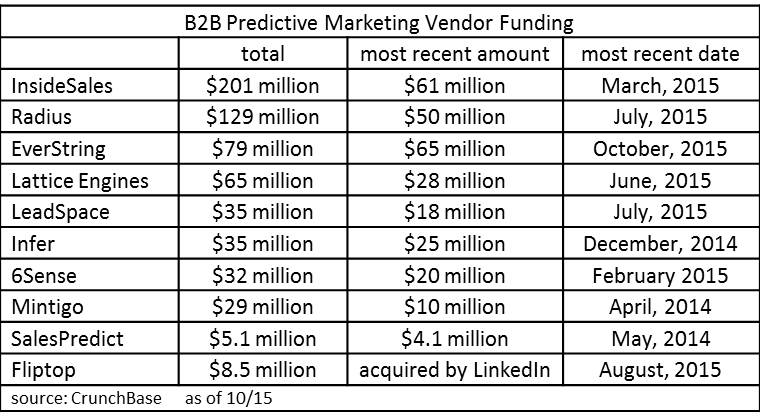
It’s clear that 2015 has been the breakout year for predictive analytics in marketing, with at least $242 million in new funding, compared with $376 million in all prior years combined.


But is it possible that predictive is already approaching commodity status? You might think so based on the emergence of open source machine learning like H20 and Google’s announcement today that is it releasing a open source version of its TensorFlow artificial intelligence engine.

Maybe I shouldn't be surprised that predictive marketing vendors seem to have anticipated this.  They are, after all, experts at seeing the future. At least, recent announcements make clear that they’re all looking to move past simple model building.  I wrote last month about Everstring’s expansion to the world of intent data and account based marketing. The past week brought three more announcements about predictive vendors expanding beyond lead scoring.

Radius kicked off the sequence on November 3 with its announcement of Performance, a dashboard that gives conversion reports on performance of Radius-sourced prospects. What’s significant here is less the reporting than that Radius is moving beyond analytics to give clients lists of potential customers. In particular, its finding new market segments that clients might enter – something different from simply scoring leads that clients present to it or even from finding individual prospects that look like current customers. This isn’t a new service for Radius but it’s one that only some of the other predictive modeling vendors provide.


Radius also recently announced a very nice free offering, the CMO Insights Report.  Companies willing to share their Salesforce CRM data can get a report assessing the quality of their CRM records, listing the top five data elements that identify high-value prospects, and suggesting five market segments they might pursue. This is based on combining the CRM data with Radius’ own massive database of information about businesses. It takes zero effort on the marketer’s part and the answer comes back in 24 hours. Needless to say, it’s a great way for Radius to show off its highly automated model building and the extent of its data. I imagine that some companies will be reluctant to sign into Salesforce via the Radius Web site, but if you can get over that hurdle, it’s worth a look.

Infer upped the ante on November 5 with its Prospect Management Platform. This also extends beyond lead scoring to provide access to Infer’s own data about businesses (which it had previously kept to itself) and do several types of artificial intelligence-based recommendations. Like Radius, Infer works by importing the client's CRM data and enhancing it with Infer's information.  The system also has connectors to import data from marketing automation and Google Analytics.  It then finds prospect segments with above-average sales results, segments that are receiving too much or too little attention from the sales team, and segments with significant changes in other key performance indicators.


Like the Pirate Code, Infer's recommendations are more guidelines than actual rules: it’s up to users to review the findings and decide what, if anything, to do with them. Users who create segments can then have the system automatically track movement of individuals into and out of segments and define actions to take when this occurs. The actions can include sending an alert or creating a task in the CRM system, assigning the lead to a nurture campaign in marketing automation, or using an API to trigger another external action. Infer plans to also recommend the best offer for each group, although this is not in the last week’s release – which is available today to current clients and will be opened to non-customers in early 2016. That last option is an interesting extension in itself, meaning Infer could be used by marketers who have no interest in lead scoring.

Mintigo’s news came today. It included some nice enhancements including a new user interface, account-based lead scores, and lists of high-potential net new accounts. But the really exciting bit was preannouncement of Predictive Campaigns, which is just entering private beta.  This is Mintigo’s attempt to build an automated campaign engine that picks the best treatment for each customer in each situation.

I've written about this sort of thing many times, as recently as this July and as far back as 2013. Mintigo’s approach is to first instrument the client’s marketing efforts across all channels to track promotion response; then run automated a/b tests to see how each offer performs in different channels for different prospects; use the results to build automated, self-adjusting predictive response models; and then set up a process to automatically select the best offer, channel, and message timing for each customer, execute it, wait for response, and repeat the cycle. Execution happens by setting up separate marketing automation campaigns for the different offers.  These campaigns execute Mintigo’s instructions for the right channel and timing for each prospect, capture the response, and alert Mintigo to start again. The initial deployment is limited to Oracle Eloqua, which had the best APIs for the purpose, although Mintigo plans to add other marketing automation partners in the future.


Conceptually, this is exactly the model I have proposed of “do the right thing, wait, and do the right thing again”. Mintigo’s actual implementation is considerably messier than that, but such is the price of working in the real world. There are still nuances to work out, such as optimizing for long-term value rather than immediate response, incorporating multi-step campaigns, finding efficient testing strategies, automating offer creation. And of course this is just a pre-beta announcement. But, it’s still exciting to see progress past the traditional limits of predefined campaign flows. And, like the other developments this week, it’s a move well beyond basic lead scoring.

Thursday, October 15, 2015

EverString Takes Another $65 Million and (More Important) Launches Predictive Ad Targeting Solution

EverString announced a $65 million funding round and new ad targeting product on Tuesday. (It also released a new survey on predictive marketing which is probably interesting, but I just can't face after last weekend’s data binge.)

The new funding is certainly impressive, although the record for a B2B predictive marketing vendor is apparently InsideSales’ $100 million Series C in April 2014.  It confirms that EverString has become a leader in the field despite its relatively late entry.


But the new product is what’s really intriguing. Integration between marketing and advertising technologies has now gone from astute prediction to overused cliché, so nobody gets credit for creating another example. But the new EverString product isn’t the usual sharing of a prospect list with an ad platform, as in display retargeting, Facebook Custom Audiences, or LinkedIn Lead Accelerator. Rather, it finds prospects who are not yet on the marketer’s own list by scanning ad exchanges for promising individuals. More precisely, it puts a tag on the client's Web site to capture visitor behavior, combines this with the client's CRM data and EverString's own data, and then builds a predictive model to find prospects who are similar to the most engaged current customers.  This is a form of lookalike modeling -- something that was separately mentioned to me twice this week (both times by big marketing cloud vendors), earning it the coveted Use Case of the Week Award.

Once the prospects are ranked, EverString lets users define the number of new prospects they want and set up real time bidding campaigns with the usual bells and whistles including total and daily budgets and frequency caps per individual.  EverString doesn’t identify the prospects by name, but it does figure out their employer and track their behaviors over time. If this all rings a bell, you’re on the right track: yes, EverString has created its very own combined Data Management Platform / Demand Side Platform and is using it build and target audience profiles.

In some ways, this isn’t such a huge leap: EverString and several other predictive marketing vendors have long assembled large databases of company and/or individual profiles. These were typically sourced from public information such as Web sites, job postings, and social media. Some vendors also added intent data based on visits to a network of publisher Web sites, but those networks capture a small share of total Web activity. Building a true DMP/DSP with access to the full range of ad exchange traffic is a major step beyond previous efforts. It puts EverString in competition with new sets of players, including the big marketing clouds, several of which have their own DMPs; the big data compilers; and ad targeting giants such LinkedIn, Google, and Facebook. Of course, the most direct competitors would be account based marketing vendors including Demandbase, Terminus, Azalead, Engagio, and Vendemore. While we’re at it, we could throw in the mix other DMP/DSPs such as RocketFuel, Turn, and IgnitionOne.

At this point, your inner business strategist may be wondering if EverString has bitten off more than it can chew or committed the cardinal sin of losing focus. That may turn out to be the case, but the company does have an internal logic guiding its decisions. Specifically, it sees itself as leveraging its core competency in B2B prospect modeling, by using the same models for multiple tasks including lead scoring, new prospect identification, and, now, ad targeting. Moreover, it sees these applications reinforcing each other by sharing the data they create: for example, the ad targeting becomes more effective when it can use information that lead scoring has gathered about who ultimately becomes a customer.

From a more mundane perspective, limiting its focus to B2B prospect management lets EverString concentrate its own marketing and sales efforts on a specific set of buyers, even as it slowly expands the range of problems it can help those buyers to solve. So there is considerably more going on here than a hammer looking for something new to nail.

Speaking of unrelated topics*, the EverString funding follows quickly on the heels of another large investment  $58 million – in automated testing and personalization vendor Optimizely, which itself followed Oracle’s acquisition of Optimizely competitor Maxymiser. I’ve never thought of predictive modeling and testing as having much to do with each other, although both do use advanced analytics. But now that they’re both in the news at the same time, I’m wondering if there might be some deeper connection. After all, both are concerned with predicting behavior and, ultimately, with choosing the right treatment for each individual. This suggests that cross-pollination could result in a useful hybrid – perhaps testing techniques could help evolve campaign structures that use predictive modeling to select messages at each step. It’s a half-baked notion but does address automated campaign design, which I see as the next grand challenge for the combined martech/adtech (=madtech) industry. On a less exalted level, I suspect that automated testing and predictive modeling can be combined to give better results in their current applications than either by itself. So I’ll be keeping an eye out for that type of integration. Let me know if you spot any.

_____________________________________________________________
*lamest transition ever

Wednesday, April 15, 2015

Marketo Conference: Is Predictive Modeling The Future of Marketing Automation?

Marketo held its annual Marketing Nation Summit this week, hosting 4,000+ clients and partners. The event seemed relatively subdued for Marketo – I didn’t spot one costumed character – but the over-all atmosphere was positive. The company made two major product announcements, expanding the reach of Marketo campaigns into mobile apps and display ad retargeting. Those struck me as strategically valuable, helping to secure Marketo’s place at the center of its users’ customer management infrastructure. Unfortunately, I wasn’t able to gather enough technical detail to understand how they work. I’ll try to write about them once that happens.

As usual for me, I spent much of conference prowling the exhibit hall checking out old and new vendors. Marketo has attracted a respectable array of partners who extend its capabilities. By far the most notable presence was predictive modeling vendors – Leadspace, Mintigo, Lattice Engines, Infer, Fliptop, SalesPredict, 6Sense, Everstring plus maybe some others I’m forgetting. I’ve written about each of these individually in the past, but seeing them in the same place brought home the very crowded nature of this market. It also prompted many interesting discussions with them vendors themselves, who, not surprisingly, are an especially analytical and thoughtful group.

Many of those conversations started with the large number of vendors now in the space and how many would ultimately survive. I actually found this concern a bit overwrought – there are other segments, most obviously B2B marketing automation itself, that support many dozens of similar vendors. By that standard, predictive analytics is still far from overcrowded. At the risk of some unfair (and unjustifiably condescending) stereotyping, I’ll propose that part of their concern comes from a sort of Spock-like rationality that says only a few different products are really needed in any given segment. That may indeed be logically correct, but real markets often support more players than anyone needs. I see nothing inherent in the predictive marketing industry that will limit it to a few survivors.

In fact, almost immediately after wondering whether there were too many choices, many vendors observed that they were already sorting themselves into specialists serving different customer types or applications. Some products sell mostly to smaller companies, some to companies with many different products, some to customers who want new prospect names, some who want to incorporate external behaviors, and so on. Here, the vendors’ perception is more nuanced than my own; they see differences that I hadn’t noticed. Despite these distinctions, I still expect that most vendors will broaden rather than narrow their scope over time. But maybe that’s my own inner Spock looking for more simplicity than really exists.

One factor simplifying buyers' selection decision was that nearly all clients test multiple systems before making a purchase.  This contrasts sharply with marketing automation, where many companies still buy the first system they consider and few conduct an extensive pre-purchase trial.  The main reason for this anomaly is that modeling systems are highly testable: buyers give each competitor a set of data, let them build a model, and can easily see whose scores do a better job of identifying right people.  It also probably helps that people buying predictive systems are generally more sophisticated marketers.  There's some danger to relying extensively on test results, since they obscure other factors such as time to build a model and how well models retain their performance over time.  I was also a bit puzzled that nearly every vendor reported winning nearly every test.  I don't think that's mathematically possible.

Probably the most interesting set of discussions revolved around the long-term relation of predictive functions to the rest of the customer management infrastructure. This was sometimes framed as whether predictive modeling will be a "feature" embedded in other systems or a "product" sold on its own. My intuition is it's a feature: marketers simply want to select on model scores the same way they’d select any other customer attribute, so scoring should be baked into whatever marketing system they’re using. But the counter argument starts with the empirical observation that marketing automation vendors haven’t done this, and speculates that maybe there’s a sound reason: not just that they don’t know how or it’s too hard, but that modeling systems need data that is stored outside of marketing automation or should connect with multiple execution systems that marketing automation does not. The data argument makes some sense to me, although I think marketing automation itself should also connect with those external sources. I don’t buy the execution system argument.  Marketing automation should select customer treatments for all execution systems; scores should be an input to the marketing automation selections.

But there’s a deeper version of this question that asks about the role of predictive analytics within the customer management process itself. Marketo CEO Phil Fernandez touched on this indirectly during his keynote, when he observed that literally mapping the customer journey as an elaborate flow chart is inherently unrealistic, because customers follow many more paths than any manageable chart could contain. He also came back to it with the image of a “self-driving” marketing automation system that, like a self-driving car, would let the user specify a goal and then handle all the details independently. Both examples suggest replacing marketer-created rules to guide customer treatments with predictive systems that select the best action in each situation. As several of the predictive vendors pointed out to me (with what sounded like the voice of painful experience), this requires marketers to give up more control than they may find comfortable – either because machines really can’t do this or because it would put marketers out of a job if the machines could. Personally, I'll bet on the machines in this contest, although with many caveats about how long it will take before humans are fully or even largely replaced.

However, and here’s the key point that came up in the most interesting discussions: predictive models can’t do this alone. At the most abstract, marketing involves picking the best customer treatment in each situation.  But models can only pick from the set of treatments that are available. In other words, someone (or some thing) has to create those treatments and, prior to that, decide what treatments to create. In current marketing practice, those decisions are made with a content map that plots available content against customer life stages and personas.  This makes sure that appropriate content is available for each situation. Proper value measurement – which means estimating the incremental impact on lifetime value of each marketing message – also relies on persons and life stages as a framework. So any machine-based approach to customer management has to generate personas, life stages, and content to be complete.*

I see no inherent reason that machines couldn’t ultimately do the persona and life stage definition. None of vendors do it today, although several appear to have given it some thought. Automated content creation is already available to a surprising degree and will only get better. But, to get back to my point: the technologies to do these things are very different from predictive modeling. So if new technology is to replace marketing automation as the controller of customer treatments, that technology will include much more than predictive modeling by itself.
 _________________________________________________________________________
* Yes, it has occurred to me that a fully machine driven system might not need personas and lifestages, which are aggregations needed because humans can't deal with each person separately.  But marketers won't adopt that approach until (a) machines can also create content without the persona / lifestage framework and (b) humans are willing to trust the black box so completely they don't need personas and lifestages to help understand what the machines are up to. On the other hand, you could argue that content recommendation engines like BrightInfo (also at the Marketo show)  already work without personas and lifestages...although I think they usually focus on a near-term action like conversion rather than long-term impact like incremental lifetime value. 

Friday, November 21, 2014

Sailthru Offers End-to-End Omnichannel Personalization for B2C Marketers

I know this is blasphemy, but I’m beginning to have doubts about solution selling – the idea that marketers should describe the customer problems they solve, not the features of their products. The issue, at least in marketing technology, is that all systems address pretty much the same general problem of sending the right messages to the right customers (in the right time, place, medium, device, language, tone, etc.). This means that solution statements sound pretty much alike, even when the actual products are different. It’s left up to the poor buyer to figure out what each product does and whether that is something she truly needs.

Sailthru is a good example. The corporate home page says “Sailthru makes it easy to personalize every channel for every customer,” which is accurate enough.  But plenty of other companies also help with omni-channel personalization.   A marketer looking for personalization solutions might add Sailthru to her list of options, but wouldn’t know whether it's a good or poor fit without digging much deeper.

On the other hand, resolving that sort of ambiguity is what keeps me in business.  So perhaps I shouldn't complain.  In any event, there are several differentiators that determine whether a product like Sailthru is suitable for a particular situation.

  • customer profiles. Sailthru builds a history of information about individual customers.  You  might think that would be done by all personalization systems but it's possible to do something that can reasonably be called “personalization” using only anonymous information such as traffic source, search terms, location, or Web pages viewed during a visit. Sailthru goes beyond this to store behaviors over time.  These are linked across channels to a customer identity that is usually known at the start of an interaction. The identity might be available because the customer is interacting with a mobile app for which she has registered, is responding to an email or text message that was already tied to her identity, has logged into an ecommerce Web site, or is known through a cookie that was previously linked to her identity. Sailthru generally does not deal with anonymous customers. It can store several identifiers for the same customer, which is how it coordinates interactions in different channels. The identifiers would be linked through “hard” matches such as an email address provided when registering a mobile app or an ID number embedded in a Web link in an email.  "Fuzzy" matching, which attempts to link identifiers that have not been directly connected, is generally avoided by Sailthru.

  • data store. Sailthru stores data in MongoDB, a “No SQL” database that can handle nearly any data type and can easily add new “fields” (not really the correct term) without formally defining them in advance. This makes it extremely flexible, which is very important in the fluid world of marketing information. Mongo is also fast and scalable and good for analytical processing in general. A fair number of multi-channel personalization systems use Mongo or something similar, but many others use conventional relational databases (which are less flexible) or other data stores.

  • data sources. Sailthru gathers most of its data from its own tags placed within emails, Web pages, and mobile apps. This distinguishes it from systems that rely primarily on feeds from external systems via API connectors or batch files. Technical users can still set up a feed using API calls or JSON posts when necessary. Prebuilt integrations are available for Magento ecommerce and WordPress, with others on the way. There are no standard integrations for marketing automation or CRM. The system usually stores emails sent, Web pages visited, purchases, content read, and mobile interactions. The system can scan, classify and tag company’s marketing contents and then use the tags to build a customer’s content consumption profile. It can do similar tracking based on merchandise category tags from ecommerce systems. Users can also set up custom variables derived from original inputs.

  • predictions. Sailthru has a recommendation engine that uses customer history to suggest the product or content they are most likely to select next. It has recently released the beta version of a predictive platform that automatically generates probability scores, rankings, and estimated values for nine actions such as making a purchase within the next 24 hours, opting out of future contacts within the next week, and expected revenue within the next thirty days. These can be used in segmentation and message selection. General release of the prediction tool is planned for early 2015. Predictive models are rebuilt and records are rescored nightly, with no changes during the day in response to new customer activity. Recommendations do adjust in real time to customer behaviors. The system can create control groups to measure the impact of recommendations on long-term customer behavior. These predictive capabilities are among the biggest differentiators for Sailthru: predictions and recommendations are oriented to consumer marketing, not B2B lead scoring, and Sailthru doesn’t (yet) allow clients to choose what they wish to predict. On the other hand, the modeling is fully automated, while many other systems require at least some manual set-up for each new model.

  • message selection. Users can define lists based on any data in the system and then send a specified email or mobile message to each list. They can also export lists for Facebook promotions or to other channels.  Messages and Web pages can contain real-time recommendations and can also adjust their contents based on data and scripts written in Sailthru’s own Zephyr language.  Marketers should look closely at this aspect of Sailthru: while powerful, it's not creating rules to send different content to different segments, doesn’t send sequences of messages over time, and doesn’t support real-time interaction flows.*  Be sure you're getting the personalization features you need.
  • message delivery. Sailthru builds and delivers email, mobile, and Web messages directly, rather than sending lists or recommendations to other systems. Many marketers will like this,  since it avoids the need to integrate with another product. But marketers who have want to use other delivery platforms may not be happy.  This is one reason I haven’t classified Sailthru as a customer data platform: although Sailthru does a great job of building a unified customer database, most CDPs are specifically designed to work with other systems when sending messages.

  • data access. Sailthru lets clients export lists based on profile data, can display individual customer profiles, and provides some limited API access to the profiles. But it doesn’t support mass exports of the profiles or allow external queries of the profile database. This is the other and more important reason I don’t consider Sailthru a CDP: making the database available to external systems is the very core of the CDP concept.

  • pricing and company background. Sailthru was founded in 2008. It currently has about 400 clients, mostly in ecommerce and media. Pricing is based on the number of active profiles and (unlike many personalization products) does not increase as clients support more channels. Prices begin around $30,000 per year. 
___________________________________________________________________________
* More precisely, it can't do those things within a single campaign flow, or what Sailthru calls a "smart strategy".  Each strategy identifies a single event which triggers a single action, such as sending an email.  Sending different emails to different customer segments would require setting up a separate strategy for each segment, each linked to its own message.

**  Similarly, a sequence of messages would require setting up a separate strategy for each step.  In both cases, it would be up to the user to write event conditions that ensure the right people are selected each time.  Real time interactions would also need to be created by defining criteria that link a series of unconnected events.

**Although users could use the Zephr scripting language to build a single message that delivers different versions to different people.  This is functionally similar to delivering different messages but is harder to manage since the variations are buried within the script.


Thursday, October 30, 2014

Wise.io Provides Another Choice for Automated Predictive Modeling

I’m beginning to feel like Lucille Ball in the chocolate factory: predictive modeling systems are coming at me faster than I can review them. I had already planned this week to write about Wise.io and then yesterday omnichannel personalization vendor Sailthru announced their own predictive solution . Now, Sailthru is interesting in its own right – it’s a Customer Data Platform with strong decisioning capabilities – but they’ll have to wait their turn. This week, I’ll stick with Wise.io.

By now, you can probably recite along with me as I list the key differentiators for predictive systems. Let’s run through them with Wise.io as the subject.

• inputs. Wise.io connects to any system with an open API, which includes most major software-as-a-service products. Vendor staff does some basic mapping for each client, which usually takes a couple of hours at most. Most of that time is spent working with the client to decide what data to include in the feed. One important feature of Wise.io is that it can handle very large numbers of inputs – hundreds or thousands of elements – so there’s not much pressure to restrict the inputs too carefully. The system can also take non-API feeds such as batch data loads, although this takes more custom work. It can handle pretty much any type of data and includes advanced natural language processing to extract information from text.

• external data. Many predictive modeling systems, especially for B2B lead scoring, supplement the client’s data with company and individual information they gather themselves from sources like social networks, Web sites, job boards, and government files. Wise.io doesn’t do this.

• data management. Wise.io maintains a database of information it has loaded from source systems. It can accept inputs from multiple sources in different formats. Data is stored on Amazon S3 and Postgres, allowing Wise.io to handle very large volumes. But the system doesn’t link records belonging to the same individual or company unless they have already been coded with a common key.

• automation. Wise.io has almost fully automated the data loading, variable selection, model building, and scoring processes. The system has sophisticated features to automatically adjust for missing values, outliers, inconsistencies, and similar real-world problems that usually require human intervention. To build a new model, users simply select the items to predict and the locations to place the results. The system’s machine learning engine automatically uses existing records in the client’s database to create the model and then places the predictions in the specified fields.

• set-up time. New clients usually have their first model within one day, assuming credentials are available to connect with source systems and the vendor and client can quickly agree on what to import. This is about as quick as it gets. While other vendors work even faster, they do this by limiting themselves to prebuilt connectors to standard systems. There’s nothing wrong with that but bear in mind that even those vendors will take longer once you start to add other inputs.


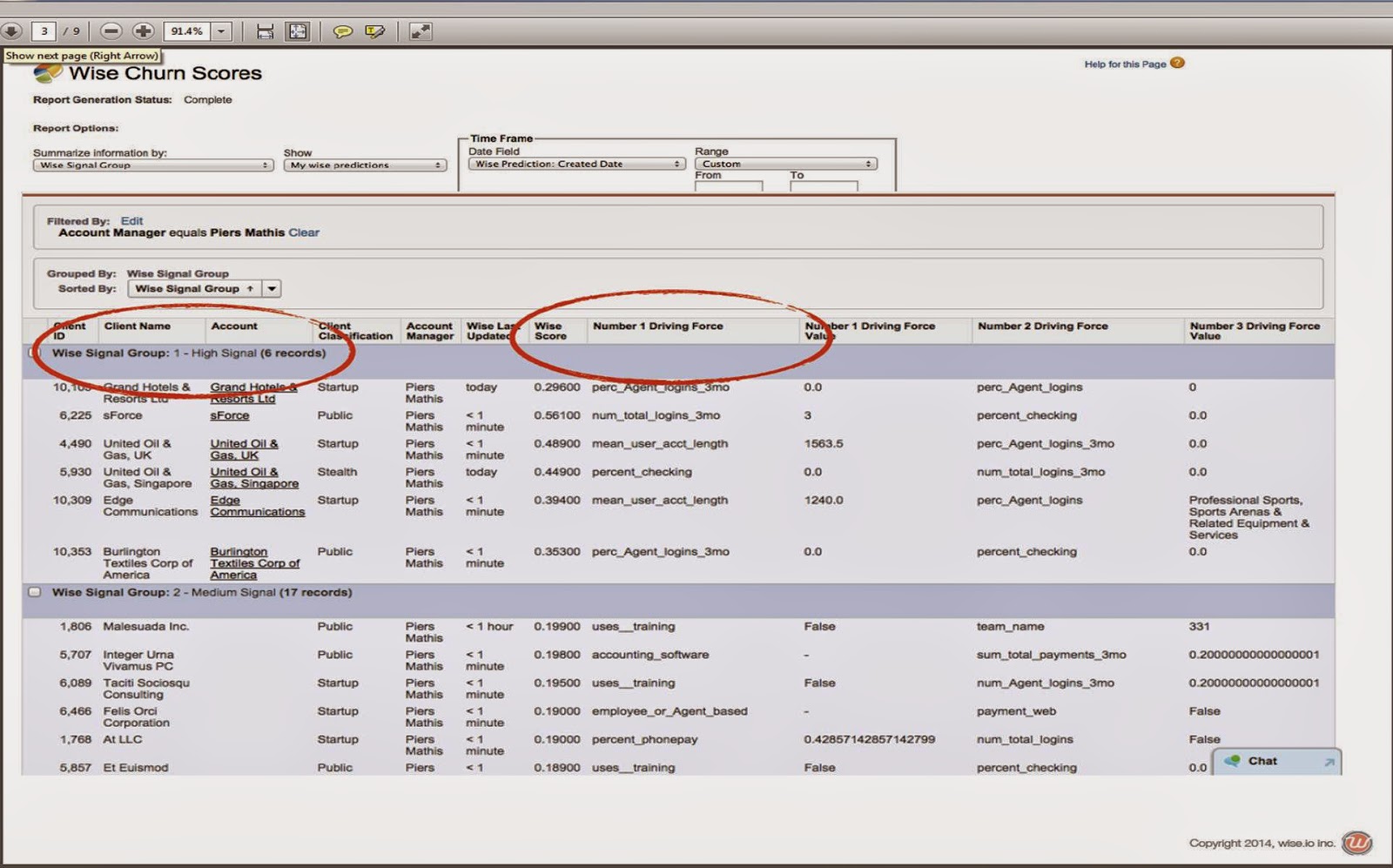
• outputs. Wise.io generates predictions, confidence scores for the predictions, and lists of drivers that show the reasons for the predictions. These are loaded into client systems where they can generate reports (see below) or be integrated with CRM or customer support agent interfaces.


• self-service.  After the initial setup, clients can build new models for themselves through a simple interface that basically involves specifying the source data, item to predict, and destination for the results. Adding a new data source would take some help from the vendor but should be pretty quick unless the source lacks a standard API or export tools.

• update frequency. Wise.io will load data in real time as it is updated in client systems, assuming the client system supports this. Scores will reflect the latest data. The system continuously and automatically updates its models to reflect new results.

• applications. Wise.io can be used for pretty much any predictive application, but the company has focused its initial efforts on customer support and retention. This involves tasks such as identifying churn risks and assigning support cases to the proper agent.

• cost. Pricing is based on the number of predictions the system generates, whether those are support tickets, email messages, or customer lists. Enterprise edition installations start in the mid-five figures (i.e., around $50,000) and can go considerably higher. A new self-service edition is limited to specific marketing automation, customer support, and CRM systems and costs somewhat less.

• vendor. The company was launched in 2013 and has some modest venture funding (published figures range from $2.5 million to $3.5 million). It has about a dozen production clients and another two dozen or so in pilot. Client include both consumer and business marketers.

Friday, October 24, 2014

SalesPredict Offers Highly Automated, Highly Flexible Predictive Modeling

A couple of weeks ago, I wrote that “predictive everywhere” is one of major trends in data-driven marketing.  I meant both that predictive models guide decisions at every stage in many marketing programs, and that models are used throughout the organization by marketing, sales, and service.

I might have added a third meaning: that systems to do predictive modeling are everywhere as well. SalesPredict is a perfect example: a small vendor with a powerful system that just launched earlier this year. Back in, say, 2008, a product like this would be big news. Today, I simply add them to my list and try to understand what makes them different.


In this case, the main technical differentiator is extreme automation: SalesPredict imports customer data, builds models, scores current records, and deploys the results with virtually no human intervention.  This is possible primarily because the painstaking work of preparing data for analysis – which is where model builders spend most of their time – is avoided by connecting to a few standard sources, currently Salesforce.com and Marketo with HubSpot soon to follow. Because it knows what to expect, the system can easily load customer data and sales results from those systems.  It then enhances the data with business and demographic information from public Web pages, social profiles, and third party sources including Zoominfo, InsideView, and Orb Intelligence.  Finally, it produces models that rank customers based on how closely they resemble members of any user-specified list, such as customers with deals that closed or who failed to renew.  Results appear as lists in a CRM interface or as scores on a marketing databaset. The whole process takes just a few hours from making the Salesforce.com connection to seeing scored records, with most of the time spent downloading CRM data and scanning the Web for other information. Once SalesPredict is installed, models are continuously updated based on new CRM information and on feedback provided by users as they review the scored records. This enables the system to automatically adjust as buyer behaviors and conditions change.

User interface is a second differentiator. CRM users see a ranked list of customer records with a system-assigned persona derived using advanced natural language processing, suggested actions such as which products to offer, and the key data values that influenced the ranking.  Users can drill further into each record to see more customer and company information including previous interactions, products owned, and won or lost deals. The company information is assembled from internal and external sources using SalesPredict’s own matching methods, so results are not at the mercy of data quality within the CRM. As previously noted, users can adjust a ranking if they feel the model is wrong; this is fed back to the system to adjust future predictions. Another screen shows which data values are most powerful in predicting success.  This helps users understand the model and suggests criteria for targeting increased marketing investment. Although there’s no great technical wizardry required to provide these interfaces (except perhaps the name and account matching), they do make results more easily understood than many other predictive modeling products.

The final differentiator is flexibility.  The system can model against any user-defined list, meaning that SalesPredict can score new leads, identify churn risk, or find the most likely buyers for new products. Recommendations also draw on a common technology, whether the system is suggesting which products a customer is most likely to buy, which content they are most likely to download, or which offers they are most likely to accept. That said, SalesPredict’s primarily integration with Salesforce.com, user interface, and company name itself suggest the vendor’s main focus is on helping sales users spend their time on the most productive lead.  This is somewhat different from predictive modeling vendors who have focused primarily on helping marketers with lead scoring.

Is SalesPredict right for you? Well, the automation and flexibility are highly attractive, but the dependence on CRM data may limit its value if you want to incorporate other sources. Pricing was originally based on the number of leads but is currently being revised, with no new details available.  However, it’s likely that the company will remain small-business-friendly in its approach. SalesPredict currently has about 15 clients, mostly in the technology industry but also with some in financial services and healthcare.

Tuesday, September 30, 2014

Vendor Selection Best Practices, Predictive Marketing Explained, Content Marketing Integration, and Other New Papers on Raab Web site

I've just gotten around to posting a  bunch of new white papers in the Resources section of the Raab Guide Web site.  Ordinarily you would need to register to view these, but I spent the whole afternoon putting this together, so I want as many people as possible to see them.  Here you go:

  • Defining Your Marketing Technology Strategy presents a framework for coordinating your marketing systems and links to an online tool that analyzes your current situations and recommends how to improve your systems.
  • Content Marketing Integration Workbook provides a set of checklists to help marketers understand how to integrate content marketing with their other marketing programs at the strategic, operational, and technical levels.
  • The Customer Data Platform describes an emerging class of products that combine marketing database management, centralizing treatment decisions, and integration with execution systems.

Thursday, August 28, 2014

6Sense Finds B2B Prospects Using Web Site Activities

I mentioned 6Sense briefly in a recent post about vendors who help companies find prospects on the Web. Since then, I’ve had a more detailed briefing, which clarified that their scope extends well beyond prospect lists to predictive models applied across all stages of the purchase cycle. We also clarified that users can extract company-level profiles including attributes (industry, revenue, etc.) and key activities (Web site visits, topics researched) and scores at both company and individual levels.

The extraction features are important – at least to me – because they determine whether 6Sense qualifies as a “customer data platform” (CDP), a type of system I see as fundamental for future marketing. As a quick refresher, CDP is defined as “a marketer-controlled system that supports external marketing execution based on persistent, cross-channel customer data.” The part about “supports external marketing execution” is where data extraction comes in: it means that external systems can access data within the CDP for their own use. 6Sense wouldn't be a CDP if it merely displayed its data on a CRM screen without letting the CRM system import it.  If 6Sense exposed model scores but no other data, it would qualify as a CDP by the thinnest margin possible.

Of course, there are more important things about 6Sense than whether I consider it a CDP. Starting at the beginning, the system imports a list of each client’s customers and sales opportunities from CRM and marketing automation systems. Standard integrations are available for Salesforce.com, Oracle Eloqua and Marketo.  APIs can load data from other sources, potentially including other CRM marketing automation products, Web logs and tags, order processing, bookings, call centers, media impressions, and pretty much anything else.

The system standardizes and deduplicates this data at the individual and company levels. It then matches against company profiles that 6Sense itself has gathered from the usual Web sources – public social media, Web sites, job boards, directories, etc. – and from a network of third-party Web sites. The Web site network is unusual if not unique among B2B data providers; the most similar offerings I can think of are audience profiles from B2C site networks, from owners of large B2B sites, and based on other B2B activity such as email response. The advantage of Web site activity is it finds companies early in the buying cycle, when they are most open to considering new vendors. The system can map known individuals to individuals on partner Web sites, using hashing techniques to avoid passing personally identifiable information.  .

The result of all this is a database with deep company and individual profiles including both attributes and activities. 6Sense uses this to build company and individual-level predictive models.  Company models score each company’s likelihood to buy from the client.  Individual models predict the individual’s likelihood to be the best sales contact. Models are built by 6Sense staff using automated techniques and take about three weeks to complete.

The system can also estimate what product each company is most likely to purchase, when it will buy, and what stage it has reached in the buying process. Stages are defined in consultation with the client. Assignment rules might use purchase likelihood or a predictive model trained against a sample of companies in each buying stage.

Outputs from 6Sense can include lists of likely new prospect companies (not in the client’s existing database), contacts at those companies, current prospects organized by purchase stage and ranked by purchase likelihood, current contacts within each company, and key indicators that drive each company’s score. The key indicators can be very specific, such as searches for competitors’ names, visits to product detail pages, or activity by known leads.

Users can define segments based on these or other attributes and export their related data to CRM, marketing automation, ad targeting, or Web personalization systems via file transfers or API calls. 6Sense can also display the information on screen to help guide sales conversations and is now testing an extension to recommend specific talking points.  

Pricing for 6Sense starts at more than $100,000 and is based on factors including the number of models created and volume of new net contacts provided.  The company was founded in 2013 and released early versions of its product that same year. Formal release was in May 2014. It has ten current customers and more in the pipeline.