V12 Group got its start in 2002 by appending demographic, behavioral, and other data to email lists. Since then, the company has added tools to help marketers make better use of this data, culminating in 2012 with Launchpad, which combined email and postal prospect lists, delivery services, display ads, and response analysis. This year V12 further expanded Launchpad by adding the ability to import and enhance clients’ own customer lists. It's still far from a complete marketing automation system: there are no multi-step workflows, event triggers, recurring campaigns, behavior tracking, CRM synchronization, touchpoint integration, or transaction database. But Launchpad does provide a way to assemble audiences and execute outbound promotions, placing it somewhere between simple email systems like Constant Contact and full-scale marketing automation products.
The core of Launchpad is its list selection interface. This is used to select names from V12’s master database of 208 million postal addresses, 80 million email addresses, and 150 million Web browser cookies; to segment previously purchased names; to retarget email responders and Web site visitors; and to select from the client’s own uploaded lists. Geographic selections begin with a U.S. state map but can also be based on Zip code, political boundaries, distance from a specified point, or user-drawn polygons. They can be further narrowed by demographics, behaviors, auto ownership, and other attributes. Users can also get lists of prospects similar to their uploaded customers, based on a system-generated predictive model. Audience counts are updated in seconds as users adjust their selections. If the audience is larger than desired, the user can specify a quantity and the system will automatically extract a random sample of that size. Users can also apply suppression lists, exclude previously selected names, and specify whether the system returns all individuals, one name per household, or one name per postal address.
For email campaigns, the system also lets users create emails based on templates, from uploaded HTML, or from scratch using a graphical page builder. Users can send test emails and include seed names. There is no built-in split test capability, although this is planned for future release. Today, users can copy an existing campaign as the foundation for a test version, but they would need to suppress the original audience as part of the list specification. Users can also deploy a standard, V12-hosted form to capture responses. Once a campaign is built, users can save it to a shopping cart where V12 shows the cost. V12 manually reviews each campaign to ensure it complies with spam regulations and other requirements. V12 sends the emails from its own domain. It will not provide actual email addresses on purchased names but does provide postal addresses on purchased names and on email responders. The company is adding integration with post card mailers.
Launchpad supports mobile marketing through mobile-friendly emails, mobile landing pages to capture user permissions, and text messages send to names where the client has received direct (first party) permission. Display advertising is handled through integration with MediaMath’s TerminalOne advertising system, which includes the V12 cookie pool as an audience option: users can select audience segments based on the V12 cookies, but cannot target specific individuals directly. Users can also set campaign and daily budgets, CPM targets, frequency caps, start and end dates, ad sources, inventory types, and geographic targets. Retargeting can be done through email lists or ad pixels. The CRM option lets clients upload their own customer lists, including custom fields, but doesn’t offer any type of contact management or associated data tables. Social media posting and listening is under development.
Reports include campaign quantities and responses, allow users to drill down to individual responders, and can calculate a simple Return on Investment based on actual costs and user-provided assumptions for response value.
Launchpad is offered directly to marketers but is sold largely through resellers including MasterCard, US Bank, SwissRe, Gannett, and YP Direct. Those firms offer the system to their own clients as a service. Direct pricing starts at $50 per month for a bundle including 1,000 emails to V12-provided prospects. Users can also purchase individual services such as data enhancements, prospect names, or customer record storage on a cost per thousand basis. The client base is ramping up quickly through the reseller channel: it is currently around 260 and expected to reach 1,000 by end of 2014 and projected to 5,000 by end of 2015. Most clients are small to mid-size B2C marketers ($1 million to $100 million revenue) although there are some B2B and larger B2C firms.
Wednesday, October 01, 2014
Tuesday, September 30, 2014
Vendor Selection Best Practices, Predictive Marketing Explained, Content Marketing Integration, and Other New Papers on Raab Web site
- Technology Evaluation Best Practices describes the challenges that marketers face in selecting the right systems and lists best practices to follow for success.
- What Matters Most In Selecting Marketing Automation explores survey results that highlight common errors when buying a marketing automation system and offers recommendations for how to avoid them.
- Why Modern B2B Marketers Need Predictive Marketing explains why predictive modeling has become essential to B2B marketers and describes specific applications.
- Defining Your Marketing Technology Strategy presents a framework for coordinating your marketing systems and links to an online tool that analyzes your current situations and recommends how to improve your systems.
- Content Marketing Integration Workbook provides a set of checklists to help marketers understand how to integrate content marketing with their other marketing programs at the strategic, operational, and technical levels.
- Questions to Ask When Selecting Your Customer Data Platform helps marketers to understand what a CDP is, whether they need one, and what specific questions to ask vendors when trying to pick the right system.
- The Customer Data Platform describes an emerging class of products that combine marketing database management, centralizing treatment decisions, and integration with execution systems.
Saturday, September 27, 2014
BlueConic Selects Targeted Messages Using a Cross-Channel Marketing Database
This blog has mentioned BlueConic in passing a couple of times but never quite gotten around to reviewing it in detail. Until now.
The delay may seem surprising, since BlueConic qualifies as a Customer Data Platform, a type of system I’ve been arguing will play an increasingly central role in marketers’ futures. For those of you who haven’t been paying close attention, a CDP is defined as a
• marketer-controlled system that
• supports external marketing execution based on
• persistent, cross-channel customer data.
This definition distinguishes CDPs from traditional marketing automation products, which do their own execution, and from real-time interaction managers, which lack persistent data stores. CDPs are important because few marketers have been able to build adequate cross-channel databases and because connecting those databases with execution systems has been difficult. The databases and connections are needed because today's customers expect personalized, coordinated treatments across all channels. Call it the “Amazon fallacy”: customers believe that since Amazon.com can give them highly personalized treatments, so can everyone else.
Anyway, back to BlueConic. The system has two main capabilities, which are to maintain customer profiles and to deliver targeted messages. The profiles can be based on data imported from other systems via batch processes or APIs or captured by BlueConic itself. It does this with “listeners” that can read data from forms or monitor behaviors via Javascript tags on Web pages, emails, and other media. “Listeners” can also create interest rankings and scores based on user behavior. All of these become available as attributes on the customer profile, which in turn can create customer segments and drive targeted messages.
The messages are delivered by what BlueConic calls “dialogues”, each of which sends a single message to a single location (email, text message, section on a Web page, etc.) to a specified customer segment. Messages tailored to customer interests would require creating a separate segment for each message. Similarly, presenting a sequence of messages would require a separate dialogue for each step in the sequence. If a customer is eligible for several dialogues at once, the system currently relies on an optimizer to pick best-responding option and will soon let users create rules to further guide the results. There is no built-in predictive modeling but the optimizer can continuously test alternative messages within a dialogue and automatically deploy the winner. Users can also apply a frequency cap to dialogues to limit the number of times any customer sees the same message.
BlueConic’s integration features are more extensive than its decision management. The system can capture data entered into forms even if the form ise not submitted. Users can insert message contains into an existing Web page without writing HTML code. Profiles capture customer identifiers provided by other systems and are automatically merged when two profiles are linked to the same external ID. Data is exchanged with other sources and execution systems via REST APIs. There are standard integrations with Twitter, Facebook, and Salesforce.com, as well as a system development kit for integration with mobile apps. The underlying data store is Apache Cassandra running on Amazon Web Services, which is highly flexible and scalable at moderate cost.
Integration and data management are what make BlueConic most interesting from a CDP perspective, since those are the core CDP functions. A “pure" CDP would provide only those services while leaving decision management and message delivery to other systems. I expect “pure” CDPs to appear, but most marketers prefer a broader solution, like BlueConic, to assembling the components for themselves. Pure CDPs will become more attractive as integration becomes easier through more standard APIs and connectors, a promise that cloud-based systems often make but are just starting to deliver.
BlueConic’s pricing is already data-centric: fees are based on numbers of profile and channels, not interactions or messages. Prices start around $1,000 per month although most clients pay more. Current implementations are mid-size and enterprise firms in B2C industries including retail, publishing, financial services, utilities, telecommunications, sports and travel. The system has about 70 current customers and is sold both directly and to partners such as ad agencies, other software vendors, and marketing service providers.
The delay may seem surprising, since BlueConic qualifies as a Customer Data Platform, a type of system I’ve been arguing will play an increasingly central role in marketers’ futures. For those of you who haven’t been paying close attention, a CDP is defined as a
• marketer-controlled system that
• supports external marketing execution based on
• persistent, cross-channel customer data.
This definition distinguishes CDPs from traditional marketing automation products, which do their own execution, and from real-time interaction managers, which lack persistent data stores. CDPs are important because few marketers have been able to build adequate cross-channel databases and because connecting those databases with execution systems has been difficult. The databases and connections are needed because today's customers expect personalized, coordinated treatments across all channels. Call it the “Amazon fallacy”: customers believe that since Amazon.com can give them highly personalized treatments, so can everyone else.
Anyway, back to BlueConic. The system has two main capabilities, which are to maintain customer profiles and to deliver targeted messages. The profiles can be based on data imported from other systems via batch processes or APIs or captured by BlueConic itself. It does this with “listeners” that can read data from forms or monitor behaviors via Javascript tags on Web pages, emails, and other media. “Listeners” can also create interest rankings and scores based on user behavior. All of these become available as attributes on the customer profile, which in turn can create customer segments and drive targeted messages.
The messages are delivered by what BlueConic calls “dialogues”, each of which sends a single message to a single location (email, text message, section on a Web page, etc.) to a specified customer segment. Messages tailored to customer interests would require creating a separate segment for each message. Similarly, presenting a sequence of messages would require a separate dialogue for each step in the sequence. If a customer is eligible for several dialogues at once, the system currently relies on an optimizer to pick best-responding option and will soon let users create rules to further guide the results. There is no built-in predictive modeling but the optimizer can continuously test alternative messages within a dialogue and automatically deploy the winner. Users can also apply a frequency cap to dialogues to limit the number of times any customer sees the same message.
BlueConic’s integration features are more extensive than its decision management. The system can capture data entered into forms even if the form ise not submitted. Users can insert message contains into an existing Web page without writing HTML code. Profiles capture customer identifiers provided by other systems and are automatically merged when two profiles are linked to the same external ID. Data is exchanged with other sources and execution systems via REST APIs. There are standard integrations with Twitter, Facebook, and Salesforce.com, as well as a system development kit for integration with mobile apps. The underlying data store is Apache Cassandra running on Amazon Web Services, which is highly flexible and scalable at moderate cost.
Integration and data management are what make BlueConic most interesting from a CDP perspective, since those are the core CDP functions. A “pure" CDP would provide only those services while leaving decision management and message delivery to other systems. I expect “pure” CDPs to appear, but most marketers prefer a broader solution, like BlueConic, to assembling the components for themselves. Pure CDPs will become more attractive as integration becomes easier through more standard APIs and connectors, a promise that cloud-based systems often make but are just starting to deliver.
BlueConic’s pricing is already data-centric: fees are based on numbers of profile and channels, not interactions or messages. Prices start around $1,000 per month although most clients pay more. Current implementations are mid-size and enterprise firms in B2C industries including retail, publishing, financial services, utilities, telecommunications, sports and travel. The system has about 70 current customers and is sold both directly and to partners such as ad agencies, other software vendors, and marketing service providers.
Tuesday, September 16, 2014
HubSpot Jumps into the CRM Marketplace
Hell probably didn’t freeze over today but there might have been a light frost: after years of rejecting the option, HubSpot today announced it will offer a CRM system.
The news was the climax of the founders’ keynote at the company’s annual Inbound Conference, which has yet again doubled to reach 10,000 attendees. Audience response was predictably enthusiastic, since CRM features have been much desired by HubSpot users and resellers for years. The system itself offers standard CRM features – contacts and company records, calendar management, emails, activity logging, tasks, deal tracking – combined with automated population of company and prospect information from Web sources and Twitter activity. There’s also a neat feature that finds existing relationships between a company and email accounts within the user’s own address book and other address books (presumably of co-workers) who have granted access. Another feature goes a step further and provides finds data on other companies that are similar to a current prospect. The goal of all these features is to find useful relationships and information while minimizing manual research and data entry by sales reps. HubSpot hopes this will encourage adoption of CRM by sales reps who have rejected it because it took too much work for too little value.
The product looked quite nice, although I think most of the features are already available in other CRM systems or add-ons. Having them easily available in a single product is convenient, but what’s really interesting is the integration of CRM with HubSpot’s marketing features and underlying database. This provides a combined sales and marketing system that’s quite unusual for mid-market companies. The approach is standard in systems for very small businesses, such as Infusionsoft and Ontraport. But that’s a different market, and one which HubSpot managers make clear they don’t want to target (although I’m sure HubSpot has many such businesses in its current customer base).
Even more unusual for the mid-market, HubSpot is offering the system for free: initially to its current customers, and to the rest of the world some time next year. The free version will have some limits, likely related to features and database size, although the company hasn’t decided on the details. This follows the model of HubSpot’s current sales enablement system, Signals, which provided some behavior tracking and itself is being expanded and renamed Sidekick. HubSpot said it already has 100,000 Signals users, who greatly outnumber the 11,500 customers of its flagship marketing system.
The business strategy behind the new system is fascinating if you’re interested in that sort of thing. It’s a continuation of HubSpot’s transition from a purely marketer-focused focused company (remember that started as a tool to attract search traffic) to one that serves all customer-facing departments. This gives it access to the CRM market, which is much larger than marketing automation and would get even bigger if HubSpot succeeds where existing mid-market CRMs have failed. For a company that wants to keep growing, movement from marketing into the adjacent CRM space is probably irresistible. Can a HubSpot service offering be far behind?
Of course, there’s an obvious risk of HubSpot losing focus as it shifts to serving a broader range of users. But the alternative is being stuck in a marketing system space that is itself adding new requirements well beyond the current standard marketing automation features, such as integration with paid advertising and Web experience management. It might soon be easier to stay competitive with other CRM systems than to meet the full needs of omni-channel, integrated marketers.
It’s hard to imagine HubSpot actually abandoning its marketing users, but that might be an option that company’s managers are keeping open by developing a new base in the CRM industry. The analogy that HubSpot leaders used more than once was Apple creating the iPod as a separate business serving a much larger audience than the MacIntosh computer. Their intent seems to be that the broader business would introduce the brand to new companies who would then buy the original product. But it has surely occurred to them that if the new business is hugely successful then it will be much less painful should the original business shrivel away.
(Just to clarify: HubSpot will continue to integrate with Salesforce.com and other CRM systems; in fact, it announced several new integrations during the same keynote. HubSpot managers said only one-third of their clients currently integrate with a CRM system and about two-thirds of those, or 20% of the total, integrate with Salesforce.com. HubSpot's goal is to serve people not currently using CRM, not to take sales away from existing CRM vendors.)
Update - September 17
I’ve now had a bit more time to digest this news. My basic opinion hasn’t changed but some doubts have crept in. Freemium hasn’t worked well in either the marketing automation or CRM markets, probably because succeeding with both types of system take serious commitment from a client, whereas the whole point of freemium is to allow casual trials. CRM also takes some serious customer support, as HubSpot managers are fully aware, which makes it harder to justify economically. Perhaps HubSpot could convince its partners to handle some of the support for freemium customers in exchange for access to potential new customers. Tom Sawyer would approve.
Nor, now that I think about it, is the combination of marketing automation and CRM so uncommon among small to mid market marketing automation systems. It’s true that most of those products are more like basic contact management than true CRM, with the specific distinction being whether they track opportunities (deals) as an independent object: HubSpot CRM does this while I think most of the other CRM-within-marketing automation options don’t. The distinction is probably important because it means there’s a good chance of people starting to use HubSpot CRM without HubSpot marketing automation, which of course is exactly HubSpot’s goal. But, again, the risk here is that HubSpot CRM will attract smaller businesses than HubSpot really wants as it tries to move closer to the middle of the market.
I’m also reconsidering my fundamental premise that the CRM business is fundamentally more attractive than selling to marketers. If memory serves, CRM software revenues are estimated at $3 to $4 billion, which is bigger than the $1 billion for marketing automation but not by such a huge margin. Nor is CRM especially profitable: like marketing automation, it suffers from a glut of competitors because it is fundamentally easy to enter. So it’s a good thing that HubSpot sees CRM as the gateway drug to marketing systems, not a profit center of its own.
Or, perhaps more cleverly, they see CRM as a gateway to establishing themselves as a platform vendor at new clients. HubSpot hasn’t used that term very much, but they did stress that the CRM and marketing system use the same database and are accessed through the same APIs. In this view, HubSpot CRM would build a database that allows HubSpot to sell other, future applications at the companies that install it. These could be HubSpot’s own applications or third party apps sold through its marketplace. That might be a better long-term strategy, since the explosion of marketing technology will make it increasingly unlikely that HubSpot alone can provide a full range of marketing and sales functions – even though HubSpot so far has been more aggressive than most at trying to provide core capabilities (marketing automation, Web content management, and now CRM) all by itself. Repeat after me: the suite is dead.
However things play out, the new CRM product gives HubSpot several options it lacked before. For that reason alone, it still strikes me as a good move.
The news was the climax of the founders’ keynote at the company’s annual Inbound Conference, which has yet again doubled to reach 10,000 attendees. Audience response was predictably enthusiastic, since CRM features have been much desired by HubSpot users and resellers for years. The system itself offers standard CRM features – contacts and company records, calendar management, emails, activity logging, tasks, deal tracking – combined with automated population of company and prospect information from Web sources and Twitter activity. There’s also a neat feature that finds existing relationships between a company and email accounts within the user’s own address book and other address books (presumably of co-workers) who have granted access. Another feature goes a step further and provides finds data on other companies that are similar to a current prospect. The goal of all these features is to find useful relationships and information while minimizing manual research and data entry by sales reps. HubSpot hopes this will encourage adoption of CRM by sales reps who have rejected it because it took too much work for too little value.
The product looked quite nice, although I think most of the features are already available in other CRM systems or add-ons. Having them easily available in a single product is convenient, but what’s really interesting is the integration of CRM with HubSpot’s marketing features and underlying database. This provides a combined sales and marketing system that’s quite unusual for mid-market companies. The approach is standard in systems for very small businesses, such as Infusionsoft and Ontraport. But that’s a different market, and one which HubSpot managers make clear they don’t want to target (although I’m sure HubSpot has many such businesses in its current customer base).
Even more unusual for the mid-market, HubSpot is offering the system for free: initially to its current customers, and to the rest of the world some time next year. The free version will have some limits, likely related to features and database size, although the company hasn’t decided on the details. This follows the model of HubSpot’s current sales enablement system, Signals, which provided some behavior tracking and itself is being expanded and renamed Sidekick. HubSpot said it already has 100,000 Signals users, who greatly outnumber the 11,500 customers of its flagship marketing system.
The business strategy behind the new system is fascinating if you’re interested in that sort of thing. It’s a continuation of HubSpot’s transition from a purely marketer-focused focused company (remember that started as a tool to attract search traffic) to one that serves all customer-facing departments. This gives it access to the CRM market, which is much larger than marketing automation and would get even bigger if HubSpot succeeds where existing mid-market CRMs have failed. For a company that wants to keep growing, movement from marketing into the adjacent CRM space is probably irresistible. Can a HubSpot service offering be far behind?
Of course, there’s an obvious risk of HubSpot losing focus as it shifts to serving a broader range of users. But the alternative is being stuck in a marketing system space that is itself adding new requirements well beyond the current standard marketing automation features, such as integration with paid advertising and Web experience management. It might soon be easier to stay competitive with other CRM systems than to meet the full needs of omni-channel, integrated marketers.
It’s hard to imagine HubSpot actually abandoning its marketing users, but that might be an option that company’s managers are keeping open by developing a new base in the CRM industry. The analogy that HubSpot leaders used more than once was Apple creating the iPod as a separate business serving a much larger audience than the MacIntosh computer. Their intent seems to be that the broader business would introduce the brand to new companies who would then buy the original product. But it has surely occurred to them that if the new business is hugely successful then it will be much less painful should the original business shrivel away.
(Just to clarify: HubSpot will continue to integrate with Salesforce.com and other CRM systems; in fact, it announced several new integrations during the same keynote. HubSpot managers said only one-third of their clients currently integrate with a CRM system and about two-thirds of those, or 20% of the total, integrate with Salesforce.com. HubSpot's goal is to serve people not currently using CRM, not to take sales away from existing CRM vendors.)
Update - September 17
I’ve now had a bit more time to digest this news. My basic opinion hasn’t changed but some doubts have crept in. Freemium hasn’t worked well in either the marketing automation or CRM markets, probably because succeeding with both types of system take serious commitment from a client, whereas the whole point of freemium is to allow casual trials. CRM also takes some serious customer support, as HubSpot managers are fully aware, which makes it harder to justify economically. Perhaps HubSpot could convince its partners to handle some of the support for freemium customers in exchange for access to potential new customers. Tom Sawyer would approve.
Nor, now that I think about it, is the combination of marketing automation and CRM so uncommon among small to mid market marketing automation systems. It’s true that most of those products are more like basic contact management than true CRM, with the specific distinction being whether they track opportunities (deals) as an independent object: HubSpot CRM does this while I think most of the other CRM-within-marketing automation options don’t. The distinction is probably important because it means there’s a good chance of people starting to use HubSpot CRM without HubSpot marketing automation, which of course is exactly HubSpot’s goal. But, again, the risk here is that HubSpot CRM will attract smaller businesses than HubSpot really wants as it tries to move closer to the middle of the market.
I’m also reconsidering my fundamental premise that the CRM business is fundamentally more attractive than selling to marketers. If memory serves, CRM software revenues are estimated at $3 to $4 billion, which is bigger than the $1 billion for marketing automation but not by such a huge margin. Nor is CRM especially profitable: like marketing automation, it suffers from a glut of competitors because it is fundamentally easy to enter. So it’s a good thing that HubSpot sees CRM as the gateway drug to marketing systems, not a profit center of its own.
Or, perhaps more cleverly, they see CRM as a gateway to establishing themselves as a platform vendor at new clients. HubSpot hasn’t used that term very much, but they did stress that the CRM and marketing system use the same database and are accessed through the same APIs. In this view, HubSpot CRM would build a database that allows HubSpot to sell other, future applications at the companies that install it. These could be HubSpot’s own applications or third party apps sold through its marketplace. That might be a better long-term strategy, since the explosion of marketing technology will make it increasingly unlikely that HubSpot alone can provide a full range of marketing and sales functions – even though HubSpot so far has been more aggressive than most at trying to provide core capabilities (marketing automation, Web content management, and now CRM) all by itself. Repeat after me: the suite is dead.
However things play out, the new CRM product gives HubSpot several options it lacked before. For that reason alone, it still strikes me as a good move.
Tuesday, September 02, 2014
Marketing Foundations Analysis Tool: Gap Analysis, Recommendations, and Benchmark for Your Marketing Systems
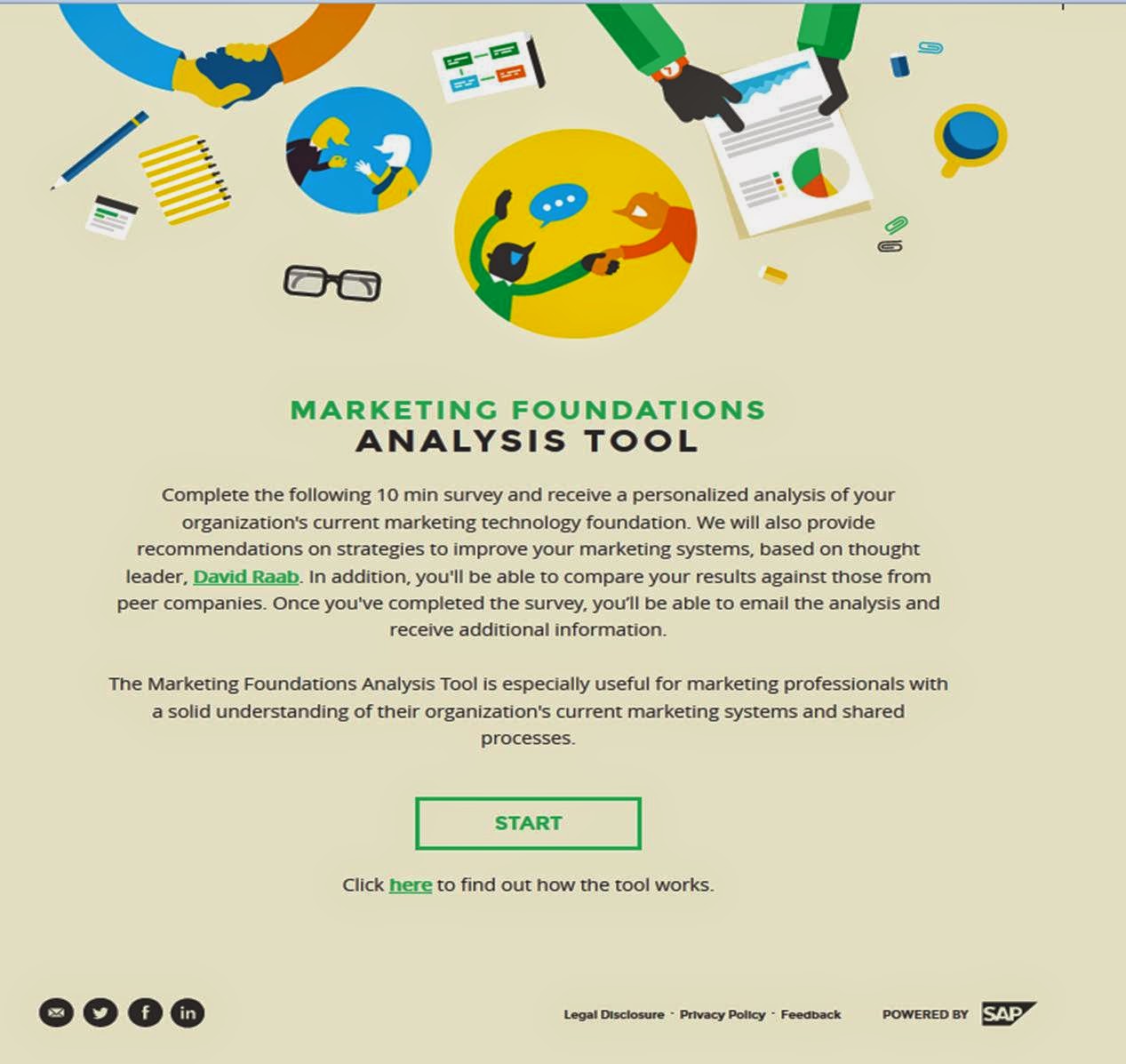
Way back in January, I began working with SAP on a set of worksheets to help marketers assess their customer management systems. The much-evolved fruits of that effort were released today as the Marketing Foundations Analysis Tool, a fully automated system that asks users a series of questions about their current systems, marketing programs, and company background, and returns recommendations for system changes and how to manage the transition. Survey-takers will also be shown how their current systems compare with everyone else who answered the questions.
The key insight powering this project was that there are relatively few types of marketing programs and systems. That may not sound very important (or surprising), but it means the problem is simple enough to address with a relatively small amount of user input and business logic. Specifically, it's practical for a survey to ask marketers which programs they want and what their current systems look like. From there, it's fairly easy to specify the system capabilities required to run each program, to aggregate these into a consolidated set of requirements, and to compare the requirements with existing capabilities for a gap analysis. This can be combined with information about the company to generate recommendations for what to do next.
In fact, if anything surprised me during this project, it was how much information could be derived from a relatively small amount of user input. The Analysis Tool asks about:
- nine types of marketing programs, ranging from customer profiling to real time interactions to loyalty programs to marketing measurement. Users specify whether they currently run each program, want to run it in the future, or have no interest.
- thirteen types of customer-facing systems, ranging from email and Web sites to display ads, retail point of sale, and customer account management. These are rated on a spectrum of integration capabilities, from being totally isolated to allowing real time interactions.
- seven types of shared customer data processes, ranging from single customer view to predictive modeling to treatment selection to advanced analytics. Each process is rated on different capabilities, such as calculating scores for predictive modeling and handling unstructured data within the single customer view.
That's it -- just 29 items, although some do have subitems. Based on those inputs, the Analysis Tool produces recommendations covering:
- general architecture (integrated suite, shared customer data platform, or application-based) and change strategy
- industry-specific issues to address, such as regulatory concerns
- opportunities to improve business results by running more marketing programs
- coordinating changes to marketing programs with changes to systems
- changes to customer-facing systems (over-all and whether to keep, enhance, or replace individual systems)
- changes to shared customer data processes (over-all and process-by-process)
That's a lot of information, and it doesn't even include the benchmark comparing your answers to everyone else's. Not bad for free. Thanks, SAP!
So how does this all work? To peel back the covers just a bit, the recommendations are made by first classifying results into general categories such as “few active applications” or “mostly simple systems”, and then applying rules to select pre-written answers. For example, a company with "few active applications" and "many desired applications" is told:
Assessment: Your company is running relatively few current marketing applications but wants to add many more. This could be a challenge given your relatively limited experience.
Recommendation: Prioritize the new applications so you don’t make too many changes at once. Start with applications that require relatively little change but also offer significant rewards. These should add capabilities that will also be used for subsequent new applications. Measure results carefully and prove success before moving on to make more changes.
Obviously I’m biased, but I think that level of advice is specific enough to be useful. It can’t replace the insight of a human analyst who can assess the situation in more detail and may see connections that simple rules will miss. But it certainly provides a starting point for discussions and a base of data to work with. Well worth a ten minute investment of your time.
Again, you can try the tool here. You can take it anonymously and view the results on screen, or give SAP your email and have them send you a copy of the report. Either way, give it a shot and let me know what you think.
The key insight powering this project was that there are relatively few types of marketing programs and systems. That may not sound very important (or surprising), but it means the problem is simple enough to address with a relatively small amount of user input and business logic. Specifically, it's practical for a survey to ask marketers which programs they want and what their current systems look like. From there, it's fairly easy to specify the system capabilities required to run each program, to aggregate these into a consolidated set of requirements, and to compare the requirements with existing capabilities for a gap analysis. This can be combined with information about the company to generate recommendations for what to do next.
In fact, if anything surprised me during this project, it was how much information could be derived from a relatively small amount of user input. The Analysis Tool asks about:
- nine types of marketing programs, ranging from customer profiling to real time interactions to loyalty programs to marketing measurement. Users specify whether they currently run each program, want to run it in the future, or have no interest.
- thirteen types of customer-facing systems, ranging from email and Web sites to display ads, retail point of sale, and customer account management. These are rated on a spectrum of integration capabilities, from being totally isolated to allowing real time interactions.
- seven types of shared customer data processes, ranging from single customer view to predictive modeling to treatment selection to advanced analytics. Each process is rated on different capabilities, such as calculating scores for predictive modeling and handling unstructured data within the single customer view.
That's it -- just 29 items, although some do have subitems. Based on those inputs, the Analysis Tool produces recommendations covering:
- general architecture (integrated suite, shared customer data platform, or application-based) and change strategy
- industry-specific issues to address, such as regulatory concerns
- opportunities to improve business results by running more marketing programs
- coordinating changes to marketing programs with changes to systems
- changes to customer-facing systems (over-all and whether to keep, enhance, or replace individual systems)
- changes to shared customer data processes (over-all and process-by-process)
That's a lot of information, and it doesn't even include the benchmark comparing your answers to everyone else's. Not bad for free. Thanks, SAP!
So how does this all work? To peel back the covers just a bit, the recommendations are made by first classifying results into general categories such as “few active applications” or “mostly simple systems”, and then applying rules to select pre-written answers. For example, a company with "few active applications" and "many desired applications" is told:
Assessment: Your company is running relatively few current marketing applications but wants to add many more. This could be a challenge given your relatively limited experience.
Recommendation: Prioritize the new applications so you don’t make too many changes at once. Start with applications that require relatively little change but also offer significant rewards. These should add capabilities that will also be used for subsequent new applications. Measure results carefully and prove success before moving on to make more changes.
Obviously I’m biased, but I think that level of advice is specific enough to be useful. It can’t replace the insight of a human analyst who can assess the situation in more detail and may see connections that simple rules will miss. But it certainly provides a starting point for discussions and a base of data to work with. Well worth a ten minute investment of your time.
Again, you can try the tool here. You can take it anonymously and view the results on screen, or give SAP your email and have them send you a copy of the report. Either way, give it a shot and let me know what you think.
Thursday, August 28, 2014
6Sense Finds B2B Prospects Using Web Site Activities
I mentioned 6Sense briefly in a recent post about vendors who help companies find prospects on the Web. Since then, I’ve had a more detailed briefing, which clarified that their scope extends well beyond prospect lists to predictive models applied across all stages of the purchase cycle. We also clarified that users can extract company-level profiles including attributes (industry, revenue, etc.) and key activities (Web site visits, topics researched) and scores at both company and individual levels.
The extraction features are important – at least to me – because they determine whether 6Sense qualifies as a “customer data platform” (CDP), a type of system I see as fundamental for future marketing. As a quick refresher, CDP is defined as “a marketer-controlled system that supports external marketing execution based on persistent, cross-channel customer data.” The part about “supports external marketing execution” is where data extraction comes in: it means that external systems can access data within the CDP for their own use. 6Sense wouldn't be a CDP if it merely displayed its data on a CRM screen without letting the CRM system import it. If 6Sense exposed model scores but no other data, it would qualify as a CDP by the thinnest margin possible.
Of course, there are more important things about 6Sense than whether I consider it a CDP. Starting at the beginning, the system imports a list of each client’s customers and sales opportunities from CRM and marketing automation systems. Standard integrations are available for Salesforce.com, Oracle Eloqua and Marketo. APIs can load data from other sources, potentially including other CRM marketing automation products, Web logs and tags, order processing, bookings, call centers, media impressions, and pretty much anything else.
The system standardizes and deduplicates this data at the individual and company levels. It then matches against company profiles that 6Sense itself has gathered from the usual Web sources – public social media, Web sites, job boards, directories, etc. – and from a network of third-party Web sites. The Web site network is unusual if not unique among B2B data providers; the most similar offerings I can think of are audience profiles from B2C site networks, from owners of large B2B sites, and based on other B2B activity such as email response. The advantage of Web site activity is it finds companies early in the buying cycle, when they are most open to considering new vendors. The system can map known individuals to individuals on partner Web sites, using hashing techniques to avoid passing personally identifiable information. .
The result of all this is a database with deep company and individual profiles including both attributes and activities. 6Sense uses this to build company and individual-level predictive models. Company models score each company’s likelihood to buy from the client. Individual models predict the individual’s likelihood to be the best sales contact. Models are built by 6Sense staff using automated techniques and take about three weeks to complete.
The system can also estimate what product each company is most likely to purchase, when it will buy, and what stage it has reached in the buying process. Stages are defined in consultation with the client. Assignment rules might use purchase likelihood or a predictive model trained against a sample of companies in each buying stage.
Outputs from 6Sense can include lists of likely new prospect companies (not in the client’s existing database), contacts at those companies, current prospects organized by purchase stage and ranked by purchase likelihood, current contacts within each company, and key indicators that drive each company’s score. The key indicators can be very specific, such as searches for competitors’ names, visits to product detail pages, or activity by known leads.
Users can define segments based on these or other attributes and export their related data to CRM, marketing automation, ad targeting, or Web personalization systems via file transfers or API calls. 6Sense can also display the information on screen to help guide sales conversations and is now testing an extension to recommend specific talking points.
Pricing for 6Sense starts at more than $100,000 and is based on factors including the number of models created and volume of new net contacts provided. The company was founded in 2013 and released early versions of its product that same year. Formal release was in May 2014. It has ten current customers and more in the pipeline.
The extraction features are important – at least to me – because they determine whether 6Sense qualifies as a “customer data platform” (CDP), a type of system I see as fundamental for future marketing. As a quick refresher, CDP is defined as “a marketer-controlled system that supports external marketing execution based on persistent, cross-channel customer data.” The part about “supports external marketing execution” is where data extraction comes in: it means that external systems can access data within the CDP for their own use. 6Sense wouldn't be a CDP if it merely displayed its data on a CRM screen without letting the CRM system import it. If 6Sense exposed model scores but no other data, it would qualify as a CDP by the thinnest margin possible.
Of course, there are more important things about 6Sense than whether I consider it a CDP. Starting at the beginning, the system imports a list of each client’s customers and sales opportunities from CRM and marketing automation systems. Standard integrations are available for Salesforce.com, Oracle Eloqua and Marketo. APIs can load data from other sources, potentially including other CRM marketing automation products, Web logs and tags, order processing, bookings, call centers, media impressions, and pretty much anything else.
The system standardizes and deduplicates this data at the individual and company levels. It then matches against company profiles that 6Sense itself has gathered from the usual Web sources – public social media, Web sites, job boards, directories, etc. – and from a network of third-party Web sites. The Web site network is unusual if not unique among B2B data providers; the most similar offerings I can think of are audience profiles from B2C site networks, from owners of large B2B sites, and based on other B2B activity such as email response. The advantage of Web site activity is it finds companies early in the buying cycle, when they are most open to considering new vendors. The system can map known individuals to individuals on partner Web sites, using hashing techniques to avoid passing personally identifiable information. .
The result of all this is a database with deep company and individual profiles including both attributes and activities. 6Sense uses this to build company and individual-level predictive models. Company models score each company’s likelihood to buy from the client. Individual models predict the individual’s likelihood to be the best sales contact. Models are built by 6Sense staff using automated techniques and take about three weeks to complete.
The system can also estimate what product each company is most likely to purchase, when it will buy, and what stage it has reached in the buying process. Stages are defined in consultation with the client. Assignment rules might use purchase likelihood or a predictive model trained against a sample of companies in each buying stage.
Outputs from 6Sense can include lists of likely new prospect companies (not in the client’s existing database), contacts at those companies, current prospects organized by purchase stage and ranked by purchase likelihood, current contacts within each company, and key indicators that drive each company’s score. The key indicators can be very specific, such as searches for competitors’ names, visits to product detail pages, or activity by known leads.
Users can define segments based on these or other attributes and export their related data to CRM, marketing automation, ad targeting, or Web personalization systems via file transfers or API calls. 6Sense can also display the information on screen to help guide sales conversations and is now testing an extension to recommend specific talking points.
Pricing for 6Sense starts at more than $100,000 and is based on factors including the number of models created and volume of new net contacts provided. The company was founded in 2013 and released early versions of its product that same year. Formal release was in May 2014. It has ten current customers and more in the pipeline.
Tuesday, August 26, 2014
HubSpot Files for IPO: Solid Financials for a Young Company
HubSpot filed its much-anticipated S-1 for a public stock offering yesterday. Since the company has been admirably transparent all along about its finances, there were no big surprises: they lose considerable money, as expected, but their expenses seem about in line. A comparison with the S-1 figures of Eloqua and Marketo, plus Marketo’s most recent six months, shows:
- loss equal to 35% of revenue, compared with 11% for Eloqua (which was run very conservatively) and 55% for Marketo (which was highly aggressive).
- high absolute revenue level (well on track to exceed $100 million for the year, about 20% higher than Eloqua and 60% higher than Marketo at the time of S-1).
- subscription and support costs are 25% of subscription revenue, in between Eloqua and Marketo. (This ratio is important because it hints at the profitability of on-going operations regardless of sales costs. Marketo has made great strides in bringing it down since their S-1. Marketo’s R&D costs are also now more in line, at 21% of revenue. In fact, Marketo today looks a lot like the HubSpot S-1.)
- sales and marketing costs at 64% of revenue, well above Eloqua (which was growing much more slowly) and similar to Marketo (which was growing slightly faster).
The basic picture, then, is a disciplined company that has grown quickly while keeping costs in line. As I say, pretty much what we suspected.
The S-1 does provide some other insights – in particular, highlighting HubSpot’s shift in focus from very small businesses to mid-size business. The following table, taken directly from the S-1, shows this clearly: revenue per customer has climbed steadily from $5,395 in 2011 to $8,823 in the first half of 2014 – a 64% increase. Still, the average revenue per client is nowhere near Marketo, which is in the $30,000 to $40,000 range.
The table also shows that customer acquisition cost has increased by 76%, which is even more than average revenue. This makes sense: it’s harder to sell bigger accounts. The increased cost might be worrisome – it means HubSpot is losing more money on each new account – but the higher lifetime revenue means the difference will be made up fairly quickly. Even more important, the "subscription dollar retention rate" has improved sharply, from 71.6% to 90.3%, probably reflecting a combinatino of better customer retention, higher revenue from existing customers, and an increase average revenue from new customers.
The S-1 also reveals that agencies and agency referrals accounted for 42% of customers and 33% of revenue for the six months ended June 30, 2014 – meaning that agency clients tend to be smaller than average. I’d expect HubSpot to have more direct sales as it engages larger clients, but that doesn’t seem to be the case, at least yet: compensation to agency partners grew by $1.2 million for all of 2013 and by $0.9 million for the first half of 2014, suggesting a 50% or better increase for the year as a whole. This is roughly in line with over-all revenue growth.
In fact, the only thing that struck me as a bit odd in the prospectus was HubSpot’s frequent description of itself as an “all in one” marketing and sales solution – a term more usually applied to micro-business specialists like Infusionsoft and Ontraport, which combine marketing automation with CRM. HubSpot does make several references to supporting sales departments in its document, which a casual reader might interpret to mean it also provides CRM features. But this is something the company has adamantly refused to do for years, despite pressure from its original small business clients and the partners who serve them. It makes even less sense when selling to the mid-market. The prospectus does eventually state that its sales features are designed to integrate with CRM, but the ambiguity is atypically off-message for a firm that is usually so clear about its position.
- loss equal to 35% of revenue, compared with 11% for Eloqua (which was run very conservatively) and 55% for Marketo (which was highly aggressive).
- high absolute revenue level (well on track to exceed $100 million for the year, about 20% higher than Eloqua and 60% higher than Marketo at the time of S-1).
- subscription and support costs are 25% of subscription revenue, in between Eloqua and Marketo. (This ratio is important because it hints at the profitability of on-going operations regardless of sales costs. Marketo has made great strides in bringing it down since their S-1. Marketo’s R&D costs are also now more in line, at 21% of revenue. In fact, Marketo today looks a lot like the HubSpot S-1.)
- sales and marketing costs at 64% of revenue, well above Eloqua (which was growing much more slowly) and similar to Marketo (which was growing slightly faster).
The basic picture, then, is a disciplined company that has grown quickly while keeping costs in line. As I say, pretty much what we suspected.
The S-1 does provide some other insights – in particular, highlighting HubSpot’s shift in focus from very small businesses to mid-size business. The following table, taken directly from the S-1, shows this clearly: revenue per customer has climbed steadily from $5,395 in 2011 to $8,823 in the first half of 2014 – a 64% increase. Still, the average revenue per client is nowhere near Marketo, which is in the $30,000 to $40,000 range.
The table also shows that customer acquisition cost has increased by 76%, which is even more than average revenue. This makes sense: it’s harder to sell bigger accounts. The increased cost might be worrisome – it means HubSpot is losing more money on each new account – but the higher lifetime revenue means the difference will be made up fairly quickly. Even more important, the "subscription dollar retention rate" has improved sharply, from 71.6% to 90.3%, probably reflecting a combinatino of better customer retention, higher revenue from existing customers, and an increase average revenue from new customers.
The S-1 also reveals that agencies and agency referrals accounted for 42% of customers and 33% of revenue for the six months ended June 30, 2014 – meaning that agency clients tend to be smaller than average. I’d expect HubSpot to have more direct sales as it engages larger clients, but that doesn’t seem to be the case, at least yet: compensation to agency partners grew by $1.2 million for all of 2013 and by $0.9 million for the first half of 2014, suggesting a 50% or better increase for the year as a whole. This is roughly in line with over-all revenue growth.
In fact, the only thing that struck me as a bit odd in the prospectus was HubSpot’s frequent description of itself as an “all in one” marketing and sales solution – a term more usually applied to micro-business specialists like Infusionsoft and Ontraport, which combine marketing automation with CRM. HubSpot does make several references to supporting sales departments in its document, which a casual reader might interpret to mean it also provides CRM features. But this is something the company has adamantly refused to do for years, despite pressure from its original small business clients and the partners who serve them. It makes even less sense when selling to the mid-market. The prospectus does eventually state that its sales features are designed to integrate with CRM, but the ambiguity is atypically off-message for a firm that is usually so clear about its position.
Thursday, August 21, 2014
MarTech Conference: Chief Marketing Technology Officers Come Out and Play
I got home late last night from the inaugural two-day MarTech conference in Boston, which was simply terrific. Conference chair Scott Brinker assembled an all-star cast of presenters and, more important, a finely balanced mix of topics from industry trends to practical issues of planning, hiring, organization, and technology choices. (I guess I should note that I also presented and contributed a few thoughts on the agenda, but credit for the success goes elsewhere.)
While the formal topic of the conference was “marketing technology”, its real theme was “marketing technology leadership”, and in particular emergence of the “chief marketing technology officer” as a critical role. Many attendees held that job, either in title or de facto responsibilities. Most were clearly delighted to find so many other people sharing the same opportunities and challenges. They had probably developed a secret handshake by the time the conference was over, although as a mere consultant I wasn’t told what it was.
The presentations were consistently excellent, which in itself is close to amazing: I guess Scott had checked everyone out carefully before extending his invitations. Different attendees probably had their own favorites depending on their own interests. That being the case, I think it doesn't insult anyone to say that the two that most resonated with me personally were by Laura McLellan of Gartner – source of the famous “marketing will spend more than IT by 2017” forecast, which she reported has already come true -- and Clorox Director of Marketing Technology Shawn Goodin.
The factoid I recall from McLellan’s presentation was the 81% of large companies already have someone in the chief marketing technologist role – so that particular future had already arrived. My favorite part of Goodin’s talk was a marketing technology capability heat map that displayed all of a company’s tech strengths and weaknesses on one page.
I was also immensely impressed with SapientNitro CTO Sheldon Monteiro’s description of their in-house training program to grow their own chief marketing technology officers – and in particular his response to the objection that people they train might then leave: “What if we don’t train them and they stay?”
The next edition of MarTech is already planned for March 31- April 1 in San Francisco, presumably to be followed by another Boston edition next year. I’m sure they’ll make the obvious extensions like more tracks and pre/post-conference intensive trainings. But why stop there? This is basically summer camp for marketing tech geeks, so I’ve already suggested to Scott that he add audience participation including:
Seriously, Scott – who would not pay good money to attend?
-
While the formal topic of the conference was “marketing technology”, its real theme was “marketing technology leadership”, and in particular emergence of the “chief marketing technology officer” as a critical role. Many attendees held that job, either in title or de facto responsibilities. Most were clearly delighted to find so many other people sharing the same opportunities and challenges. They had probably developed a secret handshake by the time the conference was over, although as a mere consultant I wasn’t told what it was.
The presentations were consistently excellent, which in itself is close to amazing: I guess Scott had checked everyone out carefully before extending his invitations. Different attendees probably had their own favorites depending on their own interests. That being the case, I think it doesn't insult anyone to say that the two that most resonated with me personally were by Laura McLellan of Gartner – source of the famous “marketing will spend more than IT by 2017” forecast, which she reported has already come true -- and Clorox Director of Marketing Technology Shawn Goodin.
I was also immensely impressed with SapientNitro CTO Sheldon Monteiro’s description of their in-house training program to grow their own chief marketing technology officers – and in particular his response to the objection that people they train might then leave: “What if we don’t train them and they stay?”
The next edition of MarTech is already planned for March 31- April 1 in San Francisco, presumably to be followed by another Boston edition next year. I’m sure they’ll make the obvious extensions like more tracks and pre/post-conference intensive trainings. But why stop there? This is basically summer camp for marketing tech geeks, so I’ve already suggested to Scott that he add audience participation including:
- role-playing: if marketers ran tech and techies ran marketing; if buyers acted like vendors and vendors acted like buyers
- TV show knockoffs: CMTO Shark Tank business plans for marketing technology investments; The Vendor Selection Dating Game; Martech Recruiting Bachelorette; CSI MarTech Unit analyzing project failures; and of course Survivor: CMTO
- board games: CMTO versions of Monopoly, Snakes and Ladders, and Dungeons and Dragons
- scavenger hunt: find the best short list of products via Web research in a fixed period of time, without ever talking to a salesperson
- camp fire stories: vendors share their scariest client experiences, while wearing paper bag masks to protect their jobs
- tall tale telling contest: who can make the most ludicrous claim with a straight face (note: separate divisions for buyers and vendors).
- not to mention a hackathon, talent show, and, karaoke.
Seriously, Scott – who would not pay good money to attend?
-
Thursday, August 14, 2014
Lots of Vendors Can Help You Find Leads on the Web
Few people would suggest you learn salesmanship from the play Glengarry Glen Ross,* but its central message rings true: good leads are the lifeblood of a sales organization.** That’s why scanning the Internet to find new prospects is such an exciting opportunity. At least a dozen firms are now following that path.
These firms scan company Web sites, social media, news sites, directories, and other sources to identify companies, extract attributes like revenue, growth rates, and technologies used, and flag events that might indicate a sales opportunity, such as opening a new office, launching a new product, or hiring new management. Of course, there are plenty of important differences which impact which might make sense for you. Some of the more important ones include:
• Specific data sources, scanning techniques, and analytical methods. Evaluating these in the abstract is interesting, but what works well for one purpose in one industry might work poorly for something else. So buyers really need to run their own tests to see what works for them.
• Types of predictive models available. Some vendors only rank leads while others build multiple models for different purposes.
• Use of the client's internal data for model scoring, and whether this extends to sources beyond CRM.
• Whether the vendor sells prospect lists or only enhance names provided by the client.
• Whether the vendor provides lists of individuals as well as companies. Since Web scanning is usually at the company level, the individual names usually come from other sources.
• Coverage outside the United States
• Information returned beyond names and lead scores, such as recommended treatments and social profiles.
• Whether the company maintains a permanent database on all businesses or only scans when clients request information about specified businesses or segments. The permanent database costs more to maintain but stores history and trend information that is otherwise unavailable.
Here are brief profiles of the vendors I’ve identified in or near this space. There are probably others. I’ve grouped them based on how much information I have available. This correlates to some degree with market presence.
Vendors I’ve Reviewed
• Mintigo both returns new prospects and applies scores to prospect lists provided by the client. It is currently stressing uses of predictive modeling beyond traditional lead scoring and making it easier for clients to set up new models on their own. I last reviewed them in June 2013.
• Lattice Engines runs different types of models against names provided by the client. It provides recommendations for customer treatments in addition to scores. I wrote about them in April 2013.
• Infer runs multiple models against leads provided by the client. It originally returned only lead scores, although they are now adding multiple applications that create different scores for different purposes. I wrote about them in August 2013.
• Fliptop returns scores and some summary data on names provided by the client. It stresses quick model building. I reviewed them in June 2014.
• LeadSpace scans for data on demand, rather than maintaining its own master database. It can find new prospects in specified segments and enhance names provided by the client. It returns individual names as well as companies. I wrote about them in June 2013.
Vendors I’ve Spoken with But Not Reviewed
• Growth Intelligence is a relatively recent UK-based startup that provides lists of companies and associated contacts that are likely to become customers. It draws from Web information, government lists, and similarity to the client’s current customer base.
• Kemvi is just emerging from stealth and plans to launch formally late this year or early 2015. It expects to focus on finding trigger events and advising salespeople about the best ways to approach each prospect.
• 6Sense finds new prospects using behavioral data gathered from a network of "several thousand" Web publishers rather scanning public sources like others in this list. So it doesn’t quite belong here, but it’s interesting nevertheless.
• Radius finds small business prospects that resemble current customers and deploys them to Salesforce.com, along with key profile information and lead scores.
Vendors I’ve Only Seen on the Web
• Avention (formerly OneSource, now part of D&B Hoovers) scans an eclectic collection of data sources to find prospect companies based on attributes and signals. It can rank companies with scoring but the scoring formulas are built manually.
• Gagein sends alerts on trigger events in media, social or public Web sites. It can track companies named by the client or build prospects lists for client-specified segments. It’s primarily a sales tool, with other features such as social selling and apparently without any predictive modeling.
• RealSociable is another sales-oriented product that tracks social media for trigger events related to target accounts. It appears to let users decide which events are important without using predictive models. But it seems to have some clever technology to extract the trigger events from unstructured social streams. That (presumed) semantic filtering is the only reason to include it on this list -- otherwise, the limit to social sources and lack of predictive models would rule it out.
_______________________________________________________________________
*and the one person who admitted to it now makes his living as an arts critic.
** Also, coffee really is for closers.
These firms scan company Web sites, social media, news sites, directories, and other sources to identify companies, extract attributes like revenue, growth rates, and technologies used, and flag events that might indicate a sales opportunity, such as opening a new office, launching a new product, or hiring new management. Of course, there are plenty of important differences which impact which might make sense for you. Some of the more important ones include:
• Specific data sources, scanning techniques, and analytical methods. Evaluating these in the abstract is interesting, but what works well for one purpose in one industry might work poorly for something else. So buyers really need to run their own tests to see what works for them.
• Types of predictive models available. Some vendors only rank leads while others build multiple models for different purposes.
• Use of the client's internal data for model scoring, and whether this extends to sources beyond CRM.
• Whether the vendor sells prospect lists or only enhance names provided by the client.
• Whether the vendor provides lists of individuals as well as companies. Since Web scanning is usually at the company level, the individual names usually come from other sources.
• Coverage outside the United States
• Information returned beyond names and lead scores, such as recommended treatments and social profiles.
• Whether the company maintains a permanent database on all businesses or only scans when clients request information about specified businesses or segments. The permanent database costs more to maintain but stores history and trend information that is otherwise unavailable.
Here are brief profiles of the vendors I’ve identified in or near this space. There are probably others. I’ve grouped them based on how much information I have available. This correlates to some degree with market presence.
Vendors I’ve Reviewed
• Mintigo both returns new prospects and applies scores to prospect lists provided by the client. It is currently stressing uses of predictive modeling beyond traditional lead scoring and making it easier for clients to set up new models on their own. I last reviewed them in June 2013.
• Lattice Engines runs different types of models against names provided by the client. It provides recommendations for customer treatments in addition to scores. I wrote about them in April 2013.
• Infer runs multiple models against leads provided by the client. It originally returned only lead scores, although they are now adding multiple applications that create different scores for different purposes. I wrote about them in August 2013.
• Fliptop returns scores and some summary data on names provided by the client. It stresses quick model building. I reviewed them in June 2014.
• LeadSpace scans for data on demand, rather than maintaining its own master database. It can find new prospects in specified segments and enhance names provided by the client. It returns individual names as well as companies. I wrote about them in June 2013.
Vendors I’ve Spoken with But Not Reviewed
• Growth Intelligence is a relatively recent UK-based startup that provides lists of companies and associated contacts that are likely to become customers. It draws from Web information, government lists, and similarity to the client’s current customer base.
• Kemvi is just emerging from stealth and plans to launch formally late this year or early 2015. It expects to focus on finding trigger events and advising salespeople about the best ways to approach each prospect.
• 6Sense finds new prospects using behavioral data gathered from a network of "several thousand" Web publishers rather scanning public sources like others in this list. So it doesn’t quite belong here, but it’s interesting nevertheless.
• Radius finds small business prospects that resemble current customers and deploys them to Salesforce.com, along with key profile information and lead scores.
Vendors I’ve Only Seen on the Web
• Avention (formerly OneSource, now part of D&B Hoovers) scans an eclectic collection of data sources to find prospect companies based on attributes and signals. It can rank companies with scoring but the scoring formulas are built manually.
• Gagein sends alerts on trigger events in media, social or public Web sites. It can track companies named by the client or build prospects lists for client-specified segments. It’s primarily a sales tool, with other features such as social selling and apparently without any predictive modeling.
• RealSociable is another sales-oriented product that tracks social media for trigger events related to target accounts. It appears to let users decide which events are important without using predictive models. But it seems to have some clever technology to extract the trigger events from unstructured social streams. That (presumed) semantic filtering is the only reason to include it on this list -- otherwise, the limit to social sources and lack of predictive models would rule it out.
_______________________________________________________________________
*and the one person who admitted to it now makes his living as an arts critic.
** Also, coffee really is for closers.
Wednesday, August 06, 2014
The Biggest Gap in Marketing Software Selection Isn't Product Information
There’s a reason I’m not a professional copy writer, which is that I’m bad at it. But, as with the press release I described yesterday, each new edition of the VEST report also requires me to write a promotional email for my house list. My solution today was:
Dear [First Name],
A friend of mine who is building one of those "wisdom of the crowd" software review sites tells me her research shows that what buyers want most is "apples to apples" comparisons of product features.
Duh.
I'll spare you my rant on why crowd sourced recommendations are a bad idea (hint: when you're sick, do you go to a doctor or ask a bunch of random strangers which treatments worked for them?) Suffice it to say that Raab Associates' B2B Marketing Automation Vendor Selection Tool (VEST) is written by a professional analyst (me) who has assembled 200 rigorously defined points of comparison on 25 marketing automation systems, allowing buyers to quickly find vendors who meet their needs. At a time when the marketing automation industry is more confusing than ever -- and when 25% of marketing automation buyers are unhappy with their results*-- it's essential to have solid, detailed information to make a sound decision.
That’s not terrible, at least by my pitifully low personal standards. But it did leave me feeling a bit uncomfortable about bashing the crowd-sourced software review sites. The problem was the doctor analogy: although it does express my fundamental objection accurately, it doesn’t tell quite the whole story. It’s true that random strangers can’t accurately diagnose you or prescribe a treatment. But random strangers can indeed provide useful information about whether a doctor is good to deal with and how well they their recommendations worked out. Similarly, crowd-sourced sites can provide valid information on how easy it is to use a piece of software and how well the company does at customer support. This is much closer with the kind of information you’d get from consumer view sites like Yelp. Customers don’t need to be technical experts to tell you whether they’re happy.
You’ll note that I haven’t criticized the crowd-sourced sites for the typical review site problems of fake reviews and biased reviewers. Companies like g2crowd (my main point of reference here, although not my friend’s business) do a reasonably good job at controlling for these by requiring users to verify their identity by logging in through LinkedIn. Of course, smart vendors will still game the system by encouraging satisfied users to post reviews, so the relative rankings will reflect the vendors’ marketing skills at least as much as their actual product quality. There’s nothing unethical about that, but it does undermine the notion that the resulting ranking accurately reflect the relative quality of the products and not just the relative skills of each company’s marketers.
On the other hand, good crowd sourcing sites let users see reviews from companies similar to their own in terms of size, industry, etc., and ask specific enough questions to get meaningful answers. And even the general comments they gather are somewhat useful as indicators of what a (highly biased) sample of users think.
But, now that I’m on the subject, I’ll let you know what I really think: which is that feature comparisons, whether prepared by a not-so-wise crowd or a professional analyst like Yours Truly, are not really the problem. What stops marketers from choosing the right software isn’t a lack of information about product features. It's a lack of understanding which features each marketer needs. Figuring out their feature needs requires crossing the gap between their business objectives, which most marketers do understand, and the features needed to support those objectives, which most marketers do not. Making that translation is where industry experts really add value, even more than in familiarity with the details of individual products. I’ve recently been working on a very interesting project to close that gap…but that’s a topic for another day.
Dear [First Name],
A friend of mine who is building one of those "wisdom of the crowd" software review sites tells me her research shows that what buyers want most is "apples to apples" comparisons of product features.
Duh.
I'll spare you my rant on why crowd sourced recommendations are a bad idea (hint: when you're sick, do you go to a doctor or ask a bunch of random strangers which treatments worked for them?) Suffice it to say that Raab Associates' B2B Marketing Automation Vendor Selection Tool (VEST) is written by a professional analyst (me) who has assembled 200 rigorously defined points of comparison on 25 marketing automation systems, allowing buyers to quickly find vendors who meet their needs. At a time when the marketing automation industry is more confusing than ever -- and when 25% of marketing automation buyers are unhappy with their results*-- it's essential to have solid, detailed information to make a sound decision.
That’s not terrible, at least by my pitifully low personal standards. But it did leave me feeling a bit uncomfortable about bashing the crowd-sourced software review sites. The problem was the doctor analogy: although it does express my fundamental objection accurately, it doesn’t tell quite the whole story. It’s true that random strangers can’t accurately diagnose you or prescribe a treatment. But random strangers can indeed provide useful information about whether a doctor is good to deal with and how well they their recommendations worked out. Similarly, crowd-sourced sites can provide valid information on how easy it is to use a piece of software and how well the company does at customer support. This is much closer with the kind of information you’d get from consumer view sites like Yelp. Customers don’t need to be technical experts to tell you whether they’re happy.
You’ll note that I haven’t criticized the crowd-sourced sites for the typical review site problems of fake reviews and biased reviewers. Companies like g2crowd (my main point of reference here, although not my friend’s business) do a reasonably good job at controlling for these by requiring users to verify their identity by logging in through LinkedIn. Of course, smart vendors will still game the system by encouraging satisfied users to post reviews, so the relative rankings will reflect the vendors’ marketing skills at least as much as their actual product quality. There’s nothing unethical about that, but it does undermine the notion that the resulting ranking accurately reflect the relative quality of the products and not just the relative skills of each company’s marketers.
On the other hand, good crowd sourcing sites let users see reviews from companies similar to their own in terms of size, industry, etc., and ask specific enough questions to get meaningful answers. And even the general comments they gather are somewhat useful as indicators of what a (highly biased) sample of users think.
But, now that I’m on the subject, I’ll let you know what I really think: which is that feature comparisons, whether prepared by a not-so-wise crowd or a professional analyst like Yours Truly, are not really the problem. What stops marketers from choosing the right software isn’t a lack of information about product features. It's a lack of understanding which features each marketer needs. Figuring out their feature needs requires crossing the gap between their business objectives, which most marketers do understand, and the features needed to support those objectives, which most marketers do not. Making that translation is where industry experts really add value, even more than in familiarity with the details of individual products. I’ve recently been working on a very interesting project to close that gap…but that’s a topic for another day.
Tuesday, August 05, 2014
VEST Report: Analytics Tops List of Upgraded Marketing Automation Features
I finished the latest release of the B2B Marketing Automation Vendor Selection Tool (VEST) yesterday, which is always a great relief. But the elation lasted about two minutes, since I then had to write a press release announcing it. The challenge with that is you need a “news hook”, meaning something that gives reporters a reason to write about your story. For the January release, that’s always easy, since I have a new estimate of industry revenues and the press loves that sort of thing. But I can’t repeat that for the mid-year release. That meant I had to dive back into the VEST data and find something interesting to say about it.Of course, that isn’t all bad, since rolling around in industry data makes me as happy as a pig in mud.* But finding clever insights on demand is still tough. Happily, I did find something intriguing, at least to my obviously-biased eyes. You can read the headline in the press release or – lucky you – get even more details below.
What I did for my analysis was look at changes in vendor scores for the 200 items that go into the VEST data. That gives an interesting view of where vendors are improving their products. I had no particular expectation of what I’d find. But when I looked at the most common items (those which had been upgraded by three or more vendors), it immediately became clear that changes related to analytics were heavily represented. In fact, if you count lead scoring and content testing as part of analytics, seven of the dozen items fell into that category. Who knew?
Looking deeper, I expanded my analysis to include items upgraded by two or more vendors, which included 43 of the 200 total. By golly, the results were similar – 19 of the items fell into analytics, compared with just four each in the next most common groups (campaign management, content marketing, and CRM integration). Houston, we have a pattern.
As I say, this result was totally unexpected, but it can still be explained with 20/20 hindsight. I might have expected more development of features for social, mobile, and content marketing, which are top-of-mind for many marketers today. But social and content marketing are mostly managed outside of marketing automation and mobile is mostly limited to ensuring messages are viewable on mobile devices. By contrast, analytics is something most marketers do want from their marketing automation system and an area where great improvements are still possible. So a clear-eyed understanding of how marketing automation is actually used, as opposed to what people are talking about, would have predicted analytics as the focus of vendor attention.
Needless to say, this analysis is really just a byproduct of the primary purpose of the VEST, which is to assemble apples-to-apples comparisons of B2B marketing automation vendors so that buyers have an easier time finding the right system. I’ll probably circle back and write a bit more about the latest data in another post. In the meantime, if you’re actually in the process of making a purchase, or just want to understand the industry better, you can buy your very own copy at the Raab Guide Web site.
_______________________________________________________________________________
* Does anyone know whether pigs really like to roll in mud? It’s a great cliché and all, but I am not a farm boy.
Friday, July 25, 2014
LinkedIn Buys Bizo and Oracle Adds Database Services: Everything Is Going According To Plan
The past week brought two industry announcements: acquisition of Bizo by LinkedIn and new “Data as a Service” offerings from Oracle. Both illustrate the continuing evolution of marketing technology towards a data-centric world.
The Bizo purchase, priced at $175 million, makes perfect sense. It gives LinkedIn more tools to expand its marketing offerings and lets Bizo use LinkedIn data to improve targeting within its own products. Some eyebrows were raised by a statement on LinkedIn’s blog that it will sell off Bizo’s Data Solutions business, which markets Bizo’s 120 million name database of business contacts. But LinkedIn doesn't need that data: it already has vastly better information in its own files. Retaining Bizo's data business would only have raised questions about whether LinkedIn data was somehow leaking into the marketplace through Bizo. Many LinkedIn customers would have considered this unacceptable use of their profiles, regardless of whether LinkedIn’s privacy policy actually allows it (which my quick reading suggests it does). The more interesting question is who, if anyone, will buy the business from Bizo.
The Oracle announcement provided unintentional symmetry with Bizo: as LinkedIn was leaving the customer data sales business, Oracle was expanding its offerings. Arguably Oracle’s announcement was little more than relabeling of the BlueKai data management platform it purchased in February. But Oracle presented it in terms that make clear it sees a new, central role for data in the marketing technology stack – a view I share wholeheartedly.
In fact, Oracle’s discussion made almost exactly the same points I’ve been making about Customer Data Platforms: that marketers need a shared customer database which integrates information about each individual and makes the consolidated information easily available to analysis and execution systems. The key notion is that this consolidated database has its own very high value, apart from the value of any applications that use it. Oracle is supporting this vision by ingesting data from hundreds of partners; doing advanced quality assurance, identity matching, and “signal extraction” from unstructured data (i.e., intent, sentiment, themes, topics, entities, etc.); and providing connectors to dozens of ad targeting, site customization, testing, and analysis systems. It also highlights functions to manage data access rights in compliance with privacy, regulatory, and contractual obligations, something that's also important even though I haven’t given it quite as much attention.
While this is quite similar to what BlueKai did before Oracle bought them, it’s a big difference to have Oracle’s muscle behind the vision of making it easy for marketers to access to a rich, powerful customer database. Among other things, the Oracle product will set a benchmark for pricing of similar services by other vendors. I didn't see a price announcement, but if Oracle prices aggressively and executes well, it will be much harder for smaller vendors to compete. The likely result is to switch the focus of competition from assembling data and providing a database to making clever use of the data through things like advanced analytics. That’s really where smaller vendors can shine and, from some lofty cosmic viewpoint, the world is better off if the smart people focus their creative energies on that rather than on duplicating the basic data assembly capabilities.
Back to that question of who will buy Bizo’s data business: I wouldn’t be at all surprised to see Salesforce.com take it over, since it would supplement their existing Data.com business and give an advertising-oriented data management platform to balance against Oracle/BlueKai. In the on-going tit-for-tat competition between Salesforce and Oracle, that is probably reason enough for Salesforce to do the deal.
The Bizo purchase, priced at $175 million, makes perfect sense. It gives LinkedIn more tools to expand its marketing offerings and lets Bizo use LinkedIn data to improve targeting within its own products. Some eyebrows were raised by a statement on LinkedIn’s blog that it will sell off Bizo’s Data Solutions business, which markets Bizo’s 120 million name database of business contacts. But LinkedIn doesn't need that data: it already has vastly better information in its own files. Retaining Bizo's data business would only have raised questions about whether LinkedIn data was somehow leaking into the marketplace through Bizo. Many LinkedIn customers would have considered this unacceptable use of their profiles, regardless of whether LinkedIn’s privacy policy actually allows it (which my quick reading suggests it does). The more interesting question is who, if anyone, will buy the business from Bizo.
The Oracle announcement provided unintentional symmetry with Bizo: as LinkedIn was leaving the customer data sales business, Oracle was expanding its offerings. Arguably Oracle’s announcement was little more than relabeling of the BlueKai data management platform it purchased in February. But Oracle presented it in terms that make clear it sees a new, central role for data in the marketing technology stack – a view I share wholeheartedly.
In fact, Oracle’s discussion made almost exactly the same points I’ve been making about Customer Data Platforms: that marketers need a shared customer database which integrates information about each individual and makes the consolidated information easily available to analysis and execution systems. The key notion is that this consolidated database has its own very high value, apart from the value of any applications that use it. Oracle is supporting this vision by ingesting data from hundreds of partners; doing advanced quality assurance, identity matching, and “signal extraction” from unstructured data (i.e., intent, sentiment, themes, topics, entities, etc.); and providing connectors to dozens of ad targeting, site customization, testing, and analysis systems. It also highlights functions to manage data access rights in compliance with privacy, regulatory, and contractual obligations, something that's also important even though I haven’t given it quite as much attention.
While this is quite similar to what BlueKai did before Oracle bought them, it’s a big difference to have Oracle’s muscle behind the vision of making it easy for marketers to access to a rich, powerful customer database. Among other things, the Oracle product will set a benchmark for pricing of similar services by other vendors. I didn't see a price announcement, but if Oracle prices aggressively and executes well, it will be much harder for smaller vendors to compete. The likely result is to switch the focus of competition from assembling data and providing a database to making clever use of the data through things like advanced analytics. That’s really where smaller vendors can shine and, from some lofty cosmic viewpoint, the world is better off if the smart people focus their creative energies on that rather than on duplicating the basic data assembly capabilities.
Back to that question of who will buy Bizo’s data business: I wouldn’t be at all surprised to see Salesforce.com take it over, since it would supplement their existing Data.com business and give an advertising-oriented data management platform to balance against Oracle/BlueKai. In the on-going tit-for-tat competition between Salesforce and Oracle, that is probably reason enough for Salesforce to do the deal.
Friday, July 18, 2014
Are Millennial Marketers More Analytical?
I had an interesting conversation this week with a vendor of marketing measurement systems on the question of why more marketers won’t buy his type of software. After all, surveys often show that marketers and CEOs alike rate better measurement as a high priority. Yet actual measurement techniques don’t improve much from year to year: to cite the most recent report to cross my desk, the 2014 State of Marketing Measurement Survey Report from Ifbyphone found that 45% of marketers are measuring Return on Investment in 2014 vs. 40% in 2013 -- a gain that is probably within the survey's margin of error. Other, simpler measures are more common and growing more quickly, but that’s exactly the point: marketers don’t invest in meaningful performance measures like ROI.
My vendor friend’s suspicion was that marketers don’t buy better measurement because, whatever they say in surveys, they really don’t want to be measured. My own opinion, based on comments from marketers over the years, is they don’t have time to put advanced measurement systems in place.
Of course, time is a matter of prioritization, so this really means that marketers think the time spent on an advanced measurement project will produce less value than if that time were spent on something else. In other words, marketers don’t invest in advanced measurement because they don’t think the resulting information will drive enough improvement in their marketing results. That's not an unreasonable belief: much ROI information is in fact interesting but not actionable and, therefore, adds no business value. Further evidence: the advanced measurement techniques that have been widely adopted, like marketing mix models and multi-touch attribution, all have proven bottom-line impact. The impact of marketing ROI, on the other hand, is often less clear.
Then our conversation took an unexpected turn: the vendor speculated that younger marketers might be more analytical and hence more inclined to ROI measurement. This was a new thought to me and offered the cheery prospect of an actual change from the long-term status quo. But neither of us had seen any research on the topic, so we couldn’t judge whether it was likely to be true. End of discussion.
I’ve since had time to look into this more deeply. There’s plenty of research on millennials’ (currently 19-34 years old) in general and a fair amount on their behavior in the workplace. Most of it reinforces familiar stereotypes: millenials are collaborative, tech-savvy, results-focused, fast-working, multi-tasking, anti-hierarchical, socially-conscious, company-disloyal, and of course digitally connected. But none of the research shed much light on whether they’re more or less analytical than older generations: since they’re skeptical of authority, you can expect them to be more open to challenging past assumptions, but this doesn’t necessarily mean they rely on data to resolve those challenges. They could just as easily rely on what feels right to them, even though they’ve had little time to sharpen their intuitions on the stone of reality. Even their presumed affinity for digital media, which is certainly more measurable than traditional media, doesn’t necessarily translate to an interest in ROI measurement. Indeed, most digital measurements such as Web traffic and social media interactions have almost nothing to do with ROI. Finding that millennials rely heavy on them would bode poorly for advanced measurement methods.
But all of this is just speculation, and I am definitely a fact-based kinda guy. Has anyone seen any information on how marketers’ behaviors differ by generation? If not, would you find it an interesting topic for a survey?
My vendor friend’s suspicion was that marketers don’t buy better measurement because, whatever they say in surveys, they really don’t want to be measured. My own opinion, based on comments from marketers over the years, is they don’t have time to put advanced measurement systems in place.
Of course, time is a matter of prioritization, so this really means that marketers think the time spent on an advanced measurement project will produce less value than if that time were spent on something else. In other words, marketers don’t invest in advanced measurement because they don’t think the resulting information will drive enough improvement in their marketing results. That's not an unreasonable belief: much ROI information is in fact interesting but not actionable and, therefore, adds no business value. Further evidence: the advanced measurement techniques that have been widely adopted, like marketing mix models and multi-touch attribution, all have proven bottom-line impact. The impact of marketing ROI, on the other hand, is often less clear.
Then our conversation took an unexpected turn: the vendor speculated that younger marketers might be more analytical and hence more inclined to ROI measurement. This was a new thought to me and offered the cheery prospect of an actual change from the long-term status quo. But neither of us had seen any research on the topic, so we couldn’t judge whether it was likely to be true. End of discussion.
I’ve since had time to look into this more deeply. There’s plenty of research on millennials’ (currently 19-34 years old) in general and a fair amount on their behavior in the workplace. Most of it reinforces familiar stereotypes: millenials are collaborative, tech-savvy, results-focused, fast-working, multi-tasking, anti-hierarchical, socially-conscious, company-disloyal, and of course digitally connected. But none of the research shed much light on whether they’re more or less analytical than older generations: since they’re skeptical of authority, you can expect them to be more open to challenging past assumptions, but this doesn’t necessarily mean they rely on data to resolve those challenges. They could just as easily rely on what feels right to them, even though they’ve had little time to sharpen their intuitions on the stone of reality. Even their presumed affinity for digital media, which is certainly more measurable than traditional media, doesn’t necessarily translate to an interest in ROI measurement. Indeed, most digital measurements such as Web traffic and social media interactions have almost nothing to do with ROI. Finding that millennials rely heavy on them would bode poorly for advanced measurement methods.
But all of this is just speculation, and I am definitely a fact-based kinda guy. Has anyone seen any information on how marketers’ behaviors differ by generation? If not, would you find it an interesting topic for a survey?
Thursday, July 03, 2014
StrongView Moves Beyond Email to Real-Time, Contextual Marketing
Today's email vendors face an interesting business challenge. On one hand, building a high-volume email engine is a lot harder than you’d think, so business is strong despite near-commodity status. But marketers want to integrate email with other messaging channels, so a stand-alone email platform is increasingly unattractive. The obvious solution is to add other channels and, even more important, features to control the decisions of when, how, and to whom messages are sent. This puts vendor at the center of the marketing operations, helping them to retain clients and charge higher fees.
Indeed, this strategy has succeeded for many vendors: ExactTarget, Responsys, Silverpop, and Neolane all grew from mostly-email to broader systems that were purchased by larger vendors as the foundation of an all-compassing marketing suite. Other email providers have remained independent but still expanded their scope to remain competitive and grow.
StrongView, which was original email specialist StrongMail, has followed this course. Rotating banners on the company Web site position StrongView as a “product platform” and “marketing cloud” as well as mentioning “cross-channel lifecycle marketing”, “present tense marketing”, “true one-to-one communication” and “the first customer insight solution supporting unlimited cross-channel interaction data”. This may set a world record for buzzword intensity, but that’s okay so long as the underlying product matches the implied promises. On the whole, I’d say it does.
The key to all this is the one unfamiliar phrase on the previous list: “present tense marketing”. This is StrongView’s own coinage, intended to describe their proprietary view of context-based marketing (which strikes me as plenty buzzy all by itself, but then I have a low tolerance for such things). The gist of contextual marketing, in StrongView's definition, is to tailor customer treatments to the current situation (location, device, environment, past behaviors, etc.), so those treatments lead the customer in a profitable direction. StrongView sees this as the future of marketing and has defined its strategy as helping marketers make the transition by providing the necessary technology and supporting services.
StrongView earns considerable credit in my book for articulating a proper strategy: one that defines not just a goal (helping marketers make the transition) but also the method for achieving that goal (by providing the necessary technology and services). Still, articulation is just a first step. The next is even more important: implementing the method effectively.
StrongView has identified several key implementation requirements. Necessary technologies include real-time analytics to select best treatments; dynamic message assembly to construct those treatments; and multi-channel routing to deliver the treatments via email, SMS, mobile apps, Web pages, social media, and display ads.
Of these technologies, content creation, dynamic assembly and delivery are extensions of the company’s original email functions. StrongView has supplemented them by building an impressive campaign flow designer that handles complex, multi-step programs. Predictive analytics rely on external modeling tools, but the vendor will compensate with prebuilt models and with services to create custom models. There’s also a methodology to guide creation of campaigns and models.
All these functions require a much larger, more flexible data environment than a traditional email system. StrongView has stepped up to the challenge by building a data store using Amazon RedShift. This closes a critical gap faced by email vendors trying to reach the next level. StrongView has also knitted together everything from content creation and campaign design to execution and reporting in a tightly integrated user interface, another requirement in providing the speed and efficiency needed for a “contextual” approach.
Finally, we come to services. StrongView recognizes that many marketers will need help in making the transition towards more advanced marketing techniques, so it is offering marketing strategy, analytics, technical development, campaign design, creative, production and delivery. These are sold on project or retainer basis as appropriate. StrongView is clear that these services are intended to help marketers supplement their own resources, not to convert the business into a service agency.
All told, this is a pretty complete package. Although StrongView’s vision is far from unique, they have carefully worked through the implications to define and deliver a complete solution. This should be enough to get their customers started. Results will determine what happens next.
Indeed, this strategy has succeeded for many vendors: ExactTarget, Responsys, Silverpop, and Neolane all grew from mostly-email to broader systems that were purchased by larger vendors as the foundation of an all-compassing marketing suite. Other email providers have remained independent but still expanded their scope to remain competitive and grow.
StrongView, which was original email specialist StrongMail, has followed this course. Rotating banners on the company Web site position StrongView as a “product platform” and “marketing cloud” as well as mentioning “cross-channel lifecycle marketing”, “present tense marketing”, “true one-to-one communication” and “the first customer insight solution supporting unlimited cross-channel interaction data”. This may set a world record for buzzword intensity, but that’s okay so long as the underlying product matches the implied promises. On the whole, I’d say it does.
The key to all this is the one unfamiliar phrase on the previous list: “present tense marketing”. This is StrongView’s own coinage, intended to describe their proprietary view of context-based marketing (which strikes me as plenty buzzy all by itself, but then I have a low tolerance for such things). The gist of contextual marketing, in StrongView's definition, is to tailor customer treatments to the current situation (location, device, environment, past behaviors, etc.), so those treatments lead the customer in a profitable direction. StrongView sees this as the future of marketing and has defined its strategy as helping marketers make the transition by providing the necessary technology and supporting services.
StrongView earns considerable credit in my book for articulating a proper strategy: one that defines not just a goal (helping marketers make the transition) but also the method for achieving that goal (by providing the necessary technology and services). Still, articulation is just a first step. The next is even more important: implementing the method effectively.
StrongView has identified several key implementation requirements. Necessary technologies include real-time analytics to select best treatments; dynamic message assembly to construct those treatments; and multi-channel routing to deliver the treatments via email, SMS, mobile apps, Web pages, social media, and display ads.
Of these technologies, content creation, dynamic assembly and delivery are extensions of the company’s original email functions. StrongView has supplemented them by building an impressive campaign flow designer that handles complex, multi-step programs. Predictive analytics rely on external modeling tools, but the vendor will compensate with prebuilt models and with services to create custom models. There’s also a methodology to guide creation of campaigns and models.
All these functions require a much larger, more flexible data environment than a traditional email system. StrongView has stepped up to the challenge by building a data store using Amazon RedShift. This closes a critical gap faced by email vendors trying to reach the next level. StrongView has also knitted together everything from content creation and campaign design to execution and reporting in a tightly integrated user interface, another requirement in providing the speed and efficiency needed for a “contextual” approach.
Finally, we come to services. StrongView recognizes that many marketers will need help in making the transition towards more advanced marketing techniques, so it is offering marketing strategy, analytics, technical development, campaign design, creative, production and delivery. These are sold on project or retainer basis as appropriate. StrongView is clear that these services are intended to help marketers supplement their own resources, not to convert the business into a service agency.
All told, this is a pretty complete package. Although StrongView’s vision is far from unique, they have carefully worked through the implications to define and deliver a complete solution. This should be enough to get their customers started. Results will determine what happens next.
Friday, June 27, 2014
Fliptop: A Customer Data Platform for Predictive Lead Scoring, Pure and Simple
It’s been a while since I wrote about Customer Data Platforms, but only because I’ve been distracted by other topics. The CDP industry has been moving along nicely without my attention: new CDPs keep emerging and the existing vendors are growing.
Fliptop wasn’t on my original list of CDPs, having launched its relevant product just after the initial CDP report was published. But it fits perfectly into the “data enhancement” category, joining Infer, Lattice Engines, Mintigo, Growth Intelligence (which I’ve also yet to review) and ReachForce. Like all the others except ReachForce, the company builds a master database of information about businesses and individuals by scanning the social networks, company Web pages, job sites, paid search spend, search engine page rank, and other sources. When it gets a new client, it loads that company’s own customer list and sales from its CRM system, finds those companies and individuals in the Fliptop database, enhances their records with Fliptop data, and uses the combined information to build a predictive model that identifies the likelihood of someone making a purchase. This model can score new leads and classify existing opportunities in the sales pipeline.
So what makes Fliptop different from its competitors? The one objective distinction is that Fliptop is publicly listed on the Salesforce.com App Exchange, meaning it has passed the Salesforce.com security reviews. Not surprisingly, the company’s Salesforce connector is very efficient, automatically pulling down leads, contacts, accounts, and opportunities through the Salesforce API and feeding them into the modeling system. New clients who import only Salesforce data can have a model ready within 24 hours, which is faster than most competitors. But data from other sources may require custom connectors, slowing the process. Fliptop is also able to model quickly because it defaults to predicting revenue: in other systems, part of the set-up time is devoted to deciding what to model against.
Once the model is built, Fliptop scores the client’s entire database and assigns contacts, accounts, and opportunities into classes based on expected results. A typical scheme would create A, B, C, and D lead classes, where A leads are best. Reports show the percentage of records in each group and the expected win rate, which in turn relates to expected revenue. A typical result might find that the top 10% of contacts account for 40% of the expected revenue or that the top 40% of contacts account for 95% of the revenue. Clients can adjust the breakpoints to create custom performance ranges. Reports also show which categories of data are contributing the most to the scoring models: this is more information than some systems provide and is presented quite understandably. (Incidentally, Fliptop reports it has generally found that "fit" data, such as company size and industry, is more powerful than behavioral data such as email clicks and content downloads.)
Fliptop scores are loaded into a CRM or marketing automation system where they can be used to prioritize sales efforts and guide campaign segmentation. There are existing connectors for Salesforce.com, Marketo, and Eloqua and it’s fairly easy to connect with others. New leads can be scored in under one minute or in a few seconds if the system is directly connected to a lead capture form. Clients can build separate models for different products or segments and receive a score for each model. The system automatically checks for new sales results at regular intervals and adjusts the models when needed.
At present, Fliptop only sends scores to other systems. (Infer takes a similar approach.) The next release of its Salesforce.com integration is expected to add top positive and negative factors on individual records. The company is considering future applications including campaign optimization, pipeline forecasting, and account-level targeting. But it does not plan to match competitors who offer treatment recommendations, sell lists of new prospects, or provide their own behavior tracking pixels.
Pricing for Fliptop is based on data volume and starts at $2,500 per month. The company offers a free 30 day trial – unusual in this segment and possible because set-up is so automated. After the trial, clients are required to sign a one-year contract. The system currently has about three dozen paying clients and a larger number of active trials.
Bottom line: Fliptop does a very good job with predictive lead scoring. Marketers looking for a broader range of applications may find other CDPs are a better fit.
Fliptop wasn’t on my original list of CDPs, having launched its relevant product just after the initial CDP report was published. But it fits perfectly into the “data enhancement” category, joining Infer, Lattice Engines, Mintigo, Growth Intelligence (which I’ve also yet to review) and ReachForce. Like all the others except ReachForce, the company builds a master database of information about businesses and individuals by scanning the social networks, company Web pages, job sites, paid search spend, search engine page rank, and other sources. When it gets a new client, it loads that company’s own customer list and sales from its CRM system, finds those companies and individuals in the Fliptop database, enhances their records with Fliptop data, and uses the combined information to build a predictive model that identifies the likelihood of someone making a purchase. This model can score new leads and classify existing opportunities in the sales pipeline.
So what makes Fliptop different from its competitors? The one objective distinction is that Fliptop is publicly listed on the Salesforce.com App Exchange, meaning it has passed the Salesforce.com security reviews. Not surprisingly, the company’s Salesforce connector is very efficient, automatically pulling down leads, contacts, accounts, and opportunities through the Salesforce API and feeding them into the modeling system. New clients who import only Salesforce data can have a model ready within 24 hours, which is faster than most competitors. But data from other sources may require custom connectors, slowing the process. Fliptop is also able to model quickly because it defaults to predicting revenue: in other systems, part of the set-up time is devoted to deciding what to model against.
Once the model is built, Fliptop scores the client’s entire database and assigns contacts, accounts, and opportunities into classes based on expected results. A typical scheme would create A, B, C, and D lead classes, where A leads are best. Reports show the percentage of records in each group and the expected win rate, which in turn relates to expected revenue. A typical result might find that the top 10% of contacts account for 40% of the expected revenue or that the top 40% of contacts account for 95% of the revenue. Clients can adjust the breakpoints to create custom performance ranges. Reports also show which categories of data are contributing the most to the scoring models: this is more information than some systems provide and is presented quite understandably. (Incidentally, Fliptop reports it has generally found that "fit" data, such as company size and industry, is more powerful than behavioral data such as email clicks and content downloads.)
Fliptop scores are loaded into a CRM or marketing automation system where they can be used to prioritize sales efforts and guide campaign segmentation. There are existing connectors for Salesforce.com, Marketo, and Eloqua and it’s fairly easy to connect with others. New leads can be scored in under one minute or in a few seconds if the system is directly connected to a lead capture form. Clients can build separate models for different products or segments and receive a score for each model. The system automatically checks for new sales results at regular intervals and adjusts the models when needed.
At present, Fliptop only sends scores to other systems. (Infer takes a similar approach.) The next release of its Salesforce.com integration is expected to add top positive and negative factors on individual records. The company is considering future applications including campaign optimization, pipeline forecasting, and account-level targeting. But it does not plan to match competitors who offer treatment recommendations, sell lists of new prospects, or provide their own behavior tracking pixels.
Pricing for Fliptop is based on data volume and starts at $2,500 per month. The company offers a free 30 day trial – unusual in this segment and possible because set-up is so automated. After the trial, clients are required to sign a one-year contract. The system currently has about three dozen paying clients and a larger number of active trials.
Bottom line: Fliptop does a very good job with predictive lead scoring. Marketers looking for a broader range of applications may find other CDPs are a better fit.
Sunday, June 22, 2014
NextPrinciples Offers Integrated Social Marketing Automation
Social marketing is growing up.
We’re seen this movie before, folks. It starts when a new medium is created – email, Web, now social. Pioneering marketers create custom tools to exploit it. These are commercialized into “point solutions” that perform a single task such as social listening, posting, and measurement. Point solutions are later combined into integrated products that manage all tasks associated with the medium. Eventually, those medium-specific products themselves become part of larger, multi-medium suites (for which the current buzzword is “omni-channel”).
But knowing the plot doesn’t make a story any less interesting: what matters is how well it’s told. In the case of social marketing, we've reached the chapter where point solutions are combined into integrated products. The challenge has shifted from finding new ideas to meshing existing features into a single efficient machine. More Henry Ford than Thomas Edison, if you will.
NextPrinciples, launched earlier this month, illustrates the transition nicely. Originally envisioned as a platform for social listening and engagement, it evolved before launch into a broader solution that addresses every step in the process of integrating social media with marketing automation. Functionally, this means it provides social listening for lead identification, social data enhancement to build expanded lead profiles, social lead scoring, social nurture campaigns, integration with marketing automation and CRM systems, and reporting to measure results.
It’s important to clarify that NextPrinciples isn’t simply a collection of point solutions. Rather, it is a truly integrated system with its own profile database that is used by all functions. It could operate without any marketing automation or CRM connection if a company wanted to, although that doesn’t sound like a good idea. Its target users are social media marketers who want to work in a single system of their own, rather than relying on point solutions and social marketing features scattered through existing marketing automation and CRM platforms.
The specific functions provided by NextPrinciples are well implemented. Users set up “trackers” to listen to social conversations on Twitter (today) and other public channels (soon), based on inclusion and exclusion keywords, date ranges, location, and language. Users review the tracker results to decide which leads are of interest, and can then pull demographic information from the leads’ public social profiles. Leads can also be imported from marketing automation or CRM systems to be tracked and enhanced. Trackers can be connected with lead scoring rules that rate leads based on demographics and social behaviors, including sentiment analysis of their social content. Qualified leads can be pushed to marketing automation or CRM, as well as entered into NextPrinciples’ own social marketing campaigns to receive targeted social messages. Campaigns can include multiple waves of templated content. The system can track results at the wave and campaign levels. It can also poll CRM systems for revenue data linked to leads acquired through NextPrinciples, thus measuring financial results. Salespeople and other users can view individual lead profiles, including a “heatmap” of topics they are discussing in social channels.
If describing these features as “well implemented” struck you as faint praise, you are correct: as near as I can tell, there’s nothing especially innovative going on here. But that’s really okay. NextPrinciples is more about integration than innovation, and its integration seems just fine. I do wonder a bit about scope, though: if this is to be a social marketer’s primary tool, I’d want more connectors for profile data such as company information and influencer scores. I’d also want lead scoring based on predictive models rather than rules. And I want more help with creating social content, such as Facebook forms, sharing buttons to embed in emails and landing pages, multi-variate testing and optimization, and semantic analysis of content “meaning”.
NextPrinciples is working on at least some of these and they’ve probably considered them all. As a practical matter, the question marketers should ask is whether NextPrinciples’ current features add enough value to justify trying the system. In this context, pricing matters: and at $99 per month for up to 100 actively managed leads, the risk is quite low. For many firms, the lead identification or publishing features alone would be worth the investment. Remember that NextPrinciples is only the next chapter in an evolving story. It doesn’t have to be the last social marketing system you buy, so long as it moves you a bit further ahead.
We’re seen this movie before, folks. It starts when a new medium is created – email, Web, now social. Pioneering marketers create custom tools to exploit it. These are commercialized into “point solutions” that perform a single task such as social listening, posting, and measurement. Point solutions are later combined into integrated products that manage all tasks associated with the medium. Eventually, those medium-specific products themselves become part of larger, multi-medium suites (for which the current buzzword is “omni-channel”).
But knowing the plot doesn’t make a story any less interesting: what matters is how well it’s told. In the case of social marketing, we've reached the chapter where point solutions are combined into integrated products. The challenge has shifted from finding new ideas to meshing existing features into a single efficient machine. More Henry Ford than Thomas Edison, if you will.
NextPrinciples, launched earlier this month, illustrates the transition nicely. Originally envisioned as a platform for social listening and engagement, it evolved before launch into a broader solution that addresses every step in the process of integrating social media with marketing automation. Functionally, this means it provides social listening for lead identification, social data enhancement to build expanded lead profiles, social lead scoring, social nurture campaigns, integration with marketing automation and CRM systems, and reporting to measure results.
It’s important to clarify that NextPrinciples isn’t simply a collection of point solutions. Rather, it is a truly integrated system with its own profile database that is used by all functions. It could operate without any marketing automation or CRM connection if a company wanted to, although that doesn’t sound like a good idea. Its target users are social media marketers who want to work in a single system of their own, rather than relying on point solutions and social marketing features scattered through existing marketing automation and CRM platforms.
The specific functions provided by NextPrinciples are well implemented. Users set up “trackers” to listen to social conversations on Twitter (today) and other public channels (soon), based on inclusion and exclusion keywords, date ranges, location, and language. Users review the tracker results to decide which leads are of interest, and can then pull demographic information from the leads’ public social profiles. Leads can also be imported from marketing automation or CRM systems to be tracked and enhanced. Trackers can be connected with lead scoring rules that rate leads based on demographics and social behaviors, including sentiment analysis of their social content. Qualified leads can be pushed to marketing automation or CRM, as well as entered into NextPrinciples’ own social marketing campaigns to receive targeted social messages. Campaigns can include multiple waves of templated content. The system can track results at the wave and campaign levels. It can also poll CRM systems for revenue data linked to leads acquired through NextPrinciples, thus measuring financial results. Salespeople and other users can view individual lead profiles, including a “heatmap” of topics they are discussing in social channels.
If describing these features as “well implemented” struck you as faint praise, you are correct: as near as I can tell, there’s nothing especially innovative going on here. But that’s really okay. NextPrinciples is more about integration than innovation, and its integration seems just fine. I do wonder a bit about scope, though: if this is to be a social marketer’s primary tool, I’d want more connectors for profile data such as company information and influencer scores. I’d also want lead scoring based on predictive models rather than rules. And I want more help with creating social content, such as Facebook forms, sharing buttons to embed in emails and landing pages, multi-variate testing and optimization, and semantic analysis of content “meaning”.
NextPrinciples is working on at least some of these and they’ve probably considered them all. As a practical matter, the question marketers should ask is whether NextPrinciples’ current features add enough value to justify trying the system. In this context, pricing matters: and at $99 per month for up to 100 actively managed leads, the risk is quite low. For many firms, the lead identification or publishing features alone would be worth the investment. Remember that NextPrinciples is only the next chapter in an evolving story. It doesn’t have to be the last social marketing system you buy, so long as it moves you a bit further ahead.
Thursday, June 12, 2014
B2B Marketing Automation Vendor Strategies: What's Worked and What's Next
I recently did a study of the strategies of B2B marketing automation vendors. Of the two dozen or so companies in the sample, six were clearly successful (defined as achieving major share within their segment), seven had failed to survive as independent companies and sold for a low price, and the rest fell somewhere in between.
The research identified 28 different strategies which fell into six major groups. Some approaches definitely had better track records than others, but it’s important to recognize that the market has changed over time, so past performance doesn’t necessarily indicate future success. What I found most intriguing was the sheer diversity of the approaches, showing that vendors continue to explore new paths to success.
The table below shows results for each strategy for each set of vendors, grouped by the major strategy categories. Most vendors used more than one strategy. Shading indicates the relative frequency of each strategy.

In general, the winners have focused on two of the major strategy groups: reducing sales barriers and expanding distribution. This made considerable sense in the early stages of a new market, when building awareness and market share was critical.
Within these categories, some strategies have worked better than others. Freemium has been particularly unsuccessful, while low price, ease of use, limited features, and agency versions have been applied by vendors with all types of results. Winning vendors were most distinguished by user education, reseller networks, and heavy spending to grow quickly. There is certainly some chicken-and-egg ambiguity about whether the companies were successful because of their strategies or were able to adopt those strategies after some initial success. One thing that doesn't show up on the chart is that some successful vendors have shifted strategies over time, generally moving away from low prices to higher prices and from small businesses to mid-size and larger.
As the market matures, I’d expect different strategies to become more important. Established vendors will need to focus on increasing client success in order to retain the clients and will want to expand their footprint to leverage their installed base, especially through setting themselves up as platforms. Those two shifts are well under way. Smaller vendors will find it harder to challenge the leaders, especially if they lack heavy financing. But they may be able to thrive in niches by focusing on narrow market segments or meeting special client needs.
The chart below shows the same data as the table but in a more visual format, for all you right-brainers out there.
The research identified 28 different strategies which fell into six major groups. Some approaches definitely had better track records than others, but it’s important to recognize that the market has changed over time, so past performance doesn’t necessarily indicate future success. What I found most intriguing was the sheer diversity of the approaches, showing that vendors continue to explore new paths to success.
The table below shows results for each strategy for each set of vendors, grouped by the major strategy categories. Most vendors used more than one strategy. Shading indicates the relative frequency of each strategy.

In general, the winners have focused on two of the major strategy groups: reducing sales barriers and expanding distribution. This made considerable sense in the early stages of a new market, when building awareness and market share was critical.
Within these categories, some strategies have worked better than others. Freemium has been particularly unsuccessful, while low price, ease of use, limited features, and agency versions have been applied by vendors with all types of results. Winning vendors were most distinguished by user education, reseller networks, and heavy spending to grow quickly. There is certainly some chicken-and-egg ambiguity about whether the companies were successful because of their strategies or were able to adopt those strategies after some initial success. One thing that doesn't show up on the chart is that some successful vendors have shifted strategies over time, generally moving away from low prices to higher prices and from small businesses to mid-size and larger.
As the market matures, I’d expect different strategies to become more important. Established vendors will need to focus on increasing client success in order to retain the clients and will want to expand their footprint to leverage their installed base, especially through setting themselves up as platforms. Those two shifts are well under way. Smaller vendors will find it harder to challenge the leaders, especially if they lack heavy financing. But they may be able to thrive in niches by focusing on narrow market segments or meeting special client needs.
The chart below shows the same data as the table but in a more visual format, for all you right-brainers out there.
Wednesday, June 04, 2014
Marketing Automation Buyer Survey: Many Myths Busted but Planning is Still Key to Success
The marketing automation user survey I mentioned last March has finally been published on the VentureBeat site (you can order it here). At more than 50 pages and with dozens of graphs and charts, it’s not light reading. But it’s still fascinating because the findings challenge much of the industry’s conventional wisdom.
For example, industry deep thinkers often say that deployment failure has more to do with bad users than bad software. The underlying logic runs along the lines that all major marketing automation systems have similar features, and certainly they share a core set that is more than adequate for most marketing organizations. So failure is the result of poor implementation, not choosing the wrong tools.
But, as I reported in my March post, it turns out that 25% of users cited “missing features” as a major obstacle – indicating that the system they bought wasn’t adequate after all. My analysis since then found that people who cited “missing features” are among the least satisfied of all users: so it really mattered that those features were missing. The contrast here is with obstacles such as creating enough content, which were cited by people who were highly satisfied, suggesting those obstacles were ultimately overcome.*
We also found that people who evaluated on “breadth of features” were far more satisfied than people who evaluated on price, ease of learning, or integration. This is independent confirmation of the same point: people who took care to find the features they needed were happy the result; those who didn’t, were not.
But the lesson isn’t just that features matter. Other answers revealed that satisfaction also depended on taking enough time to do a thorough vendor search, on evaluating multiple systems, and (less strongly) on using multiple features from the start. These findings all point to concluding that the primary driver of marketing automation success is careful preparation, which means defining in advance the types of programs you’ll run and how you’ll use marketing automation. Buying the right system is just one result of a solid preparation process; it doesn't cause success by itself. So it's correct that results ultimately depend on users rather than technology, but not in the simplistic way this is often presented.
I’d love to go through the survey results in more detail because I think they provide important insights about the organization, integration, training, outside resources, project goals, and other issues. But then I’d end up rewriting the entire report. At the very least, take a look at the executive summary available on the VentureBeat site for free. And if you really care about marketing automation success, tilt the odds in your favor by buying the full report.
__________________________________________________________________________
* I really struggled to find the best way to present this data. There are two dimensions: how often each obstacle was cited and the average satisfaction score (on a scale of 1 to 5) of people who cited that obstacle. The table in the body of the post just shows the deviation of the satisfaction scores from the over-all average of 3.21, highlighting the "impact" of each obstacle (with the caveat that "impact" implies causality, which isn't really proven by the correlation). The more standard way to show two dimensions is a scatter chart like the one below, but I find this is difficult to read and doesn't communicate any message clearly.
Another option I tried was a bar graph showing the frequency of each obstacle with color coding to show the satisfaction level. This does show both bits of information but you have to look closely to see the red and green bars: the image is dominated by frequency, which is not the primary message being communicated. If anyone has a better solution, I'm all ears.
For example, industry deep thinkers often say that deployment failure has more to do with bad users than bad software. The underlying logic runs along the lines that all major marketing automation systems have similar features, and certainly they share a core set that is more than adequate for most marketing organizations. So failure is the result of poor implementation, not choosing the wrong tools.
But, as I reported in my March post, it turns out that 25% of users cited “missing features” as a major obstacle – indicating that the system they bought wasn’t adequate after all. My analysis since then found that people who cited “missing features” are among the least satisfied of all users: so it really mattered that those features were missing. The contrast here is with obstacles such as creating enough content, which were cited by people who were highly satisfied, suggesting those obstacles were ultimately overcome.*
We also found that people who evaluated on “breadth of features” were far more satisfied than people who evaluated on price, ease of learning, or integration. This is independent confirmation of the same point: people who took care to find the features they needed were happy the result; those who didn’t, were not.
But the lesson isn’t just that features matter. Other answers revealed that satisfaction also depended on taking enough time to do a thorough vendor search, on evaluating multiple systems, and (less strongly) on using multiple features from the start. These findings all point to concluding that the primary driver of marketing automation success is careful preparation, which means defining in advance the types of programs you’ll run and how you’ll use marketing automation. Buying the right system is just one result of a solid preparation process; it doesn't cause success by itself. So it's correct that results ultimately depend on users rather than technology, but not in the simplistic way this is often presented.
I’d love to go through the survey results in more detail because I think they provide important insights about the organization, integration, training, outside resources, project goals, and other issues. But then I’d end up rewriting the entire report. At the very least, take a look at the executive summary available on the VentureBeat site for free. And if you really care about marketing automation success, tilt the odds in your favor by buying the full report.
__________________________________________________________________________
* I really struggled to find the best way to present this data. There are two dimensions: how often each obstacle was cited and the average satisfaction score (on a scale of 1 to 5) of people who cited that obstacle. The table in the body of the post just shows the deviation of the satisfaction scores from the over-all average of 3.21, highlighting the "impact" of each obstacle (with the caveat that "impact" implies causality, which isn't really proven by the correlation). The more standard way to show two dimensions is a scatter chart like the one below, but I find this is difficult to read and doesn't communicate any message clearly.
Another option I tried was a bar graph showing the frequency of each obstacle with color coding to show the satisfaction level. This does show both bits of information but you have to look closely to see the red and green bars: the image is dominated by frequency, which is not the primary message being communicated. If anyone has a better solution, I'm all ears.
Subscribe to:
Posts (Atom)