Showing posts with label marketing system architecture. Show all posts

Tuesday, September 02, 2014

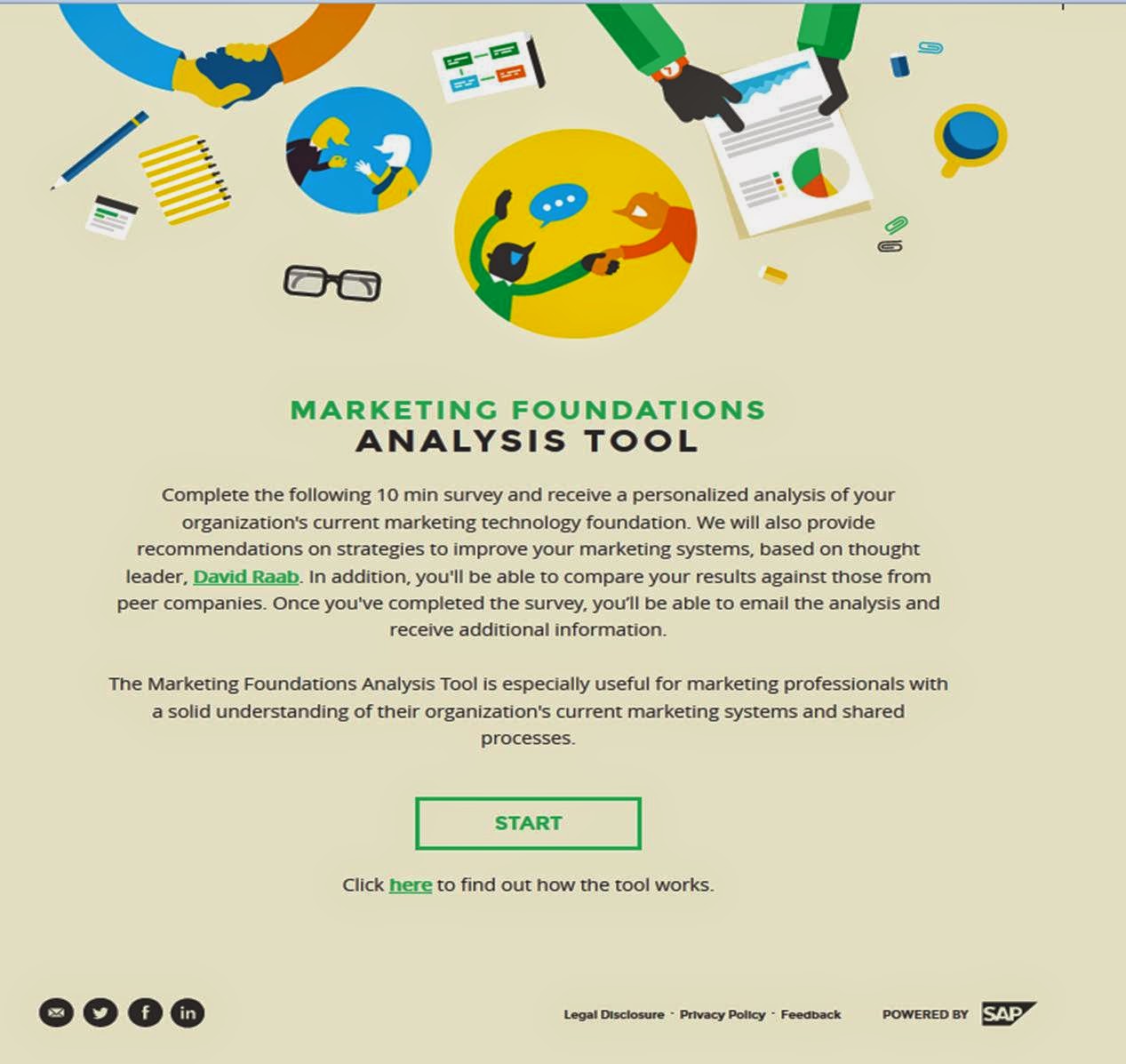
Marketing Foundations Analysis Tool: Gap Analysis, Recommendations, and Benchmark for Your Marketing Systems

Way back in January, I began working with SAP on a set of worksheets to help marketers assess their customer management systems. The much-evolved fruits of that effort were released today as the Marketing Foundations Analysis Tool, a fully automated system that asks users a series of questions about their current systems, marketing programs, and company background, and returns recommendations for system changes and how to manage the transition. Survey-takers will also be shown how their current systems compare with everyone else who answered the questions.

https://www.marketingtechgap.com/

The key insight powering this project was that there are relatively few types of marketing programs and systems.  That may not sound very important (or surprising), but it means the problem is simple enough to address with a relatively small amount of user input and business logic.  Specifically, it's practical for a survey to ask marketers which programs they want and what their current systems look like.  From there, it's fairly easy to specify the system capabilities required to run each program, to aggregate these into a consolidated set of requirements, and to compare the requirements with existing capabilities for a gap analysis.  This can be combined with information about the company to generate recommendations for what to do next.

In fact, if anything surprised me during this project, it was how much information could be derived from a relatively small amount of user input. The Analysis Tool asks about:
- nine types of marketing programs, ranging from customer profiling to real time interactions to loyalty programs to marketing measurement.  Users specify whether they currently run each program, want to run it in the future, or have no interest.

- thirteen types of customer-facing systems, ranging from email and Web sites to display ads, retail point of sale, and customer account management. These are rated on a spectrum of integration capabilities, from being totally isolated to allowing real time interactions.

- seven types of shared customer data processes, ranging from single customer view to predictive modeling to treatment selection to advanced analytics. Each process is rated on different capabilities, such as calculating scores for predictive modeling and handling unstructured data within the single customer view.

That's it -- just 29 items, although some do have subitems.  Based on those inputs, the Analysis Tool produces recommendations covering:

- general architecture (integrated suite, shared customer data platform, or application-based) and change strategy
- industry-specific issues to address, such as regulatory concerns
- opportunities to improve business results by running more marketing programs
- coordinating changes to marketing programs with changes to systems
- changes to customer-facing systems (over-all and whether to keep, enhance, or replace individual systems)
- changes to shared customer data processes (over-all and process-by-process)

That's a lot of information, and it doesn't even include the benchmark comparing your answers to everyone else's.  Not bad for free.  Thanks, SAP!


So how does this all work?  To peel back the covers just a bit, the recommendations are made by first classifying results into general categories such as “few active applications” or “mostly simple systems”, and then applying rules to select pre-written answers.  For example, a company with "few active applications" and "many desired applications" is told:

Assessment: Your company is running relatively few current marketing applications but wants to add many more. This could be a challenge given your relatively limited experience.

Recommendation: Prioritize the new applications so you don’t make too many changes at once. Start with applications that require relatively little change but also offer significant rewards. These should add capabilities that will also be used for subsequent new applications. Measure results carefully and prove success before moving on to make more changes.

Obviously I’m biased, but I think that level of advice is specific enough to be useful. It can’t replace the insight of a human analyst who can assess the situation in more detail and may see connections that simple rules will miss. But it certainly provides a starting point for discussions and a base of data to work with. Well worth a ten minute investment of your time.

Again, you can try the tool here.  You can take it anonymously and view the results on screen, or give SAP your email and have them send you a copy of the report.  Either way, give it a shot and let me know what you think.

Wednesday, December 21, 2011

Beyond Marketing Automation: Building a Complete Marketing Infrastructure

This started as a post about Empathy Logic, a company that merges data from marketing automation, CRM, Web tracking, order processing, social monitoring, and other systems; lets marketers segment and select from this more complete set of data; and sends the resulting lists back to message delivery systems such as email and Web sites.

You might think that Empathy Logic isn’t needed because a marketing automation system is supposed to build that integrated database. But B2B marketing automation products are largely limited to data they generate internally or import from CRM. The B2C marketing automation systems can usually attach to any data structure but rely on some other system to create it. So, yes, there’s a need for a company like Empathy Logic.  (Before I change topics, other key points about Empathy Logic are: product is about one year old; uses Pentaho open source software for data integration and business intelligence; runs on the Amazon EC2 cloud infrastructure; and charges $10,000 to $20,000 per month for its services.)  

Empathy Logic got me thinking about a topic that doesn’t get discussed much in B2B marketing automation circles: the place of marketing automation in the larger marketing system architecture. B2B marketing automation vendors generally position their systems as a replacement for separate applications including email, forms creation, Web analytics, content management, and reporting. This may leave the impression that marketing automation is the only system a marketing department needs.  Marketing automation vendors have little incentive to correct the error, since mentioning integration would only slow the sales cycle.  (For more about integration requirements, take a look at our recent workbook on the topic.)

Raab Associates does have its own model of a complete marketing architecture.  But before presenting it, let's look at some other opinions.   I found three surveys that address the issue.

The most intriguing was published last September by Adobe and Econsultancy.  The focus is online marketing (remember that Adobe owns Omniture, Day Software, Demdex and now Efficient Frontier) but the survey is especially interesting because it asked about adoption, value received, and effort required. The original report presented these separately but I’ve combined them in a bubble chart:


This is worth some exploration. You’ll see that marketing automation is at the bottom – meaning it’s the least resource intensive of the technologies listed. But it’s also farther left than most, meaning it’s also among the least effective at delivering profits. (I’m going to assume that “significant impact on the bottom line” meant significant positive impact.) I’m really feeling a bit disrespected here: marketing automation is easy AND ineffective? Maybe the survey-takers are getting poor results because they’re not putting in the necessary resources.  Or maybe they're mostly Web marketers who aren't really all that familiar with it.

Either way, the respondents still gave marketing automation a better effort / value ratio than attribution, buzz monitoring and social media management. Maybe they understand those better and see how much work is involved.  But campaign management, which I think is email campaigns but might be Web ad campaigns, also rates as harder than marketing automation. Doesn't marketing automation include email and a whole lot more?  I have a hard time understanding how email alone could be harder.

This survey also addresses the ever-popular question of adoption. This group reported that 38% were using marketing automation. That’s considerably higher than most estimates but it’s among the lowest rates on the chart.  In that sense, at least, it supports the general belief that marketing automation is still in its early stages.  I’ve provided the actual numbers below:


If you looked carefully at the previous survey, you probably noticed that a few important applications were missing, such as Webinars. Oops. A survey last February by Act-On Software had a more realistic range of applications. 


The Act-On survey isn't perfect for today's purpose: it was sent to small and mid-size business, listed several marketing automation components separately (email, lead nurturing, and lead scoring), lumped all of social media into a single category, and ignored Web analytics entirely. Still, it gives a pretty reasonable idea of the relative utilization of different methods, most of which would involve different marketing systems.

I found a one more survey that listed marketing systems, from the CMO Council  in July 2011.


This is by far the broadest list.  It includes CRM, call center, master data management, talent (staff) management, ecommerce, and product life cycle systems. That the question describes them all as “marketing automation solutions” gives some idea of how broadly the term is sometimes defined – which I still suspect is a major reason that many surveys show that “marketing automation” has such a high penetration rate.  Unfortunately, this survey didn't ask directly about usage.

If we look across all three surveys and add Raab Associates' own research, a reasonably complete set of components for a marketing architecture would include:
  • marketing database management (data extraction, customer data integration, master data management, database updates)
  • Web advertising (paid search, banner ads)
  • Web site management (Web content creation and management, search engine optimization, ecommerce if relevant.
  • Web analytics and optimization (could be part of Web site management but still largely done by separate systems.)
  • social marketing (blogs, social media monitoring, social media posting, community management, advocate management)
  • Webinars (it seems odd to make these their own category but they’re still separate systems and don’t easily fit with Web site management or social marketing)
  • marketing automation (direct mail, email, mobile, landing pages, web behavior, nurture campaigns, lead scoring, reporting; includes batch, trigger, and event-driven campaigns and real-time interactions)
  • media buying (for conventional media: TV, radio, newspaper, magazine, outdoor, etc.)
  • marketing resource management (project management, workflow, content and digital asset management, budgets and forecasts, purchasing, staff management) 
  • analytics (reporting, dashboards, attribution, marketing measurement, predictive modeling, mix optimization – this extends beyond the channel-specific applications like Web analytics)
  • CRM (not usually run by marketing but so intimately connected with marketing systems that I'd consider it part of the architecture.  I'm using CRM as a catch-all term for sales automation, order processing, customer service, loyalty, call centers, and partner management.)
There are many ways to draw this architecture and perhaps I'll return to it another day.  My point for now is simply that marketing automation is just one piece of the larger marketing puzzle -- and marketers need to recognize that they'll need to pull data from multiple systems to do a thorough job of managing customer relationships.