Yes, that title is a pun on Dickens’ Tale of Two Cities. Just be glad I don’t review housewares, or this could be about rating knives and forks: A Tale of Two Settings: It Was The Best of Tines, It Was The Worst of Tines.
But I digress. Where was I? Ah yes, in Las Vegas, at ONE: Teradata Marketing Festival, which is Teradata's conference for users of its marketing applications. Despite the location and title, the program did not include jousting.
What the conference did offer was a detailed look at Teradata’s current marketing applications, vision, and product roadmap. These were solid and comprehensive, although Teradata continues to make an unfashionable distinction between “omni-channel” marketing, which is conventional relationship marketing across all channels, and “digital” marketing, which is Web and email marketing. Teradata argues that many digital marketing departments still function independently of relationship marketing groups and therefore want their own tools. That’s probably true, especially at the big enterprises who are Teradata’s primary clients. But the trend is towards closer integration and you’d think Teradata would rather lead than follow. I do suspect that at least part of the reason for the distinction is internal: the omni-channel products are based on Teradata’s original marketing automation products, Aprimo and Teradata Relationship Manager, while the digital products are based on eCircle email the company purchased in 2012. To avoid misunderstanding, let me stress that Teradata does let users integrate the omni-channel and digital products if they want to and that digital includes text messages, mobile apps, social media monitoring and publishing, and Web landing pages as well as email.
Teradata’s marketing applications also extend beyond standard marketing automation to include marketing resource management and analytics. Indeed, there’s a case to be made that the company’s scope is superior to most competitive “marketing clouds”, which are usually pretty light on MRM and analytics and are often barely integrated. On the other hand, Tereadata seems to have something of a blind spot regarding advertising and anonymous customers: I got mixed messages from the various Teradata presentations about whether it considers support for paid media as part of its marketing applications. The clearest statement I can extract from my notes is that they will store anonymous identifiers such as cookies in their database but not use them until they are linked with an identifiable individual. As readers of this blog know well, I feel all media (owned, earned, paid) and all users (anonymous and known) should be managed together.
Teradata itself sees its primary differentiator as analytics. It presents an appealing vision of “adaptive self-learning marketing automation” that combines historical data, predictive models, and prescriptive models. By “prescriptive”, it means recommending the types of marketing programs to create, as opposed to predicting which existing marketing campaigns are best for an individual customer. This all strikes me as correct, if not downright futuristic.
But down at the practical level, Teradata’s near-term roadmap was considerably less visionary. Maybe that’s the nature of roadmaps. Perhaps inspired by the venue, the Teradata folks did a lot of (metaphorical) kimono opening at the event, detailing their product plans in ways I rarely see in public. What they revealed were mostly incremental enhancements such as improved user interfaces to make marketing activities easier and more nimble. There were some more fundamental promises, including better integration across suite components, more open access by external systems, and a more unified view across campaigns of the customer journey. It’s solid but not flashy, which is a pretty good summary of the Teradata style.
I was barely home from Vegas before I headed up to Boston for HubSpot’s Open House, a small event for primarily for business partners. (HubSpot’s main user conference is the INBOUND show in September. No jousting there, either.) Although the Open House style was low key, there were a couple of substantial announcements: the company’s free CRM system is now generally available (and still free); expansion of its $50/month Sidekick sales productivity tool; and eleven new integration partners including some predictive technologies (BrightInfo and Infer) and paid media retargeting (PerfectAudience). These are interesting extensions beyond the current set of partners, who mostly support operational tasks such as content creation, events management, analytics, and CRM integration. There was also some modest boasting about HubSpot’s continued growth – which actually accelerated slightly to 58% year on year in the most recent quarter – and other achievements including 15,000+ customers, 2,300 partners, 900+ employees, and top satisfaction rating in industry surveys.
HubSpot was less forthcoming than Teradata about future directions, perhaps because they see little change from the current course. Their general intention is to continue serving their existing target market (companies from 10 to 2,000 employees) with marketing and sales tools. There is a bit of redefinition to being a “growth engine” that solves additional marketing and sales problems, but this is an incremental change at most. The company’s announced focus is the improve the existing product with a mantra of faster, lighter, and easier, not to lead major changes in how businesses interact with their customers. Or perhaps HubSpot feels that most companies have virtually no automation in how they market and sell, getting more companies to adopt the existing HubSpot tools and best practices would itself be a major change. Fair enough.
On the other hand, co-founder and CTO Dharmesh Shah did tell me HubSpot is about a year away from supporting custom objects in its data model, which would open up some major new opportunities for the software. So perhaps there’s a bit more vision than they’re talking about publicly. People in Boston aren’t quite so free about opening their kimonos.
Thursday, May 21, 2015
Tuesday, May 12, 2015
MDC DOT Provides Marketing Automation for Direct Salespeople
I briefly mentioned MDC Dot in an earlier blog post about giving sales people access to marketing automation capabilities. This may not have done them justice since they are more specialized than that general description implied. What MDC Dot really does is serve organizations that wrangle a herd of independent sales people, like financial advisors or direct sales representatives. Those firms have very specific requirements for balancing central control over content and brand image with the agents’ desire for flexibility and personal client relationships. It’s actually a crowded space, with companies like Balihoo and MindMatrix competing aggressively for sales. What sets MDC Dot apart is that it targets organizations where the sales people have modest skills, modest needs, and even more modest budgets. Pricing starts at $15 per month per salesperson for a database of up to 500 active contacts and reaching a still-modest $90 per month for 10,000 active contacts.
Beyond low price, MDC Dot offers two key capabilities to suit its target audience. The first is a structure that links customers to their original salesperson, even if they later contact the organization through a Web search or visit to the corporate Web site. This is especially important for businesses that pay commissions to the customer’s original salesperson. MDC Dot does this by tagging each customer with the original salesperson’s ID and then ensuring that customer is sent back to the salesperson’s own microsite when they return. The initial tagging and subsequent redirection both require inserting some MDC Dot code onto whatever content the salesperson uses for the initial customer interaction. The redirection works best when the corporate Web site and the salespeople’s microsites are all on a subdomain hosted by MDC Dot.
The second key feature makes it easy for sales people to use content created by the central marketing team by automatically inserting tags such as the salesperson’s name and contact information. This customized content can include entire microsites, landing pages, emails, campaign flows, and social media posts. Salespeople can also set up their own contents.
Beyond these special features, MDC Dot also provides basic contact management including notes, tasks, tags, attachments, and activity tracking. Users can send emails, which come from the user’s own domain. Reports show email and Web activities, campaign results, and customers at each stage of the sales funnel. Screens are designed for simplicity and mobile devices. The interface is designed with the target of no more than three mouse clicks to accomplish any one task.
Corporate users can see the list of salespeople they are managing, along with performance statistics for each user. They can’t see the actual customers in the salesperson’s database. Corporate users also have tools to build email and social content and to set up contact sequences. These sequences are what puts the "dot" in MDC Dot: they’re built by connecting “Qualification Dots” to assign sequence members (all contacts, by contact type, via campaign manager, via sequence group), “Activity Dots” to react to behaviors within the sequence (opened an email, clicks an email, or visited a Web page, or not), and “Action Dots” to either send an email or transfer customers to another sequence group.
Sequences are built by connecting the dots (get it?). As you may have noticed, the set of available dots is pretty limited, although they are adequate to create basic email campaigns. At the moment each sequence can contain just one “Activity Dot” split, but multiple splits should be available later this year. Several sequences can be assigned to the same campaign and execute in priority order. This allows more complex treatments despite the simple design of the individual sequences.
The system also can do basic lead scoring and assign prospects to sales funnel stages. It lacks segmentation tools, although users can build an on-screen list of customers based on tags and then add the listed customers to campaigns. Landing pages must currently be built by the vendor. Tools to let users build their own filters and landing pages are under development.
MDC Dot was introduced in December 2014 and currently has more than 2,000 paying end users.
Beyond low price, MDC Dot offers two key capabilities to suit its target audience. The first is a structure that links customers to their original salesperson, even if they later contact the organization through a Web search or visit to the corporate Web site. This is especially important for businesses that pay commissions to the customer’s original salesperson. MDC Dot does this by tagging each customer with the original salesperson’s ID and then ensuring that customer is sent back to the salesperson’s own microsite when they return. The initial tagging and subsequent redirection both require inserting some MDC Dot code onto whatever content the salesperson uses for the initial customer interaction. The redirection works best when the corporate Web site and the salespeople’s microsites are all on a subdomain hosted by MDC Dot.
The second key feature makes it easy for sales people to use content created by the central marketing team by automatically inserting tags such as the salesperson’s name and contact information. This customized content can include entire microsites, landing pages, emails, campaign flows, and social media posts. Salespeople can also set up their own contents.
Beyond these special features, MDC Dot also provides basic contact management including notes, tasks, tags, attachments, and activity tracking. Users can send emails, which come from the user’s own domain. Reports show email and Web activities, campaign results, and customers at each stage of the sales funnel. Screens are designed for simplicity and mobile devices. The interface is designed with the target of no more than three mouse clicks to accomplish any one task.
Corporate users can see the list of salespeople they are managing, along with performance statistics for each user. They can’t see the actual customers in the salesperson’s database. Corporate users also have tools to build email and social content and to set up contact sequences. These sequences are what puts the "dot" in MDC Dot: they’re built by connecting “Qualification Dots” to assign sequence members (all contacts, by contact type, via campaign manager, via sequence group), “Activity Dots” to react to behaviors within the sequence (opened an email, clicks an email, or visited a Web page, or not), and “Action Dots” to either send an email or transfer customers to another sequence group.
Sequences are built by connecting the dots (get it?). As you may have noticed, the set of available dots is pretty limited, although they are adequate to create basic email campaigns. At the moment each sequence can contain just one “Activity Dot” split, but multiple splits should be available later this year. Several sequences can be assigned to the same campaign and execute in priority order. This allows more complex treatments despite the simple design of the individual sequences.
The system also can do basic lead scoring and assign prospects to sales funnel stages. It lacks segmentation tools, although users can build an on-screen list of customers based on tags and then add the listed customers to campaigns. Landing pages must currently be built by the vendor. Tools to let users build their own filters and landing pages are under development.
MDC Dot was introduced in December 2014 and currently has more than 2,000 paying end users.
Thursday, May 07, 2015
Will Machines Replace Marketers? Artificial Intelligence Isn't Ready Yet But Watch Your Back
Anyone who has chatted with me in recent months knows that I’ve added the impending domination of humans by intelligent machines to my usual list of obsessions. This most definitely applies to marketing, where I found many artificial intelligence-based solutions once I began looking for them. After accumulating a list, I’ve decided it’s time to pull together an overview of the topic.
My thesis was that AI-based systems already exist for most tasks that marketers perform, but are not yet connected into a single robo-marketer that (or is it who?) could do the job from start to finish. To test this, I listed the tasks that go into building a marketing program and matched these against my list of AI-based products.
Quite to my surprise, the machines haven’t risen so far after all. Of the three broad tasks I defined – planning, content creation, and execution – only content creation is served by what I consider to be strong AI* solutions. Some AI options are available for execution, but most are conventional predictive modeling products that I don’t count as strong AI because they still require humans to deploy their results. Marketing planning, which includes the all-important task of campaign design, is almost wholly untouched by AI.
Let’s look at each task in turn.
Planning
The lack of AI-driven planning solutions is especially surprising since so many planning tasks lend themselves to an AI approach. These tasks include market analysis (identifying potential buyers for a product, defining the needs and interests of potential buyers, identifying competitors, calculating potential market size and adoption rates), selecting marketing strategy, and selecting tactics (which can be defined as campaigns, experiences, or – if you’re cool enough – stages in the customer journey).
It seems well within the capabilities of current technology to find people who indicate a specific need, based on their Web searches or social comments, and then to understand who those people are in terms of demographics, behaviors, and other attributes. But the closest I could find were a couple of products that build profiles of groups the marketer defines in advance, such as brandAnalyzer by brandAnalyzer from Global Science Research and Empirical Insights from SG360. The one system that does look like strong AI is Bottlenose. It performs the relatively common function of identifying trends but uses enough advanced technology, including natural language processing, topic discovery, and sentiment analysis, to impress me.
Similarly, competitor analysis should be well within the capabilities of companies like Radius, Everstring and Growth Intelligence, which already ingest the contents of corporate Web sites to understand each company’s business. But those vendors focus on finding prospects for B2B sellers. If any of them offers a competitor identification service, I’m not aware of it.
Business and marketing strategies are often compared to chess, a game that AI systems can famously play better than humans. I think the analogy is sound: like chess, business and marketing strategy involves a relatively limited number of moves with easily predicted short term consequences and large databases of past competitions which computers can study to predict longer term results. Strategic planning can also be supported by a rich treasury of simulation and optimization techniques that are very familiar to AI developers. Yet the closest I can find to strategic planning is optimization of media plans by media mix model vendors like MMA , Analytic Partners , Nielsen and IRI. But that is so tactical I classify it as part of execution. Otherwise, I haven’t seen anyone use AI to recommend a marketing strategy.
Nor has anyone really promised to design marketing campaigns using an AI system. This is another area that seems a natural application: computers can certainly use past results to predict the short- and long-term results of individual messages and, with a bit less certainty, of streams of messages. But while there are plenty of systems that predict the “next best message” or recommend what content the user is most likely to select, no one seems to have taken the obvious next step of using AI to design the best message sequence and refine it over time through automated testing. The closest I’ve seen are Amplero and Insightpool. But they both start with individual data, so I'll discuss them in the section on execution.
Content Creation
Ironically, the most common reaction when I bring up machine-based marketing seems to be “well, they'll never write copy”. In fact, writing is one task where machines have already demonstrated huge success. General purpose writing programs including Wordsmith from Automated Insights , Quill from Narrative Insights and Arria NLG already write over one billion newspaper articles and reports each year, specializing in data-rich topics like sports and financial reports. Wordsmith also writes other sorts of reports, including summaries of marketing campaign performance.
Still closer to home for marketers, InboundWriter and Acrolinx score marketing content for effectiveness before it is released.
Most impressive of all from an AI perspective, Persado and Captora actually create content on their own. Persado does this by selecting and then testing content derived from a huge database of marketing language, classified by emotional, descriptive, and formatting categories. It works across email, landing pages, text messages, social posts, Facebook ads, app notifications, and other media. Captora automatically analyzes the topics and performance of content from the client and its competitors, finds opportunities for new campaigns, and creates appropriate landing pages to attract search traffic.
I consider Persado and Captora to be true AI-based marketing because they can actually replace work done by humans. But, as both vendors would probably rush to point out, what they really do is expand the volume of work that gets done, enabling marketers to execute hundreds of campaigns with the same human effort as it previously took to do dozens. So they are less about reducing the number of marketers than expanding marketer productivity.
Execution
While planning and content are arguably the most strategically important tasks that marketers do, there’s no question that they spend most of their time on execution. This is especially true since my definition of execution includes measurement and optimization because all three are so closely intertwined.
I broadly divide execution into audience development, message selection, and attribution. Audiences include paid media (purchased ads and lists), earned media (public relations and social influencers), and owned media (company Web sites and email lists, in-store promotion, call centers, etc.). Message selection includes content recommendations and personalization. Attribution includes everything that measures the results of marketing efforts – although, in practice, much message selection also relies on simple attribution to improve selection results.
Each execution category is served by advanced technology. Paid audiences are built with predictive modeling for list selection, programmatic media buys for advertising, and automated content analysis to understand intent. Earned audiences are built through influencer identification and predictions of who will cover which stories. Owned audiences are refined through more predictive models and behavior analysis. Message selection also relies on advanced analytics to recommend the right content for each individual and to find the best-performing messages for groups. Likewise, attribution systems apply sophisticated methods to isolate the incremental impact of individual marketing actions on long-term results. This long-term perspective is what distinguishes attribution from the measurement built into message selection systems, which instead chase immediate results such as email click-through or Web page conversion.
These technologies are certainly impressive, but few of them actually remove marketers from the process – which you’ll recall is my definition of marketing AI. Predictive model scores, for example, are usually plugged into marketer-created rules that decide who receives which treatments. Even the recommendation engines rarely do more than predict which messages an individual is most likely to select. Human-built rules still determine which messages are available and when messages will be presented.
There’s a lot of gray in this picture. Model scores and recommendation engines often replace complex segmentation rules even though some other rules remain. They may not replace marketers altogether but they do enable marketers to run larger numbers of more refined programs. And they're a supporting technology for true AI marketing systems even if they are not AI themselves.
On the other hand, I think programmatic media buying does rise to the level of true AI. Again, the critical distinction is whether they replace human marketers – and I think that media buyers are pretty much not needed to execute programmatic programs. Obviously a human still has to set up the programs and provide the creative, but the programmatic systems then make complex judgements on their own. Are these “judgements” significantly more advanced than the “judgements” that go into a lead scoring predictive model or personalized content recommendation? I’m not really sure. Maybe I’m misled by the fact that “media buyer” is an established profession while “lead scorer” or “content personalizer” are not job titles that people had before computers were available.
There are a few execution products that approach the border of true AI and may actually cross it. These include:
- Amplero, a newly released system that uses tree analysis to find very small market segments and then identifies the best content for each segment. What separates it from other personalization tools is that it optimizes against long-term value, such as revenue over the 14 days following each message, and its decisions take into account messages previously presented. I’d definitely consider Amplero true AI if it could plan sequences of messages, which would be pretty much the same as building multi-step campaigns. The system doesn’t do this yet but the vendor tells me they’re working on it.
- Insightpool, which identifies social media influencers, predicts how likely they are to take a user-specified action, and then recommends multi-step campaigns to encourage that result. Influencer identification and activity prediction are impressive but not unique; what makes me classify Insightpool as AI is its ability to select campaigns. This is something that you’d ordinarily expect a human marketer to do, even if the marketer was working with lists that the other functions had prepared.
- OneSpot converts existing pieces of content into multiple ad formats to permit reuse, classifies them (automatically, so near as I can tell) by purpose, and then delivers them to precisely targeted or retargeted individuals through programmatic ad exchanges in the optimal sequence to meet long-term goals. The reformatting, classification, and sequencing all strike me as things that humans would otherwise do manually, and of course I’ve already argued that programmatic media buying itself qualifies as marketing AI.
Final Thoughts
I know this post is too long to be effective but I wanted all to get this information down in one place. Artificial intelligence is an important topic in our general society and seems to attracting increased attention, even though Google Trends suggests otherwise. Marketers in particular are thinking about it as they adjust to rapidly changing technologies that increasingly rely on predictive analytics and other automation for effective management.
Given the hype that accompanies pretty much every new technical development, it’s helpful to see that AI-based marketing isn’t as far along as one might expect. But don't take that as a reason to relax: while it’s not time to panic, it’s definitely time to prepare. AI marketing systems already present some significant opportunities and their scope can only grow – perhaps exponentially as key techniques become more widely distributed. Now is the time to start building a realistic understanding of how these systems work, what they can and can’t do, and how they’ll fit into your future.
_________________________________________________________________________
* “strong AI” is used by AI experts to mean systems match or exceed human intelligence. I’m using it in that roughly sense, although with the more specific meaning of “systems that perform tasks that otherwise require human marketers”.
Thursday, April 30, 2015
Are 70% of Marketing Automation Users Unhappy? Well, Not Exactly
A recent piece in TechCrunch quoted me as saying that “almost 70 percent of marketers are either unhappy or only marginally happy with their marketing automation software.” The author included a link to the source of that quote, but unfortunately it was broken (it has since been fixed). This lead to enough questions about the data that it now seems worth a blog post on the topic.
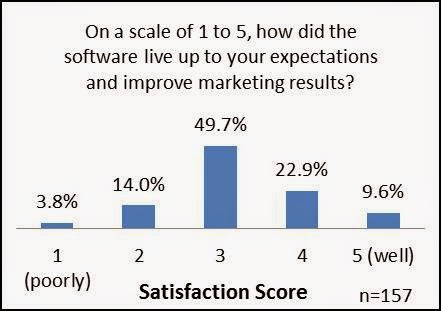
To resolve the original mystery: the quote references a survey I conducted with VentureBeat and released in June 2014. You can buy it here if you’re interested. Answers came from 159 marketing automation users. The quote refers to a question about how well marketing automation software met satisfaction and improved results, on a 1 to 5 scale. About 18% gave a score of 1 or 2, 50% gave a 3, and 32% gave a 4 or 5. The 1 and 2 scores are clearly unhappy and I’d consider a 3 to show neutral or marginally satisfied. Hence the “almost 70 percent” quote.
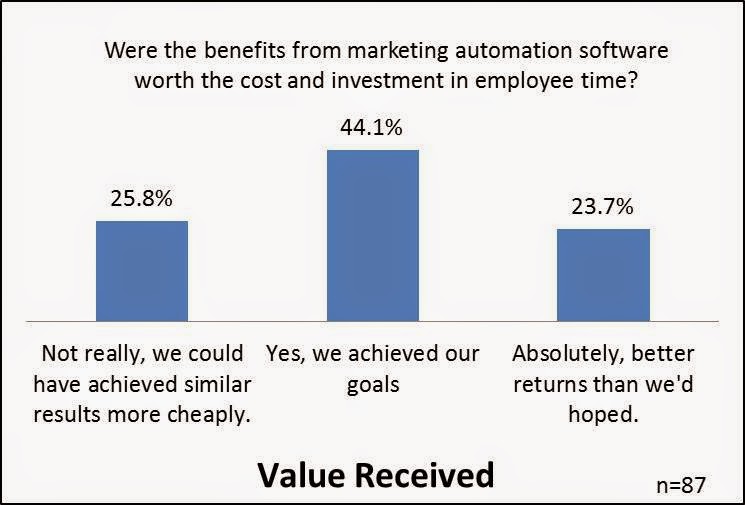
For what it’s worth, the survey also asked a second, more pointed question about whether marketing automation benefits were worth the investment. We received fewer responses (only 87) but the distribution was similar. In fact, the dissatisfied group was a higher percentage: 25.8% and there’s no question how they felt: “we could have achieved similar results more cheaply”. The middle group, 44.1% “achieved our goals” which still sounds to me like marginal satisfaction. Only 23.7% felt they exceeded expectations.
I've never considered these results particularly remarkable because they are consistent with other surveys on the topic. See my posts for October 13, 2013 and October 22, 2013 for a several other surveys.
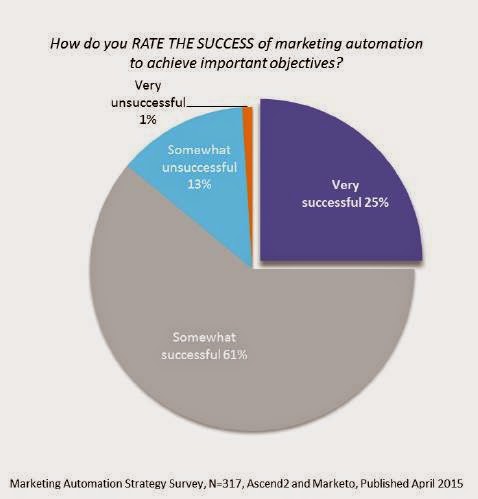
Of course, that's all old data and you may wonder whether anything has changed. The short answer is no. For example, a recent survey from Marketo and Ascend2 found that 14% of buyers rated marketing automation as clearly unsuccessful and only 25% rated it as very successful: again, there was a big intermediate group of 61% who said is was only “somewhat successful”.
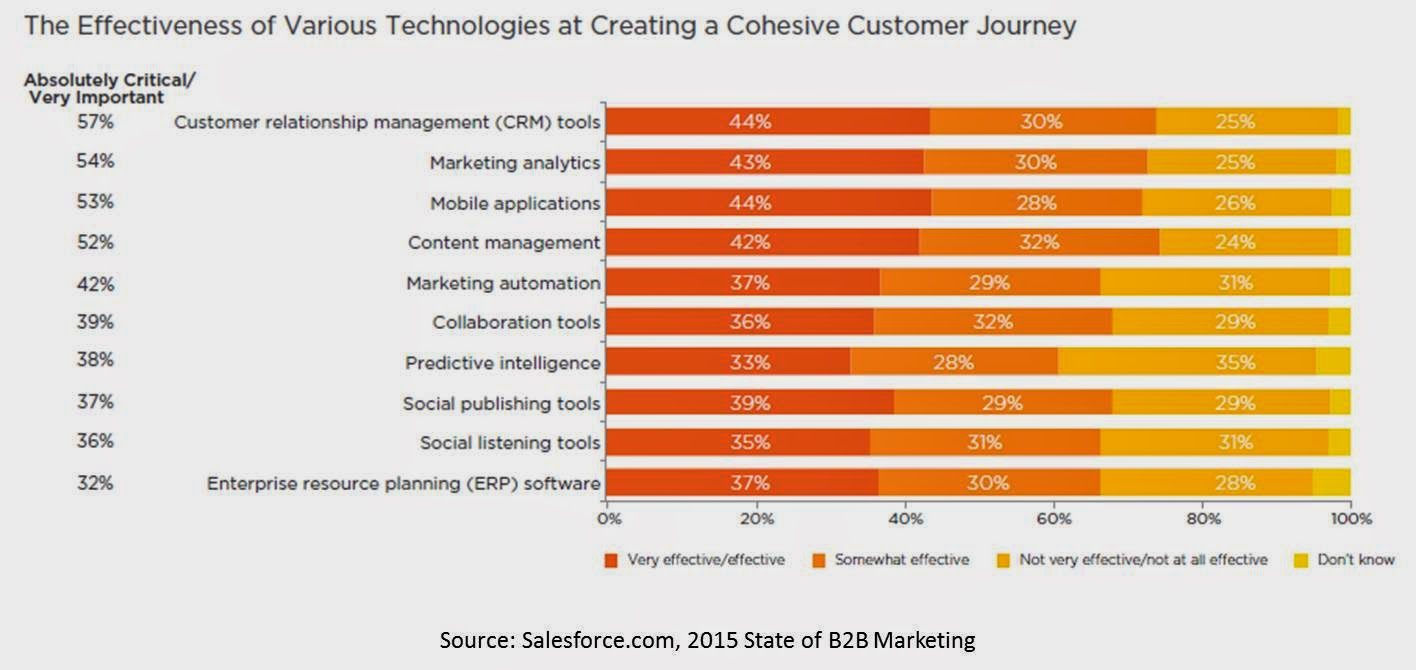
Another survey, this one from Salesforce.com, is generally more optimistic, showing 37% of users rating marketing automation as very effective or effective. But it also shows a relatively high 31% rating it as not very effective or not at all effective. The real difference is an unusually small middle group, 29% rating marketing automation as “somewhat effective”. What’s probably more disconcerting about this survey is that it shows that marketing automation has relatively low satisfaction and importance compared with other technologies. This suggests that marketers who must prioritize their spending will make other investments first.
I must say that I don’t find this topic particularly engaging at the moment. The point of the original TechCrunch article was the growth of open, predictive-based platforms that unify sales and marketing, a direction I agree the industry will take. B2B marketing automation in its current form of systems that primarily use email, landing pages, and visitor tracking to nurture leads before sending them to CRM is a subset of this much larger vision. The challenges of using current marketing automation systems are well known but they will simply make it easier for newer, more effective approaches to replace them. It’s more important and more interesting to focus on that future.
To resolve the original mystery: the quote references a survey I conducted with VentureBeat and released in June 2014. You can buy it here if you’re interested. Answers came from 159 marketing automation users. The quote refers to a question about how well marketing automation software met satisfaction and improved results, on a 1 to 5 scale. About 18% gave a score of 1 or 2, 50% gave a 3, and 32% gave a 4 or 5. The 1 and 2 scores are clearly unhappy and I’d consider a 3 to show neutral or marginally satisfied. Hence the “almost 70 percent” quote.
![]() |
| Source: Raab Associates, 2014 |
For what it’s worth, the survey also asked a second, more pointed question about whether marketing automation benefits were worth the investment. We received fewer responses (only 87) but the distribution was similar. In fact, the dissatisfied group was a higher percentage: 25.8% and there’s no question how they felt: “we could have achieved similar results more cheaply”. The middle group, 44.1% “achieved our goals” which still sounds to me like marginal satisfaction. Only 23.7% felt they exceeded expectations.
![]() |
| Source: Raab Associates, 2014 |
I've never considered these results particularly remarkable because they are consistent with other surveys on the topic. See my posts for October 13, 2013 and October 22, 2013 for a several other surveys.
Of course, that's all old data and you may wonder whether anything has changed. The short answer is no. For example, a recent survey from Marketo and Ascend2 found that 14% of buyers rated marketing automation as clearly unsuccessful and only 25% rated it as very successful: again, there was a big intermediate group of 61% who said is was only “somewhat successful”.
Another survey, this one from Salesforce.com, is generally more optimistic, showing 37% of users rating marketing automation as very effective or effective. But it also shows a relatively high 31% rating it as not very effective or not at all effective. The real difference is an unusually small middle group, 29% rating marketing automation as “somewhat effective”. What’s probably more disconcerting about this survey is that it shows that marketing automation has relatively low satisfaction and importance compared with other technologies. This suggests that marketers who must prioritize their spending will make other investments first.
Friday, April 24, 2015
Bombora Feeds B2B Data to Everyone
One of the little patterns that caught my attention at last week’s Marketo conference was that several vendors mentioned using data from the same source: Madison Logic Data, which recently renamed itself Bombora*. The company was already familiar to me through clients who deal with it. But I had never gotten a clear picture of exactly what they do. Those additional mentions finally pushed me to explore further.
A couple of emails later and I was on the phone with Erik Matlick, Madison Logic founder and Bombora CEO. We went through a bit of the back story: Madison Logic was founded as a B2B media company six years ago. It built a network of B2B publishers to sell ads and gather data about their site visitors. Both businesses grew nicely, but the company found that selling media conflicted with finding partners to gather data. So last November it spun off the data piece as Madison Logic Data, keeping Madison Logic as the media business. The change from Madison Logic Data to Bombora was announced on April 13.
To which you probably say, who cares? Fair enough. What really matters is what Bombora does today and, more pointedly, what it can do for you. Turns out, that’s quite a bit.
Bombora’s core business is assembling data about B2B companies and individuals. It does this through a network of publishers who put a Bombora pixel on their Web pages. This lets Bombora track activities including article and video viewing, white paper downloads, Webinar attendance, on-site search, and participation in online communities. The company tags its publishers' content with a 2,300-topic taxonomy, allowing it to associate visitors with intent based on the topics they consume. It identifies visitors based on IP address, domain, and registration forms on the publisher sites. It also attaches demographic information based on information they provide on the registration forms and the publishers have in their own profiles. The volumes are huge: 4 billion transactions per month, more than 250 million business decision makers, and 85 million email addresses collected in a year.
All that information has many uses: [feel free to insert your favorite cliché about how data being important]. Like meat packers who use every part of the pig but the squeal, Bombora is determined the squeeze the most value possible from the data it assembles. This means selling it intent and demographic audience segments for display advertising, marketing automation and email segmentation, Web audience analytics, data enhancement, content personalization, media purchasing, and predictive modeling. Different users get different data: sometimes cookies, device IDs or email addresses, and sometimes by company, individual, or segment. Publishers who contribute data are treated as part of a co-op and get access to all 2,300 intent topics. Others only can select from around 60 summary categories.
If you’re a B2B marketer, you’re probably drooling at the thought of all that data. So why haven’t you heard of Madison Logic and Bombora before? Well, like those thrifty meat packers, Bombora sells only at wholesale. In each channel, partners embed the Bombora data within their own products. Sometimes it's baked into the price and sometimes you pay extra. It’s a “Bombora inside” strategy and makes perfect sense: everything’s better with data.
At the risk of beating a dead pig, I'll also note out that Bombora illustrates a point I've made before: that public sources of data will increasingly supplement and to some degree may even replace privately gathered data. This is a key part of the "madtech" vision that says the data layer of your customer management infrastructure will increasingly reside outside of your company's control. The risk to companies who use this data is that their competitors can access it just as easily, so there's still a need to build proprietary data sources in addition to adding value in other areas such as better analytics or customer experience.
Enough of that. I'm hungry.
_________________________________________________________________
*Something to do with surfing in Australia. There's a sea of data metaphor in there somewhere, I think.
A couple of emails later and I was on the phone with Erik Matlick, Madison Logic founder and Bombora CEO. We went through a bit of the back story: Madison Logic was founded as a B2B media company six years ago. It built a network of B2B publishers to sell ads and gather data about their site visitors. Both businesses grew nicely, but the company found that selling media conflicted with finding partners to gather data. So last November it spun off the data piece as Madison Logic Data, keeping Madison Logic as the media business. The change from Madison Logic Data to Bombora was announced on April 13.
To which you probably say, who cares? Fair enough. What really matters is what Bombora does today and, more pointedly, what it can do for you. Turns out, that’s quite a bit.
Bombora’s core business is assembling data about B2B companies and individuals. It does this through a network of publishers who put a Bombora pixel on their Web pages. This lets Bombora track activities including article and video viewing, white paper downloads, Webinar attendance, on-site search, and participation in online communities. The company tags its publishers' content with a 2,300-topic taxonomy, allowing it to associate visitors with intent based on the topics they consume. It identifies visitors based on IP address, domain, and registration forms on the publisher sites. It also attaches demographic information based on information they provide on the registration forms and the publishers have in their own profiles. The volumes are huge: 4 billion transactions per month, more than 250 million business decision makers, and 85 million email addresses collected in a year.
All that information has many uses: [feel free to insert your favorite cliché about how data being important]. Like meat packers who use every part of the pig but the squeal, Bombora is determined the squeeze the most value possible from the data it assembles. This means selling it intent and demographic audience segments for display advertising, marketing automation and email segmentation, Web audience analytics, data enhancement, content personalization, media purchasing, and predictive modeling. Different users get different data: sometimes cookies, device IDs or email addresses, and sometimes by company, individual, or segment. Publishers who contribute data are treated as part of a co-op and get access to all 2,300 intent topics. Others only can select from around 60 summary categories.
If you’re a B2B marketer, you’re probably drooling at the thought of all that data. So why haven’t you heard of Madison Logic and Bombora before? Well, like those thrifty meat packers, Bombora sells only at wholesale. In each channel, partners embed the Bombora data within their own products. Sometimes it's baked into the price and sometimes you pay extra. It’s a “Bombora inside” strategy and makes perfect sense: everything’s better with data.
At the risk of beating a dead pig, I'll also note out that Bombora illustrates a point I've made before: that public sources of data will increasingly supplement and to some degree may even replace privately gathered data. This is a key part of the "madtech" vision that says the data layer of your customer management infrastructure will increasingly reside outside of your company's control. The risk to companies who use this data is that their competitors can access it just as easily, so there's still a need to build proprietary data sources in addition to adding value in other areas such as better analytics or customer experience.
Enough of that. I'm hungry.
_________________________________________________________________
*Something to do with surfing in Australia. There's a sea of data metaphor in there somewhere, I think.
Friday, April 17, 2015
Marketo Adds Custom Objects. It's a Big Deal. Trust Me.
My first question when Marketo announced its new mobile app connector this week wasn’t, “What cool new things can marketers do?” but “Where is the data stored?”
It's not that I'm obsessed with data. (Well, maybe a little.) But one of Marketo’s biggest technical weaknesses has always been an inflexible data model. Specifically, it hasn’t let users set up custom objects (although they’ve been able to import custom objects from Salesforce.com or Microsoft Dynamics CRM). This was a common limitation among early B2B marketing automation products but many have removed it over the years. Indeed, even $300 per month Ontraport is about to add custom objects (and does a good job of explaining the concept in a typically wry video).
Sure enough, when I finally connected with Marketo SVP Products and Engineering Steve Sloan, he revealed that the mobile data is being managed through a new custom objects capability – one that Marketo didn’t announce prominently because they felt Marketing Nation attendees wouldn’t be interested. I suspect that underestimates the technical savvy of Marketo users, but no matter.
For people who understand such things, the importance is clear: custom objects open the path to Marketo supporting new channels and interactions, removing a major roadblock to competing as the core decision engine of an enterprise-grade customer management system. This will be more true once Marketo finishes its planned migration of activity data to a combination of Hadoop and HBase. This will give vastly greater scale and flexibility than the current relational database (MySQL). Sloan said that even before this happens, data in the custom objects will be fully available to Marketo rules for list building and campaign flows.
The strategic importance of this development to Marketo is high. Marketo is increasingly squeezed between enterprise marketing suites and smaller, cheaper B2B marketing automation specialists. Its limited data structure and scale were primary obstacles to competing in the B2C market, where custom data models have always been standard. Even in B2B, Marketo’s ability to serve the largest enterprises was limited without custom objects. While this one change won’t magically make Marketo a success in those markets, its prospects without the change were bleak.
All that being said, the immediate impact of Marketo’s new mobile and ad integration features is modest. The mobile features let Marketo capture actions within a mobile app and push out messages in response. This is pretty standard functionality, although Marketo users will benefit from coordinating the in-app messages with messages in other channels. Similarly, the advertising features make it simpler to export audiences to receive ads in Facebook, LinkedIn, and Google and to find similar audiences in ad platforms Turn, MediaMath, and Rocketfuel. Again, this is pretty standard retargeting and look-alike targeting, with the advantage of tailoring messages to people in different stages in Marketo campaigns. The actual matching of Marketo contacts to the advertising audiences will rely on whatever methods the ad platform has available, not on anything unique to the Marketo integration.
In fact, I’d say the audience reaction to the announcement of these features during the Marketing Nation keynote was pretty subdued. (They were probably more excited that they can now manage their email campaigns from their mobile devices.) So maybe next time, Marketo should make the technical announcements during the big speech: at least the martech geeks will be on their chairs cheering, even if everybody else just keeps looking at their email or cat videos or whatever it is they do to amuse themselves during these things.
Note: for an excellent in-depth review of what Marketo announced, look at this post from Perkuto.
It's not that I'm obsessed with data. (Well, maybe a little.) But one of Marketo’s biggest technical weaknesses has always been an inflexible data model. Specifically, it hasn’t let users set up custom objects (although they’ve been able to import custom objects from Salesforce.com or Microsoft Dynamics CRM). This was a common limitation among early B2B marketing automation products but many have removed it over the years. Indeed, even $300 per month Ontraport is about to add custom objects (and does a good job of explaining the concept in a typically wry video).
Sure enough, when I finally connected with Marketo SVP Products and Engineering Steve Sloan, he revealed that the mobile data is being managed through a new custom objects capability – one that Marketo didn’t announce prominently because they felt Marketing Nation attendees wouldn’t be interested. I suspect that underestimates the technical savvy of Marketo users, but no matter.
For people who understand such things, the importance is clear: custom objects open the path to Marketo supporting new channels and interactions, removing a major roadblock to competing as the core decision engine of an enterprise-grade customer management system. This will be more true once Marketo finishes its planned migration of activity data to a combination of Hadoop and HBase. This will give vastly greater scale and flexibility than the current relational database (MySQL). Sloan said that even before this happens, data in the custom objects will be fully available to Marketo rules for list building and campaign flows.
The strategic importance of this development to Marketo is high. Marketo is increasingly squeezed between enterprise marketing suites and smaller, cheaper B2B marketing automation specialists. Its limited data structure and scale were primary obstacles to competing in the B2C market, where custom data models have always been standard. Even in B2B, Marketo’s ability to serve the largest enterprises was limited without custom objects. While this one change won’t magically make Marketo a success in those markets, its prospects without the change were bleak.
All that being said, the immediate impact of Marketo’s new mobile and ad integration features is modest. The mobile features let Marketo capture actions within a mobile app and push out messages in response. This is pretty standard functionality, although Marketo users will benefit from coordinating the in-app messages with messages in other channels. Similarly, the advertising features make it simpler to export audiences to receive ads in Facebook, LinkedIn, and Google and to find similar audiences in ad platforms Turn, MediaMath, and Rocketfuel. Again, this is pretty standard retargeting and look-alike targeting, with the advantage of tailoring messages to people in different stages in Marketo campaigns. The actual matching of Marketo contacts to the advertising audiences will rely on whatever methods the ad platform has available, not on anything unique to the Marketo integration.
In fact, I’d say the audience reaction to the announcement of these features during the Marketing Nation keynote was pretty subdued. (They were probably more excited that they can now manage their email campaigns from their mobile devices.) So maybe next time, Marketo should make the technical announcements during the big speech: at least the martech geeks will be on their chairs cheering, even if everybody else just keeps looking at their email or cat videos or whatever it is they do to amuse themselves during these things.
Note: for an excellent in-depth review of what Marketo announced, look at this post from Perkuto.
Wednesday, April 15, 2015
Marketo Conference: Is Predictive Modeling The Future of Marketing Automation?
Marketo held its annual Marketing Nation Summit this week, hosting 4,000+ clients and partners. The event seemed relatively subdued for Marketo – I didn’t spot one costumed character – but the over-all atmosphere was positive. The company made two major product announcements, expanding the reach of Marketo campaigns into mobile apps and display ad retargeting. Those struck me as strategically valuable, helping to secure Marketo’s place at the center of its users’ customer management infrastructure. Unfortunately, I wasn’t able to gather enough technical detail to understand how they work. I’ll try to write about them once that happens.
As usual for me, I spent much of conference prowling the exhibit hall checking out old and new vendors. Marketo has attracted a respectable array of partners who extend its capabilities. By far the most notable presence was predictive modeling vendors – Leadspace, Mintigo, Lattice Engines, Infer, Fliptop, SalesPredict, 6Sense, Everstring plus maybe some others I’m forgetting. I’ve written about each of these individually in the past, but seeing them in the same place brought home the very crowded nature of this market. It also prompted many interesting discussions with them vendors themselves, who, not surprisingly, are an especially analytical and thoughtful group.
Many of those conversations started with the large number of vendors now in the space and how many would ultimately survive. I actually found this concern a bit overwrought – there are other segments, most obviously B2B marketing automation itself, that support many dozens of similar vendors. By that standard, predictive analytics is still far from overcrowded. At the risk of some unfair (and unjustifiably condescending) stereotyping, I’ll propose that part of their concern comes from a sort of Spock-like rationality that says only a few different products are really needed in any given segment. That may indeed be logically correct, but real markets often support more players than anyone needs. I see nothing inherent in the predictive marketing industry that will limit it to a few survivors.
In fact, almost immediately after wondering whether there were too many choices, many vendors observed that they were already sorting themselves into specialists serving different customer types or applications. Some products sell mostly to smaller companies, some to companies with many different products, some to customers who want new prospect names, some who want to incorporate external behaviors, and so on. Here, the vendors’ perception is more nuanced than my own; they see differences that I hadn’t noticed. Despite these distinctions, I still expect that most vendors will broaden rather than narrow their scope over time. But maybe that’s my own inner Spock looking for more simplicity than really exists.
One factor simplifying buyers' selection decision was that nearly all clients test multiple systems before making a purchase. This contrasts sharply with marketing automation, where many companies still buy the first system they consider and few conduct an extensive pre-purchase trial. The main reason for this anomaly is that modeling systems are highly testable: buyers give each competitor a set of data, let them build a model, and can easily see whose scores do a better job of identifying right people. It also probably helps that people buying predictive systems are generally more sophisticated marketers. There's some danger to relying extensively on test results, since they obscure other factors such as time to build a model and how well models retain their performance over time. I was also a bit puzzled that nearly every vendor reported winning nearly every test. I don't think that's mathematically possible.
Probably the most interesting set of discussions revolved around the long-term relation of predictive functions to the rest of the customer management infrastructure. This was sometimes framed as whether predictive modeling will be a "feature" embedded in other systems or a "product" sold on its own. My intuition is it's a feature: marketers simply want to select on model scores the same way they’d select any other customer attribute, so scoring should be baked into whatever marketing system they’re using. But the counter argument starts with the empirical observation that marketing automation vendors haven’t done this, and speculates that maybe there’s a sound reason: not just that they don’t know how or it’s too hard, but that modeling systems need data that is stored outside of marketing automation or should connect with multiple execution systems that marketing automation does not. The data argument makes some sense to me, although I think marketing automation itself should also connect with those external sources. I don’t buy the execution system argument. Marketing automation should select customer treatments for all execution systems; scores should be an input to the marketing automation selections.
But there’s a deeper version of this question that asks about the role of predictive analytics within the customer management process itself. Marketo CEO Phil Fernandez touched on this indirectly during his keynote, when he observed that literally mapping the customer journey as an elaborate flow chart is inherently unrealistic, because customers follow many more paths than any manageable chart could contain. He also came back to it with the image of a “self-driving” marketing automation system that, like a self-driving car, would let the user specify a goal and then handle all the details independently. Both examples suggest replacing marketer-created rules to guide customer treatments with predictive systems that select the best action in each situation. As several of the predictive vendors pointed out to me (with what sounded like the voice of painful experience), this requires marketers to give up more control than they may find comfortable – either because machines really can’t do this or because it would put marketers out of a job if the machines could. Personally, I'll bet on the machines in this contest, although with many caveats about how long it will take before humans are fully or even largely replaced.
However, and here’s the key point that came up in the most interesting discussions: predictive models can’t do this alone. At the most abstract, marketing involves picking the best customer treatment in each situation. But models can only pick from the set of treatments that are available. In other words, someone (or some thing) has to create those treatments and, prior to that, decide what treatments to create. In current marketing practice, those decisions are made with a content map that plots available content against customer life stages and personas. This makes sure that appropriate content is available for each situation. Proper value measurement – which means estimating the incremental impact on lifetime value of each marketing message – also relies on persons and life stages as a framework. So any machine-based approach to customer management has to generate personas, life stages, and content to be complete.*
I see no inherent reason that machines couldn’t ultimately do the persona and life stage definition. None of vendors do it today, although several appear to have given it some thought. Automated content creation is already available to a surprising degree and will only get better. But, to get back to my point: the technologies to do these things are very different from predictive modeling. So if new technology is to replace marketing automation as the controller of customer treatments, that technology will include much more than predictive modeling by itself.
_________________________________________________________________________
* Yes, it has occurred to me that a fully machine driven system might not need personas and lifestages, which are aggregations needed because humans can't deal with each person separately. But marketers won't adopt that approach until (a) machines can also create content without the persona / lifestage framework and (b) humans are willing to trust the black box so completely they don't need personas and lifestages to help understand what the machines are up to. On the other hand, you could argue that content recommendation engines like BrightInfo (also at the Marketo show) already work without personas and lifestages...although I think they usually focus on a near-term action like conversion rather than long-term impact like incremental lifetime value.
As usual for me, I spent much of conference prowling the exhibit hall checking out old and new vendors. Marketo has attracted a respectable array of partners who extend its capabilities. By far the most notable presence was predictive modeling vendors – Leadspace, Mintigo, Lattice Engines, Infer, Fliptop, SalesPredict, 6Sense, Everstring plus maybe some others I’m forgetting. I’ve written about each of these individually in the past, but seeing them in the same place brought home the very crowded nature of this market. It also prompted many interesting discussions with them vendors themselves, who, not surprisingly, are an especially analytical and thoughtful group.
Many of those conversations started with the large number of vendors now in the space and how many would ultimately survive. I actually found this concern a bit overwrought – there are other segments, most obviously B2B marketing automation itself, that support many dozens of similar vendors. By that standard, predictive analytics is still far from overcrowded. At the risk of some unfair (and unjustifiably condescending) stereotyping, I’ll propose that part of their concern comes from a sort of Spock-like rationality that says only a few different products are really needed in any given segment. That may indeed be logically correct, but real markets often support more players than anyone needs. I see nothing inherent in the predictive marketing industry that will limit it to a few survivors.
In fact, almost immediately after wondering whether there were too many choices, many vendors observed that they were already sorting themselves into specialists serving different customer types or applications. Some products sell mostly to smaller companies, some to companies with many different products, some to customers who want new prospect names, some who want to incorporate external behaviors, and so on. Here, the vendors’ perception is more nuanced than my own; they see differences that I hadn’t noticed. Despite these distinctions, I still expect that most vendors will broaden rather than narrow their scope over time. But maybe that’s my own inner Spock looking for more simplicity than really exists.
One factor simplifying buyers' selection decision was that nearly all clients test multiple systems before making a purchase. This contrasts sharply with marketing automation, where many companies still buy the first system they consider and few conduct an extensive pre-purchase trial. The main reason for this anomaly is that modeling systems are highly testable: buyers give each competitor a set of data, let them build a model, and can easily see whose scores do a better job of identifying right people. It also probably helps that people buying predictive systems are generally more sophisticated marketers. There's some danger to relying extensively on test results, since they obscure other factors such as time to build a model and how well models retain their performance over time. I was also a bit puzzled that nearly every vendor reported winning nearly every test. I don't think that's mathematically possible.
Probably the most interesting set of discussions revolved around the long-term relation of predictive functions to the rest of the customer management infrastructure. This was sometimes framed as whether predictive modeling will be a "feature" embedded in other systems or a "product" sold on its own. My intuition is it's a feature: marketers simply want to select on model scores the same way they’d select any other customer attribute, so scoring should be baked into whatever marketing system they’re using. But the counter argument starts with the empirical observation that marketing automation vendors haven’t done this, and speculates that maybe there’s a sound reason: not just that they don’t know how or it’s too hard, but that modeling systems need data that is stored outside of marketing automation or should connect with multiple execution systems that marketing automation does not. The data argument makes some sense to me, although I think marketing automation itself should also connect with those external sources. I don’t buy the execution system argument. Marketing automation should select customer treatments for all execution systems; scores should be an input to the marketing automation selections.
But there’s a deeper version of this question that asks about the role of predictive analytics within the customer management process itself. Marketo CEO Phil Fernandez touched on this indirectly during his keynote, when he observed that literally mapping the customer journey as an elaborate flow chart is inherently unrealistic, because customers follow many more paths than any manageable chart could contain. He also came back to it with the image of a “self-driving” marketing automation system that, like a self-driving car, would let the user specify a goal and then handle all the details independently. Both examples suggest replacing marketer-created rules to guide customer treatments with predictive systems that select the best action in each situation. As several of the predictive vendors pointed out to me (with what sounded like the voice of painful experience), this requires marketers to give up more control than they may find comfortable – either because machines really can’t do this or because it would put marketers out of a job if the machines could. Personally, I'll bet on the machines in this contest, although with many caveats about how long it will take before humans are fully or even largely replaced.
However, and here’s the key point that came up in the most interesting discussions: predictive models can’t do this alone. At the most abstract, marketing involves picking the best customer treatment in each situation. But models can only pick from the set of treatments that are available. In other words, someone (or some thing) has to create those treatments and, prior to that, decide what treatments to create. In current marketing practice, those decisions are made with a content map that plots available content against customer life stages and personas. This makes sure that appropriate content is available for each situation. Proper value measurement – which means estimating the incremental impact on lifetime value of each marketing message – also relies on persons and life stages as a framework. So any machine-based approach to customer management has to generate personas, life stages, and content to be complete.*
I see no inherent reason that machines couldn’t ultimately do the persona and life stage definition. None of vendors do it today, although several appear to have given it some thought. Automated content creation is already available to a surprising degree and will only get better. But, to get back to my point: the technologies to do these things are very different from predictive modeling. So if new technology is to replace marketing automation as the controller of customer treatments, that technology will include much more than predictive modeling by itself.
_________________________________________________________________________
* Yes, it has occurred to me that a fully machine driven system might not need personas and lifestages, which are aggregations needed because humans can't deal with each person separately. But marketers won't adopt that approach until (a) machines can also create content without the persona / lifestage framework and (b) humans are willing to trust the black box so completely they don't need personas and lifestages to help understand what the machines are up to. On the other hand, you could argue that content recommendation engines like BrightInfo (also at the Marketo show) already work without personas and lifestages...although I think they usually focus on a near-term action like conversion rather than long-term impact like incremental lifetime value.
Thursday, April 02, 2015
MarTech Conference: Some Random Impressions and Interesting New Vendors
I spent last Tuesday and Wednesday at the MarTech Conference in San Francisco, where close to 1,000 marketing technologists heard sage advice, shared experiences, and otherwise frolicked with their peers.
It might just be me, but this MarTech felt a bit less intense – less tribal -- than the first, held last August in Boston. It might have been the larger crowd, more laid back West Coast audience, or that talking to so many exhibitors reduced the time attendees spent interacting with each other. Or maybe the second MarTech experience is inherently less ground-breaking than the first.
That said, the conference was still tremendously valuable, with a wide range of speakers covering the organizational, operational, and technical issues surrounding marketing technology management. With so much wisdom flying through the air, I won’t pretend to have captured everything. (You can download the slide decks from the MarTech Slideshare channel.) Here are a few points that, for whatever reason, struck me in particular:
- Thomas Stubbs of Coca-Cola describing the lessons from several huge Web site launches tied to the World Cup (and therefore with fixed deadlines). What stood out was that the smoothest deployment happened when the creative and technical work was done by two independent agencies. This gave the technical team the leverage to push back against unrealistic timelines. By contrast, when the company used a combined creative-technical agency, the technical team’s objections were often overruled by agency management.
- Several presenters diagrammed the actual marketing systems in place at their companies. This was an important reminder of how complicated marketing technology infrastructures are in the real-world, as opposed to the simple diagrams drawn by people like me.
- A panel with Oracle, Salesforce.com and Marketo, where incisive questions from Chief Martech Himself Scott Brinker highlighted the different philosophies underlying each vendor’s marketing cloud and how few companies really deploy any cloud in full.
- A panel of venture capitalists where at least one member argued that marketing technology is the one sector where best of breed systems can outcompete integrated suites, because the small performance advantage of best of breed systems translates into large financial value. I’d say the only place that is clearly true is among large enterprises, which have the skills to take advantage of the most sophisticated features and where small percentage benefits translate to large dollar amounts. If you want a (pseudo) equation: integration for best of breed costs pretty much the same regardless of company size, while the benefits increase with company size. So there’s a point beneath which the costs outweigh the benefit. The real question is whether SaaS technologies will reduce integration costs or make them volume-related. If that happens – and the jury is very much out – then best of breed would make sense for many more companies, especially if best of breed vendors can build in enough automation that high user skills are also not required to benefit from their systems.
As I mentioned earlier, the biggest difference between this MarTech and the previous edition was a large exhibition hall. There were about seventy vendors covering an extraordinary range of functions. In fact, the very variety was intriguing: everything from content management to reporting to predictive modeling to social intelligence to data enhancement to plain old marketing automation. Many firms were familiar to me but others were new. Some of the unfamiliar ones I found most intriguing were (in alphabetical order):
- Acrolinx: very sophisticated scoring of content to match its tone, complexity, subject, and other attributes to target audiences. It doesn’t write copy but does analyze the copy you give it.
- Advanse: rule-based ad customization drawing on an advertiser’s individual-level data as matched to audience cookies. The system won’t create new ads by itself but will test alternatives designed by the user and will automatically deploy the winner.
- brandAnalyzer by Global Science Research: uses a large, projectable consumer survey and social media traffic to build detailed psychological profiles of brand customers. These are used to help guide creative development and media placements, but not to target individual consumers.
- Amplero by Globys: self-directed machine-learning to find the best message for each customer for each situation. Definitely very cool but we spoke twice and I still don’t understand exactly what it’s doing. I know the system generates messages with random combinations of offers, incentives, and prices and then refines its choices over time based on which perform best in which situations. But that leaves a lot of questions unanswered. I’ll get a briefing and let you know what I find.
- Insightpool: identifies social media influencers and manages campaigns to build relationships with them. What’s interesting is that the system looks for different types of influencers and designs different campaigns based on different user goals (traffic, followers, reviews, etc.) Campaigns contain different types of social media interactions (mentions, follows, direct messages, etc.) at different intervals or sequences.
- Persado: generates and tests optimal language for emails, landing pages, social media, and other messages. Essentially, it does multivariate testing with the test cases chosen by the system based on a huge database of marketing language and sophisticated semantic understanding. Just to be clear, it’s finding the best version for an entire audience or segment, not creating different versions for each individual. (Persado wasn't really new to me, but I've yet to review them formally. Will do that soon.)
- Unmetric: social intelligence for brands. This is social media monitoring on steroids, ranking performance of individual content items, classified by topic and brand, and then offering a variety of reports and alerts. It also tracks response time to social media customer service requests.
- Whatrunswhere: tracks ad placements in online media to give competitive intelligence. World-wide coverage with details about reach and frequency.
Of course, there were many other interesting exhibitors; apologies to those I've left out. The full list is available here on the MarTech Conference site.
It might just be me, but this MarTech felt a bit less intense – less tribal -- than the first, held last August in Boston. It might have been the larger crowd, more laid back West Coast audience, or that talking to so many exhibitors reduced the time attendees spent interacting with each other. Or maybe the second MarTech experience is inherently less ground-breaking than the first.
That said, the conference was still tremendously valuable, with a wide range of speakers covering the organizational, operational, and technical issues surrounding marketing technology management. With so much wisdom flying through the air, I won’t pretend to have captured everything. (You can download the slide decks from the MarTech Slideshare channel.) Here are a few points that, for whatever reason, struck me in particular:
- Thomas Stubbs of Coca-Cola describing the lessons from several huge Web site launches tied to the World Cup (and therefore with fixed deadlines). What stood out was that the smoothest deployment happened when the creative and technical work was done by two independent agencies. This gave the technical team the leverage to push back against unrealistic timelines. By contrast, when the company used a combined creative-technical agency, the technical team’s objections were often overruled by agency management.
- Several presenters diagrammed the actual marketing systems in place at their companies. This was an important reminder of how complicated marketing technology infrastructures are in the real-world, as opposed to the simple diagrams drawn by people like me.
- A panel with Oracle, Salesforce.com and Marketo, where incisive questions from Chief Martech Himself Scott Brinker highlighted the different philosophies underlying each vendor’s marketing cloud and how few companies really deploy any cloud in full.
- A panel of venture capitalists where at least one member argued that marketing technology is the one sector where best of breed systems can outcompete integrated suites, because the small performance advantage of best of breed systems translates into large financial value. I’d say the only place that is clearly true is among large enterprises, which have the skills to take advantage of the most sophisticated features and where small percentage benefits translate to large dollar amounts. If you want a (pseudo) equation: integration for best of breed costs pretty much the same regardless of company size, while the benefits increase with company size. So there’s a point beneath which the costs outweigh the benefit. The real question is whether SaaS technologies will reduce integration costs or make them volume-related. If that happens – and the jury is very much out – then best of breed would make sense for many more companies, especially if best of breed vendors can build in enough automation that high user skills are also not required to benefit from their systems.
As I mentioned earlier, the biggest difference between this MarTech and the previous edition was a large exhibition hall. There were about seventy vendors covering an extraordinary range of functions. In fact, the very variety was intriguing: everything from content management to reporting to predictive modeling to social intelligence to data enhancement to plain old marketing automation. Many firms were familiar to me but others were new. Some of the unfamiliar ones I found most intriguing were (in alphabetical order):
- Acrolinx: very sophisticated scoring of content to match its tone, complexity, subject, and other attributes to target audiences. It doesn’t write copy but does analyze the copy you give it.
- Advanse: rule-based ad customization drawing on an advertiser’s individual-level data as matched to audience cookies. The system won’t create new ads by itself but will test alternatives designed by the user and will automatically deploy the winner.
- brandAnalyzer by Global Science Research: uses a large, projectable consumer survey and social media traffic to build detailed psychological profiles of brand customers. These are used to help guide creative development and media placements, but not to target individual consumers.
- Amplero by Globys: self-directed machine-learning to find the best message for each customer for each situation. Definitely very cool but we spoke twice and I still don’t understand exactly what it’s doing. I know the system generates messages with random combinations of offers, incentives, and prices and then refines its choices over time based on which perform best in which situations. But that leaves a lot of questions unanswered. I’ll get a briefing and let you know what I find.
- Insightpool: identifies social media influencers and manages campaigns to build relationships with them. What’s interesting is that the system looks for different types of influencers and designs different campaigns based on different user goals (traffic, followers, reviews, etc.) Campaigns contain different types of social media interactions (mentions, follows, direct messages, etc.) at different intervals or sequences.
- Persado: generates and tests optimal language for emails, landing pages, social media, and other messages. Essentially, it does multivariate testing with the test cases chosen by the system based on a huge database of marketing language and sophisticated semantic understanding. Just to be clear, it’s finding the best version for an entire audience or segment, not creating different versions for each individual. (Persado wasn't really new to me, but I've yet to review them formally. Will do that soon.)
- Unmetric: social intelligence for brands. This is social media monitoring on steroids, ranking performance of individual content items, classified by topic and brand, and then offering a variety of reports and alerts. It also tracks response time to social media customer service requests.
- Whatrunswhere: tracks ad placements in online media to give competitive intelligence. World-wide coverage with details about reach and frequency.
Of course, there were many other interesting exhibitors; apologies to those I've left out. The full list is available here on the MarTech Conference site.
Thursday, March 26, 2015
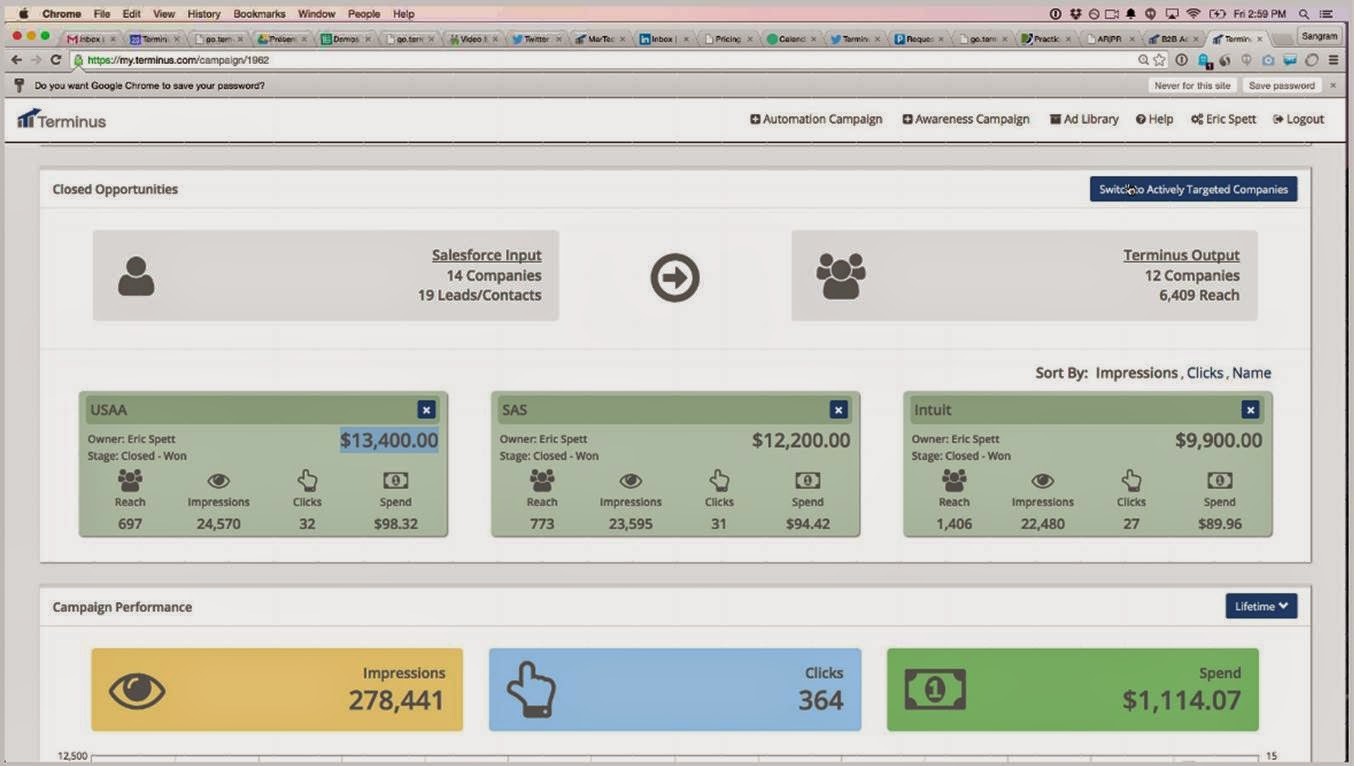
Terminus Offers Targeted Display Ads for B2B
Tuesday’s post on the Adobe Marketing Cloud illustrated the complexity of solutions that combine many marketing and advertising components. Despite my best efforts, and much cooperation from Adobe, I’m sure it still misses many nuances of how Adobe components do or don’t work together. Nor does it address the challenges that users face in making sense of it all. Coincidentally, yesterday's FierceCMO blog indirectly quotes Lenovo’s Michael Ballard on this very point: “Adobe is not a solution for everyone because it requires a lot of expertise and attention. To help the system run smoothly, Lenovo has both dedicated internal Adobe teams, as well as full-time support people on Adobe's payroll, which means the company spends equal amounts on both products and support services.” And Lenovo uses just only two of Adobe’s eight solutions.
For many smaller companies, a suite like Adobe, Oracle, IBM, Salesforce.com, SAS, or Teradata isn’t an option and would be overkill if it were. Those firms will generally do better with a simpler solution that was built as an integrated whole, such as a StrongView (recently reviewed here) or SiteCore (reviewed here not so recently).
But such integrated solutions are rarely comprehensive. This means that meeting a full range of needs requires connecting with external systems. Some vendors do this better than others. A good foundational system also needs a robust customer database that can integrate data from all the channels, whether it supports them directly or via partners.
One area where partners are especially common is ad management. Although martech and adtech are on the path to merging into madtech, they’re still largely separate, especially outside the big enterprise suites. This means that integration has largely meant sharing audiences defined in a marketing automation system with demand side platforms (DSPs), so the DSPs can bid on audience members when they appear on ad networks. For B2B marketers, this has happened mostly through Demandbase and what was formerly Bizo (now part of LinkedIn). Vendemore (reviewed here) is another option.
Terminus, which officially launched in February, is new alternative. The system imports lists of target accounts from a company’s CRM or marketing automation system, or lets clients build their own lists from Terminus’ own B2B company database. Users can then specify the corporate roles they want to target. Terminus uses third party data partners to identify cookies belonging to people in the specified roles at the selected companies and connects to ad exchanges, Facebook, and mobile apps to bid on them. The system automatically monitors response and optimizes its bids to get the best results within a company’s campaign budget.
Here are a few features to consider when comparing Terminus with other B2B advertising solutions:
- self-service. The system provides users with a multi-step process to import their data, select target segments, assign creative materials, set daily and/or total campaign budgets, define campaign end dates, and start executing campaigns. During campaign set-up, the system shows how many companies and contacts match the segmentation criteria within the imported CRM or marketing automation data and how many Terminus can find in its cookie pool.
- email-based targeting. Terminus selects cookies by using LiveRamp and other data partners to match them against email addresses from the CRM or marketing automation system. The company says this is more accurate than targeting based on IP address. (The company can also use its own database to reach people not in the clients' systems.) Integration is currently available for Salesforce.com CRM, Marketo, and HubSpot, with plans to add Salesforce.com Pardot and Oracle Eloqua shortly.
- ad inventory. Terminus currently integrates with well over fifty ad networks and exchanges. It is adding programmatic premium inventory and direct deals to the base programmatic impressions.
- sales stages. Terminus imports opportunity stage from the CRM system and can use this in segmentation. This lets it build separate campaigns to serve different creative to companies in different stages. But the system isn’t tracking messages to specific individuals, so it can’t avoid showing the same message multiple times to the same person.
- automated optimization. Terminus adjusts bids based on twenty variables such as ad size and time of day without asking marketers to make any decisions. Like most real time bidding systems, it typically aims to optimize click through rate or cost per click. The system will automatically serve alternative creatives and pick the best one; true a/b testing and reporting is planned for future release.
- reporting: the system shows spend, reach, impressions, and clicks for each account, giving marketers a precise view of how each account has been treated. Opportunity value can be imported to add return on investment analysis. Reports can be filtered by opportunity status, for example to show only closed deals. Reports can also summarize results by device, ad format, creative version, and other variables. Marketers can change creative from within the reporting screen if they spot something that isn’t performing well.
- pricing. Terminus charges a fixed platform fee and passes through the advertising expenses at cost. The company considers this among its most important innovations, compared with other firms that make their profit by marking up advertising expenses. The Terminus approach provides greater clarity and lets the company optimize its clients’ ad purchases without affecting its own profits. The platform fee is currently about $500 per month although Terminus expects to offer several tiers starting from $725 to $1,000 per month later this year.
For many smaller companies, a suite like Adobe, Oracle, IBM, Salesforce.com, SAS, or Teradata isn’t an option and would be overkill if it were. Those firms will generally do better with a simpler solution that was built as an integrated whole, such as a StrongView (recently reviewed here) or SiteCore (reviewed here not so recently).
But such integrated solutions are rarely comprehensive. This means that meeting a full range of needs requires connecting with external systems. Some vendors do this better than others. A good foundational system also needs a robust customer database that can integrate data from all the channels, whether it supports them directly or via partners.
One area where partners are especially common is ad management. Although martech and adtech are on the path to merging into madtech, they’re still largely separate, especially outside the big enterprise suites. This means that integration has largely meant sharing audiences defined in a marketing automation system with demand side platforms (DSPs), so the DSPs can bid on audience members when they appear on ad networks. For B2B marketers, this has happened mostly through Demandbase and what was formerly Bizo (now part of LinkedIn). Vendemore (reviewed here) is another option.
Terminus, which officially launched in February, is new alternative. The system imports lists of target accounts from a company’s CRM or marketing automation system, or lets clients build their own lists from Terminus’ own B2B company database. Users can then specify the corporate roles they want to target. Terminus uses third party data partners to identify cookies belonging to people in the specified roles at the selected companies and connects to ad exchanges, Facebook, and mobile apps to bid on them. The system automatically monitors response and optimizes its bids to get the best results within a company’s campaign budget.
Here are a few features to consider when comparing Terminus with other B2B advertising solutions:
- self-service. The system provides users with a multi-step process to import their data, select target segments, assign creative materials, set daily and/or total campaign budgets, define campaign end dates, and start executing campaigns. During campaign set-up, the system shows how many companies and contacts match the segmentation criteria within the imported CRM or marketing automation data and how many Terminus can find in its cookie pool.
- email-based targeting. Terminus selects cookies by using LiveRamp and other data partners to match them against email addresses from the CRM or marketing automation system. The company says this is more accurate than targeting based on IP address. (The company can also use its own database to reach people not in the clients' systems.) Integration is currently available for Salesforce.com CRM, Marketo, and HubSpot, with plans to add Salesforce.com Pardot and Oracle Eloqua shortly.
- ad inventory. Terminus currently integrates with well over fifty ad networks and exchanges. It is adding programmatic premium inventory and direct deals to the base programmatic impressions.
- sales stages. Terminus imports opportunity stage from the CRM system and can use this in segmentation. This lets it build separate campaigns to serve different creative to companies in different stages. But the system isn’t tracking messages to specific individuals, so it can’t avoid showing the same message multiple times to the same person.
- automated optimization. Terminus adjusts bids based on twenty variables such as ad size and time of day without asking marketers to make any decisions. Like most real time bidding systems, it typically aims to optimize click through rate or cost per click. The system will automatically serve alternative creatives and pick the best one; true a/b testing and reporting is planned for future release.
- reporting: the system shows spend, reach, impressions, and clicks for each account, giving marketers a precise view of how each account has been treated. Opportunity value can be imported to add return on investment analysis. Reports can be filtered by opportunity status, for example to show only closed deals. Reports can also summarize results by device, ad format, creative version, and other variables. Marketers can change creative from within the reporting screen if they spot something that isn’t performing well.
- pricing. Terminus charges a fixed platform fee and passes through the advertising expenses at cost. The company considers this among its most important innovations, compared with other firms that make their profit by marking up advertising expenses. The Terminus approach provides greater clarity and lets the company optimize its clients’ ad purchases without affecting its own profits. The platform fee is currently about $500 per month although Terminus expects to offer several tiers starting from $725 to $1,000 per month later this year.
Tuesday, March 24, 2015
Adobe Marketing Cloud Marches Towards Martech and Adtech Integration
At pretty much the same moment I was publishing my post on the merger of martech and adtech into madtech, Adobe was announcing its latest marketing products, including a press release on uniting “Data-driven Marketing and Ad Tech” . Naturally, this caught my attention.
As you might expect, Adobe’s reality is considerably more complicated than the simplicity of the “madtech” vision. Like the other enterprise software vendors who offer broad martech and adtech solutions, Adobe has built its marketing cloud by buying specialist systems. And, again like its competitors, it has only integrated them to a limited degree.
In Adobe’s case, the various products remain as distinct “solutions” served by a common set of “core services”. The current set of eight solutions includes Analytics (Web, video and mobile analytics, née Omniture Site Catalyst), Social (social publishing, based on Context Optional), Target (Web optimization and personalization, derived from Omniture Test & Target/Offermatica), Experience Manager (Web content management , originally Day Software), Media Optimizer (based on Efficient Frontier and Demdex), Campaign (formerly Neolane); Primetime (addressable TV) and Audience Manager (data management platform, formerly Demdex). Of course, the products have all been modified to some degree since their acquisitions. But each still has its own data store, business logic and execution components.
Rather than replacing these components with common systems, Adobe has enabled a certain amount of sharing through its core services. In the case of customer data, the “profiles and audiences” core service maintains a common ID that is mapped to identities in the different solutions. This means that even though most customer data stays in the solutions’ own databases, the core service can use that data to build audience segments. There's also an option to load some attributes into the core services profiles themselves. Audiences, which are lists of IDs, can either be defined in solutions and sent to the core service or built within the core service itself. Either way, they can then be shared with other solutions. Data from external systems can also be imported to the core service in batch processes and used in segmentation.
Adobe says that data stored in the solutions can be accessed in real time. I'm skeptical about performance of such queries, but the ability to store key attributes within the core service profiles should give marketers direct access when necessary. There’s certainly a case to be made that digital volumes are so huge and change so quickly that it would be impractical to copy data from the solutions to a central database. Where external data is concerned, marketers will increasingly have no choice but to rely on distributed data access.
But here’s the catch: Adobe's approach only works if all your systems are actually tied into the central system. Adobe recognizes this and is working on it, but so far has only integrated five of its solutions with the profiles and audiences core service. These are Analytics, Target, Campaign, Audience Manager, and Media Optimizer. The rest will be added over time.
The second big limit to Adobe’s current approach is sharing with external systems. Only Adobe solutions can access other solutions’ data through core services. This makes it difficult to substitute an external product if you already have one in place for a particular function or don’t like Adobe’s solution.
Adobe does connect with non-Adobe systems through Audience Manager, its data management platform, which can exchange data with a company’s own CRM or operational databases, business partners, and external data pools and ad networks. Audience Manager can hold vast amounts of detailed data, but does not store personally identifiable information such as names or email addresses. Audience Manager can also copy Web behavior information directly from Analytics, the one instance (so far as I know) where detailed data is shared between Adobe solutions.
So far, I’ve only been discussing data integration. The various Adobe components also have their own tools for segmentation, decision logic, content creation, and other functions. These are also slowly converging across products: for example, there is an “assets” core service that provides a central asset library whose components can be uploaded to at least some of the individual solutions. The segmentation interface is also being standardized product-by-product. There’s no point in trying to list exactly what is and isn't standard today, since this will only change over time.
The lesson here is that suites are not simple. Marketers considering Adobe or any other Marketing Cloud need to examine the details of the architectures, integration, and consistency among the components they plan on using. The differences can be subtle and the vendors often don’t explain them very clearly. But it pays to dig in: the answers have a big impact on whether the system you choose will deliver the results you expect.
Thursday, March 19, 2015
Everstring Offers Fast, Flexible, Account-based Predictive Models for B2B Sales and Marketing
Remember how much simpler life was back in 2010? Among our quaint notions, we thought that B2B companies couldn’t build predictive models because they didn’t have enough data about their customers and prospects. The Internet has changed that, providing oceans of relevant detail from company Web sites, social media, job boards, and other sources. Today, at least a dozen vendors are offering predictive models for B2B lead scoring, sales intelligence, and customer success management.
Many of the original scoring vendors specialized in a single application. But today, most are broadening their products to serve multiple purposes. This lets the vendor charge more to each client and blocks out potential competitors. Marketers also benefit since they only have to buy, learn, and integrate a single system.
Everstring is relative newcomer to the B2B predictive modeling arena, founded in 2012 but only seriously entering the market after it received $12 million in Series A funding last August. The late start has let it adopt a broader scope from the beginning, offering both lead scoring and new prospect identification. The company plans to extend its offerings later this year to include real-time treatment recommendations.
But what really sets Everstring apart are two other factors: it works at the account rather than individual level, and it builds models really, really fast – as in, six minutes for a new model once data connections are in place. The two factors are related: Everstring can work quickly because it only imports a client’s account list and sales activities, saving complicated data mapping and analysis, and because it has preclassified its master database of six million U.S. businesses into clusters based on similarities in products, technologies used, hiring patterns, news events, social data, and other factors. This means that building a new model only requires using activity history to identify the client’s responsive accounts and finding which segments have the highest concentrations of those accounts.
That’s pretty light work compared with loading individual level data and identifying which attributes are most predictive for each client’s business. Matching against six million companies rather than 100 million individuals speeds things up too. The approach also lets clients score anonymous leads if IP address or similar information can identify their company. Models for different products can be based built by selecting only accounts that purchased that product.
Once a model is built, Everstring can score any new leads by just by identifying the segment their company belongs to and applying that segment’s score. Lists of new prospects require simply taking names from the highest-scoring segments.
Sounds pretty simple, eh? That’s because I’ve over-simplified. The data gathering and actual math are actually quite complicated. Beyond that, Everstring does more than provide segment scores, which measure the fit between a new account and the client’s previously responsive prospects. Specifically, it also measures purchase intent by based on more than 1 billion clicks per day on third party Web sites and emails. And it measures engagement by analyzing visitor behaviors on the client’s own Web site, gathered through a tracking pixel, plus other data imported from marketing automation. The combination of fit, intent, and engagement will guide the real-time treatment recommendations and can support additional scoring applications. Fit scores alone are much more limited..
So, how do you deploy all this? Everstring has standard integrations with Salesforce.com, Marketo and Oracle Eloqua, which can send data for the initial model building and score new accounts as they are added to those systems. A real-time API can integrate with other CRM and marketing automation systems.
Pricing for Everstring is based on the types of models and volume. Lead scoring usually runs from $60,000 to $100,000 per year. New prospect names is additional. Pricing for real-time message selection isn’t yet set. The system currently has about 25 clients, nearly all added since last August.
Many of the original scoring vendors specialized in a single application. But today, most are broadening their products to serve multiple purposes. This lets the vendor charge more to each client and blocks out potential competitors. Marketers also benefit since they only have to buy, learn, and integrate a single system.
Everstring is relative newcomer to the B2B predictive modeling arena, founded in 2012 but only seriously entering the market after it received $12 million in Series A funding last August. The late start has let it adopt a broader scope from the beginning, offering both lead scoring and new prospect identification. The company plans to extend its offerings later this year to include real-time treatment recommendations.
But what really sets Everstring apart are two other factors: it works at the account rather than individual level, and it builds models really, really fast – as in, six minutes for a new model once data connections are in place. The two factors are related: Everstring can work quickly because it only imports a client’s account list and sales activities, saving complicated data mapping and analysis, and because it has preclassified its master database of six million U.S. businesses into clusters based on similarities in products, technologies used, hiring patterns, news events, social data, and other factors. This means that building a new model only requires using activity history to identify the client’s responsive accounts and finding which segments have the highest concentrations of those accounts.
That’s pretty light work compared with loading individual level data and identifying which attributes are most predictive for each client’s business. Matching against six million companies rather than 100 million individuals speeds things up too. The approach also lets clients score anonymous leads if IP address or similar information can identify their company. Models for different products can be based built by selecting only accounts that purchased that product.
Once a model is built, Everstring can score any new leads by just by identifying the segment their company belongs to and applying that segment’s score. Lists of new prospects require simply taking names from the highest-scoring segments.
Sounds pretty simple, eh? That’s because I’ve over-simplified. The data gathering and actual math are actually quite complicated. Beyond that, Everstring does more than provide segment scores, which measure the fit between a new account and the client’s previously responsive prospects. Specifically, it also measures purchase intent by based on more than 1 billion clicks per day on third party Web sites and emails. And it measures engagement by analyzing visitor behaviors on the client’s own Web site, gathered through a tracking pixel, plus other data imported from marketing automation. The combination of fit, intent, and engagement will guide the real-time treatment recommendations and can support additional scoring applications. Fit scores alone are much more limited..
So, how do you deploy all this? Everstring has standard integrations with Salesforce.com, Marketo and Oracle Eloqua, which can send data for the initial model building and score new accounts as they are added to those systems. A real-time API can integrate with other CRM and marketing automation systems.
Pricing for Everstring is based on the types of models and volume. Lead scoring usually runs from $60,000 to $100,000 per year. New prospect names is additional. Pricing for real-time message selection isn’t yet set. The system currently has about 25 clients, nearly all added since last August.
Monday, March 09, 2015
Marketing Technology of the Future: Beyond the Customer Data Platform
The last three minutes of my MarTech Conference presentation are driving me crazy.
The preceding portions cover the current state of Customer Data Platforms. I have no trouble talking about that. But it somehow got into my head that the last section should look at how CDPs will fit into the long-term future of marketing technology. I have some fuzzy notions that this future martech will be radically different from today. But to cover it succinctly I must first think it through in detail. That has been considerably harder than I expected. Here’s what I have so far.
Current Trends
These are developments happening now that will provide the context for industry changes. Some will be the topic of other MarTech presentations.
• Convergence of Adtech with Martech. These have until recently been largely separate: Adtech deals with messages to audiences whose members may share common characteristics but are not individually identified. Martech deals with known individuals. As anonymity becomes increasingly unavailable, marketers will know exactly who is receiving their advertising messages. Martech targeting techniques will therefore be used in adtech as well. Conversely, some adtech features will become standard martech practice. More about that later.
• Contextual data. Social networks, mobile devices including phones and wearables, and the Internet of Things will provide ever-more details about the precise situation of each customer during each interaction. Location is an obvious data point, but marketers will also know your local weather, your mood and physical condition, what you’re wearing, when and what you last ate, and whether your car needs gas. This may sound seriously creepy but the good news is you’ll get better-targeted messages. I’d love to call this “contextual marketing” but that term is taken.
• Marketing to machines. I’m not talking about marketing with machine-generated data (e.g., your running shoes telling Nike how many miles you’ve logged) or marketing through messages on your machine (your washer suggesting you buy Tide-brand detergent). I’m talking marketing to machines that are making purchase decisions on their own. I discussed this last year in Do Self-Driving Cars Pick Their Own Gas Stations? and More on Marketing To Things. Frankly, I've been surprised to see little else written on the topic. Trust me, this will be big: imagine convincing Siri to recommend your restaurant every time someone asks where they should go to lunch.
Implications for Martech
Given the trends I’ve just listed, I see martech changing significantly.
• Data synergy. I just made that term up but the idea is old: related bits of data are worth more when they’re combined. So knowing you just booked a trip to Alaska and knowing you just walked into a department store are each marginally useful by themselves, but together they let you offer me a great deal on a warm coat. It helps even more if I know you don’t already have one. The implication of this is that there’s a lot of value gained from combining data from different sources into shared repositories. It also implies there’s a lot of value in “identity association” technologies that link related data to the same person. If you've been wondering why companies like Oracle, Acxiom, and Nielsen have been buying big data aggregators, you can stop.
• Everything is biddable. Another implication of data synergy is that each opportunity to communicate with an individual will be much more valuable to some people than others. Let’s stick with that Alaska trip: selling you a coat might be worth less than selling you a hotel room. So, when you walk into the store, the hotel chain might be willing to pay more for the chance to send you a message than the store itself. Having all the messaging devices connected to a central database and bidding system makes this possible – in fact, it already happens with real time bidding on Web ads. Now Martech platforms get to do the same. And oh, to make this work well, Martech has to hugely improve its ability to measure the actual impact of each message – so advanced, predictive attribution also plays a leading role in the martech world of the tomorrow.
• Campaigns are dead but the customer journey lives on. If each interaction is bid separately, then the notion of campaigns that lead the customer through a sequence of contacts on a flow chart is irrelevant. Honestly, I’m glad to see it go: the very first campaign management system I saw, more than twenty years ago, had exactly that sort of interface and it’s well past time for a change. But this doesn’t mean we can stop thinking about customer journeys. Any model that supports bidding on individual messages must understand where each customer is in her journey and how the message will influence the result. Of course, different marketers will be tracking different journeys.
• Automation takes over. It’s obvious that mass data consolidation, real time bidding, optimized messaging, and omnichannel execution require near-total automation of the entire process. This has to be really intelligent automation that finds patterns, notices when they change, and optimizes treatments with minimal human guidance. And where will all that highly tailored content come from? You guessed it: automated content creation systems, which are more common and further advanced than you may realize. See Paul Roetzer’s recent post on artificial intelligence in marketing automation for an introduction to the topic and watch Humans Need Not Apply if you want to get really scared.
• Machines buy martech. If the over-all trend is machines selling to other machines, why should martech be left out? In fact, testing the huge number of new martech options (or even generating Scott Brinker's martech landscape supergraphic) is something machines could do really well. Once suitably open architectures are in place, it should be easy to plug in new components like a better predictive modeling system, new type of video promotion, or the latest social media app. Even if those components are less than fully automated, they could be identified, screened, integrated, and assessed with minimal human intervention. Machines would almost surely assess results better than humans, since they’d be more objective and better able to look for subtle effects on customer behavior than human analysts.
• Humans keep things running. It’s possible that machines will eventually control every aspect of our marketing. But I think humans will have a role to play at least for a while. This won’t necessarily be the traditional “creative” work such as copywriting and design, which machines already do better than we care to admit. But they’ll still need people to come up with non-incremental products, non-obvious insights, and deals with other organizations. Even things that machines could do better than people won’t be wholly machine-run for a while, just due to the normal lags in technology and organizational development. This may sound like a dark view of humanity’s future, but I’m more optimistic than it seems. Technology never works quite as well as promised, so I figure humans will still be needed to keep things running.
Implications for Marketers
If Martech moves in the directions I’m proposing, marketers need to do certain things to prepare.
• Expect imperfection. Sure we’ll have vastly more data than ever, but don’t assume it will be perfectly complete, accurate, or integrated. In fact, you can guarantee it won't. Predictive models make mistakes as well. Look for systems that are designed to accommodate incomplete information, check for differences between actual and expected performance, and adapt gracefully to failures. Above all, demand transparency so you can see what the automated systems are doing and have some idea of why. This will probably require help from other systems, but make sure the monitors are as independent as possible so they’re not fooled by shared mistakes. If you’re really feeling clever, examine imperfections for opportunities – you may find bargains in bidding on messages to customers that other systems have rejected because their data is unavailable or contradictory.
• Plan for change. As anyone who has tried to modify a complex campaign workflow already knows, sophisticated systems can be brittle. High performance automated systems are likely to optimize themselves for specific conditions, which is great until those conditions change. Be sure you can easily introduce new data sources, components, objectives, and execution channels. And be sure you can always revert to a simpler, more manual mode of operation if things really go bad.
• Focus on the analytics layer. One implication of data synergy is that the richest databases will live outside of your company’s own data center: they’ll be too big, too complicated, and updated too frequently to maintain a copy in-house. Similarly, if companies are bidding to deliver messages everywhere a customer appears, they won’t own the touchpoints. So the only piece the company can expect to own is the analytical layer – the bidding and content engines. Those engines should be freely swappable as well. What’s left to hold things together is a core of profile data shared by the analytical and content engines. This is connected to the external data store on one end and the touchpoint systems on the other. All told, it’s a rather wispy little framework, but it should be enough to provide the glue needed to link all the other components.
So, where does that leave us? Gigantic external data pools linked to personal identities, real time bidding, messages delivered through paid channels: it's "adtech without the privacy" if you want to put it in a nutshell. That isn't where I expected to end up, but that's exactly why I needed to write this. I can’t guarantee I won’t change my mind after further reflection, but for now I think this gives a reasonable picture of what martech might look like five or ten years from now. In the shorter term, I still expect the central role will be played by Customer Data Platforms or (more likely) by Marketing Platforms that combine the data parts of a CDP with a multi-purpose analytical and decision layer.
Now all I have to do is figure out how to cram this into three minutes.
...hmm...
On further reflection, it comes down to a hybrid of martech plus adtech, which is inevitably named madtech:
Monday, March 02, 2015
Reborn AutoPilot Aims to Simplify Multi-Channel Marketing
Autopilot*, formerly AutopilotHQ and Bislr before that, relaunched itself today. I wrote about Bislr in November 2013. Back then, they positioned themselves as a “marketing operating system” that provided core functions but would ultimately let users connect with third party apps. The latest incarnation describes itself as “software for multi-channel marketing” but still provides core functions and connects with third party apps. So what has changed?
The difference is in the details. AutoPilot has spent much of the past 18 months making the system easier to use and now has handful of actual integrations available. These include Salesforce.com for CRM, InsideView and FullContact for data enhancement, Twilio for text messaging, Lob for postcards, Segment for event tracking, and GoodData for reporting. Email and landing pages are still native to the product but the vendor has added tools to import, edit, and reuse HTML from external Web sites and email systems. This allows marketers to adopt Autopilot without discarding their current tools, easing the transition.
If there’s a substantive difference between the earlier Autopilot vision and the latest edition, it’s that the vendor spoke in 2013 of making it easy to build custom apps for Autopilot, while today they speak of integrating with existing best-of-breed systems. The current approach makes Autopilot easier to adopt although it also reduces the difference between Autopilot and other “marketing platforms” that have their own app stores.
But from Autopilot’s own perspective, its real differentiator is simplicity. It sees itself as filling the gap between simple email systems and enterprise marketing automation products. That space is plenty crowded, although Autopilot may be a bit easier to use than most of its competitors. The drag-and-drop campaign builder is attractive; more important, actions in external apps appear as icons, making them as accessible the vendor's own features. Autopilot also provides a library of prebuilt campaign “guidebooks” that give new users an easy way to get started. The library is expected to grow as Autopilot users contribute their own guidebooks to the list.
The company’s other differentiator is a seriously aggressive pricing model. This starts at $4 per month (you read that right) for up to 500 names in the database. A more realistic 10,000 contacts is still just $160 per month including unlimited email. In comparison, mid-market stalwart Act-On charges $1,150 per month for 10,000 names. The vendor expects to survive at such low prices by minimizing sales and support costs, allowing almost total self-service in both areas. (There’s no phone support although users can submit questions by email during West Coast business or look in the community forums and knowledgebase.) Whether this can satisfy new small business users remains to be seen.
I know you're wondering by now whether I’ll classify AutoPilot as a Customer Data Platform. (Rumor has it, there’s a drinking game that involves reading my blog posts aloud and taking a shot every time the phrase comes up. Get a life, people.) In fact, I do not: AutoPilot doesn’t do the complex data management a CDP requires. But the system does integrate with Segment, an expanded tag management system that qualifies as a CDP quite nicely. So you might consider AutoPilot as part of a complete CDP package.
AutoPilot was founded in 2011 and introduced the first version of its system in 2013. The company has accrued more than 100 clients, Most are small businesses but some are bigger.
_______________________________________________________________________
* The Web site is www.autopilothq.com. The domain autopilot.com belongs to a firm selling salt chlorine generators. So far as I know, there’s no connection.
The difference is in the details. AutoPilot has spent much of the past 18 months making the system easier to use and now has handful of actual integrations available. These include Salesforce.com for CRM, InsideView and FullContact for data enhancement, Twilio for text messaging, Lob for postcards, Segment for event tracking, and GoodData for reporting. Email and landing pages are still native to the product but the vendor has added tools to import, edit, and reuse HTML from external Web sites and email systems. This allows marketers to adopt Autopilot without discarding their current tools, easing the transition.
If there’s a substantive difference between the earlier Autopilot vision and the latest edition, it’s that the vendor spoke in 2013 of making it easy to build custom apps for Autopilot, while today they speak of integrating with existing best-of-breed systems. The current approach makes Autopilot easier to adopt although it also reduces the difference between Autopilot and other “marketing platforms” that have their own app stores.
But from Autopilot’s own perspective, its real differentiator is simplicity. It sees itself as filling the gap between simple email systems and enterprise marketing automation products. That space is plenty crowded, although Autopilot may be a bit easier to use than most of its competitors. The drag-and-drop campaign builder is attractive; more important, actions in external apps appear as icons, making them as accessible the vendor's own features. Autopilot also provides a library of prebuilt campaign “guidebooks” that give new users an easy way to get started. The library is expected to grow as Autopilot users contribute their own guidebooks to the list.
The company’s other differentiator is a seriously aggressive pricing model. This starts at $4 per month (you read that right) for up to 500 names in the database. A more realistic 10,000 contacts is still just $160 per month including unlimited email. In comparison, mid-market stalwart Act-On charges $1,150 per month for 10,000 names. The vendor expects to survive at such low prices by minimizing sales and support costs, allowing almost total self-service in both areas. (There’s no phone support although users can submit questions by email during West Coast business or look in the community forums and knowledgebase.) Whether this can satisfy new small business users remains to be seen.
I know you're wondering by now whether I’ll classify AutoPilot as a Customer Data Platform. (Rumor has it, there’s a drinking game that involves reading my blog posts aloud and taking a shot every time the phrase comes up. Get a life, people.) In fact, I do not: AutoPilot doesn’t do the complex data management a CDP requires. But the system does integrate with Segment, an expanded tag management system that qualifies as a CDP quite nicely. So you might consider AutoPilot as part of a complete CDP package.
AutoPilot was founded in 2011 and introduced the first version of its system in 2013. The company has accrued more than 100 clients, Most are small businesses but some are bigger.
_______________________________________________________________________
* The Web site is www.autopilothq.com. The domain autopilot.com belongs to a firm selling salt chlorine generators. So far as I know, there’s no connection.
Subscribe to:
Posts (Atom)