eBay’s $2.4 billion offer for e-commerce services giant GSI Commerce has been described largely in terms of helping eBay to compete with Amazon in servicing retailers – or, as eBay President John Donahoe put it somewhat more diplomatically in the press release, “GSI will enhance our position as the leading strategic global commerce partner of choice for retailers and brands of all sizes.”
I suppose that’s legitimately the main point of the story. But what I really want to know is what it means for marketing automation. Not that I’m obsessed or anything.
What makes the connection worth pondering is the approach to marketing automation taken by IBM, most recently in the Smarter Commerce initiative announced earlier this month. IBM defines marketing automation as digital analytics, and puts digital analytics at the center of the business universe. The broad argument is that online activities, including both paid advertising and social messages, drive consumer behavior and can therefore be used to improve both supply chain operations (creating and stocking the right products) and demand chain operations (creating sales and managing brand attributes).
This desire to merge marketing into the larger stream of business activities is shared by GSI Commerce (and now eBay) in their approach of offering marketing within a suite of ecommerce operations. It’s been intriguing over the past few years to watch GSI supplement its core operational services (order processing, fulfillment and call center) with marketing services including email (e-Dialog), agency (Silverlign), mobile (M3), affiliate (Pepperjam), retargeting (Fetchback), database (MBS), and attribution (ClearSaleing).
I fully realize that eBay/GSI’s focus is limited to retail while IBM’s scope is literally the entire world. But both are pushing the fundamental idea of marketing as a node within the larger organizational collective. This is quite different from marketing, and marketing automation, as a largely self-contained activity that only connects with the rest of the organization comes when it drives customers to make a purchase. It also suggests that the notion of “integrated marketing management” is fundamentally flawed – if you take “integrated marketing management” as referring to a system to tightly integrate activities within the marketing department..
There, I said it. It feels so good I’ll say it again: integrated marketing management is bad. Bad bad bad. Companies need to integrate their customer treatments across all functions. The role of marketing, and marketing automation, is to guide those treatments. To do that efficiently, marketing automation must be built into the operational systems, not sit outside them. The only thing that can be handled separately is marketing analytics, just like other types of specialized analytics. But the results of those analytics must be communicated to operational systems for execution. Those operational systems must themselves be tightly integrated with each other to ensure the treatments are coordinated.
You could argue that this coordination across operational systems is also a role for “marketing automation”. I agree it is, but don't think it's not the primary meaning of the term. Traditional marketing automation is about campaign planning, execution, and analysis.
Now, don’t take this to mean that I’ve swallowed the Smarter Commerce Kool-Aid. I still think it’s presented in ways that ignore the fact that most activity is still non-digital. (I also recognize that the folks are IBM are plenty smart enough to realize this, and expect that they’ll merrily include non-digital activities in their projects. Or they’ll argue that even non-digital activities are captured digitally and therefore included in their definition. The latter is true, but if "digital" encompasses everything, why use the term at all?)
Okay, that's just quibbling about words. I see a more important difference between whether you start with an operational platform and add analytics (the GSI approach, if I oversimplify a bit), or you start with analytics and tie it into operational systems (the IBM approach, for sure). In an ideal world, the operational systems would all have great customer management features and the operational approach would win. But here on Planet Earth, most companies have several customer-unfriendly operational systems that won’t go away any time soon. Connecting them into an external analytics system – even if the connections are a bit superficial – is probably the best bet for most organizations. (I could explain this with a wonderful analogy about running extension cords vs. rewiring the walls. But I won’t. You’re welcome.)
Bottom line: whether eBay intends to or not, their GSI purchase supports the broad view of marketing automation as an enterprise-wide utility, not a tool for intra-marketing efficiency. (Ha – and you thought I couldn’t write a concise sentence.)
Tuesday, March 29, 2011


Thursday, March 24, 2011
OMMA Metrics Conference: Online Ads Must Prove Real Value To Succeed
I took a break from my usual obsessions yesterday to attend the New York edition of MediaPost’s OMMA Metrics and Measurement conference. It was a good chance to dive into this particular sector of the marketing analytics universe. (Another version of the program will be presented in San Francisco in July; the company also live streams a free Webcast. You can also download selected presentations from yesterday.)
If there was an overriding theme to the event, it was frustration that online advertising isn’t attracting as much money as it should. There was more than a little ”TV-envy”: the feeling that TV gets more advertising because buying is based on simple, widely-accepted audience measures. Some speakers argued for duplicating this situation, by removing some middlemen and creating standard online audience measures.
Others pointed to a deeper issue: that online marketers can’t measure the value of their efforts in terms of revenue or brand metrics like awareness and preference. In this view, TV buyers accept simple measures like Gross Rating Points because these measures have proven over time to correlate with real business results. Media mix modeling has more recently confirmed this. But except for direct response, online media can’t show the same relationship. This forces online marketers to report endless (but never complete) data about who saw what and how they acted, in the hopes that piling on enough details will somehow make advertisers happy. It never does.
This is the online version of the old joke about the drunk who loses his keys in the alley but looks for them under the streetlamp “because the light is better”. Moral of story: no volume of irrelevant data can substitute for the information you really need.
In the case of online advertising, the dark alley is the connections between ad placements and final business results. Several speakers touched on parts of this. IBM’s Yuchun Lee gave an opening keynote that highlighted the pervasive influence of online information over all customer activities, not just online purchases. Adometry’s Steve O’Brien explicitly stated that attribution must measure the incremental impact of each marketing effort on final results (although I think he limited this to online results). ForeSee Results’ Larry Freed stressed the need to trace all online and offline behaviors to understand their true role in final outcomes. Others cited studies where careful measurement found that indirect results showed online to be much more powerful than direct attribution alone.
Yesterday’s speakers also raised the problem of scalability: that is, being able to duplicate and expand on success. This is one area where TV envy makes sense, because it’s easy to add more Gross Rating Points and be reasonably sure of getting the expected results. Online ad buying is more like buying print ads or mailing lists: you may have some sense of the audience demographics, but the only way to really know how it will perform is to run a test. But this isn't a measurement problem: simple, standard measures that hide true audience differences are only going to be unreliable predictors of actual results. What’s really needed are better testing methods to predict as quickly and cheaply as possible how each new audience will perform. The trick is you’re not just looking at immediate response, but all of those indirect effects that are so tricky to capture in the first place. Now you have to predict them in advance as well as measure them after the fact.
Nobody said it would be easy.
If there was an overriding theme to the event, it was frustration that online advertising isn’t attracting as much money as it should. There was more than a little ”TV-envy”: the feeling that TV gets more advertising because buying is based on simple, widely-accepted audience measures. Some speakers argued for duplicating this situation, by removing some middlemen and creating standard online audience measures.
Others pointed to a deeper issue: that online marketers can’t measure the value of their efforts in terms of revenue or brand metrics like awareness and preference. In this view, TV buyers accept simple measures like Gross Rating Points because these measures have proven over time to correlate with real business results. Media mix modeling has more recently confirmed this. But except for direct response, online media can’t show the same relationship. This forces online marketers to report endless (but never complete) data about who saw what and how they acted, in the hopes that piling on enough details will somehow make advertisers happy. It never does.
This is the online version of the old joke about the drunk who loses his keys in the alley but looks for them under the streetlamp “because the light is better”. Moral of story: no volume of irrelevant data can substitute for the information you really need.
In the case of online advertising, the dark alley is the connections between ad placements and final business results. Several speakers touched on parts of this. IBM’s Yuchun Lee gave an opening keynote that highlighted the pervasive influence of online information over all customer activities, not just online purchases. Adometry’s Steve O’Brien explicitly stated that attribution must measure the incremental impact of each marketing effort on final results (although I think he limited this to online results). ForeSee Results’ Larry Freed stressed the need to trace all online and offline behaviors to understand their true role in final outcomes. Others cited studies where careful measurement found that indirect results showed online to be much more powerful than direct attribution alone.
Yesterday’s speakers also raised the problem of scalability: that is, being able to duplicate and expand on success. This is one area where TV envy makes sense, because it’s easy to add more Gross Rating Points and be reasonably sure of getting the expected results. Online ad buying is more like buying print ads or mailing lists: you may have some sense of the audience demographics, but the only way to really know how it will perform is to run a test. But this isn't a measurement problem: simple, standard measures that hide true audience differences are only going to be unreliable predictors of actual results. What’s really needed are better testing methods to predict as quickly and cheaply as possible how each new audience will perform. The trick is you’re not just looking at immediate response, but all of those indirect effects that are so tricky to capture in the first place. Now you have to predict them in advance as well as measure them after the fact.
Nobody said it would be easy.
Wednesday, March 23, 2011
Infusionsoft Helps Clients Map Their Marketing Strategy
Summary: Infusionsoft is making it easier to build campaigns and taken a new approach to helping clients plan their marketing programs. Both are needed for marketing automation to reach to a wider audience.
Infusionsoft this week staged the official coming out party for its latest release at its annual Infusioncon users conference. The big news was a one-step “web lead campaign” generator that automatically creates a Web landing page and three cross-linked email flows: a set of follow-up messages after the initial Web form; a “hot lead” track for people who click on a link in any follow-up message; and a “nurture” track for people who complete the follow-up sequence without clicking on anything. Users still need to build the initial Web form and put copy into all the blank emails. But Infusionsoft said that the automated set-up itself saves six to eight hours of work and even more time puzzling out the underlying concepts.
This may seem underwhelming: Infusionsoft has simply added campaign templates, which higher-end marketing automation systems have offered for years. Indeed, you could sniff that Infusionsoft is only now adding campaigns, in the sense of a container to link separate process flows. As if to drive the point home, the company was also previewing early designs for its next release, which will apparently center on a visual flow chart to build campaign diagrams: Dude, welcome to 2003!
Okay, that was totally unfair. First of all, some of these features are pretty impressive. For example, the system-generated forms and emails automatically include campaign-specific tracking codes, which most systems require users to add manually. And true branching campaigns – as opposed to sequential campaigns with splits inside each step – still aren’t found in most marketing automation systems (although those vendors argue they’re not needed. See last week’s post on eTrigue for details).
More important, the significance of Infusionsoft’s new features isn’t that they’re playing catch-up with systems built for larger companies. It’s that Infusionsoft has been tremendously successful – more than 6,000 clients and 20,000 individual users – without them.
In fact, the company’s research has found that nearly half its clients do almost no email, using the system instead primarily for sales automation and service. Others have used its sequential processes either separately, to automate a variety of annoying manual tasks, or by painstakingly stringing them together by themselves or with professional help.
Another to look at it is this: campaign management is just one application for Infusionsoft, and to date it hasn’t been the dominant one. Rather, Infusionsoft clients have valued labor savings they gain from having one integrated system for marketing, sales, e-commerce, and service. Some of those savings are inherent in the integration itself – that is, files don’t need to be moved from one place to another. Other savings come from running simple automated processes against that integrated data. Only a few Infusionsoft users have added value by running more complex processes, although the crowd at Infusioncom was clearly eager to join them.
The other big announcement at Infusioncom wasn’t about technology at all. It was a new planning methodology called the “Perfect Customer Lifecycle”. It made immediate sense to me, in good part because it somewhat resembles the Customer Experience Matrix that long ago gave this blog its name.
Like the Matrix, the Perfect Customer Lifecycle is organized around the stages in a customer’s relationship with the company, from Attract Traffic through Collect Cash to Get Referrals. Infusionsoft developed it after realizing that few clients could see how the pieces of their marketing programs fit together, which made it difficult to prioritize and maintain focused.
The Perfect Customer Lifecycle replaces a previous Infusionsoft methodology that based on standard marketing programs shared by Infusionsoft’s most successful clients. Although Infusionsoft doesn’t put it this way, the critical difference I see is that one methodology is built around the customer while the other is built around the company. As with the Customer Experience Matrix – still used by my friend and the concept’s original developer, Michael Hoffman of ClientXClient – the customer-oriented approach makes it easy to track every step in the customer relationship and pinpoint opportunities for improvement.
The Perfect Customer Lifecycle illustrates how much effort Infusionsoft puts into helping its customers succeed. I don’t want to make too much of this, since many vendors – and surely all the good ones – care deeply about their customers’ success. But there's an extra passion at Infusionsoft that I think comes from serving small business people. (The company and its clients prefer the term “entrepreneur”; I’ve been toying with “micro-business” as a label. From a practical standpoint, I draw the line at $5 million in revenue and having a professional marketer on staff). The micro-business owner's life is tied to the company’s success in the way that even the most loyal employee's or corporate manager's life is not. I see the same passion for helping customers at other firms serving this market, notably OfficeAutoPilot.
(It doesn’t hurt that micro-business owners often see themselves as self-created Ayn Randian heroes and are more than little susceptible to flattery along those lines. But they're also passionately loyal to anyone who genuinely seems to care about helping them.)
That brings me to my central observation. Marketing automation for micro-businesses is fundamentally different from marketing automation for larger firms.
The technical difference is that micro-business systems expand beyond marketing to integrate marketing, sales, and service. Of course, this is the same scope as traditional CRM, but the micro-business systems add stronger process automation than most CRM products.
The integration and the process automation share the same root cause: small businesses lack the resources to build custom integration or tolerate process inefficiency. Larger firms are organized into departments where the costs of separation are less obvious, intra-departmental efficiency is often hidden from top management, and, probably most important, department heads want separate systems they control directly. Those departmental fiefdoms don’t exist at a micro-business because the owner makes all important decisions personally,
Micro-businesses also need more vendor services because they lack internal marketing expertise. Remember, pretty much by definition, these companies have no professional marketers on staff. The exceptions are small marketing agencies and business coaches, who form a major segment of successful micro-business marketing automation users. This makes sense: they’re the one group of micro-business owners equipped to figure out how to use the systems for themselves, or at least to ask vendors for the right kinds of help. Other micro-businesses nearly all rely heavily on the vendors for both technical and marketing assistance.
By contrast, the pioneering users of larger-company marketing automation systems have largely been technology firms. I think the driving force with this group has been comfort with technology – almost verging on blind faith – even when specific applications were unclear.
If micro-business marketing automation (which obviously shouldn’t be called “marketing automation”) is distinct from the rest of the industry, the next question is whether the adjacent segment is one group of firms from $5 million to $500 million in revenue, or that segment must be divided. My first instinct to look for a division, but when I think about the systems used by companies in that range, their functionality is not very different. You may I recently pointed out that Eloqua, Marketo and Pardot all have about half of their clients with under $20 million revenue (but I suspect very few under $5 million). So even the more powerful marketing automation systems have a lot of small(er) clients.
I do suspect that some mid-tier vendors skew towards the smaller end of the scale and others skew towards the higher end. But that has more to do with pricing and sales models than the products themselves. So maybe one big segment from $5 million to $500 million makes sense after all.
Regardless of how you split the market, it’s clear that both the micro-business and other (regular? corporate? grande?) segments are moving beyond pioneers towards mass adoption. Furthermore, both groups face exactly the same challenge: to make marketing automation easy enough for non-pioneers to adopt it.
Infusionsoft’s move towards campaign templates and visual flows is a big step in this direction. But those features alone won’t solve the problem: if they could, other products that already have them would be more widely adopted. The need to supplement simplicity with marketing training is why Infusionsoft is simultaneously moving ahead with the “Perfect Customer Lifecycle” and related programs.
Vendors selling to larger companies have also been stressing education. So far, though, their focus has seemed more tactical (“how to run a Webinar”) than strategic (“optimize the customer lifecycle”). Maybe that’s because their clients are professional marketers who already have the big picture or rely on marketing agencies and other service partners to provide it. Or – and this is my bet – the marketing automation vendors just haven’t yet recognized that they need to offer strategic frameworks. This is a delicate task since you don't want to insult your prospective buyers. Perhaps the frameworks will be disguised as deployment methodologies and best practices. If I’m right, it doesn’t bode well for vendors who believe that greater ease of use by itself can greatly expand adoption.
This line of thought (plus lack of sleep and coffee – most of this was written on a late night plane ride) leads a final question. If micro- and non-micro-marketing automation vendors are converging on features and strategy training, will the micro-business focus on process automation also be duplicated at larger companies? I can’t point to any evidence yet, but it wouldn't surprise me. Certainly all marketers are subject to the same pressure to operate more efficiently. If process automation does become more important, it will further increase the pressure for process optimization as part of successful deployments. Not to beat a dead horse.
Infusionsoft this week staged the official coming out party for its latest release at its annual Infusioncon users conference. The big news was a one-step “web lead campaign” generator that automatically creates a Web landing page and three cross-linked email flows: a set of follow-up messages after the initial Web form; a “hot lead” track for people who click on a link in any follow-up message; and a “nurture” track for people who complete the follow-up sequence without clicking on anything. Users still need to build the initial Web form and put copy into all the blank emails. But Infusionsoft said that the automated set-up itself saves six to eight hours of work and even more time puzzling out the underlying concepts.
This may seem underwhelming: Infusionsoft has simply added campaign templates, which higher-end marketing automation systems have offered for years. Indeed, you could sniff that Infusionsoft is only now adding campaigns, in the sense of a container to link separate process flows. As if to drive the point home, the company was also previewing early designs for its next release, which will apparently center on a visual flow chart to build campaign diagrams: Dude, welcome to 2003!
Okay, that was totally unfair. First of all, some of these features are pretty impressive. For example, the system-generated forms and emails automatically include campaign-specific tracking codes, which most systems require users to add manually. And true branching campaigns – as opposed to sequential campaigns with splits inside each step – still aren’t found in most marketing automation systems (although those vendors argue they’re not needed. See last week’s post on eTrigue for details).
More important, the significance of Infusionsoft’s new features isn’t that they’re playing catch-up with systems built for larger companies. It’s that Infusionsoft has been tremendously successful – more than 6,000 clients and 20,000 individual users – without them.
In fact, the company’s research has found that nearly half its clients do almost no email, using the system instead primarily for sales automation and service. Others have used its sequential processes either separately, to automate a variety of annoying manual tasks, or by painstakingly stringing them together by themselves or with professional help.
Another to look at it is this: campaign management is just one application for Infusionsoft, and to date it hasn’t been the dominant one. Rather, Infusionsoft clients have valued labor savings they gain from having one integrated system for marketing, sales, e-commerce, and service. Some of those savings are inherent in the integration itself – that is, files don’t need to be moved from one place to another. Other savings come from running simple automated processes against that integrated data. Only a few Infusionsoft users have added value by running more complex processes, although the crowd at Infusioncom was clearly eager to join them.
The other big announcement at Infusioncom wasn’t about technology at all. It was a new planning methodology called the “Perfect Customer Lifecycle”. It made immediate sense to me, in good part because it somewhat resembles the Customer Experience Matrix that long ago gave this blog its name.
Like the Matrix, the Perfect Customer Lifecycle is organized around the stages in a customer’s relationship with the company, from Attract Traffic through Collect Cash to Get Referrals. Infusionsoft developed it after realizing that few clients could see how the pieces of their marketing programs fit together, which made it difficult to prioritize and maintain focused.
The Perfect Customer Lifecycle replaces a previous Infusionsoft methodology that based on standard marketing programs shared by Infusionsoft’s most successful clients. Although Infusionsoft doesn’t put it this way, the critical difference I see is that one methodology is built around the customer while the other is built around the company. As with the Customer Experience Matrix – still used by my friend and the concept’s original developer, Michael Hoffman of ClientXClient – the customer-oriented approach makes it easy to track every step in the customer relationship and pinpoint opportunities for improvement.
The Perfect Customer Lifecycle illustrates how much effort Infusionsoft puts into helping its customers succeed. I don’t want to make too much of this, since many vendors – and surely all the good ones – care deeply about their customers’ success. But there's an extra passion at Infusionsoft that I think comes from serving small business people. (The company and its clients prefer the term “entrepreneur”; I’ve been toying with “micro-business” as a label. From a practical standpoint, I draw the line at $5 million in revenue and having a professional marketer on staff). The micro-business owner's life is tied to the company’s success in the way that even the most loyal employee's or corporate manager's life is not. I see the same passion for helping customers at other firms serving this market, notably OfficeAutoPilot.
(It doesn’t hurt that micro-business owners often see themselves as self-created Ayn Randian heroes and are more than little susceptible to flattery along those lines. But they're also passionately loyal to anyone who genuinely seems to care about helping them.)
That brings me to my central observation. Marketing automation for micro-businesses is fundamentally different from marketing automation for larger firms.
The technical difference is that micro-business systems expand beyond marketing to integrate marketing, sales, and service. Of course, this is the same scope as traditional CRM, but the micro-business systems add stronger process automation than most CRM products.
The integration and the process automation share the same root cause: small businesses lack the resources to build custom integration or tolerate process inefficiency. Larger firms are organized into departments where the costs of separation are less obvious, intra-departmental efficiency is often hidden from top management, and, probably most important, department heads want separate systems they control directly. Those departmental fiefdoms don’t exist at a micro-business because the owner makes all important decisions personally,
Micro-businesses also need more vendor services because they lack internal marketing expertise. Remember, pretty much by definition, these companies have no professional marketers on staff. The exceptions are small marketing agencies and business coaches, who form a major segment of successful micro-business marketing automation users. This makes sense: they’re the one group of micro-business owners equipped to figure out how to use the systems for themselves, or at least to ask vendors for the right kinds of help. Other micro-businesses nearly all rely heavily on the vendors for both technical and marketing assistance.
By contrast, the pioneering users of larger-company marketing automation systems have largely been technology firms. I think the driving force with this group has been comfort with technology – almost verging on blind faith – even when specific applications were unclear.
If micro-business marketing automation (which obviously shouldn’t be called “marketing automation”) is distinct from the rest of the industry, the next question is whether the adjacent segment is one group of firms from $5 million to $500 million in revenue, or that segment must be divided. My first instinct to look for a division, but when I think about the systems used by companies in that range, their functionality is not very different. You may I recently pointed out that Eloqua, Marketo and Pardot all have about half of their clients with under $20 million revenue (but I suspect very few under $5 million). So even the more powerful marketing automation systems have a lot of small(er) clients.
I do suspect that some mid-tier vendors skew towards the smaller end of the scale and others skew towards the higher end. But that has more to do with pricing and sales models than the products themselves. So maybe one big segment from $5 million to $500 million makes sense after all.
Regardless of how you split the market, it’s clear that both the micro-business and other (regular? corporate? grande?) segments are moving beyond pioneers towards mass adoption. Furthermore, both groups face exactly the same challenge: to make marketing automation easy enough for non-pioneers to adopt it.
Infusionsoft’s move towards campaign templates and visual flows is a big step in this direction. But those features alone won’t solve the problem: if they could, other products that already have them would be more widely adopted. The need to supplement simplicity with marketing training is why Infusionsoft is simultaneously moving ahead with the “Perfect Customer Lifecycle” and related programs.
Vendors selling to larger companies have also been stressing education. So far, though, their focus has seemed more tactical (“how to run a Webinar”) than strategic (“optimize the customer lifecycle”). Maybe that’s because their clients are professional marketers who already have the big picture or rely on marketing agencies and other service partners to provide it. Or – and this is my bet – the marketing automation vendors just haven’t yet recognized that they need to offer strategic frameworks. This is a delicate task since you don't want to insult your prospective buyers. Perhaps the frameworks will be disguised as deployment methodologies and best practices. If I’m right, it doesn’t bode well for vendors who believe that greater ease of use by itself can greatly expand adoption.
This line of thought (plus lack of sleep and coffee – most of this was written on a late night plane ride) leads a final question. If micro- and non-micro-marketing automation vendors are converging on features and strategy training, will the micro-business focus on process automation also be duplicated at larger companies? I can’t point to any evidence yet, but it wouldn't surprise me. Certainly all marketers are subject to the same pressure to operate more efficiently. If process automation does become more important, it will further increase the pressure for process optimization as part of successful deployments. Not to beat a dead horse.
Wednesday, March 16, 2011
eTrigue Puts a New Interface on Mature Marketing Automation Features
Summary: eTrigue's new product is aimed at small-to-mid size businesses who want an easier alternative to leading marketing automation systems. With mature features and a $1,000 per month starting price, the system is worth a look.
eTrigue officially announced its new DemandCenter marketing automation system on Tuesday, replacing an earlier product dating back more than five years.
The system is positioned as “marketing automation for the rest of us”, meaning that eTrigue considers it much easier to use than leading marketing automation products. If that sounds familiar, it’s because I recently mentioned similar claims from Net-Results , Act-On Software, and tMarketbright. All believe that the complexity of standard marketing systems is the major reason they have not been more widely adopted and that they can offer a simpler alternative.
Bear in mind that’s a two-part proposition. Even if these vendors are right that complexity is the key barrier to adoption, there’s no business opportunity unless their systems are simpler. Otherwise, they’ve simply explained why marketing automation can never succeed, or at least won’t succeed until a critical mass of marketers have been trained to handle a new level of complexity.
So let’s cut to the critical question: is DemandCenter easier to use than systems like Pardot, Marketo, and Genius? The answer is a definite…maybe. DemandCenter has a campaign flow interface that does seem easier to use than standard products. But the rest of it, while nicely done, doesn’t strike me as materially different.
What makes the campaign builder different? Well, most systems use some variation of two basic approaches. One is to create a classic branching flow diagram, like a Visio chart. Here’s a state-of-the-art version from Eloqua:
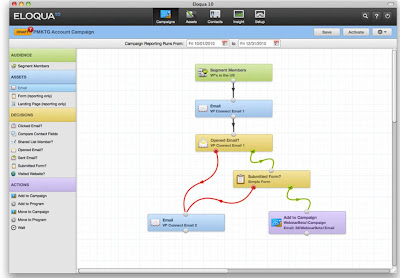
This has the advantage of displaying the exact flow of leads, including branches that split apart and come together. It allows complex flows and is pretty much the way that most people diagram a campaign when they're planning it. But flow diagrams get confusing once you move beyond a handful of branches.
The other option is to build a list of steps without any branching. Rules within each step can still deliver different treatments to different segments, but everyone moves to the same next step at the same time. This is easier to follow but it lacks flexibility and you must look inside each step to see the details. Here is Marketo’s version:

DemandCenter lies somewhere in between. It lays out the steps within a single sequence on a row – similar to the list of steps but sideways. But it also allows distinct branches, showing each branch as its own row. This isn't perfect – you can’t draw lines to connect different boxes across branches, as in a flow diagram – but it’s probably more intuitive than the other approaches for moderately complex flows. Users can also collapse an entire, multi-branch campaign onto a single row and show multiple campaigns on the screen.
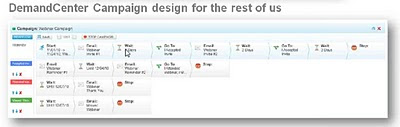
(Of course, nothing is truly unique. DemandCenter’s approach is conceptually similar to the interface introduced by Silverpop last year, which also showed branches as horizontal tracks. I liked that one too.)
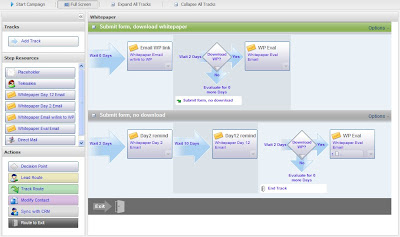
So let's grant that eTrigue has built a somewhat better mousetrap. How much does it really matter? The campaign interface is just one of many components within a marketing automation system. A better campaign interface by itself is not enough to radically change the complexity of marketing automation as a whole.
Now, if all DemandCenter features were easier than the competition, that might change things. But while the rest of DemandCenter is well designed, nothing struck me as different enough to make a substantial difference in usability. So if superior ease of use is the only way for eTrigue to distinguish itself, it will have a very hard time.
But marketing automation systems actually compete on more than ease of use. eTrigue’s original product was originally developed in 2004/2005 by Silicon Valley marketing agency 3marketeers, which couldn’t find a system that met its own needs. The system has since been sold to about 150 clients. This long experience has led eTrigue to include capabilities that are missing in most low-to-mid-tier marketing automation products. These include:
- anonymous visitor look-up, based on IP address, with automatic exclusion of ISP addresses
- reporting on anonymous visitors as individuals (not companies) and indefinite retention of anonymous visitor histories (most systems erase the related cookies after a few months)
- real-time sales alerts triggered by lead behaviors
- ability to send leads directly from one campaign to another
- statistics for each campaign step visible in the campaign flow diagram
- a cube-based data mart for time-series analysis and other advanced reporting
- automated execution of reports on user-defined schedules
- precise user- and group-level security, including options to limit specific campaigns to specific users
- ability for Salesforce.com users to send emails through eTrigue
- tailored dashboards for each user
These are in addition to the usual marketing automation functions: email campaigns, landing pages and forms, lead scoring, and bi-directional integration with both Salesforce.com and Microsoft Dynamics.
That's a richer feature set than most marketing automation systems targeted towards the small and mid-size business. But pricing of DemandCenter is actually lower than most vendors in that segment, starting at $1,000 per month for a 10,000 name database. This includes implementation and training. The combination of mature features, a new interface, and low pricing makes eTrigue an attractive alternative even if it doesn’t break any major barriers for ease of use.
eTrigue also has a product aimed at salespeople, called SalesPro. This works directly from a Salesforce.com database, using the Salesforce.com email engine but applying eTrigue email authoring, campaign structures, Web tracking, and lead scores. The system doesn't include landing pages. It's priced at $500 per month for 10 users.
eTrigue officially announced its new DemandCenter marketing automation system on Tuesday, replacing an earlier product dating back more than five years.
The system is positioned as “marketing automation for the rest of us”, meaning that eTrigue considers it much easier to use than leading marketing automation products. If that sounds familiar, it’s because I recently mentioned similar claims from Net-Results , Act-On Software, and tMarketbright. All believe that the complexity of standard marketing systems is the major reason they have not been more widely adopted and that they can offer a simpler alternative.
Bear in mind that’s a two-part proposition. Even if these vendors are right that complexity is the key barrier to adoption, there’s no business opportunity unless their systems are simpler. Otherwise, they’ve simply explained why marketing automation can never succeed, or at least won’t succeed until a critical mass of marketers have been trained to handle a new level of complexity.
So let’s cut to the critical question: is DemandCenter easier to use than systems like Pardot, Marketo, and Genius? The answer is a definite…maybe. DemandCenter has a campaign flow interface that does seem easier to use than standard products. But the rest of it, while nicely done, doesn’t strike me as materially different.
What makes the campaign builder different? Well, most systems use some variation of two basic approaches. One is to create a classic branching flow diagram, like a Visio chart. Here’s a state-of-the-art version from Eloqua:

This has the advantage of displaying the exact flow of leads, including branches that split apart and come together. It allows complex flows and is pretty much the way that most people diagram a campaign when they're planning it. But flow diagrams get confusing once you move beyond a handful of branches.
The other option is to build a list of steps without any branching. Rules within each step can still deliver different treatments to different segments, but everyone moves to the same next step at the same time. This is easier to follow but it lacks flexibility and you must look inside each step to see the details. Here is Marketo’s version:

DemandCenter lies somewhere in between. It lays out the steps within a single sequence on a row – similar to the list of steps but sideways. But it also allows distinct branches, showing each branch as its own row. This isn't perfect – you can’t draw lines to connect different boxes across branches, as in a flow diagram – but it’s probably more intuitive than the other approaches for moderately complex flows. Users can also collapse an entire, multi-branch campaign onto a single row and show multiple campaigns on the screen.

(Of course, nothing is truly unique. DemandCenter’s approach is conceptually similar to the interface introduced by Silverpop last year, which also showed branches as horizontal tracks. I liked that one too.)

So let's grant that eTrigue has built a somewhat better mousetrap. How much does it really matter? The campaign interface is just one of many components within a marketing automation system. A better campaign interface by itself is not enough to radically change the complexity of marketing automation as a whole.
Now, if all DemandCenter features were easier than the competition, that might change things. But while the rest of DemandCenter is well designed, nothing struck me as different enough to make a substantial difference in usability. So if superior ease of use is the only way for eTrigue to distinguish itself, it will have a very hard time.
But marketing automation systems actually compete on more than ease of use. eTrigue’s original product was originally developed in 2004/2005 by Silicon Valley marketing agency 3marketeers, which couldn’t find a system that met its own needs. The system has since been sold to about 150 clients. This long experience has led eTrigue to include capabilities that are missing in most low-to-mid-tier marketing automation products. These include:
- anonymous visitor look-up, based on IP address, with automatic exclusion of ISP addresses
- reporting on anonymous visitors as individuals (not companies) and indefinite retention of anonymous visitor histories (most systems erase the related cookies after a few months)
- real-time sales alerts triggered by lead behaviors
- ability to send leads directly from one campaign to another
- statistics for each campaign step visible in the campaign flow diagram
- a cube-based data mart for time-series analysis and other advanced reporting
- automated execution of reports on user-defined schedules
- precise user- and group-level security, including options to limit specific campaigns to specific users
- ability for Salesforce.com users to send emails through eTrigue
- tailored dashboards for each user
These are in addition to the usual marketing automation functions: email campaigns, landing pages and forms, lead scoring, and bi-directional integration with both Salesforce.com and Microsoft Dynamics.
That's a richer feature set than most marketing automation systems targeted towards the small and mid-size business. But pricing of DemandCenter is actually lower than most vendors in that segment, starting at $1,000 per month for a 10,000 name database. This includes implementation and training. The combination of mature features, a new interface, and low pricing makes eTrigue an attractive alternative even if it doesn’t break any major barriers for ease of use.
eTrigue also has a product aimed at salespeople, called SalesPro. This works directly from a Salesforce.com database, using the Salesforce.com email engine but applying eTrigue email authoring, campaign structures, Web tracking, and lead scores. The system doesn't include landing pages. It's priced at $500 per month for 10 users.
Wednesday, March 09, 2011
Act-On Software Stresses Ease of Use
Summary: Act-On Software’s revised system offers a reasonable mix of features in an easy-to-use interface. At $500 per month with no annual contract, it’s priced to make it easy to get started with marketing automation.
I started last week to write a review of Act-On Software’s latest release but got distracted by the larger and sexier question of Act-On’s business strategy. So let me try again.
The new release is designed for marketers who want to start using the system with little or no training. The home page all but screams as much, with a huge central panel of “quick start” links to different types of projects. These include:
- outbound marketing programs (e-mail campaigns, events & webinars, and automated programs)
- program components (Web forms, landing pages, list management, media library)
- traffic monitoring (Twitter dashboard, Website visitors)

This mix of programs, components, and monitoring may be logically inconsistent, but it serves the practical purpose of giving marketers one-click access to common tasks. The section for each task continues this approach by combining all task-related functions including set-up, execution and reporting. By contrast, other systems often put reporting in a separate area.
The actual functions provided by Act-On are generally competitive with low-to-mid tier marketing automation products. Of course, every system has its own mix of strengths and weaknesses. In Act-On's case, unusual advantages include:
- “smart” content blocks that can be embedded like widgets in emails and Web pages. These include calendars, Webex invitations, surveys, payments via Paypal, and SMS alerts when a link is clicked.
- unusually close Webex integration, including direct posting of Act-On invitation forms to Webex registration lists and automatic import of attendee lists from Webex into Act-On.
- a “Twitter prospector” that executes automated searches, weeds out spam posts (identified by third-party links within the post), sends the remaining results to an in-box for review, and lets users apply standard templates to create replies.
- Web analytics based on user-assigned page names, so tracking can work without building codes into the URL structure
The system has some other strengths that are less unusual, but still hard to find:
- anonymous visitor tracking based on IP address lookup, with automated integration into Jigsaw to look up contact names and automated alerts for visits from named accounts. While some other system provide this, many marketing automation vendors rely on third-party products instead.
- tracking within Act-On emails sent through Microsoft Outlook. Such emails would otherwise be invisible to the marketing automation system.
- sequential campaign flows with conditional actions in each step and “early exit” conditions that can remove leads from the flow at any step. Most marketing automation systems offer conditional actions, which let the system send different messages to different lead segments. But an early exit rule is harder to find.
- a preinstalled library of stock images, such as form buttons. This simplifies content creation.
Act-On has also retained its list-oriented approach to the marketing database. This lets users manage the database as if it were a set of separate lists. (In reality, Act-On actually does store the leads in a traditional database. The same lead can belong to multiple lists.) Act-On can also push or pull data to Salesforce.com on a list-by-list basis, which gives users more control than moving all records at once. I've never seen the benefits of the list-based approach, but Act-On says its clients find it easier to grasp than traditional segments.
Act-On does have some weaknesses compared with most other products. These include limits on lead scoring and lack of progressive profiling.
As for that user interface: it's certainly attractive and does look easy, although I can't say whether it's substantially simpler than the competition. My general feeling remains that any initial advantage in ease of use quickly becomes irrelevant as marketers gain experience. After that, what really matters is having a system with the capabilities that match your needs. So any selection decision should consider long-term requirements in addition to the interface.
Pricing of Act-On starts at $500 per month, which is low for a mid-tier marketing automation product although it's limited to three users and 10,000 active contacts (plus an unlimited number of inactive contacts). No long-term contract is required and a 14 day free trial is available. Act-On has over 200 clients.
I started last week to write a review of Act-On Software’s latest release but got distracted by the larger and sexier question of Act-On’s business strategy. So let me try again.
The new release is designed for marketers who want to start using the system with little or no training. The home page all but screams as much, with a huge central panel of “quick start” links to different types of projects. These include:
- outbound marketing programs (e-mail campaigns, events & webinars, and automated programs)
- program components (Web forms, landing pages, list management, media library)
- traffic monitoring (Twitter dashboard, Website visitors)

This mix of programs, components, and monitoring may be logically inconsistent, but it serves the practical purpose of giving marketers one-click access to common tasks. The section for each task continues this approach by combining all task-related functions including set-up, execution and reporting. By contrast, other systems often put reporting in a separate area.
The actual functions provided by Act-On are generally competitive with low-to-mid tier marketing automation products. Of course, every system has its own mix of strengths and weaknesses. In Act-On's case, unusual advantages include:
- “smart” content blocks that can be embedded like widgets in emails and Web pages. These include calendars, Webex invitations, surveys, payments via Paypal, and SMS alerts when a link is clicked.
- unusually close Webex integration, including direct posting of Act-On invitation forms to Webex registration lists and automatic import of attendee lists from Webex into Act-On.
- a “Twitter prospector” that executes automated searches, weeds out spam posts (identified by third-party links within the post), sends the remaining results to an in-box for review, and lets users apply standard templates to create replies.
- Web analytics based on user-assigned page names, so tracking can work without building codes into the URL structure
The system has some other strengths that are less unusual, but still hard to find:
- anonymous visitor tracking based on IP address lookup, with automated integration into Jigsaw to look up contact names and automated alerts for visits from named accounts. While some other system provide this, many marketing automation vendors rely on third-party products instead.
- tracking within Act-On emails sent through Microsoft Outlook. Such emails would otherwise be invisible to the marketing automation system.
- sequential campaign flows with conditional actions in each step and “early exit” conditions that can remove leads from the flow at any step. Most marketing automation systems offer conditional actions, which let the system send different messages to different lead segments. But an early exit rule is harder to find.
- a preinstalled library of stock images, such as form buttons. This simplifies content creation.
Act-On has also retained its list-oriented approach to the marketing database. This lets users manage the database as if it were a set of separate lists. (In reality, Act-On actually does store the leads in a traditional database. The same lead can belong to multiple lists.) Act-On can also push or pull data to Salesforce.com on a list-by-list basis, which gives users more control than moving all records at once. I've never seen the benefits of the list-based approach, but Act-On says its clients find it easier to grasp than traditional segments.
Act-On does have some weaknesses compared with most other products. These include limits on lead scoring and lack of progressive profiling.
As for that user interface: it's certainly attractive and does look easy, although I can't say whether it's substantially simpler than the competition. My general feeling remains that any initial advantage in ease of use quickly becomes irrelevant as marketers gain experience. After that, what really matters is having a system with the capabilities that match your needs. So any selection decision should consider long-term requirements in addition to the interface.
Pricing of Act-On starts at $500 per month, which is low for a mid-tier marketing automation product although it's limited to three users and 10,000 active contacts (plus an unlimited number of inactive contacts). No long-term contract is required and a 14 day free trial is available. Act-On has over 200 clients.
The Pond Just Got More Crowded: Google, Salesforce.com and Sequoia Invest in HubSpot
Summary: HubSpot announced a $32 million investment yesterday by Sequoia Partners, Google and Salesforce.com. This could be a real game-changer in the small business marketing automation landscape.
If you heard a loud thud late Tuesday afternoon, it was the sound of two shoes dropping. Salesforce.com and Google announced their long-anticipated entry into the marketing automation industry, in the baby-step form of investments in HubSpot. The $32 million fourth round of funding was led by Sequoia Capital, which apparently provided most of the money (numbers were not announced). It followed $33 million in earlier funding since the company was founded in 2006.
In many ways, this investment strikes me as more significant than last year’s acquisitions of Unica by IBM and of Aprimo by Teradata, which were widely touted as “validating” the concept marketing automation and involved vastly more money ($1 billion combined). Both Unica and Aprimo were long-established vendors with fundamentally stable products sold primarily to large enterprises: although their new owners may market them more broadly, they’ll be selling pretty much what IBM and Teradata always sold (big systems) to pretty much the same customers (big companies). Even the most ambitious vision articulated by the vendors – radically more integrated, analytically-driven marketing management – won’t really change their sector of the marketing automation industry.
But HubSpot plays in a different pond, where the frogs are more numerous and much livelier. It’s selling to small and mid-size companies and business-to-business marketers, who are just dipping their toes into marketing automation. It’s not yet clear which vendors will dominate the industry or what form the successful systems will take. And the current frogs are all small enough that a powerful newcomer could displace them, especially if it had a natural entry point such as, oh, Google AdWords or Salesforce.com’s CRM system.
During the analyst call that followed the announcement, HubSpot co-founders Brian Halligan and Dharmesh Shah made quite clear that they hoped to leverage the Google and Salesforece.com relationships in just this way. This will involve tighter technical integration with both Google and Saleforce.com, and apparently some marketing to the Salesforce.com customer base.
Of course, the entry of Salesforce.com as a direct competitor has long been the worst nightmare of B2B marketing automation vendors, who exist largely because Salesforce.com doesn’t give marketers what they need. A viable marketing solution within Salesforce.com would preempt many purchases of a separate marketing automation system in companies where Salesforce.com is already in place.
Yesterday’s announcement doesn’t mean the nightmare has come true – this is a small investment by Salesforce.com, not an acquisition, and it’s quite clear that HubSpot intends to go public on its own. But if Salesforce.com likes what it sees, who knows where that will lead? The same goes for Google, although Google Venture Partner Rich Miner went out of his way during the analyst call to say that the Google investment was financial (i.e., intended to make money on its own) rather than strategic (i.e., intended to extend Google’s own business).
All this is good and kudos to HubSpot for getting this far and landing such powerful partners. The company also deserves praise for articulating a sound vision of future growth through expanded product features. This is as close as you can reasonably expect them to come to acknowledging that the existing HubSpot is far from a complete marketing automation solution. (See my December 2009 post for a more detailed discussion of HubSpot's capabilities; basically, they are still pretty weak in outbound email, lead scoring, and nurturing, which are all core components of standard B2B marketing automation. They also lack integrated CRM features – a hallmark of small business marketing automation – although the Salesforce.com connection probably makes that moot.)
Yet something really bothered me about yesterday’s announcement. HubSpot has always been quite clear that it is focused on small-to-mid-size businesses and that it offers “inbound marketing” rather than traditional marketing automation. In fact, it has always been highly dismissive of traditional outbound marketing as essentially obsolete – a claim it repeated again yesterday.
Despite this background, yesterday’s announcement positioned the firm’s competitors as the mid-to-large company B2B marketing automation vendors, listing Eloqua, Marketo, Genius, Manticore Technology, and Neolane by name. This wasn’t a casual comment – the press release twice called the HubSpot a marketing industry “leader” and included a pie chart showing “over 50% Market Share”, a claim that is only true if you (a) count clients, not revenue (an absurd mixing of apples and oranges in this case) and (b) ignore HubSpot’s most direct competitors, the other small business marketing automation vendors including Infusionsoft (6,000+ customers vs. HubSpot’s 4,000+) and OfficeAutoPilot (2,000+ customers). [Note: comments from Infusionsoft and HubSpot, posted below, suggest those vendors may compete less than I thought when I wrote this. But I still think excluding them from the analysis is wrong.]
If you heard a loud thud late Tuesday afternoon, it was the sound of two shoes dropping. Salesforce.com and Google announced their long-anticipated entry into the marketing automation industry, in the baby-step form of investments in HubSpot. The $32 million fourth round of funding was led by Sequoia Capital, which apparently provided most of the money (numbers were not announced). It followed $33 million in earlier funding since the company was founded in 2006.
In many ways, this investment strikes me as more significant than last year’s acquisitions of Unica by IBM and of Aprimo by Teradata, which were widely touted as “validating” the concept marketing automation and involved vastly more money ($1 billion combined). Both Unica and Aprimo were long-established vendors with fundamentally stable products sold primarily to large enterprises: although their new owners may market them more broadly, they’ll be selling pretty much what IBM and Teradata always sold (big systems) to pretty much the same customers (big companies). Even the most ambitious vision articulated by the vendors – radically more integrated, analytically-driven marketing management – won’t really change their sector of the marketing automation industry.
But HubSpot plays in a different pond, where the frogs are more numerous and much livelier. It’s selling to small and mid-size companies and business-to-business marketers, who are just dipping their toes into marketing automation. It’s not yet clear which vendors will dominate the industry or what form the successful systems will take. And the current frogs are all small enough that a powerful newcomer could displace them, especially if it had a natural entry point such as, oh, Google AdWords or Salesforce.com’s CRM system.
During the analyst call that followed the announcement, HubSpot co-founders Brian Halligan and Dharmesh Shah made quite clear that they hoped to leverage the Google and Salesforece.com relationships in just this way. This will involve tighter technical integration with both Google and Saleforce.com, and apparently some marketing to the Salesforce.com customer base.
Of course, the entry of Salesforce.com as a direct competitor has long been the worst nightmare of B2B marketing automation vendors, who exist largely because Salesforce.com doesn’t give marketers what they need. A viable marketing solution within Salesforce.com would preempt many purchases of a separate marketing automation system in companies where Salesforce.com is already in place.
Yesterday’s announcement doesn’t mean the nightmare has come true – this is a small investment by Salesforce.com, not an acquisition, and it’s quite clear that HubSpot intends to go public on its own. But if Salesforce.com likes what it sees, who knows where that will lead? The same goes for Google, although Google Venture Partner Rich Miner went out of his way during the analyst call to say that the Google investment was financial (i.e., intended to make money on its own) rather than strategic (i.e., intended to extend Google’s own business).
All this is good and kudos to HubSpot for getting this far and landing such powerful partners. The company also deserves praise for articulating a sound vision of future growth through expanded product features. This is as close as you can reasonably expect them to come to acknowledging that the existing HubSpot is far from a complete marketing automation solution. (See my December 2009 post for a more detailed discussion of HubSpot's capabilities; basically, they are still pretty weak in outbound email, lead scoring, and nurturing, which are all core components of standard B2B marketing automation. They also lack integrated CRM features – a hallmark of small business marketing automation – although the Salesforce.com connection probably makes that moot.)
Yet something really bothered me about yesterday’s announcement. HubSpot has always been quite clear that it is focused on small-to-mid-size businesses and that it offers “inbound marketing” rather than traditional marketing automation. In fact, it has always been highly dismissive of traditional outbound marketing as essentially obsolete – a claim it repeated again yesterday.
Despite this background, yesterday’s announcement positioned the firm’s competitors as the mid-to-large company B2B marketing automation vendors, listing Eloqua, Marketo, Genius, Manticore Technology, and Neolane by name. This wasn’t a casual comment – the press release twice called the HubSpot a marketing industry “leader” and included a pie chart showing “over 50% Market Share”, a claim that is only true if you (a) count clients, not revenue (an absurd mixing of apples and oranges in this case) and (b) ignore HubSpot’s most direct competitors, the other small business marketing automation vendors including Infusionsoft (6,000+ customers vs. HubSpot’s 4,000+) and OfficeAutoPilot (2,000+ customers). [Note: comments from Infusionsoft and HubSpot, posted below, suggest those vendors may compete less than I thought when I wrote this. But I still think excluding them from the analysis is wrong.]

Here’s what I consider a more realistic view of the market:
- Based on revenue, HubSpot had less than 7% of the B2B marketing automation market in 2010 ($15 million HubSpot revenue vs. $225 million total) (see my post of January 11, 2011) and an even smaller fraction if you include B2C marketing automation.
- Based on client counts, adding Infusionsoft and OfficeAutoPilot reduces HubSpot’s share to about 25% (data from our B2B Marketing Automation Vendor Selection Tool).
- The small business vendors, including Infusionsoft, OfficeAutoPilot,It's those firms, and other small-business-focused competitors including Act-On Software, Net-Results, and Marketbright, who have the most to fear from HubSpot.
Now, I wasn’t born yesterday and am rarely upset to see a company spin the facts in its favor. In fact, as a marketer myself, I have a grudging admiration for people who do it deftly. But a distortion this large really bothers me. I could say that’s because it harms the market by confusing people, but I think the real reason is more visceral: it insults my own intelligence and that of everyone else who is apparently expected to believe it. What’s even sadder is these particular claims are totally unnecessary: HubSpot is a strong company with a solid product and excellent story. It doesn't need exaggeration.
I’ve also found HubSpot to be quite open and honest in the past, which makes this all the more puzzling. I hope it’s just an aberration.
One other point from today: in a related blog post, Brian Halligan gives some insight into HubSpot’s business strategy and the reasons for this round of funding. I’ve no complaints about any of it. But there’s an intriguing graphic that shows HubSpot’s lead sources – intended to illustrate how HubSpot “eats our own dog-food” through inbound marketing. Am I reading this wrong, or does it show that (bad, obsolete, interruptive) email is their largest source of business, while organic search and social media barely register? Now THAT's what I call openness.

Tuesday, March 08, 2011
Webinar this Friday - 5 Things You Must Consider Before Purchasing Marketing Automation
This Friday I'll be presenting a 45 minute free Webinar, sponsored by Focus.com and hosted by the ever-popular Adam Needles, on preparing for a successful marketing automation deployment.
You can register here. Details below:
Friday, March 11, 2011
10:00AM PST / 1:00PM EST
There’s plenty of information on why you need to buy marketing automation and, as statistics show, many marketing organizations (big and small) are jumping on board. But this webinar isn’t about why you should buy marketing automation – that’s been discussed at length by everyone in the business. Instead, Focus Expert David Raab will dive deeper to tell you the “how,” the “who,” the “when” and whether you are ready to automate your marketing in the first place. David will cover a number of factors to consider to know before you buy, including:
• The non-technology factors you must have in place to be successful
• Why your lead management program should drive your implementation
• How to organize the marketing department for success
f you’re interested but can’t attend the live event, register today and we will send you a link to the on-demand archive when available.
Friday, March 04, 2011
Are We Making Marketing Automation Harder Than Necessary?
Summary: Is stressing the need for process change making marketing automation too complicated, or a recognition of what it really takes for success? Vendors take both sides of the argument. So did Aesop: see The Tortoise and the Hare.
Act-On Software officially relaunched its system earlier this week, offering a new interface and a new positioning. The interface is perfectly nice but the positioning is ultimately more important. The company’s press release puts the key claim succinctly: “The Act-On Integrated Marketing Platform disrupts the conventional wisdom that companies need marketing automation solutions that are expensive, complex, and require significant services engagements to get them up and running.”
I’m not sure that whoever speaks for “conventional wisdom” would agree that marketing automation solutions must be expensive and complex. My own position (loosely paraphrasing Einstein) is it should be as complicated and costly as necessary, but not more.
However, the real meat of that statement is the third item: “significant services engagements”. This refers to the idea that marketing automation must accompanied by comprehensive planning and process engineering, which often require external assistance. The oracles of conventional wisdom would probably agree. I know I do.
Act-On begs to differ. Their belief, outlined to me in January by Sales VP Shawn Naggiar and CMO David Applebaum, is that most marketers just want to get things done immediately with existing resources. Of course, no one could argue with that – we all want something for nothing. The real question is whether marketing automation can actually deliver value without marketers making a more substantial investment. Act-On is betting that they can, especially if aided by software that’s designed to make easy things simple. The company just received $4 million in funding from others willing to share the bet, on top of an initial $2.5 million.
It would be easy to dismiss Act-On’s proposition as something between wishful thinking and pandering, right up there with diet-free weight loss. But I’ve heard almost exactly the same argument recently from other vendors including Net-Results, Marketbright, and, to lesser extent, Genius.com. All cite the need for an intermediate step between the simplicity of email-only systems and the complexity of full-blown marketing automation. They see closing this gap as the critical requirement in spreading marketing automation to the masses, and as a great business opportunity for themselves. When so many smart people reach the same conclusion, it's worth serious consideration.
On the other hand, the vendors with the greatest success to date have stressed the importance of process. This is true not just at the high end of the market, but also at the low end, where Infusionsoft, OfficeAutoPilot and HubSpot all make huge efforts to educate and cajole their clients into using their systems fully.
Infusionsoft and OfficeAutoPilot are selling to much smaller businesses than Act-On, Net-Results, and the new Marketbright. Still, it's interesting that vendors at both ends of the spectrum have found that process focus is essential. Maybe success requirements are really different in the middle – but I’d say the burden of proof is on those making that claim.
If I want to start a good argument, I should probably end this post here. Drawing clear battle lines between vendors who believe in process and those who don't should certainly prompt some response.
But that wouldn’t be fair to either side. The process-oriented vendors do strive to make it easy to get started, and the start-up-oriented vendors do expect their clients’ processes to mature over time. And, while Act-On, Net-Results, Marketbright, and Genius all argue that their systems are substantially easier to use than products like Pardot, Marketo and LoopFuse, those vendors surely disagree. My own (fair but wimpy) opinion is that there are significant differences among individual systems but neither group is generally easier or more powerful than the other. Users have to do the hard work of matching the system to their particular needs and style. Eat your spinach.
That said, the role of process is an important and worthwhile subject for debate. The greatest danger I see facing the B2B marketing automation industry is that it will develop a reputation for failure. This is exactly what happened to CRM systems when people started to think that simply purchasing one was a guarantee of success. It took a long time and much hard work for the industry to overcome the stigma of the resulting failures. They have now established that careful planning and disciplined deployment are essential for clients to receive real benefits.
Perhaps we're doomed to repeat this history. It's the "trough of despair" in the hype cycle. But we can at least try to avoid it. My position is this: marketers can start small with their automation systems, but they should still go into the project recognizing that real value requires substantial change. Ignoring this reality is bad for everyone.
Act-On Software officially relaunched its system earlier this week, offering a new interface and a new positioning. The interface is perfectly nice but the positioning is ultimately more important. The company’s press release puts the key claim succinctly: “The Act-On Integrated Marketing Platform disrupts the conventional wisdom that companies need marketing automation solutions that are expensive, complex, and require significant services engagements to get them up and running.”
I’m not sure that whoever speaks for “conventional wisdom” would agree that marketing automation solutions must be expensive and complex. My own position (loosely paraphrasing Einstein) is it should be as complicated and costly as necessary, but not more.
However, the real meat of that statement is the third item: “significant services engagements”. This refers to the idea that marketing automation must accompanied by comprehensive planning and process engineering, which often require external assistance. The oracles of conventional wisdom would probably agree. I know I do.
Act-On begs to differ. Their belief, outlined to me in January by Sales VP Shawn Naggiar and CMO David Applebaum, is that most marketers just want to get things done immediately with existing resources. Of course, no one could argue with that – we all want something for nothing. The real question is whether marketing automation can actually deliver value without marketers making a more substantial investment. Act-On is betting that they can, especially if aided by software that’s designed to make easy things simple. The company just received $4 million in funding from others willing to share the bet, on top of an initial $2.5 million.
It would be easy to dismiss Act-On’s proposition as something between wishful thinking and pandering, right up there with diet-free weight loss. But I’ve heard almost exactly the same argument recently from other vendors including Net-Results, Marketbright, and, to lesser extent, Genius.com. All cite the need for an intermediate step between the simplicity of email-only systems and the complexity of full-blown marketing automation. They see closing this gap as the critical requirement in spreading marketing automation to the masses, and as a great business opportunity for themselves. When so many smart people reach the same conclusion, it's worth serious consideration.
On the other hand, the vendors with the greatest success to date have stressed the importance of process. This is true not just at the high end of the market, but also at the low end, where Infusionsoft, OfficeAutoPilot and HubSpot all make huge efforts to educate and cajole their clients into using their systems fully.
Infusionsoft and OfficeAutoPilot are selling to much smaller businesses than Act-On, Net-Results, and the new Marketbright. Still, it's interesting that vendors at both ends of the spectrum have found that process focus is essential. Maybe success requirements are really different in the middle – but I’d say the burden of proof is on those making that claim.
If I want to start a good argument, I should probably end this post here. Drawing clear battle lines between vendors who believe in process and those who don't should certainly prompt some response.
But that wouldn’t be fair to either side. The process-oriented vendors do strive to make it easy to get started, and the start-up-oriented vendors do expect their clients’ processes to mature over time. And, while Act-On, Net-Results, Marketbright, and Genius all argue that their systems are substantially easier to use than products like Pardot, Marketo and LoopFuse, those vendors surely disagree. My own (fair but wimpy) opinion is that there are significant differences among individual systems but neither group is generally easier or more powerful than the other. Users have to do the hard work of matching the system to their particular needs and style. Eat your spinach.
That said, the role of process is an important and worthwhile subject for debate. The greatest danger I see facing the B2B marketing automation industry is that it will develop a reputation for failure. This is exactly what happened to CRM systems when people started to think that simply purchasing one was a guarantee of success. It took a long time and much hard work for the industry to overcome the stigma of the resulting failures. They have now established that careful planning and disciplined deployment are essential for clients to receive real benefits.
Perhaps we're doomed to repeat this history. It's the "trough of despair" in the hype cycle. But we can at least try to avoid it. My position is this: marketers can start small with their automation systems, but they should still go into the project recognizing that real value requires substantial change. Ignoring this reality is bad for everyone.
Wednesday, February 23, 2011
MarketingPilot Offers Integrated Marketing Management for Mid-Size Companies
Yesterday's acquisition of AssetLink by SAS has prompted me to finally write about MarketingPilot, a vendor I've been following since its launch nearly ten years ago.
MarketingPilot started as an operations management tool for mid-size direct marketers, with features for project management, list and media buying, source code tracking, expense capture, and vendor management. Since then it has expanded steadily to encompass the full range of marketing resource management and then gone ahead to add marketing database management and campaign execution. The technology has evolved from Windows-based client server systems – using the Borland Interbase engine, if you want a real whiff from the memory jar – to a mix of on-premise and hosted options.
Average price and client size have also increased steadily, although the focus has remained on mid-size rather than enterprise clients. The company also created special editions for ad agencies, which now provide about 40% of its business. MarketingPilot has about 40 employees and 400 installations with over 15,000 end-users.
With AssetLink (60 employees) now owned by SAS, MarketingPilot also may be the largest remaining independent MRM vendor. I can’t say for sure because there are several companies in the field that I’ve never researched. But it doesn’t really matter, because MarketingPilot is now positioned as an integrated marketing management product. That puts it into roughly the same class as much larger firms including Neolane (200 employees) and Alterian (370 employees).
I say “roughly” because Neolane and Alterian are rooted in the campaign management side of marketing automation, while MarketingPilot is based on marketing resource management. Although the overlap between these products is growing, they are still quite different.
To give you an idea of the scope of MarketingPilot, here is a set of headings from its Web site:
Alerts - Analytics/Performance Measurement - Approvals - Budgets - Calendars - Campaign Management - Collateral Management - Contract Management - CRM - Digital Asset/Document Management - Direct Marketing - Direct Response - Editions - Email Marketing - Enterprise Edition - Enterprise Marketing Management - Estimates - Event Management - Expense Management - Financial Management - Internet/Online Marketing - Inventory Management - Lead Management - List Management - Marketing Automation - Marketing Database - Marketing Plans - Marketing Resource Management - Media Buying and Planning - Multi-currency - Purchasing - Print Production - Reports - Scheduling - Social Media - Solutions - Strategic Planning - Supply Chain/Vendor Management - Time Slips - Trade Shows - Web Portal
This is broader list than you'll see from most marketing automation vendors – a group not known for modest product claims. But even MarketingPilot isn’t all things to all people (yet). Here's a quick inventory of strengths and weaknesses:
- just about any MRM feature you can imagine: planning, budgeting, project management, vendor management, media buying, content management, creative mark-up, approval workflows, etc.
- email, landing page and Web form creation
- high volume email delivery
- social media execution and tracking
- lead distribution and lead scoring based on attributes, but not behaviors
- integrated CRM, with an future option to synchronize with external CRM systems
- marketing database management with separate company and contact levels
- a highly tailorable interface that shows each user only the features they can access (critical in a system with so many options)
- multiple languages, currencies and time zones
- segmentation on contact and company data, with plans for a visual query builder that allows more complex queries against additional tables
- single-step campaign execution, with multi-step campaign flows due later this year
- response reporting, with plans to add ROI calculations
- Google Analytics integration, with expanded Web visitor tracking and analytics using MarketingPilot’s own tags due later this year.
That’s an impressive list, even after recognizing that key marketing automation features are not yet available, including multi-step campaigns, advanced segmentation, Web behavior tracking, behavior-based lead scoring, and ROI calculations. But they’re all promised fairly soon. Once they’re delivered, MarketingPilot will be a viable mid-market option for integrated marketing management.
If somebody doesn’t buy them first.
MarketingPilot started as an operations management tool for mid-size direct marketers, with features for project management, list and media buying, source code tracking, expense capture, and vendor management. Since then it has expanded steadily to encompass the full range of marketing resource management and then gone ahead to add marketing database management and campaign execution. The technology has evolved from Windows-based client server systems – using the Borland Interbase engine, if you want a real whiff from the memory jar – to a mix of on-premise and hosted options.
Average price and client size have also increased steadily, although the focus has remained on mid-size rather than enterprise clients. The company also created special editions for ad agencies, which now provide about 40% of its business. MarketingPilot has about 40 employees and 400 installations with over 15,000 end-users.
With AssetLink (60 employees) now owned by SAS, MarketingPilot also may be the largest remaining independent MRM vendor. I can’t say for sure because there are several companies in the field that I’ve never researched. But it doesn’t really matter, because MarketingPilot is now positioned as an integrated marketing management product. That puts it into roughly the same class as much larger firms including Neolane (200 employees) and Alterian (370 employees).
I say “roughly” because Neolane and Alterian are rooted in the campaign management side of marketing automation, while MarketingPilot is based on marketing resource management. Although the overlap between these products is growing, they are still quite different.
To give you an idea of the scope of MarketingPilot, here is a set of headings from its Web site:
Alerts - Analytics/Performance Measurement - Approvals - Budgets - Calendars - Campaign Management - Collateral Management - Contract Management - CRM - Digital Asset/Document Management - Direct Marketing - Direct Response - Editions - Email Marketing - Enterprise Edition - Enterprise Marketing Management - Estimates - Event Management - Expense Management - Financial Management - Internet/Online Marketing - Inventory Management - Lead Management - List Management - Marketing Automation - Marketing Database - Marketing Plans - Marketing Resource Management - Media Buying and Planning - Multi-currency - Purchasing - Print Production - Reports - Scheduling - Social Media - Solutions - Strategic Planning - Supply Chain/Vendor Management - Time Slips - Trade Shows - Web Portal
This is broader list than you'll see from most marketing automation vendors – a group not known for modest product claims. But even MarketingPilot isn’t all things to all people (yet). Here's a quick inventory of strengths and weaknesses:
- just about any MRM feature you can imagine: planning, budgeting, project management, vendor management, media buying, content management, creative mark-up, approval workflows, etc.
- email, landing page and Web form creation
- high volume email delivery
- social media execution and tracking
- lead distribution and lead scoring based on attributes, but not behaviors
- integrated CRM, with an future option to synchronize with external CRM systems
- marketing database management with separate company and contact levels
- a highly tailorable interface that shows each user only the features they can access (critical in a system with so many options)
- multiple languages, currencies and time zones
- segmentation on contact and company data, with plans for a visual query builder that allows more complex queries against additional tables
- single-step campaign execution, with multi-step campaign flows due later this year
- response reporting, with plans to add ROI calculations
- Google Analytics integration, with expanded Web visitor tracking and analytics using MarketingPilot’s own tags due later this year.
That’s an impressive list, even after recognizing that key marketing automation features are not yet available, including multi-step campaigns, advanced segmentation, Web behavior tracking, behavior-based lead scoring, and ROI calculations. But they’re all promised fairly soon. Once they’re delivered, MarketingPilot will be a viable mid-market option for integrated marketing management.
If somebody doesn’t buy them first.
Tuesday, February 22, 2011
SAS Acquires AssetLink: Great for Enterprises, But What About the Rest of Us?
Summary: SAS's purchase of AssetLink ensures it's a viable alternative to IBM/Unica and Teradata/Aprimo for integrated marketing management. The real question is whether mid-size firms will be able to afford those systems.
SAS today announced its acquisition of marketing resource management vendor AssetLink. The move makes perfect sense: the other big MRM vendor was Aprimo, and once they were acquired by Teradata, SAS and AssetLink had no alternative partners in the enterprise marketing space.
Let me make clear that when I say “enterprise”, I mean “enterprise”, as in big business. Our friends at Gartner have recently proposed replacing “enterprise marketing management” with “integrated marketing management” as the general term for, um, integrated marketing management. Makes sense. But AssetLink told me their 50+ clients are all big companies. SAS’s marketing systems are also sold mostly to big firms. So we’re really talking about the “enterprise” market here. Once you starting considering mid-size businesses, there are other players, most notably MarketingPilot for MRM and Alterian and Neolane for business-to-consumer marketing automation.
Naturally, SAS and AssetLink don’t intend to limit themselves to enterprise buyers. Like IBM/Unica and Teradata/Aprimo, they hope to sell integrated marketing systems to mid-size firms too. This may be easier for the other two vendors: IBM and Unica certainly have more mid-size marketing clients than SAS and AssetLink, and although Teradata is mostly a big-company vendor, Aprimo has a broader client mix and a relatively new “Marketing Studio On Demand” product that was designed for smaller buyers. Still, we can expect SAS to try.
I'll admit to being skeptical that enterprise-oriented firms like IBM, Teradata, and SAS can successfully sell their products for the mid-market. The transition faces some technical roadblocks, mostly about hiding complexity and reducing the need for customization. But those can be solved. The larger challenges are rooted in corporate culture and require changes in areas like pricing and sales compensation. To put it more bluntly, enterprise firms like to sell big deals.
In fact, I think big deals are exactly what have attracted IBM, Teradata, and SAS to focus on marketing systems. They all seem to have adopted the grand vision of integrated marketing automation as a centrally-managed, analytically-driven process to coordinate customer contacts across all touchpoints. This requires integrating the marketing system with sales, customer service and Web systems. While I also love that vision, I suspect that only a few large firms will have the resources to implement it. This could mean that, in practice, integrated marketing management is limited to enterprise buyers.
This leads to another question: What are Oracle and SAP up to? They’re the other big enterprise software vendors and they’re surely interested in offering integrated marketing automation to their own clients, both to increase revenue and to block account penetration by competitors. Both vendors do have some marketing automation products but these don’t have much of a public presence. If integrated marketing automation really takes off at enterprise accounts, I suspect we’ll see Oracle and SAP pay more attention to this market, either through acquisition or enhancement of existing products.
You’ll notice I haven’t said much here about the SAS/AssetLink deal itself. That’s not due to any lack of enthusiasm: it’s just that the pairing was so obvious that it doesn’t require much explanation. It ensures that SAS’s marketing automation suite remains a viable alternative to IBM and Teradata, by giving it the scope that those other vendors possess. Of course, there are still substantial differences among the products, so buyers who are free to choose any of them will need to dig into the details and match them against their requirements. But I suspect that many companies will have a strong predisposition towards one vendor or another, depending on what other systems they have in place. In that case, there may be fewer truly competitive deals than we saw in the past, when marketing could choose its system without the rest of the company really caring all that much.
My bottom line, then, is that this deal doesn’t reshape the market, but it does clarify its structure and ensure that SAS continues to compete. My real concern is whether mid-size companies will be able to participate or integrated marketing automation will remain the preserve of enterprise marketers.
SAS today announced its acquisition of marketing resource management vendor AssetLink. The move makes perfect sense: the other big MRM vendor was Aprimo, and once they were acquired by Teradata, SAS and AssetLink had no alternative partners in the enterprise marketing space.
Let me make clear that when I say “enterprise”, I mean “enterprise”, as in big business. Our friends at Gartner have recently proposed replacing “enterprise marketing management” with “integrated marketing management” as the general term for, um, integrated marketing management. Makes sense. But AssetLink told me their 50+ clients are all big companies. SAS’s marketing systems are also sold mostly to big firms. So we’re really talking about the “enterprise” market here. Once you starting considering mid-size businesses, there are other players, most notably MarketingPilot for MRM and Alterian and Neolane for business-to-consumer marketing automation.
Naturally, SAS and AssetLink don’t intend to limit themselves to enterprise buyers. Like IBM/Unica and Teradata/Aprimo, they hope to sell integrated marketing systems to mid-size firms too. This may be easier for the other two vendors: IBM and Unica certainly have more mid-size marketing clients than SAS and AssetLink, and although Teradata is mostly a big-company vendor, Aprimo has a broader client mix and a relatively new “Marketing Studio On Demand” product that was designed for smaller buyers. Still, we can expect SAS to try.
I'll admit to being skeptical that enterprise-oriented firms like IBM, Teradata, and SAS can successfully sell their products for the mid-market. The transition faces some technical roadblocks, mostly about hiding complexity and reducing the need for customization. But those can be solved. The larger challenges are rooted in corporate culture and require changes in areas like pricing and sales compensation. To put it more bluntly, enterprise firms like to sell big deals.
In fact, I think big deals are exactly what have attracted IBM, Teradata, and SAS to focus on marketing systems. They all seem to have adopted the grand vision of integrated marketing automation as a centrally-managed, analytically-driven process to coordinate customer contacts across all touchpoints. This requires integrating the marketing system with sales, customer service and Web systems. While I also love that vision, I suspect that only a few large firms will have the resources to implement it. This could mean that, in practice, integrated marketing management is limited to enterprise buyers.
This leads to another question: What are Oracle and SAP up to? They’re the other big enterprise software vendors and they’re surely interested in offering integrated marketing automation to their own clients, both to increase revenue and to block account penetration by competitors. Both vendors do have some marketing automation products but these don’t have much of a public presence. If integrated marketing automation really takes off at enterprise accounts, I suspect we’ll see Oracle and SAP pay more attention to this market, either through acquisition or enhancement of existing products.
You’ll notice I haven’t said much here about the SAS/AssetLink deal itself. That’s not due to any lack of enthusiasm: it’s just that the pairing was so obvious that it doesn’t require much explanation. It ensures that SAS’s marketing automation suite remains a viable alternative to IBM and Teradata, by giving it the scope that those other vendors possess. Of course, there are still substantial differences among the products, so buyers who are free to choose any of them will need to dig into the details and match them against their requirements. But I suspect that many companies will have a strong predisposition towards one vendor or another, depending on what other systems they have in place. In that case, there may be fewer truly competitive deals than we saw in the past, when marketing could choose its system without the rest of the company really caring all that much.
My bottom line, then, is that this deal doesn’t reshape the market, but it does clarify its structure and ensure that SAS continues to compete. My real concern is whether mid-size companies will be able to participate or integrated marketing automation will remain the preserve of enterprise marketers.
Thursday, February 17, 2011
Constant Contact Adds Social CRM: Should Marketing Automation Vendors Be Worried?
Small-business email provider Constant Contact yesterday announced the acquisition of "social CRM"* vendor Bantam Live. This is a major expansion for Constant Contact, placing it more squarely into competition with CRM and marketing automation vendors. As I've noted previously, small businesses are particularly likely to adopt a single platform for all of their marketing and customer management needs because the inefficiencies of multiple platforms are so obvious and painful in a small organization.
Email vendors like Constant Contact are especially well positioned to grab this business because they are one of first technologies that businesses adopt. (Other entry points: accounting software like Intuit Quickbooks, email clients like Microsoft Outlook, personal productivity suites like Microsoft Office, Web hosting companies like GoDaddy, and of course CRM like Salesforce.com.) As a point of reference, Constant Contact says it is used by more than 400,000 organizations, compared with maybe 10,000 for all marketing automation systems combined. The company expects more than $200 million in revenue in 2011, which about equals my estimate for 2010 revenues for all B2B marketing automation. And Constant Contact is just one of many small business email providers.
I've been meaning for some time to write a post about the small business sector of the marketing automation industry, because I really see it as very distinct from marketing automation for mid-size and large businesses. But this Constant Contact announcement underscores one the major points I had in mind: that the low number of current marketing automation installations in this field doesn't mean it's a wide open market. Rather, it means that there are plenty of other partial solutions in place at most firms. Expanding the solutions to offer reasonably complete marketing automation just isn't that hard, technically. And any vendor who does this has a major advantage because they can sell marketing automation as a product extension to their existing clients.
Finding a way to displace these existing vendors is the real challenge for small business marketing automation systems, since small businesses are not likely to add a new system without getting rid of an old one. The other big issue is that the existing solutions often cost only a few dollars per month (for example, Constant Contact averages under $50 per month per client). This means the $300 per month of even the cheapest marketing automation systems is a big increase that many small businesses will not be willing to pay.
____________________________________________________________
* I put "social CRM" in quotation marks because I personally am not quite sure what it really means. According to their Web site, Bantam Live offers the usual sales automation functions (contact management, profile management, pipeline management, sales analytics, calendar sharing, file sharing, workgroups) plus a bucket of social media capabilities including social search, network feeds, messaging, discussions and collaborative workflow.
Email vendors like Constant Contact are especially well positioned to grab this business because they are one of first technologies that businesses adopt. (Other entry points: accounting software like Intuit Quickbooks, email clients like Microsoft Outlook, personal productivity suites like Microsoft Office, Web hosting companies like GoDaddy, and of course CRM like Salesforce.com.) As a point of reference, Constant Contact says it is used by more than 400,000 organizations, compared with maybe 10,000 for all marketing automation systems combined. The company expects more than $200 million in revenue in 2011, which about equals my estimate for 2010 revenues for all B2B marketing automation. And Constant Contact is just one of many small business email providers.
I've been meaning for some time to write a post about the small business sector of the marketing automation industry, because I really see it as very distinct from marketing automation for mid-size and large businesses. But this Constant Contact announcement underscores one the major points I had in mind: that the low number of current marketing automation installations in this field doesn't mean it's a wide open market. Rather, it means that there are plenty of other partial solutions in place at most firms. Expanding the solutions to offer reasonably complete marketing automation just isn't that hard, technically. And any vendor who does this has a major advantage because they can sell marketing automation as a product extension to their existing clients.
Finding a way to displace these existing vendors is the real challenge for small business marketing automation systems, since small businesses are not likely to add a new system without getting rid of an old one. The other big issue is that the existing solutions often cost only a few dollars per month (for example, Constant Contact averages under $50 per month per client). This means the $300 per month of even the cheapest marketing automation systems is a big increase that many small businesses will not be willing to pay.
____________________________________________________________
* I put "social CRM" in quotation marks because I personally am not quite sure what it really means. According to their Web site, Bantam Live offers the usual sales automation functions (contact management, profile management, pipeline management, sales analytics, calendar sharing, file sharing, workgroups) plus a bucket of social media capabilities including social search, network feeds, messaging, discussions and collaborative workflow.
Monday, February 14, 2011
ClickDimensions Offers Marketing Automation as a Microsoft CRM Add-on
Now that I’m more or less finished launching the B2B Marketing Automation Vendor Selection Tool (VEST), I can start catching up on the other topics.
Let’s start with ClickDimensions, a system I explored last September but never wrote about. ClickDimensions does pretty much the standard marketing automation activities: email, landing pages, Web visitor tracking, drip marketing campaigns, and lead scoring.
What’s missing from the list is CRM integration. That's no accident: ClickDimensions doesn’t integrate with CRM in the regular sense of synchronizing data. Rather, it works directly from Microsoft Dynamics CRM files. In other words, ClickDimensions is a Microsoft CRM add-on.
Not that there’s anything wrong with that. In fact, I (and many others) have long argued that marketing automation makes more sense as an integrated component of a CRM system than a stand-alone product. After all, separate systems must synchronize databases, campaigns, users, content libraries, activity histories, and other things, adding cost and complexity. Small business systems like Infusionsoft and OfficeAutoPilot solve this problem by bundling their own CRM features. This isn't an option at bigger companies, where one or more CRM systems are often deeply embedded. So it makes more sense to extend CRM to include marketing automation than the other way around.
This potential expansion has always been the biggest cloud hovering over B2B marketing automation, which has arguably been allowed to develop only because the business remained too small for the major CRM vendors to care about. Of course, another way to look at this is that the CRM vendors already do marketing automation – certainly Oracle/Siebel does, and plenty of folks would argue that Salesforce.com has adequate marketing automation capabilities for most purposes, although most experts (and I) would disagree. Still, a slow incremental expansion of CRM vendors’ marketing automation features is all it would take to squeeze the dedicated marketing automation vendors into an ever-smaller corner of the market, leaving them to serve only companies with specialized needs.
But I digress. ClickDimensions illustrates the advantages of a combined CRM/marketing automation platform. It works off the Dynamics CRM database, so sales and marketing have access to the same, complete data without synchronization. Perhaps more important, ClickDimensions use the Dynamics CRM platform to handle data management, campaign workflows, and user rights. This has freed ClickDimensions to concentrate on the building features that are absent (at least for now) in Dynamics and other CRM systems: advanced email campaigns and Web activity tracking.
ClickDimensions has its own email engine, replacing the product’s original reliance on ExactTarget. The engine supports dynamic content, which is unusual for lower-to-mid-tier marketing automation products. I did find the implementation rather basic: users must write rules in a scripting language and the content is embedded in the email templates rather than read from a shared library.
On the other hand, ClickDimensions has an advanced Outlook email integration that I’ve never seen anywhere else. An administrator can assign an email address to a mailing list; then, end-users send a personalized email to that address and the system delivers it to everyone on the list. ClickDimensions calls this “Outlookcasting.” The advantage is that salespeople can use their familiar Outlook email to send mass emails which are tracked through the marketing automation system.
The system's other major extension beyond standard CRM capabilities is Web activity tracking. This is pretty straightforward: users tag their Web pages with ClickDimensions tracking codes and the system stores activities in custom data objects within the Dynamics data structure. Like many marketing automation systems, ClickDimensions can use the IP address of anonymous visitors to identify their company (if they are using a corporate IP address). It also lets users manually label IP addresses that might belong to a generic ISP but the user knows are linked to a specific company. The system tracks the usual Web information: visits, page views, posted forms, posted fields, and so on.
Email and Web activity data, as well as any activities captured by Dynamics itself, are available for lead scoring and event triggers. Multi-step campaign flows are built using the Dynamics workflow engine. I haven't examined the Dynamics workflow in detail but it seems comparable to most marketing automation campaign engines.
ClickDimensions pricing ranges from $4,000 to $12,000 per year based on email volume. That’s considerably cheaper than standard mid-tier marketing automation products, although some small business systems are cheaper. The initial version of ClickDimensions was released in September 2010, although the company’s own email engine wasn’t added until December. The vendor reports more than 50 current clients, including a few big companies. It sells the product directly in the U.S. and through resellers in Europe. ClickDimensions is also part of Microsoft’s BizSpark program, an initiative to form close relationships with high-potential start-ups.
Let’s start with ClickDimensions, a system I explored last September but never wrote about. ClickDimensions does pretty much the standard marketing automation activities: email, landing pages, Web visitor tracking, drip marketing campaigns, and lead scoring.
What’s missing from the list is CRM integration. That's no accident: ClickDimensions doesn’t integrate with CRM in the regular sense of synchronizing data. Rather, it works directly from Microsoft Dynamics CRM files. In other words, ClickDimensions is a Microsoft CRM add-on.
Not that there’s anything wrong with that. In fact, I (and many others) have long argued that marketing automation makes more sense as an integrated component of a CRM system than a stand-alone product. After all, separate systems must synchronize databases, campaigns, users, content libraries, activity histories, and other things, adding cost and complexity. Small business systems like Infusionsoft and OfficeAutoPilot solve this problem by bundling their own CRM features. This isn't an option at bigger companies, where one or more CRM systems are often deeply embedded. So it makes more sense to extend CRM to include marketing automation than the other way around.
This potential expansion has always been the biggest cloud hovering over B2B marketing automation, which has arguably been allowed to develop only because the business remained too small for the major CRM vendors to care about. Of course, another way to look at this is that the CRM vendors already do marketing automation – certainly Oracle/Siebel does, and plenty of folks would argue that Salesforce.com has adequate marketing automation capabilities for most purposes, although most experts (and I) would disagree. Still, a slow incremental expansion of CRM vendors’ marketing automation features is all it would take to squeeze the dedicated marketing automation vendors into an ever-smaller corner of the market, leaving them to serve only companies with specialized needs.
But I digress. ClickDimensions illustrates the advantages of a combined CRM/marketing automation platform. It works off the Dynamics CRM database, so sales and marketing have access to the same, complete data without synchronization. Perhaps more important, ClickDimensions use the Dynamics CRM platform to handle data management, campaign workflows, and user rights. This has freed ClickDimensions to concentrate on the building features that are absent (at least for now) in Dynamics and other CRM systems: advanced email campaigns and Web activity tracking.
ClickDimensions has its own email engine, replacing the product’s original reliance on ExactTarget. The engine supports dynamic content, which is unusual for lower-to-mid-tier marketing automation products. I did find the implementation rather basic: users must write rules in a scripting language and the content is embedded in the email templates rather than read from a shared library.
On the other hand, ClickDimensions has an advanced Outlook email integration that I’ve never seen anywhere else. An administrator can assign an email address to a mailing list; then, end-users send a personalized email to that address and the system delivers it to everyone on the list. ClickDimensions calls this “Outlookcasting.” The advantage is that salespeople can use their familiar Outlook email to send mass emails which are tracked through the marketing automation system.
The system's other major extension beyond standard CRM capabilities is Web activity tracking. This is pretty straightforward: users tag their Web pages with ClickDimensions tracking codes and the system stores activities in custom data objects within the Dynamics data structure. Like many marketing automation systems, ClickDimensions can use the IP address of anonymous visitors to identify their company (if they are using a corporate IP address). It also lets users manually label IP addresses that might belong to a generic ISP but the user knows are linked to a specific company. The system tracks the usual Web information: visits, page views, posted forms, posted fields, and so on.
Email and Web activity data, as well as any activities captured by Dynamics itself, are available for lead scoring and event triggers. Multi-step campaign flows are built using the Dynamics workflow engine. I haven't examined the Dynamics workflow in detail but it seems comparable to most marketing automation campaign engines.
ClickDimensions pricing ranges from $4,000 to $12,000 per year based on email volume. That’s considerably cheaper than standard mid-tier marketing automation products, although some small business systems are cheaper. The initial version of ClickDimensions was released in September 2010, although the company’s own email engine wasn’t added until December. The vendor reports more than 50 current clients, including a few big companies. It sells the product directly in the U.S. and through resellers in Europe. ClickDimensions is also part of Microsoft’s BizSpark program, an initiative to form close relationships with high-potential start-ups.
Thursday, February 10, 2011
Which B2B Marketing Automation Systems Have Hard-to-Find Features? The Answers May Surprise You
Summary: A close look at which vendors have the least common features finds some are widely distributed, while others are concentrated among products for big companies. As always, you need to look at the details to see which products have what you need.
Last week’s post used data from our B2B Marketing Automation Vendor Selection Tool (VEST) to identify leading vendors in categories such as lead generation, campaign management, and technology. The main point, at least as I saw it, was that no single vendor dominates everything. Different firms are best at serving small, mid-size and large marketing organizations, and for each of these buyer types, different vendors lead different categories.
It’s like the awards ceremony at a progressive elementary school: everybody is best at something.
That may sound all warm and fuzzy, but this conclusion also has great practical significance: it means that you can’t assume a sector leader has the best product for your particular needs. You must look at the details to find the best match.
I cautioned in that post that you can’t stop at the category level. Even the vendor with the highest category score won’t necessarily have a feature you need. The chart below takes the analysis to the next level, looking at which vendors meet specific requirements. It lists the 33 least common items of the 190 we captured in our research. The green cells identify vendors who fully match an item (score=2); the orange column at the right shows how many of the 18 vendors had this score. (Yellow cells indicate a score of 1, meaning an item was partly fulfilled. I’ve ignored those cells in the following discussion but show them to make the point that many vendors do have some capabilities in these areas.)
 There is an obvious over-all pattern: the green cells cluster heavily towards the right. Since the chart is organized with small business systems to the left and big business systems to the right, this means the rarer features are most often found in products for big marketing departments. That makes intuitive sense – you’d expect bigger organizations to need more special features. (You'd also expect to need more features in general, which the data also confirms although I haven't illustrated it here.) One caveat is that the item list itself was leaned heavily towards the needs of mid-size and large businesses; a list of features tailored to small businesses might have a different pattern.
But while most green cells are on the right, there are plenty of exceptions. This is important: it means that buyers who need an unusual feature might find it any type of system. Indeed, nearly half of these items (14 of the 33) can be found in the small business columns (the first five on the left). Nor is it simply that these items are small business specialties. Twelve of the 14 are also found in five big-business products on the right.
The other pattern clearly visible is the two heavily-populated columns in the center, representing mid-market leaders Eloqua and Marketo. The high number of green cells (seven for Marketo and nine for Eloqua) shows that both products are feature-rich. But they're far from twins: their combined green cells cover 13 different items, and there are just three items which both vendors satisfy fully. Once more, the moral of the story is that even direct competitors are quite different when you start looking at details. The good news is this means that buyers who know exactly what they want should be able to distinguish strong from weak candidates quite easily.
Although the items I've listed are shared across all kinds of systems, the distribution isn't simply random. The chart below illustrates which kinds of features are found where. It summarizes the results for the three groups I’ve been discussing: small-business vendors (the five left-hand columns), big-business vendors (the five right-hand columns), and the Marketo/Eloqua combination. Green cells indicate at least one vendor in the group supports an item. Numbers indicate how many vendors support the item.

I’ve given yellow labels to items that are supported big-business systems only. You'll see that most relate advanced marketing planning and administration, which is something only big companies really need. These include detailed cost calculations, expiration dates on marketing content, project schedules, project task detail, results forecasts, approval workflows, marketing calendars, and plan vs. actual reporting. Several of the remaining items relate to advanced offer selection, another requirement for big programs because they have too many potential offers to manage manually or through simple rules. The rest, including multi-language user interface and on-premise deployment, also deal with needs unique to large enterprises. The only real odd-ball here is online chat. What can I say?
The blue labels are items found in a small-business system. All of these are also available in at least one other category, which basically confirms that all kinds of marketers need them. Half relate to specific output channels: fax, RSS, social media, direct mail, email, external Web sites, and Webinars. My interpretation is that vendors of all sizes see the need to simplify multi-channel integration for their clients. The balance are advanced capabilities used by sophisticated marketers in all sizes of organizations.
The five remaining items, with white labels, are shared by mid-tier and big-business systems. Two relate to channel integration (social media and events) and three are generally big-business concerns (fractional revenue attribution, offer coordination, and user-defined matching rules). It’s interesting that the second group are the items shared by Marketo and Eloqua. Without reading too much into this, it suggests that both vendors are looking to the needs of larger rather than smaller companies.
As you’re surely gathered by now, I find this data inherently intriguing. It's a way to understand the contours of the marketing automation industry. But most buyers just want to pick the right system. For them, this data simply reinforces that same central lesson: you must look at the details to find your best match. Still, that’s a lesson too few people have learned, so I’m perfectly happy to keep repeating it.
Last week’s post used data from our B2B Marketing Automation Vendor Selection Tool (VEST) to identify leading vendors in categories such as lead generation, campaign management, and technology. The main point, at least as I saw it, was that no single vendor dominates everything. Different firms are best at serving small, mid-size and large marketing organizations, and for each of these buyer types, different vendors lead different categories.
It’s like the awards ceremony at a progressive elementary school: everybody is best at something.
That may sound all warm and fuzzy, but this conclusion also has great practical significance: it means that you can’t assume a sector leader has the best product for your particular needs. You must look at the details to find the best match.
I cautioned in that post that you can’t stop at the category level. Even the vendor with the highest category score won’t necessarily have a feature you need. The chart below takes the analysis to the next level, looking at which vendors meet specific requirements. It lists the 33 least common items of the 190 we captured in our research. The green cells identify vendors who fully match an item (score=2); the orange column at the right shows how many of the 18 vendors had this score. (Yellow cells indicate a score of 1, meaning an item was partly fulfilled. I’ve ignored those cells in the following discussion but show them to make the point that many vendors do have some capabilities in these areas.)
 There is an obvious over-all pattern: the green cells cluster heavily towards the right. Since the chart is organized with small business systems to the left and big business systems to the right, this means the rarer features are most often found in products for big marketing departments. That makes intuitive sense – you’d expect bigger organizations to need more special features. (You'd also expect to need more features in general, which the data also confirms although I haven't illustrated it here.) One caveat is that the item list itself was leaned heavily towards the needs of mid-size and large businesses; a list of features tailored to small businesses might have a different pattern.
But while most green cells are on the right, there are plenty of exceptions. This is important: it means that buyers who need an unusual feature might find it any type of system. Indeed, nearly half of these items (14 of the 33) can be found in the small business columns (the first five on the left). Nor is it simply that these items are small business specialties. Twelve of the 14 are also found in five big-business products on the right.
The other pattern clearly visible is the two heavily-populated columns in the center, representing mid-market leaders Eloqua and Marketo. The high number of green cells (seven for Marketo and nine for Eloqua) shows that both products are feature-rich. But they're far from twins: their combined green cells cover 13 different items, and there are just three items which both vendors satisfy fully. Once more, the moral of the story is that even direct competitors are quite different when you start looking at details. The good news is this means that buyers who know exactly what they want should be able to distinguish strong from weak candidates quite easily.
Although the items I've listed are shared across all kinds of systems, the distribution isn't simply random. The chart below illustrates which kinds of features are found where. It summarizes the results for the three groups I’ve been discussing: small-business vendors (the five left-hand columns), big-business vendors (the five right-hand columns), and the Marketo/Eloqua combination. Green cells indicate at least one vendor in the group supports an item. Numbers indicate how many vendors support the item.

I’ve given yellow labels to items that are supported big-business systems only. You'll see that most relate advanced marketing planning and administration, which is something only big companies really need. These include detailed cost calculations, expiration dates on marketing content, project schedules, project task detail, results forecasts, approval workflows, marketing calendars, and plan vs. actual reporting. Several of the remaining items relate to advanced offer selection, another requirement for big programs because they have too many potential offers to manage manually or through simple rules. The rest, including multi-language user interface and on-premise deployment, also deal with needs unique to large enterprises. The only real odd-ball here is online chat. What can I say?
The blue labels are items found in a small-business system. All of these are also available in at least one other category, which basically confirms that all kinds of marketers need them. Half relate to specific output channels: fax, RSS, social media, direct mail, email, external Web sites, and Webinars. My interpretation is that vendors of all sizes see the need to simplify multi-channel integration for their clients. The balance are advanced capabilities used by sophisticated marketers in all sizes of organizations.
The five remaining items, with white labels, are shared by mid-tier and big-business systems. Two relate to channel integration (social media and events) and three are generally big-business concerns (fractional revenue attribution, offer coordination, and user-defined matching rules). It’s interesting that the second group are the items shared by Marketo and Eloqua. Without reading too much into this, it suggests that both vendors are looking to the needs of larger rather than smaller companies.
As you’re surely gathered by now, I find this data inherently intriguing. It's a way to understand the contours of the marketing automation industry. But most buyers just want to pick the right system. For them, this data simply reinforces that same central lesson: you must look at the details to find your best match. Still, that’s a lesson too few people have learned, so I’m perfectly happy to keep repeating it.
Thursday, February 03, 2011
B2B Marfketing Automation Vendor Selection Tool: What’s Inside and Why
Summary: Our new B2B Marketing Automation Vendor Selection Tool (VEST) has been carefully crafted to help marketers at every step of the selection process. I think it’s worth walking through the main components to explain why they’re there.
Here's a screen-by-screen look at the components of the VEST. For more information or to order, please click here.
Explanations
 What It Is: This is basic information for people who are just starting to explore marketing automation. It includes a general introduction suggesting how to use the VEST and then provides explanations of what marketing automation means and why it’s important, an overview of the state of the industry, advice on running a selection project, and details on the vendor scoring.
Why It’s There: Many buyers are new to marketing automation. They need a coherent explanation of what it is, why it matters, how it fits into the larger scheme of marketing technology, and how to go about selecting a tool. I think the industry veterans will also find these materials interesting, but they’re really aimed at bringing the newbies up to speed.
Sector Charts

What It Is: This is the vendor landscape chart that users love and analysts are apparently obligated to produce. It uses our vendor scores to plot the relative positions of products in terms of how well they fit buyer needs. This lets us place “leaders” in the upper right quadrant. There are four versions: one each based on weights for small, mid-size and large businesses, plus a custom chart with the user’s own weights. Sliders make it easy adjust the weights assigned to broad categories within product and vendor fit.
Why It’s There: The chart makes it easy for each user to identify the most likely candidates, quickly reducing the consideration set to something manageable. More important, having alternative sets of weights, allowing custom weights, and making easy to adjust category weights all encourage buyers to recognize that there’s no "one true leader" and therefore to think about what weights are really relevant to their own needs.
Vendor Profiles

What It Is: This gives concise descriptions of the strengths, weaknesses, market position, and most suitable clients for each vendor. These are accompanied by charts displaying key factoids, such as the number of clients, number of employees and year founded; the position of the vendor in each of the three sector charts; and the relative strength of specific categories within the product and vendor fit scores.
Why It’s There: Now that buyers have tentatively identified their best candidates, they can look here to get a better sense of the products. The descriptions are based on Raab Associates’ detailed product research, and thus highlight information not captured in the numeric scores. For the first time in the VEST, this section introduces the category details within the score totals. This provides the next level of detail and lets buyers to see how vendor strengths actually line up with their priorities.
Item Detail

What It Is: This shows the nearly 200 specific items used in scoring the vendors. It provides the detailed definitions used in rating each item for each vendor (typically on a scale of 0 to 2) and shows the weights assigned to each item in the small, mid-size and large scoring schemes. It also gives users another opportunity to view and adjust the category weights.
Why It’s There: This introduces the actual items used in the scoring, encouraging them to look even deeper below the surface. The definitions include explanations of when and why each item matters, helping to further the users’ understanding of important-but-subtle product differences. Showing the variation of weights for the same item in the different scoring schemes implicitly encourages users to consider what weight makes the most sense for them.
Compare Vendors

What It Is: This lets users select any three vendors and compare them side-by-side. Screens start with a summary view that shows the product and vendor fit totals and the sum of both raw and weighted values for the categories. Users can then drill into each category to see the item-level ratings and weighted scores for all three vendors.
Why It’s There: This lets users drill into the vendor details at the finest possible level, seeing exactly what is driving the category scores and exactly how the vendors differ. Showing the sum of the raw values along with the weighted values graphically illustrates the impact of the category weights on the summary scores, encouraging users to ensure that the category weights reflect their own priorities. By this point in the process, users should understand which items they care about most.
Custom Weights

What It Is: This lets users set the item and category weights they’ll use in their custom scoring. They can apply the standard small, mid-size or large weights as a starting point. They can also save their weights as a scenario to use in another session. They can save any number of those scenarios.
Why It’s There: This lets users create their own custom scores, based by now on a deep understanding of their own needs and the information embedded within the VEST. Custom scoring won’t make the selection decision for anyone, but it will facilitate comparisons between vendors and highlight key items to research in detail.
Here's a screen-by-screen look at the components of the VEST. For more information or to order, please click here.
Explanations
 What It Is: This is basic information for people who are just starting to explore marketing automation. It includes a general introduction suggesting how to use the VEST and then provides explanations of what marketing automation means and why it’s important, an overview of the state of the industry, advice on running a selection project, and details on the vendor scoring.
Why It’s There: Many buyers are new to marketing automation. They need a coherent explanation of what it is, why it matters, how it fits into the larger scheme of marketing technology, and how to go about selecting a tool. I think the industry veterans will also find these materials interesting, but they’re really aimed at bringing the newbies up to speed.
Sector Charts

What It Is: This is the vendor landscape chart that users love and analysts are apparently obligated to produce. It uses our vendor scores to plot the relative positions of products in terms of how well they fit buyer needs. This lets us place “leaders” in the upper right quadrant. There are four versions: one each based on weights for small, mid-size and large businesses, plus a custom chart with the user’s own weights. Sliders make it easy adjust the weights assigned to broad categories within product and vendor fit.
Why It’s There: The chart makes it easy for each user to identify the most likely candidates, quickly reducing the consideration set to something manageable. More important, having alternative sets of weights, allowing custom weights, and making easy to adjust category weights all encourage buyers to recognize that there’s no "one true leader" and therefore to think about what weights are really relevant to their own needs.
Vendor Profiles

What It Is: This gives concise descriptions of the strengths, weaknesses, market position, and most suitable clients for each vendor. These are accompanied by charts displaying key factoids, such as the number of clients, number of employees and year founded; the position of the vendor in each of the three sector charts; and the relative strength of specific categories within the product and vendor fit scores.
Why It’s There: Now that buyers have tentatively identified their best candidates, they can look here to get a better sense of the products. The descriptions are based on Raab Associates’ detailed product research, and thus highlight information not captured in the numeric scores. For the first time in the VEST, this section introduces the category details within the score totals. This provides the next level of detail and lets buyers to see how vendor strengths actually line up with their priorities.
Item Detail

What It Is: This shows the nearly 200 specific items used in scoring the vendors. It provides the detailed definitions used in rating each item for each vendor (typically on a scale of 0 to 2) and shows the weights assigned to each item in the small, mid-size and large scoring schemes. It also gives users another opportunity to view and adjust the category weights.
Why It’s There: This introduces the actual items used in the scoring, encouraging them to look even deeper below the surface. The definitions include explanations of when and why each item matters, helping to further the users’ understanding of important-but-subtle product differences. Showing the variation of weights for the same item in the different scoring schemes implicitly encourages users to consider what weight makes the most sense for them.
Compare Vendors

What It Is: This lets users select any three vendors and compare them side-by-side. Screens start with a summary view that shows the product and vendor fit totals and the sum of both raw and weighted values for the categories. Users can then drill into each category to see the item-level ratings and weighted scores for all three vendors.
Why It’s There: This lets users drill into the vendor details at the finest possible level, seeing exactly what is driving the category scores and exactly how the vendors differ. Showing the sum of the raw values along with the weighted values graphically illustrates the impact of the category weights on the summary scores, encouraging users to ensure that the category weights reflect their own priorities. By this point in the process, users should understand which items they care about most.
Custom Weights

What It Is: This lets users set the item and category weights they’ll use in their custom scoring. They can apply the standard small, mid-size or large weights as a starting point. They can also save their weights as a scenario to use in another session. They can save any number of those scenarios.
Why It’s There: This lets users create their own custom scores, based by now on a deep understanding of their own needs and the information embedded within the VEST. Custom scoring won’t make the selection decision for anyone, but it will facilitate comparisons between vendors and highlight key items to research in detail.
Tuesday, February 01, 2011
Picking Your Best Marketing Automation Vendor: One Size Won't Fit All
Summary: Vendor scores from our new B2B Marketing Automation Vendor Selection Tool offer new proof of an old truth: there's no one best system for everyone.
The one point I make every time I discuss software selection is that you have to find a vendor that matches your own business needs. No one ever denies this, of course, but the typical next question is still, Who are industry leaders? – with the unstated but obvious intention of limiting consideration to whomever gets named.
It’s not that these people didn’t listen: they certainly want a system to meet their needs. But I think they’re assuming that most systems are pretty much the same, and therefore the industry leaders are the most likely meet their requirements. The assumption is wrong but it’s hard to shake. My reluctance to contribute to this error is the main reason I’ve carefully avoided any formal ranking of vendors over the years.
But of course you know that I’ve now abandoned that position with the new B2B Marketing Automation Vendor Selection Tool (VEST) – which I’ll remind you is both totally awesome and available for sale on this very nice Web page. I’ll admit my change is partly about giving the market what it wants. But I also believe the new VEST can help to educate people about product differences, leading them to look more deeply than they would otherwise. Certainly the VEST gives them fingertip access to vastly more information about more products than they are likely to gather on their own. So, in that sense at least, it will surely help them to consider more options.
Back to the education part. Even someone as wise as you, a Regular Reader Of This Blog, may wonder whether those Important Differences really exist. After all, wouldn’t it be safe to assume that the industry leaders are in fact the strongest products across the board?
Nope.
In fact, the best thing about the new VEST may be that I finally have hard data to prove this point. The graphic below may not be very legible, but it’s really intended to illustrate patterns rather than show a lot of detailed information.
 Before you squint too hard, here’s what you’re looking at:
- left to right, I’ve listed the 18 VEST vendors (nice alliteration) in order of their percentage of small business clients. So vendors with mostly small clients are at the left, and vendors with mostly large clients are at the right.
- reading down, there are three big blocks relating to vendor scores for small, mid-size and large businesses. (In case you missed a class, the VEST has different scoring schemes for those three client groups because their needs are different.)
- within the three big blocks, there are blocks for product categories (lead generation, campaign management, scoring and distribution, reporting, technology, usability and pricing) and for vendorcategories (company strength and sector presence [sectors are another term for the small, mid-size and large businesses]). Each category has its own row.
- the bright green cells represent the highest-ranked vendors for each category. Specifically, I took the vendor scores (based on the weighted sum of vendor scores on the individual items—as many as 60 items in some categories) and normalized on a scale of 0 to 1. In the product categories, green cells represent a normalized score of .9 or higher (that is, the vendor’s score was within 10% of the highest score). In the vendor categories, where the top vendor sometimes scores much higher than the rest, green cells represent a normalized score of .75 or better.
- the dark green cells show the highest combined scores across all product and vendor categories. The combined scores reflect the weights applied to the individual categories, as I explained in my earlier posts. Again, the scores are normalized and the green indicates scores higher than .9 for product fit and .75 for vendor fit.
Ok then. Now that you know what you’re looking at, here are a few observations:
- colored cells are concentrated at the left in the upper blocks, spread pretty widely in the middle, and to the right in the lower blocks. In concrete terms, this means that vendors with the most small business clients are rated most highly on small business features, vendors with a mix of clients dominate the middle, and vendors with large clients have the strongest big-client features. Not at all surprising but good validation that the scores are realistic.
- there are no solid columns of cells. That is, no single vendor is best at everything, even within a single buyer type. The nearest exception is at the bottom right, where Neolane has five green product cells out of seven for large clients. Good for them, of course, but note there are five dark green cells on the large-company product fit row: that is, several other vendors have combined product scores within 10% of Neolane’s.
- light green cells are spread widely across the rows. This means that most vendors are among the best at something. In fact, only Genius lacks at least one green cell somewhere on the diagram. (And this isn’t fair to Genius, which has some unique features that are very important to certain users.)
- dark green cells aren’t necessarily below the most light green cells. The most glaring example is in the center row, where True Influence has a dark green cell (among the best over-all) without any light green cells (not the best in any category). This reflects the range in scores within each vendor: that is, vendors are often very good at some things and not so good at others.
All these observations lead back to the same central point: different vendors are good at different things and no one vendor is best at everything. This is exactly what buyers need to recognize to understand why it isn’t safe to look only at the market leaders. Nor can they simply decide based on the category rankings: there’s plenty of variation among individual items within those rankings too. In other words, there’s truly no substitute for understanding your requirements and researching the vendors in detail. The new VEST will help, but whether you buy it or not, you still have to do the work to make a good choice.
The one point I make every time I discuss software selection is that you have to find a vendor that matches your own business needs. No one ever denies this, of course, but the typical next question is still, Who are industry leaders? – with the unstated but obvious intention of limiting consideration to whomever gets named.
It’s not that these people didn’t listen: they certainly want a system to meet their needs. But I think they’re assuming that most systems are pretty much the same, and therefore the industry leaders are the most likely meet their requirements. The assumption is wrong but it’s hard to shake. My reluctance to contribute to this error is the main reason I’ve carefully avoided any formal ranking of vendors over the years.
But of course you know that I’ve now abandoned that position with the new B2B Marketing Automation Vendor Selection Tool (VEST) – which I’ll remind you is both totally awesome and available for sale on this very nice Web page. I’ll admit my change is partly about giving the market what it wants. But I also believe the new VEST can help to educate people about product differences, leading them to look more deeply than they would otherwise. Certainly the VEST gives them fingertip access to vastly more information about more products than they are likely to gather on their own. So, in that sense at least, it will surely help them to consider more options.
Back to the education part. Even someone as wise as you, a Regular Reader Of This Blog, may wonder whether those Important Differences really exist. After all, wouldn’t it be safe to assume that the industry leaders are in fact the strongest products across the board?
Nope.
In fact, the best thing about the new VEST may be that I finally have hard data to prove this point. The graphic below may not be very legible, but it’s really intended to illustrate patterns rather than show a lot of detailed information.
 Before you squint too hard, here’s what you’re looking at:
- left to right, I’ve listed the 18 VEST vendors (nice alliteration) in order of their percentage of small business clients. So vendors with mostly small clients are at the left, and vendors with mostly large clients are at the right.
- reading down, there are three big blocks relating to vendor scores for small, mid-size and large businesses. (In case you missed a class, the VEST has different scoring schemes for those three client groups because their needs are different.)
- within the three big blocks, there are blocks for product categories (lead generation, campaign management, scoring and distribution, reporting, technology, usability and pricing) and for vendorcategories (company strength and sector presence [sectors are another term for the small, mid-size and large businesses]). Each category has its own row.
- the bright green cells represent the highest-ranked vendors for each category. Specifically, I took the vendor scores (based on the weighted sum of vendor scores on the individual items—as many as 60 items in some categories) and normalized on a scale of 0 to 1. In the product categories, green cells represent a normalized score of .9 or higher (that is, the vendor’s score was within 10% of the highest score). In the vendor categories, where the top vendor sometimes scores much higher than the rest, green cells represent a normalized score of .75 or better.
- the dark green cells show the highest combined scores across all product and vendor categories. The combined scores reflect the weights applied to the individual categories, as I explained in my earlier posts. Again, the scores are normalized and the green indicates scores higher than .9 for product fit and .75 for vendor fit.
Ok then. Now that you know what you’re looking at, here are a few observations:
- colored cells are concentrated at the left in the upper blocks, spread pretty widely in the middle, and to the right in the lower blocks. In concrete terms, this means that vendors with the most small business clients are rated most highly on small business features, vendors with a mix of clients dominate the middle, and vendors with large clients have the strongest big-client features. Not at all surprising but good validation that the scores are realistic.
- there are no solid columns of cells. That is, no single vendor is best at everything, even within a single buyer type. The nearest exception is at the bottom right, where Neolane has five green product cells out of seven for large clients. Good for them, of course, but note there are five dark green cells on the large-company product fit row: that is, several other vendors have combined product scores within 10% of Neolane’s.
- light green cells are spread widely across the rows. This means that most vendors are among the best at something. In fact, only Genius lacks at least one green cell somewhere on the diagram. (And this isn’t fair to Genius, which has some unique features that are very important to certain users.)
- dark green cells aren’t necessarily below the most light green cells. The most glaring example is in the center row, where True Influence has a dark green cell (among the best over-all) without any light green cells (not the best in any category). This reflects the range in scores within each vendor: that is, vendors are often very good at some things and not so good at others.
All these observations lead back to the same central point: different vendors are good at different things and no one vendor is best at everything. This is exactly what buyers need to recognize to understand why it isn’t safe to look only at the market leaders. Nor can they simply decide based on the category rankings: there’s plenty of variation among individual items within those rankings too. In other words, there’s truly no substitute for understanding your requirements and researching the vendors in detail. The new VEST will help, but whether you buy it or not, you still have to do the work to make a good choice.
Saturday, January 29, 2011
B2B Marketing Automation Report Is Now Available Online. Thanks, OfficeAutoPilot
Thanks to the heroic efforts of my friends at OfficeAutoPilot, the new B2B Marketing Automation Vendor Selection Tool (VEST) is finally available for online sales. You can click here to access the new landing page and order forms.
There's a long story behind this, with many lessons that reinforce and illuminate the basic premise behind marketing automation: that is, marketers need a system that makes it easy to do their jobs. I don't have the energy to write that at the moment, however. But I will point you to the animated video on the OfficeAutoPilot home page, which is laugh-out-loud funny (to me, at least) and makes the fundamental case quite clearly.
I'll qualify this a bit by pointing out that OfficeAutoPilot is one of the systems aimed at small businesses, which means it includes the CRM and e-commerce components you don't find in products aimed at larger organizations. This is what made it perfect for Raab Associates' own needs, since the specific roadblock to selling the VEST on the existing Raab Guide Web site was that the e-commerce bit wasn't working.
Even more important, OfficeAutoPilot (again like other small business specialists) has recognized that its clients need a great deal of help in setting up their systems and has organized accordingly. The OfficeAutoPilot staff spent nearly two full days working to get me running, drawing on best practices to create a much more sophisticated process than I would have started with by myself. More to the point, they did this without charging a penny -- which I'm pretty sure is what they do for all their clients, not just industry analysts like me. In fact, although OfficeAutoPilot owner Landon Ray did give me a free subscription to the system (full disclosure), the staff who worked on my project didn't seem to have any particular sense of what I do.
This gets to the heart of the marketing automation deployment challenge, which is helping marketers get real value from their systems from the start. Industry gurus, myself included, rant about this endlessly. So I wasn't particularly surprised to find myself living it, but I was pleasantly surprised to find that OfficeAutoPilot really works to solve it in the most direct way possible: by just doing the stuff for clients who need help. I fully recognize that life isn't so simple at bigger organizations, but it's still an important example to hold up as one type of ideal.
Ok, I guess I wrote a little more about this than I had planned--it's my way of winding down after an intense several weeks of first getting the VEST created and then finally putting it into the market. The job isn't really done: I need to toss the old Joomla-based Raab Guide site and create a new one in WordPress that I can maintain personally. And at some point I still need to do a more detailed review of OfficeAutoPilot itself, which I'll say in general I'm finding quite satisfactory. But for now the real story is just to say thanks to the folks at OfficeAutoPilot who took such good care of me, and I am quite certain will continue to do so in the future.
There's a long story behind this, with many lessons that reinforce and illuminate the basic premise behind marketing automation: that is, marketers need a system that makes it easy to do their jobs. I don't have the energy to write that at the moment, however. But I will point you to the animated video on the OfficeAutoPilot home page, which is laugh-out-loud funny (to me, at least) and makes the fundamental case quite clearly.
I'll qualify this a bit by pointing out that OfficeAutoPilot is one of the systems aimed at small businesses, which means it includes the CRM and e-commerce components you don't find in products aimed at larger organizations. This is what made it perfect for Raab Associates' own needs, since the specific roadblock to selling the VEST on the existing Raab Guide Web site was that the e-commerce bit wasn't working.
Even more important, OfficeAutoPilot (again like other small business specialists) has recognized that its clients need a great deal of help in setting up their systems and has organized accordingly. The OfficeAutoPilot staff spent nearly two full days working to get me running, drawing on best practices to create a much more sophisticated process than I would have started with by myself. More to the point, they did this without charging a penny -- which I'm pretty sure is what they do for all their clients, not just industry analysts like me. In fact, although OfficeAutoPilot owner Landon Ray did give me a free subscription to the system (full disclosure), the staff who worked on my project didn't seem to have any particular sense of what I do.
This gets to the heart of the marketing automation deployment challenge, which is helping marketers get real value from their systems from the start. Industry gurus, myself included, rant about this endlessly. So I wasn't particularly surprised to find myself living it, but I was pleasantly surprised to find that OfficeAutoPilot really works to solve it in the most direct way possible: by just doing the stuff for clients who need help. I fully recognize that life isn't so simple at bigger organizations, but it's still an important example to hold up as one type of ideal.
Ok, I guess I wrote a little more about this than I had planned--it's my way of winding down after an intense several weeks of first getting the VEST created and then finally putting it into the market. The job isn't really done: I need to toss the old Joomla-based Raab Guide site and create a new one in WordPress that I can maintain personally. And at some point I still need to do a more detailed review of OfficeAutoPilot itself, which I'll say in general I'm finding quite satisfactory. But for now the real story is just to say thanks to the folks at OfficeAutoPilot who took such good care of me, and I am quite certain will continue to do so in the future.
Subscribe to:
Posts (Atom)