Business marketers can find plenty of books on broad strategies and plenty of other books on specific tactics. But a framework for connecting tactics to strategic goals has been missing. Adam Needles’ new book Balancing the Demand Equation (available here from BN.com and here from Amazon) closes the gap.
Needles is a well-known industry leader who is Chief Strategy Officer at demand generation agency Leftbrain DGA. His book starts with a review of changes in the B2B buying process and the new demands these place on B2B marketers. While this is an oft-told story, he summarizes it nicely in two requirements: focusing on the buyer relationship, not on the sales process; and, replacing disconnected push campaigns with an operations mindset of continuous processing.
The discussion then switches to tactics. These fall under two major headings of content marketing and lead management. The book provides practical hints for each topic, such as changing who signs your emails as buyers progress through the purchase cycle. (Spoiler alert: early emails should come from industry peers, later emails from vendor experts.) Much of this advice is sourced from other industry leaders – which is to say that it’s useful but not new.
Needles saves his own contribution for last. This is the concept of “Demand Process Integration”, which he calls a framework to connect content management with lead management so they reinforce each other. Actually, “framework” doesn’t quite do this justice: what Needles presents is really a step-by-step methodology that includes defining buyer personas, planning the dialog for each persona, mapping the dialog steps to lead stages, defining nurture logic (with separate tracks for active buyers, buyers who need follow-up offers, and inactive buyers), creating lead scores for different personas and stages, and rerouting leads who enter in the middle of the process or should be moved to a different track. The concepts are illustrated diagrams from Needles’ work at Leftbrain.
The design methodology is followed by advice drawn from operations management theory on process execution, monitoring, and optimization. Key metrics include process capacity, throughput time, and system balance. Needles tailors these to demand generation by recommending that marketers check for nurture logic integrity, conversion rates by stage, lead scoring accuracy, and routing errors.
This may start to sound painfully detailed, but marketers wondering how to connect grand strategic visions with practical execution will find it hugely helpful. If you want something more inspirational, that’s here too: the book closes with a list of big-picture implications including re-conceptualizing the role of B2B marketers, changing the relationship between marketing and sales, and paying marketers based on results. As Needles himself puts it:
“Let’s be clear; we’re not talking about a minor course correction here. This is not a book filled with tactical best practices. We’re talking about a massive overhaul of how we approach B2B demand generation and a significant re-orientation for B2B marketers. The stakes are pretty high.”
Indeed they are. Consider this a guidebook for how to play the game and win.
Sunday, September 18, 2011


Tuesday, September 13, 2011
Pardot Stays Focused on Small and Mid-Size Clients
I caught up last week with Pardot co-founder and Chief Operating Office Adam Blitzer. It had been over a year since I’d had a serious briefing from Pardot, although we do keep in touch and I have current information on them in my VEST report on industry vendors. Pardot is funny that way: with nearly 700 clients, they’re arguably the third-largest B2B marketing automation vendor and have a broad industry presence, but their formal marketing is relatively quiet. For example, their Web site lists eight press releases during 2011, compared with 46 for Eloqua and 30 for Marketo.
The company’s product strategy takes a similarly modest approach, favoring incremental improvements over bold new directions. The biggest news in its latest release, announced August 31, was using Qwerly to copy public social media profiles into the marketing database. Nice, but not unique: Eloqua, Net-Results and SalesFusion have similar connectors and there are probably others. The new release also included sending pre-scheduled social media messages from within the system and tracking social content consumption and resharing at the individual level. Again, good stuff but not revolutionary.
The previous release, announced last May, also featured a number of small steps, including better tagging of marketing content, more precise control over data synchronization, and a plugin to capture Gmail messages within the Pardot database.
Pardot can limit itself to small refinements because it already provides all the basic marketing automation features. This approach also reflects the company’s disciplined focus on small and mid-size businesses, which don’t want the complexity added by advanced features. Less positively, the modest enhancements may also reflect Pardot’s constrained resources – the company has no outside funding and sells at relatively low prices of $1,000 to $3,000 per month.
This doesn’t mean that Pardot lacks some interesting features. One is an ability to capture the search terms used by individuals, both when they find the company Web site through search engines like Google and when they search within the company site itself. In-site search is a powerful indicator of intent and not one I recall seeing in other marketing automation systems. Pardot also has connectors for SugarCRM, NetSuite, and Microsoft CRM as well as Salesforce.com – not unique, but a broader range than most. The company is adding Webinar integration, starting with Webex and soon to be followed by ReadyTalk.
But features are just part of the equation for marketing automation buyers, especially at small and mid-size businesses. Ease of use, pricing, and support weigh at least as heavily, and Pardot scores well on all three counts. Pardot still uses only inside sales people to keep down its selling expenses, which is one way keep down its prices. Blitzer argues that still lower pricing would require cuts in customer service and support, which he sees as essential to long-term customer success. Of course, other vendors disagree. Maybe there’s no single answer because different approaches will suit different clients. All we can say right now is that Pardot’s approach seems to be working for them.
The company’s product strategy takes a similarly modest approach, favoring incremental improvements over bold new directions. The biggest news in its latest release, announced August 31, was using Qwerly to copy public social media profiles into the marketing database. Nice, but not unique: Eloqua, Net-Results and SalesFusion have similar connectors and there are probably others. The new release also included sending pre-scheduled social media messages from within the system and tracking social content consumption and resharing at the individual level. Again, good stuff but not revolutionary.
The previous release, announced last May, also featured a number of small steps, including better tagging of marketing content, more precise control over data synchronization, and a plugin to capture Gmail messages within the Pardot database.
Pardot can limit itself to small refinements because it already provides all the basic marketing automation features. This approach also reflects the company’s disciplined focus on small and mid-size businesses, which don’t want the complexity added by advanced features. Less positively, the modest enhancements may also reflect Pardot’s constrained resources – the company has no outside funding and sells at relatively low prices of $1,000 to $3,000 per month.
This doesn’t mean that Pardot lacks some interesting features. One is an ability to capture the search terms used by individuals, both when they find the company Web site through search engines like Google and when they search within the company site itself. In-site search is a powerful indicator of intent and not one I recall seeing in other marketing automation systems. Pardot also has connectors for SugarCRM, NetSuite, and Microsoft CRM as well as Salesforce.com – not unique, but a broader range than most. The company is adding Webinar integration, starting with Webex and soon to be followed by ReadyTalk.
But features are just part of the equation for marketing automation buyers, especially at small and mid-size businesses. Ease of use, pricing, and support weigh at least as heavily, and Pardot scores well on all three counts. Pardot still uses only inside sales people to keep down its selling expenses, which is one way keep down its prices. Blitzer argues that still lower pricing would require cuts in customer service and support, which he sees as essential to long-term customer success. Of course, other vendors disagree. Maybe there’s no single answer because different approaches will suit different clients. All we can say right now is that Pardot’s approach seems to be working for them.
Friday, September 02, 2011
Dreamforce 2011: Salesforce.com Will Leave Marketing Automation Alone. But Revenue Performance Management Might Be Another Story.
I spent most of this week at Salesforce.com’s Dreamforce conference. With 45,000 registrants, the company says that Dreamforce is now the largest technology industry gathering. I don’t know whether that’s true (as someone pointed out, the Consumer Electronics Show is much bigger, for starters). But I did notice about two years ago that pretty much everyone in the B2B marketing automation space was more or less assuming I’d attend. Peer pressure worked, and there I was.
If the big question on the mind of the marketing automation industry has been whether Salesforce would launch its own product, the show provided what I consider to be a definitive answer: No (at least for now; never say never). In both public announcements and private conversations, Salesforce leaders made clear their focus is on much bigger game: becoming a strategic enterprise technology supplier on par with IBM or HP. They plan to do this by becoming the platform for the “social enterprise”, which they see as the next major generation of computing.
More precisely, they are almost mechanically mimicking Facebook, which they see as the new center of online life. Their equivalent is Salesforce Chatter, the social network for company workers they see as connecting all company systems. Part of the strategy is to build enterprise applications on Salesforce platforms, and part of it is to access other enterprise applications from within Chatter. The still broader goal is to add customers and suppliers to each firm’s Chatter network, and to incorporate non-human objects such as orders and equipment. For better or worse, this is already happening today: the company demonstrated networks where an automobile can warn you that its tire pressure is low or a network switch can report on its status.
As someone who gets pretty darned annoyed when my printer tells me it wants an expensive new cartridge, I have mixed feelings about letting so many new and completely self-centered voices clamor for my attention. In fact, I’d say most people's biggest computer-related problem today is social media overload: people need better ways to structure and filter their social messages, not ways to get more of them. The Chatter group that Salesforce set up for Dreamforce itself struck me as a perfect example: it was filled with largely irrelevant noise that made it nearly impossible to see the useful information. If Salesforce hadn’t also sent nicely structured emails with schedules and contact information, I wouldn’t have known what to do when I got there.
Of course, any true believer would dismiss me as part of a pre-digital generation, and therefore both obsolete and irrelevant as a human being. Maybe so. I do recall that some (traditional, structured) research has shown that human brains physically adjust when they must process unstructured inputs. But even if people get better at filtering noise, that filtering still takes energy from other, more directly productive purposes. So unless the value of the nuggets captured by that filtering exceeds the effort consumed by the filtering, the result is a net loss.
Oh dear, I do sound pretty crotchety, don’t I? Blame lack of sleep from social networking of the old-fashioned, face-to-face kind. Cranky or not, I came away from Dreamforce very impressed how clearly Salesforce has defined their vision and aligned their actions to execute it. Although I heard some grumbling that there was nothing really new in the show’s announcements, I took that as evidence that Salesforce had previously decided what it wants to do and is now doing it. The specific announcements were all tied directly to the “social enterprise” strategy: things like adding Java support to the Heroku platform (making it easier to deploy applications on the Salesforce infrastructure) and adding presence and external parties to Chatter (making it easier to replace other collaboration systems).
That said, there’s a difference between a clear strategy and a successful strategy. I’d say that Salesforce has a pretty good chance of evolving Chatter into a ubiquitous enterprise social network. But whether that translates to becoming the core platform for all enterprise systems is another question. After all, there are other ubiquitous enterprise systems – for example, the telephone and email – that didn’t end up controlling everything else. But maybe I’m missing the point; perhaps all Salesforce wants or needs from this is continued revenue growth from processing on its platforms. “Social enterprise” offers a nice theme to make this possible by attracting application developers. Although Salesforce CEO Mark Benioff clearly has a more messianic vision than that, fulfilling the grander vision isn’t really necessary from a business standpoint.
All of which brings us back to B2B marketing automation. As a $2.1 billion company, Salesforce is looking where its next $2 billion in revenue will come from. Marketing automation is clearly too small to make a serious contribution to that goal. Existing B2B marketing automation systems already support Salesforce, so it has no particular strategic reason to replace them with its own applications.
On the other hand, Salesforce would probably like marketing automation to run on its own platforms, rather than simply synchronizing with Salesforce data and campaigns. So I wouldn’t be surprised to see Salesforce encourage third party developers to build marketing automation systems using Salesforce's Force.com and Heroku platforms and Database.com database, or to see them encourage existing vendors to migrate to the Salesforce.com infrastructure. This is pretty much the notion of “Salesforce add-ons” that I wrote about on August 16 (see "Can CRM Add-Ons Replace Marketing Automation?")
I also still expect that Salesforce will continue to enhance its core Sales application with features that make it better at specific marketing automation functions like complex campaign flows and Web tracking. Between native apps and organic product growth, today’s B2B marketing automation vendors definitely face some serious threats from Salesforce even if it doesn’t target them directly. It’s like sleeping with an elephant: it could roll over and crush you without even noticing.
Speaking of which, one thing you don’t do when sleeping next to an elephant is to poke it awake. There’s an element of that in Revenue Performance Management, which stakes a claim to a much larger territory than marketing automation by itself. I discussed RPM with both Eloqua and Marketo during Dreamforce. Both share a vision of combining marketing automation data with sales data, and ideally with data from other sources. This expanded database is really the core of RPM because it’s what gives the end-to-end view of the revenue cycle.
I agree with the goal, but Salesforce also has its eye on storing all that data. The bigger the pool of data the marketing automation vendors assemble, the more appealing it looks to Salesforce. And if you combine the data with a claim to managing strategic decisions about marketing and sales programs, you’re definitely poaching on their turf. At the moment, it’s a bit of a blind spot because analytics and business intelligence have not been Salesforce strengths. But that could well change – in fact, it must change if Salesforce is to provide a comprehensive alternative to existing enterprise platforms. When it does, they won’t just accidentally crush RPM vendors by rolling over: they’ll take aim with their giant feet and stomp them directly.
Or maybe I'm being naive. Perhaps RPM is a way for marketing automation vendors to attract Salesforce's attention as a potential strategic acquisition. In that case, poking the elephant is exactly the right approach.
If the big question on the mind of the marketing automation industry has been whether Salesforce would launch its own product, the show provided what I consider to be a definitive answer: No (at least for now; never say never). In both public announcements and private conversations, Salesforce leaders made clear their focus is on much bigger game: becoming a strategic enterprise technology supplier on par with IBM or HP. They plan to do this by becoming the platform for the “social enterprise”, which they see as the next major generation of computing.
More precisely, they are almost mechanically mimicking Facebook, which they see as the new center of online life. Their equivalent is Salesforce Chatter, the social network for company workers they see as connecting all company systems. Part of the strategy is to build enterprise applications on Salesforce platforms, and part of it is to access other enterprise applications from within Chatter. The still broader goal is to add customers and suppliers to each firm’s Chatter network, and to incorporate non-human objects such as orders and equipment. For better or worse, this is already happening today: the company demonstrated networks where an automobile can warn you that its tire pressure is low or a network switch can report on its status.
As someone who gets pretty darned annoyed when my printer tells me it wants an expensive new cartridge, I have mixed feelings about letting so many new and completely self-centered voices clamor for my attention. In fact, I’d say most people's biggest computer-related problem today is social media overload: people need better ways to structure and filter their social messages, not ways to get more of them. The Chatter group that Salesforce set up for Dreamforce itself struck me as a perfect example: it was filled with largely irrelevant noise that made it nearly impossible to see the useful information. If Salesforce hadn’t also sent nicely structured emails with schedules and contact information, I wouldn’t have known what to do when I got there.
Of course, any true believer would dismiss me as part of a pre-digital generation, and therefore both obsolete and irrelevant as a human being. Maybe so. I do recall that some (traditional, structured) research has shown that human brains physically adjust when they must process unstructured inputs. But even if people get better at filtering noise, that filtering still takes energy from other, more directly productive purposes. So unless the value of the nuggets captured by that filtering exceeds the effort consumed by the filtering, the result is a net loss.
Oh dear, I do sound pretty crotchety, don’t I? Blame lack of sleep from social networking of the old-fashioned, face-to-face kind. Cranky or not, I came away from Dreamforce very impressed how clearly Salesforce has defined their vision and aligned their actions to execute it. Although I heard some grumbling that there was nothing really new in the show’s announcements, I took that as evidence that Salesforce had previously decided what it wants to do and is now doing it. The specific announcements were all tied directly to the “social enterprise” strategy: things like adding Java support to the Heroku platform (making it easier to deploy applications on the Salesforce infrastructure) and adding presence and external parties to Chatter (making it easier to replace other collaboration systems).
That said, there’s a difference between a clear strategy and a successful strategy. I’d say that Salesforce has a pretty good chance of evolving Chatter into a ubiquitous enterprise social network. But whether that translates to becoming the core platform for all enterprise systems is another question. After all, there are other ubiquitous enterprise systems – for example, the telephone and email – that didn’t end up controlling everything else. But maybe I’m missing the point; perhaps all Salesforce wants or needs from this is continued revenue growth from processing on its platforms. “Social enterprise” offers a nice theme to make this possible by attracting application developers. Although Salesforce CEO Mark Benioff clearly has a more messianic vision than that, fulfilling the grander vision isn’t really necessary from a business standpoint.
All of which brings us back to B2B marketing automation. As a $2.1 billion company, Salesforce is looking where its next $2 billion in revenue will come from. Marketing automation is clearly too small to make a serious contribution to that goal. Existing B2B marketing automation systems already support Salesforce, so it has no particular strategic reason to replace them with its own applications.
On the other hand, Salesforce would probably like marketing automation to run on its own platforms, rather than simply synchronizing with Salesforce data and campaigns. So I wouldn’t be surprised to see Salesforce encourage third party developers to build marketing automation systems using Salesforce's Force.com and Heroku platforms and Database.com database, or to see them encourage existing vendors to migrate to the Salesforce.com infrastructure. This is pretty much the notion of “Salesforce add-ons” that I wrote about on August 16 (see "Can CRM Add-Ons Replace Marketing Automation?")
I also still expect that Salesforce will continue to enhance its core Sales application with features that make it better at specific marketing automation functions like complex campaign flows and Web tracking. Between native apps and organic product growth, today’s B2B marketing automation vendors definitely face some serious threats from Salesforce even if it doesn’t target them directly. It’s like sleeping with an elephant: it could roll over and crush you without even noticing.
Speaking of which, one thing you don’t do when sleeping next to an elephant is to poke it awake. There’s an element of that in Revenue Performance Management, which stakes a claim to a much larger territory than marketing automation by itself. I discussed RPM with both Eloqua and Marketo during Dreamforce. Both share a vision of combining marketing automation data with sales data, and ideally with data from other sources. This expanded database is really the core of RPM because it’s what gives the end-to-end view of the revenue cycle.
I agree with the goal, but Salesforce also has its eye on storing all that data. The bigger the pool of data the marketing automation vendors assemble, the more appealing it looks to Salesforce. And if you combine the data with a claim to managing strategic decisions about marketing and sales programs, you’re definitely poaching on their turf. At the moment, it’s a bit of a blind spot because analytics and business intelligence have not been Salesforce strengths. But that could well change – in fact, it must change if Salesforce is to provide a comprehensive alternative to existing enterprise platforms. When it does, they won’t just accidentally crush RPM vendors by rolling over: they’ll take aim with their giant feet and stomp them directly.
Or maybe I'm being naive. Perhaps RPM is a way for marketing automation vendors to attract Salesforce's attention as a potential strategic acquisition. In that case, poking the elephant is exactly the right approach.
Monday, August 29, 2011
Insights from Eloqua's IPO Registration Statement
Summary: Eloqua's registration statement offers new and interesting details about its business. My analysis is below. Hopefully it's accurate -- I think that SEC rules prevent them from commenting if it's not.
Eloqua last week filed for an initial public offering of its stock. The registration statements accompanying these filings are like a striptease: often more interesting for what they hide than what they reveal. Eloqua’s was no exception.
Let’s start with what they showed. This included the basics: revenue, customers, profits, and cash flow.
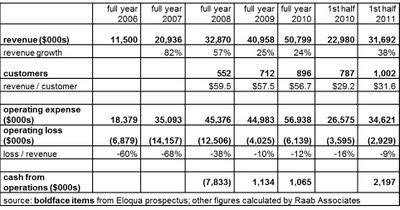 Revenue increased roughly $10 million per year from 2006 through 2010, which is nothing to sneeze at although the higher base meant the percentage rate slumped significantly in 2009 and 2010, to about 25%. Year to date in 2011, growth is back up to nearly 40%, which would translate to $70 million for full year 2011 if maintained.
Client counts are reported only for 2008 through mid 2011. The first bit of news is that revenue per client was virtually flat during that period. I expected it to grow as Eloqua sold into larger accounts. Eloqua doesn’t offer an explanation, but my guess is heavy competition forced them to reduce prices during this period.
Operating expenses grew sharply through 2008, nearly outpacing revenue. The company tightened its belt in response to economic conditions in 2009, in particular by reducing marketing and sales costs by nearly $4 million (more on that later). It reinstated most of that budget the next year, but we can wonder how much the cutbacks slowed Eloqua’s revenue growth. The industry as a whole was almost certainly grew faster than 25% in 2009 and Raab Associates estimates it doubled in 2010.
On a brighter note, cash from operations has been positive since 2009 and looks great for the first half of 2011. The difference between positive cash flow and negative profits is one of those accounting mysteries I won’t claim to fully understand; as near as I can tell, it’s due to a combination of advance customer payments (which won’t be counted as revenue until they are earned) and non-cash expenses in paid in company stock.
So much for what Eloqua said. (Of course, these are just highlights – the full registration statement runs over 200 pages.) But what does it mean?
Ultimately, investors want to know whether Eloqua will ever show a profit. Companies in the early growth stage rarely do, so the losses to date are not necessarily cause for concern. Software-as-a-service vendors in particular love to point out that they get a recurring revenue stream from each customer, so there are future profits that are masked by first-year sales expenses. They also argue that much of their operating cost is fixed, so the incremental cost of servicing new customers is quite low. In both cases, then, present losses are a harbinger of future profit.
Let’s start with the servicing costs. Eloqua reports separate revenues for subscription and support (what I’d call servicing costs) and professional services. It also breaks out costs for those two categories. Professional services are under 10% of revenue and they jump depending on whether Eloqua performs them in-house or shares them with partners. They also run at a loss, which means they are more like a sales cost. In any case, let’s ignore them for now and focus on servicing costs.
What we see is that, instead of falling, the amount of revenue spent to support each client has actually increased as Eloqua added more clients. The good news is that it has pretty much stabilized around $45,000 per client or 20% of revenue in 2009 and 2010. The reason seems to be a substantial upgrading of Eloqua’s infrastructure in recent years, perhaps combined with competitive pressures that have prevented it from raising prices as it serves larger clients. A reasonable conclusion, at least for the short term, is that Eloqua’s operating margins won’t get much better as it grows.
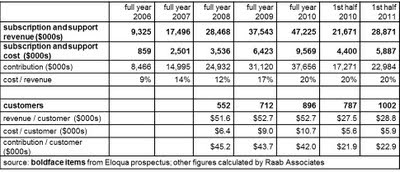
Ah, but what about sales costs? After all, the company pays those just once per client, while it earns its $45,000 per client each year. Once it earns back the sales cost, that future contribution is gravy (or, at least, contribution to other fixed costs).
And what is each sale costing? The registration statement shows marketing and sales costs each year and year-end client counts. So we can easily calculate the number of clients added each year and, from that, the sales cost per new client. What we find is a rather frightening $120,000 per client in 2010, and about the same so far in 2011. At $45,000 contribution per year, that would take nearly 3 years to recoup. Ouch.
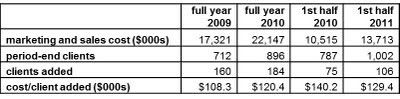 But that’s assuming all sales and marketing costs are spent on new clients. Some of them probably go to service existing clients – although that actually makes things worse, since those costs would recur each year and reduce the operating contribution. What makes things better, sort of, is recognizing that Eloqua actually loses some existing clients each year.
This is where what Eloqua didn’t reveal is intriguing. I couldn’t find retention rate anywhere in the registration statement. This is a critical variable in software-as-a-service economics and is regularly reported by public companies. I’m not aware of a rule against Eloqua reporting it, although I’ve never researched that point. (If anyone out there knows either way, please tell me.)
In the absence of real information, I’ll just blindly speculate. Let’s say Eloqua loses 20% of its customers each year – a figure that translates to better than 98% per month retention, which would be considered pretty good. We use that value in two ways: to calculate the number of clients Eloqua must sell to replace its losses, and to estimate the lifetime value of a client.
Adding in the replacement clients, the cost per new client comes down to about $70,000, for a payback of about 1.5 years at $45,000 contribution. That’s pretty respectable.
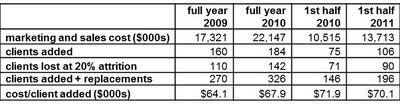 Attrition also reduces the lifetime value: at 20% per year, the five year value comes to about 3.4 years (1.0 + .80 + .64 + .51 + .41), or $151,000. Subtracting the sales cost, you still have a nice $81,000 contribution to other fixed costs over the five year period. Those other fixed costs (R&D and G&A) have been rising much more slowly – around 15% per year, to where they are now around 36% of revenue.
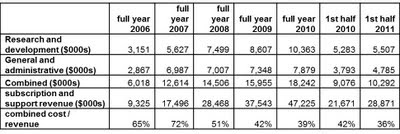
If we put all those figures together, assume a 30% growth rate, and ignore professional services, it looks like Eloqua should just about break even in 2011, make a reasonable profit in 2012, and make a substantial amount in 2013.
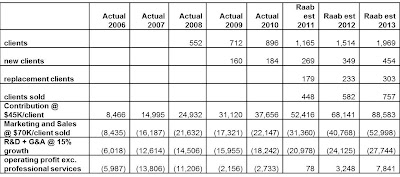
But can we really ignore professional services? As I mentioned earlier, it runs at a loss but has varied greatly over time: from recovering 91% in 2007 to just 51% in 2010. The closest relationship I can find is between professional services revenue and marketing and sales cost: both were cut in 2009 and have rebounded since.
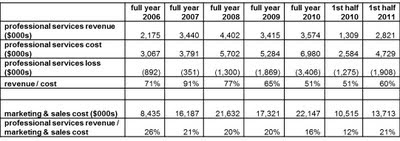
A somewhat optimistic estimate of professional services losses might be the actual rate for 2011: revenue at 20% of sales cost and recovering 60% of expenses. At that level, my estimates push out profitability to 2013. On the other hand, Eloqua has considerable control over pricing of its services. Should market conditions improve, they might be able to raise prices again to something close to breakeven. So perhaps I’m being pessimistic.
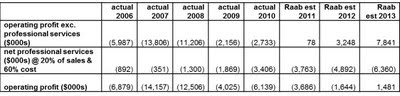
Back to that earlier question: What does it all mean? Certainly that Eloqua can be profitable even at current levels of pricing, operating costs, and sales costs. Not every firm in the business can say that. Equally important, I suspect improvements are possible in each of those areas – and would fall straight to the bottom line. So, current losses notwithstanding, Eloqua's future looks pretty bright.
Eloqua last week filed for an initial public offering of its stock. The registration statements accompanying these filings are like a striptease: often more interesting for what they hide than what they reveal. Eloqua’s was no exception.
Let’s start with what they showed. This included the basics: revenue, customers, profits, and cash flow.
 Revenue increased roughly $10 million per year from 2006 through 2010, which is nothing to sneeze at although the higher base meant the percentage rate slumped significantly in 2009 and 2010, to about 25%. Year to date in 2011, growth is back up to nearly 40%, which would translate to $70 million for full year 2011 if maintained.
Client counts are reported only for 2008 through mid 2011. The first bit of news is that revenue per client was virtually flat during that period. I expected it to grow as Eloqua sold into larger accounts. Eloqua doesn’t offer an explanation, but my guess is heavy competition forced them to reduce prices during this period.
Operating expenses grew sharply through 2008, nearly outpacing revenue. The company tightened its belt in response to economic conditions in 2009, in particular by reducing marketing and sales costs by nearly $4 million (more on that later). It reinstated most of that budget the next year, but we can wonder how much the cutbacks slowed Eloqua’s revenue growth. The industry as a whole was almost certainly grew faster than 25% in 2009 and Raab Associates estimates it doubled in 2010.
On a brighter note, cash from operations has been positive since 2009 and looks great for the first half of 2011. The difference between positive cash flow and negative profits is one of those accounting mysteries I won’t claim to fully understand; as near as I can tell, it’s due to a combination of advance customer payments (which won’t be counted as revenue until they are earned) and non-cash expenses in paid in company stock.
So much for what Eloqua said. (Of course, these are just highlights – the full registration statement runs over 200 pages.) But what does it mean?
Ultimately, investors want to know whether Eloqua will ever show a profit. Companies in the early growth stage rarely do, so the losses to date are not necessarily cause for concern. Software-as-a-service vendors in particular love to point out that they get a recurring revenue stream from each customer, so there are future profits that are masked by first-year sales expenses. They also argue that much of their operating cost is fixed, so the incremental cost of servicing new customers is quite low. In both cases, then, present losses are a harbinger of future profit.
Let’s start with the servicing costs. Eloqua reports separate revenues for subscription and support (what I’d call servicing costs) and professional services. It also breaks out costs for those two categories. Professional services are under 10% of revenue and they jump depending on whether Eloqua performs them in-house or shares them with partners. They also run at a loss, which means they are more like a sales cost. In any case, let’s ignore them for now and focus on servicing costs.
What we see is that, instead of falling, the amount of revenue spent to support each client has actually increased as Eloqua added more clients. The good news is that it has pretty much stabilized around $45,000 per client or 20% of revenue in 2009 and 2010. The reason seems to be a substantial upgrading of Eloqua’s infrastructure in recent years, perhaps combined with competitive pressures that have prevented it from raising prices as it serves larger clients. A reasonable conclusion, at least for the short term, is that Eloqua’s operating margins won’t get much better as it grows.

Ah, but what about sales costs? After all, the company pays those just once per client, while it earns its $45,000 per client each year. Once it earns back the sales cost, that future contribution is gravy (or, at least, contribution to other fixed costs).
And what is each sale costing? The registration statement shows marketing and sales costs each year and year-end client counts. So we can easily calculate the number of clients added each year and, from that, the sales cost per new client. What we find is a rather frightening $120,000 per client in 2010, and about the same so far in 2011. At $45,000 contribution per year, that would take nearly 3 years to recoup. Ouch.
 But that’s assuming all sales and marketing costs are spent on new clients. Some of them probably go to service existing clients – although that actually makes things worse, since those costs would recur each year and reduce the operating contribution. What makes things better, sort of, is recognizing that Eloqua actually loses some existing clients each year.
This is where what Eloqua didn’t reveal is intriguing. I couldn’t find retention rate anywhere in the registration statement. This is a critical variable in software-as-a-service economics and is regularly reported by public companies. I’m not aware of a rule against Eloqua reporting it, although I’ve never researched that point. (If anyone out there knows either way, please tell me.)
In the absence of real information, I’ll just blindly speculate. Let’s say Eloqua loses 20% of its customers each year – a figure that translates to better than 98% per month retention, which would be considered pretty good. We use that value in two ways: to calculate the number of clients Eloqua must sell to replace its losses, and to estimate the lifetime value of a client.
Adding in the replacement clients, the cost per new client comes down to about $70,000, for a payback of about 1.5 years at $45,000 contribution. That’s pretty respectable.
 Attrition also reduces the lifetime value: at 20% per year, the five year value comes to about 3.4 years (1.0 + .80 + .64 + .51 + .41), or $151,000. Subtracting the sales cost, you still have a nice $81,000 contribution to other fixed costs over the five year period. Those other fixed costs (R&D and G&A) have been rising much more slowly – around 15% per year, to where they are now around 36% of revenue.

If we put all those figures together, assume a 30% growth rate, and ignore professional services, it looks like Eloqua should just about break even in 2011, make a reasonable profit in 2012, and make a substantial amount in 2013.

But can we really ignore professional services? As I mentioned earlier, it runs at a loss but has varied greatly over time: from recovering 91% in 2007 to just 51% in 2010. The closest relationship I can find is between professional services revenue and marketing and sales cost: both were cut in 2009 and have rebounded since.

A somewhat optimistic estimate of professional services losses might be the actual rate for 2011: revenue at 20% of sales cost and recovering 60% of expenses. At that level, my estimates push out profitability to 2013. On the other hand, Eloqua has considerable control over pricing of its services. Should market conditions improve, they might be able to raise prices again to something close to breakeven. So perhaps I’m being pessimistic.

Back to that earlier question: What does it all mean? Certainly that Eloqua can be profitable even at current levels of pricing, operating costs, and sales costs. Not every firm in the business can say that. Equally important, I suspect improvements are possible in each of those areas – and would fall straight to the bottom line. So, current losses notwithstanding, Eloqua's future looks pretty bright.
Monday, August 22, 2011
Affiliate Summit East: How to Stand Out in a Crowded Market
I spent several hours this morning at the Affiliate Summit East in New York. This is a corner of the direct marketing industry I haven't examined in depth although it overlaps with lead generation, online advertising, and performance measurement segments I know well. The exhibit hall was enticingly crammed with unfamiliar vendors, although I saw enough to identify a few general categories: offer aggregators who bring together products for affiliates to sell; network providers who assemble audiences for affiliates to sell to; and technology providers to support both groups.
Swimming through the aisles were the affiliate marketers themselves – people who make their living by selling other companies’ products in return for a share of the revenue. They are the main audience for the show and, thus, of the speakers. I heard two presentations: a keynote by Wil Reynolds of SEER Interactive and a session on starting an affiliate business by Nicholas Reese of Microbrand Media. Both shared the somewhat disconcerting theme that affiliate marketers shouldn’t build traffic with shady techniques – something each speaker admitted, with the fervor of a repentant sinner, he had done in their early days. Each also offered ethical alternatives for creating a sound business.
Reynolds offered nuts-and-bolts advice, including ways to gain new links, create more appealing search results, and attract social traffic. He also offered recommendations for using a slew of free or low-cost tools, including:
- export.ly, which analyzes your Twitter followers
- Rapportive, which assembles profiles on contacts
- SEOmoz, which offers a package of features including lists of people who link to you
- Row Feeder, which reports search results against Twitter and Facebook
- Speechpad, a $1 per minute voice-to-text transcription service
- Promedia Suggester, which suggests search advertising keywords and topics
Reese worked at a more strategic level, offering advice on how to identify a promising affiliate business opportunity and then how to develop it. He made an intriguing distinction between problems solved with the customer's money (good opportunities) and problems solved with the customer’s time (not so good, because it’s harder to generate transaction that will yield a commission). He also suggested careful consideration of customers' knowledge (enough to recognize the problem exists, but not so much that they already know how to solve it). And he also listed churn rate as a key factor – he didn’t elaborate on that one, but I assume his point was you want customers who’ll stick around enough to generate repeat business.
For building a business, Reese argued that email is still king because it’s much harder to ignore than social media. He also urged marketers to build unique strategic relationships with companies that don’t have standard affiliate programs, since those relationships have higher profit potential than a program that’s already open to others.
That last point is important: with so many vendors providing packages of products to sell and of audiences to reach, it’s easier to start an affiliate business but harder to offer anything unique. Skillful content generation and traffic building may still be enough to build a profitable business, but I suspect that large-scale success requires something everyone else can't buy off the shelf. This might be an actual product, marketing technology, or business method. Affiliate marketers or suppliers who can create these will probably be the big winners in the long run.
Swimming through the aisles were the affiliate marketers themselves – people who make their living by selling other companies’ products in return for a share of the revenue. They are the main audience for the show and, thus, of the speakers. I heard two presentations: a keynote by Wil Reynolds of SEER Interactive and a session on starting an affiliate business by Nicholas Reese of Microbrand Media. Both shared the somewhat disconcerting theme that affiliate marketers shouldn’t build traffic with shady techniques – something each speaker admitted, with the fervor of a repentant sinner, he had done in their early days. Each also offered ethical alternatives for creating a sound business.
Reynolds offered nuts-and-bolts advice, including ways to gain new links, create more appealing search results, and attract social traffic. He also offered recommendations for using a slew of free or low-cost tools, including:
- export.ly, which analyzes your Twitter followers
- Rapportive, which assembles profiles on contacts
- SEOmoz, which offers a package of features including lists of people who link to you
- Row Feeder, which reports search results against Twitter and Facebook
- Speechpad, a $1 per minute voice-to-text transcription service
- Promedia Suggester, which suggests search advertising keywords and topics
Reese worked at a more strategic level, offering advice on how to identify a promising affiliate business opportunity and then how to develop it. He made an intriguing distinction between problems solved with the customer's money (good opportunities) and problems solved with the customer’s time (not so good, because it’s harder to generate transaction that will yield a commission). He also suggested careful consideration of customers' knowledge (enough to recognize the problem exists, but not so much that they already know how to solve it). And he also listed churn rate as a key factor – he didn’t elaborate on that one, but I assume his point was you want customers who’ll stick around enough to generate repeat business.
For building a business, Reese argued that email is still king because it’s much harder to ignore than social media. He also urged marketers to build unique strategic relationships with companies that don’t have standard affiliate programs, since those relationships have higher profit potential than a program that’s already open to others.
That last point is important: with so many vendors providing packages of products to sell and of audiences to reach, it’s easier to start an affiliate business but harder to offer anything unique. Skillful content generation and traffic building may still be enough to build a profitable business, but I suspect that large-scale success requires something everyone else can't buy off the shelf. This might be an actual product, marketing technology, or business method. Affiliate marketers or suppliers who can create these will probably be the big winners in the long run.
Tuesday, August 16, 2011
Can CRM Add-Ons Replace Marketing Automation?
I’ve long believed that B2B marketing automation is just a passing phase: that, ultimately, B2B marketing automation systems will be absorbed into CRM systems instead of operating independently. It’s a view I discuss sparingly in public, since so many of my friends in the marketing automation industry have a vested interest to the contrary. But there are also a few vendors who have bet in favor of merged systems, so it wouldn’t be fair to ignore their view entirely.
Vendors have made the bet by building marketing automation add-ons to a CRM system instead of building a stand-alone marketing automation product.* I wrote in February about ClickDimensions, which adds advanced email campaigns and Web tracking to Microsoft Dynamics CRM. Of course, the jackpot here is Salesforce.com. At least two vendors have tried to hit it: Predictive Response and BizConnector, whose product is Lead Follow-Up.
Of the two, BizConnector’s Lead Follow-Up is more tightly focused, offering primarily a rules engine that allows lead nurturing and other workflows. It also provides real-time alerts and landing pages. Predictive Response has a broader range, with more advanced email features, including split tests, content templates, and branching campaigns, as well as Web visitor tracking, lead scoring, dashboards, and some data cleansing on form entries. Neither matches the scope of even a mid-tier marketing automation product, but many of the “missing” features would be available in other Salesforce add-ons. So the real question is whether the core campaign management features are adequate substitutes for a marketing automation product.
That question has no simple answer. Lead Follow-Up would probably suffice for small organizations, although it’s targeted more at individual salespeople than marketing departments. Predictive Response (which I have not examined in depth) might serve small and mid-tier marketing groups but probably not large enterprises.
Beyond these particular products lies the larger question of whether their CRM-based approach makes more sense than the separate-but-synchronized platforms offered by most marketing automation vendors. Each method has advantages:
- separate systems can present specialized marketing functions without getting in the way of sales activities.
- separate systems can use database designs optimized to process the entire database at once, instead of the one-record-at-a-time transactional processing needed for sales and service interactions.
- separate systems give each department complete control over its own system, something both groups often prefer.
On the other hand….
- unified systems avoid the need for data synchronization, which reduces complexity, eases cross-department coordination, and eliminates most risk of inconsistency.
- unified systems simplify deployment and support, especially from the perspective of the IT group (although this should be a minor factor in Software-as-a-Service systems, since most work is handled by the vendor).
- unified systems should save money, although it's not clear they do in practice.
The main technical issue here is whether marketing and CRM systems need different database structures. But even if that’s true, one vendor can provide and synchronize both structures at least as easily as separate vendors. Similarly, if separate user interfaces are really necessary, one system can offer both. So the technical differences are largely irrelevant.
Instead, the argument for separate systems really comes down the political desire of each department to have its own system, and a somewhat related expectation that a vendor focused exclusively on marketing automation will build a better system than a small division within a CRM company.
I actually accept those arguments. Vendors serving either marketing or sales will probably do a better job than vendors trying to serve both. But I don’t think this will matter in the long run. As marketing automation requirements become better understood, the CRM-based products will come closer to meeting marketers’ needs. As the functional gap narrows between the two sets of products, the convenience and cost advantages of a unified system will swing the balance in their direction. This will be reinforced by the business need for tighter coordination between sales and marketing, as well as the larger role played by corporate IT groups in selecting customer-related systems. Only marketing departments with very sophisticated needs will be able to justify buying a specialized marketing automation product.
In short, the merger between B2B marketing automation and CRM seems inevitable. In the B2B world, where sales is generally the dominant department, this means that CRM will encompass marketing automation rather than vice versa. The mechanics of the process are less predictable: CRM vendors might expand their features incrementally, acquire add-on systems, or buy a marketing automation product and integrate it. Different vendors may take different paths and move at different rates. But however they get there, I think the destination is clear.
_________________________________________________________
* For very small companies, vendors including Infusionsoft and OfficeAutoPilot have made the bet by offering their own CRM / marketing automation combination.
Vendors have made the bet by building marketing automation add-ons to a CRM system instead of building a stand-alone marketing automation product.* I wrote in February about ClickDimensions, which adds advanced email campaigns and Web tracking to Microsoft Dynamics CRM. Of course, the jackpot here is Salesforce.com. At least two vendors have tried to hit it: Predictive Response and BizConnector, whose product is Lead Follow-Up.
Of the two, BizConnector’s Lead Follow-Up is more tightly focused, offering primarily a rules engine that allows lead nurturing and other workflows. It also provides real-time alerts and landing pages. Predictive Response has a broader range, with more advanced email features, including split tests, content templates, and branching campaigns, as well as Web visitor tracking, lead scoring, dashboards, and some data cleansing on form entries. Neither matches the scope of even a mid-tier marketing automation product, but many of the “missing” features would be available in other Salesforce add-ons. So the real question is whether the core campaign management features are adequate substitutes for a marketing automation product.
That question has no simple answer. Lead Follow-Up would probably suffice for small organizations, although it’s targeted more at individual salespeople than marketing departments. Predictive Response (which I have not examined in depth) might serve small and mid-tier marketing groups but probably not large enterprises.
Beyond these particular products lies the larger question of whether their CRM-based approach makes more sense than the separate-but-synchronized platforms offered by most marketing automation vendors. Each method has advantages:
- separate systems can present specialized marketing functions without getting in the way of sales activities.
- separate systems can use database designs optimized to process the entire database at once, instead of the one-record-at-a-time transactional processing needed for sales and service interactions.
- separate systems give each department complete control over its own system, something both groups often prefer.
On the other hand….
- unified systems avoid the need for data synchronization, which reduces complexity, eases cross-department coordination, and eliminates most risk of inconsistency.
- unified systems simplify deployment and support, especially from the perspective of the IT group (although this should be a minor factor in Software-as-a-Service systems, since most work is handled by the vendor).
- unified systems should save money, although it's not clear they do in practice.
The main technical issue here is whether marketing and CRM systems need different database structures. But even if that’s true, one vendor can provide and synchronize both structures at least as easily as separate vendors. Similarly, if separate user interfaces are really necessary, one system can offer both. So the technical differences are largely irrelevant.
Instead, the argument for separate systems really comes down the political desire of each department to have its own system, and a somewhat related expectation that a vendor focused exclusively on marketing automation will build a better system than a small division within a CRM company.
I actually accept those arguments. Vendors serving either marketing or sales will probably do a better job than vendors trying to serve both. But I don’t think this will matter in the long run. As marketing automation requirements become better understood, the CRM-based products will come closer to meeting marketers’ needs. As the functional gap narrows between the two sets of products, the convenience and cost advantages of a unified system will swing the balance in their direction. This will be reinforced by the business need for tighter coordination between sales and marketing, as well as the larger role played by corporate IT groups in selecting customer-related systems. Only marketing departments with very sophisticated needs will be able to justify buying a specialized marketing automation product.
In short, the merger between B2B marketing automation and CRM seems inevitable. In the B2B world, where sales is generally the dominant department, this means that CRM will encompass marketing automation rather than vice versa. The mechanics of the process are less predictable: CRM vendors might expand their features incrementally, acquire add-on systems, or buy a marketing automation product and integrate it. Different vendors may take different paths and move at different rates. But however they get there, I think the destination is clear.
_________________________________________________________
* For very small companies, vendors including Infusionsoft and OfficeAutoPilot have made the bet by offering their own CRM / marketing automation combination.
Monday, August 08, 2011
CRM Evolution Conference: Social CRM Takes Center Stage
I caught an all-star panel on social CRM today at the CRMEvolution conference in New York. Up on the dais were Jim Berkowitz of CRM Mastery, Esteban Kolsky of ThinkJar, Brent Leary of CRM Essentials, Ray Wang of Constellation Group, and Denis Pombriant of Beagle Research Group. You won’t find a more distinguished set of gurus, and moderator Berkowitz asked appropriately incisive questions.
Yet my final impression was that social CRM is a problem in search of a solution. Maybe it was because the speakers kept emphasizing the need to define strategy and goals for any social CRM project. Of course this is sound advice, for social CRM or anything else. But that the speakers kept repeating it suggests pretty strongly that they’ve seen lots of people deploy social CRM without that sort of planning. In addition, the goals the panel cited, collaboration and customer intimacy, struck me as pretty darn vague themselves. A couple of audience questions asking for more specific examples of the benefits didn’t yield much more substance.
The group did better when it came to tactical advice. Two suggestions that stuck with me were that companies should start with internal collaboration projects before trying to collaborate with consumers, and that companies recognize they shouldn’t be equally transparent about everything.
The panel also recognized the serious privacy issues raised by social channels, and the danger of appearing to be creepily aware of everything customers have done in different public forums. The focus was more on the dangers of displaying the information than on the dangers of gathering it in the first place. That probably mirrored the concerns of the audience.
For what it’s worth, I did pick up a pair of intriguing buzzwords: the need to display information in “context” and to pick the context based on the user’s “intent”. At least two people discussed these, so apparently they've been echoing through the gurusphere for some time without my noticing. The general idea is that context and intent can tame the flood of raw information by giving users only the data they need in formats that make sense. That's certainly not a new idea, but if some nice fresh buzzwords can get people to do a better job presenting data, I'm all for it.
Yet my final impression was that social CRM is a problem in search of a solution. Maybe it was because the speakers kept emphasizing the need to define strategy and goals for any social CRM project. Of course this is sound advice, for social CRM or anything else. But that the speakers kept repeating it suggests pretty strongly that they’ve seen lots of people deploy social CRM without that sort of planning. In addition, the goals the panel cited, collaboration and customer intimacy, struck me as pretty darn vague themselves. A couple of audience questions asking for more specific examples of the benefits didn’t yield much more substance.
The group did better when it came to tactical advice. Two suggestions that stuck with me were that companies should start with internal collaboration projects before trying to collaborate with consumers, and that companies recognize they shouldn’t be equally transparent about everything.
The panel also recognized the serious privacy issues raised by social channels, and the danger of appearing to be creepily aware of everything customers have done in different public forums. The focus was more on the dangers of displaying the information than on the dangers of gathering it in the first place. That probably mirrored the concerns of the audience.
For what it’s worth, I did pick up a pair of intriguing buzzwords: the need to display information in “context” and to pick the context based on the user’s “intent”. At least two people discussed these, so apparently they've been echoing through the gurusphere for some time without my noticing. The general idea is that context and intent can tame the flood of raw information by giving users only the data they need in formats that make sense. That's certainly not a new idea, but if some nice fresh buzzwords can get people to do a better job presenting data, I'm all for it.
Tuesday, August 02, 2011
Act-On Buys Marketbright Assets
Act-On Software announced last week that they had purchased the assets of Marketbright, a pioneering marketing automation vendor that has struggled in recent years. Marketbright’s problems have been obvious for months, so that they would vanish is not news. The interesting question is why Act-On made the purchase.
I discussed this last Thursday with Act-On CEO Raghu Raghavan. Part of his answer was because they could: having raised $10 million in June, Act-On can now consider acquisitions of less-well-endowed competitors. Beyond that, Raghavan cited several narrow benefits, including the chance of converting Marketbright customers to Act-On, the business knowledge and skills of key Marketbright employees, and some design features of the Marketbright system. He made clear that the actual Marketbright software will not be merged into Act-On because they are built with different technologies.
In other words, the Marketbright acquisition was a tactical measure to pick up some modest assets at a modest price. It is neither central to Act-On’s current strategy nor a shift towards a new strategy.
That strategy has remained remarkably consistent. It boils down to providing an easy transition between basic email systems and full-scale marketing automation. Raghavan said that Act-On has now deployed a consistent sales process to convince marketers they can benefit from replacing multiple point solutions with a single Act-On installation, even without the major process reengineering or staff training recommended by other marketing automation vendors.
This is clearly a successful argument: Act-On just added its 350th client, and is on pace to triple its total over the next twelve months. Most buyers are small businesses, and many are in financial services, insurance, retail, healthcare, and education rather than high-tech. Installations at large companies are often used by small groups who want an alternative to the existing corporate marketing automation system. The system’s $500 per month starting price and no-annual-contract policy encourage such casual implementations by reducing the financial risk.
In fact, the risk is so low that Act-On has actually reduced its free trial period from 30 days to 14 days and eschewed the freemium offers used by competitors Genius and LoopFuse. Raghavan argues that marketing automation systems are too complicated for freemiums to work well. (For what it’s worth, Genius and LoopFuse seem satisfied with their freemium results. Beyond inducing trial, freemiums can also attract long-term users who will move up to the paying version when their needs expand. Agencies who use freemium versions at small clients may also use the same product for larger clients who will pay for the system.)
If it sounds like my discussions with Act-On have centered more on strategy than product features, that’s correct. Raghavan argues marketing automation vendors' success is now determined less by product features than repeatable, profitable processes for sales, deployment, and support. He said Act-On has developed these processes and can now safely accelerate its growth with predictable results. One change the company plans is to expand its managed services, such as help with deploying campaigns. Some of these services will come from Act-On and others by agency partners.
Although Act-On sells the product as a replacement for existing point solutions, the company says clients do use additional features fairly quickly. The most popular are drip marketing, anonymous visitor identification, sales integration, and Web traffic analysis. Complex nurture campaigns and lead scoring are used much less. Under-utilization of advanced features is common across all marketing automation systems, but it may also reflect Act-On’s sales pitch that clients don't need extensive changes to their marketing processes. Similarly, it's tempting to argue that clients' demand for managed services reflects the company’s deploy-first, change-later approach, but that’s also something that clients of all vendors consistently request.
In short, Act-On is doing quite nicely by ignoring the industry conventional wisdom that process change and planning are necessary for marketing automation success. But that doesn’t mean the conventional wisdom is wrong. After all, Act-On’s main sales proposition isn't about marketing automation: it's about making existing tasks easier. It also helps that Act-On is selling to small, consumer-oriented firms, whose marketing automation needs are genuinely simpler than at larger, B2B marketers. In fact, although Act-On is selling to slightly larger companies than micro-business specialists Infusionsoft and OfficeAutoPilot, its resembles them in several ways.
The real test of Act-On comes after clients have gained experience with it and find they do need marketing automation training and process change. So long as Act-On has the features and services to support this – which I believe it does -- the clients should be happy and renew. But if they find they’ve outgrown Act-On because they need more change more than they originally realized, they’ll have to look elsewhere.
I discussed this last Thursday with Act-On CEO Raghu Raghavan. Part of his answer was because they could: having raised $10 million in June, Act-On can now consider acquisitions of less-well-endowed competitors. Beyond that, Raghavan cited several narrow benefits, including the chance of converting Marketbright customers to Act-On, the business knowledge and skills of key Marketbright employees, and some design features of the Marketbright system. He made clear that the actual Marketbright software will not be merged into Act-On because they are built with different technologies.
In other words, the Marketbright acquisition was a tactical measure to pick up some modest assets at a modest price. It is neither central to Act-On’s current strategy nor a shift towards a new strategy.
That strategy has remained remarkably consistent. It boils down to providing an easy transition between basic email systems and full-scale marketing automation. Raghavan said that Act-On has now deployed a consistent sales process to convince marketers they can benefit from replacing multiple point solutions with a single Act-On installation, even without the major process reengineering or staff training recommended by other marketing automation vendors.
This is clearly a successful argument: Act-On just added its 350th client, and is on pace to triple its total over the next twelve months. Most buyers are small businesses, and many are in financial services, insurance, retail, healthcare, and education rather than high-tech. Installations at large companies are often used by small groups who want an alternative to the existing corporate marketing automation system. The system’s $500 per month starting price and no-annual-contract policy encourage such casual implementations by reducing the financial risk.
In fact, the risk is so low that Act-On has actually reduced its free trial period from 30 days to 14 days and eschewed the freemium offers used by competitors Genius and LoopFuse. Raghavan argues that marketing automation systems are too complicated for freemiums to work well. (For what it’s worth, Genius and LoopFuse seem satisfied with their freemium results. Beyond inducing trial, freemiums can also attract long-term users who will move up to the paying version when their needs expand. Agencies who use freemium versions at small clients may also use the same product for larger clients who will pay for the system.)
If it sounds like my discussions with Act-On have centered more on strategy than product features, that’s correct. Raghavan argues marketing automation vendors' success is now determined less by product features than repeatable, profitable processes for sales, deployment, and support. He said Act-On has developed these processes and can now safely accelerate its growth with predictable results. One change the company plans is to expand its managed services, such as help with deploying campaigns. Some of these services will come from Act-On and others by agency partners.
Although Act-On sells the product as a replacement for existing point solutions, the company says clients do use additional features fairly quickly. The most popular are drip marketing, anonymous visitor identification, sales integration, and Web traffic analysis. Complex nurture campaigns and lead scoring are used much less. Under-utilization of advanced features is common across all marketing automation systems, but it may also reflect Act-On’s sales pitch that clients don't need extensive changes to their marketing processes. Similarly, it's tempting to argue that clients' demand for managed services reflects the company’s deploy-first, change-later approach, but that’s also something that clients of all vendors consistently request.
In short, Act-On is doing quite nicely by ignoring the industry conventional wisdom that process change and planning are necessary for marketing automation success. But that doesn’t mean the conventional wisdom is wrong. After all, Act-On’s main sales proposition isn't about marketing automation: it's about making existing tasks easier. It also helps that Act-On is selling to small, consumer-oriented firms, whose marketing automation needs are genuinely simpler than at larger, B2B marketers. In fact, although Act-On is selling to slightly larger companies than micro-business specialists Infusionsoft and OfficeAutoPilot, its resembles them in several ways.
The real test of Act-On comes after clients have gained experience with it and find they do need marketing automation training and process change. So long as Act-On has the features and services to support this – which I believe it does -- the clients should be happy and renew. But if they find they’ve outgrown Act-On because they need more change more than they originally realized, they’ll have to look elsewhere.
Friday, July 22, 2011
HubSpot Spreads Its Wings
The folks at HubSpot have been busy this summer, announcing their acquisition of Performable in June and their HubSpot App Marketplace last week. Both events mark a continued expansion of their product.
The company gave me a brief preview of the App Marketplace back in May, when the public beta had just launched. App markets are quite the fashion right now, and HubSpot’s joins the Eloqua AppCloud announced in June. In both cases, what’s really happening is the vendor has published APIs that make it easier for other vendors to build products that integrate with their systems. Such APIs are available to varying degrees for other marketing automation products too, so an app marketplace isn’t quite as huge a leap as it may seem. But marketplaces do make it easier to find compatible applications and, done right, ensure that deployment is very simple.
I couldn’t find a public list of the available HubSpot apps, but their press release cites a connector for Microsoft Dynamics CRM and my notes from May mention custom analytics and shopping cart integration.
Unlike smartphone app stores or Salesforce.com AppExchange, the marketing automation vendor app markets won’t establish their products as “platforms” for a broad range of tasks (although the vendors can dream). They instead extend the functionality of the core product and, mostly, simplify integration with other products that already exist independently. In other words, the app markets are useful but not huge strategic differentiators.
Acquisitions, on the other hand, can be strategically decisive. HubSpot didn’t make that claim for its Performable deal, which shows an admirable sense of reality. Performable offers some interesting capabilities but nothing that radically alters HubSpot’s market position.
The main feature of Performable is an ability to define “events”, which can be page visits, form submissions, or other Web behaviors. This is a useful extension of standard Web behavior tracking techniques. Like other Web tracking, it requires users to install a small Javascript tag on their Web pages. Performable also has existing connectors with a variety of social media, help desk, email, billing, chat and CRM systems. Events and connectors make it easy to build a central database of customer behavior.
Performable leverages this central database with some impressive reporting, showing the first, last, and intervening sources (i.e., the Web site they came from) for visitors who reach each event. Although HubSpot already had reasonable Web analytics, Performable's ability to incorporate additional external activity is a substantial improvement.
Events can also trigger multi-step campaigns that send an email or call an external URL. The URL calls can including parameters with customer information or other data, providing lightweight integration with nearly any external system. Performable also has an impressive landing page builder that supports a/b testing and can ensure that visitors assigned to a particular test group are treated consistently in later visits.
However, the multi-step campaign engine is quite basic. It allows wait periods and conditional steps, but does not allow grouping to automatically exclude customers who meet one condition from subsequent steps. That's a pretty basic feature, typically used to send different messages to different segments at the same stage of a campaign. Users who wanted to do this would need to write conditions for each step that exclude conditions for previous steps. This can be a pain-staking and error-prone chore.
Multi-step campaigns are a weakness in the existing HubSpot system, so it's disappointing that Performable doesn't provide much help. Somewhat similarly, Performable relies on third-party email systems, so it doesn't directly improve HubSpot’s existing email engine, which also lags competitors.
But HubSpot made clear that the Performable acquisition was as much about getting first-rate development talent as about the product itself. In fact, the entire Performable staff joined HubSpot after the acquisition and Performable CEO David Cancel is now HubSpot’s Chief Product Officer. So in that sense, at least, the acquisition is indeed strategic.
The company gave me a brief preview of the App Marketplace back in May, when the public beta had just launched. App markets are quite the fashion right now, and HubSpot’s joins the Eloqua AppCloud announced in June. In both cases, what’s really happening is the vendor has published APIs that make it easier for other vendors to build products that integrate with their systems. Such APIs are available to varying degrees for other marketing automation products too, so an app marketplace isn’t quite as huge a leap as it may seem. But marketplaces do make it easier to find compatible applications and, done right, ensure that deployment is very simple.
I couldn’t find a public list of the available HubSpot apps, but their press release cites a connector for Microsoft Dynamics CRM and my notes from May mention custom analytics and shopping cart integration.
Unlike smartphone app stores or Salesforce.com AppExchange, the marketing automation vendor app markets won’t establish their products as “platforms” for a broad range of tasks (although the vendors can dream). They instead extend the functionality of the core product and, mostly, simplify integration with other products that already exist independently. In other words, the app markets are useful but not huge strategic differentiators.
Acquisitions, on the other hand, can be strategically decisive. HubSpot didn’t make that claim for its Performable deal, which shows an admirable sense of reality. Performable offers some interesting capabilities but nothing that radically alters HubSpot’s market position.
The main feature of Performable is an ability to define “events”, which can be page visits, form submissions, or other Web behaviors. This is a useful extension of standard Web behavior tracking techniques. Like other Web tracking, it requires users to install a small Javascript tag on their Web pages. Performable also has existing connectors with a variety of social media, help desk, email, billing, chat and CRM systems. Events and connectors make it easy to build a central database of customer behavior.
Performable leverages this central database with some impressive reporting, showing the first, last, and intervening sources (i.e., the Web site they came from) for visitors who reach each event. Although HubSpot already had reasonable Web analytics, Performable's ability to incorporate additional external activity is a substantial improvement.
Events can also trigger multi-step campaigns that send an email or call an external URL. The URL calls can including parameters with customer information or other data, providing lightweight integration with nearly any external system. Performable also has an impressive landing page builder that supports a/b testing and can ensure that visitors assigned to a particular test group are treated consistently in later visits.
However, the multi-step campaign engine is quite basic. It allows wait periods and conditional steps, but does not allow grouping to automatically exclude customers who meet one condition from subsequent steps. That's a pretty basic feature, typically used to send different messages to different segments at the same stage of a campaign. Users who wanted to do this would need to write conditions for each step that exclude conditions for previous steps. This can be a pain-staking and error-prone chore.
Multi-step campaigns are a weakness in the existing HubSpot system, so it's disappointing that Performable doesn't provide much help. Somewhat similarly, Performable relies on third-party email systems, so it doesn't directly improve HubSpot’s existing email engine, which also lags competitors.
But HubSpot made clear that the Performable acquisition was as much about getting first-rate development talent as about the product itself. In fact, the entire Performable staff joined HubSpot after the acquisition and Performable CEO David Cancel is now HubSpot’s Chief Product Officer. So in that sense, at least, the acquisition is indeed strategic.
Tuesday, July 12, 2011
B2B Marketing Automation Industry Size and Segments
As I mentioned yesterday, our new B2B Marketing Automation Vendor Selection Tool (VEST) asks vendors to estimate the number of clients in each of four size categories.
This provides an interesting overview of the industry. The segments are defined based on revenue. Installation counts are:
 Looking at the raw percentages doesn’t make much sense since businesses in each group are quite different. There’s a strong case to be made that micro-businesses in particular have such different needs that their vendors are not really part of the same industry as the rest of B2B marketing automation. I’ve described those differences in this post and go into them in our Vendor Selection Workbook (different from the VEST, and free on the Raab Guide site.)
But if you do want to consider all these vendors as one industry, the minimum adjustment to make is to account for differences in price. The table below calculates revenues using reasonable assumptions about revenue per client in each segment:
 Combined with the previous chart, this shows the micro-business segment represents 61% of clients but just 17% of industry revenues. At the other extreme, large business represents just 6% of clients but 28% of revenue. The small- and mid-size companies are the heart of the industry , with 55% of the revenue from 33% of the clients.
The $257.5 million revenue estimate is reasonable but it excludes revenues from B2B marketing automation vendors not in the VEST report and the B2B revenues of B2C marketing automation firms. So I’d estimate total industry revenue at $325* million for 2011. This represents a 50% growth over my estimate for 2010. That is consistent with the growth rate I reported yesterday.
The figures also shed light on the ever-popular question of penetration rates. The table below shows company counts by revenue range from business list compiler Manta. But not all of these are B2B marketers. Looking at the industry categories, I'd put the estimated market at half the total.

The 26.7% figure for the large company category is clearly too high, but that's easy to explain: big companies have lots of divisions, so many vendors have sold to a little piece of those firms. There’s certainly still plenty of opportunity left. It’s possible the 3% figure for mid-size firms reflects some of this effect as well.
Figures for the first three categories are more intriguing. They're much lower than the usual estimates that 5% to 10% of companies have marketing automation. Either the surveys behind those estimates are incorrect or my market definition is too broad.
It’s probably a bit of each: surveys tend to reach people who have above-average interest in the topic, and my 50% figure is based on categories that could potentially use marketing automation, not the categories that have deployed it so far. A count of the pioneer companies, basically tech and manufacturing industries, would reduce the estimated market to anything from one quarter to one tenth the numbers shown. This would translate to penetration rates of 10% to 30%, which is more in line with current estimates.
But I’d argue that the market is already growing beyond this core group, so the long-term potential is considerably larger. That’s great news – so long as vendors don’t get stuck in the current niche and so long as competitors from the CRM, email, Web software, Web advertising or other industries don’t swoop in and snatch it all away.
______________________________________________________________
*The original version of this post estimated $300 million. On consideration, I raised the estimate to $325 million because
- my revised estimate for 2010 was $225
- the 52% growth rate in the previous post was in number of clients, but growth is faster in the higher-priced segments, so the revenue growth would be higher
- average prices are probably rising a bit in the mid-sized segment and big segments, so revenue would rise faster than client counts
- the client counts were gathered in May and June, so they are not quite mid-year figures
I would have gone higher, but the large-company figures are probably overstated in my estimates because many of the 1,200 installations are small, departmental systems that wouldn't generate anything near $60,000 per year.
This provides an interesting overview of the industry. The segments are defined based on revenue. Installation counts are:
 Looking at the raw percentages doesn’t make much sense since businesses in each group are quite different. There’s a strong case to be made that micro-businesses in particular have such different needs that their vendors are not really part of the same industry as the rest of B2B marketing automation. I’ve described those differences in this post and go into them in our Vendor Selection Workbook (different from the VEST, and free on the Raab Guide site.)
But if you do want to consider all these vendors as one industry, the minimum adjustment to make is to account for differences in price. The table below calculates revenues using reasonable assumptions about revenue per client in each segment:
 Combined with the previous chart, this shows the micro-business segment represents 61% of clients but just 17% of industry revenues. At the other extreme, large business represents just 6% of clients but 28% of revenue. The small- and mid-size companies are the heart of the industry , with 55% of the revenue from 33% of the clients.
The $257.5 million revenue estimate is reasonable but it excludes revenues from B2B marketing automation vendors not in the VEST report and the B2B revenues of B2C marketing automation firms. So I’d estimate total industry revenue at $325* million for 2011. This represents a 50% growth over my estimate for 2010. That is consistent with the growth rate I reported yesterday.
The figures also shed light on the ever-popular question of penetration rates. The table below shows company counts by revenue range from business list compiler Manta. But not all of these are B2B marketers. Looking at the industry categories, I'd put the estimated market at half the total.

The 26.7% figure for the large company category is clearly too high, but that's easy to explain: big companies have lots of divisions, so many vendors have sold to a little piece of those firms. There’s certainly still plenty of opportunity left. It’s possible the 3% figure for mid-size firms reflects some of this effect as well.
Figures for the first three categories are more intriguing. They're much lower than the usual estimates that 5% to 10% of companies have marketing automation. Either the surveys behind those estimates are incorrect or my market definition is too broad.
It’s probably a bit of each: surveys tend to reach people who have above-average interest in the topic, and my 50% figure is based on categories that could potentially use marketing automation, not the categories that have deployed it so far. A count of the pioneer companies, basically tech and manufacturing industries, would reduce the estimated market to anything from one quarter to one tenth the numbers shown. This would translate to penetration rates of 10% to 30%, which is more in line with current estimates.
But I’d argue that the market is already growing beyond this core group, so the long-term potential is considerably larger. That’s great news – so long as vendors don’t get stuck in the current niche and so long as competitors from the CRM, email, Web software, Web advertising or other industries don’t swoop in and snatch it all away.
______________________________________________________________
*The original version of this post estimated $300 million. On consideration, I raised the estimate to $325 million because
- my revised estimate for 2010 was $225
- the 52% growth rate in the previous post was in number of clients, but growth is faster in the higher-priced segments, so the revenue growth would be higher
- average prices are probably rising a bit in the mid-sized segment and big segments, so revenue would rise faster than client counts
- the client counts were gathered in May and June, so they are not quite mid-year figures
I would have gone higher, but the large-company figures are probably overstated in my estimates because many of the 1,200 installations are small, departmental systems that wouldn't generate anything near $60,000 per year.
Monday, July 11, 2011
B2B Marketing Automation Growth Slowed In First Half of 2011
You know that red-hot B2B marketing automation industry? Don’t look now, but growth is already slowing.
Our just-released update to the B2B Marketing Automation Vendor Selection Toolkit (VEST) shows that client counts grew just over 50% over the year ending in June, compared with nearly 100% growth for the year ending last December. That’s a marked decline, and the pattern is consistent across individual vendors: although some grew faster than others, each grew slower than during the previous period.*
You might think the slower rate is expected because each period starts from a larger base. But it turns out that even the absolute number of new clients fell: about 6,100 were added during the recent period, compared 7,000 during the earlier year. I’ll say that again: fewer new B2B marketing automation systems were sold during the past year than the year ending six months earlier. Ouch.
Here’s the actual data:
These figures come from eight vendors including all the industry heavyweights: Infusionsoft, OfficeAutoPilot, HubSpot, Pardot, Marketo, Eloqua, Manticore Technology, and Genius. The report actually covers 17 vendors, but the others either were not in the January edition or didn’t provide accurate year-earlier information. The eight companies account for more than 90% of the total installations, so the exclusions are statistically insignificant.**
One obvious question is whether different segments of the industry are growing at different rates. The new report sheds light on this as well. We now ask vendors to estimate their client counts based on four segments:
- micro-businesses, under $5 million in revenue;
- small businesses, $5 to $20 million revenue;
- mid-size business, $20 to $500 million revenue, and
- large business, $500 million or more revenue.
The micro-business segment is concentrated among three vendors: Infusionsoft and OfficeAutoPilot, which serve micro-businesses almost exclusively, and HubSpot, which estimates 50% of its clients are micro-businesses. The remaining five vendors in my data (Pardot, Marketo, Eloqua, Manticore Technology, and Genius) have 69% of their clients in the small and mid-size segments.
The slowdown in growth rates applies to the both sets of vendors, although the small and mid-size group is slightly stronger. Client counts show the same pattern: the absolute increase in the most recent period was lower for the micro-business vendors (4,777 vs. 5,650), while it was essentially flat for the small and mid-size business vendors (1,315 vs. 1,340).
So, what does this mean? Is the marketing automation bubble about to burst?
Not necessarily. Year-on-year growth of 50% is nothing to sneeze at, and, as I mentioned earlier, some vendors are growing much faster. Also bear in mind that several vendors have recently received large infusions of funding, which they'll spend on sales and marketing to further accelerate growth.
But it’s still worth sounding a note of caution. Business plans predicated on the industry continuing to grow exponentially now look more dubious than ever. B2B marketing automation could still stall – as B2C marketing automation did – as a niche product for an elite group of sophisticated marketers. It's fine for vendors to expand their product scope, as several are. But they shouldn’t let this distract them from the more fundamental task of growing the base market through promotion, education, and training.
I like irony as much as anyone, but if the demand generation industry failed to generate demand for its own product, no one would be laughing.
__________________________________________________________________________________
*As best we can tell. Some vendors provided partial information, so we had to do some interpolation. And the data flowed in over a two month period, so it doesn’t all align precisely with the January and December time-frames. But the pattern is so strong and so consistent that the general conclusions seem reliable.
**There a few mid-sized vendors who didn’t make the report at all, including Act-On Software and ActiveConversion, which have about 300 clients each. I’d guess these and other vendors add 1,000 to 2,000 to the total client count.
Our just-released update to the B2B Marketing Automation Vendor Selection Toolkit (VEST) shows that client counts grew just over 50% over the year ending in June, compared with nearly 100% growth for the year ending last December. That’s a marked decline, and the pattern is consistent across individual vendors: although some grew faster than others, each grew slower than during the previous period.*
You might think the slower rate is expected because each period starts from a larger base. But it turns out that even the absolute number of new clients fell: about 6,100 were added during the recent period, compared 7,000 during the earlier year. I’ll say that again: fewer new B2B marketing automation systems were sold during the past year than the year ending six months earlier. Ouch.
Here’s the actual data:
| As of: | Client Count | Year-Earlier Client Count | Change in Client Count | Growth Rate |
| June 2011 | 17,215 | 11,098 | 6,117 | 55% |
| December 2011 | 14,177 | 7,212 | 6,965 | 97% |
These figures come from eight vendors including all the industry heavyweights: Infusionsoft, OfficeAutoPilot, HubSpot, Pardot, Marketo, Eloqua, Manticore Technology, and Genius. The report actually covers 17 vendors, but the others either were not in the January edition or didn’t provide accurate year-earlier information. The eight companies account for more than 90% of the total installations, so the exclusions are statistically insignificant.**
One obvious question is whether different segments of the industry are growing at different rates. The new report sheds light on this as well. We now ask vendors to estimate their client counts based on four segments:
- micro-businesses, under $5 million in revenue;
- small businesses, $5 to $20 million revenue;
- mid-size business, $20 to $500 million revenue, and
- large business, $500 million or more revenue.
The micro-business segment is concentrated among three vendors: Infusionsoft and OfficeAutoPilot, which serve micro-businesses almost exclusively, and HubSpot, which estimates 50% of its clients are micro-businesses. The remaining five vendors in my data (Pardot, Marketo, Eloqua, Manticore Technology, and Genius) have 69% of their clients in the small and mid-size segments.
The slowdown in growth rates applies to the both sets of vendors, although the small and mid-size group is slightly stronger. Client counts show the same pattern: the absolute increase in the most recent period was lower for the micro-business vendors (4,777 vs. 5,650), while it was essentially flat for the small and mid-size business vendors (1,315 vs. 1,340).
| Year-on-Year Growth Rate (Client Count) | |||
| Year Ending: | Infusionsoft, OfficeAutoPilot, HubSpot | Pardot, Marketo, Eloqua, Manticore Technology, Genius | All Vendors Combined |
| June 2011 | 52% | 68% | 55% |
| December 2011 | 97% | 93% | 97% |
So, what does this mean? Is the marketing automation bubble about to burst?
Not necessarily. Year-on-year growth of 50% is nothing to sneeze at, and, as I mentioned earlier, some vendors are growing much faster. Also bear in mind that several vendors have recently received large infusions of funding, which they'll spend on sales and marketing to further accelerate growth.
But it’s still worth sounding a note of caution. Business plans predicated on the industry continuing to grow exponentially now look more dubious than ever. B2B marketing automation could still stall – as B2C marketing automation did – as a niche product for an elite group of sophisticated marketers. It's fine for vendors to expand their product scope, as several are. But they shouldn’t let this distract them from the more fundamental task of growing the base market through promotion, education, and training.
I like irony as much as anyone, but if the demand generation industry failed to generate demand for its own product, no one would be laughing.
__________________________________________________________________________________
*As best we can tell. Some vendors provided partial information, so we had to do some interpolation. And the data flowed in over a two month period, so it doesn’t all align precisely with the January and December time-frames. But the pattern is so strong and so consistent that the general conclusions seem reliable.
**There a few mid-sized vendors who didn’t make the report at all, including Act-On Software and ActiveConversion, which have about 300 clients each. I’d guess these and other vendors add 1,000 to 2,000 to the total client count.
Wednesday, June 29, 2011
ExactTarget and Eloqua Stake Their Claim To Centralized Customer Management
You probably saw ExactTarget’s June 13 announcement of its strategic partnership with Marketo and Eloqua’s June 21 announcement of its new AppCloud marketplace for connectors with other systems. So did I. But it took a little while to connect with the vendors to get the details, so I’m only now ready to write about them.
Both announcements shared a theme of integration between core marketing platforms and other marketing systems. That Eloqua sees itself as the center of a marketing infrastructure isn’t surprising, although it does show how far we've traveled from the once-common view of marketing automation as an auxiliary to the sales automation “system of record”. ExactTarget’s aspiration to a central role was less expected, since its original and still primary business is email delivery. But ExactTarget has added mobile, Web pages, and social in recent years. They've been pulling these together with an “Interactive Marketing Hub” in beta since last September, which is now used by 500 of their 4,000 clients. The IMH, as we cognoscenti call it, combines ExactTarget's email, mobile, Web pages, Web visitor tracking, and social media with external touchpoints as well as Salesforce.com and Microsoft CRM.
The IMH sports a slick user interface with a very nice dashboard showing real-time updates of summary statistics for each channel. It also provides a central marketing calendar of campaigns across the channels. The underlying database can be simple lists, as in traditional email system, or a proper multi-table structure acting as the primary marketing database. As Captain Planet used to say, The Power Is Yours.
It’s perfectly sensible for ExactTarget to move in this direction, since it otherwise risks being pushed to the unprofitable edges of the marketing world as a commodity email engine. In fact, the real head-scratcher was why ExactTarget would deal with Marketo if it had ambitions to occupy the same central turf. (Marketo’s motivation is obvious: to gain broader distribution.)
ExactTarget’s answer was refreshingly honest: IMH lacks key B2B marketing automation features including lead scoring, advanced segmentation, and multi-step campaigns. The campaign engine will be improved before IMH's official launch this September, but other specialized B2B features probably won’t be added. ExactTarget also sees Marketo as the first of many partner applications for IMH, further clarifying that they see it in the central position.
Eloqua’s AppCloud is obviously modeled on Salesforce.com’s AppExchange and other application stores. The goal is for third parties to extend the value of a core platform by building tools that enhance it. In Eloqua’s case, most of the initial applications are connectors with other systems for Webinars, social communities, messaging and data acquisition. These will be joined over time by apps that add functionality within Eloqua itself. The AppCloud is an extension of Eloqua’s earlier Cloud Connector initiative, which provides APIs for external systems to access Eloqua data and functions. Basically, AppCloud makes it easier to find and deploy those connectors.
I did ask Eloqua how AppCloud relates to its Revenue Performance Management positioning. This felt like a pretty clever question until I later saw it was addressed in the AppCloud press release. Oh well. The answer came smoothly enough: AppCloud makes it easier to gather the activity data needed for Revenue Performance Management analysis. That makes sense, although AppCloud implies a more active integration with external systems than simply reporting against them.
Both the ExactTarget and Eloqua announcements reflect a strategy of positioning their products as a company’s primary customer management system. If you recall my post last week on Adobe and Oracle announcements, those firms also wanted to place themselves at the center of the customer management universe. So does pretty much everyone else.
Obviously they all can’t win this game. At the end of the day, I’d still put my money on the big CRM systems as the logical central repository for customer data. But I do believe that many auxiliary systems will continue to feed data to the central system and somehow coordinate treatment decisions with it. Connectors created to service ExactTarget, Eloqua, and others will make it easier to integrate the peripheral systems with whichever product ends up in the middle. So it’s all good.
Both announcements shared a theme of integration between core marketing platforms and other marketing systems. That Eloqua sees itself as the center of a marketing infrastructure isn’t surprising, although it does show how far we've traveled from the once-common view of marketing automation as an auxiliary to the sales automation “system of record”. ExactTarget’s aspiration to a central role was less expected, since its original and still primary business is email delivery. But ExactTarget has added mobile, Web pages, and social in recent years. They've been pulling these together with an “Interactive Marketing Hub” in beta since last September, which is now used by 500 of their 4,000 clients. The IMH, as we cognoscenti call it, combines ExactTarget's email, mobile, Web pages, Web visitor tracking, and social media with external touchpoints as well as Salesforce.com and Microsoft CRM.
The IMH sports a slick user interface with a very nice dashboard showing real-time updates of summary statistics for each channel. It also provides a central marketing calendar of campaigns across the channels. The underlying database can be simple lists, as in traditional email system, or a proper multi-table structure acting as the primary marketing database. As Captain Planet used to say, The Power Is Yours.
It’s perfectly sensible for ExactTarget to move in this direction, since it otherwise risks being pushed to the unprofitable edges of the marketing world as a commodity email engine. In fact, the real head-scratcher was why ExactTarget would deal with Marketo if it had ambitions to occupy the same central turf. (Marketo’s motivation is obvious: to gain broader distribution.)
ExactTarget’s answer was refreshingly honest: IMH lacks key B2B marketing automation features including lead scoring, advanced segmentation, and multi-step campaigns. The campaign engine will be improved before IMH's official launch this September, but other specialized B2B features probably won’t be added. ExactTarget also sees Marketo as the first of many partner applications for IMH, further clarifying that they see it in the central position.
Eloqua’s AppCloud is obviously modeled on Salesforce.com’s AppExchange and other application stores. The goal is for third parties to extend the value of a core platform by building tools that enhance it. In Eloqua’s case, most of the initial applications are connectors with other systems for Webinars, social communities, messaging and data acquisition. These will be joined over time by apps that add functionality within Eloqua itself. The AppCloud is an extension of Eloqua’s earlier Cloud Connector initiative, which provides APIs for external systems to access Eloqua data and functions. Basically, AppCloud makes it easier to find and deploy those connectors.
I did ask Eloqua how AppCloud relates to its Revenue Performance Management positioning. This felt like a pretty clever question until I later saw it was addressed in the AppCloud press release. Oh well. The answer came smoothly enough: AppCloud makes it easier to gather the activity data needed for Revenue Performance Management analysis. That makes sense, although AppCloud implies a more active integration with external systems than simply reporting against them.
Both the ExactTarget and Eloqua announcements reflect a strategy of positioning their products as a company’s primary customer management system. If you recall my post last week on Adobe and Oracle announcements, those firms also wanted to place themselves at the center of the customer management universe. So does pretty much everyone else.
Obviously they all can’t win this game. At the end of the day, I’d still put my money on the big CRM systems as the logical central repository for customer data. But I do believe that many auxiliary systems will continue to feed data to the central system and somehow coordinate treatment decisions with it. Connectors created to service ExactTarget, Eloqua, and others will make it easier to integrate the peripheral systems with whichever product ends up in the middle. So it’s all good.
Wednesday, June 22, 2011
Dueling Strategies: Adobe and Oracle Take Opposite Paths to Customer Experience Management
Adobe on Monday announced a new “Digital Enterprise Platform for Customer Experience Management”. The platform fills the center of Adobe’s three-part corporate mission to “make, manage, and measure” digital content and experiences. The other two pieces were already in place: “make” is Adobe’s original content creation business, while “measure” is Omniture Web analytics.
The strategic significance of the announcement seems more important than the actual product enhancements. These include improved integration of the company’s Web content management system (formerly Day C5) with Scene 7 dynamic content and Omniture Survey and Test & Target; features for salespeople and customer service agents to customize standard documents in a controlled fashion; integrated content reviews and workflows; and a platform to build and share content in multiple formats. The announcement also included beta versions of tools for social engagement, online enrollment, and agent workspaces. Good stuff but nothing earth-shaking.
Adobe's strategy itself is a curious mixture of broad ambition and narrow execution. Adobe describes its scope as nothing less than optimizing customer experience and marketing spend across the entire customer journey, from first learning about a company through validation, purchase decision, product use, and commitment. But Adobe also explicitly limits its scope to digital channels, and implicitly limits its concern to content creation, delivery, and evaluation. In fact, the only customer-facing technology Adobe offers is Web site management. Otherwise, Adobe expects even digital content such as emails to be delivered by third party products. Offline interactions, such as telephone and retail, are definitely out of the picture. Nor does Adobe manage the underlying customer database, marketing campaigns, or deep analytics. The only exceptions are customer profiles, segmentation, and content to support Web personalization.
The company argues the tools it does provide, combined with the cross-channel content sharing, are enough to build a unified digital customer experience. I’m not so sure that’s correct, and even if it is, I question whether customers will be happy to have only their digital experiences be unified. Either way, marketers will certainly need other vendors' products to manage their full customer relationships.
On the other hand, I do agree with Adobe’s argument that its approach lets clients create a unified digital experience without replacing their entire enterprise infrastructure. This is certainly an advantage.
Adobe’s announcement was released on Monday, but I didn’t get around to writing about it until today. The delay is unfortunate, since the attention of the enterprise marketing automation world has already shifted to yesterday’s announcement that Oracle is acquiring Web “experience” management vendor FatWire Software. I’m not sure I accept “Web experience management” as a legitimate software category, but FatWire does combine conventional Web content management with unusually strong targeting, personalization, content analytics, digital asset management, mobile, and social features. Perhaps that justifies calling it more than plain old Web content management.
The strategic purpose of the FatWire acquisition is self-evident: to fill a gap in Oracle’s customer-facing technologies, which already had ATG ecommerce and general Enterprise Content Management for Web sites, as well as Oracle CRM and Oracle Loyalty. (Oracle isn’t very creative with product names.) FatWire will allow much richer, more personalized and targeted Web site interactions. It also provides some Web analytics, although I still think Oracle has a gap to fill there.
The Oracle and Adobe announcements do highlight a clear strategic contrast. Adobe has largely limited itself to digital interactions, and has largely avoided customer-facing systems except for Web sites. Oracle has embraced the full range of online and offline interactions, including customer-facing systems in every channel. Oracle has also hedged its bets a bit with Real Time Decisions, which can coordinate customer treatments delivered by non-Oracle systems and powered by non-Oracle data sources. Of the other enterprise-level marketing automation vendors, IBM, SAS and Teradata share Adobe's focus on digital channels and its avoidance of customer-facing systems, although they resemble Oracle in offering deep analytics and customer database management.
Based on my fundamental rule that “suites win”, I think Oracle’s strategy is more likely to succeed. But only time will tell.
The strategic significance of the announcement seems more important than the actual product enhancements. These include improved integration of the company’s Web content management system (formerly Day C5) with Scene 7 dynamic content and Omniture Survey and Test & Target; features for salespeople and customer service agents to customize standard documents in a controlled fashion; integrated content reviews and workflows; and a platform to build and share content in multiple formats. The announcement also included beta versions of tools for social engagement, online enrollment, and agent workspaces. Good stuff but nothing earth-shaking.
Adobe's strategy itself is a curious mixture of broad ambition and narrow execution. Adobe describes its scope as nothing less than optimizing customer experience and marketing spend across the entire customer journey, from first learning about a company through validation, purchase decision, product use, and commitment. But Adobe also explicitly limits its scope to digital channels, and implicitly limits its concern to content creation, delivery, and evaluation. In fact, the only customer-facing technology Adobe offers is Web site management. Otherwise, Adobe expects even digital content such as emails to be delivered by third party products. Offline interactions, such as telephone and retail, are definitely out of the picture. Nor does Adobe manage the underlying customer database, marketing campaigns, or deep analytics. The only exceptions are customer profiles, segmentation, and content to support Web personalization.
The company argues the tools it does provide, combined with the cross-channel content sharing, are enough to build a unified digital customer experience. I’m not so sure that’s correct, and even if it is, I question whether customers will be happy to have only their digital experiences be unified. Either way, marketers will certainly need other vendors' products to manage their full customer relationships.
On the other hand, I do agree with Adobe’s argument that its approach lets clients create a unified digital experience without replacing their entire enterprise infrastructure. This is certainly an advantage.
Adobe’s announcement was released on Monday, but I didn’t get around to writing about it until today. The delay is unfortunate, since the attention of the enterprise marketing automation world has already shifted to yesterday’s announcement that Oracle is acquiring Web “experience” management vendor FatWire Software. I’m not sure I accept “Web experience management” as a legitimate software category, but FatWire does combine conventional Web content management with unusually strong targeting, personalization, content analytics, digital asset management, mobile, and social features. Perhaps that justifies calling it more than plain old Web content management.
The strategic purpose of the FatWire acquisition is self-evident: to fill a gap in Oracle’s customer-facing technologies, which already had ATG ecommerce and general Enterprise Content Management for Web sites, as well as Oracle CRM and Oracle Loyalty. (Oracle isn’t very creative with product names.) FatWire will allow much richer, more personalized and targeted Web site interactions. It also provides some Web analytics, although I still think Oracle has a gap to fill there.
The Oracle and Adobe announcements do highlight a clear strategic contrast. Adobe has largely limited itself to digital interactions, and has largely avoided customer-facing systems except for Web sites. Oracle has embraced the full range of online and offline interactions, including customer-facing systems in every channel. Oracle has also hedged its bets a bit with Real Time Decisions, which can coordinate customer treatments delivered by non-Oracle systems and powered by non-Oracle data sources. Of the other enterprise-level marketing automation vendors, IBM, SAS and Teradata share Adobe's focus on digital channels and its avoidance of customer-facing systems, although they resemble Oracle in offering deep analytics and customer database management.
Based on my fundamental rule that “suites win”, I think Oracle’s strategy is more likely to succeed. But only time will tell.
Monday, June 20, 2011
How Do You Measure the Influence of Marketing Messages?
My review of Coremetrics Lifestyle raised the issue of measuring the impact of marketing materials on customer behavior. Of course, this is just one piece of the marketing attribution puzzle. But it’s worth a separate discussion because it’s such a common question – and, unlike so many measurement problems, this one actually has an answer.
Let’s start with the original impetus. This was an “influence” report that showed the percentage of people reaching a marketing stage who had received specific marketing treatments (or had other attributes such as source, product history, demographic, etc.). The idea was that treatments received by a higher percentage of customers were more influential. In other words, if 100% of new buyers saw a white paper offer and just 50% saw a Webinar invitation, then the white paper has more influence than the Webinar.
Plausible, yes. But wrong.
Let’s think through the example. What if the white paper is offered to everyone? Yes, 100% of new buyers saw it, but so did 100% of non-buyers. We know exactly nothing about whether it made its recipients more or less likely to purchase.
Now, let’s say just 10% of prospects see the Webinar invitation, compared with 50% of buyers. Can we say it has a positive influence? Still no: maybe the Webinar attracts hot prospects who would have purchased anyway. It’s even possible that the Webinar offer annoys people and actually reduces purchase rates. You can’t tell from these figures.
In other words, it’s not enough to know what was seen by customers who became buyers (or, more generally, by people who took any particular action). You also need to know what was seen by non-buyers and, ideally, to compare results for groups that are similar except for that particular treatment.
So, what measures do make sense for assessing influence?
- the simplest measure compares the result rate of treated customers with results for non-treated customers. You might find that 20% of people who receive a white paper became buyers, compared with 10% of people who don’t receive the white paper. These two figures can be combined in a single ratio: 20% of treated / 10% of non-treated = 2.0. The higher the ratio, the more it seems that receiving the white paper increased the likelihood that someone would purchase. But it’s no more than a suggestion: maybe the white paper was sent to people who were stronger prospects to begin with.
- a more advanced measure adjusts for the audience by attempting to limit the non-treated group (e.g., non-buyers) to customers similar to the target group. This could be done by building a statistical model that uses all other attributes to predict behavior. Or, you could apply lead scores or funnel stage definitions. Whatever the technique, the result is to divide the audience into groups that are expected to behave similarly. The calculation would then compare results of treated vs. non-treated customers in each same group. So, a report might find that 40% of “stage 3 leads” (whatever they are) made a purchase after attending a Webinar, while just 15% of “stage 3 leads” made a purchase if they didn't attend a Webinar. Again, the treated and non-treated figures could be combined in a ratio (40% / 15% = 2.7)
- of course, the only true measure is a structured test. This ensures that the only difference between the treated and non-treated groups is the treatment itself. Without such tests, there's a good chance that the customers selected for treatment would have performed differently in any event.
A proper reporting system would present the ratios along with actual result rates, trends over time, the number of customers receiving each treatment, and comparisons with ratios for other treatments. These figures help marketers focus their energies on the most valuable opportunities. Still, the starting point is always a comparison of treated vs. non-treated performance: without that, the numbers could mean anything.
Let’s start with the original impetus. This was an “influence” report that showed the percentage of people reaching a marketing stage who had received specific marketing treatments (or had other attributes such as source, product history, demographic, etc.). The idea was that treatments received by a higher percentage of customers were more influential. In other words, if 100% of new buyers saw a white paper offer and just 50% saw a Webinar invitation, then the white paper has more influence than the Webinar.
Plausible, yes. But wrong.
Let’s think through the example. What if the white paper is offered to everyone? Yes, 100% of new buyers saw it, but so did 100% of non-buyers. We know exactly nothing about whether it made its recipients more or less likely to purchase.
Now, let’s say just 10% of prospects see the Webinar invitation, compared with 50% of buyers. Can we say it has a positive influence? Still no: maybe the Webinar attracts hot prospects who would have purchased anyway. It’s even possible that the Webinar offer annoys people and actually reduces purchase rates. You can’t tell from these figures.
In other words, it’s not enough to know what was seen by customers who became buyers (or, more generally, by people who took any particular action). You also need to know what was seen by non-buyers and, ideally, to compare results for groups that are similar except for that particular treatment.
So, what measures do make sense for assessing influence?
- the simplest measure compares the result rate of treated customers with results for non-treated customers. You might find that 20% of people who receive a white paper became buyers, compared with 10% of people who don’t receive the white paper. These two figures can be combined in a single ratio: 20% of treated / 10% of non-treated = 2.0. The higher the ratio, the more it seems that receiving the white paper increased the likelihood that someone would purchase. But it’s no more than a suggestion: maybe the white paper was sent to people who were stronger prospects to begin with.
- a more advanced measure adjusts for the audience by attempting to limit the non-treated group (e.g., non-buyers) to customers similar to the target group. This could be done by building a statistical model that uses all other attributes to predict behavior. Or, you could apply lead scores or funnel stage definitions. Whatever the technique, the result is to divide the audience into groups that are expected to behave similarly. The calculation would then compare results of treated vs. non-treated customers in each same group. So, a report might find that 40% of “stage 3 leads” (whatever they are) made a purchase after attending a Webinar, while just 15% of “stage 3 leads” made a purchase if they didn't attend a Webinar. Again, the treated and non-treated figures could be combined in a ratio (40% / 15% = 2.7)
- of course, the only true measure is a structured test. This ensures that the only difference between the treated and non-treated groups is the treatment itself. Without such tests, there's a good chance that the customers selected for treatment would have performed differently in any event.
A proper reporting system would present the ratios along with actual result rates, trends over time, the number of customers receiving each treatment, and comparisons with ratios for other treatments. These figures help marketers focus their energies on the most valuable opportunities. Still, the starting point is always a comparison of treated vs. non-treated performance: without that, the numbers could mean anything.
Thursday, June 09, 2011
Swyft Offers Low-Cost Interaction Management Software as a Service
Summary: Swyft offers a Software-as-a-Service real-time interaction manager. It costs less than traditional versions of those products but has similar features.
Last month’s post on Oracle Real Time Decisions offered a brief overview of real-time interaction management products. I won’t repeat that here, except to summarize that these systems use data from multiple source systems to feed centrally-managed, real-time decisions to multiple touchpoints. The most common application has probably been product recommendations in customer service call centers, where there’s a substantial opportunity to sell something to a customer once you’ve solved their problem. Another frequent use has been selecting offers on Web sites, such as the familiar book recommendations on Amazon.com.
You’ll note that both of these are single-channel examples. That may seem odd, since coordinating treatments across channels is a key selling point. I believe the explanation is that most buyers purchase interaction management systems to get more powerful decision engines than those provided with their call center and Web site products.
Indeed, effective interaction management requires a sophisticated mix of predictive modeling, business rules, flow management, response capture, data integration, real-time processing, simulation, and analytics. The simple scripting and personalization engines built into call center and Web products don't provide all this. Equally important, the results of an interaction management deployment are immediately and precisely measureable – so it’s clear when one product works better than another. This means specialist vendors with superior products have a good chance to survive.
But you’ll also notice that these products don’t have many customers. I haven’t done a proper census but doubt there are five hundred implementations among all vendors combined. One reason is the sophistication itself: only a highly knowledgeable set of users can deploy the required rules and models effectively. Another is cost: you’re looking at the price of a 50 foot yacht (about a quarter million dollars if you haven’t bought one lately), plus a sister ship or two for implementation. Few firms with the resources and business volume needed to justify this expense.

(Alternate interpretation: the tools built into standard call center and Web applications are pretty good, so dedicated interaction managers offer only a small percentage gain. A company must be quite large for this to cover the interaction manager's cost.)
Swyft provides a low-cost alternative – more like a 30 footer (around $100,000).

The comparison is inexact because traditional interaction management systems are sold as licensed on-premise software, while Swyft is a Software-as-a-Service product, billed monthly. Pricing for agent-based applications (call centers, field sales, etc.) runs about one dinghy per user ($50 to $80 per month). But even small clients buy a fleet of 100 or more. Web site applications are priced on number of customers but come to roughly the same total.

Implementation is around $15,000 to $25,000, with data connections handled through standard Web Services. The company says a typical deployment takes 30 to 90 days, usually closer to 30.
Functionally, Swyft offers a pretty full set of interaction management capabilities. Decision rules can take into account capacity constraints such as call center workload; customer propensities; current and previous interactions; channel distinctions; offer eligibility; and event-based triggers. Interactions can kick off complex back-end workflows for follow-up treatments.
Call center integrations monitor agent activities and flash an alert if the system has an offer to make. The system then guides the agent through transition statements, probing questions, objections, offers, closing statements, and disposition capture. It can present different messages depending on the agent’s skill level. Web site implementations can present offers, collect data, and run champion/challenger and multivariate tests. The system will automatically adjust offer frequencies based on test results.
One feature that Swyft lacks is built-in predictive modeling. The company says it has found that most clients already have models in place. Rules can use model scores as inputs.
Like other interaction managers, Swyft relies primarily on data stored in external systems. Again like other products, it creates its own database of offers made and responses received for each customer. Less typically, it also stores marketing contents internally and provides a content builder to create these. The system can import and store additioinal information if real-time access is not appropriate.
The current version of Swyft lacks an interface that lets business users create their own rules. The company addresses this largely by doing the work for its clients, providing a “concierge” service that includes content and rule management as part of the base price. Clients do have the option to do this work for themselves; the company says it can be done after a couple weeks of training. A simpler end-user interface is planned for future development.
Swyft was founded in 2004 and launched its product in 2006. It has about ten clients spread among financial services, insurance, communications and media. The largest are mid-sized firms, with a several million customers. Intriguingly, the company offers its product on the Salesforce.com App Exchange, specifically offering a smartphone-enabled version that can use geolocation to identify a salesperson’s current location and recommend the most efficient prospects to visit. It has not yet deployed this at an actual client.
Last month’s post on Oracle Real Time Decisions offered a brief overview of real-time interaction management products. I won’t repeat that here, except to summarize that these systems use data from multiple source systems to feed centrally-managed, real-time decisions to multiple touchpoints. The most common application has probably been product recommendations in customer service call centers, where there’s a substantial opportunity to sell something to a customer once you’ve solved their problem. Another frequent use has been selecting offers on Web sites, such as the familiar book recommendations on Amazon.com.
You’ll note that both of these are single-channel examples. That may seem odd, since coordinating treatments across channels is a key selling point. I believe the explanation is that most buyers purchase interaction management systems to get more powerful decision engines than those provided with their call center and Web site products.
Indeed, effective interaction management requires a sophisticated mix of predictive modeling, business rules, flow management, response capture, data integration, real-time processing, simulation, and analytics. The simple scripting and personalization engines built into call center and Web products don't provide all this. Equally important, the results of an interaction management deployment are immediately and precisely measureable – so it’s clear when one product works better than another. This means specialist vendors with superior products have a good chance to survive.
But you’ll also notice that these products don’t have many customers. I haven’t done a proper census but doubt there are five hundred implementations among all vendors combined. One reason is the sophistication itself: only a highly knowledgeable set of users can deploy the required rules and models effectively. Another is cost: you’re looking at the price of a 50 foot yacht (about a quarter million dollars if you haven’t bought one lately), plus a sister ship or two for implementation. Few firms with the resources and business volume needed to justify this expense.

(Alternate interpretation: the tools built into standard call center and Web applications are pretty good, so dedicated interaction managers offer only a small percentage gain. A company must be quite large for this to cover the interaction manager's cost.)
Swyft provides a low-cost alternative – more like a 30 footer (around $100,000).

The comparison is inexact because traditional interaction management systems are sold as licensed on-premise software, while Swyft is a Software-as-a-Service product, billed monthly. Pricing for agent-based applications (call centers, field sales, etc.) runs about one dinghy per user ($50 to $80 per month). But even small clients buy a fleet of 100 or more. Web site applications are priced on number of customers but come to roughly the same total.

Implementation is around $15,000 to $25,000, with data connections handled through standard Web Services. The company says a typical deployment takes 30 to 90 days, usually closer to 30.
Functionally, Swyft offers a pretty full set of interaction management capabilities. Decision rules can take into account capacity constraints such as call center workload; customer propensities; current and previous interactions; channel distinctions; offer eligibility; and event-based triggers. Interactions can kick off complex back-end workflows for follow-up treatments.
Call center integrations monitor agent activities and flash an alert if the system has an offer to make. The system then guides the agent through transition statements, probing questions, objections, offers, closing statements, and disposition capture. It can present different messages depending on the agent’s skill level. Web site implementations can present offers, collect data, and run champion/challenger and multivariate tests. The system will automatically adjust offer frequencies based on test results.
One feature that Swyft lacks is built-in predictive modeling. The company says it has found that most clients already have models in place. Rules can use model scores as inputs.
Like other interaction managers, Swyft relies primarily on data stored in external systems. Again like other products, it creates its own database of offers made and responses received for each customer. Less typically, it also stores marketing contents internally and provides a content builder to create these. The system can import and store additioinal information if real-time access is not appropriate.
The current version of Swyft lacks an interface that lets business users create their own rules. The company addresses this largely by doing the work for its clients, providing a “concierge” service that includes content and rule management as part of the base price. Clients do have the option to do this work for themselves; the company says it can be done after a couple weeks of training. A simpler end-user interface is planned for future development.
Swyft was founded in 2004 and launched its product in 2006. It has about ten clients spread among financial services, insurance, communications and media. The largest are mid-sized firms, with a several million customers. Intriguingly, the company offers its product on the Salesforce.com App Exchange, specifically offering a smartphone-enabled version that can use geolocation to identify a salesperson’s current location and recommend the most efficient prospects to visit. It has not yet deployed this at an actual client.
Wednesday, June 08, 2011
Coremetrics Offers a Foggy View of Lifecycle Analysis
I stumbled over an Adexchanger interview yesterday with John Squire, the Chief Strategy Officer of IBM Coremetrics. It first caught my eye because the headline read “IBM’s Vision for the Marketer”, which is always a topic of interest. Then I noticed it was touting new reporting feature called Coremetrics Lifecycle, which the company describes as “the industry’s first application geared to enable online marketers to track and understand how customers progress through long-term conversion lifecycles.”
This was intriguing. On one hand, I’ve seen plenty of systems that track customers through the buying process, including Eloqua, Marketo, Leadformix, Clear Saleing, C3 Metrics, and Encore Media Metrics. So the claim to be first is questionable. But, on the other hand, seeing another vendor offer this sort of analysis reinforces the importance of the concept.
But a closer look at Lifecycle itself was disappointing. The product does allow tracking of individual Web site visitors over time, which is the foundation of lifecycle analysis. But, in my opinion, a lifecycle tracking system reports on movement of customers across stages within the lifecycle. That is, it shows conversions from one stage to the next. This implies reports that show the previous stages of customers who enter a new stage (“where they came from”), and show the destinations of customers who leave a stage (“where they went”). These are typically represented as a matrix showing all combinations of previous and current stages, or a flow chart that highlights the most common before-and-after pairs.
Lifecycle does none of this. Rather, it lets users define any number of segmentation schemes and count the number of customers in each segment. It does report how many customers entered each segment during a specified time period, but not where they came from. In fact, there is no requirement for a logical progression from one segment to the next, which to me is what a lifecycle implies.
Lifecycle has some other useful features. It can report on the most common marketing treatments received by people who moved into a segment, giving some insight into treatment effectiveness. It calculates the average number of days and Web sessions that customers spend in a segment, which is a limited velocity measure. It also lets users select segment members and send them messages through Coremetrics’ products for email, display ad retargeting, and Web site personalization, although it's not clear the process can be automated.
But a proper lifecycle analysis tool would go much further. It would calculate the end-to-end completion rates, show the drop-off from one stage to the next, estimate the incremental impact of specific treatments, project future segment counts, and show changes in these measures over time. So while I’m pleased that Coremetrics is promoting the concept of lifecycle analysis, I’m disappointed that its product doesn’t deliver a real lifecycle measurement solution.
Addendum - June 19, 2011
After the original post and IBM's comment on it, I reviewed the Lifecycle product with the Coremetrics team. This uncovered no substantive errors in the original post, although a couple of points could have been stated more clearly.
- the system supports two types of lifecycles, one requiring that customers progress through the stages in sequence and one that does not. Users specify the type when they set up a new lifecycle. In both cases, the stages are defined by selection rules created by the user.
- there is a limit of six stages per lifeycle.
- for sequential lifecycles, the system will warn the user if the selection rules are not inherently sequential. (An inherently sequential rule might be based on the number of purchases made; you can't make three purchases without having previously made two. Other stage definitions, such as downloading a white paper or leaving a comment, might come in any order and, therefore, are not inherently sequential.)
- in a sequential lifecycle, the system will not allow customers to advance outside of sequence even if the definitions would allow it. Nor does it report on customers who would qualify for a later stage but cannot reach it because they didn't qualify for a previous one.
- the system's primary report shows the number of customers within each stage during a specified date range. Think of this as an inventory. A "Migrator" report shows how many customers entered their current stage during the report period: for example, there were 500 customers in stage 3, of whom 200 first entered stage 3 during this period. This gives some sense of movement, but it's not the classic funnel analysis showing the percentage of customers in each stage who eventually move to the next stage.
- users can run the standard reports against "segments", which could be defined as anything including a cohort of customers who entered the system during a specified time period. A Lifecycle inventory report for such a cohort would show how many customers reached each stage and got no further. This is the information needed to build a classic funnel analysis, although users would have to extract the data and manipulate it to produce an actual funnel report. This would be done outside of Coremetrics, because there is no end-user report writer.
- reports show the average number of days and Web sessions it takes customers to reach each stage (i.e., since they first entered the system), not the number of days and sessions spent in each stage, as I wrote originally.
- users do have the option to create a recurring process that automatically selects customers in a particular stage and sends them an email or other message. The system could apply a few rules to this process, such as eliminating people who had been selected previously. But more sophisticated controls would be handled outside of Coremetrics, in the message delivery system.
- the system can profile customers in each stage against many attributes (products purchased, geography, social network membership, etc.) in addition to marketing contents received. But, as I wrote originally, the reporting only shows the percentage of customers in each stage who match a particular attribute: this is far from measuring influence, for reasons I'll explain in a future post.
- we confirmed that the system doesn't do projections of future inventory counts, report on out-of-sequence customer movements, or allow customers to migrate backwards into lower-ranked stages (as might happen if stages were based on recency or ratios).
I'm happy to have clarified these matters but none of this changes my original assessment: Lifecycle is a useful product that falls far short of serious life stage analysis.
This was intriguing. On one hand, I’ve seen plenty of systems that track customers through the buying process, including Eloqua, Marketo, Leadformix, Clear Saleing, C3 Metrics, and Encore Media Metrics. So the claim to be first is questionable. But, on the other hand, seeing another vendor offer this sort of analysis reinforces the importance of the concept.
But a closer look at Lifecycle itself was disappointing. The product does allow tracking of individual Web site visitors over time, which is the foundation of lifecycle analysis. But, in my opinion, a lifecycle tracking system reports on movement of customers across stages within the lifecycle. That is, it shows conversions from one stage to the next. This implies reports that show the previous stages of customers who enter a new stage (“where they came from”), and show the destinations of customers who leave a stage (“where they went”). These are typically represented as a matrix showing all combinations of previous and current stages, or a flow chart that highlights the most common before-and-after pairs.
Lifecycle does none of this. Rather, it lets users define any number of segmentation schemes and count the number of customers in each segment. It does report how many customers entered each segment during a specified time period, but not where they came from. In fact, there is no requirement for a logical progression from one segment to the next, which to me is what a lifecycle implies.
Lifecycle has some other useful features. It can report on the most common marketing treatments received by people who moved into a segment, giving some insight into treatment effectiveness. It calculates the average number of days and Web sessions that customers spend in a segment, which is a limited velocity measure. It also lets users select segment members and send them messages through Coremetrics’ products for email, display ad retargeting, and Web site personalization, although it's not clear the process can be automated.
But a proper lifecycle analysis tool would go much further. It would calculate the end-to-end completion rates, show the drop-off from one stage to the next, estimate the incremental impact of specific treatments, project future segment counts, and show changes in these measures over time. So while I’m pleased that Coremetrics is promoting the concept of lifecycle analysis, I’m disappointed that its product doesn’t deliver a real lifecycle measurement solution.
Addendum - June 19, 2011
After the original post and IBM's comment on it, I reviewed the Lifecycle product with the Coremetrics team. This uncovered no substantive errors in the original post, although a couple of points could have been stated more clearly.
- the system supports two types of lifecycles, one requiring that customers progress through the stages in sequence and one that does not. Users specify the type when they set up a new lifecycle. In both cases, the stages are defined by selection rules created by the user.
- there is a limit of six stages per lifeycle.
- for sequential lifecycles, the system will warn the user if the selection rules are not inherently sequential. (An inherently sequential rule might be based on the number of purchases made; you can't make three purchases without having previously made two. Other stage definitions, such as downloading a white paper or leaving a comment, might come in any order and, therefore, are not inherently sequential.)
- in a sequential lifecycle, the system will not allow customers to advance outside of sequence even if the definitions would allow it. Nor does it report on customers who would qualify for a later stage but cannot reach it because they didn't qualify for a previous one.
- the system's primary report shows the number of customers within each stage during a specified date range. Think of this as an inventory. A "Migrator" report shows how many customers entered their current stage during the report period: for example, there were 500 customers in stage 3, of whom 200 first entered stage 3 during this period. This gives some sense of movement, but it's not the classic funnel analysis showing the percentage of customers in each stage who eventually move to the next stage.
- users can run the standard reports against "segments", which could be defined as anything including a cohort of customers who entered the system during a specified time period. A Lifecycle inventory report for such a cohort would show how many customers reached each stage and got no further. This is the information needed to build a classic funnel analysis, although users would have to extract the data and manipulate it to produce an actual funnel report. This would be done outside of Coremetrics, because there is no end-user report writer.
- reports show the average number of days and Web sessions it takes customers to reach each stage (i.e., since they first entered the system), not the number of days and sessions spent in each stage, as I wrote originally.
- users do have the option to create a recurring process that automatically selects customers in a particular stage and sends them an email or other message. The system could apply a few rules to this process, such as eliminating people who had been selected previously. But more sophisticated controls would be handled outside of Coremetrics, in the message delivery system.
- the system can profile customers in each stage against many attributes (products purchased, geography, social network membership, etc.) in addition to marketing contents received. But, as I wrote originally, the reporting only shows the percentage of customers in each stage who match a particular attribute: this is far from measuring influence, for reasons I'll explain in a future post.
- we confirmed that the system doesn't do projections of future inventory counts, report on out-of-sequence customer movements, or allow customers to migrate backwards into lower-ranked stages (as might happen if stages were based on recency or ratios).
I'm happy to have clarified these matters but none of this changes my original assessment: Lifecycle is a useful product that falls far short of serious life stage analysis.
Thursday, June 02, 2011
Oracle Integrates On Demand Marketing with On Demand CRM
Summary: Oracle has integrated marketing automation with its on-demand CRM product. Will competitors do the same?
If I were more on the ball, I would have noticed that May 25 marked a full year since Oracle bought the intellectual property* of high-end B2B marketing automation vendor Market2Lead. I was actually briefed on May 17 by the Oracle team handling the resulting product but hadn’t noticed that the anniversary was approaching. I wonder if they had cake?
I hope so, since they’ve clearly been working hard. In February they released the first “Oraclized” version of the product, now Oracle CRM On Demand Marketing. This included a redesigned user interface that matches the look, feel, and terminology of Oracle’s on-demand CRM product, is available in the same 20 languages, and allows unified user IDs and log-ins.
The new system uses the same data structures as the rest of Oracle CRM On Demand. It shares many physical tables as well, but keeps the major contact tables separate yet synchronized. This is largely because Marketing systems typically contain many more leads than Sales wants in CRM. Marketing systems also run large, complex queries that would interfere with CRM performance if both systems used the same physical files.
The unified data structure allows unified reporting across the customer buying process. Although Oracle doesn’t use the term, this is very consistent with the revenue management concepts described by other B2B marketing automation vendors. Oracle’s new Marketing system supports this with a separate analytical database, which is essential for advanced revenue reporting such as time-series analysis.
Except for improved reporting, the features of the new Oracle product are pretty much the same as the old Market2Lead, which I last reviewed two years ago. This was, and remains, one of the most powerful in the industry. Important capabilities include “adaptive” program flows, which vary depending on customer behavior; advanced Web pages and forms; automated content recommendations; and several types of asset templates. These are mostly relevant to large companies, which fits nicely with Oracle’s customer base.
In fact, most On Demand Marketing sales are part of an Oracle CRM On Demand installation, either at current Oracle CRM users or at clients buying both CRM and marketing automation simultaneously. It doesn’t hurt that On Demand Marketing is the only choice for companies who want a Software-as-a-Service marketing system from Oracle. The company’s other big marketing automation product, Siebel Marketing, is on-premise software.
All this makes Oracle a poster child of sorts for the proposition that CRM and marketing automation should be part of a single system. I’ve argued this for a long time but it’s still a minority view, especially (and for obvious reasons) among the vendors of stand-alone marketing automation products. Oracle itself has announced an initiative for “cross channel customer experience management” which incorporates its products for CRM, marketing, loyalty, real-time decisions, and ecommerce.
It will be interesting to see whether Oracle’s integrated marketing-plus-sales product leads its not-so-friendly competitors at Salesforce.com to respond with an integrated solution of their own. Or, more broadly, whether IBM sticks to its position that it doesn’t need a CRM product to dominate the integrated marketing world. The B2B marketing automation vendors are definitely mice at an elephant dance. It’s a dangerous but exciting position.
____________________________________________________
* It wasn’t an outright acquisition because Salesforce.com wouldn’t permit integration with an Oracle-owned product. So existing Market2Lead clients remained with the old company until it could migrate them to other marketing platforms. Once this is done, Market2Lead will complete its shutdown.
If I were more on the ball, I would have noticed that May 25 marked a full year since Oracle bought the intellectual property* of high-end B2B marketing automation vendor Market2Lead. I was actually briefed on May 17 by the Oracle team handling the resulting product but hadn’t noticed that the anniversary was approaching. I wonder if they had cake?
I hope so, since they’ve clearly been working hard. In February they released the first “Oraclized” version of the product, now Oracle CRM On Demand Marketing. This included a redesigned user interface that matches the look, feel, and terminology of Oracle’s on-demand CRM product, is available in the same 20 languages, and allows unified user IDs and log-ins.
The new system uses the same data structures as the rest of Oracle CRM On Demand. It shares many physical tables as well, but keeps the major contact tables separate yet synchronized. This is largely because Marketing systems typically contain many more leads than Sales wants in CRM. Marketing systems also run large, complex queries that would interfere with CRM performance if both systems used the same physical files.
The unified data structure allows unified reporting across the customer buying process. Although Oracle doesn’t use the term, this is very consistent with the revenue management concepts described by other B2B marketing automation vendors. Oracle’s new Marketing system supports this with a separate analytical database, which is essential for advanced revenue reporting such as time-series analysis.
Except for improved reporting, the features of the new Oracle product are pretty much the same as the old Market2Lead, which I last reviewed two years ago. This was, and remains, one of the most powerful in the industry. Important capabilities include “adaptive” program flows, which vary depending on customer behavior; advanced Web pages and forms; automated content recommendations; and several types of asset templates. These are mostly relevant to large companies, which fits nicely with Oracle’s customer base.
In fact, most On Demand Marketing sales are part of an Oracle CRM On Demand installation, either at current Oracle CRM users or at clients buying both CRM and marketing automation simultaneously. It doesn’t hurt that On Demand Marketing is the only choice for companies who want a Software-as-a-Service marketing system from Oracle. The company’s other big marketing automation product, Siebel Marketing, is on-premise software.
All this makes Oracle a poster child of sorts for the proposition that CRM and marketing automation should be part of a single system. I’ve argued this for a long time but it’s still a minority view, especially (and for obvious reasons) among the vendors of stand-alone marketing automation products. Oracle itself has announced an initiative for “cross channel customer experience management” which incorporates its products for CRM, marketing, loyalty, real-time decisions, and ecommerce.
It will be interesting to see whether Oracle’s integrated marketing-plus-sales product leads its not-so-friendly competitors at Salesforce.com to respond with an integrated solution of their own. Or, more broadly, whether IBM sticks to its position that it doesn’t need a CRM product to dominate the integrated marketing world. The B2B marketing automation vendors are definitely mice at an elephant dance. It’s a dangerous but exciting position.
____________________________________________________
* It wasn’t an outright acquisition because Salesforce.com wouldn’t permit integration with an Oracle-owned product. So existing Market2Lead clients remained with the old company until it could migrate them to other marketing platforms. Once this is done, Market2Lead will complete its shutdown.
Subscribe to:
Posts (Atom)