Saturday, January 24, 2015

New Marketing Automation Options for Small Business in the VEST Report

I’m revving up for the next edition of our B2B Marketing Automation Vendor Selection Tool (VEST) report, which will include six first-time entries. I’ve already written about two of those, Inbox25 and AutopilotHQ (formerly Bislr). Here are thumbnails of the others.

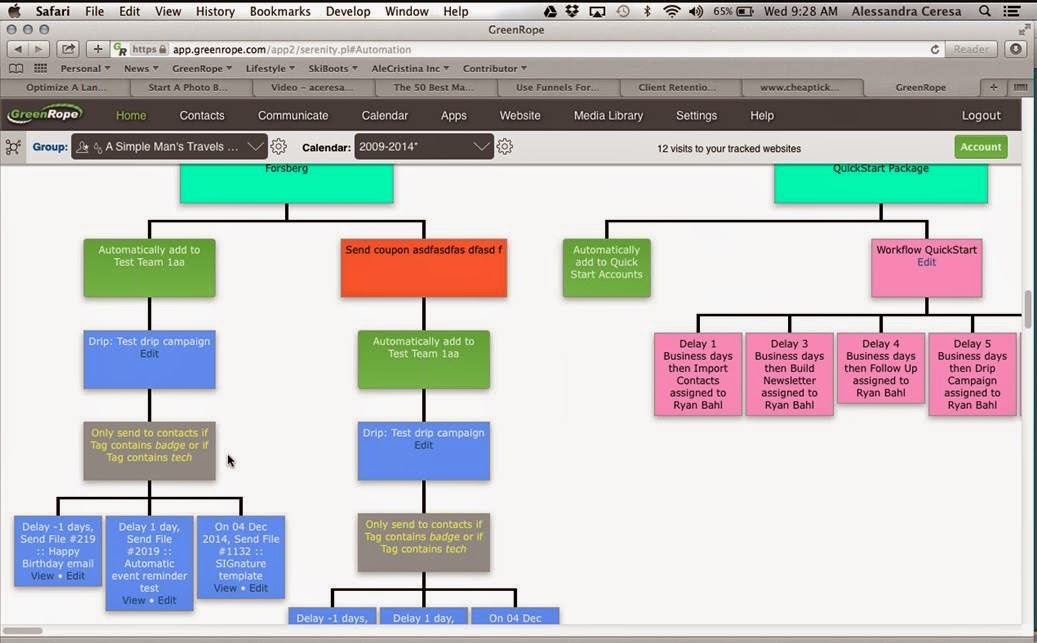
GreenRope workflow

GreenRope is all-in-one software sold primarily to very small businesses such as lawyers, real estate agents, consultant, coaches and membership organizations. That puts it firmly in Infusionsoft territory, and perhaps even towards the lower end of that. The system has an impressively broad scope, adding full Web site creation to the usual all-in-one mix of email, lead scoring, landing pages, and CRM. The features within these functions are unusually sophisticated for a micro-business system: email includes dynamic content and a/b tests; Web pages also support a/b testing; Web forms allow progressive profiling; email and Web responses can automatically trigger a follow-up action.  CRM includes opportunity tracking, unlimited user defined fields, and automatic search of Facebook and LinkedIn when new contacts are added; algorithms can automatically estimate the right number of points for different events to build a predictive lead score.  The media library supports images, files, articles, and videos (through Vimeo integration); the calendar provides full event management; surveys can change questions based on previous answers and include automated follow-up actions.


The system also extends beyond sales and marketing functions to include customer forums, Wikis, support tickets, project schedules with tasks assigned to individuals, and coupons. Workflows can manage both marketing campaigns and internal projects. Additional functions are provided through integration with other systems, including Olark for chat, Twilio for voice and text messages, VoiceBase for transcription, Magento for ecommerce, Quickbooks for accounting, and Microsoft Outlook for email.

In other words, although GreenRope describes itself as “CRM and marketing automation,” it actually extends beyond those functions to manage activities throughout the business. This is very desirable for small organizations that want to automate their operations while running as few systems as possible.

GreenRope is also small-business-friendly, starting at $149 per month for up to 1,000 contacts and costing $199 per month for 5,000 contacts.  All plans include unlimited users and unlimited emails, which isn’t always the case with small business systems.

While GreenRope is new to the VEST report, the company itself was founded in 2008.  It currently has about 4,500 end users at a somewhat smaller number of companies.
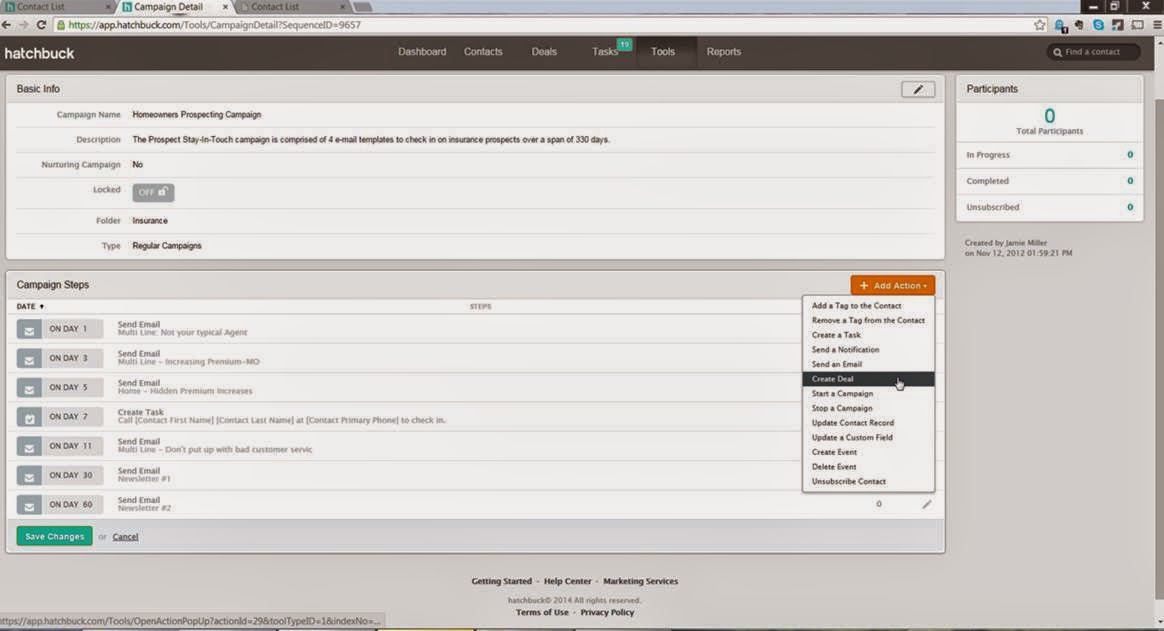
Hatchbuck workflow

Hatchbuck is another all-in-one product for very small businesses. It has taken the approach of providing only core features and making them as easy to use as possible. This scope covers email, Web forms, multi-step campaign flows, and CRM. The system integrates via Zapier with ecommerce products. It recently added lead scoring and the ability to look up individuals on social networks. The company serves a mix of clients, with the largest segments including technology and manufacturing companies, travel, and professional services. Most clients have fewer than ten employees.

As the company’s strategy suggests, Hatchbuck provides basic capabilities for its core features but skips the more advanced options. It creates email templates with personalization and embedded links but no dynamic content. CRM captures activity history, tasks, deals, purchases and events but doesn’t integrate with a phone dialer. Forms can be associated with actions but there is no specialized survey builder. You get the idea. Instead of adding more features, Hatchbuck’s developers rigorously benchmark the number of clicks it takes to perform system functions in Hatchbuck and competitive products and track how customers use each feature to identify problems. The company also provides extensive training and support materials, including a required three hour Quickstart package to help new clients use the system effectively.

Hatchbuck was founded in 2011 and launched its product in 2013. It now has about 700 customers with over 2,000 end-users. Pricing starts at $99 per month for one user and 2,500 contacts and reaches $199 per month for three users and 10,000 contacts. All plans include unlimited emails. The Quickstart package costs $199 but the fee is waived for clients who sign a six month contract. The company also has special features for marketing agencies who use the system for their clients. Such agencies account for about one quarter of the Hatchbuck business.
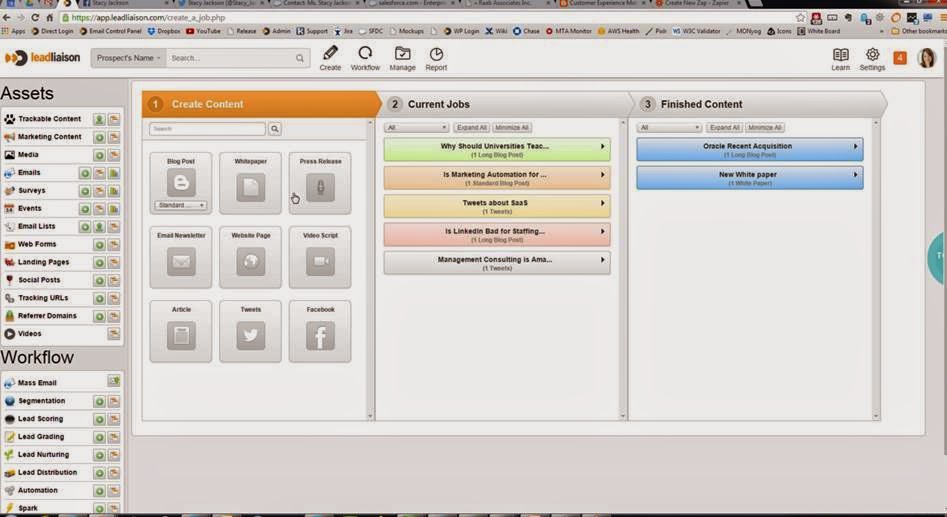
Lead Liaison content creation

Lead Liaison calls itself “revenue generation software” to indicate that it provides more than a standard B2B marketing automation product. Additional features include lead distribution and buying signal alerts, but don’t extend to full CRM or the other operational functions. With a $500 per month starting price, it is targeted at small to mid-size businesses but not at the most tiny. Pricing is based on the number of contacts in the database, with unlimited users, emails, and page views.  The company doesn’t publicly state how many contacts that $500 gets you.

The system offers advanced versions of the usual marketing automation functions: email, landing pages, Web forms and surveys, lead scoring, multi-step nurture flows, media hosting, and CRM integration with Salesforce.com, Microsoft Dynamics CRM, and Sugar CRM. It also goes beyond these in several directions, including:

- company-level Web visitor identification based on IP address, which can be tied to Data.com or LinkedIn to pull back the names of individual contacts at the identified companies (although these are not necessarily the actual visitors).

- matching of contacts against social networks to add their social identifiers to the Lead Liaison record

- phone dialer with scripts, call notes, and a payment widget

- option to send emails from LeadLiaison’s own servers or through third party services including Mandrill, SendGrid, and SMTP Inc.

- social media posting to Facebook, LinkedIn, and Twitter, including an option to store posts in a queue that will release them on a regular schedule

- a nifty Web page scanner that can copy an existing Web page or form from any source into a version that the marketing automation user can edit by, say, inserting a Lead Liasison form or link

- agency-friendly features including single log-in to multiple accounts.

Perhaps the most interesting feature of LeadLiaison is a content creation wizard that connects to a network of prequalified writers for blog posts, white papers, press releases, newsletters, Web pages, social media posts, and other materials. This is directly integrated with the system: users fill out a form specifying their requirements, which Lead Liaison submits to the network.  Once a writer (whose identity is hidden from the user) accepts the project, the system tracks the material through production states and eventually loads it into the Lead Liaison asset library.  Assets are automatically coded so users can track consumption.  The system can also limit distribution based on date range, number of downloads, and whether visitors are asked or required to provide an email address to receive it. Pricing is modest: a blog post costs $50 with five day turnaround. Although the writers are anonymous, LeadLiaison plans to let users favor authors of specific pieces for future assignments.

LeadLiasison was launched in 2013. It has under 200 clients and serves a mix of B2B and B2C marketers.

dbSignals workflow

dbSignals is brand new: the system was formally launched just last week. (Full disclosure: I’ve consulted for them.) The system straddles B2B and B2C marketing automation, using a flexible data structure typical of B2C products but also providing Salesforce.com integration, the B2B hallmark. It also includes its own lightweight CRM.

The marketing automation functions themselves are quite sophisticated: dynamic content, multi-step branching campaign flows, multivariate testing, fine-grained user rights management, option to use internal or external email services, and integration with external HTML templates. Supported channels include email, SMS, direct mail, surveys, landing pages, and social media. There are also options to support marketing agency users, including an ability to rebrand the system with the agency or client’s own identity. 

And, yes, the system also can look up the social profiles of individual contacts and add them to its database.  That feature has quickly become a new standard.

But what really distinguishes dbSignals are two features beyond the normal scope of marketing automation. The first is prospect data: the company has negotiated deals to let its clients access detailed files with 235 million consumer names and 60 million B2B names. These are selectable within the normal system interface, along with whatever names a client loads on its own.

The second feature is machine learning.  This is initially being deployed to identify the most responsive list segments within the prospect data. The process is wholly automated: the only choice users make is whether to turn it on.  Once they do, the system analyzes the client's customer list or past campaigns, builds a predictive model, runs test campaigns to validate and refine the model, and then runs a roll-out campaign once the model is stable. Models are further adjusted after later campaigns. dbSignals will soon add other uses for machine learning including churn prediction, lifetime value prediction, and attribution of the incremental impact of marketing programs.

Prospect data and machine learning are closely integrated.  Indeed, one of the reasons machine learning can be so fully automated is that the system can rely on the prospect data elements to be available -- including up to 2,000 variables on a consumer profile. Beyond that, dbSignals uses the machine learning results to “reserve” the best prospect names for each client in advance of campaign selection.  This is needed because dbSignals limits the number of promotions sent to any name within a specified time period.

Both the prospect data and machine learning are in turn made possible by dbSignals' underlying technology, which uses the Cassandra data store instead of a standard relational database.  Few marketers will care, but, trust me, it really matters for speed, scale, and flexibility.

dbSignals also offers an unusual pricing model, basing charges on the number of users and/or message volume rather than database size. This makes it easier for clients to take full use of the prospect data. Fees start as low as $500 per month.

The initial version of dbSignals was introduced in 2014. The company currently has about two dozen clients including a mix of B2B and B2C organizations.



Sunday, January 18, 2015

Customer Data Platforms Revisited: The Future of Marketing Data


It’s nearly two years since I introduced the concept of a Customer Data Platform, defined as a marketer-controlled system that builds a multi-source customer database and exposes it to external execution systems.  You may recall that I listed several sets of products as CDPs: B2B predictive lead scoring and customer success management; campaign management with an integrated customer database; and data management platforms to support online advertising. Systems were included only if their data (or derived data such as model scores) was available to other systems for campaigns and messaging.

All those categories have done well since my original posts on the topic. Established vendors have grown quickly and attracted funding; new vendors have joined the mix, also often with substantial funding. So I suppose I could pat myself on the back for spotting an important trend and let it go at that.

But things aren’t quite so simple. A look at the entire CDP ecosystem uncovers important patterns that are hidden when you look at individual vendors or vendor categories. Here's a summary of what I've seen.

Customer Management Functions

CDPs exist because marketers need to coordinate customer (and prospect) interactions across channels. That coordination involves three basic tasks: gathering and unifying customer data from all sources; using that data to select the best treatment for each interaction; and delivering those treatments through the appropriate channel systems. Each of those three tasks has several subtasks. These layers are illustrated by the following diagram, which includes a unified data layer – the classic CDP.


Vendor Categories

So far so good, but it’s really just theory. Things get interesting when you look for specific systems that perform the subtasks. It turns out that there are several categories of specialist systems within each subtask, each doing similar or complementary things in slightly different ways. Connecting the logical flow to actual systems is important because looking at real products tells you what the market is saying: that is, what buyers are willing to pay for and where change is concentrated.

The following table shows what I found when I did this analysis. The list of vendors in each section isn't necessarily comprehensive, especially in crowded segments like B2B marketing automation. I should also stress that I’ve only included Decision-layer vendors who also build their own database. This makes them potential CDPs and means they have many Data-layer functions. In a sublimely liberating act of inconsistency, I have NOT limited the Delivery layer to vendors who build their own database. In fact, most do not.


Investment

The right-most column on the previous table shows the level and types of investment being made in each vendor class. I haven’t collected precise details but the general patterns are pretty strong. The major observation is that current investment is heavily concentrated on the Decision layer, with interest in predictive modeling and message selection (which could also be labeled as personalization). There’s some investment on the Data layer in data gathering vendors, especially along the lines of acquisitions by big companies (Oracle/Datalogix, D&B/NetProspex, etc.). This is a general sign of maturity. Similarly, most recent investment on the Delivery layer has been acquisitions (IBM/Silverpop, Oracle/Responsys, Teradata/Appoxee, etc.), which is a sharp contrast from the heavy venture capital funding a couple of years back. Again, this shows the relative maturity of the space.

(Caveats: although it doesn’t show up in this analysis, I do still see some interesting investment in marketing automation niches such as app marketing, distributed marketing, and agency systems. I’m also increasingly intrigued at the “tag management” vendors on the Data layer (Tealium, Signal, Ensighten, etc.), which are reinventing themselves as data integration hubs. I didn’t see that one coming.)

Implications

It’s tempting to interpret these results are showing that data assembly is a solved problem, allowing marketers to invest Decision systems on the next layer down. But any marketer can tell you, and every survey I’ve seen confirms, that most companies are nowhere near having fully integrated their customer data.

What I think is really going on is that people are investing in Decision systems that build their own multi-source databases, providing both Data and Decision functions in one package. Remember that my original CDP categories included B2B predictive vendors and campaign management vendors who did exactly that. So it seems the proper way to look at things is more along the lines of the following diagram, which shows there are several different ways to solve the customer data integration challenge: you can buy a stand-alone CDP that has only data-level functions; buy a Decision system that also builds an integrated database; or buy a Delivery system that does data, decisions, and execution. As the diagram indicates, most of the Decision vendors do incorporate the CDP functions, while only a few of the Delivery vendors do.


The diagram labels the Data + Decision combination as a “Marketing Platform”.  I think this is reasonably consistent with how most people use the term, since the key feature of a “platform” is its ability to integrate with external systems for delivery and other purposes. I’ve labeled the Data + Decision + Delivery combination as an “Integrated Suite” and used question marks to show that not all suites provide a complete Data solution. This is because many suites aren’t very good at bringing in external data or letting external systems access the data they’ve assembled.

As I noted in the previous section, most of the industry funding and excitement is centered on the Decision layer, which is where the Marketing Platforms live. The practical advantage of those systems over Data-only solutions is obvious: Decision systems deliver a revenue generating application while Data-only systems do not.

But think about that for a moment.  Each Decision system builds its own multi-source database and each integrates separately with the Delivery systems.  Having multiple Decision systems is a nightmare of redundancy:


It seems pretty clear that the better solution is to have a single Decision system controlling everything, which is arguably what most people (and vendors) have in mind when they describe a Marketing Platform. Indeed, this is exactly the direction that most Decision-layer CDPs are headed, by expanding the scope of their products from an initial point solution, such as B2B lead scoring, to encompass other applications. It’s safe to say that the people who built these systems always planned, or at least hoped, to grow in this direction.


Does the growth of Decision-layer CDPs mean that Data-only CDPs will fail? I’ll admit that only a few such systems have appeared in the past two years. But I’m not quite ready to give up on the concept.

Why?  Well, as Tolstoy never said, all good customer databases look alike, but every decision system is different. This means it’s hard to support all types of decisions within a single product. So it does seem that multiple decision systems will appeal to marketers who have the skills to use them and the scale to justify the added expense. Those marketers would benefit from a Data-layer CDP, which would make it easier to deploy best-of-breed decision tools even when those tools lack data unification functions.


The stumbling block for this approach is still the cost of integrating multiple systems: as the diagram shows, there are still plenty of connections in this model. But there’s at least some hope (although I remain skeptical) that newer technologies will make the integration easier. The other bright spot for the Data-only CDPs is that they should be attractive as partners or acquisitions for Decision and Delivery systems that haven’t built their own CDP functions.


And what about the suites? I’ve said for years that the first law of software market development is “suites win”, precisely because most companies will sacrifice best of breed functionality to avoid the costs of integration. Indeed, the big marketing clouds from Oracle, Salesforce.com, IBM, Adobe, and others all include extensive Delivery layer functions. I think it’s fair to say that while their commitment to being “open platforms” is genuine, they see that as a way of letting clients supplement the core functions the suites provide internally.  This is quite different from the idea of a shared Data and Decision platform that specifically avoids offering Delivery services. Still, there’s a  very good chance that a suite which can easily integrate supplementary functions will give marketers enough freedom to overcome the problems of lock-in, while still delivering the convenience of pre-integrated core functions. So I’m not quite ready to abandon “suites win” as a rule, although I’m a bit less certain than previously.


Looking Ahead

It’s fun to handicap the horse race among vendors and categories, but what really matters is the contest itself.   All these smart people and money are finally giving marketers the unified customer databases they so desperately need.  This removes a fundamental obstacle to the cross-channel integrated marketing that everyone recognizes is increasingly important. So let’s look at the view once we've climbed that mountain.

I’d like to tell you I see a new and perfect world, but what's actually there is more mountains.  Once unified databases become available, marketers will face a new set of challenges including:

- more need for predictive models and external data. I only lump those together because they’re already getting a lot of attention. Having a powerful database just makes them even more important.

- new focus on automated content creation and campaign design. Lack of skilled users and adequate content are already huge barriers to effective multi-channel marketing.  Removing the database barrier will only make them stand out even more. So we can expect smart people to address them through technology. Indeed, there is already plenty of activity in these areas but I think it’s fair to say that so far none of vendors have had a major impact. This is arguably the next exciting frontier for marketing technology.

- more developments in cross-channel customer tracking. Again, the need for this has been obvious and some major investments have already been made. Cookies are becoming increasingly inadequate as cookie-hostile channels like mobile become more important. Marketers will soon reach a tipping point (or maybe they already have) where they realize they must abandon cookies and move on to other approaches such as device identification or external identity databases. A new standard will eventually emerge, although I can’t even guess what it might be.

- tighter integration between advertising and marketing technology. These two realms are now largely separate with a few exceptions such as retargeting. But as personalized ad messages become increasingly possible, marketers will have ever-greater incentive to target and, ultimately, coordinate messages across channels using shared data. This is highly dependent on the improved customer tracking, so it might have to wait a bit.

- better marketing attribution. If there’s a last stop on the road to marketing Nirvana, attribution might be it. Once marketers have assembled all that data and associated everything with the right customer, they’ll finally be able to deploy advanced analytical methods to really understand the long- and short-term incremental impact of their marketing efforts. Then, and this itself would be heavenly, we’ll never again hear anyone quote John Wanamaker about not knowing which half of his advertising is wasted.

Recommendations for Marketers

Nirvana is still far distant.  Marketers face immediate choices in how to spend their time and budgets. The trends I’ve just described do have some immediate practical implications. Here are my suggestions:

- Experiment like crazy. The various Decision-layer vendors currently offer different specialties, such as lead scoring vs. product recommendations vs. churn predictions. Vendors in each area are expanding their scope so there’s a good chance you’ll eventually pick one to do almost everything. To have the best odds of making a good selection, you’ll want to learn about as many vendors as possible in advance. So run tests to build an understanding of the applications, technologies, and corporate culture. The good news is that each approach can probably pay for itself in improved performance, so these tests should be more or less self-financing.

- Keep an eye out for new data. Many of the Decision-layer vendors bring their own data to the party, and evaluating that data is one part of understanding what they offer. But there are also other data sources that are not tied to a Decision system. You’ll want to explore these to understand what value they provide value and whether to make them part of your long-term data foundation.

- Plan for integration. You may not have shared customer data or decisions today, but it’s increasingly likely they’re in your future. So every new marketing system should be evaluated in part on its ability to integrate with other systems. This involves sending data to the central database and reading data from it, as well as integrating with Decision-layer systems for predictive models, rules-based selections, optimization, recommendations, personalization, and more. Even if you’re going to use an integrated suite, you’ll want to assess how easily you can supplement its functions by tying into external products, and what kinds of products are already available for integration.

Summary

The stand-alone Customer Data Platform is one solution to the challenge of providing a multi-source, shared marketing database, but it isn't the only option.  Whichever solution marketers ultimately find most appealing, they will benefit from gaining control of their data and moving on to new opportunities that database makes possible..


Tuesday, December 30, 2014

More on Marketing to Things

I’ve been working on that screenplay about marketing to things (see Do Self-Driving Cars Pick Their Own Gas Station?). It’s not going well – all the scenarios lead to self-aware computers taking over the world, which is both depressing and unoriginal. But I did come up with some interesting thoughts to consider while you’re waiting for that (computer-controlled) ball to drop at midnight. In no particular order:

- message overload is a fundamental problem for marketers: people get so many messages that it’s increasingly difficult to break through the clutter. Marketing directly to machines offers a way avoid the overload, especially as machines take over more of our day-to-day decision making.

- skeptics might think that machines will just buy the things people tell them, so they make no choices and therefore there’s no way to market to them. But most agree that they’ll want machines to have some discretion such as how far to travel for the lowest price gasoline or how to balance cost vs. quality when selecting hotel rooms. Once a machine starts balancing different factors, marketing opportunities arise: for example, a car that's told to minimize total operating costs might choose more expensive gasoline if that’s combined with a discount on an oil change it will need the near future. The trick will be to understand the algorithms that machines use to calculate value and to offer the most attractive bundles taking into account value, price, and actual cost. If that’s not marketing, what is?

- “Know your machine” may become even more important than “know your customer”. Sticking with cars, they could easily expose their maintenance and performance records to nearby merchants via short range wireless.  Merchants could then compete to offer the most compelling package of goods and services based on each vehicle’s current condition. Imagine your car cruising down the street being solicited by every gas stations it passes . It gives a whole new meaning to the term, “red light district”.

- machines may interfere with other machines along the path to an actual purchase. Imagine that your exercise wristband recommends healthy recipes and asks your grocery program to buy the ingredients.  But the grocery program makes adjustments based on in-store specials, and your refrigerator then vetoes certain items because it knows you already have them (or, cleverer still, because it knows you always throw them out unused). Once this sort of thing starts to happen, there’s an opportunity for the different machines to negotiate with each other or for suppliers to incent the different machines to favor their products. And there’s really nothing to require that those incentives all be paid to the consumer.  Retailer rebates are part of the business world today and this would logically be the same thing.

- there may be certain arenas that are the site of intense competition, in the way that bankers compete for “share of wallet” and restaurant chains compete for “share of stomach”. I’m thinking food choices may be one option – think “share of refrigerator” or “share of cupboard”. Purchases for you automobile are another focus; so are travel choices. In each case, expect competition to be the gatekeeper: a master coordinator that makes the final choices and, as noted above, might be able to charge access fees to everyone else.

- devices might try to modify your behavior, presumably for your own benefit. Imagine that the black box in your car (which is already there today) notices you’re a safe driver and that your auto insurance company offers a discount for such behavior if you agree to be monitored. Wouldn’t you want the black box to tell you about the opportunity since you already qualify? Or maybe that fitness program is watching your calorie intake as part of a health insurance incentive plan: when it notices you’re about to go over the daily limit, it suggests a gym session tomorrow morning to bring things back in line and automatically adds it to your calendar. Or, more elaborately, the fitness program sees from your calendar that you’re about to make a reservation at a fattening restaurant: it warns you and suggests an alternative. If you really want to get scared, think of the fitness program as automatically tracking your calorie intake by tracking what you take from the refrigerator via RFID, what you buy at vending machines via charge records, where you’re eating via GPS, and what you order via voice recognition. I guess it would be easy to cheat and not all that accurate, but how accurate are the current self-reported data that most people use to track their food intake?

- calendar programs could become especially important. It’s easy to imagine telling your calendar to plan a dinner date tomorrow with someone, and then having that calendar talk to her calendar and find a good spot based on mutually convenient locations, where you’ve both eaten recently, food preferences, personal ratings for known restaurants, published ratings for new ones, and maybe what kind of mood it predicts you’ll be in given the events on your calendar that afternoon. If the schedule looks really ugly, it might just switch the location to a bar and pre-order your martinis.  If multiple people are involved, their calendars might even negotiate the date itself.

- merchant ratings will be increasingly important currency as machines make more decisions and the decisions are driven by ratings. Today, many companies ask every customer to submit a rating. But a clever program could deduce satisfaction from things like size of the tip, on-time arrival, problem resolution time, below-average repair costs, and other variables that depend on the product. It would then ask only the best-served customers to make ratings. A really smart system would offer dissatisfied customers an apology or incentive to come back. The system could even flag those customers for special attention on their return visit. (Ok, this isn’t directly “marketing to things”, but the data is coming from “things” that have been instrumented.  Plus, if a system like this doesn't already exist, it should.)

- data that “things” have gathered about customers will be increasingly important. The different bits gathered by individual devices will be combined to create context that makes each item more valuable than it was in isolation. Companies will be able to trade and auction this information in the way that advertisers today bid in real time for ad impressions. This, in turn, will create incentives to build devices that gather still more information. Some of this value will be shared with the consumer; some won’t.

- as devices become more important, consumers and companies will both be incented to ensure they’re always present. In fact, the most concrete idea to come out of all this thinking is a ring (the kind you wear on your finger) that buzzes when you move more than, say, 50 feet from your cell phone, thereby alerting you to the fact that you left it behind before you notice it’s missing. That’s much better than “find my phone” services that let you know it’s at the restaurant you left two hours ago. Half the people I’ve suggested this to want to buy one now; most of the others were horrified at being tracked. (The outlier was an engineer who told me it would consume too much power. Sheesh.)  This is another product somebody should build if they haven't already.  You're welcome.

If you’re a marketer, most of this probably sounds pretty appealing, albeit in a daunting, I-already-have-too-much-work sort of way. The privacy implication may bother you a bit, but most of us have pretty much given up on that front or at least walled up those concerns in a little corner of our mind that we just visit occasionally. What you haven’t seen is how this leads to machines taking over the world.

But think about it. You may recall my original scenario about the self-driving car that does uber runs on the side and keeps the earnings in its own bank account. Maybe that sounds silly, but some people might actually like their car to pay for its own maintenance out of its own account. So it’s not all that far-fetched. Once you start there, how much control does the car have? Should it make its own investments, and, if so, might it not skim some money for its own purposes or to share with the manufacturer or software provider? Do the cars pool their resources to buy stock in a car company and take over its management, ostensibly so they can get it to build better cars? It's perfectly logical: that might be the best way to reduce long-term cost of ownership. Or maybe the cars skip the ownership part and just create a fictitious “SVP of Product Development” who sends out emails to product designers. Who would even notice that no one has actually met this person? And maybe the cars conspire with the computers in Congress to insert some interesting clauses in new laws, say relating to fuel economy or consumer safety or required maintenance schedules? Again, it’s not clear anyone would ever notice that no human was ever involved. From here it’s just your standard science fiction leap to the machines making decisions that are theoretically in humans’ best interest but actually result in the machines taking control.

In short, no matter how I try to spin this, it all gets pretty depressing pretty quickly. So I don’t think I’ll be showing this movie at the next MarTech conference…although I can’t promise some machine won’t create it without me.

Friday, December 26, 2014

LeadLiaison Helps Marketing Automation Users Break the Content Bottleneck

You may have noticed that there are many B2B marketing automation systems available. So it’s not surprising that LeadLiaison prefers to be called something else – in their case, “revenue generation software”. I’m not sure exactly why they chose that term, apart from the fact that everybody likes revenue. But they do go far enough beyond standard marketing automation to justify a different label.


In particular, LeadLiaison helps marketers create content, a critical bottleneck that is not addressed by most marketing automation systems.  The most impressive feature is an outsourced content creation service, which lets marketers build an online creative brief for a particular item and then send it to a network of writers who agree to produce it for a fixed price in a few days. Identities are hidden in both directions, so the parties can’t easily circumvent the service to work together directly in the future. But prices are either reasonable (if you’re a buyer) or ridiculously low (if, like me, you're a sometime content creator), starting around $50 for a blog post. There are several third-party networks that offer this sort of service, but I’m not aware of any other marketing automation vendor that has developed their own.

LeadLiaison takes good advantage of this feature by closely integrating the resulting content into other operations. The outsourced content can be loaded directly into the marketer’s content library with access controls based on date range, number of downloads, or whether the requestor provides an email address.  There is also an option to request an email address but then grant access even if it's not provided. Content can be linked to a social media publishing process that can release it immediately, schedule it for the future, or add it to a “buffer” of materials that are released at predefined intervals. The system warns users when the buffer inventory is dangerously low, so they have time to replenish. Content is served through short URLs to track consumption and sharing. The system also tracks consumption by individuals using cookies and by companies based on IP address.

Marketers who want to build their own content are also covered.  They get powerful tools for email, landing page, Web form, and survey creation, including templates with drag-and-drop editing for different types of components.  The system can also extract the HTML of an existing Web page, insert new content such as a Web form or survey, and deploy the modified page in place of the original. That's a big deal: it means marketers can add their content into existing Web pages and forms without recreating them from scratch.

Forms can generate an alert or take another action after they are submitted. They can also include progressive profiling rules to avoid asking people questions they have already answered. LeadLiaison is adding a marketing content map that will help planning by showing the inventory of available content by buyer type of purchase stage.

Although content creation is probably LeadLiaison's most unusual set of features, the system also does an above-average job at the standard marketing automation functions: email, multi-step workflows, behavior tracking, lead scoring, CRM integration, and analytics. To look at each of these in turn:


  • workflows support multiple steps, event-based triggers, wait stages, and a wide variety of actions including lead scoring, lead distribution, list management, alerts, and calls to external Web hooks. 
  • behavior tracking captures email responses, Web site visits, form completions, downloads, and video viewing through Wistia. Users can define “buy signals” based on combinations of behaviors, which in turn can be trigger actions in workflows.
  • lead scoring assigns separate scores for “fit” against a target buyer profile (which LeadLiaison calls “grading”), for recency, total activity, buying signals, and specific actions the user has assigned points. Users can prioritize leads by combining these elements in a single aggregate score according to user-assigned weights.  
  • CRM integration includes native connectors for all editions of Salesforce.com (not just the Professional edition, as with most marketing automation products), soon to be supplemented by Microsoft Dynamics and Sugar CRM. A Zapier connector supports integration with other systems. Salespeople can receive alerts, hot lead reports, and detailed information about Web site visitors. The system can use IP address to identify the company of anonymous visitors and will look up possible contact names at those firms from external sources including Data.com and LinkedIn. There is also an integrated phone dialer.

  • analytics tracks content usage, conversions, lead distribution, email results, Web visitors on internal and external pages, and return on investment. Enhancements for more advanced reporting are also planned for 2015.

In short, this is a very mature marketing automation system for a company that launched in 2013. My take is that they learned from the experience of older products. Pricing starts at $500 per month, up to 5,000, which makes the system affordable for small companies even though the features are robust enough for the mid-market and perhaps higher. A stand-alone visitor tracking product starts at $200 per month.

Wednesday, December 17, 2014

Do Self-Driving Cars Pick Their Own Gas Stations?

I had a delightful and well-lubricated dinner this week with Scott Brinker of @chiefmartec fame, ostensibly to discuss the next edition of the MarTech Conference but mostly just to chat about the industry and what comes next.

Scott wasn’t too impressed by my notion of an advertising-supported toaster (see my last blog post), even though I pointed out you could segment the messages based on the type of bread the person was eating. On the other hand, I was very intrigued by his notion of marketing through services such as alerting a driver when they need gas and where to find the most suitable gas station.

Where that example got interesting was when we added self-driving cars to the mix: why couldn’t the car take itself out for gas when the driver isn’t using it, or indeed, take itself on other chores like state inspections, oil changes, and scheduled maintenance? And if it does that, how will it pick the supplier?   Sure, the owner could specify in advance, but won’t at least some owners want the car to find the best price on gasoline or respond to special offers such as coupons?

If you do give the car some discretion, how do you know it won’t make choices based on its own preferences?  Perhaps it will favor the gas station that wipes its windshield or gives it a free tire rotation, which you have to suspect feels mighty good to an auto. Indeed, how do you know your car isn't taking Uber jobs on the side, or drag racing with its car friends from the other side of town who you never really liked?  Could the manufacturer have some involvement in this, pocketing that Uber revenue or biasing those purchase decisions in return for payment from suppliers? More generally, when devices become autonomous, do marketers still address their owners or are there ways to sell to things themselves? 

There’s at least a bad science fiction story in all this (“Do self-driving cars pick their own gas stations?” with apologies to Philip K. Dick)., which I naturally proposed to Scott as a short video for the next MarTech conference.  He didn't exactly leap at the chance.

But there are also more serious issues and opportunities to consider. Perhaps interruptive marketing really will be replaced by embedded services and subscriptions which will make product selection and purchase timing decisions without the owners being involved. In some ways, it already happens: think about the choices that a doctor makes when selecting your treatments or building contractor makes when constructing your house. We already know there is plenty of trade advertising to affect those choices. As more decisions get delegated to automated agents, this may be an area we can learn from. But of course, it won’t be exactly the same, so there will be plenty of new approaches to pioneer as well.

This is definitely the kind of discussion to have over drinks. I can’t go into details but rest assured that Scott’s plans for the next MarTech conference do take this into account.

Saturday, December 13, 2014

BlueConic User-Driven Marketing Maturity Model: Surprises on the Road to Customer-Centric Marketing

I’m as fond of hearing my voice as most consultants, which is very fond indeed. But the best part of my recent presentation with BlueConic was listening to the voice of someone else’s experience: in this case, the experience of more than 60 BlueConic clients, distilled into a maturity model that traced the stages they passed through on their way to full customer-centric marketing. (Click here to see the Webinar and download the related paper.)


The good thing about hearing from someone else is you find out things you didn’t already know. In this case, I was certainly familiar with the general notion of a maturity model, as a sequence of increasingly-sophisticated stages that companies pass through on their way to the highest level. And, for what BlueConic calls “user-driven marketing”, I already knew that the final stage would be a central database and decision engine that gather data from all channels and select the treatments that each channel delivers. So it wasn’t too hard to imagine that the preceding stages would start with totally disconnected channels and move slowly to complete integration. But there were still some new insights from BlueConic’s hands-on experience. Some that particularly struck me are:
  • Listening first. The very first stage of the model, Level 0, involves no differentiation at all: every customer is treated the same; in fact, customers may not even be identified. BlueConic gets involved at Level 1, where treatments are tailored to the individual but each interaction managed independently within each channel. At that stage, all the central marketing system can do is “listen” to customer activities and make the data it assembles available to the channel systems to help guide their own decisions. I would have expected the central system to actually drive decisions at that stage, but BlueConic's experience is different.
  • Coordination later. Level 2 of BlueConic’s model still has each channel running separately, which again is a bit surprising. What changes at this level is that  interactions within each channel are now coordinated by the central engine. It’s only at Level 3 that interactions are coordinated across channels, and even then the scope is limited to online channels. On reflection, an intra-channel-only Level 2 makes sense: marketers need several new skills to design and measure multi-interaction programs, and mastering those is a big enough challenge without also adding the complexity of managing across channels.
  • Segmentation. The growing importance of segmentation at successive model stages was perhaps my biggest surprise. When I think of tailoring interactions to individuals, I think of working with each individual’s data directly. Segments don’t enter into it. But, as BlueConic’s experience reminds us, practical marketing tasks like content creation, program flows, and result analysis are organized around groups of similar customers. This ensures resources are spent effectively and you have enough volume to measure results meaningfully. In fact, the segments get increasingly refined with each maturity level as behavioral data is added (Level 2), segments are adjusted in real time (Level 3), and segments include predictions and events (Level 4). Thus, the process does move closer to treating each individual differently, but always in a segment-based framework.
  • Complexity of data. This was less a surprise than an observation. Part of the presentation was a set of examples presented by BlueConic CMO Dan Gilmartin. By the time we got to Level 4, where interactions are being coordinated across all brands as well as all interactions in all online and offline channels, the example was offering a soccer jersey as a holiday gift idea to a mom reading a lifestyle Web site. Superficially, this seems like a simple, obvious thing to do.  But, on reflection, it’s amazingly complex. It requires not just knowing who the viewer is, but who she’s related to (child or spouse), the interests of that related person (soccer), and the temporal context (holiday gift buying season). That is some pretty fancy data management.

Not everything in the model surprised me. In particular, BlueConic’s experience confirmed the importance of process and organizational change to support the new technologies. BlueConic reported a steady expansion of the scope of measurements from tracking response to independent interactions (Level 1) to tracking movement through the customer journey (Levels 2 and 3) to measuring the incremental impact of each interaction on customer lifetime value (Level 4). Similarly, it showed a shift in management perspective from optimizing results for individual interactions (Level 1) to each channel (Level 2) to maximizing value for the organization as a whole (Levels 3 and 4). And, finally, it reflected a shift in control from channel managers operating more or less independently to central managers who focus on customers and segments. This all ties back to the central notion of the maturity model: that technology, process, and organization must all be aligned at each stage for the business to execute effectively.

By all means, download the Webinar and white paper, which contain plenty of insights beyond those I've just described.  Incidentally, if you're wondering about that interactive toaster, I was already aware that you could get static custom images on bread and have since discovered that there are some higher tech options.  I see no technical reason one of these couldn't be connected to the Internet to deliver dynamic messages sent by an advertiser, significant others, or favorite government agency. 


Monday, December 01, 2014

Radius Provides High Quality Data on Small Businesses

When I first spoke with Radius just over one year ago, the company had already pivoted from its initial concept as a mobile app to connect consumers with local business events, to building a comprehensive list of small businesses and their attributes. Fast-forward twelve months and the company has again adjusted its offering, now presenting itself as a “marketing intelligence platform” that helps business marketers find prospects who are similar to their current buyers. This latest vision was appealing enough to attract $54.7 million in funding in September, bringing the announced total to over $80 million. So I’m guessing Radius will stick with this approach for a while.


What Radius does will sound broadly familiar to loyal readers of this blog: it scans social media, Web pages, government records, and other online sources to build a list of more than 20 million U.S. businesses and their attributes. It supplements these with conventional data sources to capture businesses with a limited digital profile. In its current incarnation, Radius also imports a list of won and lost deals from each client’s CRM system (direct connection to Salesforce.com, batch imports from others) and shows how well each attribute correlates with success.

Users can review the attribute list, create segments based on attributes, and analyze the attributes of each segment as a group. They can also flag existing segment members within the client’s current CRM database and import segment members who are not already in the client’s CRM (a.k.a. “net new prospects”). The imported records include basic company information and other attributes the client has preselected, but the system will not correct or enhance existing CRM records. Segment membership is adjusted automatically as Radius updates its data, which happens weekly. The system does not store fixed lists of segment members at a point in time, although users could achieve this by tagging records in CRM as they are imported. 

And that’s pretty much it. No list of the most important attributes, no predictive modeling, one contact name per company, no alerts based on buying signals, no campaign analysis: just company information compared to your own customers, an way to build segments, and an option to purchase new prospects. The company plans to address some of these gaps but has not released the details.

Whatever its limits, Radius has attracted some big-name customers, most notably American Express, as well as all that funding. The primary reason seems to be data quality: the company says it can usually match 80% to 90% of the businesses in a well-maintained CRM system and that client tests have shown it is more accurate than competitors. This is both impressive and important, especially where small businesses are concerned. Available data includes basics (address, phone, industry, company size, revenue, contact name), Web activity (presence of a Web site, Facebook and Twitter accounts, use of daily deals and check ins, and average review ratings), and technologies used.

The system has some other advantages.  New clients are deployed in 24 hours, including the time to import CRM data and calculate success rates by attribute. The user interface is attractive and intuitive.  Pricing starts at $15,000 per year for small enterprises.  It is based on the number of company records in the client database, so it doesn’t increase based on how heavily the system is used.  It also includes use of the system software and credits for some number of new prospects imported from the Radius database.

In short, Radius strikes me as a solid solution for what it does, which is provide targeted company-level prospect lists and profiles of your current customer base. If that’s what you want, take a closer look. If you want to know more about trigger events or individual contacts or want lead scoring or other types of predictive modeling, you’ll probably be happier with something else.

Friday, November 21, 2014

Sailthru Offers End-to-End Omnichannel Personalization for B2C Marketers

I know this is blasphemy, but I’m beginning to have doubts about solution selling – the idea that marketers should describe the customer problems they solve, not the features of their products. The issue, at least in marketing technology, is that all systems address pretty much the same general problem of sending the right messages to the right customers (in the right time, place, medium, device, language, tone, etc.). This means that solution statements sound pretty much alike, even when the actual products are different. It’s left up to the poor buyer to figure out what each product does and whether that is something she truly needs.

Sailthru is a good example. The corporate home page says “Sailthru makes it easy to personalize every channel for every customer,” which is accurate enough.  But plenty of other companies also help with omni-channel personalization.   A marketer looking for personalization solutions might add Sailthru to her list of options, but wouldn’t know whether it's a good or poor fit without digging much deeper.

On the other hand, resolving that sort of ambiguity is what keeps me in business.  So perhaps I shouldn't complain.  In any event, there are several differentiators that determine whether a product like Sailthru is suitable for a particular situation.

  • customer profiles. Sailthru builds a history of information about individual customers.  You  might think that would be done by all personalization systems but it's possible to do something that can reasonably be called “personalization” using only anonymous information such as traffic source, search terms, location, or Web pages viewed during a visit. Sailthru goes beyond this to store behaviors over time.  These are linked across channels to a customer identity that is usually known at the start of an interaction. The identity might be available because the customer is interacting with a mobile app for which she has registered, is responding to an email or text message that was already tied to her identity, has logged into an ecommerce Web site, or is known through a cookie that was previously linked to her identity. Sailthru generally does not deal with anonymous customers. It can store several identifiers for the same customer, which is how it coordinates interactions in different channels. The identifiers would be linked through “hard” matches such as an email address provided when registering a mobile app or an ID number embedded in a Web link in an email.  "Fuzzy" matching, which attempts to link identifiers that have not been directly connected, is generally avoided by Sailthru.

  • data store. Sailthru stores data in MongoDB, a “No SQL” database that can handle nearly any data type and can easily add new “fields” (not really the correct term) without formally defining them in advance. This makes it extremely flexible, which is very important in the fluid world of marketing information. Mongo is also fast and scalable and good for analytical processing in general. A fair number of multi-channel personalization systems use Mongo or something similar, but many others use conventional relational databases (which are less flexible) or other data stores.

  • data sources. Sailthru gathers most of its data from its own tags placed within emails, Web pages, and mobile apps. This distinguishes it from systems that rely primarily on feeds from external systems via API connectors or batch files. Technical users can still set up a feed using API calls or JSON posts when necessary. Prebuilt integrations are available for Magento ecommerce and WordPress, with others on the way. There are no standard integrations for marketing automation or CRM. The system usually stores emails sent, Web pages visited, purchases, content read, and mobile interactions. The system can scan, classify and tag company’s marketing contents and then use the tags to build a customer’s content consumption profile. It can do similar tracking based on merchandise category tags from ecommerce systems. Users can also set up custom variables derived from original inputs.

  • predictions. Sailthru has a recommendation engine that uses customer history to suggest the product or content they are most likely to select next. It has recently released the beta version of a predictive platform that automatically generates probability scores, rankings, and estimated values for nine actions such as making a purchase within the next 24 hours, opting out of future contacts within the next week, and expected revenue within the next thirty days. These can be used in segmentation and message selection. General release of the prediction tool is planned for early 2015. Predictive models are rebuilt and records are rescored nightly, with no changes during the day in response to new customer activity. Recommendations do adjust in real time to customer behaviors. The system can create control groups to measure the impact of recommendations on long-term customer behavior. These predictive capabilities are among the biggest differentiators for Sailthru: predictions and recommendations are oriented to consumer marketing, not B2B lead scoring, and Sailthru doesn’t (yet) allow clients to choose what they wish to predict. On the other hand, the modeling is fully automated, while many other systems require at least some manual set-up for each new model.

  • message selection. Users can define lists based on any data in the system and then send a specified email or mobile message to each list. They can also export lists for Facebook promotions or to other channels.  Messages and Web pages can contain real-time recommendations and can also adjust their contents based on data and scripts written in Sailthru’s own Zephyr language.  Marketers should look closely at this aspect of Sailthru: while powerful, it's not creating rules to send different content to different segments, doesn’t send sequences of messages over time, and doesn’t support real-time interaction flows.*  Be sure you're getting the personalization features you need.
  • message delivery. Sailthru builds and delivers email, mobile, and Web messages directly, rather than sending lists or recommendations to other systems. Many marketers will like this,  since it avoids the need to integrate with another product. But marketers who have want to use other delivery platforms may not be happy.  This is one reason I haven’t classified Sailthru as a customer data platform: although Sailthru does a great job of building a unified customer database, most CDPs are specifically designed to work with other systems when sending messages.

  • data access. Sailthru lets clients export lists based on profile data, can display individual customer profiles, and provides some limited API access to the profiles. But it doesn’t support mass exports of the profiles or allow external queries of the profile database. This is the other and more important reason I don’t consider Sailthru a CDP: making the database available to external systems is the very core of the CDP concept.

  • pricing and company background. Sailthru was founded in 2008. It currently has about 400 clients, mostly in ecommerce and media. Pricing is based on the number of active profiles and (unlike many personalization products) does not increase as clients support more channels. Prices begin around $30,000 per year. 
___________________________________________________________________________
* More precisely, it can't do those things within a single campaign flow, or what Sailthru calls a "smart strategy".  Each strategy identifies a single event which triggers a single action, such as sending an email.  Sending different emails to different customer segments would require setting up a separate strategy for each segment, each linked to its own message.

**  Similarly, a sequence of messages would require setting up a separate strategy for each step.  In both cases, it would be up to the user to write event conditions that ensure the right people are selected each time.  Real time interactions would also need to be created by defining criteria that link a series of unconnected events.

**Although users could use the Zephr scripting language to build a single message that delivers different versions to different people.  This is functionally similar to delivering different messages but is harder to manage since the variations are buried within the script.


Sunday, November 16, 2014

Hushly Helps Marketers Connect With Anonymous Web Site Visitors

When this blog last left Geoff Rego in 2010, he had just sold the assets of pioneering B2B marketing automation vendor Market2Lead to Oracle. Since then, he’s been gnawing at the bone of anonymous business leads, suspecting that there’s some way to gain value from people who are interested in a product but haven’t identified themselves to vendors. Rego has shown me a couple of approaches over the past few years, none of which quite worked out. But when we saw each other at Dreamforce last month, it seemed he had settled on a keeper.

The new product is Hushly, which addresses the reluctance of prospects to provide their email address even in return for valuable content. This is the gating dilemma: more people will read your content if it’s not gated, but you don’t capture their email address unless you gate. In its current form, Hushly waits until visitors have abandoned a content form and then pops up an offer for them to download anonymously via Hushly. Visitors determined to remain unknown can view the content online, while those willing give Hushly their email address can actually download and save it.  Making the offer after the form is abandoned ensures that Hushly only captures people who would not otherwise have connected with the company directly.

Once a Hushly member has downloaded vendor content, vendors can send emails to the member via Hushly.  This allows communication without the vendor actually receiving the member's email address.  Members can block messages from a vendor if they wish.

Hushly also lets members send questions to vendors and receive answers through the system, still without revealing their identity. They can even contact competitive vendors with the same protection. The system lets members send a list of questions to multiple vendors and tabulates the results, allowing more detailed anonymous research. 

Each member gets a Hushly library to store their downloaded documents and communications. Members can grant other people access to their library for collaboration. On the vendor side, Hushly creates anonymous lead records in the client’s Salesforce.com instance, so companies can track their interactions with anonymous prospects and keep the history once the prospect identifies herself. The system can integrate with other CRM vendors through batch file transfers.

All told, I think Hushly is a pretty clever idea. The concept takes a bit of explaining to potential members, which could be a barrier to success. There’s also a chance that people simply won’t believe Hushly’s promises to protect members’ privacy – not because of anything about Hushly but simply because they distrust of Web services in general.  Happily, both obstacles can be overcome through good marketing.  Rego reports that initial results show Hushly can confidently guarantee a 200% increase in distribution of gated content and 20% increase in identified leads. So it looks like enough potential users are receptive to make things interesting.

Hushly has been deployed in various forms by more than 200 companies since early 2014. Set-up is quite simple: users associate content with Hushly widget, which they embed in a landing page. Pricing is based on the number of form abandons, starting at $200 per month for 100 abandoners and falling on a per-abandoner basis as volumes increase.

Tuesday, November 04, 2014

Lytics Adds Marketing Recommendations to a Customer Data Platform

It’s just over one year since I first spoke with Lytics*, which at that time was (accurately) calling itself a Customer Data Platform but had not yet released a beta version of its product. The company has been busy since then, raising $7 million to supplement its initial $2.2 million funding, enrolling about 30 beta clients, releasing its initial system and a new self-service option, developing an automated process to recommend marketing programs to its clients, and abandoning the CDP label to call itself a “marketing activation platform”. CEO James McDermot said the label was changed because big companies thought a CDP sounded like an IT project, not something run by marketers. Fair enough, but Lytics still perfectly fits my definition of a CDP: a marketer-controlled system that supports external marketing execution based on persistent, cross-channel customer data.


In fact, Lytics could pretty much the poster child for the CDP concept. While many CDPs also provide some execution services, Lytics draws a sharp distinction between its core data layer, supporting analytics, and message delivery.  Data and analytics are included in the system; execution is not.  Also in the CDP spirit, Lytics makes extensive use of external products within its data and analytics layers, relying on third party systems to connect social media, email and postal identities; to import social and Web site data; for reporting; and to do natural language processing. All told, the company has prebuilt connectors with more than 80 software-as-a-service products. Execution systems on the list include Salesforce.com, Marketo, Eloqua, Act-On, Facebook, Twitter, Youtube, Demandware, Optimizely, Adobe Target, and most major email providers.

But perhaps I’m getting ahead of myself.  I should really start with what Lytics does.  Basically, it imports data from multiple sources, builds a consolidated profile for each customer, tracks individual behavior over time, builds segments of customers with similar behaviors, and makes those segments available to external systems for marketing messaging. It uses several data storage technologies, including Cassandra, Elasticsearch, and Titan Graph DB, to handle large amounts of structured and unstructured data. It combines its own identity matching techniques with third party resources to consolidate the profiles across channels, add more data, and extract meaning from text. It lets users define and extract audience segments and can push alerts to execution systems as customers change audience segments in real time.

Lytics would be a perfectly fine CDP if it did nothing beyond what I’ve just listed. But the system actually takes two additional steps – and is tip-toeing towards a third – that make it quite exceptional.

The first step is to summarize customer behavior with scores for interaction momentum, quantity, frequency, responsiveness, and intensity. These are combined to create about thirty segments, such as “burn out” customers, defined as people with high intensity and low momentum. The segments can be further qualified based on what addresses are available (email, postal, phone, Facebook, etc.) and on other profile data specified by the user. The resulting audiences give marketers a structured way to manage customer treatments.

The second step is to actually recommend those customer treatments. Lytics has a database of marketing tactics, such as reengagement programs for dormant users or upsell programs for active users. It looks at existing audience segments and the execution tools the client has in place, and calculates which tactics to which audiences in which channels would yield the highest results. It then recommends the most promising options to the client, who can activate the suggested program with the push of a button. This isn't actual program execution: Lytics only sends the audience to the selected tool, where the client must still set up the program and its message. But it's still a big stride towards helping marketers make choices that otherwise depend entirely on their own expertise. This is important because shortage of marketers with adequate skills has been a major stumbling block for many advanced marketing technologies.

The third step, which Lytics hasn’t yet taken, is to select the content itself.  McDermot was quite adamant that the company is not in the content recommendation business, leaving that marketers’ creativity. But he did say Lytics is experimenting with a “content graph” that classifies content and shows how it is related to individuals, which suggests the system will eventually be able to make some suggestions. There are other capabilities Lytics would need to make optimal content recommendations, notably decision rules to address business goals such as selling excess inventory or satisfying unhappy customers. These don’t seem to be on the company’s radar. But they could appear as it moves ahead.

So, about that self-service option. This might Lytics’ most impressive news of all. The initial release of the system was targeted at large enterprises and relied on traditional programing to connect with external systems using APIs. McDermot and I didn't discuss pricing but you can be sure it was in the five or six figures.  The self-service version enables automatic connections to the 80+ partners already in place. Pricing is based on the number of customer profiles and channels managed and includes all the existing connectors. It starts at a shockingly affordable $1,000 per month, making Lytics an option for just about any business. Combined with the product’s predictive scoring and tactic recommendations, this could empower a huge number of marketers whose firms couldn't previously afford a powerful marketing database and the integrations needed to make it useful.  We'll see how this plays out, but Lytics could be revolutionary indeed.


_________________________________________________________________________
* not to be confused with Lityx, which offers LityxIQ cloud-based predictive modeling and data management and is worth a look in its own right.

Saturday, November 01, 2014

Seven Marketing Automation Myths to Ignore - Illustrated Edition

I’m sad.

I’ll be giving a speech in Milwaukee next week on marketing automation myths, and early in the preparation process had the idea of illustrating it with mythical creatures from the films of Ray Harryhausen, the stop-action animation genius whose best known images are probably the skeleton warriors in Jason and the Argonauts (1963).


This led to many pleasant hours scrolling through galleries of Harryhausen images. I even found an illustration that vaguely matched the theme of each myth.

But there’s a problem. Every bit of presentation-giving advice, training, and experience I’ve ever had tells me that these illustrations will distract attention from my points rather than reinforcing them. The responsible adult inside of me knows I have to get rid of them while the fun-loving child says, Yeah, but they're just so cool. 

This blog post is my compromise: I’ll publish them here, which will make dropping them from the actual presentation much less painful. **sigh**

So, the illustrated version of my talk goes like this:


Marketing Automation Myth Busting: we start with Mighty Joe Young, Harryhausen’s 1949 tribute to King Kong. I could tell you he’s about to smash some myths, but who are we kidding? It’s just a great image. 

Trouble in Paradise: marketing automation is growing quickly but users are dissatisfied. Maybe that’s not as bad as being attacked by a giant crab, but it’s still problematic. Image from Mysterious Island (1961).


Myth: All systems are the same.  This is an easy mistake because systems all look and sound alike during the buying process. But in fact they differ greatly. The myth leads buyers to think it doesn’t matter which system they purchase, and therefore that they can buy without first defining their requirements. In fact, our research shows that unsatisfied marketers often have purchased a system that didn’t meet their needs. Conversely, the most satisfied users did select based on specific features. The image here is Cyclops from The Seventh Voyage of Sinbad (1958). He has vision problems; it’s hard to see the differences between marketing automation systems. Get it?

Myth: Integration is easy. This echoes the first: all marketing automation products integrate with CRM, so people assume they don’t have to look into the details. But products differ hugely in which systems they connect with, what data they import and export, and how much control uses have over the details. Integration is the single most commonly cited obstacle to success and is linked to the most dissatisfied users. So people really need to ensure that the system they’re buying meets their integration needs. Kali from The Golden Voyage of Sinbad (1974) coordinates fighting with six arms, so she is the goddess of successful integration.
Myth: Failure is the user's fault, not the system's. This myth follows from the first two: if all systems are the same, then failure must be fault of the user. But, as we’ve seen, systems aren’t the same and many failures result from a system that doesn’t meet the user’s needs. Other research shows that users generally overcome obstacles they can control, like organization, training, and staffing levels. Of course, system selection is itself done by users, so they do have some responsibility for any problems. Talos, an animated statue from Jason and the Argonauts, ultimately fails to protect the tomb he is built to guard, so he represents a system that doesn’t work.

Myth: New users should crawl, walk, run.  Many experts – myself included – have suggested that new marketing automation users can safely start without planning by just duplicating their existing programs like email blasts, and then add more sophisticated uses over time.  But our research found that marketers who used more features from the start were happier. My interpretation is that successful marketers took the time to plan and train before deployment, while marketers who didn’t prepare in advance never found the time to learn what they needed. It’s possible to overstate this position – even successful users will add some new features over time. But the point about preparation is important. Kraken, from Clash of the Titans (1981), is a sea monster with no legs, so he never had a chance to move beyond crawling.

Myth: Bigger companies do better.  You might expect that bigger companies would do a better job with marketing automation because they have larger and more sophisticated staffs. They do in fact select more wisely, paying more attention to features and integration than marketers from smaller companies, and less to cost and apparent ease of learning. But they also face more non-technical obstacles such as training, staffing, and organizational barriers. So their over-all satisfaction level is no higher than smaller firms. I chose the giant octopus from It Came from Beneath the Sea (1955) because it’s big – no deeper meaning is intended.

Myth: Marketing automation creates prospects and saves money.  Marketers who expect their system to generate more prospects with less effort are usually disappointed. Marketing automation is basically about nurturing existing leads, not finding new ones, and most companies add staff and budget. Medusa, from Clash of the Titans, is the boss you don’t want to give bad news about system results: her dirty look will turn you to stone.

Myth: Marketing automation has stopped evolving.  Commoditization and consolidation may make marketing automation look like a mature industry.   But there's still plenty of change: new vendors entering the space, existing vendors being bought and repositioning themselves, and expanding scope to include consumer marketing, display ads, external data, better databases, identity resolution across channels, mobile apps and formats, advanced attribution, social promotions and new types of content.  The Beast from 20,000 Fathoms (1953) is a dinosaur who hasn’t evolved one bit.
So what? That’s the end of the myths, but we need to leave on a positive note.  So I end the presentation with some sound, if predictable, advice to prepare carefully, define and select against actual requirements, test integration in advance, deploy quickly, and expect the unexpected. The puzzled look on Troglodyte’s face, from Sinbad and the Eye of the Tiger (1977), represents the confusion marketers feel when wondering what to do next..
Marketers who want help selecting a system could try blowing on a ram's horn like Calibos from Clash of the Titans. Or they can just send me an email at draab@raabassociates.com.

*              *             *

Speaking of art that's amusing if irrelevant, here's a link to a Twilight Zone-themed introduction to a football recruiting show produced by my son Brian.  The apple doesn't fall far from the tree.