The InterWebs were buzzing this morning with an Atlanta Business Chronicle article reporting that IBM is negotiating to buy Silverpop. My only reaction was, What the heck took so long? The other enterprise-level B2C email vendors (ExactTarget, Responsys) have already been bought at wondrously high prices, and every B2B marketing automation vendor I talk to tells me that potential investors are approaching them constantly. So it was a totally safe bet that Silverpop was fielding many offers as well. With $50 million in funding, most of it provided years ago, it was an equally safe bet that Silverpop had some investors eager to cash out.
IBM as an acquirer also makes perfect sense. Although they bought B2C marketing automation leader Unica several years ago, they lack enterprise-scale B2C email engine and B2B marketing automation. This makes Silverpop a perfect fit.
The only surprise in this deal is the price, rumored to be about $270 million or 3x revenue. ExactTarget and Responsys both sold for 6-7x revenue and I would have expected Silverpop to yield something similar. The company has always been very tight with financial information, although client and employee counts they’ve provided for our VEST report suggest recent growth rates of 20% to 30% per year, which considerably lags the industry as a whole. We don’t know anything about profitability, but I’d guess they run close to break even, since they haven’t announced any new investment recently and the slow growth rate would reduce the need for capital. In general, the market seems to reward growth over profitability, so these results may depress their price somewhat.
The company’s mix of B2B and B2C clients may also confuse potential buyers and drive down the price a bit. Plus, there just aren’t that many enterprise software companies who still need what Silverpop is offering: Oracle and Salesforce.com have already made their purchases, Adobe is part of the way there with Neolane, and SAS and Teradata have their own tools and are probably less interested in B2B because most buyers are small or mid-size firms. SAP might be a potential buyer but hasn’t really shown an interest and just announced a deal to resell Adobe’s marketing suite. You could make an interesting case for Marketo as a buyer – to gain market share and some good technology, while leveraging a stock valued at more than 10x revenue – but that doesn’t seem to be part of their strategy.
So we’ll see. I wouldn’t be surprised if someone else offered Silverpop a higher price, but it’s not obvious who that would be. And if the IBM deal goes through, Silverpop will fit nicely into its new home.
Wednesday, March 26, 2014


Wednesday, March 19, 2014
IgnitionOne Buys Knotice, Prompting Many Deep Thoughts

The only gaps shared by both systems are B2B clients and Web scanning for customer data, which is also mostly a B2B application. This further highlights the shift in industry acquisitions to B2C marketing technologies in general (ExactTarget/Salesforce, Responsys/Oracle, Neoalane/Adobe) and in audience data management platforms (BlueKai/Oracle, Aggregate Knowledge/Neustar) in particular.

These deals also reflect some other trends beyond acquisitions. One is the expansion of email vendors into broader multi-channel marketing. ExactTarget, Responsys, and Neolane all did this before they were acquired. StrongView (formerly StrongMail) and SmartFocus (formerly eMailVision) are making similar moves. SiteCore and SDL are moving in similar directions from a base in Web content management.
The second trend is a move by data-owning companies towards execution systems. Neustar, whose core business is linking people to phone numbers, is one example: it recently introduced “PlatformOne”, which it describes as a “centralized marketing solution” that gives marketers “a complete, real-time portrait of their customers and prospects based on accurate data, enabling a personalized dialogue across all marketing channels.”
V12 Group, another major data compiler, offers “Launchpad”, which “allows organizations of all sizes to build new audiences and manage existing customers using multiple channels and tools on a single platform.” Infogroup (which for some reason refuses to speak with me directly) in January announced “Yes Lifecycle Marketing” combining “email and digital marketing services, data, database technology, and agency services”. Venerable Acxiom has repositioned itself around the “Audience Operating System”, an “open platform” where “marketers, agencies and publishers can plan, buy and optimize audiences across channels, devices and applications, with precision and scale.”
Of the two trends, I think the second is more important. It’s not because execution systems are hard to find. Quite the opposite: they are essentially commodities, which is what makes it possible for so many data vendors to offer them. The significance is that consolidated customer databases are still very difficult to build, which is why there’s a Guide to Customer Data Platforms in the first place. A consolidated customer database is inherently part of the data vendors’ offering of execution systems, since the execution systems need to access a company’s own data to be useful. This means that data vendors entering the execution market will compete to offer consolidated customer databases to marketers, hopefully at a much lower cost than the custom-built databases those vendors have traditionally provided. That these databases will combine digital advertising audiences with personally-identifiable names and addresses is pretty much a given, subject of course to privacy constraints. Many marketers will find hiring one of these vendors is an appealing alternative to building their consolidated customer database in-house.
Of course, today's real giants in compiling customer data are the companies like Google, Facebook, and Amazon. They already sell advertising and do some customer data ingestion, and their resources dwarf the data vendors listed above. Don’t be surprised if any of them start building customer databases and offering execution systems. The only barrier is they may not think it’s a big enough business to be worth the trouble.
Monday, March 17, 2014
Marketing Automation Dissatisfaction: Are Users Buying the Wrong Systems?
 I took a preliminary peek at the results of the marketing automation deployment survey that VentureBeat and I have been fielding for the past few weeks. There are some hints of really interesting insights, but we don’t have enough responses yet to publish. Like the sheriff in Blazing Saddles who held himself hostage, I'm writing this to encourage more people to complete the survey so we can release it.
First, some context. One of the rarely-spoken truths about B2B marketing automation is that a sizable minority of users – roughly one-third in most surveys – are not happy with their results. I wrote about last year in a pair of posts (here and here). One purpose of the new survey was to probe for the reasons. We tested a number of possibilities: buyers are picking the wrong systems; they lack the skills to operate their systems; systems are too hard to use; marketing automation programs don’t deliver enough value to be worth the effort.
The results are open to interpretation but one figure jumped out at me: 25.9% of the respondents cited “missing needed features” as a top-three challenge in successfully using their systems. This wasn’t the most common answer but it still means that one-quarter of the users bought a system that didn’t meet their needs – that is, they bought the wrong system.

Answers about time spent on the search, number of systems considered, evaluation critieria, training, and staffing seem to consistent with this view. We’d gain some clarity if we could split the responders into groups: for example, were people who looked at more systems or searched for longer periods more happy with their selection?
This is where you come in, Dear Reader. We need more responses before we can publish the full results or do deeper analysis. If you’ve recently purchased a marketing automation system, please take the survey yourself and encourage others to do the same. Everyone who takes the survey will get a free copy of the report.
Thursday, March 13, 2014
Teradata Integrates Its Marketing Automation Acquisitions for Enterprise Marketers
Last year’s biggest marketing automation acquisitions were products for consumer marketing: ExactTarget by Salesforce.com, Neolane by Adobe, and Responsys by Oracle. But it would be wrong to see these as expanding the industry to a new set of users. Consumer marketers have had their own, highly sophisticated marketing automation systems for years. Products like Unica (now IBM), Teradata Customer Interaction Manager, and SAS Marketing Automation were introduced before the earliest B2B marketing automation systems and B2C email products. They’ve continued to grow their client bases, which are concentrated among large enterprises. As new entrants explore the world of B2C marketing automation, it’s important to recognize that the territory is already occupied.
I recently caught up with the folks at Teradata, which had its own marketing automation system for a decade before it acquired Aprimo marketing automation in 2011 and added Munich-based email vendor eCircle in 2012. The three products overlapped significantly, especially in campaign management, and it took Teradata a while to sort things out. But as of earlier this year, everything is now marketed as part of a Teradata Integrated Marketing Cloud including Marketing Operations (largely Aprimo’s marketing resource management technology), Campaign Management (the Teradata campaign engine with a sprinkling of Aprimo features and new user interface), and Digital Messaging (based on eCircle). The company also offers a suite of analytic applications for database management and predictive modeling.

The new user interface is the most noticeable change in Campaign Management’s latest release, version 7. But, bright colors and curly lines aside, what distinguishes it from other marketing automation systems is that nodes in a campaign flow can feed in customers from different database segments or Web interactions. Most other systems do this audience definition outside the campaign flow. The Teradata flows do continue with nodes that move through the program after they enter. Users can assign separate paths to different treatment outcomes, such as an email bounce, open, or click, and can merge several paths into a subsequent node. Treatment nodes can be linked to data output templates and content templates, which can include dynamic blocks that are populated in real time when the message is rendered. Rules can limit the combined number of messages sent to each customer across all campaigns, with separate limits for messages of different types in different channels. These are advanced features for consumer marketing automation and almost unheard of in B2B systems.
Beyond the campaign interface, Teradata builds on its traditional strengths in data management and analytics. It provides unified access to digital and offline data, automated predictive modeling, cookie-free Web behavior tracking through an alliance with Celebrus, user-defined response measures, posting of Twitter comments to customer profiles, and “extended” data tables that draw from multiple sources. Users can create emails and landing pages and preview how they would appear on different devices, although the system-generated contents don't automatically reformat the outputs to fit the viewing platform (a.k.a., "responsive design"). The system can deliver emails and support real time interactions across other channels. Messaging and real-time interaction are software-as-a-service only, while other components can run on-premise or be hosted by the vendor. The system can run on SQL Server as well as Teradata’s own database, and can interact with data stored in Oracle, SQL Server, and Teradata.
The Marketing Operations and Digital Messaging components of Teradata’s Marketing Cloud are similarly advanced. The company this week announced enhancements to both, including new interfaces, collaboration tools, a central repository for marketing assets, and tighter integration with Campaign Manager. The underlying theme is providing a more comprehensive, shared view of customer behaviors across all channels and connecting marketing costs with results to enable more accurate return on investment calculations.
All of this doesn't come cheap: Teradata aims at clients with at least $500 million revenue and sets is prices accordingly. But large, sophisticated marketing organizations that need a large, sophisticated marketing system should keep Teradata on their list of options.
I recently caught up with the folks at Teradata, which had its own marketing automation system for a decade before it acquired Aprimo marketing automation in 2011 and added Munich-based email vendor eCircle in 2012. The three products overlapped significantly, especially in campaign management, and it took Teradata a while to sort things out. But as of earlier this year, everything is now marketed as part of a Teradata Integrated Marketing Cloud including Marketing Operations (largely Aprimo’s marketing resource management technology), Campaign Management (the Teradata campaign engine with a sprinkling of Aprimo features and new user interface), and Digital Messaging (based on eCircle). The company also offers a suite of analytic applications for database management and predictive modeling.
The new user interface is the most noticeable change in Campaign Management’s latest release, version 7. But, bright colors and curly lines aside, what distinguishes it from other marketing automation systems is that nodes in a campaign flow can feed in customers from different database segments or Web interactions. Most other systems do this audience definition outside the campaign flow. The Teradata flows do continue with nodes that move through the program after they enter. Users can assign separate paths to different treatment outcomes, such as an email bounce, open, or click, and can merge several paths into a subsequent node. Treatment nodes can be linked to data output templates and content templates, which can include dynamic blocks that are populated in real time when the message is rendered. Rules can limit the combined number of messages sent to each customer across all campaigns, with separate limits for messages of different types in different channels. These are advanced features for consumer marketing automation and almost unheard of in B2B systems.
Beyond the campaign interface, Teradata builds on its traditional strengths in data management and analytics. It provides unified access to digital and offline data, automated predictive modeling, cookie-free Web behavior tracking through an alliance with Celebrus, user-defined response measures, posting of Twitter comments to customer profiles, and “extended” data tables that draw from multiple sources. Users can create emails and landing pages and preview how they would appear on different devices, although the system-generated contents don't automatically reformat the outputs to fit the viewing platform (a.k.a., "responsive design"). The system can deliver emails and support real time interactions across other channels. Messaging and real-time interaction are software-as-a-service only, while other components can run on-premise or be hosted by the vendor. The system can run on SQL Server as well as Teradata’s own database, and can interact with data stored in Oracle, SQL Server, and Teradata.
The Marketing Operations and Digital Messaging components of Teradata’s Marketing Cloud are similarly advanced. The company this week announced enhancements to both, including new interfaces, collaboration tools, a central repository for marketing assets, and tighter integration with Campaign Manager. The underlying theme is providing a more comprehensive, shared view of customer behaviors across all channels and connecting marketing costs with results to enable more accurate return on investment calculations.
All of this doesn't come cheap: Teradata aims at clients with at least $500 million revenue and sets is prices accordingly. But large, sophisticated marketing organizations that need a large, sophisticated marketing system should keep Teradata on their list of options.
Friday, March 07, 2014
Ontraport Revamps Its Small Business Marketing Automation System
It’s five long years since I wrote a detailed review of OfficeAutoPilot (now Ontraport), which is a lifetime in industry terms. But, while the product has steadily expanded its features during that period, the basic interface and structure have remained unchanged. I speak with particular authority here, since Ontraport is the marketing automation system of record at Raab Associates – in part because they give me a free account, but mostly because it has the particular mix of email, Web forms, order processing, automation, and WordPress integration that suits my needs and have provided great customer support. Nor does it hurt that I enjoy their corporate sense of humor – see their recent announcement of integration with Wistia for video display, featuring 9-year-old “Girl CEO” Phoebe Ray, daughter of the company founder.
Great customer support has been important because setting up work flows in Ontraport, such as order processing for the VEST report, was pretty darn complicated. It was especially hard for someone like me who only touches those features once or twice a year. Ontraport recognized the issue some time ago and has in fact been working on a complete rebuild for more than two years. They finally released it last week, at least for new clients. Existing installations will be converted over the next few months. But I saw a beta version some time ago and it looks like a major improvement.

The basic workflow approach is still the same: customers define a list of steps without a graphical flow chart. This is somewhat simplistic but adequate for most small businesses. What’s changed is that emails within the workflow are now read from a central library, avoiding the common mistake (at least by me) of editing the library copy without realizing that the system sends a separate copy stored within the workflow itself. The other big improvement, also a pain point for Yours Truly, is that data capture forms and order forms are now the combined: previously, they were created and stored separately. The new version also allows users to store incomplete steps while building a sequence, to assign actions to different task outcomes, and to track response using Google Analytics tags. Those haven’t been issues for me personally but they should be valuable to others. Ontraport can now send and receive SMS messages as well.
I’m only talking here about new enhancements. Ontraport already provided rich features for CRM, task management, marketing automation, order capture, and partner and membership programs. An open API lets it integrate with third-party systems for shopping carts, payment processing, and webinars, as well as with WordPress for Web content management and Facebook for social sign-on. In addition to email and SMS, the system supports postcard mailings through integration with a network of printers. Beyond standard customer support, users can pay a “concierge service” to execute projects for them. Pricing remains a very affordable $297 per month for up to 25,000 contacts, 100,000 emails per month, and two users.
Ontraport reports about 5,000 clients, about half of whom are on SendPepper, a lower priced system for email, postcards, and landing pages. This makes it one of the industry's larger vendors, although the company has kept a relatively low profile. It’s certainly worth a look if you’re in the market for a small business all-in-one sales and marketing system.
Great customer support has been important because setting up work flows in Ontraport, such as order processing for the VEST report, was pretty darn complicated. It was especially hard for someone like me who only touches those features once or twice a year. Ontraport recognized the issue some time ago and has in fact been working on a complete rebuild for more than two years. They finally released it last week, at least for new clients. Existing installations will be converted over the next few months. But I saw a beta version some time ago and it looks like a major improvement.
The basic workflow approach is still the same: customers define a list of steps without a graphical flow chart. This is somewhat simplistic but adequate for most small businesses. What’s changed is that emails within the workflow are now read from a central library, avoiding the common mistake (at least by me) of editing the library copy without realizing that the system sends a separate copy stored within the workflow itself. The other big improvement, also a pain point for Yours Truly, is that data capture forms and order forms are now the combined: previously, they were created and stored separately. The new version also allows users to store incomplete steps while building a sequence, to assign actions to different task outcomes, and to track response using Google Analytics tags. Those haven’t been issues for me personally but they should be valuable to others. Ontraport can now send and receive SMS messages as well.
I’m only talking here about new enhancements. Ontraport already provided rich features for CRM, task management, marketing automation, order capture, and partner and membership programs. An open API lets it integrate with third-party systems for shopping carts, payment processing, and webinars, as well as with WordPress for Web content management and Facebook for social sign-on. In addition to email and SMS, the system supports postcard mailings through integration with a network of printers. Beyond standard customer support, users can pay a “concierge service” to execute projects for them. Pricing remains a very affordable $297 per month for up to 25,000 contacts, 100,000 emails per month, and two users.
Ontraport reports about 5,000 clients, about half of whom are on SendPepper, a lower priced system for email, postcards, and landing pages. This makes it one of the industry's larger vendors, although the company has kept a relatively low profile. It’s certainly worth a look if you’re in the market for a small business all-in-one sales and marketing system.
Tuesday, March 04, 2014
Vendemore Moves B2B Display Ad Targeting Towards the Bottom of the Funnel
My post last month on DemandBase and Bizo’s products to target Web display ads at individual businesses resulted in a call from Vendemore, a Stockholm, Sweden-based firm that has been providing similar services for seven and a half years. Like the other firms, Vendemore uses IP address to identify the company of Web site visitors, spots visitors of interest to its clients, and sends targeted ads to those visitors. This can happen via real time bidding for ads on external Web sites or on the client’s own home page. Vendemore can also use cookies to identify site visitors for retargeting on other Web sites within an ad network.

Users can assign spending limits, frequency caps, and ad contents to individual businesses or to lists of businesses. API integration with CRM and marketing automation systems also lets those systems assign businesses to the target lists. This allows marketers to send different contents to companies as the marketing automation system tracks them through different stages of the buying process. Vendemore has also developed standard formats for channels including YouTube, Twitter, Facebook, blogs, and surveys, making it easy to convert existing content into advertisements. It provides more global coverage than U.S.-centric DemandBase and Bizo.
It's tempting to position Vendemore and similar firms at the top of the marketing funnel, as a way to connect with new prospects that have not yet identified themselves to a company. This would offer a simple narrative about expanding B2B marketing automation beyond its home base in the middle of the funnel, where it nurtures known leads. But that’s not quite right. Vendemore CEO Christopher Engman says the system is used primarily to reach people at firms which have already begun a buying process. He said the other most common applications are to encourage cross selling within existing client accounts and to reach potential users at firms that have authorized corporate purchases of a product but left the actual buying decisions to individual divisions or departments. In each case, the systems reaches people at target firms who can't be identified by the sales force or marketing automation. In two of those three cases, the result is actually to move further down the funnel, to existing customers, rather than higher up.
Looking even further down the funnel, today also brought an announcement by retention specialist Optimove of its new ability send retention messages via paid online advertising, in the form of Facebook Custom Audiences. I’ve recently had some other conversations as well about using marketing automation to support retention campaigns.
So we are indeed seeing an expansion of marketing automation along two dimensions: beyond email to media such as paid advertising and Web personalization, and down the funnel towards customer growth and retention. The move down-funnel makes particular sense because it leverages the known individuals present in the marketing automation database.
I still do expect to see marketing automation systems move up-funnel towards acquisition. This will use paid advertising and social media, supported by unified databases built with Customer Data Platforms. But apparently it will happen later than I had expected. After all, it's easier to add value when selling to existing customers, there are fewer synergies between acquisition and marketing automation (i.e., no known individuals to leverage), and marketing automation is run by different people than paid advertising and social media. If you’re sniffing around for the Next Big Thing, this suggests you might turn your nose in a slightly different direction.
Users can assign spending limits, frequency caps, and ad contents to individual businesses or to lists of businesses. API integration with CRM and marketing automation systems also lets those systems assign businesses to the target lists. This allows marketers to send different contents to companies as the marketing automation system tracks them through different stages of the buying process. Vendemore has also developed standard formats for channels including YouTube, Twitter, Facebook, blogs, and surveys, making it easy to convert existing content into advertisements. It provides more global coverage than U.S.-centric DemandBase and Bizo.
It's tempting to position Vendemore and similar firms at the top of the marketing funnel, as a way to connect with new prospects that have not yet identified themselves to a company. This would offer a simple narrative about expanding B2B marketing automation beyond its home base in the middle of the funnel, where it nurtures known leads. But that’s not quite right. Vendemore CEO Christopher Engman says the system is used primarily to reach people at firms which have already begun a buying process. He said the other most common applications are to encourage cross selling within existing client accounts and to reach potential users at firms that have authorized corporate purchases of a product but left the actual buying decisions to individual divisions or departments. In each case, the systems reaches people at target firms who can't be identified by the sales force or marketing automation. In two of those three cases, the result is actually to move further down the funnel, to existing customers, rather than higher up.
Looking even further down the funnel, today also brought an announcement by retention specialist Optimove of its new ability send retention messages via paid online advertising, in the form of Facebook Custom Audiences. I’ve recently had some other conversations as well about using marketing automation to support retention campaigns.
So we are indeed seeing an expansion of marketing automation along two dimensions: beyond email to media such as paid advertising and Web personalization, and down the funnel towards customer growth and retention. The move down-funnel makes particular sense because it leverages the known individuals present in the marketing automation database.
I still do expect to see marketing automation systems move up-funnel towards acquisition. This will use paid advertising and social media, supported by unified databases built with Customer Data Platforms. But apparently it will happen later than I had expected. After all, it's easier to add value when selling to existing customers, there are fewer synergies between acquisition and marketing automation (i.e., no known individuals to leverage), and marketing automation is run by different people than paid advertising and social media. If you’re sniffing around for the Next Big Thing, this suggests you might turn your nose in a slightly different direction.
Monday, February 24, 2014
Oracle Buys BlueKai and Puts Marketing Databases In the Spotlight
Oracle announced this morning that it is buying BlueKai, a leading Data Management Platform (DMP) technology vendor and operator of one of the largest data marketplaces. Since I just wrote last Friday about how DMPs integrate with marketing automation to unify customer treatments in Web advertising and direct channels, I’m tempted to just point you to that post for an explanation of how this works and why it matters. I’m also tempted to remind you that I predicted this convergence as an industry trend back in December. But instead I’ll expand a bit on the fundamental significance of this deal – which is that it promises a serious step toward solving the fundamental problem that increasingly hobbles advanced marketing technology: lack of a solid underlying customer database.
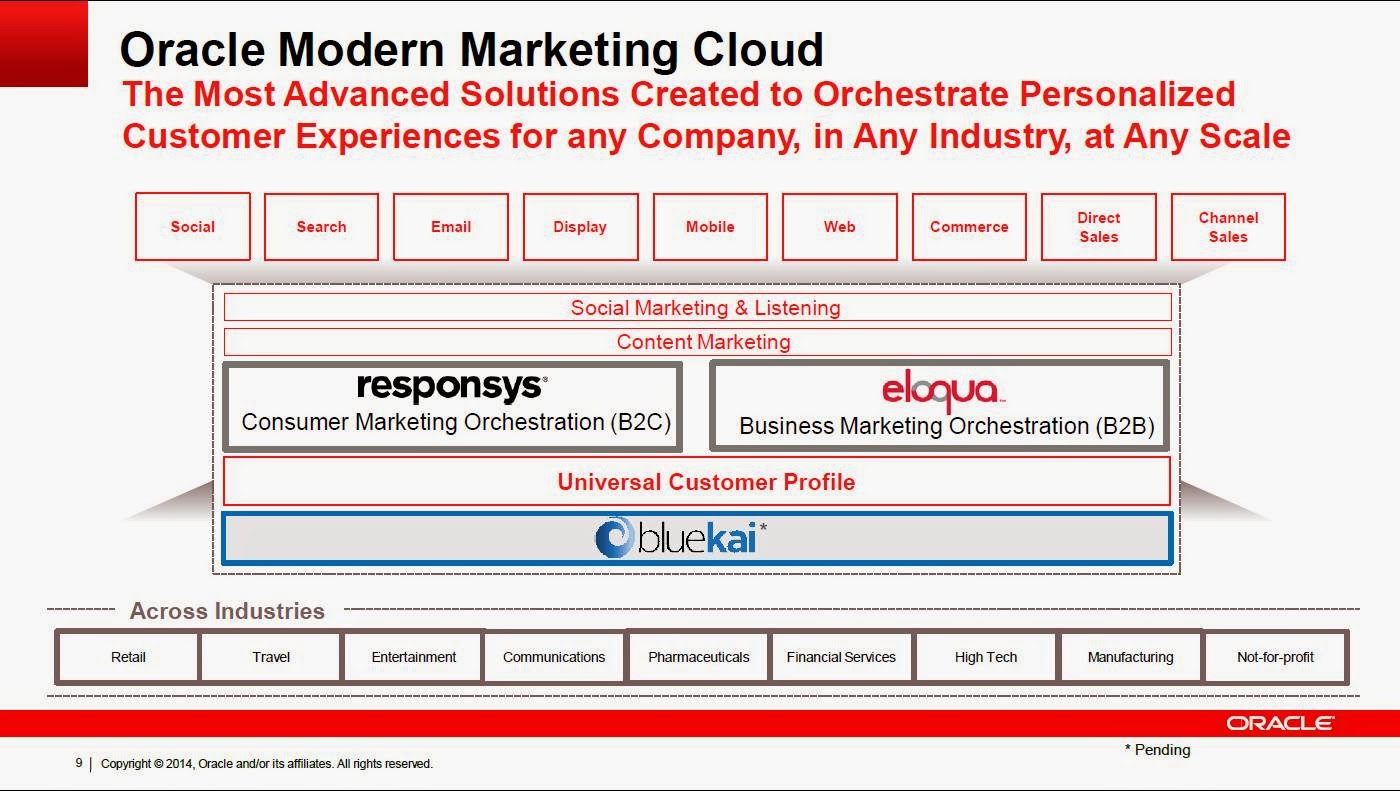
If you look at Oracle’s diagram of their newly expanded Marketing Cloud, you’ll see BlueKai sitting beneath Responsys and Eloqua, providing a “universal customer profile” that allows them to act as “marketing orchestration” systems which, in turn, support programs across all channels – social, search, email, display, mobile, web, commerce, direct sales, and channel sales.
“Marketing orchestration” is a considerable jump beyond the traditional role of “marketing automation”, but I’ll save that analysis for another day. What matters right now is that Oracle places BlueKai exactly where I’ve been placing the Customer Data Platform: as a multi-source database that feeds unified customer data to marketing applications.
This is the first time we’ve seen a major enterprise software vendor draw that picture quite so clearly. More typically, they just do some hand waving around the customer database without explaining how it magically appears. Deep in their hearts, what they really hope is that the database for their core application – CRM, email, Web site management, whatever – will be that central, shared database. They hope this even though their application doesn’t really provide the database management tools needed to make it happen, and their database itself is often tailored too narrowly to the specific application to support the full range of other uses.
BlueKai, on the other hand, is all about the data. Like other DMPs, it is still mostly organized around cookies and advertising audiences, but it does offer the ability to import other types of data and can certainly track identified individuals if the user wants. The fact that it can combine anonymous and identified profiles is extremely important if marketers are to build a single unified customer data repository and use it to support all contact channels, including Web advertising. The fact that it’s a distinct, named product gives that central customer database the prominence that it deserves.
In short – and I don’t use this term loosely – the BlueKai acquisition could truly be a “game changer” that forces other enterprise software vendors to also give marketers the CDP-style database building tools they’ve needed so desperately. As of this morning, Oracle’s competitors have a new gap in their product lines. It will be interesting to see how they fill it.
If you look at Oracle’s diagram of their newly expanded Marketing Cloud, you’ll see BlueKai sitting beneath Responsys and Eloqua, providing a “universal customer profile” that allows them to act as “marketing orchestration” systems which, in turn, support programs across all channels – social, search, email, display, mobile, web, commerce, direct sales, and channel sales.
“Marketing orchestration” is a considerable jump beyond the traditional role of “marketing automation”, but I’ll save that analysis for another day. What matters right now is that Oracle places BlueKai exactly where I’ve been placing the Customer Data Platform: as a multi-source database that feeds unified customer data to marketing applications.
This is the first time we’ve seen a major enterprise software vendor draw that picture quite so clearly. More typically, they just do some hand waving around the customer database without explaining how it magically appears. Deep in their hearts, what they really hope is that the database for their core application – CRM, email, Web site management, whatever – will be that central, shared database. They hope this even though their application doesn’t really provide the database management tools needed to make it happen, and their database itself is often tailored too narrowly to the specific application to support the full range of other uses.
BlueKai, on the other hand, is all about the data. Like other DMPs, it is still mostly organized around cookies and advertising audiences, but it does offer the ability to import other types of data and can certainly track identified individuals if the user wants. The fact that it can combine anonymous and identified profiles is extremely important if marketers are to build a single unified customer data repository and use it to support all contact channels, including Web advertising. The fact that it’s a distinct, named product gives that central customer database the prominence that it deserves.
In short – and I don’t use this term loosely – the BlueKai acquisition could truly be a “game changer” that forces other enterprise software vendors to also give marketers the CDP-style database building tools they’ve needed so desperately. As of this morning, Oracle’s competitors have a new gap in their product lines. It will be interesting to see how they fill it.
Friday, February 21, 2014
Bizo and DemandBase Lead B2B Marketing Automation to Web Advertising and Beyond
I had a fascinating chat earlier this week with a client who described his vision for using DemandBase to tailor messages to Web site visitors from target accounts, using Bizo to further tailor messages to individuals by title, using all this data to synch inbound and outbound campaigns in Eloqua, and eventually driving everything with predictive model scores from a tool like Lattice Engines. That could serve as a pretty complete summary of the state of the art for B2B marketing today, especially if you consider “content marketing” as implicitly included. Equally helpful to me personally, it reinforced my intention to write about Bizo and DemandBase, both of which have recently briefed me on their latest product extensions.
Let’s start with DemandBase. Astonishingly, four years have passed since I last wrote about them. In that time, they’ve continued to build applications that exploit their core technology for identifying Web site visitors by company based on their IP address. This started by providing visitor lists and real-time alerts to sales people who were interested in specific accounts. It later extended to returning visitor attributes in real time so companies could pre-fill forms and personalize Web pages to match visitor interests. The most recent expansion went beyond a company’s own Web site to the much larger world of online advertising.
To reach that market, the company had to build its own version of “data management platform” (DMP) systems that manage lists of known entities, recognizes them when they appear on an external Web site, and delivers them an appropriate advertisement. The big difference is that DemandBase entities are companies identified by IP address, while traditional DMP entities are cookies attached to browsers (and assumed to relate to individual human beings). DemandBase had to build its own engines for real time bidding (RTB) and ad serving (Demand Side Platform or DSP) to support its approach. These can integrate with Demandbase’s own network of Web publishers that will accept its ads and with other ad exchanges that connect to their own, larger publisher networks.
Data in the DemandBase DMP comes from both DemandBase and clients. The DemandBase data are the company-level attributes that DemandBase has long assembled: company name, industry, revenue, employees, technologies used, etc. Some of this, such as DUNS Number, is purchased from external sources and requires extra payment. The client data, which of course is available only to the client who provided it, could be anything but is usually attributes such as account type, buying stage, and sales territory. The system doesn’t store any information about individuals. Marketing automation, Web analytics, and Web content management systems can all access this data via API calls for analytics and as inputs to their own selection and treatment rules. Outside the DMP itself, DemandBase can store content and decision rules to guide bidding and select which ad is displayed to each account.
So much for the mechanics. The business value is that DemandBase is allowing marketers to tailor messages to target accounts even before they engage directly with the company, thereby (hopefully) luring new prospects into the top of the funnel and engaging them if they don’t respond. This is a major extension beyond traditional marketing automation, which works mostly through email to known prospects. It also goes beyond Web site personalization, which requires people to at least visit your Web site and in most cases actively provide information about themselves. As you might imagine, DemandBase offers many case studies to show how much this improves performance.
Bizo comes at Web advertising from the traditional route of building a pool of cookies and assembling them into audiences based on the attributes of the individuals they represent. The pool was originally used to target display advertising and retarget site visitors by sending them ads on other sites. The company says it has pulled data from 4,200 publishers and other sources to identify about 120 million individuals worldwide, including 85 million within the U.S. The number of actual cookies is higher still.* Profiles contain titles and business demographics such as industry, but no personally identifiable information such as names or addresses.
Like DemandBase, Bizo has found many applications for its core data asset. These now extend beyond display ads to social media advertising through Facebook and LinkedIn, Web site personalization through Adobe, Web analytics through Google Analytics and Adobe, and integration with Salesforce.com CRM, BlueKai DMP, and Eloqua marketing automation. Other partners will be added over time.
I’ll assume the Eloqua integration is most interesting to readers of this blog. Basically, it lets Bizo read audience segments created by Eloqua. Bizo then matches segment members to Bizo identities and delivers Web site, advertising or social messages tailored to each segment. Because Eloqua captures such detailed information about prospect behaviors, this allows highly tailored advertising that is tightly synchronized with prospects’ progress through buying stages and marketing automation campaigns. Since it’s driven by cookies, it can send messages to anonymous as well as identified prospects – a huge expansion in marketing automation’s reach. Bizo can even allocate advertising spend across the different media to achieve reach and frequency targets as efficiently as possible. To encourage this approach, its pricing is based on the number of unique individuals that marketers manage in its system, rather than impressions or ad budget.
The business value offered by Bizo is similar to DemandBase: reaching prospects that haven’t yet engaged with a company directly or retargeting them when they don’t respond. The different technical approaches have their own strengths and weaknesses: IP-based identification is relatively stable but works only at the company level and doesn’t identify small businesses that lack their own stable IP address; cookies identify individuals but are often deleted, miss some people, and result in multiple, fragmented identities for others. Like the client I mentioned at the start of this article, you can probably think of them as complementary rather than competing components of a complete B2B marketing solution.
________________________________________________________________________
* Given that the total employed U.S. workforce is about 145 million, I suspect that 85 million contains quite a few duplicates, meaning any one profile captures just a fragment of an individual’s activity. But that’s the nature of this sort of thing; the business question is how well the data works even in its imperfect state.
Let’s start with DemandBase. Astonishingly, four years have passed since I last wrote about them. In that time, they’ve continued to build applications that exploit their core technology for identifying Web site visitors by company based on their IP address. This started by providing visitor lists and real-time alerts to sales people who were interested in specific accounts. It later extended to returning visitor attributes in real time so companies could pre-fill forms and personalize Web pages to match visitor interests. The most recent expansion went beyond a company’s own Web site to the much larger world of online advertising.
To reach that market, the company had to build its own version of “data management platform” (DMP) systems that manage lists of known entities, recognizes them when they appear on an external Web site, and delivers them an appropriate advertisement. The big difference is that DemandBase entities are companies identified by IP address, while traditional DMP entities are cookies attached to browsers (and assumed to relate to individual human beings). DemandBase had to build its own engines for real time bidding (RTB) and ad serving (Demand Side Platform or DSP) to support its approach. These can integrate with Demandbase’s own network of Web publishers that will accept its ads and with other ad exchanges that connect to their own, larger publisher networks.
Data in the DemandBase DMP comes from both DemandBase and clients. The DemandBase data are the company-level attributes that DemandBase has long assembled: company name, industry, revenue, employees, technologies used, etc. Some of this, such as DUNS Number, is purchased from external sources and requires extra payment. The client data, which of course is available only to the client who provided it, could be anything but is usually attributes such as account type, buying stage, and sales territory. The system doesn’t store any information about individuals. Marketing automation, Web analytics, and Web content management systems can all access this data via API calls for analytics and as inputs to their own selection and treatment rules. Outside the DMP itself, DemandBase can store content and decision rules to guide bidding and select which ad is displayed to each account.
So much for the mechanics. The business value is that DemandBase is allowing marketers to tailor messages to target accounts even before they engage directly with the company, thereby (hopefully) luring new prospects into the top of the funnel and engaging them if they don’t respond. This is a major extension beyond traditional marketing automation, which works mostly through email to known prospects. It also goes beyond Web site personalization, which requires people to at least visit your Web site and in most cases actively provide information about themselves. As you might imagine, DemandBase offers many case studies to show how much this improves performance.
Bizo comes at Web advertising from the traditional route of building a pool of cookies and assembling them into audiences based on the attributes of the individuals they represent. The pool was originally used to target display advertising and retarget site visitors by sending them ads on other sites. The company says it has pulled data from 4,200 publishers and other sources to identify about 120 million individuals worldwide, including 85 million within the U.S. The number of actual cookies is higher still.* Profiles contain titles and business demographics such as industry, but no personally identifiable information such as names or addresses.
Like DemandBase, Bizo has found many applications for its core data asset. These now extend beyond display ads to social media advertising through Facebook and LinkedIn, Web site personalization through Adobe, Web analytics through Google Analytics and Adobe, and integration with Salesforce.com CRM, BlueKai DMP, and Eloqua marketing automation. Other partners will be added over time.
I’ll assume the Eloqua integration is most interesting to readers of this blog. Basically, it lets Bizo read audience segments created by Eloqua. Bizo then matches segment members to Bizo identities and delivers Web site, advertising or social messages tailored to each segment. Because Eloqua captures such detailed information about prospect behaviors, this allows highly tailored advertising that is tightly synchronized with prospects’ progress through buying stages and marketing automation campaigns. Since it’s driven by cookies, it can send messages to anonymous as well as identified prospects – a huge expansion in marketing automation’s reach. Bizo can even allocate advertising spend across the different media to achieve reach and frequency targets as efficiently as possible. To encourage this approach, its pricing is based on the number of unique individuals that marketers manage in its system, rather than impressions or ad budget.
The business value offered by Bizo is similar to DemandBase: reaching prospects that haven’t yet engaged with a company directly or retargeting them when they don’t respond. The different technical approaches have their own strengths and weaknesses: IP-based identification is relatively stable but works only at the company level and doesn’t identify small businesses that lack their own stable IP address; cookies identify individuals but are often deleted, miss some people, and result in multiple, fragmented identities for others. Like the client I mentioned at the start of this article, you can probably think of them as complementary rather than competing components of a complete B2B marketing solution.
________________________________________________________________________
* Given that the total employed U.S. workforce is about 145 million, I suspect that 85 million contains quite a few duplicates, meaning any one profile captures just a fragment of an individual’s activity. But that’s the nature of this sort of thing; the business question is how well the data works even in its imperfect state.
Thursday, February 13, 2014
Marketing Automation 2014 Industry Overview: What the Surveys Tell Us
The Interwebs have delivered an unusually rich trove of data about the marketing automation industry in the past few weeks. Other than Raab Associates’ own VEST report, we’ve seen surveys of active buyers from Software Advice, usage figures based on direct observation from Mintigo and Venture Beat (using Datanyze), and another broad-based survey from Pepper Global and Holger Shulze. Taken together, these provide a clearer picture than usual of the state of marketing automation. Here’s how I see things.
Strong Growth Continues
As I reported last week, I expect industry revenue to grow 60% in 2014, accelerating from the already-impressive 50% per year we saw in 2012 and 2013.

The main basis for my prediction is high growth that vendors reported in 2013, and in particular a trend towards higher revenue per client among the vendors who share that information with me.
These include:
My VEST data suggests that maybe 3% of micro-businesses (under $5 million revenue) now use a marketing automation system, and under 10% of larger firms do.

This varies hugely from the usual survey results, which often show something like 50% penetration. The reason is selection bias: most surveys are answered by people who are actively engaged in marketing automation. They are vastly more likely than average to have a system in place.
The Mintigo results confirm this. Mintigo’s technology scans the Internet for things like job listings and Javascript tags and infers from those which products are used at every company it finds. There’s still a bit of selection bias – it won’t work if a company isn’t on the Internet – but the impact is obviously much less. Mintigo’s conclusion across 186,500 B2B companies was that just three percent were using the most common marketing automation systems: Oracle Eloqua, Marketo, HubSpot, and Salesforce.com Pardot. Penetration reached eight percent among larger firms and varied substantially by industry.

Mintigo sagely warns that industry penetration rates are not the same as share of marketing automation customers, since some industries are bigger than others. Software Advice does show the number of prospective buyers by industry: not surprisingly, tech is still the most common industry among new buyers. But more interesting is that 77% come from somewhere else. I don’t have any historical data available but strongly suspect it would confirm that the industry is increasingly selling outside its original base of tech clients.

Users Want Core Marketing Automation Features
Both Software Advice and Pepper Global asked what features marketing automation buyers want. This is a pretty common question so the answers were not very surprising. In fact, what was most impressive was the relative consistency of the rankings, with ead nurturing, analytics, and lead scoring at the top in both surveys, email and campaign management in the middle, and list segmentation is at the bottom.
Those top three are the key improvements that marketing automation provides over simple email or CRM systems, so this prioritization makes sense. It was intriguing to see inbound marketing and social media marketing ranked so low on the Software Advice data – I read this to mean that marketers already get them from systems outside of marketing automation and don't see much need for a change. Similarly, the Pepper Global data’s low ratings for lead activity tracking, lead capture, and Website visitor tracking reflect that marketers have systems in place for those.

Features Don't Drive Decisions ...or Create Success
Pepper Global also asked some interesting questions about evaluation criteria and obstacles. Again, there were no particular surprises in the answers – marketers care more about cost, integration, and ease of use than vendor or technical details. (I guess meeting functional requirements is assumed.) Similarly, it’s no surprise to see the biggest obstacles are budget, employee skills, data quality and content. The two sets of answers do correlate (budget relates to cost; employee skills relates to ease of use), which is reassuring.

But take a closer look. Did you notice how few of these obstacles can actually be addressed by marketing automation functions? The real issues are budgetary (budgets and content), organizational (skills, data quality, sales feedback, sales integration, and performance standards), and technical (data collection and compatibility). This has practical implications for how marketing automation vendors should position themselves, invest in product development, and supplement their products with services.
Pepper Global also makes some intriguing observations about differences in responses from small businesses vs. mid to large businesses: cost and budget are the biggest issues for small business, while integration and analytics matter more to bigger companies. Sadly, they didn't publish additional details. Still, it’s worth being reminded that these differences exist and should be considered by vendors in their planning and by marketers in their system selection.
The Real Competition Isn't Other Vendors
As the industry penetration figures indicate, the real competition in most marketing automation purchases is a different technology, not another marketing automation vendor. Software Advice drives this point home by showing how prospective buyers are currently managing marketing activities: nearly half are relying on a CRM. A surprisingly small fraction cite email, although presumably they all have email capabilities. I'd guess this is because they are answering specifically about marketing management. If I were an email vendor, I'd think about that one.

Given the industry's low over-all penetration rate, it's interesting that nine percent of prospective buyers are looking to replace an existing system. This suggests they like the idea of marketing automation but aren't happy with their particular product. Sure enough, just over ten percent of the buyers say they're evaluating a new system for exactly that reason. But the much more common reasons apply to people with no marketing automation in place: improve lead management, automate processes, and get more/better features than current [non-marketing automation] tools.

Market Share Varies by Sector
Narrowing the focus to existing users, Venture Beat and Pepper Global both have some data, as does the VEST. Remember that these come from different sources:
Venture Beat uses Datanyze to read the actual systems that are embedded in marketers’ web sites.

Pepper Global is based on a survey of the B2B Technology Marketing Community on LinkedIn.

VEST data is self-reported by the vendors.

Mintigo’s technique would also reveal market share but they have diplomatically chosen not to share.
The results are broadly consistent once you take into account that Pepper Global’s sample has many fewer small companies than Venture Beat, and thus understates clients for vendors like HubSpot and Infusionsoft. One extremely important caveat is that these figures are counting clients, not revenue: HubSpot has three times as many clients than Marketo but 10% less 2013 revenue. (The revenue figures aren't on the chart but are public: $77.6 million for HubSpot and $85.1 million for Marketo.) As the Pepper Global slide suggests, different vendors are strongest in different customer segments.
Lots of Choices
There are plenty of vendors beyond the handful of industry leaders. The Venture Beat slide lists some; we report on a good number of them in the VEST; and I've written about others on this blog. Here’s a list I recently pulled together, along with client self-reported counts. It still leaves many out.

Why would anyone pick a vendor other than the leaders? One answer is, because they don’t know anyone else: some vendors still tell me more than half their deals are uncontested, meaning they are selling against doing nothing or an incumbent CRM or email system. Presumably this will become less common as more marketers realize that marketing automation systems are a category with lots of options.
Another, better answer is that the systems really are different. Sure, all marketing automation products share the same core features: email, landing pages and forms, web behavior tracking, nurture campaigns, lead scoring, CRM integration, and reporting. But there are still significant differentiators. In fact, I'd argue these are becoming increasingly important as ways for new and smaller companies to find niches where they can compete. Here’s a list of some of the approaches and a sample of vendors who have taken them. (Many vendors would fit into multiple categories; pardon the oversimplification.)

Note that just about everyone cites low cost and ease of use, as they should: they're what buyers say are most important. But this means those claims pretty much cancel each other out, regardless of the underlying system's actual merits. This leaves more concrete differences, some based on features and others based on service or distribution models. Even the surveys showed that features alone will rarely drive a decision, the exceptions are features that are absolute requirements and hard to find, such as integration with a particular CRM system or support for channel partners. So far, every differentiator on this list can point to at least some measure of success.
So there you have it, folks: my current snapshot of our rapidly changing industry. Thanks to Mintigo, Software Advice, Venture Beat, Pepper Global, and all the other people who publish such great data.
Strong Growth Continues
As I reported last week, I expect industry revenue to grow 60% in 2014, accelerating from the already-impressive 50% per year we saw in 2012 and 2013.
The main basis for my prediction is high growth that vendors reported in 2013, and in particular a trend towards higher revenue per client among the vendors who share that information with me.
These include:
- HubSpot (50% revenue growth on 25% client growth)
- Act-On (115% revenue growth on 59% client growth)
- SalesFUSION (100% revenue growth on 47% client growth)
- Marketo (64% revenue growth on 30% client growth)
My VEST data suggests that maybe 3% of micro-businesses (under $5 million revenue) now use a marketing automation system, and under 10% of larger firms do.
This varies hugely from the usual survey results, which often show something like 50% penetration. The reason is selection bias: most surveys are answered by people who are actively engaged in marketing automation. They are vastly more likely than average to have a system in place.
The Mintigo results confirm this. Mintigo’s technology scans the Internet for things like job listings and Javascript tags and infers from those which products are used at every company it finds. There’s still a bit of selection bias – it won’t work if a company isn’t on the Internet – but the impact is obviously much less. Mintigo’s conclusion across 186,500 B2B companies was that just three percent were using the most common marketing automation systems: Oracle Eloqua, Marketo, HubSpot, and Salesforce.com Pardot. Penetration reached eight percent among larger firms and varied substantially by industry.
Mintigo sagely warns that industry penetration rates are not the same as share of marketing automation customers, since some industries are bigger than others. Software Advice does show the number of prospective buyers by industry: not surprisingly, tech is still the most common industry among new buyers. But more interesting is that 77% come from somewhere else. I don’t have any historical data available but strongly suspect it would confirm that the industry is increasingly selling outside its original base of tech clients.
Users Want Core Marketing Automation Features
Both Software Advice and Pepper Global asked what features marketing automation buyers want. This is a pretty common question so the answers were not very surprising. In fact, what was most impressive was the relative consistency of the rankings, with ead nurturing, analytics, and lead scoring at the top in both surveys, email and campaign management in the middle, and list segmentation is at the bottom.
Those top three are the key improvements that marketing automation provides over simple email or CRM systems, so this prioritization makes sense. It was intriguing to see inbound marketing and social media marketing ranked so low on the Software Advice data – I read this to mean that marketers already get them from systems outside of marketing automation and don't see much need for a change. Similarly, the Pepper Global data’s low ratings for lead activity tracking, lead capture, and Website visitor tracking reflect that marketers have systems in place for those.
Features Don't Drive Decisions ...or Create Success
Pepper Global also asked some interesting questions about evaluation criteria and obstacles. Again, there were no particular surprises in the answers – marketers care more about cost, integration, and ease of use than vendor or technical details. (I guess meeting functional requirements is assumed.) Similarly, it’s no surprise to see the biggest obstacles are budget, employee skills, data quality and content. The two sets of answers do correlate (budget relates to cost; employee skills relates to ease of use), which is reassuring.
But take a closer look. Did you notice how few of these obstacles can actually be addressed by marketing automation functions? The real issues are budgetary (budgets and content), organizational (skills, data quality, sales feedback, sales integration, and performance standards), and technical (data collection and compatibility). This has practical implications for how marketing automation vendors should position themselves, invest in product development, and supplement their products with services.
Pepper Global also makes some intriguing observations about differences in responses from small businesses vs. mid to large businesses: cost and budget are the biggest issues for small business, while integration and analytics matter more to bigger companies. Sadly, they didn't publish additional details. Still, it’s worth being reminded that these differences exist and should be considered by vendors in their planning and by marketers in their system selection.
The Real Competition Isn't Other Vendors
As the industry penetration figures indicate, the real competition in most marketing automation purchases is a different technology, not another marketing automation vendor. Software Advice drives this point home by showing how prospective buyers are currently managing marketing activities: nearly half are relying on a CRM. A surprisingly small fraction cite email, although presumably they all have email capabilities. I'd guess this is because they are answering specifically about marketing management. If I were an email vendor, I'd think about that one.
Given the industry's low over-all penetration rate, it's interesting that nine percent of prospective buyers are looking to replace an existing system. This suggests they like the idea of marketing automation but aren't happy with their particular product. Sure enough, just over ten percent of the buyers say they're evaluating a new system for exactly that reason. But the much more common reasons apply to people with no marketing automation in place: improve lead management, automate processes, and get more/better features than current [non-marketing automation] tools.
Market Share Varies by Sector
Narrowing the focus to existing users, Venture Beat and Pepper Global both have some data, as does the VEST. Remember that these come from different sources:
Venture Beat uses Datanyze to read the actual systems that are embedded in marketers’ web sites.
Pepper Global is based on a survey of the B2B Technology Marketing Community on LinkedIn.
VEST data is self-reported by the vendors.
Mintigo’s technique would also reveal market share but they have diplomatically chosen not to share.
The results are broadly consistent once you take into account that Pepper Global’s sample has many fewer small companies than Venture Beat, and thus understates clients for vendors like HubSpot and Infusionsoft. One extremely important caveat is that these figures are counting clients, not revenue: HubSpot has three times as many clients than Marketo but 10% less 2013 revenue. (The revenue figures aren't on the chart but are public: $77.6 million for HubSpot and $85.1 million for Marketo.) As the Pepper Global slide suggests, different vendors are strongest in different customer segments.
Lots of Choices
There are plenty of vendors beyond the handful of industry leaders. The Venture Beat slide lists some; we report on a good number of them in the VEST; and I've written about others on this blog. Here’s a list I recently pulled together, along with client self-reported counts. It still leaves many out.
Why would anyone pick a vendor other than the leaders? One answer is, because they don’t know anyone else: some vendors still tell me more than half their deals are uncontested, meaning they are selling against doing nothing or an incumbent CRM or email system. Presumably this will become less common as more marketers realize that marketing automation systems are a category with lots of options.
Another, better answer is that the systems really are different. Sure, all marketing automation products share the same core features: email, landing pages and forms, web behavior tracking, nurture campaigns, lead scoring, CRM integration, and reporting. But there are still significant differentiators. In fact, I'd argue these are becoming increasingly important as ways for new and smaller companies to find niches where they can compete. Here’s a list of some of the approaches and a sample of vendors who have taken them. (Many vendors would fit into multiple categories; pardon the oversimplification.)
Note that just about everyone cites low cost and ease of use, as they should: they're what buyers say are most important. But this means those claims pretty much cancel each other out, regardless of the underlying system's actual merits. This leaves more concrete differences, some based on features and others based on service or distribution models. Even the surveys showed that features alone will rarely drive a decision, the exceptions are features that are absolute requirements and hard to find, such as integration with a particular CRM system or support for channel partners. So far, every differentiator on this list can point to at least some measure of success.
So there you have it, folks: my current snapshot of our rapidly changing industry. Thanks to Mintigo, Software Advice, Venture Beat, Pepper Global, and all the other people who publish such great data.
Thursday, February 06, 2014
Genius and LoopFuse Are Acquired; Leadsius Picks Up the Freemium Banner
The past week has seen two acquisition announcements in the B2B marketing automation space: LoopFuse by SalesFUSION and LeadRocket/Genius by CallidusCloud, which owns LeadFormix. Both of the acquired vendors had bright prospects at one time but fell by the wayside. Interestingly, both pursued a “freemium” strategy of offering their system for free to users with small databases. The goal is to build a big base of users, some of whom will eventually pay real money for a larger installation. Since both vendors ultimately failed to survive, it might seem reasonable to conclude that freemium doesn’t work for B2B marketing automation, despite its successes elsewhere.
But this week also saw the start of a big freemium push by Leadsius, a new small business marketing automation vendor I wrote about two weeks ago. Leadsius reports more than 1,200 freemium accounts since they started offering them a bit over a year ago. Can they succeed where Genius and LoopFuse did not?
Obviously I don’t know, but it’s fair to say that the odds are against them. Genius and LoopFuse were both good products run by smart people backed by venture funding (a lot for Genius, a little for LoopFuse). Each reported thousands of freemium sign-ups that converted to paid accounts at a reasonable rate – “reasonable” being defined as an acceptable cost per new customer when the cost of the freemium accounts was included. The problem seemed to be that the absolute number of converted accounts wasn’t high enough to sustain the business, and neither vendor had enough business coming in from other sources. I’d also guess that freemium appealed most to small companies which didn’t generate much revenue even after they started to pay. (Even though many freemium users are departments within large companies, I'd suspect those firms buy different, enterprise-level systems when they decide to make a real commitment.)
Freemium is a much-discussed topic in tech circles, and there are many people who have thought more deeply about it than I have. My casual impression is it probably makes the most sense when there’s a network effect, meaning you need to attract lots of users quickly to succeed. Obviously it needs to be a product that’s easy to learn and use, so training and support costs are kept at a minimum.
My take is that freemium doesn’t fit well with marketing automation because marketing automation takes a lot of work to use effectively. Compare this with email and Web site hosting, where freemium has worked well: casual users can be quite successful with those products. In fact, the trend in the marketing automation industry has generally been to increase rather than remove barriers to getting started, by doing away with options such as 30 day free trials or free implementation support. Vendors like HubSpot and Infusionsoft have tried many approaches but ended up requiring significant up-front investment from new clients, specifically to screen out buyers who won’t put in enough work to succeed. That’s about as far from the freemium approach as you can get.
None of this means that Leadsius is set to fail. They might find a way to make freemium work or they might abandon freemium and succeed doing things the old fashioned way. From a prospective buyer’s perspective, what really matters are the quality of the system and the pricing, which are quite competitive. So long as they’re willing to learn from experience – and abandon freemium if that is what experience teaches – their prospects are bright.
But this week also saw the start of a big freemium push by Leadsius, a new small business marketing automation vendor I wrote about two weeks ago. Leadsius reports more than 1,200 freemium accounts since they started offering them a bit over a year ago. Can they succeed where Genius and LoopFuse did not?
Obviously I don’t know, but it’s fair to say that the odds are against them. Genius and LoopFuse were both good products run by smart people backed by venture funding (a lot for Genius, a little for LoopFuse). Each reported thousands of freemium sign-ups that converted to paid accounts at a reasonable rate – “reasonable” being defined as an acceptable cost per new customer when the cost of the freemium accounts was included. The problem seemed to be that the absolute number of converted accounts wasn’t high enough to sustain the business, and neither vendor had enough business coming in from other sources. I’d also guess that freemium appealed most to small companies which didn’t generate much revenue even after they started to pay. (Even though many freemium users are departments within large companies, I'd suspect those firms buy different, enterprise-level systems when they decide to make a real commitment.)
Freemium is a much-discussed topic in tech circles, and there are many people who have thought more deeply about it than I have. My casual impression is it probably makes the most sense when there’s a network effect, meaning you need to attract lots of users quickly to succeed. Obviously it needs to be a product that’s easy to learn and use, so training and support costs are kept at a minimum.
My take is that freemium doesn’t fit well with marketing automation because marketing automation takes a lot of work to use effectively. Compare this with email and Web site hosting, where freemium has worked well: casual users can be quite successful with those products. In fact, the trend in the marketing automation industry has generally been to increase rather than remove barriers to getting started, by doing away with options such as 30 day free trials or free implementation support. Vendors like HubSpot and Infusionsoft have tried many approaches but ended up requiring significant up-front investment from new clients, specifically to screen out buyers who won’t put in enough work to succeed. That’s about as far from the freemium approach as you can get.
None of this means that Leadsius is set to fail. They might find a way to make freemium work or they might abandon freemium and succeed doing things the old fashioned way. From a prospective buyer’s perspective, what really matters are the quality of the system and the pricing, which are quite competitive. So long as they’re willing to learn from experience – and abandon freemium if that is what experience teaches – their prospects are bright.
Tuesday, February 04, 2014
New Raab VEST Report: B2B Marketing Automation Will Reach $1.2 Billion in 2014
I’ve just published the latest edition of our B2B Marketing Automation Vendor Selection Tool (VEST), with updated entries on all your favorites and several new entries to boot. This is always a fun project because it gives me an overview of what all the vendors have been up to for the past six months. A few interesting trends stood out:

- revenue growth is accelerating. My data are a little less comprehensive than previously because several of the big vendors are now part of public companies and don’t share detailed information. Those that did provide information showed great growth in 2013, in most cases over the 50% I had predicted for the industry as a whole. Even more interesting, nearly everyone reported faster growth in revenue than in clients: to take one vendor that does provide statistics, HubSpot recently reported 50% revenue growth vs. 25% growth in number of clients. In their case and others, the reason seems to be a combination of larger size deals on new customers and growth in billing to existing customers. Based on this data, I’m projecting a 60% increase in industry revenue for 2014, to $1.2 billion. You heard it here first.
- the hot new feature is…SEO content rating. Yes, there’s continued growth in various aspects of social media marketing and in mobile-friendly content creation. That’s old news. What I hadn’t realized before is that at least a half dozen vendors had added or improved features to help marketers build content that attracts search engine hits on selected keywords or concepts. I suppose that’s become increasingly important as marketing automation moves beyond its original role in lead management to help attract new leads at the top of the funnel. (Do I get SEO credit for using “top of the funnel”?)
- lots of new vendors. I added four new vendors to the report, all of which have just begun to market their products aggressively. None is very large yet, except for SimplyCast, which won’t release precise data but did say it has 3,000 to 5,000 customers for its multi-channel customer management system (you may recall that I reviewed them briefly last week.) The new systems offer a broad range of configurations, from ultra-simple interfaces with limited functions to elaborate multi-channel workflows that are correspondingly complex.
- agency systems are big. Two of the four new vendors are agency system specialists, and several other vendors have also launched special agency editions. This creates some weird feature combinations, since agencies to serve small businesses need administrative features, such as precise user rights management, that are otherwise only used by big enterprises, . Of course, the reliance on agencies is more evidence that many marketing departments still lack the skills needed to do advanced marketing automation on their own – but you knew that.
- mid-market leadership may be up for grabs. Small but established mid-market firms including SalesFusion and eTrigue have been growing particularly quickly, as has Act-On. This may be because the current mid-market leaders, Marketo and Pardot in particular, have been focusing more on enterprise sales. I had thought that heavy funding would be necessary become a new market leader, which is the way Marketo, Act-On and HubSpot did it. SalesFusion did just take an $8.25 million investment but their revenue doubled last year without it. So perhaps having a good product and being focused will enough for someone new to elbow into a top-three position. We'll see.
Friday, January 31, 2014
More New Systems Challenge the Marketing Automation Status Quo
Last week’s post looked at newer marketing automation systems that focused on small businesses. They shared a similar approach of offering limited features in exchange for lower cost: messaging was largely limited to emails (except in Salesformics) and campaign flows were basically linear. The general notion is that small businesses are finding existing marketing automation products too hard to use and would be happy with something simpler, especially if it costs less.
Although this approach is popular, there are others. Here are a few options.
MindFire Studio grew out of MindFire’s original Look Who’s Clicking software, which is used by more than 1,100 printers and other graphics arts vendors to add personalized URLs to print promotions. Studio, released in mid-2012, lets those firms offer full marketing automation capabilities to their clients and is also sold directly to corporate marketers. The system supports email, print, SMS, Twitter, and voice messages, typically delivered via integration with third party systems. It also provides the rest of the standard marketing automation functions, including landing pages and microsites, Web behavior tracking, lead scoring, and integration with Salesforce.com. The approach is organized around events, such as an email open or click: there are different events for different channels, and each event can be assigned points for lead scoring, goals for behavior tracking, and costs for reporting. Events also act as triggers for actions within workflows, which begin with contact lists and can be filtered based on attributes and behaviors. One quirk is that the system reacts to all event-based triggers, rather than following a single branch within a workflow. This means that filters must be carefully crafted to avoid sending too many messages to the same person.
MindFire provides prebuilt templates for common marketing programs, to further assist clients who need help using the system. It doesn’t currently provide email or landing page builders, since its graphics arts clients typically had such tools already. It will be adding these as it sells more to corporate marketers, who tend to need them. Studio also provides other features suited to agencies or large corporate marketing departments, including multiple subaccounts, digital asset management, collaboration, and detailed user rights management. Pricing is based on the number of contacts and messages sent; it starts at $500 per month for corporate users with up to 10,000 contacts. Agencies can create their own branded version of the system and have full control over what they charge their customers.

SharpSpring also started as a narrow application – in this case, Web visitor identification and analytics – and evolved into a full marketing automation platform selling through agencies. The current system, launched mid-2013, includes the full set of standard features: email including templates that can be locked down in sections to prevent unauthorized changes; landing pages built and managed within the system or from external vendors including formstack, GravityForms, Wufoo, SugarCRM, or Salesforce.com; Web behavior tracking using Javascript tags; lead scoring based on attributes and behaviors; workflow using plain English statements rather than diagrams and supporting basic triggers, filters, actions and multiple steps but no branching; and CRM integration with Salesforce.com today and SugarCRM and ZohoCRM soon. The system also offers its own CRM – a useful option for agencies who might need to provide a low cost system to some clients, while accommodating others that have a system in place.
Other advantages include Google Adword integration; tagging leads by search term and Facebook ad; integration with Webex and GoToWebinar for event management; and a partnership with ZoomInfo to add contact names from companies that visit the client’s Web site. SharpSpring has built an exceptionally simple interface, featuring a single “new” button to add any type of object, screen overlays to illustrate available features and link to instructional videos, and real-time display of emails and forms as they are built. It supports agency clients with multi-account sign-on, precise user rights management, and exceptionally low pricing, beginning at $500 per month for up to five agency clients. Non-agency pricing starts at $200 per month for up to 500 contacts and reaches $800 per month for unlimited contacts.

SimplyCast is yet another multi-channel system, although it was designed that way from its start in 2010 and – quite unusually these days -- uses its own messaging tools rather third party systems. In fact, the vendor says it has sold more than one million separate subscriptions for email, auto-response, fax, SMS, voice broadcast, surveys, Web forms, landing pages, Web tracking, events, Twitter, and Facebook marketing, at prices starting from $3.00 to $9.99 per month. The integrated solution, SimplyCast 360, combines many of these with a unified customer database and workflow engine for $99 per month and up. Simple contact management is built into the system, or users can integrate with Salesforce.com, vTiger, SecondCRM, Wordpress, and Zoho. Clients who don’t want to use SimplyCast tools for a particular function can integrate with external products via APIs. The only standard marketing automation function that’s missing is lead scoring, which is due for release next month. The workflow engine has a graphical interface, multiple steps and query-based branching, although users must manually ensure branch conditions are mutually exclusive to avoid multiple executions. The vendor says that between 3,000 and 5,000 clients use SimplyCast 360. The $99 per month rate includes the base features and up to 500 active contacts; adding 10,000 active contacts would cost $500 per month more. There are also some other fees related to advanced features and certain message types.

Inbox25 began as an email system, used primarily as a module for SugarCRM. It launched its full-scale marketing automation system last fall. This provides reasonably powerful versions of the standard marketing automation features: email, landing pages and forms, Web tracking, lead scoring, workflow, and real-time synchronization with SugarCRM. Integration with other CRM systems is due soon. There is some social behavior tracking and detailed reporting on movement through buyer stages, as defined by score ranges. Workflow supports multiple steps linked to conditions defined by email, Web, and social behaviors, lead scores, and various attributes. Steps can execute actions within the system, including sending emails, updating scores and other data, adding to lists, and sending changes to the CRM system. What’s missing is connecting with other execution systems to send messages or import data, although this could be done via APIs or HTTP posts. The workflow doesn’t do true branching, defined as sending contacts down different paths within a single flow. But it does let users specify how contacts move through each flow, with options that include rechecking the original selection condition each time a step is executed, checking only the condition of the current step before it is executed, and checking all conditions up to the current step before it is executed. Inbox25 also recently added a “contact stream” option, similar to Marketo’s engagement engine, that scans a prioritized list of content at regular intervals and sends each contact the highest-priority item they haven’t seen before. Pricing for the marketing automation system starts at $99 per month for up to 250 active contacts. A more robust 12,500 active contacts costs $615 per month.

To summarize a bit: all these new systems stress low cost and ease of use. Some achieve modest improvements in usability by departing from traditional interfaces, but the real gains come from reducing functionality: the simplest systems avoid branching within multi-step sequences and support only email messaging. The other big difference among systems is whether messaging, CRM, and other functions are handled by the vendor’s own tools or by integrating with third party products. Some systems rely exclusively on internal or external tools, while others include their own tools but add APIs that support external integration as an alternative. Finally, there's a flowering of systems designed to let marketing agencies use the product for multiple clients. This type of specialization is both a sign of industry maturity and recognition that many marketing departments, especially at small companies, lack the resources to run advanced marketing automation by themselves.
Although this approach is popular, there are others. Here are a few options.
MindFire Studio grew out of MindFire’s original Look Who’s Clicking software, which is used by more than 1,100 printers and other graphics arts vendors to add personalized URLs to print promotions. Studio, released in mid-2012, lets those firms offer full marketing automation capabilities to their clients and is also sold directly to corporate marketers. The system supports email, print, SMS, Twitter, and voice messages, typically delivered via integration with third party systems. It also provides the rest of the standard marketing automation functions, including landing pages and microsites, Web behavior tracking, lead scoring, and integration with Salesforce.com. The approach is organized around events, such as an email open or click: there are different events for different channels, and each event can be assigned points for lead scoring, goals for behavior tracking, and costs for reporting. Events also act as triggers for actions within workflows, which begin with contact lists and can be filtered based on attributes and behaviors. One quirk is that the system reacts to all event-based triggers, rather than following a single branch within a workflow. This means that filters must be carefully crafted to avoid sending too many messages to the same person.
MindFire provides prebuilt templates for common marketing programs, to further assist clients who need help using the system. It doesn’t currently provide email or landing page builders, since its graphics arts clients typically had such tools already. It will be adding these as it sells more to corporate marketers, who tend to need them. Studio also provides other features suited to agencies or large corporate marketing departments, including multiple subaccounts, digital asset management, collaboration, and detailed user rights management. Pricing is based on the number of contacts and messages sent; it starts at $500 per month for corporate users with up to 10,000 contacts. Agencies can create their own branded version of the system and have full control over what they charge their customers.
SharpSpring also started as a narrow application – in this case, Web visitor identification and analytics – and evolved into a full marketing automation platform selling through agencies. The current system, launched mid-2013, includes the full set of standard features: email including templates that can be locked down in sections to prevent unauthorized changes; landing pages built and managed within the system or from external vendors including formstack, GravityForms, Wufoo, SugarCRM, or Salesforce.com; Web behavior tracking using Javascript tags; lead scoring based on attributes and behaviors; workflow using plain English statements rather than diagrams and supporting basic triggers, filters, actions and multiple steps but no branching; and CRM integration with Salesforce.com today and SugarCRM and ZohoCRM soon. The system also offers its own CRM – a useful option for agencies who might need to provide a low cost system to some clients, while accommodating others that have a system in place.
Other advantages include Google Adword integration; tagging leads by search term and Facebook ad; integration with Webex and GoToWebinar for event management; and a partnership with ZoomInfo to add contact names from companies that visit the client’s Web site. SharpSpring has built an exceptionally simple interface, featuring a single “new” button to add any type of object, screen overlays to illustrate available features and link to instructional videos, and real-time display of emails and forms as they are built. It supports agency clients with multi-account sign-on, precise user rights management, and exceptionally low pricing, beginning at $500 per month for up to five agency clients. Non-agency pricing starts at $200 per month for up to 500 contacts and reaches $800 per month for unlimited contacts.
SimplyCast is yet another multi-channel system, although it was designed that way from its start in 2010 and – quite unusually these days -- uses its own messaging tools rather third party systems. In fact, the vendor says it has sold more than one million separate subscriptions for email, auto-response, fax, SMS, voice broadcast, surveys, Web forms, landing pages, Web tracking, events, Twitter, and Facebook marketing, at prices starting from $3.00 to $9.99 per month. The integrated solution, SimplyCast 360, combines many of these with a unified customer database and workflow engine for $99 per month and up. Simple contact management is built into the system, or users can integrate with Salesforce.com, vTiger, SecondCRM, Wordpress, and Zoho. Clients who don’t want to use SimplyCast tools for a particular function can integrate with external products via APIs. The only standard marketing automation function that’s missing is lead scoring, which is due for release next month. The workflow engine has a graphical interface, multiple steps and query-based branching, although users must manually ensure branch conditions are mutually exclusive to avoid multiple executions. The vendor says that between 3,000 and 5,000 clients use SimplyCast 360. The $99 per month rate includes the base features and up to 500 active contacts; adding 10,000 active contacts would cost $500 per month more. There are also some other fees related to advanced features and certain message types.
Inbox25 began as an email system, used primarily as a module for SugarCRM. It launched its full-scale marketing automation system last fall. This provides reasonably powerful versions of the standard marketing automation features: email, landing pages and forms, Web tracking, lead scoring, workflow, and real-time synchronization with SugarCRM. Integration with other CRM systems is due soon. There is some social behavior tracking and detailed reporting on movement through buyer stages, as defined by score ranges. Workflow supports multiple steps linked to conditions defined by email, Web, and social behaviors, lead scores, and various attributes. Steps can execute actions within the system, including sending emails, updating scores and other data, adding to lists, and sending changes to the CRM system. What’s missing is connecting with other execution systems to send messages or import data, although this could be done via APIs or HTTP posts. The workflow doesn’t do true branching, defined as sending contacts down different paths within a single flow. But it does let users specify how contacts move through each flow, with options that include rechecking the original selection condition each time a step is executed, checking only the condition of the current step before it is executed, and checking all conditions up to the current step before it is executed. Inbox25 also recently added a “contact stream” option, similar to Marketo’s engagement engine, that scans a prioritized list of content at regular intervals and sends each contact the highest-priority item they haven’t seen before. Pricing for the marketing automation system starts at $99 per month for up to 250 active contacts. A more robust 12,500 active contacts costs $615 per month.
To summarize a bit: all these new systems stress low cost and ease of use. Some achieve modest improvements in usability by departing from traditional interfaces, but the real gains come from reducing functionality: the simplest systems avoid branching within multi-step sequences and support only email messaging. The other big difference among systems is whether messaging, CRM, and other functions are handled by the vendor’s own tools or by integrating with third party products. Some systems rely exclusively on internal or external tools, while others include their own tools but add APIs that support external integration as an alternative. Finally, there's a flowering of systems designed to let marketing agencies use the product for multiple clients. This type of specialization is both a sign of industry maturity and recognition that many marketing departments, especially at small companies, lack the resources to run advanced marketing automation by themselves.
Wednesday, January 22, 2014
Next-Generation Marketing Automation Systems Target Small Business
I’ve been gearing up for the next edition of our VEST report on B2B marketing automation systems, which involves catching up with established vendors and chasing down some new ones. The new entrants are clustered towards the small business end of the market, where they see an opportunity for simpler systems at lower prices than existing market leaders. I always wonder whether newcomers can find substantially simpler approaches than the older firms, which are already focused on ease of use and typically gone through several redesigns as they learn from experience. But it’s still worth scanning the new entrants to see how they’ve departed from older approaches. It’s also interesting to see how the new systems are similar, which gives some insight into what are apparently perceived as common problems in the older approaches.
Before jumping into the new systems, it helps to define a set of standard features to measure them against. I’ve written about this extensively in the past, so I won’t go into great detail here. Briefly, a standard B2B marketing automation system can send bulk emails to segmented lists, capture email responses on landing pages and forms, track email and Web site behaviors, score leads based on behaviors and profile attributes, execute multi-step workflows (i.e., nurture campaigns), and share leads with a CRM system like Salesforce.com. Not quite standard but increasingly common features include social media sharing and tracking, Webinar integration, visitor identification via reverse IP lookup, and capturing campaign information from Google AdWords. A system can be useful even if it lacks some of the standard features, but buyers should know what they’re missing so they can decide whether it’s something they really want.
Here are highlights of several vendors I’ve looked at recently. I’ll write about some others next week and then offer some general observations.
Leadsberry is among the oldest of these systems, launched in July 2012. It basic versions of the standard marketing automation features: lists are not updated automatically, workflows only branch on email behavior (opens, clicks, or nothing), and lead scoring is largely limited to profile attributes. On the other hand, it adds a powerful survey tool, easy conversion of emails to Facebook, Twitter, and LinkedIn messages, and easily created “instant offers”. Looking beyond technology, the vendor provides access to a 15 million name email database, a telephone lead generation team, and other services that can supplement or even replace an in-house marketing department. System pricing starts at $99 per month for up to 1,000 contacts; a system with 15,000 contacts costs $499 per month. There are additional fees for survey responses, list rental, and other services.

Leadsius launched its first paid version around July 2013. Like several of the new vendors, it is based in Europe (Sweden), although the user interface is in English. The system includes email, landing pages and forms, and Web behavior tracking. Workflows are currently limited: triggers are based only on email and Web activities, segments are defined only with profile attributes, and the only actions are emails. The next release will support list-based triggers and additional actions. Workflows can execute multiple steps but only branch on whether the previous email was opened. Synchronization with Salesforce.com and SugarCRM are due by mid-2014. Lead scoring is not available and probably won’t be added any time soon, because the developer feels it is dangerous without validating that scores are accurate. Among its strengths, the system provides detailed control over the rights assigned to different users; premium clients can have their own domain for landing pages and IP address for emails; and lists can be dynamic (i.e., continuously updated) as well as static. Leadsius comes in several versions including a free edition with a good set of basic features. New pricing in mid-February will retain the free version and introduce several other levels, most under $1,000 per month.

Salesformics is designed primarily to give sales people a pleasant-to-use CRM system, while offering marketing automation and dashboards to everyone in the organization. The system was developed by a UK-based marketing services firm and is still in public beta, which should end in mid-February. In a relatively radical departure from standard interfaces, it replaces traditional menus with a search box that lets users type commands or contact information (name, address, phone, etc.) and have the system return the best matching results. The system is also unusually reliant on third-party applications – dare we say “platform”? – using external systems to trigger promotions (for example, executing targeted searches in Twitter or LinkedIn to find contact-related events), to capture data (via externally-built web forms), and to deliver messages (email via Constant Contact or SMS via Twilio). Data from those sources, as well as the built-in CRM functions, can be used to create campaign segments. Indeed, the only traditional marketing automation functions provided by Salesformics itself are workflow and basic (untracked) email. Otherwise, trackable email and forms are provided via integration, there is no cookie-based Web behavior tracking, and lead scoring is not yet available (though planned). There is no synchronization to any external CRM system since Salesformics includes its own. The workflow uses a conventional diagram of triggers linked to actions; the triggers and actions are based on both internal and external data. A workflow can include multiple steps but branching won’t be supported until mid-2014. Pricing is based on number of users and starts at $79 per user per month.

Target360 was also developed by a UK-based service firm, in this case CRM consultants specializing in Microsoft Dynamics. The system adds email marketing and campaign tracking to Dynamics, working with Dynamics files directly rather than synching to a separate database. Among U.S-based firms, CoreMotives and ClickDimensions take a similar approach. Of the standard marketing automation functions, Target360 provides email, Web behavior tracking, lead scoring, and workflows. There is no form builder but the vendor provides a tool to map existing forms to the Dynamics database. Campaign workflows can only react to an email result, with separate branches for opens, clicks, and no response, although standard Dynamics workflows could support other actions as well. The system’s particular strength is tracking customer activities across different channels by assigning them campaign codes; this covers emails, Web visits, social media responses, and CRM interactions. These are connected with revenue captured in CRM to create return on investment reports. Revenue can be attributed in these reports to either the first or last campaign to reach a customer. The system was released in mid-2012 and starts at $1,050 per month including a Dynamics license.

Before jumping into the new systems, it helps to define a set of standard features to measure them against. I’ve written about this extensively in the past, so I won’t go into great detail here. Briefly, a standard B2B marketing automation system can send bulk emails to segmented lists, capture email responses on landing pages and forms, track email and Web site behaviors, score leads based on behaviors and profile attributes, execute multi-step workflows (i.e., nurture campaigns), and share leads with a CRM system like Salesforce.com. Not quite standard but increasingly common features include social media sharing and tracking, Webinar integration, visitor identification via reverse IP lookup, and capturing campaign information from Google AdWords. A system can be useful even if it lacks some of the standard features, but buyers should know what they’re missing so they can decide whether it’s something they really want.
Here are highlights of several vendors I’ve looked at recently. I’ll write about some others next week and then offer some general observations.
Leadsberry is among the oldest of these systems, launched in July 2012. It basic versions of the standard marketing automation features: lists are not updated automatically, workflows only branch on email behavior (opens, clicks, or nothing), and lead scoring is largely limited to profile attributes. On the other hand, it adds a powerful survey tool, easy conversion of emails to Facebook, Twitter, and LinkedIn messages, and easily created “instant offers”. Looking beyond technology, the vendor provides access to a 15 million name email database, a telephone lead generation team, and other services that can supplement or even replace an in-house marketing department. System pricing starts at $99 per month for up to 1,000 contacts; a system with 15,000 contacts costs $499 per month. There are additional fees for survey responses, list rental, and other services.
Leadsius launched its first paid version around July 2013. Like several of the new vendors, it is based in Europe (Sweden), although the user interface is in English. The system includes email, landing pages and forms, and Web behavior tracking. Workflows are currently limited: triggers are based only on email and Web activities, segments are defined only with profile attributes, and the only actions are emails. The next release will support list-based triggers and additional actions. Workflows can execute multiple steps but only branch on whether the previous email was opened. Synchronization with Salesforce.com and SugarCRM are due by mid-2014. Lead scoring is not available and probably won’t be added any time soon, because the developer feels it is dangerous without validating that scores are accurate. Among its strengths, the system provides detailed control over the rights assigned to different users; premium clients can have their own domain for landing pages and IP address for emails; and lists can be dynamic (i.e., continuously updated) as well as static. Leadsius comes in several versions including a free edition with a good set of basic features. New pricing in mid-February will retain the free version and introduce several other levels, most under $1,000 per month.
Salesformics is designed primarily to give sales people a pleasant-to-use CRM system, while offering marketing automation and dashboards to everyone in the organization. The system was developed by a UK-based marketing services firm and is still in public beta, which should end in mid-February. In a relatively radical departure from standard interfaces, it replaces traditional menus with a search box that lets users type commands or contact information (name, address, phone, etc.) and have the system return the best matching results. The system is also unusually reliant on third-party applications – dare we say “platform”? – using external systems to trigger promotions (for example, executing targeted searches in Twitter or LinkedIn to find contact-related events), to capture data (via externally-built web forms), and to deliver messages (email via Constant Contact or SMS via Twilio). Data from those sources, as well as the built-in CRM functions, can be used to create campaign segments. Indeed, the only traditional marketing automation functions provided by Salesformics itself are workflow and basic (untracked) email. Otherwise, trackable email and forms are provided via integration, there is no cookie-based Web behavior tracking, and lead scoring is not yet available (though planned). There is no synchronization to any external CRM system since Salesformics includes its own. The workflow uses a conventional diagram of triggers linked to actions; the triggers and actions are based on both internal and external data. A workflow can include multiple steps but branching won’t be supported until mid-2014. Pricing is based on number of users and starts at $79 per user per month.
Target360 was also developed by a UK-based service firm, in this case CRM consultants specializing in Microsoft Dynamics. The system adds email marketing and campaign tracking to Dynamics, working with Dynamics files directly rather than synching to a separate database. Among U.S-based firms, CoreMotives and ClickDimensions take a similar approach. Of the standard marketing automation functions, Target360 provides email, Web behavior tracking, lead scoring, and workflows. There is no form builder but the vendor provides a tool to map existing forms to the Dynamics database. Campaign workflows can only react to an email result, with separate branches for opens, clicks, and no response, although standard Dynamics workflows could support other actions as well. The system’s particular strength is tracking customer activities across different channels by assigning them campaign codes; this covers emails, Web visits, social media responses, and CRM interactions. These are connected with revenue captured in CRM to create return on investment reports. Revenue can be attributed in these reports to either the first or last campaign to reach a customer. The system was released in mid-2012 and starts at $1,050 per month including a Dynamics license.
Monday, January 13, 2014
Understanding Relationships Within the Marketing Technology Landscape
Scott Brinker, a.k.a. chiefmartec*, last week published a terrific Marketing Technology Landscape Supergraphic organizing nearly 1,000 vendors into 43 categories and six major classes. As Scott modestly writes, his classes present “a semblance of meaningful structure” with Internet and Infrastructure providing the foundations, Marketing Backbone platforms (major channel systems) managing most interactions, Marketing Middleware (including Customer Data Platforms) providing a connective layer, and Marketing Experiences and Marketing Operations systems offering specialized capabilities. Here is his diagram:
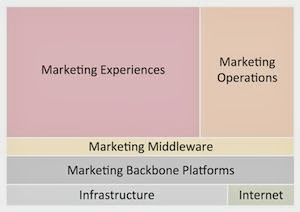
I’m delighted that Scott has found the CDP concept useful† and am in turn happy to adopt his distinction between Backbone Platforms and the other types of marketing applications. The Backbone Platforms are, indeed, platforms that support most Experience and Operations systems, enabling those systems to focus on particular tasks without creating complete customer management environments of their own. That's a difference worth noting.
Scott never claimed that his diagram illustrates a precise relationship among the components, so it's no criticism to point out that it doesn't. Experience and Operations systems sometimes connect with Backbone Platforms through a Middleware system, but more often they connect with the Backbone Platforms directly. In fact, some of the Experience and Operations systems connect with multiple Platforms, serving as sort of do-it-yourself Middleware. The challenge of illustrating this becomes clear when you try adding lines to show how the classes of systems interact with each other – it’s not as simple as connecting the adjacent layers on Scott’s diagram.
Being a visual thinker, I found this ambiguity to be endlessly disturbing.** Try as I might, I couldn’t rearrange the boxes to show the relationships correctly.
Then, I had a dream about a snake rolling downhill with its tail in its mouth, and discovered the answer: the systems could all be arranged in a circle graph, allowing any two to be connected directly.††
I must admit that I am ridiculously pleased with this approach. I know there’s nothing especially brilliant about circle graphs per se, but I’ve never seen one used in an architecture diagram. The pictures below illustrate, at least to my satisfaction, how much more clearly the circle graph shows relationships among systems than the traditional boxes and layers. Each diagram shows the same relationships among a small set of systems. The top left picture uses the traditional approach of showing only the links between categories – as you see, this hides any connections between non-adjacent components or individual systems. The top right picture shows the direct connections between systems, but it’s hard to read because lines cross behind the boxes. True, you could use curved lines to avoid this, but that quickly becomes impractical. The bottom picture shows the circle approach: here, the lines themselves might cross but no connections are hidden. The relative clarity of the circle graph grows as more systems are introduced.
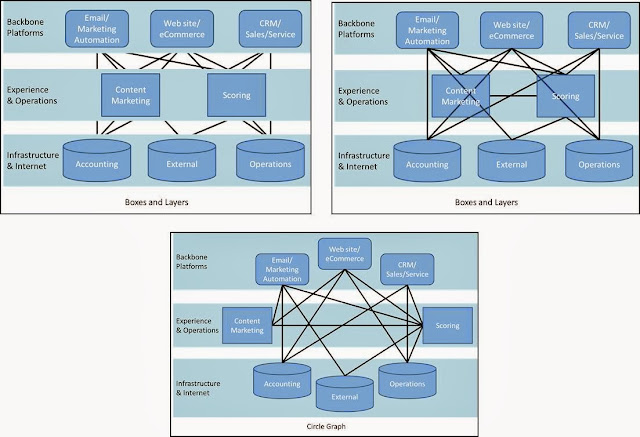
Showing the actual connections between system pairs has another advantage: it lets you represent the architecture as a formal graph, meaning you can compare architectures using standard graph analysis techniques. Even just counting the connections gives a useful measure of relative complexity.
The diagrams below illustrate this nicely: the top picture shows the same architecture as before, which has 14 system-to-system connections (out of 28 possible pairs, another useful metric, even though some wouldn't make much sense). The bottom picture shows the same systems with everything connecting through a central database: now there are only eight connections and several missing system-to-system links have been provided automatically. If you want a crude approximation of how much a central database reduces complexity (and hence cost), this is good place to start.

The circle approach has other advantages, such as making it easier to see missing connections between systems. I'm working on it as part of a larger methodology to help marketers assess the value of a Customer Data Platform and plan for deployment. I expect to be describing the full approach over the next couple of months...stay tuned for details.
______________________________________________________________________________________
*a name that virtually demands a sidekick. Obvious choice is “Data Boy” but I’m sure my readers can think of something more clever.
† and appreciate the credit has he given me.
** Yes, I do recognize how fortunate I am that this is of my major problems in life.
†† Not really. The snake dream is how Kekulé discovered the structure of benzene. But it makes a good story, eh?

I’m delighted that Scott has found the CDP concept useful† and am in turn happy to adopt his distinction between Backbone Platforms and the other types of marketing applications. The Backbone Platforms are, indeed, platforms that support most Experience and Operations systems, enabling those systems to focus on particular tasks without creating complete customer management environments of their own. That's a difference worth noting.
Scott never claimed that his diagram illustrates a precise relationship among the components, so it's no criticism to point out that it doesn't. Experience and Operations systems sometimes connect with Backbone Platforms through a Middleware system, but more often they connect with the Backbone Platforms directly. In fact, some of the Experience and Operations systems connect with multiple Platforms, serving as sort of do-it-yourself Middleware. The challenge of illustrating this becomes clear when you try adding lines to show how the classes of systems interact with each other – it’s not as simple as connecting the adjacent layers on Scott’s diagram.
Being a visual thinker, I found this ambiguity to be endlessly disturbing.** Try as I might, I couldn’t rearrange the boxes to show the relationships correctly.
Then, I had a dream about a snake rolling downhill with its tail in its mouth, and discovered the answer: the systems could all be arranged in a circle graph, allowing any two to be connected directly.††
I must admit that I am ridiculously pleased with this approach. I know there’s nothing especially brilliant about circle graphs per se, but I’ve never seen one used in an architecture diagram. The pictures below illustrate, at least to my satisfaction, how much more clearly the circle graph shows relationships among systems than the traditional boxes and layers. Each diagram shows the same relationships among a small set of systems. The top left picture uses the traditional approach of showing only the links between categories – as you see, this hides any connections between non-adjacent components or individual systems. The top right picture shows the direct connections between systems, but it’s hard to read because lines cross behind the boxes. True, you could use curved lines to avoid this, but that quickly becomes impractical. The bottom picture shows the circle approach: here, the lines themselves might cross but no connections are hidden. The relative clarity of the circle graph grows as more systems are introduced.

Showing the actual connections between system pairs has another advantage: it lets you represent the architecture as a formal graph, meaning you can compare architectures using standard graph analysis techniques. Even just counting the connections gives a useful measure of relative complexity.
The diagrams below illustrate this nicely: the top picture shows the same architecture as before, which has 14 system-to-system connections (out of 28 possible pairs, another useful metric, even though some wouldn't make much sense). The bottom picture shows the same systems with everything connecting through a central database: now there are only eight connections and several missing system-to-system links have been provided automatically. If you want a crude approximation of how much a central database reduces complexity (and hence cost), this is good place to start.

The circle approach has other advantages, such as making it easier to see missing connections between systems. I'm working on it as part of a larger methodology to help marketers assess the value of a Customer Data Platform and plan for deployment. I expect to be describing the full approach over the next couple of months...stay tuned for details.
______________________________________________________________________________________
*a name that virtually demands a sidekick. Obvious choice is “Data Boy” but I’m sure my readers can think of something more clever.
† and appreciate the credit has he given me.
** Yes, I do recognize how fortunate I am that this is of my major problems in life.
†† Not really. The snake dream is how Kekulé discovered the structure of benzene. But it makes a good story, eh?
Monday, January 06, 2014
BrightInfo: Content Recommendations Made Simple
I spent much of last year writing about Customer Data Platform systems and have reviews on tap for a half dozen more. But I thought I’d start out 2014 with something different, just to show I’m not totally obsessed. Although, as you’ll see shortly, there’s a CDP angle to this story as well.
Today's topic is BrightInfo, which uses semantic technology to automatically recommend the most relevant content to Web site and blog visitors. Specifically, the system crawls the client’s Web site and blog to find and classify existing content, and then tracks visitor behavior to offer new content relevant to what the visitor has already selected. The recommendations can be presented on a fixed area of a page or as a pop-up. They can appear continuously or only when a visitor indicates they are about to leave by moving their mouse towards the browser’s URL bar. BrightInfo uses Javascript tags and cookies to track visitors over time, allowing it to base recommendations on individual behavior as well as content similarity and popularity. Behaviors across Web sites, landing pages, and blogs are all tracked by the same cookie, so each recommendation reflects a consolidated history. However, the system does not incorporate other information sources – meaning it can’t use the central customer data a CDP would provide. Nor, at present, does the system support mobile, which doesn't use cookies and requires different display methods. But this is coming soon.
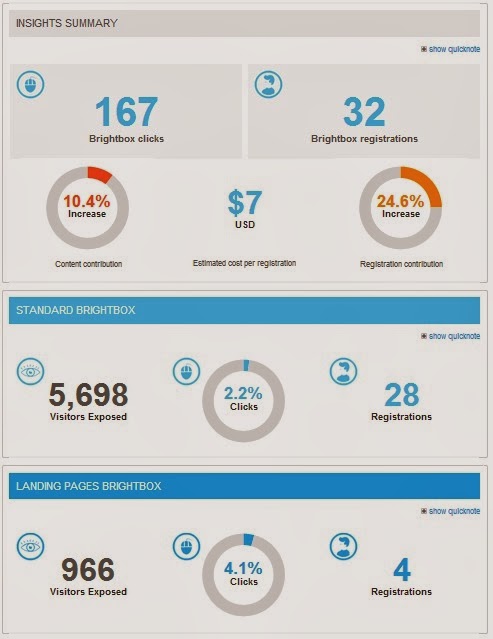
It should be fairly easy for BrightInfo to access external data sources, since the necessary changes are unrelated to its core technologies of semantic analysis and recommendations. Most companies today could probably use the system as it stands, since they lack a centralized customer database or policies to coordinate customer treatments across channels. BrightInfo already lets users override the purely algorithmic recommendations by specifying that some content will be shown in all circumstances, that other content will never be shown, and that recommendations will appear only on specified pages. Sophisticated marketers might want more refined controls, such as limits on how often the same content is offered or recommendations based on expected response value rather than the simple click rate. But BrightInfo is targeted at small and mid-size businesses, which are less concerned with such refinements.
What those businesses do care about are easy deployment and low cost. BrightInfo provides those by automating the content discovery and classification, running as a service rather than installed software, and pricing based on visitor volume. Javascript tags, cookies, and isolation from other data sources also simplify deployment, whatever their other drawbacks. Measurement is similarly simplified by providing reports that compare how many clicks were made on native content and system-recommended content. Clicks on system-recommended content are a rough measure of system-added activity, although presumably some visitors would have chosen other content had the recommendations not been available. BrightInfo considered setting up formal a/b tests to measure true incremental value, but found that most small and mid-size businesses have too little volume to support this. The company has recently integrated its reporting with Marketo, HubSpot, and Google Analytics.
BrightInfo officially released its product last September, after about a year of development. The underlying semantic and recommendation technologies came from sister company Softlib Software, which uses them for automated service and knowledge management and was founded in 2004. Pricing is published on the BrightInfo Web site and is free up to 1,000 visitors per month, $89 per month up to 5,000 visitors, and $224 per month up to 15,000 visitors. The system has several dozen clients.
To summarize, then: BrightInfo provides a very simple, very low cost way to increase engagement with Web visitors by making targeted content recommendations. It's worth knowing about because traditional recommendation engines are often harder to deploy and more expensive.
But what’s the CDP angle? It’s not simply that BrightInfo is an example of an application that could use the customer data in a CDP to make more accurate recommendations. It’s actually a somewhat deeper question of where the recommendation functions belong in a CDP-based architecture. I’d argue that recommendations should be part of the central platform, so they can be used to coordinate treatments across all touchpoints. In other words, it’s probably wrong to imagine BrightInfo as an application that attaches to a CDP and uses its data to improve Web and blog results. Rather, in an ideal world, BrightInfo’s technology would be used within the CDP to generate recommendation that the CDP itself feeds to all applications. This is pretty theoretical and largely irrelevant to BrightInfo itself, which is targeted at companies that don’t have a CDP in the first place. But as marketing technology continues to evolve and more companies have CDPs, or centralized customer databases by any other name, it’s important to understand how the pieces should fit together.
Today's topic is BrightInfo, which uses semantic technology to automatically recommend the most relevant content to Web site and blog visitors. Specifically, the system crawls the client’s Web site and blog to find and classify existing content, and then tracks visitor behavior to offer new content relevant to what the visitor has already selected. The recommendations can be presented on a fixed area of a page or as a pop-up. They can appear continuously or only when a visitor indicates they are about to leave by moving their mouse towards the browser’s URL bar. BrightInfo uses Javascript tags and cookies to track visitors over time, allowing it to base recommendations on individual behavior as well as content similarity and popularity. Behaviors across Web sites, landing pages, and blogs are all tracked by the same cookie, so each recommendation reflects a consolidated history. However, the system does not incorporate other information sources – meaning it can’t use the central customer data a CDP would provide. Nor, at present, does the system support mobile, which doesn't use cookies and requires different display methods. But this is coming soon.
It should be fairly easy for BrightInfo to access external data sources, since the necessary changes are unrelated to its core technologies of semantic analysis and recommendations. Most companies today could probably use the system as it stands, since they lack a centralized customer database or policies to coordinate customer treatments across channels. BrightInfo already lets users override the purely algorithmic recommendations by specifying that some content will be shown in all circumstances, that other content will never be shown, and that recommendations will appear only on specified pages. Sophisticated marketers might want more refined controls, such as limits on how often the same content is offered or recommendations based on expected response value rather than the simple click rate. But BrightInfo is targeted at small and mid-size businesses, which are less concerned with such refinements.
What those businesses do care about are easy deployment and low cost. BrightInfo provides those by automating the content discovery and classification, running as a service rather than installed software, and pricing based on visitor volume. Javascript tags, cookies, and isolation from other data sources also simplify deployment, whatever their other drawbacks. Measurement is similarly simplified by providing reports that compare how many clicks were made on native content and system-recommended content. Clicks on system-recommended content are a rough measure of system-added activity, although presumably some visitors would have chosen other content had the recommendations not been available. BrightInfo considered setting up formal a/b tests to measure true incremental value, but found that most small and mid-size businesses have too little volume to support this. The company has recently integrated its reporting with Marketo, HubSpot, and Google Analytics.
BrightInfo officially released its product last September, after about a year of development. The underlying semantic and recommendation technologies came from sister company Softlib Software, which uses them for automated service and knowledge management and was founded in 2004. Pricing is published on the BrightInfo Web site and is free up to 1,000 visitors per month, $89 per month up to 5,000 visitors, and $224 per month up to 15,000 visitors. The system has several dozen clients.
To summarize, then: BrightInfo provides a very simple, very low cost way to increase engagement with Web visitors by making targeted content recommendations. It's worth knowing about because traditional recommendation engines are often harder to deploy and more expensive.
But what’s the CDP angle? It’s not simply that BrightInfo is an example of an application that could use the customer data in a CDP to make more accurate recommendations. It’s actually a somewhat deeper question of where the recommendation functions belong in a CDP-based architecture. I’d argue that recommendations should be part of the central platform, so they can be used to coordinate treatments across all touchpoints. In other words, it’s probably wrong to imagine BrightInfo as an application that attaches to a CDP and uses its data to improve Web and blog results. Rather, in an ideal world, BrightInfo’s technology would be used within the CDP to generate recommendation that the CDP itself feeds to all applications. This is pretty theoretical and largely irrelevant to BrightInfo itself, which is targeted at companies that don’t have a CDP in the first place. But as marketing technology continues to evolve and more companies have CDPs, or centralized customer databases by any other name, it’s important to understand how the pieces should fit together.
Subscribe to:
Posts (Atom)