My first question when Marketo announced its new mobile app connector this week wasn’t, “What cool new things can marketers do?” but “Where is the data stored?”
It's not that I'm obsessed with data. (Well, maybe a little.) But one of Marketo’s biggest technical weaknesses has always been an inflexible data model. Specifically, it hasn’t let users set up custom objects (although they’ve been able to import custom objects from Salesforce.com or Microsoft Dynamics CRM). This was a common limitation among early B2B marketing automation products but many have removed it over the years. Indeed, even $300 per month Ontraport is about to add custom objects (and does a good job of explaining the concept in a typically wry video).
Sure enough, when I finally connected with Marketo SVP Products and Engineering Steve Sloan, he revealed that the mobile data is being managed through a new custom objects capability – one that Marketo didn’t announce prominently because they felt Marketing Nation attendees wouldn’t be interested. I suspect that underestimates the technical savvy of Marketo users, but no matter.
For people who understand such things, the importance is clear: custom objects open the path to Marketo supporting new channels and interactions, removing a major roadblock to competing as the core decision engine of an enterprise-grade customer management system. This will be more true once Marketo finishes its planned migration of activity data to a combination of Hadoop and HBase. This will give vastly greater scale and flexibility than the current relational database (MySQL). Sloan said that even before this happens, data in the custom objects will be fully available to Marketo rules for list building and campaign flows.
The strategic importance of this development to Marketo is high. Marketo is increasingly squeezed between enterprise marketing suites and smaller, cheaper B2B marketing automation specialists. Its limited data structure and scale were primary obstacles to competing in the B2C market, where custom data models have always been standard. Even in B2B, Marketo’s ability to serve the largest enterprises was limited without custom objects. While this one change won’t magically make Marketo a success in those markets, its prospects without the change were bleak.
All that being said, the immediate impact of Marketo’s new mobile and ad integration features is modest. The mobile features let Marketo capture actions within a mobile app and push out messages in response. This is pretty standard functionality, although Marketo users will benefit from coordinating the in-app messages with messages in other channels. Similarly, the advertising features make it simpler to export audiences to receive ads in Facebook, LinkedIn, and Google and to find similar audiences in ad platforms Turn, MediaMath, and Rocketfuel. Again, this is pretty standard retargeting and look-alike targeting, with the advantage of tailoring messages to people in different stages in Marketo campaigns. The actual matching of Marketo contacts to the advertising audiences will rely on whatever methods the ad platform has available, not on anything unique to the Marketo integration.
In fact, I’d say the audience reaction to the announcement of these features during the Marketing Nation keynote was pretty subdued. (They were probably more excited that they can now manage their email campaigns from their mobile devices.) So maybe next time, Marketo should make the technical announcements during the big speech: at least the martech geeks will be on their chairs cheering, even if everybody else just keeps looking at their email or cat videos or whatever it is they do to amuse themselves during these things.
Note: for an excellent in-depth review of what Marketo announced, look at this post from Perkuto.
Showing posts with label marketo. Show all posts
Friday, April 17, 2015
Wednesday, April 15, 2015
Marketo Conference: Is Predictive Modeling The Future of Marketing Automation?
Marketo held its annual Marketing Nation Summit this week, hosting 4,000+ clients and partners. The event seemed relatively subdued for Marketo – I didn’t spot one costumed character – but the over-all atmosphere was positive. The company made two major product announcements, expanding the reach of Marketo campaigns into mobile apps and display ad retargeting. Those struck me as strategically valuable, helping to secure Marketo’s place at the center of its users’ customer management infrastructure. Unfortunately, I wasn’t able to gather enough technical detail to understand how they work. I’ll try to write about them once that happens.
As usual for me, I spent much of conference prowling the exhibit hall checking out old and new vendors. Marketo has attracted a respectable array of partners who extend its capabilities. By far the most notable presence was predictive modeling vendors – Leadspace, Mintigo, Lattice Engines, Infer, Fliptop, SalesPredict, 6Sense, Everstring plus maybe some others I’m forgetting. I’ve written about each of these individually in the past, but seeing them in the same place brought home the very crowded nature of this market. It also prompted many interesting discussions with them vendors themselves, who, not surprisingly, are an especially analytical and thoughtful group.
Many of those conversations started with the large number of vendors now in the space and how many would ultimately survive. I actually found this concern a bit overwrought – there are other segments, most obviously B2B marketing automation itself, that support many dozens of similar vendors. By that standard, predictive analytics is still far from overcrowded. At the risk of some unfair (and unjustifiably condescending) stereotyping, I’ll propose that part of their concern comes from a sort of Spock-like rationality that says only a few different products are really needed in any given segment. That may indeed be logically correct, but real markets often support more players than anyone needs. I see nothing inherent in the predictive marketing industry that will limit it to a few survivors.
In fact, almost immediately after wondering whether there were too many choices, many vendors observed that they were already sorting themselves into specialists serving different customer types or applications. Some products sell mostly to smaller companies, some to companies with many different products, some to customers who want new prospect names, some who want to incorporate external behaviors, and so on. Here, the vendors’ perception is more nuanced than my own; they see differences that I hadn’t noticed. Despite these distinctions, I still expect that most vendors will broaden rather than narrow their scope over time. But maybe that’s my own inner Spock looking for more simplicity than really exists.
One factor simplifying buyers' selection decision was that nearly all clients test multiple systems before making a purchase. This contrasts sharply with marketing automation, where many companies still buy the first system they consider and few conduct an extensive pre-purchase trial. The main reason for this anomaly is that modeling systems are highly testable: buyers give each competitor a set of data, let them build a model, and can easily see whose scores do a better job of identifying right people. It also probably helps that people buying predictive systems are generally more sophisticated marketers. There's some danger to relying extensively on test results, since they obscure other factors such as time to build a model and how well models retain their performance over time. I was also a bit puzzled that nearly every vendor reported winning nearly every test. I don't think that's mathematically possible.
Probably the most interesting set of discussions revolved around the long-term relation of predictive functions to the rest of the customer management infrastructure. This was sometimes framed as whether predictive modeling will be a "feature" embedded in other systems or a "product" sold on its own. My intuition is it's a feature: marketers simply want to select on model scores the same way they’d select any other customer attribute, so scoring should be baked into whatever marketing system they’re using. But the counter argument starts with the empirical observation that marketing automation vendors haven’t done this, and speculates that maybe there’s a sound reason: not just that they don’t know how or it’s too hard, but that modeling systems need data that is stored outside of marketing automation or should connect with multiple execution systems that marketing automation does not. The data argument makes some sense to me, although I think marketing automation itself should also connect with those external sources. I don’t buy the execution system argument. Marketing automation should select customer treatments for all execution systems; scores should be an input to the marketing automation selections.
But there’s a deeper version of this question that asks about the role of predictive analytics within the customer management process itself. Marketo CEO Phil Fernandez touched on this indirectly during his keynote, when he observed that literally mapping the customer journey as an elaborate flow chart is inherently unrealistic, because customers follow many more paths than any manageable chart could contain. He also came back to it with the image of a “self-driving” marketing automation system that, like a self-driving car, would let the user specify a goal and then handle all the details independently. Both examples suggest replacing marketer-created rules to guide customer treatments with predictive systems that select the best action in each situation. As several of the predictive vendors pointed out to me (with what sounded like the voice of painful experience), this requires marketers to give up more control than they may find comfortable – either because machines really can’t do this or because it would put marketers out of a job if the machines could. Personally, I'll bet on the machines in this contest, although with many caveats about how long it will take before humans are fully or even largely replaced.
However, and here’s the key point that came up in the most interesting discussions: predictive models can’t do this alone. At the most abstract, marketing involves picking the best customer treatment in each situation. But models can only pick from the set of treatments that are available. In other words, someone (or some thing) has to create those treatments and, prior to that, decide what treatments to create. In current marketing practice, those decisions are made with a content map that plots available content against customer life stages and personas. This makes sure that appropriate content is available for each situation. Proper value measurement – which means estimating the incremental impact on lifetime value of each marketing message – also relies on persons and life stages as a framework. So any machine-based approach to customer management has to generate personas, life stages, and content to be complete.*
I see no inherent reason that machines couldn’t ultimately do the persona and life stage definition. None of vendors do it today, although several appear to have given it some thought. Automated content creation is already available to a surprising degree and will only get better. But, to get back to my point: the technologies to do these things are very different from predictive modeling. So if new technology is to replace marketing automation as the controller of customer treatments, that technology will include much more than predictive modeling by itself.
_________________________________________________________________________
* Yes, it has occurred to me that a fully machine driven system might not need personas and lifestages, which are aggregations needed because humans can't deal with each person separately. But marketers won't adopt that approach until (a) machines can also create content without the persona / lifestage framework and (b) humans are willing to trust the black box so completely they don't need personas and lifestages to help understand what the machines are up to. On the other hand, you could argue that content recommendation engines like BrightInfo (also at the Marketo show) already work without personas and lifestages...although I think they usually focus on a near-term action like conversion rather than long-term impact like incremental lifetime value.
As usual for me, I spent much of conference prowling the exhibit hall checking out old and new vendors. Marketo has attracted a respectable array of partners who extend its capabilities. By far the most notable presence was predictive modeling vendors – Leadspace, Mintigo, Lattice Engines, Infer, Fliptop, SalesPredict, 6Sense, Everstring plus maybe some others I’m forgetting. I’ve written about each of these individually in the past, but seeing them in the same place brought home the very crowded nature of this market. It also prompted many interesting discussions with them vendors themselves, who, not surprisingly, are an especially analytical and thoughtful group.
Many of those conversations started with the large number of vendors now in the space and how many would ultimately survive. I actually found this concern a bit overwrought – there are other segments, most obviously B2B marketing automation itself, that support many dozens of similar vendors. By that standard, predictive analytics is still far from overcrowded. At the risk of some unfair (and unjustifiably condescending) stereotyping, I’ll propose that part of their concern comes from a sort of Spock-like rationality that says only a few different products are really needed in any given segment. That may indeed be logically correct, but real markets often support more players than anyone needs. I see nothing inherent in the predictive marketing industry that will limit it to a few survivors.
In fact, almost immediately after wondering whether there were too many choices, many vendors observed that they were already sorting themselves into specialists serving different customer types or applications. Some products sell mostly to smaller companies, some to companies with many different products, some to customers who want new prospect names, some who want to incorporate external behaviors, and so on. Here, the vendors’ perception is more nuanced than my own; they see differences that I hadn’t noticed. Despite these distinctions, I still expect that most vendors will broaden rather than narrow their scope over time. But maybe that’s my own inner Spock looking for more simplicity than really exists.
One factor simplifying buyers' selection decision was that nearly all clients test multiple systems before making a purchase. This contrasts sharply with marketing automation, where many companies still buy the first system they consider and few conduct an extensive pre-purchase trial. The main reason for this anomaly is that modeling systems are highly testable: buyers give each competitor a set of data, let them build a model, and can easily see whose scores do a better job of identifying right people. It also probably helps that people buying predictive systems are generally more sophisticated marketers. There's some danger to relying extensively on test results, since they obscure other factors such as time to build a model and how well models retain their performance over time. I was also a bit puzzled that nearly every vendor reported winning nearly every test. I don't think that's mathematically possible.
Probably the most interesting set of discussions revolved around the long-term relation of predictive functions to the rest of the customer management infrastructure. This was sometimes framed as whether predictive modeling will be a "feature" embedded in other systems or a "product" sold on its own. My intuition is it's a feature: marketers simply want to select on model scores the same way they’d select any other customer attribute, so scoring should be baked into whatever marketing system they’re using. But the counter argument starts with the empirical observation that marketing automation vendors haven’t done this, and speculates that maybe there’s a sound reason: not just that they don’t know how or it’s too hard, but that modeling systems need data that is stored outside of marketing automation or should connect with multiple execution systems that marketing automation does not. The data argument makes some sense to me, although I think marketing automation itself should also connect with those external sources. I don’t buy the execution system argument. Marketing automation should select customer treatments for all execution systems; scores should be an input to the marketing automation selections.
But there’s a deeper version of this question that asks about the role of predictive analytics within the customer management process itself. Marketo CEO Phil Fernandez touched on this indirectly during his keynote, when he observed that literally mapping the customer journey as an elaborate flow chart is inherently unrealistic, because customers follow many more paths than any manageable chart could contain. He also came back to it with the image of a “self-driving” marketing automation system that, like a self-driving car, would let the user specify a goal and then handle all the details independently. Both examples suggest replacing marketer-created rules to guide customer treatments with predictive systems that select the best action in each situation. As several of the predictive vendors pointed out to me (with what sounded like the voice of painful experience), this requires marketers to give up more control than they may find comfortable – either because machines really can’t do this or because it would put marketers out of a job if the machines could. Personally, I'll bet on the machines in this contest, although with many caveats about how long it will take before humans are fully or even largely replaced.
However, and here’s the key point that came up in the most interesting discussions: predictive models can’t do this alone. At the most abstract, marketing involves picking the best customer treatment in each situation. But models can only pick from the set of treatments that are available. In other words, someone (or some thing) has to create those treatments and, prior to that, decide what treatments to create. In current marketing practice, those decisions are made with a content map that plots available content against customer life stages and personas. This makes sure that appropriate content is available for each situation. Proper value measurement – which means estimating the incremental impact on lifetime value of each marketing message – also relies on persons and life stages as a framework. So any machine-based approach to customer management has to generate personas, life stages, and content to be complete.*
I see no inherent reason that machines couldn’t ultimately do the persona and life stage definition. None of vendors do it today, although several appear to have given it some thought. Automated content creation is already available to a surprising degree and will only get better. But, to get back to my point: the technologies to do these things are very different from predictive modeling. So if new technology is to replace marketing automation as the controller of customer treatments, that technology will include much more than predictive modeling by itself.
_________________________________________________________________________
* Yes, it has occurred to me that a fully machine driven system might not need personas and lifestages, which are aggregations needed because humans can't deal with each person separately. But marketers won't adopt that approach until (a) machines can also create content without the persona / lifestage framework and (b) humans are willing to trust the black box so completely they don't need personas and lifestages to help understand what the machines are up to. On the other hand, you could argue that content recommendation engines like BrightInfo (also at the Marketo show) already work without personas and lifestages...although I think they usually focus on a near-term action like conversion rather than long-term impact like incremental lifetime value.
Thursday, April 10, 2014
Marketo Conference: Small Changes, Big Picture
Marketo wrapped up its three day Marketing Nation conference yesterday, having once more displayed its own marketing prowess by attracting national media attention (see here and here) with an appearance by Hillary Clinton. Still, the real focus was on Marketo’s own announcements, which included several product changes and a new positioning. (I wasn’t at the conference but Marketo briefed me on their plans.)
The product changes were quite modest: new search engine optimization features for entry level users; a global marketing calendar; and relabeling of InsightEra, which Marketo purchased in December, as Marketo Real Time Personalization. The SEO and calendar features are still in beta and will be rolled out this spring and summer. Real Time Personalization already exists, obviously, and will remain a separate product that can work with any marketing automation system.
The company also announced a deal to use Acxiom data for personalization and, somewhat more interesting, to coordinate advertising messages purchased through Acxiom with email and Web site messages delivered by Marketo. This borders on integration of Web display with marketing automation, an extremely important trend. But it's Acxiom, not Marketo, doing the hard part of matching advertising audiences with identified individuals.
Marketo placed these changes in the context of unveiling itself as “customer engagement platform”. Ordinarily, I don’t pay much attention to these announcements: after all, Marketo has pivoted more than Ben Franklin dancing a gavotte. But Marketo had the hype-blasters turned to 11, so the news is impossible to ignore.
My main reaction was, what’s new? Marketo has described itself as a platform for at least a year now (see this press release, for example) and I’ve been talking about marketing systems as platforms for even longer. More important, the value of platforms has been widely recognized through the tech industry for decades: classic examples include Salesforce.com’s own AppExchange, Apple’s iPhone AppStore, Microsoft’s operating system software, and, going way back, the original IBM System 360. The appeal of the platform model is obvious: platform systems are quasi-monopolies (or actual monopolies), so their owners can charge high prices while the app developers compete brutally with each other and must keep prices low. Consumers are intuitively reluctant to accept the monopoly relationship, but usually trade away their freedom because no other choice available or in exchange for convenience and low total cost. App developers make a similar calculation, trading lower margins and less control for the larger marketplace and less development expense.
The trick to winning these benefits is becoming a platform in the first place. This requires a large customer base, easy access by app developers, enough power to be useful, and a barrier that keeps the monopoly intact. Salesforce.com, Oracle, IBM, Adobe, Microsoft, and other contenders to own “customer experience platforms” all did it the hard way, by first building up a big customer base for their conventional systems and then opening that universe as a platform to app developers.
Every major marketing automation vendor has tried to do the same. But their customer bases are nowhere near as large, so what’s actually happened in most cases is that app developers have integrated their systems with multiple “platforms”. One of the more subtle tricks in the platform playbook is to prevent this by making your system different enough from others that it isn't easy to support them as well. This is usually done by means of a uniquely structured application program interface. But developers won’t put up with this unless a platform offers a big enough audience or other benefits to make it worthwhile. It’s doubtful that Marketo, or any other remaining independent marketing automation vendor, has the market power to do this.
Let me be clear. I’m not saying the platform approach is a bad one for Marketo. I’m saying they lack the market strength to erect barriers to collect monopoly rents. They’ll have to keep their APIs simple enough that app developers can integrate with other marketing automation systems as well. This means Marketo will be competing with other platforms for app developer relationships and can’t rely on Marketo-exclusive apps to attract new customers or prevent old ones from leaving. This is good news for app developers and marketers, if not for Marketo investors.
But it’s not enough to decide to be a platform. You have to decide whom the platform will serve and what functions it will include. In the case of customer management, the big question is whether the marketing system should be separate from sales and service systems. The obvious answer is they should be the same: after all, we want a unified customer experience across the entire life cycle, so all departments delivering those experiences should be on the same platform. Indeed, Marketo seems to imply as much with the term “customer experience platform”.
But in an excellent blog post describing the new positioning, Marketo VP Marketing and co-founder Jon Miller makes clear that Marketo believes marketers alone are in charge: “marketers are responsible for an all-consuming process that starts with attracting initial buyer attention and continues all the way to locking in customer loyalty and advocacy.” To remove any doubt, he later clarifies that the “customer engagement platform is the core system of record for marketing, just like CRM is the system for sales and Human Capital Management is the system for HR.”
I’d say this approach is debatable. It will probably be harder for a marketing-owned system to integrate with customer-facing systems in other departments. Certainly other “marketing cloud” providers like Salesforce.com and Oracle would argue otherwise – that, at the least, there should be a shared customer database, and probably some shared processes to select customer treatments, even if those treatments are delivered by channel- or department-specific systems.
Marketo’s conclusion does position them as the best choice for marketing buyers, since they are the only marketing platform vendor with such a limited scope. To quote Miller again: “The marketing platform provider should be a partner to marketing, a company that truly understands what’s happening in marketing and that 'has marketing’s back'. Your marketing platform is not an add-on to sales technology, or a component of an IT solution. It’s the core foundation to all aspects of marketing success. That’s why at Marketo, we think that a marketing platform should come from a company 100% focused on marketing.” Fair enough.
The second big question is what’s included in the core platform and what’s provided by partners. In many ways, this is where the discussion moves from theory to reality, since there are specific choices to be made. Marketo’s published diagram lists three major functions at the platform layer – decisioning (a.k.a. “the brain”), database (“marketing system of record”) and analytics. They put an application layer on top of that, including marketing automation, interactions (real time personalization, search engine optimization, social marketing), and operations (marketing management). The third layer includes delivery in different channels (email, social, landing pages, sales, web/mobile personalization, search). APIs are available to connect each layer to third party applications.
My own definition of the platform layer is pretty much the same as Marketo’s. But Miller’s post lists six components of a marketing platform, corresponding to both the platform and application layers. And Marketo actually delivers functionality across all three layers. In other words, Marketo is not actually selling the platform by itself: it sells the platform in combination with applications and delivery systems, some of which are included and some of which are optional.
At first I thought this violated the platform concept, since the vendor’s own tools will likely have tighter integration with the rest of the system than the APIs make available to third parties. But, on reflection, there’s no requirement for a platform to be fully “application neutral”. Marketo seems to be proposing to sell a basic set of applications and delivery systems and let clients supplement them with third party applications as needed. APIs are an escape hatch for emergency use only, not Lego blocks that let users build a custom collection of products from scratch.
There’s a good case to be made for bundling the platform with applications and execution systems, boiling down to that it saves marketers from having to make a lot of choices before they get started. It also justifies a much higher price than the platform alone, especially if the monopoly position is unavailable. Of course, this ends up looking an awful lot like a traditional marketing software suite, which is exactly what Marketo was and remains under the hood. Marketers excited by the platform vision should look very closely at the reality before assuming that Marketo, or anyone else, can deliver the benefits they expect.
The product changes were quite modest: new search engine optimization features for entry level users; a global marketing calendar; and relabeling of InsightEra, which Marketo purchased in December, as Marketo Real Time Personalization. The SEO and calendar features are still in beta and will be rolled out this spring and summer. Real Time Personalization already exists, obviously, and will remain a separate product that can work with any marketing automation system.
The company also announced a deal to use Acxiom data for personalization and, somewhat more interesting, to coordinate advertising messages purchased through Acxiom with email and Web site messages delivered by Marketo. This borders on integration of Web display with marketing automation, an extremely important trend. But it's Acxiom, not Marketo, doing the hard part of matching advertising audiences with identified individuals.
Marketo placed these changes in the context of unveiling itself as “customer engagement platform”. Ordinarily, I don’t pay much attention to these announcements: after all, Marketo has pivoted more than Ben Franklin dancing a gavotte. But Marketo had the hype-blasters turned to 11, so the news is impossible to ignore.
My main reaction was, what’s new? Marketo has described itself as a platform for at least a year now (see this press release, for example) and I’ve been talking about marketing systems as platforms for even longer. More important, the value of platforms has been widely recognized through the tech industry for decades: classic examples include Salesforce.com’s own AppExchange, Apple’s iPhone AppStore, Microsoft’s operating system software, and, going way back, the original IBM System 360. The appeal of the platform model is obvious: platform systems are quasi-monopolies (or actual monopolies), so their owners can charge high prices while the app developers compete brutally with each other and must keep prices low. Consumers are intuitively reluctant to accept the monopoly relationship, but usually trade away their freedom because no other choice available or in exchange for convenience and low total cost. App developers make a similar calculation, trading lower margins and less control for the larger marketplace and less development expense.
The trick to winning these benefits is becoming a platform in the first place. This requires a large customer base, easy access by app developers, enough power to be useful, and a barrier that keeps the monopoly intact. Salesforce.com, Oracle, IBM, Adobe, Microsoft, and other contenders to own “customer experience platforms” all did it the hard way, by first building up a big customer base for their conventional systems and then opening that universe as a platform to app developers.
Every major marketing automation vendor has tried to do the same. But their customer bases are nowhere near as large, so what’s actually happened in most cases is that app developers have integrated their systems with multiple “platforms”. One of the more subtle tricks in the platform playbook is to prevent this by making your system different enough from others that it isn't easy to support them as well. This is usually done by means of a uniquely structured application program interface. But developers won’t put up with this unless a platform offers a big enough audience or other benefits to make it worthwhile. It’s doubtful that Marketo, or any other remaining independent marketing automation vendor, has the market power to do this.
Let me be clear. I’m not saying the platform approach is a bad one for Marketo. I’m saying they lack the market strength to erect barriers to collect monopoly rents. They’ll have to keep their APIs simple enough that app developers can integrate with other marketing automation systems as well. This means Marketo will be competing with other platforms for app developer relationships and can’t rely on Marketo-exclusive apps to attract new customers or prevent old ones from leaving. This is good news for app developers and marketers, if not for Marketo investors.
But it’s not enough to decide to be a platform. You have to decide whom the platform will serve and what functions it will include. In the case of customer management, the big question is whether the marketing system should be separate from sales and service systems. The obvious answer is they should be the same: after all, we want a unified customer experience across the entire life cycle, so all departments delivering those experiences should be on the same platform. Indeed, Marketo seems to imply as much with the term “customer experience platform”.
But in an excellent blog post describing the new positioning, Marketo VP Marketing and co-founder Jon Miller makes clear that Marketo believes marketers alone are in charge: “marketers are responsible for an all-consuming process that starts with attracting initial buyer attention and continues all the way to locking in customer loyalty and advocacy.” To remove any doubt, he later clarifies that the “customer engagement platform is the core system of record for marketing, just like CRM is the system for sales and Human Capital Management is the system for HR.”
I’d say this approach is debatable. It will probably be harder for a marketing-owned system to integrate with customer-facing systems in other departments. Certainly other “marketing cloud” providers like Salesforce.com and Oracle would argue otherwise – that, at the least, there should be a shared customer database, and probably some shared processes to select customer treatments, even if those treatments are delivered by channel- or department-specific systems.
Marketo’s conclusion does position them as the best choice for marketing buyers, since they are the only marketing platform vendor with such a limited scope. To quote Miller again: “The marketing platform provider should be a partner to marketing, a company that truly understands what’s happening in marketing and that 'has marketing’s back'. Your marketing platform is not an add-on to sales technology, or a component of an IT solution. It’s the core foundation to all aspects of marketing success. That’s why at Marketo, we think that a marketing platform should come from a company 100% focused on marketing.” Fair enough.
The second big question is what’s included in the core platform and what’s provided by partners. In many ways, this is where the discussion moves from theory to reality, since there are specific choices to be made. Marketo’s published diagram lists three major functions at the platform layer – decisioning (a.k.a. “the brain”), database (“marketing system of record”) and analytics. They put an application layer on top of that, including marketing automation, interactions (real time personalization, search engine optimization, social marketing), and operations (marketing management). The third layer includes delivery in different channels (email, social, landing pages, sales, web/mobile personalization, search). APIs are available to connect each layer to third party applications.
My own definition of the platform layer is pretty much the same as Marketo’s. But Miller’s post lists six components of a marketing platform, corresponding to both the platform and application layers. And Marketo actually delivers functionality across all three layers. In other words, Marketo is not actually selling the platform by itself: it sells the platform in combination with applications and delivery systems, some of which are included and some of which are optional.
At first I thought this violated the platform concept, since the vendor’s own tools will likely have tighter integration with the rest of the system than the APIs make available to third parties. But, on reflection, there’s no requirement for a platform to be fully “application neutral”. Marketo seems to be proposing to sell a basic set of applications and delivery systems and let clients supplement them with third party applications as needed. APIs are an escape hatch for emergency use only, not Lego blocks that let users build a custom collection of products from scratch.
There’s a good case to be made for bundling the platform with applications and execution systems, boiling down to that it saves marketers from having to make a lot of choices before they get started. It also justifies a much higher price than the platform alone, especially if the monopoly position is unavailable. Of course, this ends up looking an awful lot like a traditional marketing software suite, which is exactly what Marketo was and remains under the hood. Marketers excited by the platform vision should look very closely at the reality before assuming that Marketo, or anyone else, can deliver the benefits they expect.
Thursday, July 25, 2013
Marketo's Engagement Engine Simplifies Complex Marketing Automation Campaigns
I’ve long said that the best campaign design would be one circle: the system executes the best treatment for each customer, waits a day, and repeats. My point is that elaborate, branching flows are too complex for most marketers to build and maintain, and – because reality is infinitely messier than even the most sophisticated flow chart – will often give customers a sub-optimal treatment.
It’s probably just as well that no vendor has ever built a system based on my design. But the good folks at Marketo have taken a step in that direction with their latest enhancement, which they call an “engagement program”. It has more than one step but does get away from the idea of a rigid, branching campaign flow. Instead, it is organized in terms of “streams” that contain pools of content. Once a customer is added to a stream, the system will offer the next piece of content whenever a contact is due according to the campaign cadence. What’s next is set by the order of content within the stream: users just drag content into the container and put on top the ones they want sent first. The system will go through the content in this order during each execution (which Marketo calls a “cast”), and send each person the first item they have not already received. This avoids duplicate messages and lets the system deliver a defined series of messages without explicitly setting up a sequence. It also makes it almost effortless to insert a high priority message that goes to everyone or to swap out contents as new materials become available.
As you’ll immediately notice, sending the next thing isn’t quite the same as sending the best next thing. In my ideal world, the content would be selected by calculating the value of each item for each individual and taking the highest. This would only take a small tweak in the current approach, which is one reason I like what Marketo has done. Marketo does in fact plan to apply predictive modeling to the system, although I think they're trying to find the most effective content sequence for all customers, rather than scoring content at the individual level.
There’s quite a bit more to the new Marketo feature than I’ve described so far. Content can actually be a multi-step program of its own, such as a sequence of messages to promote and manage a Webinar. Content can also have availability dates that are enforced automatically, so future messages can be added at any time and obsolete messages are automatically discontinued. One thing that’s missing is eligibility rules on content, to let users specify who is allowed to receive it. This is a key feature in traditional decision management systems, permitting customer-level customization within a fixed priority sequence. But Marketo users can achieve the same thing by embedding content within programs, which do have such rules, and adding the programs to the stream instead of the content itself. This is Marketo’s recommended approach because it also provides better data for reporting.
Users can further tailor treatments to customers by setting up multiple streams within one engagement program. Each stream has “transition rules” that pull in qualified customers from other streams. This is less rigid than having selection rules in one stream push customers to another stream. It's not quite clear what happens if someone qualifies for more than one stream: Marketo's position is that would only happen if you make a mistake. I think reality is not so tidy. Marketo is considering letting marketers prioritize the transitions based on the position of the streams, just as they prioritize contents within a stream.
In any event, customers can only be in one stream at a time, so they won’t receive multiple messages from the same engagement program. Whether they receive messages from multiple programs is controlled by Marketo’s standard communication limit features, which can set a maximum number of messages per day and per week. Users can decide whether those limits apply to any particular program. The system also lets salespeople or other programs pause messages from an engagement program to an individual customer.
The new package includes a good set of reports that track content usage and results. They also provide an “engagement score” that combines several success metrics into a single value. Other reports show how many people in the program have run out of content – a good way to ensure the company doesn’t lose touch with them. Surprisingly, there's no report on movement from one stream to the next. But Marketo says this can be set up using their revenue performance management module, which tracks movement of customers across other types of stages.
The engagement engine is included in all Marketo versions, although lower-level versions have some limits. Adding a more powerful version to the Standard edition of Marketo starts at $295 per month.
Added Thought: Marketo engagement programs are a type of state-based system, an idea that has been tried from time to time in marketing systems and is currently the basis of Whatsnexx. As the name implies, state-based systems assign customers to categories and then define treatment rules within each category. Unlike the sequential flow of a traditional multi-step campaign, customers in a state-based system remain in the same category so long as they meet its membership conditions. State-based systems typically reclassify all members at the start of each cycle, which is different from Marketo's approach of relying on transition rules to pull customers from one stream to the next. This means that someone could remain in a stream even though they no longer met its entry criteria. This is something Marketo might want to reconsider.
It’s probably just as well that no vendor has ever built a system based on my design. But the good folks at Marketo have taken a step in that direction with their latest enhancement, which they call an “engagement program”. It has more than one step but does get away from the idea of a rigid, branching campaign flow. Instead, it is organized in terms of “streams” that contain pools of content. Once a customer is added to a stream, the system will offer the next piece of content whenever a contact is due according to the campaign cadence. What’s next is set by the order of content within the stream: users just drag content into the container and put on top the ones they want sent first. The system will go through the content in this order during each execution (which Marketo calls a “cast”), and send each person the first item they have not already received. This avoids duplicate messages and lets the system deliver a defined series of messages without explicitly setting up a sequence. It also makes it almost effortless to insert a high priority message that goes to everyone or to swap out contents as new materials become available.
As you’ll immediately notice, sending the next thing isn’t quite the same as sending the best next thing. In my ideal world, the content would be selected by calculating the value of each item for each individual and taking the highest. This would only take a small tweak in the current approach, which is one reason I like what Marketo has done. Marketo does in fact plan to apply predictive modeling to the system, although I think they're trying to find the most effective content sequence for all customers, rather than scoring content at the individual level.
There’s quite a bit more to the new Marketo feature than I’ve described so far. Content can actually be a multi-step program of its own, such as a sequence of messages to promote and manage a Webinar. Content can also have availability dates that are enforced automatically, so future messages can be added at any time and obsolete messages are automatically discontinued. One thing that’s missing is eligibility rules on content, to let users specify who is allowed to receive it. This is a key feature in traditional decision management systems, permitting customer-level customization within a fixed priority sequence. But Marketo users can achieve the same thing by embedding content within programs, which do have such rules, and adding the programs to the stream instead of the content itself. This is Marketo’s recommended approach because it also provides better data for reporting.
Users can further tailor treatments to customers by setting up multiple streams within one engagement program. Each stream has “transition rules” that pull in qualified customers from other streams. This is less rigid than having selection rules in one stream push customers to another stream. It's not quite clear what happens if someone qualifies for more than one stream: Marketo's position is that would only happen if you make a mistake. I think reality is not so tidy. Marketo is considering letting marketers prioritize the transitions based on the position of the streams, just as they prioritize contents within a stream.
In any event, customers can only be in one stream at a time, so they won’t receive multiple messages from the same engagement program. Whether they receive messages from multiple programs is controlled by Marketo’s standard communication limit features, which can set a maximum number of messages per day and per week. Users can decide whether those limits apply to any particular program. The system also lets salespeople or other programs pause messages from an engagement program to an individual customer.
The new package includes a good set of reports that track content usage and results. They also provide an “engagement score” that combines several success metrics into a single value. Other reports show how many people in the program have run out of content – a good way to ensure the company doesn’t lose touch with them. Surprisingly, there's no report on movement from one stream to the next. But Marketo says this can be set up using their revenue performance management module, which tracks movement of customers across other types of stages.
The engagement engine is included in all Marketo versions, although lower-level versions have some limits. Adding a more powerful version to the Standard edition of Marketo starts at $295 per month.
Added Thought: Marketo engagement programs are a type of state-based system, an idea that has been tried from time to time in marketing systems and is currently the basis of Whatsnexx. As the name implies, state-based systems assign customers to categories and then define treatment rules within each category. Unlike the sequential flow of a traditional multi-step campaign, customers in a state-based system remain in the same category so long as they meet its membership conditions. State-based systems typically reclassify all members at the start of each cycle, which is different from Marketo's approach of relying on transition rules to pull customers from one stream to the next. This means that someone could remain in a stream even though they no longer met its entry criteria. This is something Marketo might want to reconsider.
Wednesday, February 27, 2013
Yesterday's News: Marketo Plans IPO, Eloqua Eyes B2C
There were two bits of news from Marketing Automation Land yesterday: Marketo announced it has filed a draft registration statement for an initial public offering, and Eloqua CEO Joe Payne was quoted as saying his company plans to expand into business-to-consumer marketing.
The Marketo news is long-expected. CEO Phil Fernandez said last September that the company planned an IPO for first half of 2013, so they are pretty much on schedule. Of course, it’s still possible that someone would purchase the company instead, but the asking price is probably too high, and the prospect of an IPO just made it higher. No word on timing of the actual filing. Hopefully this means we soon get to see a filing statement with lots of juicy financial details…my mouth is already watering.
I have little doubt that Marketo can manage a successful IPO. But it's less clear it can survive long-term as an independent company. Previous marketing automation leaders including Eloqua, Unica, and Aprimo all ended up as part of larger organizations. The fundamental reason is that marketing is ever-more-closely related to other business activities, as companies strive to provide an integrated customer experience. Clients prefer to buy complete, integrated suites for all customer-management functions. They good news for marketing automation vendors is that they can plug a gap that many big vendors need to fill.
This makes Eloqua's plan to pursue B2C marketers even more interesting. Perhaps it they aren't really plans -- it was just a comment in a phone call, which I didn't hear myself. But my immediate reaction is that Oracle already has a B2C marketing system, cleverly called Oracle Marketing and derived from its Siebel acquisition. I've never heard an enthusiastic comment about the system, but as I recall from the last time I looked at it -- many years ago -- it was reasonably capable. The only reason I can see for Oracle to use Eloqua as a B2C product is that Eloqua is a true SaaS offering, while Siebel was originally engineered for on-premise deployment and is still largely oriented that way.
This is pretty much consistent with a presentation last week by Oracle CEO Mark Hurd, along with Payne and Oracle EVP for Product Development Thomas Kuria. They set out a broad vision of customer experience management that included content management, social relationships, marketing, e-commerce, sales, and customer service, with Eloqua as the marketing component.
I wholly agree with the theory. As I wrote recently in Why is B2B Marketing Automation Growing So Slowly?, today's marketing automation manages just one slice of the customer life cycle, and indeed just one slice of the acquisition cycle. Marketers need a broader system that itself fits into a larger puzzle. Oracle’s presentation showed they understand this quite clearly, and see exactly how Eloqua contributes to a solution. In this context, using Eloqua for B2C makes sense, since there’s no distinction between a B2B marketing cloud and B2C marketing cloud.
But the real world is more complicated than the picture suggests. B2B and B2C marketers have different requirements. Eloqua is more flexible than most B2B marketing automation systems but still can't match a good B2C system. The biggest issue is data structure: Eloqua is built around a standard model based on CRM systems. It does let users add auxiliary tables but even those are subject to some constraints. A true B2C system can accommodate any data model. There are also issues of scalability and of specialized needs such as programs with hundreds or thousands of segments. It’s hard to imagine Eloqua competing in the top tier of B2C. It might be able to support mid-size B2C systems, but that doesn’t seem to be Oracle’s intent.
Oracle’s diagram might make you think they have actually addressed this issue by replacing Eloqua’s own database with a “customer experience foundation” that includes data management and integration, along with automation, decisioning, collaboration, and business intelligence. That would be really great: one database to serve all the customer experience business functions, including marketing. But, alas, that’s not how Oracle does it. Each component of its customer experience cloud is a separate software application, many of which were purchased. Oracle does some data synchronization and sharing of certain functions, but that’s it.
So we're back to where we started: with an essentially separate Eloqua that is is engineered for B2B marketing automation. Oracle has the money and engineering talent to rebuild Eloqua to meet B2C needs, but their track record for enhancing acquired products isn't good. If Oracle wants a serious B2C cloud marketing product, it will probably need to buy something else.
The Marketo news is long-expected. CEO Phil Fernandez said last September that the company planned an IPO for first half of 2013, so they are pretty much on schedule. Of course, it’s still possible that someone would purchase the company instead, but the asking price is probably too high, and the prospect of an IPO just made it higher. No word on timing of the actual filing. Hopefully this means we soon get to see a filing statement with lots of juicy financial details…my mouth is already watering.
I have little doubt that Marketo can manage a successful IPO. But it's less clear it can survive long-term as an independent company. Previous marketing automation leaders including Eloqua, Unica, and Aprimo all ended up as part of larger organizations. The fundamental reason is that marketing is ever-more-closely related to other business activities, as companies strive to provide an integrated customer experience. Clients prefer to buy complete, integrated suites for all customer-management functions. They good news for marketing automation vendors is that they can plug a gap that many big vendors need to fill.
This makes Eloqua's plan to pursue B2C marketers even more interesting. Perhaps it they aren't really plans -- it was just a comment in a phone call, which I didn't hear myself. But my immediate reaction is that Oracle already has a B2C marketing system, cleverly called Oracle Marketing and derived from its Siebel acquisition. I've never heard an enthusiastic comment about the system, but as I recall from the last time I looked at it -- many years ago -- it was reasonably capable. The only reason I can see for Oracle to use Eloqua as a B2C product is that Eloqua is a true SaaS offering, while Siebel was originally engineered for on-premise deployment and is still largely oriented that way.
This is pretty much consistent with a presentation last week by Oracle CEO Mark Hurd, along with Payne and Oracle EVP for Product Development Thomas Kuria. They set out a broad vision of customer experience management that included content management, social relationships, marketing, e-commerce, sales, and customer service, with Eloqua as the marketing component.
I wholly agree with the theory. As I wrote recently in Why is B2B Marketing Automation Growing So Slowly?, today's marketing automation manages just one slice of the customer life cycle, and indeed just one slice of the acquisition cycle. Marketers need a broader system that itself fits into a larger puzzle. Oracle’s presentation showed they understand this quite clearly, and see exactly how Eloqua contributes to a solution. In this context, using Eloqua for B2C makes sense, since there’s no distinction between a B2B marketing cloud and B2C marketing cloud.
But the real world is more complicated than the picture suggests. B2B and B2C marketers have different requirements. Eloqua is more flexible than most B2B marketing automation systems but still can't match a good B2C system. The biggest issue is data structure: Eloqua is built around a standard model based on CRM systems. It does let users add auxiliary tables but even those are subject to some constraints. A true B2C system can accommodate any data model. There are also issues of scalability and of specialized needs such as programs with hundreds or thousands of segments. It’s hard to imagine Eloqua competing in the top tier of B2C. It might be able to support mid-size B2C systems, but that doesn’t seem to be Oracle’s intent.
Oracle’s diagram might make you think they have actually addressed this issue by replacing Eloqua’s own database with a “customer experience foundation” that includes data management and integration, along with automation, decisioning, collaboration, and business intelligence. That would be really great: one database to serve all the customer experience business functions, including marketing. But, alas, that’s not how Oracle does it. Each component of its customer experience cloud is a separate software application, many of which were purchased. Oracle does some data synchronization and sharing of certain functions, but that’s it.
So we're back to where we started: with an essentially separate Eloqua that is is engineered for B2B marketing automation. Oracle has the money and engineering talent to rebuild Eloqua to meet B2C needs, but their track record for enhancing acquired products isn't good. If Oracle wants a serious B2C cloud marketing product, it will probably need to buy something else.
Labels:
eloqua,
marketing automation,
marketing suites,
marketo,
marketo ipo,
oracle
Thursday, December 20, 2012
Oracle Buys Eloqua: Winners and Losers for B2B Marketing Automation
Oracle announced today that it has agreed to purchase B2B marketing automation leader Eloqua for $23.50 per share, which comes to $871 million. This was a bit of a surprise, given that Eloqua just went public in August. The stock had been hovering around $17.50 recently, so $23.50 is a 34% premium: reasonable but not exciting. It suggests that neither Oracle nor Eloqua management felt the company was substantially undervalued.
The deal makes obvious sense, in that it gives Oracle a much stronger position in the fast-growing B2B marketing automation industry*. Oracle does have an existing B2B marketing automation product, based on the technology it acquired from Market2Lead in 2010. Market2Lead was very good system, but it lacked the huge market presence that Oracle gains from Eloqua. Oracle may also be gaining a more sophisticated “cloud native” platform, since other Oracle products grew largely from on-premise roots.**
So that’s all fine, but what industry observers really want to know is how Salesforce.com will react. Before addressing that, let’s acknowledge that it’s an "inside the Beltway" concern. Working marketers care more about how this affects the products and services they’ll get as current or potential Eloqua customers.
The jury on that is very much still out. Eloqua’s press release promises that Oracle will “significantly increase engineering investments in Eloqua products” and “make Eloqua the centerpiece of its Oracle Marketing Cloud”. But that’s what they all say, eh? It seems more likely that Oracle will slow down Eloqua enhancements as it evaluates the product’s direction and decides how to best integrate existing Oracle technologies. Indeed, the company says as much in its FAQ on the deal: “Oracle plans to integrate several of its key technology assets, such as Big Data and Business Intelligence, to deliver enhanced value to Eloqua’s products.” That may be the best for Eloqua’s customers in the long run, but the changes will take time to deliver and necessarily distract from near-term product enhancements.
The impact on customer service is likely to be even more negative. Eloqua’s culture is very focused on customer success, and it has been a clear leader in areas like marketer training. Oracle is less customer-focused and generally less nimble (I'm being polite here). It will be Oracle’s culture that dominates the combined organization.
Small businesses in particular can expect little love from an Oracle-ized Eloqua. The company had already been pulling away from that market and now will almost surely give it even less attention. One very specific reason is that B2B marketing automation vendors have always touted client counts as a competitive success metric, which encouraged them to sell to a lot of small clients to inflate that number. Oracle doesn’t report client counts, so that motivation will be gone.
What if you're an enterprise marketer? In that case, this might well be a good thing. If you look back at my earlier post this week on the industry future, I argued that the major marketing automation systems will become platforms that support a range of independently developed applications, similar to the Apple and Android app stores or the Salesforce.com AppExchange. As part of the Oracle “Customer Experience Cloud”, Eloqua itself will plug into a larger platform: so it’s pretty much the same model but on a larger scale.
The advantage is that this platform (shown in Oracle’s diagram as the “Customer Experience Foundation”) is unequivocally designed to span all customer-facing activities in the company. A marketing automation platform can't do this because it bumps up against the competing platform of CRM. A platform that truly includes all customer-facing activities can be more powerful than one limited to marketing automation. This applies especially to the data structures, which are limited for different reasons in both marketing automation and cloud-based CRM systems. (The reasons: marketing automation databases are constrained by the need to synchronize the CRM data structures; CRM databases are limited by the challenges of delivering adequate performance at reasonable cost for operational processing.)
Of course, a platform that serves all customer life stages also by definition contains all information about each customer. This is another Good Thing, since it provides a truly complete customer view and thus enables the best possible coordination of customer treatments across systems and throughout the relationship.
I’m not saying Oracle is guaranteed to fulfill this potential (see my earlier comments under "nimbleness, lack of"). But at least it’s possible. And, just maybe, Oracle managers will see the value of Eloqua’s “appcloud” marketplace and expand rather than kill it. Wouldn’t that be nice?
Okay, now we can talk about Salesforce.com. There’s a case to be made that this whole purchase is just a way for Oracle’s Larry Ellison to annoy Salesforce’s Marc Benioff: after all, Eloqua isn’t costing that much more than the Hawaiian island that Ellison bought himself not long ago and it might give Ellison greater pleasure. It’s certainly worth a chuckle at Oracle headquarters that Eloqua was recently selected as Salesforce’s own marketing automation tool.
More significantly, the Eloqua purchase poses an awkward dilemma for Salesforce, which wouldn’t let Market2Lead continue to integrate with Salesforce after Oracle bought it. Taking the same line with an Oracle-owned Elqoua isn’t quite as easy, and in fact is probably impossible. So now Salesforce finds itself forced to give Oracle access to prime customers, which cannot be a pleasant prospect. We’ll see how they handle it.
The Eloqua purchase certainly exposes the downside of relying on AppExchange partners to provide significant functionality needed by Salesforce clients. Yes, Salesforce.com gets to leverage those partners’ efforts, saving its own funds for other, more strategic investments. But if a big partner like Eloqua goes away, there’s some danger it could take Salesforce clients with it. This doesn’t matter when there are plenty of alternative partners to provide Salesforce clients with similar capabilities, which has been the case with marketing automation. The calculus changes when a few large vendors start to dominate the marketing automation space – especially among enterprise clients, who have special needs that only a few vendors can meet. More concretely, Salesforce now has to think long and hard about Marketo’s future. The expectation has always been that Marketo would remain independent, eventually as a public company. But what if they get bought by potentially serious competitor like SAP or IBM, either before or after a public offering? Salesforce might well decide to buy them itself just as a defensive measure.
As I say, this is really just inside gossip that's not terribly relevant to most working marketers. But who doesn’t like a good soap opera? Stay tuned…
_____________________________________________________________________
* Raab Associates estimates the industry grew about 50% this year, to $525 million. I haven’t come up with a considered estimate for next year, but suspect the rate will fall a bit on a percentage basis, even though absolute dollar growth will be about the same or higher.
** In fact, Oracle has two B2B marketing automation products, the other being Oracle Fusion Marketing.
The deal makes obvious sense, in that it gives Oracle a much stronger position in the fast-growing B2B marketing automation industry*. Oracle does have an existing B2B marketing automation product, based on the technology it acquired from Market2Lead in 2010. Market2Lead was very good system, but it lacked the huge market presence that Oracle gains from Eloqua. Oracle may also be gaining a more sophisticated “cloud native” platform, since other Oracle products grew largely from on-premise roots.**
So that’s all fine, but what industry observers really want to know is how Salesforce.com will react. Before addressing that, let’s acknowledge that it’s an "inside the Beltway" concern. Working marketers care more about how this affects the products and services they’ll get as current or potential Eloqua customers.
The jury on that is very much still out. Eloqua’s press release promises that Oracle will “significantly increase engineering investments in Eloqua products” and “make Eloqua the centerpiece of its Oracle Marketing Cloud”. But that’s what they all say, eh? It seems more likely that Oracle will slow down Eloqua enhancements as it evaluates the product’s direction and decides how to best integrate existing Oracle technologies. Indeed, the company says as much in its FAQ on the deal: “Oracle plans to integrate several of its key technology assets, such as Big Data and Business Intelligence, to deliver enhanced value to Eloqua’s products.” That may be the best for Eloqua’s customers in the long run, but the changes will take time to deliver and necessarily distract from near-term product enhancements.
The impact on customer service is likely to be even more negative. Eloqua’s culture is very focused on customer success, and it has been a clear leader in areas like marketer training. Oracle is less customer-focused and generally less nimble (I'm being polite here). It will be Oracle’s culture that dominates the combined organization.
Small businesses in particular can expect little love from an Oracle-ized Eloqua. The company had already been pulling away from that market and now will almost surely give it even less attention. One very specific reason is that B2B marketing automation vendors have always touted client counts as a competitive success metric, which encouraged them to sell to a lot of small clients to inflate that number. Oracle doesn’t report client counts, so that motivation will be gone.
What if you're an enterprise marketer? In that case, this might well be a good thing. If you look back at my earlier post this week on the industry future, I argued that the major marketing automation systems will become platforms that support a range of independently developed applications, similar to the Apple and Android app stores or the Salesforce.com AppExchange. As part of the Oracle “Customer Experience Cloud”, Eloqua itself will plug into a larger platform: so it’s pretty much the same model but on a larger scale.
The advantage is that this platform (shown in Oracle’s diagram as the “Customer Experience Foundation”) is unequivocally designed to span all customer-facing activities in the company. A marketing automation platform can't do this because it bumps up against the competing platform of CRM. A platform that truly includes all customer-facing activities can be more powerful than one limited to marketing automation. This applies especially to the data structures, which are limited for different reasons in both marketing automation and cloud-based CRM systems. (The reasons: marketing automation databases are constrained by the need to synchronize the CRM data structures; CRM databases are limited by the challenges of delivering adequate performance at reasonable cost for operational processing.)
Of course, a platform that serves all customer life stages also by definition contains all information about each customer. This is another Good Thing, since it provides a truly complete customer view and thus enables the best possible coordination of customer treatments across systems and throughout the relationship.
I’m not saying Oracle is guaranteed to fulfill this potential (see my earlier comments under "nimbleness, lack of"). But at least it’s possible. And, just maybe, Oracle managers will see the value of Eloqua’s “appcloud” marketplace and expand rather than kill it. Wouldn’t that be nice?
Okay, now we can talk about Salesforce.com. There’s a case to be made that this whole purchase is just a way for Oracle’s Larry Ellison to annoy Salesforce’s Marc Benioff: after all, Eloqua isn’t costing that much more than the Hawaiian island that Ellison bought himself not long ago and it might give Ellison greater pleasure. It’s certainly worth a chuckle at Oracle headquarters that Eloqua was recently selected as Salesforce’s own marketing automation tool.
More significantly, the Eloqua purchase poses an awkward dilemma for Salesforce, which wouldn’t let Market2Lead continue to integrate with Salesforce after Oracle bought it. Taking the same line with an Oracle-owned Elqoua isn’t quite as easy, and in fact is probably impossible. So now Salesforce finds itself forced to give Oracle access to prime customers, which cannot be a pleasant prospect. We’ll see how they handle it.
The Eloqua purchase certainly exposes the downside of relying on AppExchange partners to provide significant functionality needed by Salesforce clients. Yes, Salesforce.com gets to leverage those partners’ efforts, saving its own funds for other, more strategic investments. But if a big partner like Eloqua goes away, there’s some danger it could take Salesforce clients with it. This doesn’t matter when there are plenty of alternative partners to provide Salesforce clients with similar capabilities, which has been the case with marketing automation. The calculus changes when a few large vendors start to dominate the marketing automation space – especially among enterprise clients, who have special needs that only a few vendors can meet. More concretely, Salesforce now has to think long and hard about Marketo’s future. The expectation has always been that Marketo would remain independent, eventually as a public company. But what if they get bought by potentially serious competitor like SAP or IBM, either before or after a public offering? Salesforce might well decide to buy them itself just as a defensive measure.
As I say, this is really just inside gossip that's not terribly relevant to most working marketers. But who doesn’t like a good soap opera? Stay tuned…
_____________________________________________________________________
* Raab Associates estimates the industry grew about 50% this year, to $525 million. I haven’t come up with a considered estimate for next year, but suspect the rate will fall a bit on a percentage basis, even though absolute dollar growth will be about the same or higher.
** In fact, Oracle has two B2B marketing automation products, the other being Oracle Fusion Marketing.
Thursday, August 23, 2012
Raab Report: Act-On, Eloqua, Pardot, and Marketo Vie to Lead in Mid-Size B2B Marketing Automation Segment
Today I’ll present the third and (mercifully?) final installment in my series of posts on leaders in the different B2B marketing automation sectors, as determined by the ratings in our VEST report. I’ve saved the best for last, in the sense that the small to mid-size sector is the heart of the industry and its most complicated arena.
We define small to mid-size business as companies with $5 million to $500 million revenue. This covers a broad range of marketing users with widely varied needs. Most require the full set of marketing automation functions but apply these in simple ways. They have one to fifteen marketing automation users. This sector generates nearly 60% of 2012 revenue ($200 million) from 33% of the installations (9,400 as of mid-2012). The VEST report provides separate client counts for small business ($5 million to $20 million revenue) and mid-size business ($20 million to $500 million). These account for 16% and 41% of revenue and 16% and 17% of installations, respectively. Although small businesses generally buy lower-priced systems, they have largely the same requirements as mid-size companies.
The leaders quadrant in this sector is quite crowded, with Act-On, Eloqua, Pardot, and Marketo all jostling for position. Silverpop, Neolane, and Genius are all lurking nearby. In case you haven’t caught on to my color coding, blue type indicates that Eloqua and Neolane are leaders in the large company segment, while red type shows the others have their strongest position in this sector.
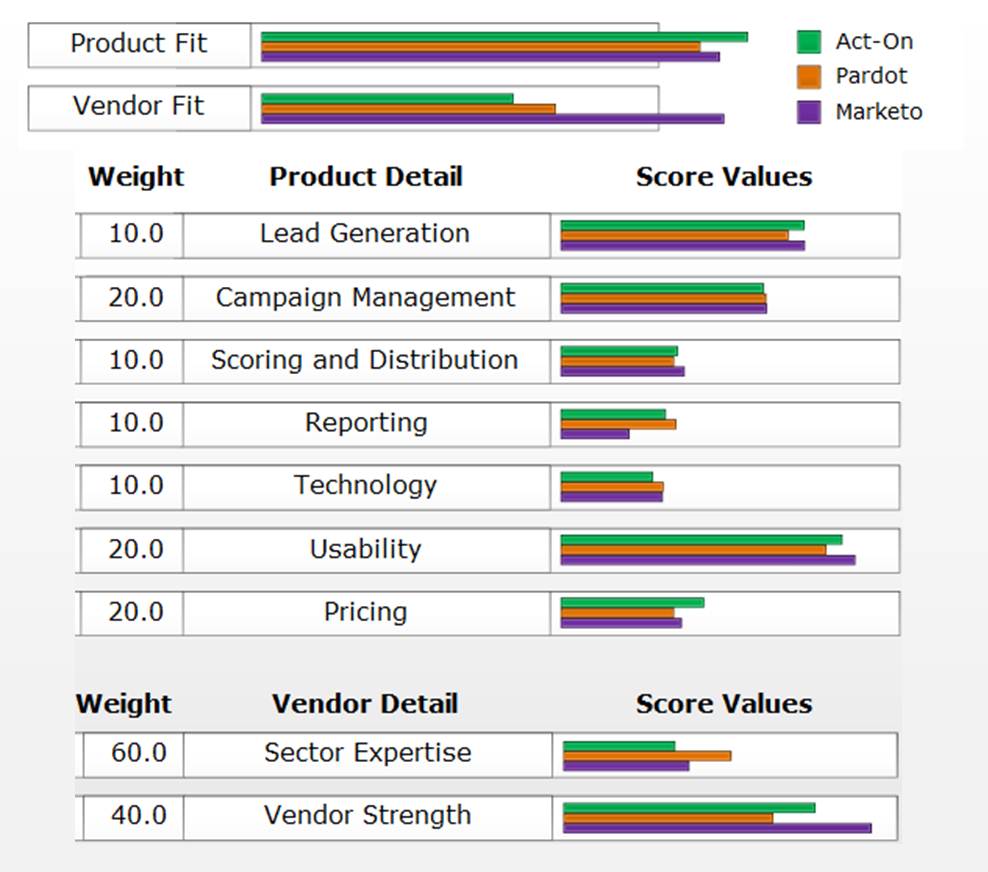
The variety of users within this segment is reflected by the differences among the leaders. Act-On, Pardot, and Genius specialize in smaller companies than Marketo or Silverpop, which in turn serve generally smaller clients than Eloqua or Neolane. Act-On’s position on top of the product fit range is a bit misleading: when you look at the components of that score (see below; this comparison chart is another VEST feature), the vendors are all very close. In fact, the only category where Act-On scores higher than everyone else is pricing.
This isn’t at all to say that the products are equivalent. Rather, it means they each have different strengths and weaknesses that balance each other out when measured with generic scoring weights. For actual buyers with clear priorities, the difference among these vendors’ scores will almost always be much larger.
As with the other sector charts, the vendors in the upper left are also worth considering: they have strong product fit but relatively low market position. SalesFusion appears here as it did in the micro- and large-business charts: what can I say, they have rich features at a good price. (And, no, they’re not my client.) eTrigue is the other noteworthy contender; it and LeadFormix are both close to the leader quadrant based on their vendor fit.
If there’s any one lesson from all these charts, it’s that picking the “leading” vendor is no guarantee of making a good choice. Our three sets of weights yield different sets of leaders, and even those vendors have different strengths and weaknesses. I’ve said it a million times but I’ll say it again: there’s no substitute for understanding your own needs and finding out which vendors match them best.
We define small to mid-size business as companies with $5 million to $500 million revenue. This covers a broad range of marketing users with widely varied needs. Most require the full set of marketing automation functions but apply these in simple ways. They have one to fifteen marketing automation users. This sector generates nearly 60% of 2012 revenue ($200 million) from 33% of the installations (9,400 as of mid-2012). The VEST report provides separate client counts for small business ($5 million to $20 million revenue) and mid-size business ($20 million to $500 million). These account for 16% and 41% of revenue and 16% and 17% of installations, respectively. Although small businesses generally buy lower-priced systems, they have largely the same requirements as mid-size companies.
The leaders quadrant in this sector is quite crowded, with Act-On, Eloqua, Pardot, and Marketo all jostling for position. Silverpop, Neolane, and Genius are all lurking nearby. In case you haven’t caught on to my color coding, blue type indicates that Eloqua and Neolane are leaders in the large company segment, while red type shows the others have their strongest position in this sector.
The variety of users within this segment is reflected by the differences among the leaders. Act-On, Pardot, and Genius specialize in smaller companies than Marketo or Silverpop, which in turn serve generally smaller clients than Eloqua or Neolane. Act-On’s position on top of the product fit range is a bit misleading: when you look at the components of that score (see below; this comparison chart is another VEST feature), the vendors are all very close. In fact, the only category where Act-On scores higher than everyone else is pricing.
This isn’t at all to say that the products are equivalent. Rather, it means they each have different strengths and weaknesses that balance each other out when measured with generic scoring weights. For actual buyers with clear priorities, the difference among these vendors’ scores will almost always be much larger.
As with the other sector charts, the vendors in the upper left are also worth considering: they have strong product fit but relatively low market position. SalesFusion appears here as it did in the micro- and large-business charts: what can I say, they have rich features at a good price. (And, no, they’re not my client.) eTrigue is the other noteworthy contender; it and LeadFormix are both close to the leader quadrant based on their vendor fit.
If there’s any one lesson from all these charts, it’s that picking the “leading” vendor is no guarantee of making a good choice. Our three sets of weights yield different sets of leaders, and even those vendors have different strengths and weaknesses. I’ve said it a million times but I’ll say it again: there’s no substitute for understanding your own needs and finding out which vendors match them best.
Tuesday, October 11, 2011
Marketo Spark Targets Small Business Marketing Automation
Marketo today announced the launch of Spark, a new brand aimed at small and mid-size business. Functionally, Spark is pretty much identical to the standard Marketo system. Exceptions are advanced features including revenue cycle reporting, email deliverability assistance, API access, fine-grained user rights management, and the Sales Insight salesperson application. Most of these aren’t of interest to small business, and several involve additional charges even for Marketo’s regular packages.
So the news here is price. Spark starts at $750 per month with no annual contract, compared with Marketo’s $2,000 per month minimum and annual contract for its full-featured Professional Edition. Marketo has discontinued its $1,200 per month Small Business Edition, which lacked some features now included with Spark.
In other words, this is a price cut. To me, it looks like a reaction to the success of other low cost small business systems, including HubSpot, Act-On Software, and Pardot. (HubSpot and Act-On have similar pricing to Spark, while Pardot runs a bit higher.) Some of those firms are actually growing at a faster rate than Marketo, although on a smaller base. Spark should help to blunt their momentum while increasing Marketo's own client total -- a closely watched metric, regardless of the associated revenue per client.
Whether Marketo actually makes any money at Spark's price is questionable. It really depends on the sales and support costs, and Marketo doesn’t appear to have changed how those are delivered to keep them down. Other small business specialists have designed sales and support models that are not as staff-intensive as traditional approaches. By contrast, Marketo is stressing that Spark includes services to help clients take advantage of their systems.
Of course, Marketo could have lowered its entry price without creating a new brand. So why bother to launch Spark?
One reason may be to avoid cannibalizing sales of its other, higher-priced editions. But, let’s face it, any sentient buyer will notice that Spark is out there. I think the more important reason is that Spark lets Marketo address small businesses separately from larger companies. The two groups do have different needs and neither wants a system designed for the other. Spark lets Marketo position itself as a small business specialist when selling to small businesses, without alienating big-business marketers who would consider a small business system an unsuitable toy.
This is a delicate game. For one thing, "small business" means different things to different people. Small business specialists like Infusionsoft and OfficeAutoPilot actually serve a different market -- one that I label "microbusiness" and put at under $5 million revenue. Those products have a different configuration from Spark, HubSpot, Pardot, or Act-On. Specifically, Infusionsoft and OfficeAutoPilot have starting prices around $300 per month and offer built-in shopping carts and CRM. (Other micro-business specialists like Genoo and MakesBridge also have a sub-$500 monthly price, but no CRM or shopping.) Although Spark is not aimed at the micro-business market, some people may not recognize the distinction.
Nor it is clear that the Spark brand will be enough let Marketo play in both the small and mid-size business segments ($5 to $500 million revenue, by my definition) and the big business segment (more than $500 million revenue.) Nearly every other marketing automation vendor focuses on one or the other. The main exception is HubSpot, which is also trying to add larger clients without losing its small business base -- and facing some positioning challenges of its own.
Spark also poses a financial challenge. Marketo has said it will earn around $30 million revenue in 2011, and will have an average of around 1,100 clients. That comes to about $2,500 per client per month, a figure Marketo has been striving to increase. A large number of Spark clients at $750 per month would dramatically reduce its average. The profit margins, if any, will surely be lower as well, again dragging down the corporate average.
Now, this is all interesting stuff, but does it matter to anyone who isn't a Marketo investor? Probably not. Spark may push prices a little lower and may put a small crimp in some competitors' growth rates. It may also give small business marketers another fine set of resource materials to complement those from HubSpot and others. But the bottom line is that similar capabilities were already available at a similar price point from Marketo and others. Spark just doesn't change much.
So the news here is price. Spark starts at $750 per month with no annual contract, compared with Marketo’s $2,000 per month minimum and annual contract for its full-featured Professional Edition. Marketo has discontinued its $1,200 per month Small Business Edition, which lacked some features now included with Spark.
In other words, this is a price cut. To me, it looks like a reaction to the success of other low cost small business systems, including HubSpot, Act-On Software, and Pardot. (HubSpot and Act-On have similar pricing to Spark, while Pardot runs a bit higher.) Some of those firms are actually growing at a faster rate than Marketo, although on a smaller base. Spark should help to blunt their momentum while increasing Marketo's own client total -- a closely watched metric, regardless of the associated revenue per client.
Whether Marketo actually makes any money at Spark's price is questionable. It really depends on the sales and support costs, and Marketo doesn’t appear to have changed how those are delivered to keep them down. Other small business specialists have designed sales and support models that are not as staff-intensive as traditional approaches. By contrast, Marketo is stressing that Spark includes services to help clients take advantage of their systems.
Of course, Marketo could have lowered its entry price without creating a new brand. So why bother to launch Spark?
One reason may be to avoid cannibalizing sales of its other, higher-priced editions. But, let’s face it, any sentient buyer will notice that Spark is out there. I think the more important reason is that Spark lets Marketo address small businesses separately from larger companies. The two groups do have different needs and neither wants a system designed for the other. Spark lets Marketo position itself as a small business specialist when selling to small businesses, without alienating big-business marketers who would consider a small business system an unsuitable toy.
This is a delicate game. For one thing, "small business" means different things to different people. Small business specialists like Infusionsoft and OfficeAutoPilot actually serve a different market -- one that I label "microbusiness" and put at under $5 million revenue. Those products have a different configuration from Spark, HubSpot, Pardot, or Act-On. Specifically, Infusionsoft and OfficeAutoPilot have starting prices around $300 per month and offer built-in shopping carts and CRM. (Other micro-business specialists like Genoo and MakesBridge also have a sub-$500 monthly price, but no CRM or shopping.) Although Spark is not aimed at the micro-business market, some people may not recognize the distinction.
Nor it is clear that the Spark brand will be enough let Marketo play in both the small and mid-size business segments ($5 to $500 million revenue, by my definition) and the big business segment (more than $500 million revenue.) Nearly every other marketing automation vendor focuses on one or the other. The main exception is HubSpot, which is also trying to add larger clients without losing its small business base -- and facing some positioning challenges of its own.
Spark also poses a financial challenge. Marketo has said it will earn around $30 million revenue in 2011, and will have an average of around 1,100 clients. That comes to about $2,500 per client per month, a figure Marketo has been striving to increase. A large number of Spark clients at $750 per month would dramatically reduce its average. The profit margins, if any, will surely be lower as well, again dragging down the corporate average.
Now, this is all interesting stuff, but does it matter to anyone who isn't a Marketo investor? Probably not. Spark may push prices a little lower and may put a small crimp in some competitors' growth rates. It may also give small business marketers another fine set of resource materials to complement those from HubSpot and others. But the bottom line is that similar capabilities were already available at a similar price point from Marketo and others. Spark just doesn't change much.
Wednesday, June 29, 2011
ExactTarget and Eloqua Stake Their Claim To Centralized Customer Management
You probably saw ExactTarget’s June 13 announcement of its strategic partnership with Marketo and Eloqua’s June 21 announcement of its new AppCloud marketplace for connectors with other systems. So did I. But it took a little while to connect with the vendors to get the details, so I’m only now ready to write about them.
Both announcements shared a theme of integration between core marketing platforms and other marketing systems. That Eloqua sees itself as the center of a marketing infrastructure isn’t surprising, although it does show how far we've traveled from the once-common view of marketing automation as an auxiliary to the sales automation “system of record”. ExactTarget’s aspiration to a central role was less expected, since its original and still primary business is email delivery. But ExactTarget has added mobile, Web pages, and social in recent years. They've been pulling these together with an “Interactive Marketing Hub” in beta since last September, which is now used by 500 of their 4,000 clients. The IMH, as we cognoscenti call it, combines ExactTarget's email, mobile, Web pages, Web visitor tracking, and social media with external touchpoints as well as Salesforce.com and Microsoft CRM.
The IMH sports a slick user interface with a very nice dashboard showing real-time updates of summary statistics for each channel. It also provides a central marketing calendar of campaigns across the channels. The underlying database can be simple lists, as in traditional email system, or a proper multi-table structure acting as the primary marketing database. As Captain Planet used to say, The Power Is Yours.
It’s perfectly sensible for ExactTarget to move in this direction, since it otherwise risks being pushed to the unprofitable edges of the marketing world as a commodity email engine. In fact, the real head-scratcher was why ExactTarget would deal with Marketo if it had ambitions to occupy the same central turf. (Marketo’s motivation is obvious: to gain broader distribution.)
ExactTarget’s answer was refreshingly honest: IMH lacks key B2B marketing automation features including lead scoring, advanced segmentation, and multi-step campaigns. The campaign engine will be improved before IMH's official launch this September, but other specialized B2B features probably won’t be added. ExactTarget also sees Marketo as the first of many partner applications for IMH, further clarifying that they see it in the central position.
Eloqua’s AppCloud is obviously modeled on Salesforce.com’s AppExchange and other application stores. The goal is for third parties to extend the value of a core platform by building tools that enhance it. In Eloqua’s case, most of the initial applications are connectors with other systems for Webinars, social communities, messaging and data acquisition. These will be joined over time by apps that add functionality within Eloqua itself. The AppCloud is an extension of Eloqua’s earlier Cloud Connector initiative, which provides APIs for external systems to access Eloqua data and functions. Basically, AppCloud makes it easier to find and deploy those connectors.
I did ask Eloqua how AppCloud relates to its Revenue Performance Management positioning. This felt like a pretty clever question until I later saw it was addressed in the AppCloud press release. Oh well. The answer came smoothly enough: AppCloud makes it easier to gather the activity data needed for Revenue Performance Management analysis. That makes sense, although AppCloud implies a more active integration with external systems than simply reporting against them.
Both the ExactTarget and Eloqua announcements reflect a strategy of positioning their products as a company’s primary customer management system. If you recall my post last week on Adobe and Oracle announcements, those firms also wanted to place themselves at the center of the customer management universe. So does pretty much everyone else.
Obviously they all can’t win this game. At the end of the day, I’d still put my money on the big CRM systems as the logical central repository for customer data. But I do believe that many auxiliary systems will continue to feed data to the central system and somehow coordinate treatment decisions with it. Connectors created to service ExactTarget, Eloqua, and others will make it easier to integrate the peripheral systems with whichever product ends up in the middle. So it’s all good.
Both announcements shared a theme of integration between core marketing platforms and other marketing systems. That Eloqua sees itself as the center of a marketing infrastructure isn’t surprising, although it does show how far we've traveled from the once-common view of marketing automation as an auxiliary to the sales automation “system of record”. ExactTarget’s aspiration to a central role was less expected, since its original and still primary business is email delivery. But ExactTarget has added mobile, Web pages, and social in recent years. They've been pulling these together with an “Interactive Marketing Hub” in beta since last September, which is now used by 500 of their 4,000 clients. The IMH, as we cognoscenti call it, combines ExactTarget's email, mobile, Web pages, Web visitor tracking, and social media with external touchpoints as well as Salesforce.com and Microsoft CRM.
The IMH sports a slick user interface with a very nice dashboard showing real-time updates of summary statistics for each channel. It also provides a central marketing calendar of campaigns across the channels. The underlying database can be simple lists, as in traditional email system, or a proper multi-table structure acting as the primary marketing database. As Captain Planet used to say, The Power Is Yours.
It’s perfectly sensible for ExactTarget to move in this direction, since it otherwise risks being pushed to the unprofitable edges of the marketing world as a commodity email engine. In fact, the real head-scratcher was why ExactTarget would deal with Marketo if it had ambitions to occupy the same central turf. (Marketo’s motivation is obvious: to gain broader distribution.)
ExactTarget’s answer was refreshingly honest: IMH lacks key B2B marketing automation features including lead scoring, advanced segmentation, and multi-step campaigns. The campaign engine will be improved before IMH's official launch this September, but other specialized B2B features probably won’t be added. ExactTarget also sees Marketo as the first of many partner applications for IMH, further clarifying that they see it in the central position.
Eloqua’s AppCloud is obviously modeled on Salesforce.com’s AppExchange and other application stores. The goal is for third parties to extend the value of a core platform by building tools that enhance it. In Eloqua’s case, most of the initial applications are connectors with other systems for Webinars, social communities, messaging and data acquisition. These will be joined over time by apps that add functionality within Eloqua itself. The AppCloud is an extension of Eloqua’s earlier Cloud Connector initiative, which provides APIs for external systems to access Eloqua data and functions. Basically, AppCloud makes it easier to find and deploy those connectors.
I did ask Eloqua how AppCloud relates to its Revenue Performance Management positioning. This felt like a pretty clever question until I later saw it was addressed in the AppCloud press release. Oh well. The answer came smoothly enough: AppCloud makes it easier to gather the activity data needed for Revenue Performance Management analysis. That makes sense, although AppCloud implies a more active integration with external systems than simply reporting against them.
Both the ExactTarget and Eloqua announcements reflect a strategy of positioning their products as a company’s primary customer management system. If you recall my post last week on Adobe and Oracle announcements, those firms also wanted to place themselves at the center of the customer management universe. So does pretty much everyone else.
Obviously they all can’t win this game. At the end of the day, I’d still put my money on the big CRM systems as the logical central repository for customer data. But I do believe that many auxiliary systems will continue to feed data to the central system and somehow coordinate treatment decisions with it. Connectors created to service ExactTarget, Eloqua, and others will make it easier to integrate the peripheral systems with whichever product ends up in the middle. So it’s all good.
Labels:
b2b marketing automation,
crm,
customer management,
eloqua,
exacttarget,
marketo
Friday, November 19, 2010
More on Marketo Financials: Despite Past Losses, Prospects Are Bright
Summary: Public data gives some insights into Marketo's financial history and prospects. Despite past losses, the company is in a strong position to continue to compete aggressively. (Note: as Marketo has commented below, this article is based on my own analysis and was written without access to Marketo's actual financial information.)
Here’s a bit more on this week's $25 million investment in Marketo: a piece in VentureWire quotes revenue for Markteo as $4.5 million for 2009 and "triple that" ($13.5 million) for 2010. This is the first time I've seen published revenue figures for the company. They allow for some interesting analysis.
Data I've collected over the years shows that Marketo had about 120 clients at the start of 2009, 325 at the start of 2010, and should end 2010 with about 800. Doing a bit of math, this yields average counts of 222 for 2009 and 562 for 2010, which in turn shows average revenue per client of $20,000 per year or $1,700 per month in 2009 and $24,000 or $2,000 per month in 2010. The table below throws in a reasonable guess for 2008 as well.
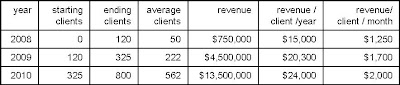
Given that Marketo’s list prices start at $2,000 per month for the smallest implementation of its full-featured edition, this is pretty firm evidence that the company has indeed been aggressively discounting its system – as competitors have long stated.
(Some competitors have also said that Marketo's reported client counts are cumulative new clients, without reductions for attrition. If so, the revenue per active client would actually be a bit higher than I've calculated here. But Marketo itself says the reported figures are indeed active clients and I've no basis to doubt them. The following analysis wouldn't change much either way.)
If you’ll accept a bit more speculation, we can even estimate the size of those discounts. That same VentureWire article quotes Marketo’s current headcount as 130 employees, compared with half that number at the start of the year. Assume there were 70 at the start of 2010 (which matches my own data) and will be 140 by year-end, for an average of 105. My records suggest that the headcount at the start of the 2009 was around 35, so the average headcount for that year was about 52.
Let’s assume a "normal" revenue of $200,000 per employee, which is about typical for software companies (and matches published figures for Marketo competitors Aprimo and Unica). That means Marketo revenues without discounting “should” have been about $10.4 million in 2009 and $21 million in 2010. Compared with actual revenues, this shows 2009 revenue was about 43% of the “normal” price ($4.5 million actual vs. $10.4 million expected) and 2010 revenue at about 64% ($13.5 million vs. $21 million).
So the good news for Marketo’s new investors is that Marketo has been discounting less (although there’s an alternative explanation that we’ll get to in a minute). The bad news is they have quite a way to go before they’re selling at full price.

We can use the same data to estimate Marketo’s burn rate. Costs are likely to be very close to the same $200,000 per employee (this includes everything, not just salary). My records suggest the company had about 25 average employees in 2008, for $5 million in expenses. Marketo was founded in late 2005, so let’s figure it averaged 10 employees during the previous two years, and that they cost only $150,000 because the early stage doesn’t involve marketing costs. This adds another $3 million. That gives a cumulative investment of $39.4 million.
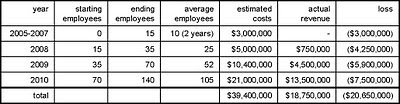
We already know revenue for 2009 and 2010 will be about $18 million. The company started selling in late February 2008 and my records show it ended that year with 120 clients. Assume the equivalent of 50 annual clients at $15,000 and you get 2008 revenue of $750,000, for $18.75 million total. That leaves a gap of $20.65 million between life-to-date costs vs. revenues.
This nicely matches the “approximately $20 million” investment to date that Marketo CEO Phil Fernandez reportedin his own blog post on the new funding.
Now you can see why Marketo needed more money: its losses are actually growing despite having more customers and improved pricing. It lost nearly $16,000 for each new client last year ($7.5 million loss on 475 new clients). At that rate, even a modest increase in the number of new clients would have burned through nearly all of the company’s remaining $12 million within one year.
This isn’t just a matter of scale. It’s true that a start-up has to spread its fixed costs over a small number of clients, yielding a high cost per client during the early stages. Marketo shows this effect: the number of clients per employee has grown started at 3.4 at the end of 2008 and dropped to 5.7 at the end of 2010. This is the alternative to discounting as an explanation for those ratios of "normal" to actual revenue (remember: “normal” revenue based on number of employees).
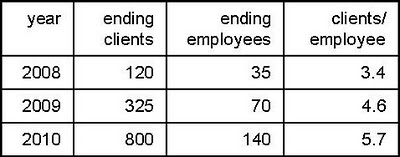
But the client/employee ratio can’t improve indefinitely. Many costs are not fixed: staffing for customer support, marketing, sales and administrative functions will all increase as clients are added. To get some idea of Marketo's variable costs, compare the change in employees with the change in clients. This is improving more slowly:
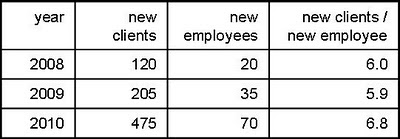
And here’s the problem: at 1 new employee for every 6.8 clients, Marketo is adding $200,000 in cost for just $163,000 in revenue (=6.8 x $24,000 / client). It truly does lose money on each new customer. You can’t grow your way out of that.
So what happens now? Let’s assume Marketo gets a bit more efficient and the new clients to new employee ratio eventually tops out at a relatively optimistic 8. At a cost of $200,000 per employee, those clients have to generate $25,000 in revenue for Marketo just to cover the increased expense. This is just a bit higher than the current $24,000 per client, so it seems pretty doable. But it leaves the existing $7.5 million annual loss in place forever.
In other words, Marketo must substantially increase revenue per client to become profitable. (In theory, Marketo could also cut costs. But the main controllable cost is sales and marketing, and incremental cost per sale is likely to rise as the company enters new markets and faces stiffer competition while pushing for continued growth. So higher revenue is the only real option.)
Revenue per client can be increased through higher prices, new products, and/or bigger clients. Pricing will be constrained by competition, although Marketo could probably discount a bit less. This leaves new products and bigger clients. Those are exactly the areas that Marketo is now pursuing through add-ons such as Revenue Cycle Analytics and Sales Insight, and enhancements for large companies in its Enterprise Edition. So, in my humble opinion, they're doing exactly the right things.
Some back-of-envelope calculations confirm that revenue per client is by far the most important variable in Marketo’s financial future. The following tables use some reasonable assumptions about growth in clients and clients per employee; take my word for it that the results don’t change much if you modify these. But results change hugely depending on what happens to revenue per client: losses continue indefinitely if it remains at the current $24,000 per year; they continue for two years and total $10 million if it increases at 10% per year; and they end after one year and $4.4 million if it grows at 20% per year. Bear in mind that revenue per customer did grow 20% from 2009 to 2010 ($20,000 to $24,000). So I’d expect it to continue rising sharply as Marketo firms up its pricing and starts acquiring larger clients.
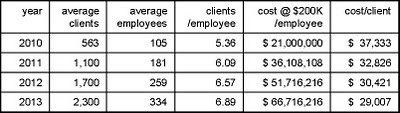
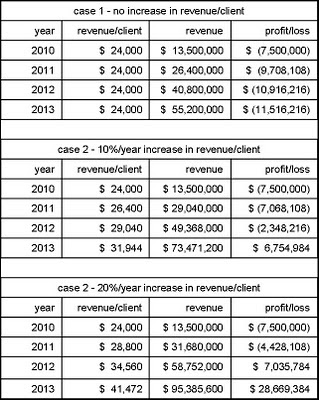
Indeed, these figures raise the unexpected (to me) question of whether $25 million in funding is more than Marketo will need. I’d guess the company’s management and current investors were careful not to dilute their equity any more than necessary, so I think they’re planning some heavy investments that are not factored into my assumptions. In fact, the company has said as much: the VentureWire piece quotes Fernandez as stating the new funds will be used for additional sales and marketing staff, to open offices abroad, to integrate with other vendors and launch vertical services in sectors like health care and financial services.
I also expect continued aggressive pricing (perhaps more selectively than in the past) and maybe some acquisitions. It's possible that Marketo will also expand its own professional services staff, since clients definitely need help with adoption. But that would conflict with its existing channel partners so it would need to move carefully.
What does it all mean? Here are my conclusions:
- Marketo's losses reflect a conscious strategy to grow quickly through aggressive pricing. There is no fundamental problem with its cost structure: company could be profitable fairly quickly if it decided to slow down and raise prices.
- Marketo's future lies in the middle and upper tiers of the market. Its pressing financial need is to raise revenue per client, which will lead it away from the low-cost, bitterly competitive market serving very small businesses.
- The new funding will support an expanded marketing and product push. Competing with Marketo in its target segments is going to be a challenge indeed.
Here’s a bit more on this week's $25 million investment in Marketo: a piece in VentureWire quotes revenue for Markteo as $4.5 million for 2009 and "triple that" ($13.5 million) for 2010. This is the first time I've seen published revenue figures for the company. They allow for some interesting analysis.
Data I've collected over the years shows that Marketo had about 120 clients at the start of 2009, 325 at the start of 2010, and should end 2010 with about 800. Doing a bit of math, this yields average counts of 222 for 2009 and 562 for 2010, which in turn shows average revenue per client of $20,000 per year or $1,700 per month in 2009 and $24,000 or $2,000 per month in 2010. The table below throws in a reasonable guess for 2008 as well.
Given that Marketo’s list prices start at $2,000 per month for the smallest implementation of its full-featured edition, this is pretty firm evidence that the company has indeed been aggressively discounting its system – as competitors have long stated.(Some competitors have also said that Marketo's reported client counts are cumulative new clients, without reductions for attrition. If so, the revenue per active client would actually be a bit higher than I've calculated here. But Marketo itself says the reported figures are indeed active clients and I've no basis to doubt them. The following analysis wouldn't change much either way.)
If you’ll accept a bit more speculation, we can even estimate the size of those discounts. That same VentureWire article quotes Marketo’s current headcount as 130 employees, compared with half that number at the start of the year. Assume there were 70 at the start of 2010 (which matches my own data) and will be 140 by year-end, for an average of 105. My records suggest that the headcount at the start of the 2009 was around 35, so the average headcount for that year was about 52.
Let’s assume a "normal" revenue of $200,000 per employee, which is about typical for software companies (and matches published figures for Marketo competitors Aprimo and Unica). That means Marketo revenues without discounting “should” have been about $10.4 million in 2009 and $21 million in 2010. Compared with actual revenues, this shows 2009 revenue was about 43% of the “normal” price ($4.5 million actual vs. $10.4 million expected) and 2010 revenue at about 64% ($13.5 million vs. $21 million).
So the good news for Marketo’s new investors is that Marketo has been discounting less (although there’s an alternative explanation that we’ll get to in a minute). The bad news is they have quite a way to go before they’re selling at full price.
We can use the same data to estimate Marketo’s burn rate. Costs are likely to be very close to the same $200,000 per employee (this includes everything, not just salary). My records suggest the company had about 25 average employees in 2008, for $5 million in expenses. Marketo was founded in late 2005, so let’s figure it averaged 10 employees during the previous two years, and that they cost only $150,000 because the early stage doesn’t involve marketing costs. This adds another $3 million. That gives a cumulative investment of $39.4 million.
We already know revenue for 2009 and 2010 will be about $18 million. The company started selling in late February 2008 and my records show it ended that year with 120 clients. Assume the equivalent of 50 annual clients at $15,000 and you get 2008 revenue of $750,000, for $18.75 million total. That leaves a gap of $20.65 million between life-to-date costs vs. revenues.This nicely matches the “approximately $20 million” investment to date that Marketo CEO Phil Fernandez reportedin his own blog post on the new funding.
Now you can see why Marketo needed more money: its losses are actually growing despite having more customers and improved pricing. It lost nearly $16,000 for each new client last year ($7.5 million loss on 475 new clients). At that rate, even a modest increase in the number of new clients would have burned through nearly all of the company’s remaining $12 million within one year.
This isn’t just a matter of scale. It’s true that a start-up has to spread its fixed costs over a small number of clients, yielding a high cost per client during the early stages. Marketo shows this effect: the number of clients per employee has grown started at 3.4 at the end of 2008 and dropped to 5.7 at the end of 2010. This is the alternative to discounting as an explanation for those ratios of "normal" to actual revenue (remember: “normal” revenue based on number of employees).
But the client/employee ratio can’t improve indefinitely. Many costs are not fixed: staffing for customer support, marketing, sales and administrative functions will all increase as clients are added. To get some idea of Marketo's variable costs, compare the change in employees with the change in clients. This is improving more slowly:
And here’s the problem: at 1 new employee for every 6.8 clients, Marketo is adding $200,000 in cost for just $163,000 in revenue (=6.8 x $24,000 / client). It truly does lose money on each new customer. You can’t grow your way out of that.So what happens now? Let’s assume Marketo gets a bit more efficient and the new clients to new employee ratio eventually tops out at a relatively optimistic 8. At a cost of $200,000 per employee, those clients have to generate $25,000 in revenue for Marketo just to cover the increased expense. This is just a bit higher than the current $24,000 per client, so it seems pretty doable. But it leaves the existing $7.5 million annual loss in place forever.
In other words, Marketo must substantially increase revenue per client to become profitable. (In theory, Marketo could also cut costs. But the main controllable cost is sales and marketing, and incremental cost per sale is likely to rise as the company enters new markets and faces stiffer competition while pushing for continued growth. So higher revenue is the only real option.)
Revenue per client can be increased through higher prices, new products, and/or bigger clients. Pricing will be constrained by competition, although Marketo could probably discount a bit less. This leaves new products and bigger clients. Those are exactly the areas that Marketo is now pursuing through add-ons such as Revenue Cycle Analytics and Sales Insight, and enhancements for large companies in its Enterprise Edition. So, in my humble opinion, they're doing exactly the right things.
Some back-of-envelope calculations confirm that revenue per client is by far the most important variable in Marketo’s financial future. The following tables use some reasonable assumptions about growth in clients and clients per employee; take my word for it that the results don’t change much if you modify these. But results change hugely depending on what happens to revenue per client: losses continue indefinitely if it remains at the current $24,000 per year; they continue for two years and total $10 million if it increases at 10% per year; and they end after one year and $4.4 million if it grows at 20% per year. Bear in mind that revenue per customer did grow 20% from 2009 to 2010 ($20,000 to $24,000). So I’d expect it to continue rising sharply as Marketo firms up its pricing and starts acquiring larger clients.

Indeed, these figures raise the unexpected (to me) question of whether $25 million in funding is more than Marketo will need. I’d guess the company’s management and current investors were careful not to dilute their equity any more than necessary, so I think they’re planning some heavy investments that are not factored into my assumptions. In fact, the company has said as much: the VentureWire piece quotes Fernandez as stating the new funds will be used for additional sales and marketing staff, to open offices abroad, to integrate with other vendors and launch vertical services in sectors like health care and financial services.I also expect continued aggressive pricing (perhaps more selectively than in the past) and maybe some acquisitions. It's possible that Marketo will also expand its own professional services staff, since clients definitely need help with adoption. But that would conflict with its existing channel partners so it would need to move carefully.
What does it all mean? Here are my conclusions:
- Marketo's losses reflect a conscious strategy to grow quickly through aggressive pricing. There is no fundamental problem with its cost structure: company could be profitable fairly quickly if it decided to slow down and raise prices.
- Marketo's future lies in the middle and upper tiers of the market. Its pressing financial need is to raise revenue per client, which will lead it away from the low-cost, bitterly competitive market serving very small businesses.
- The new funding will support an expanded marketing and product push. Competing with Marketo in its target segments is going to be a challenge indeed.
Wednesday, November 17, 2010
Why Put Another $25 Million Into Marketo?
So...our friends at Marketo announced today that they've received another $25 million in venture funding. As one of their competitors snippily commented on Twitter, "Does that make the total $50M or $60M? I lost track."
I've lost track too, but it doesn't really matter. Marketo's strategy has been clear from the start: spend heavily to establish a strong position despite a relatively late start in the market. Of course, it wasn't just a matter of spending (Microsoft Zune, anyone?); they needed a solid product and good marketing as well. On all fronts, Mission Accomplished.
But the question is, what happens now? Obviously Marketo has a plan in mind and has convinced some pretty savvy investors that it makes sense. Presumably they've demonstrated a highly scalable business model that will allow them to take the latest funding and reliably transform it into growth and, eventually, into profits.
I find it a bit surprising that anyone can be $25-million-worth-of-certain about anything in such a young and volatile market, particularly because I still think B2B marketing automation will eventually be absorbed by larger CRM and/or Web content management suites. Certainly Marketo could be acquired by one of those companies but I don't think the price would be high enough to make the VCs happy. And surely they're still some time away from an IPO given what must be seriously money-losing financials to date.
I'm mostly writing this post in the hopes of seeing some helpful comments from others in the industry. Where does this all lead, both for Marketo and its competitors?
I've lost track too, but it doesn't really matter. Marketo's strategy has been clear from the start: spend heavily to establish a strong position despite a relatively late start in the market. Of course, it wasn't just a matter of spending (Microsoft Zune, anyone?); they needed a solid product and good marketing as well. On all fronts, Mission Accomplished.
But the question is, what happens now? Obviously Marketo has a plan in mind and has convinced some pretty savvy investors that it makes sense. Presumably they've demonstrated a highly scalable business model that will allow them to take the latest funding and reliably transform it into growth and, eventually, into profits.
I find it a bit surprising that anyone can be $25-million-worth-of-certain about anything in such a young and volatile market, particularly because I still think B2B marketing automation will eventually be absorbed by larger CRM and/or Web content management suites. Certainly Marketo could be acquired by one of those companies but I don't think the price would be high enough to make the VCs happy. And surely they're still some time away from an IPO given what must be seriously money-losing financials to date.
I'm mostly writing this post in the hopes of seeing some helpful comments from others in the industry. Where does this all lead, both for Marketo and its competitors?
Friday, October 15, 2010
Fractional Response Attribution is Worse Than Nothing
Summary: Should companies apply fractional revenue attribution when more sophisticated methods are impractical? I think not: it gives inaccurate results that could result in bad decisions. Better to avoid financial measures at all if you can't do them properly.
I spent most of the past week in San Francisco at overlapping conferences for the Direct Marketing Association and Marketo. My Marketo presentation was based on the marketing measurement white paper I recently wrote for them, which argues that measurement should be based on tracking buyers through stages in the purchase process. One corollary to this is not attributing fractions of revenue among different marketing touches. The analogy I’m currently using is baking a cake – it doesn’t make sense to assign partial credit for the final flavor to different ingredients: the recipe as a whole either works or doesn’t. Only testing can determine the impact of making changes.
Given this mindset, I was more than a little surprised to attend a DMA panel discussion where two of the more sophisticated marketing measurement vendors described their systems as providing fractional attribution. Both vendors also offer more advanced methods and both made clear that they used such methods in appropriate situations. But they seemed to feel that when adequate data is not available, fractional attribution is better than nothing.
I certainly understand their attitude. Many of the business-to-business marketers at the Marketo conference have exactly this problem: their data volumes are too small to accurately measure the incremental impact of most marketing programs. The best suggestion I can make is that they run whatever tests their volumes make practical. I’d further suggest that testing may actually be more practical than they realize if they actively and creatively look for opportunities to do it.
But, again, the vendors on my panel knew this. The examples they gave were situations where companies had previously attributed all marketing revenue to the “last touch” before an actual purchase or other conversion event. They used fractional attribution to help people (marketers and those who fund them) see that other contacts also contribute to those final results. The practical goal was to justify funding for early-stage programs that such as search engine optimization and display advertising that precede that “last touch” itself.
I’m all in favor of recognizing that early-stage contacts have value. But I still feel that assigning a fundamentally arbitrary financial value to those contacts is a mistake. The main danger is that people who don’t know any better may use these numbers to allocate marketing funds to the more “productive” uses. Such figures are not accurate enough to support such decisions.
I’d rather use non-monetary measures such as correlations between different kinds of touches and ultimate results. These can highlight the connections between early and later touches without providing financial values that are easily misapplied. Maybe this is just wishful thinking, but perhaps refusing to provide unreliable financial metrics will even highlight the need for tests that can provide truly meaningful ones—thus helping marketers to make the necessarily investments.
So what do you think: is fractional revenue attribution of reasonable compromise or a harmful distraction? Let me know your thoughts.
I spent most of the past week in San Francisco at overlapping conferences for the Direct Marketing Association and Marketo. My Marketo presentation was based on the marketing measurement white paper I recently wrote for them, which argues that measurement should be based on tracking buyers through stages in the purchase process. One corollary to this is not attributing fractions of revenue among different marketing touches. The analogy I’m currently using is baking a cake – it doesn’t make sense to assign partial credit for the final flavor to different ingredients: the recipe as a whole either works or doesn’t. Only testing can determine the impact of making changes.
Given this mindset, I was more than a little surprised to attend a DMA panel discussion where two of the more sophisticated marketing measurement vendors described their systems as providing fractional attribution. Both vendors also offer more advanced methods and both made clear that they used such methods in appropriate situations. But they seemed to feel that when adequate data is not available, fractional attribution is better than nothing.
I certainly understand their attitude. Many of the business-to-business marketers at the Marketo conference have exactly this problem: their data volumes are too small to accurately measure the incremental impact of most marketing programs. The best suggestion I can make is that they run whatever tests their volumes make practical. I’d further suggest that testing may actually be more practical than they realize if they actively and creatively look for opportunities to do it.
But, again, the vendors on my panel knew this. The examples they gave were situations where companies had previously attributed all marketing revenue to the “last touch” before an actual purchase or other conversion event. They used fractional attribution to help people (marketers and those who fund them) see that other contacts also contribute to those final results. The practical goal was to justify funding for early-stage programs that such as search engine optimization and display advertising that precede that “last touch” itself.
I’m all in favor of recognizing that early-stage contacts have value. But I still feel that assigning a fundamentally arbitrary financial value to those contacts is a mistake. The main danger is that people who don’t know any better may use these numbers to allocate marketing funds to the more “productive” uses. Such figures are not accurate enough to support such decisions.
I’d rather use non-monetary measures such as correlations between different kinds of touches and ultimate results. These can highlight the connections between early and later touches without providing financial values that are easily misapplied. Maybe this is just wishful thinking, but perhaps refusing to provide unreliable financial metrics will even highlight the need for tests that can provide truly meaningful ones—thus helping marketers to make the necessarily investments.
So what do you think: is fractional revenue attribution of reasonable compromise or a harmful distraction? Let me know your thoughts.
Wednesday, September 22, 2010
Webinar and White Paper on Marketing Measurement
Marketo yesterday released Winning the Marketing Measurement Marathon, a white paper that I wrote for them. This was timed to coincide release of their new Revenue Cycle Explorer, which adds advanced reporting to their Revenue Cycle Analytics line. (See my August 3 post for more details on Revenue Cycle Analytics.)
I'll also be speaking with Marketo in an October 7 Webinar hosted by American Marketing Association. Please join us.
Tuesday, August 03, 2010
Marketo's Enterprise Edition and Revenue Cycle Management: Looking Under the Hood
Summary: Marketo continues to follow its own path. Enterprise Edition adds the complex security needed by large organizations but sticks to simple campaign flows. Revenue Cycle Management blazes an important new trail for others to follow.
I finally caught up with Marketo for a briefing on their Enterprise Edition (announced in March) and Revenue Cycle Analytics (announced in May). Since both are somewhat old news, and Marketo describes them in detail on its Web site, I’ll just make a few comments.
Executive Edition shows what Marketo believes is needed to service large marketing organizations. The most extensive enhancements provide finer-grained control over user rights. This is critical in large organizations, where regional and product groups may be responsible for different market segments and where users will have different functional specialties and approval authorities. Enterprise Edition supports these by adding user roles, “lead partitions” to control access to database segments and “workspaces” to make Marketo objects (contents, campaigns, lists, etc.) available to different user groups. User roles (but not lead partitions or workspaces) are now available in Marketo’s Professional Edition as well.
These changes are a big advance over earlier versions of Marketo, which distinguished only between users and administrators and let all users access pretty much everything. Enterprise Edition also adds a “sandbox” environment for training, testing and development – the sort of things that small companies might do on a live system, but large organizations cannot safely allow.
The other major big-company need that Enterprise addresses is more sophisticated integration with other corporate systems. Related features include LDAP integration with enterprise security systems and a Web services API to call Marketo functions and access its data.
Perhaps most interesting is that Marketo did NOT expand the complexity of its actual campaign flows. These remain fundamentally linear: that is, all leads follow the same flow from step 1 to step 2 to step 3, etc. Rules within each step can deliver different treatments to different segments, but everyone still moves to the same next step unless they leave the campaign altogether. Other enterprise-level marketing automation systems can create different branches within their campaigns, so different segments follow entirely separate paths. This makes it easier to design and visualize fundamentally different treatments for different types of leads, something that matters more in a large enterprise with many different lead types. I’ve always considered branching campaign flows to be one of the key requirements for an enterprise-level marketing automation system. It seems that Marketo disagrees.
(Actually, Marketo disagrees with much of the preceding paragraph. Everything in it is factually accurate, but I'm happy to clarify that (1) several campaigns can run simultaneously, sending leads through different flows and (2) steps within Marketo campaigns can remove leads or send them to other campaigns (3) Marketo can connect several campaigns to produce the same flows as single branching campaign in other systems.)
Revenue Cycle Analytics breaks some important new ground. As I commented in an earlier post on purchase funnel measurement, Marketo’s approach is not conceptually unique. The basic idea is to track leads through stages in a purchase funnel, which is similar to pipeline reporting in many sales automation systems. It just starts earlier in the process.
However, Marketo's implementation brings this reporting to a new level. Most specifically, Marketo has introduced a star-schema reporting database, which I’m pretty sure no other marketing automation system currently offers. (Market2Lead had something similar but is no longer sold.) This is important because the structure of an operational marketing database, which most B2B marketing automation systems also use for reporting, makes it hard or impossible to do the necessary time-based analysis.
Other components are similarly sophisticated. These include graphical models that track movement of leads through the stages, detailed analytics with specialized measures such as conversion rates and speeds, statistical projections based on current inventory and historical flow rates, and executive dashboards. The models capture more than a simple linear pipeline: they support skipping and backwards flows among stages, splits within flows for different lead types, complex stage definitions, and transitional stages where leads are processed and reassigned.
Marketo is also tackling the difficult issue of allocating revenue to multiple individuals and marketing touches. Its methods are not particularly advanced: credit can be spread evenly or based on marketing-assigned weights. But no one else has found a much better solution, particularly at the low volumes of most B2B marketing programs.
My only real complaint is that you can't actually buy it all today. Marketo is releasing Revenue Cycle Analytics in stages. The database itself was available for the May announcement and the modeling engine was released in July. Initial analytics are set for delivery this month (August), with the really cool projections and dashboards out during the first half of next year. This delay could prove costly, since funnel-based marketing measurement is a hot topic and other vendors could well build or partner to deploy something similar in the interim.
Pricing of Revenue Cycle Analytics starts at $1,500 per month and grows with database size. Incidentally, I don’t think they’ve published that figure anywhere before, so there’s a bit of news in this post after all. Huzzah.
I finally caught up with Marketo for a briefing on their Enterprise Edition (announced in March) and Revenue Cycle Analytics (announced in May). Since both are somewhat old news, and Marketo describes them in detail on its Web site, I’ll just make a few comments.
Executive Edition shows what Marketo believes is needed to service large marketing organizations. The most extensive enhancements provide finer-grained control over user rights. This is critical in large organizations, where regional and product groups may be responsible for different market segments and where users will have different functional specialties and approval authorities. Enterprise Edition supports these by adding user roles, “lead partitions” to control access to database segments and “workspaces” to make Marketo objects (contents, campaigns, lists, etc.) available to different user groups. User roles (but not lead partitions or workspaces) are now available in Marketo’s Professional Edition as well.
These changes are a big advance over earlier versions of Marketo, which distinguished only between users and administrators and let all users access pretty much everything. Enterprise Edition also adds a “sandbox” environment for training, testing and development – the sort of things that small companies might do on a live system, but large organizations cannot safely allow.
The other major big-company need that Enterprise addresses is more sophisticated integration with other corporate systems. Related features include LDAP integration with enterprise security systems and a Web services API to call Marketo functions and access its data.
Perhaps most interesting is that Marketo did NOT expand the complexity of its actual campaign flows. These remain fundamentally linear: that is, all leads follow the same flow from step 1 to step 2 to step 3, etc. Rules within each step can deliver different treatments to different segments, but everyone still moves to the same next step unless they leave the campaign altogether. Other enterprise-level marketing automation systems can create different branches within their campaigns, so different segments follow entirely separate paths. This makes it easier to design and visualize fundamentally different treatments for different types of leads, something that matters more in a large enterprise with many different lead types. I’ve always considered branching campaign flows to be one of the key requirements for an enterprise-level marketing automation system. It seems that Marketo disagrees.
(Actually, Marketo disagrees with much of the preceding paragraph. Everything in it is factually accurate, but I'm happy to clarify that (1) several campaigns can run simultaneously, sending leads through different flows and (2) steps within Marketo campaigns can remove leads or send them to other campaigns (3) Marketo can connect several campaigns to produce the same flows as single branching campaign in other systems.)
Revenue Cycle Analytics breaks some important new ground. As I commented in an earlier post on purchase funnel measurement, Marketo’s approach is not conceptually unique. The basic idea is to track leads through stages in a purchase funnel, which is similar to pipeline reporting in many sales automation systems. It just starts earlier in the process.
However, Marketo's implementation brings this reporting to a new level. Most specifically, Marketo has introduced a star-schema reporting database, which I’m pretty sure no other marketing automation system currently offers. (Market2Lead had something similar but is no longer sold.) This is important because the structure of an operational marketing database, which most B2B marketing automation systems also use for reporting, makes it hard or impossible to do the necessary time-based analysis.
Other components are similarly sophisticated. These include graphical models that track movement of leads through the stages, detailed analytics with specialized measures such as conversion rates and speeds, statistical projections based on current inventory and historical flow rates, and executive dashboards. The models capture more than a simple linear pipeline: they support skipping and backwards flows among stages, splits within flows for different lead types, complex stage definitions, and transitional stages where leads are processed and reassigned.
Marketo is also tackling the difficult issue of allocating revenue to multiple individuals and marketing touches. Its methods are not particularly advanced: credit can be spread evenly or based on marketing-assigned weights. But no one else has found a much better solution, particularly at the low volumes of most B2B marketing programs.
My only real complaint is that you can't actually buy it all today. Marketo is releasing Revenue Cycle Analytics in stages. The database itself was available for the May announcement and the modeling engine was released in July. Initial analytics are set for delivery this month (August), with the really cool projections and dashboards out during the first half of next year. This delay could prove costly, since funnel-based marketing measurement is a hot topic and other vendors could well build or partner to deploy something similar in the interim.
Pricing of Revenue Cycle Analytics starts at $1,500 per month and grows with database size. Incidentally, I don’t think they’ve published that figure anywhere before, so there’s a bit of news in this post after all. Huzzah.
Wednesday, June 30, 2010
LoopFuse Offers Free Marketing Automation System: Another Step Towards Industry Consolidation
Summary: LoopFuse has launched a free entry-level version of its marketing automation system. It's one example of how vendors are now competing to attract new users. Only the winners will survive industry consolidation, which may be here sooner than you think.
LoopFuse today promised to “transform” the marketing automation industry by offering a free version of its system. Although LoopFuse and others already provide free trials, this is indeed different: while most free trials expire after 30 days and often have limited functionality, LoopFuse’s FreeView can be used for as long as you like and provides pretty much the same features as the paid version of the system. The critical constraint is that volume is limited to 2,500 prospect names, 5,000 emails and 100,000 page views per month. In practice, this means that only very small companies will actually be able to use the free system as their primary long-term marketing system.
LoopFuse knows that, of course. When they briefed me last week, they said the main purpose of the new system is really to entice trial among companies just starting with marketing automation. They’ll make their money when users see the value they gain and pay for higher volumes and add-on features.
Personally, I’d argue that the really significant news out of LoopFuse is their newly tiered pricing structure. The entry point of $350 per month (for up to 10,000 prospects with unlimited emails and page views) is much lower than the $1,000 to $2,000 starting price of most full-function marketing automation systems. Prices at higher volumes are also much lower than competitors. This will put substantial pricing pressure on vendors who, in many cases, are already struggling to reach sustainable margins.
Here’s where the free system comes back into play. To make a free product viable, LoopFuse needed to engineer as much cost as possible out of the entire client life cycle. This means it had to be possible for clients to purchase and configure the system, learn how to use it and resolve support issues with next to no involvement by LoopFuse staff. Once this was accomplished, LoopFuse was in a position to charge lower fees to its paying clients as well. Other vendors – notably Pardot – have followed a similar cost-removal strategy. But LoopFuse may have been more focused than anyone else.
This doesn’t mean that LoopFuse’s success is guaranteed. Other vendors have similar price points for the small business market (see my list of demand generation vendors) although I suspect their internal costs are higher.
More important, price is just one factor in picking a system. Features, ease of use, and support from the vendor and business partners are usually (and rightly) the main considerations. The free product should increase the number of companies that try LoopFuse first, which will gain it paying customers down the road. But I think that most buyers will recognize that they are likely to stay with their first system and conduct a careful evaluation before they start.
For evidence that a free entry-level product does not automatically drive out higher priced systems, consider the hosted CRM market. Salesforce.com easily dominates despite the presence of surprisingly capable free products like ZohoCRM and FreeCRM .
Whatever the result for LoopFuse, the new offering is part of a larger pattern within the industry. Marketing automation (more precisely, B2B marketing automation) has now passed beyond the pioneer stage where fundamentally different approaches compete for acceptance. At this point, we all pretty much know what a marketing automation system does and, truth be told, the major systems are functionally quite similar.
Competition now shifts from building a technically better system to surviving the inevitable industry consolidation. This requires finding ways to attract masses of new customers as they enter the market.
LoopFuse’s price-driven approach is one such strategy. But many vendors have recently taken others:
- Eloqua, Silverpop, True Influence and at least one other vendor I can’t name are planning new interfaces that they believe will substantially improve ease of use, which they see as the critical barrier blocking many potential buyers. I’m skeptical that truly radical improvements are possible but am certainly eager to see what they come up with.
- LeadLife has embedded best practice hints throughout its system, another way to support adoption by users who lack marketing automation knowledge.
- Infusionsoft has repositioned itself as “email 2.0” rather than marketing automation. They believe this makes it easier for their target customers (under 25 employees) to see them as the next logical step beyond standard email.
- Genius.com added a new Demand Generation edition that falls between its basic Email Marketing and full-blown Marketing Automation products. This is another way of easing the transition from basic email marketing.
- LeadForce1 launched a solution that uses advanced text analysis to measure user intent, and thus provide much better guidance to salespeople than conventional behavioral analysis. Although their approach is based on superior technology, it's still a way to attract customers by offering radically greater value than competitors.
- Marketo now calls itself a “the revenue cycle management company”, giving equal public weight to lead management, sales insight and analytics. They still haven’t briefed me on this or their features to support large enterprises, but they seem to be seeking larger, more sophisticated clients who will presumably provide higher profit margins. Given how many other vendors are targeting small businesses, this certainly makes sense. But Marketo will also find itself competing with established marketing automation vendors like Aprimo, Neolane and Unica. who are entering this market from a different direction. It will also be competing with Eloqua, Silverpop and, perhaps most dangerously, the Market2Lead technology recently purchased by Oracle.
The Market2Lead-Oracle deal raises the other major question facing marketing automation vendors: what role CRM vendors will play? In addition to Oracle, CDC Software (owner of Pivotal CRM and MarketFirst) recently invested in Marketbright.
Of course, the really big question is whether Salesforce.com will make a similar move. There have been off-and-on rumors along those lines for months, followed by stout (if not necessarily credible) denial from Salesforce.com that it has any interest in that direction. I’ve tended to take them at their word, but Oracle and Salesforce.com are blood rivals, so Oracle’s move could easily prompt a Salesforce.com reaction.
Oddly enough, no seems to consider whether Microsoft will enter the game. That's surely a possibility, and would move towards a certainty if its two big on-demand CRM rivals both added marketing automation products. We might even see Google and Intuit participate: both already sell to small business marketers.
My fundamental conclusion is that the B2B marketing automation industry is about to enter the long-predicted stage of vendor consolidation, and that this will move quite quickly. The survivors will serve particular market segments: primarily small vs. large businesses, plus possibly some vertical industry specialization. The window for new entrants is rapidly closing, so any new player will need a major differentiator that creates a clear advantage and distinct identity.
LoopFuse today promised to “transform” the marketing automation industry by offering a free version of its system. Although LoopFuse and others already provide free trials, this is indeed different: while most free trials expire after 30 days and often have limited functionality, LoopFuse’s FreeView can be used for as long as you like and provides pretty much the same features as the paid version of the system. The critical constraint is that volume is limited to 2,500 prospect names, 5,000 emails and 100,000 page views per month. In practice, this means that only very small companies will actually be able to use the free system as their primary long-term marketing system.
LoopFuse knows that, of course. When they briefed me last week, they said the main purpose of the new system is really to entice trial among companies just starting with marketing automation. They’ll make their money when users see the value they gain and pay for higher volumes and add-on features.
Personally, I’d argue that the really significant news out of LoopFuse is their newly tiered pricing structure. The entry point of $350 per month (for up to 10,000 prospects with unlimited emails and page views) is much lower than the $1,000 to $2,000 starting price of most full-function marketing automation systems. Prices at higher volumes are also much lower than competitors. This will put substantial pricing pressure on vendors who, in many cases, are already struggling to reach sustainable margins.
Here’s where the free system comes back into play. To make a free product viable, LoopFuse needed to engineer as much cost as possible out of the entire client life cycle. This means it had to be possible for clients to purchase and configure the system, learn how to use it and resolve support issues with next to no involvement by LoopFuse staff. Once this was accomplished, LoopFuse was in a position to charge lower fees to its paying clients as well. Other vendors – notably Pardot – have followed a similar cost-removal strategy. But LoopFuse may have been more focused than anyone else.
This doesn’t mean that LoopFuse’s success is guaranteed. Other vendors have similar price points for the small business market (see my list of demand generation vendors) although I suspect their internal costs are higher.
More important, price is just one factor in picking a system. Features, ease of use, and support from the vendor and business partners are usually (and rightly) the main considerations. The free product should increase the number of companies that try LoopFuse first, which will gain it paying customers down the road. But I think that most buyers will recognize that they are likely to stay with their first system and conduct a careful evaluation before they start.
For evidence that a free entry-level product does not automatically drive out higher priced systems, consider the hosted CRM market. Salesforce.com easily dominates despite the presence of surprisingly capable free products like ZohoCRM and FreeCRM .
Whatever the result for LoopFuse, the new offering is part of a larger pattern within the industry. Marketing automation (more precisely, B2B marketing automation) has now passed beyond the pioneer stage where fundamentally different approaches compete for acceptance. At this point, we all pretty much know what a marketing automation system does and, truth be told, the major systems are functionally quite similar.
Competition now shifts from building a technically better system to surviving the inevitable industry consolidation. This requires finding ways to attract masses of new customers as they enter the market.
LoopFuse’s price-driven approach is one such strategy. But many vendors have recently taken others:
- Eloqua, Silverpop, True Influence and at least one other vendor I can’t name are planning new interfaces that they believe will substantially improve ease of use, which they see as the critical barrier blocking many potential buyers. I’m skeptical that truly radical improvements are possible but am certainly eager to see what they come up with.
- LeadLife has embedded best practice hints throughout its system, another way to support adoption by users who lack marketing automation knowledge.
- Infusionsoft has repositioned itself as “email 2.0” rather than marketing automation. They believe this makes it easier for their target customers (under 25 employees) to see them as the next logical step beyond standard email.
- Genius.com added a new Demand Generation edition that falls between its basic Email Marketing and full-blown Marketing Automation products. This is another way of easing the transition from basic email marketing.
- LeadForce1 launched a solution that uses advanced text analysis to measure user intent, and thus provide much better guidance to salespeople than conventional behavioral analysis. Although their approach is based on superior technology, it's still a way to attract customers by offering radically greater value than competitors.
- Marketo now calls itself a “the revenue cycle management company”, giving equal public weight to lead management, sales insight and analytics. They still haven’t briefed me on this or their features to support large enterprises, but they seem to be seeking larger, more sophisticated clients who will presumably provide higher profit margins. Given how many other vendors are targeting small businesses, this certainly makes sense. But Marketo will also find itself competing with established marketing automation vendors like Aprimo, Neolane and Unica. who are entering this market from a different direction. It will also be competing with Eloqua, Silverpop and, perhaps most dangerously, the Market2Lead technology recently purchased by Oracle.
The Market2Lead-Oracle deal raises the other major question facing marketing automation vendors: what role CRM vendors will play? In addition to Oracle, CDC Software (owner of Pivotal CRM and MarketFirst) recently invested in Marketbright.
Of course, the really big question is whether Salesforce.com will make a similar move. There have been off-and-on rumors along those lines for months, followed by stout (if not necessarily credible) denial from Salesforce.com that it has any interest in that direction. I’ve tended to take them at their word, but Oracle and Salesforce.com are blood rivals, so Oracle’s move could easily prompt a Salesforce.com reaction.
Oddly enough, no seems to consider whether Microsoft will enter the game. That's surely a possibility, and would move towards a certainty if its two big on-demand CRM rivals both added marketing automation products. We might even see Google and Intuit participate: both already sell to small business marketers.
My fundamental conclusion is that the B2B marketing automation industry is about to enter the long-predicted stage of vendor consolidation, and that this will move quite quickly. The survivors will serve particular market segments: primarily small vs. large businesses, plus possibly some vertical industry specialization. The window for new entrants is rapidly closing, so any new player will need a major differentiator that creates a clear advantage and distinct identity.
Subscribe to:
Posts (Atom)