Showing posts with label b2b marketing automation. Show all posts

Thursday, April 30, 2015

Are 70% of Marketing Automation Users Unhappy? Well, Not Exactly

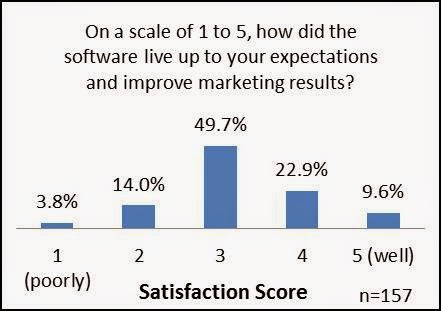
A recent piece in TechCrunch quoted me as saying that “almost 70 percent of marketers are either unhappy or only marginally happy with their marketing automation software.” The author included a link to the source of that quote, but unfortunately it was broken (it has since been fixed).  This lead to enough questions about the data that it now seems worth a blog post on the topic.

To resolve the original mystery: the quote references a survey I conducted with VentureBeat and released in June 2014. You can buy it here if you’re interested.  Answers came from 159 marketing automation users.  The quote refers to a question about how well marketing automation software met satisfaction and improved results, on a 1 to 5 scale. About 18% gave a score of 1 or 2, 50% gave a 3, and 32% gave a 4 or 5. The 1 and 2 scores are clearly unhappy and I’d consider a 3 to show neutral or marginally satisfied. Hence the “almost 70 percent” quote.

Source: Raab Associates, 2014


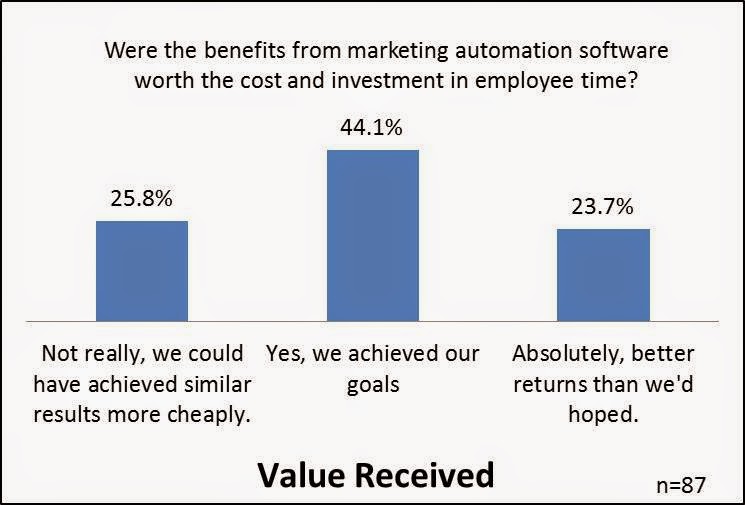
For what it’s worth, the survey also asked a second, more pointed question about whether marketing automation benefits were worth the investment. We received fewer responses (only 87) but the distribution was similar. In fact, the dissatisfied group was a higher percentage: 25.8% and there’s no question how they felt: “we could have achieved similar results more cheaply”. The middle group, 44.1% “achieved our goals” which still sounds to me like marginal satisfaction. Only 23.7% felt they exceeded expectations.

Source: Raab Associates, 2014


I've never considered these results particularly remarkable because they are consistent with other surveys on the topic.  See my posts for October 13, 2013  and October 22, 2013 for a several other surveys.

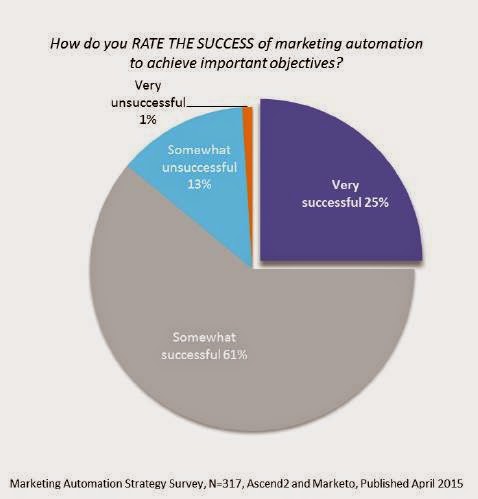
Of course, that's all old data and you may wonder whether anything has changed.  The short answer is no. For example, a recent survey from Marketo and Ascend2  found that 14% of buyers rated marketing automation as clearly unsuccessful and only 25% rated it as very successful: again, there was a big intermediate group of 61% who said is was only “somewhat successful”.


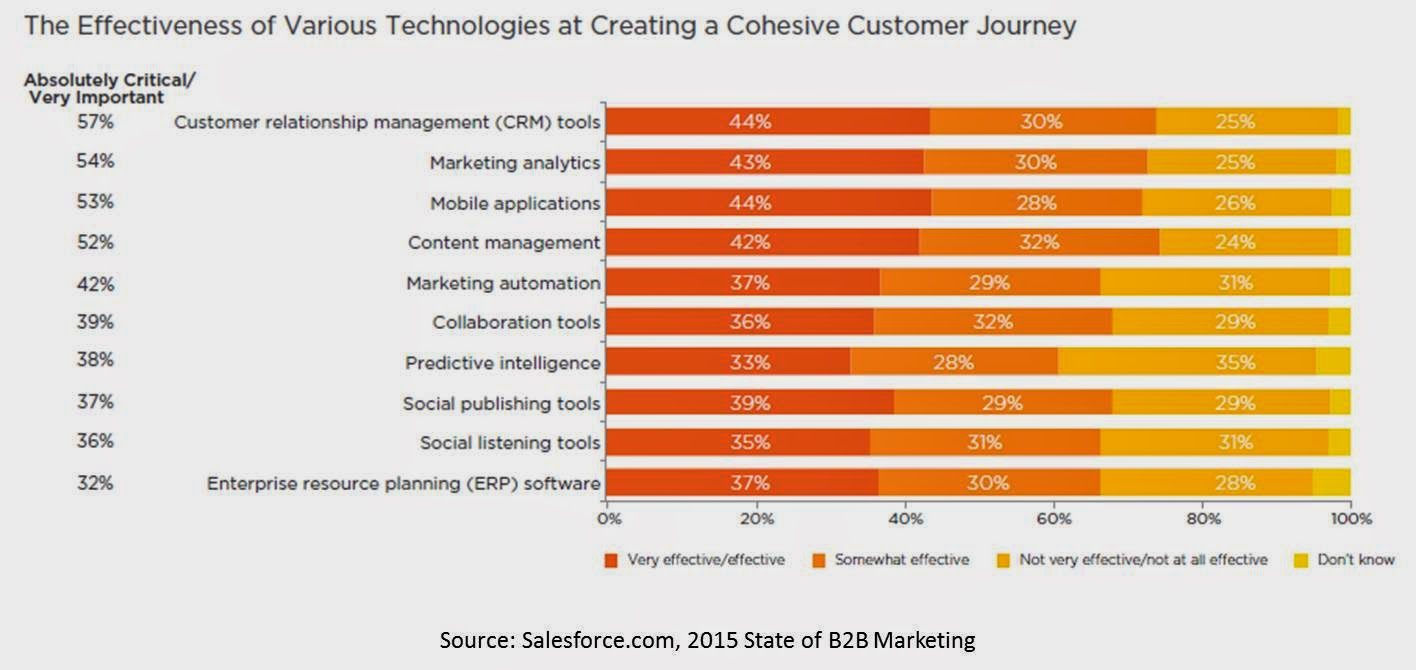
Another survey, this one from Salesforce.com, is generally more optimistic, showing 37% of users rating marketing automation as very effective or effective. But it also shows a relatively high 31% rating it as not very effective or not at all effective. The real difference is an unusually small middle group, 29% rating marketing automation as “somewhat effective”.  What’s probably more disconcerting about this survey is that it shows that marketing automation has relatively low satisfaction and importance compared with other technologies. This suggests that marketers who must prioritize their spending will make other investments first.
 
I must say that I don’t find this topic particularly engaging at the moment. The point of the original TechCrunch article was the growth of open, predictive-based platforms that unify sales and marketing, a direction I agree the industry will take. B2B marketing automation in its current form of systems that primarily use email, landing pages, and visitor tracking to nurture leads before sending them to CRM is a subset of this much larger vision. The challenges of using current marketing automation systems are well known but they will simply make it easier for newer, more effective approaches to replace them. It’s more important and more interesting to focus on that future.

Thursday, February 05, 2015

VEST Report: Latest Trends in Marketing Automation, and Where's My Hoverboard?

I just finished the latest release of the B2B Marketing Automation Vendor Selection Tool, a.k.a. VEST Report. The new version includes a big technical change: instead of the interactive Flash document that was very cool but people often had trouble running, it’s now a combination of PDF for the core document and Excel spreadsheet for the detailed vendor scores. That’s a technical step backwards but will actually make it easier for buyers to access the detailed vendor information, and in particular to screen for vendors with particular capabilities. Less is more, I suppose. The good news is that this format lets me expand beyond 25 vendors, which was the maximum the old system allowed before running out of memory.

Of course, none of this is your concern, Dear Reader. What’s you'll find more interesting is that the VEST provides an opportunity to see new patterns emerging in the industry. Usually I do this by taking a close look at which features have become more common since the last report. But this time there were a few more obvious changes that stood out. Here’s what struck me.

- more micro-business vendors. All six of the vendors new to this report sell primarily to small businesses, and most are “all-in-one” systems that combine marketing automation with integrated CRM. They join another six vendors from previous editions who also serve this market. I'm also aware of several other vendors, not yet in the VEST, who also compete for this business. Many of these firms are new while others have been around for a few years but just hit my radar. What this says to me is that the all-in-one segment is more crowded and more mature than it has seemed. Of course, there’s still a huge opportunity – hundreds of thousands if not millions of potential clients have yet to buy their first system. But anyone planning to enter this business had better realize they will be fighting for new customers.*

- agency relationships. It seems that just about every vendor in the VEST now touts special features to support marketing agencies that resell the system to their clients or operate the system on the clients’ behalf. This isn’t exactly new but what once seemed like a niche strategy now looks more like a standard approach. It’s always been obvious that agencies were a sensible channel for marketing automation vendors to pursue, but I’m beginning to wonder whether agencies might turn out to be the primary channel for such systems, excepting only direct sales to large enterprises. If this happens, the reason will be that agencies provide the missing skills that have prevented so many companies from taking full advantage of marketing automation systems by themselves. Vendors have been knocking themselves out for the past five years trying to educate marketers to run their systems.  Perhaps having agencies run them is the real solution instead.

- social data. Maybe my biggest surprise was finding that many if not most vendors have now added features to automatically look up new contacts in social networks and add that data to their marketing automation or CRM profile. This seemed like magic three years ago when I first saw John Ferrara's Nimble do it; but now it’s commonplace. In fact, any vendor that hasn’t developed their own technology can just integrate FullContact to do it for them. So the competitive advantage is now precisely zero. (Okay, not zero: some companies surely do it better than others.  But that’s a much weaker selling point than being one of the few firms to do it at all.)

- ad tech integration. This one isn’t so common yet, although Oracle Eloqua, Marketo, HubSpot and some others have announced some ad retargeting partnerships. Google Adwords integration and advertising through Facebook, Twitter, and LinkedIn audiences are more widely available but I don’t include them here. But despite the slow growth, there’s no question that serious integration between Web display ads and marketing automation programs will become much more widely available. What I won't do is predict how quickly that will happen. But I’ll certainly add it to the list of VEST questions so I can track it more closely in the future.

- dogs that didn’t bark. That’s a Sherlock Holmes reference, not an insult to technologies that haven’t been as widely adopted as the industry seemed to expect. Okay, maybe it’s a bit of both. In any event, I didn’t commute to work today on my hoverboard, and you probably didn’t sit down to do advanced mobile marketing, predictive modeling or revenue analytics in your marketing automation system. Those three – mobile, predictive, and revenue analytics – are all technologies that should take off, but so far are not deeply integrated with most marketing automation platforms. Maybe mobile has become so ubiquitous that I don’t even notice it, but, so near as I can tell, few vendors have done more than make it easier to create emails and Web pages that look good on mobile devices. Surely mobile can do more than that. Predictive analytics are growing quickly but so far are still done by specialized vendors rather than built into the marketing automation platform. (Yes, there are a few exceptions like the machine learning features of dbSignals and RedPoint. But they’re exceptions.) Revenue analytics is only discussed by a couple of companies; although important, it doesn’t seem to have captured the industry’s imagination. I haven’t given up hope for any of these, but no longer expect them to quickly become part of the mainstream.

So those are my impressions while the VEST updates are fresh in mind. The report is well worth buying if you want do to your own industry analysis, or (its primary purpose) are searching for a new system. As I say, the new format does make finding vendors with specific features much easier. You can find more information or place an order at www.raabguide.com/vest. Let me know what you think.


__________________________________________________________________________________
*In fact, the micro-business segment is even more complicated than I’ve suggested. The real competitors are companies like ConstantContact who are providing a broad range of services, such as local advertising, that extend well beyond marketing automation and CRM. There are also many vendors with specialized services for vertical markets such as plumbers and funeral homes. Come to think of it, I recently noticed that one of my many plumbers (don’t ask) uses a system developed by a funeral home website firm. If there’s a logical connection between those businesses, I don’t want to know about it.

Saturday, January 24, 2015

New Marketing Automation Options for Small Business in the VEST Report

I’m revving up for the next edition of our B2B Marketing Automation Vendor Selection Tool (VEST) report, which will include six first-time entries. I’ve already written about two of those, Inbox25 and AutopilotHQ (formerly Bislr). Here are thumbnails of the others.
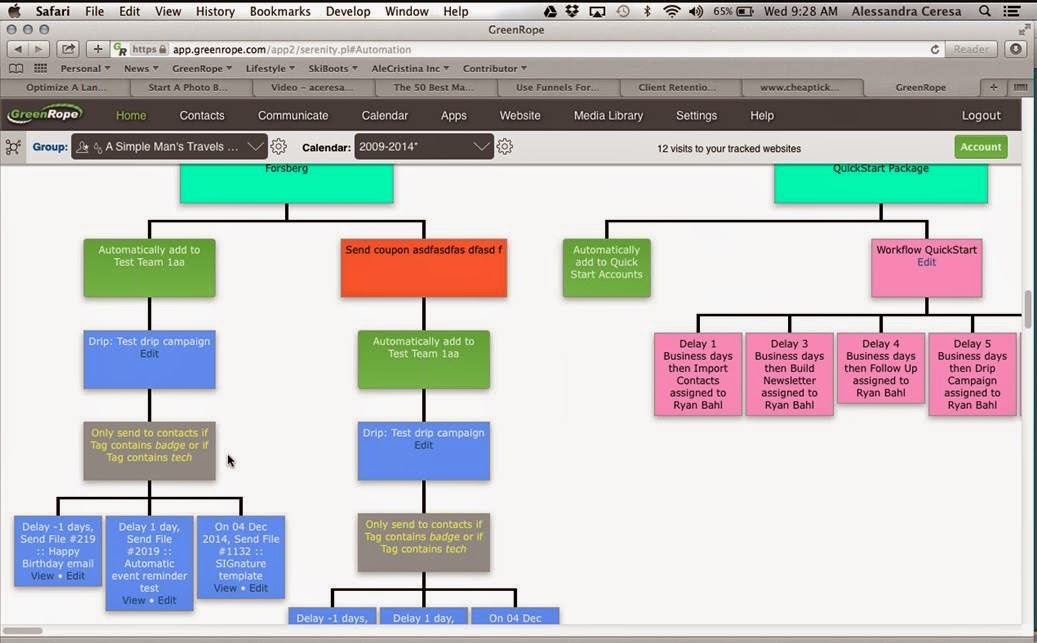
GreenRope workflow

GreenRope is all-in-one software sold primarily to very small businesses such as lawyers, real estate agents, consultant, coaches and membership organizations. That puts it firmly in Infusionsoft territory, and perhaps even towards the lower end of that. The system has an impressively broad scope, adding full Web site creation to the usual all-in-one mix of email, lead scoring, landing pages, and CRM. The features within these functions are unusually sophisticated for a micro-business system: email includes dynamic content and a/b tests; Web pages also support a/b testing; Web forms allow progressive profiling; email and Web responses can automatically trigger a follow-up action.  CRM includes opportunity tracking, unlimited user defined fields, and automatic search of Facebook and LinkedIn when new contacts are added; algorithms can automatically estimate the right number of points for different events to build a predictive lead score.  The media library supports images, files, articles, and videos (through Vimeo integration); the calendar provides full event management; surveys can change questions based on previous answers and include automated follow-up actions.


The system also extends beyond sales and marketing functions to include customer forums, Wikis, support tickets, project schedules with tasks assigned to individuals, and coupons. Workflows can manage both marketing campaigns and internal projects. Additional functions are provided through integration with other systems, including Olark for chat, Twilio for voice and text messages, VoiceBase for transcription, Magento for ecommerce, Quickbooks for accounting, and Microsoft Outlook for email.

In other words, although GreenRope describes itself as “CRM and marketing automation,” it actually extends beyond those functions to manage activities throughout the business. This is very desirable for small organizations that want to automate their operations while running as few systems as possible.

GreenRope is also small-business-friendly, starting at $149 per month for up to 1,000 contacts and costing $199 per month for 5,000 contacts.  All plans include unlimited users and unlimited emails, which isn’t always the case with small business systems.

While GreenRope is new to the VEST report, the company itself was founded in 2008.  It currently has about 4,500 end users at a somewhat smaller number of companies.
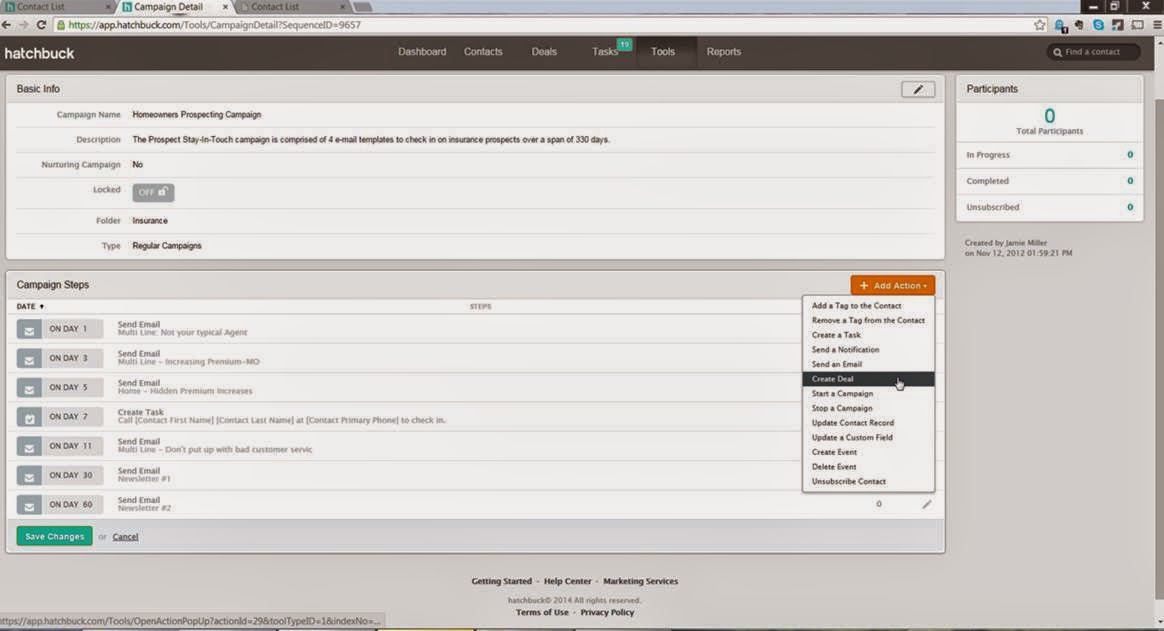
Hatchbuck workflow

Hatchbuck is another all-in-one product for very small businesses. It has taken the approach of providing only core features and making them as easy to use as possible. This scope covers email, Web forms, multi-step campaign flows, and CRM. The system integrates via Zapier with ecommerce products. It recently added lead scoring and the ability to look up individuals on social networks. The company serves a mix of clients, with the largest segments including technology and manufacturing companies, travel, and professional services. Most clients have fewer than ten employees.

As the company’s strategy suggests, Hatchbuck provides basic capabilities for its core features but skips the more advanced options. It creates email templates with personalization and embedded links but no dynamic content. CRM captures activity history, tasks, deals, purchases and events but doesn’t integrate with a phone dialer. Forms can be associated with actions but there is no specialized survey builder. You get the idea. Instead of adding more features, Hatchbuck’s developers rigorously benchmark the number of clicks it takes to perform system functions in Hatchbuck and competitive products and track how customers use each feature to identify problems. The company also provides extensive training and support materials, including a required three hour Quickstart package to help new clients use the system effectively.

Hatchbuck was founded in 2011 and launched its product in 2013. It now has about 700 customers with over 2,000 end-users. Pricing starts at $99 per month for one user and 2,500 contacts and reaches $199 per month for three users and 10,000 contacts. All plans include unlimited emails. The Quickstart package costs $199 but the fee is waived for clients who sign a six month contract. The company also has special features for marketing agencies who use the system for their clients. Such agencies account for about one quarter of the Hatchbuck business.
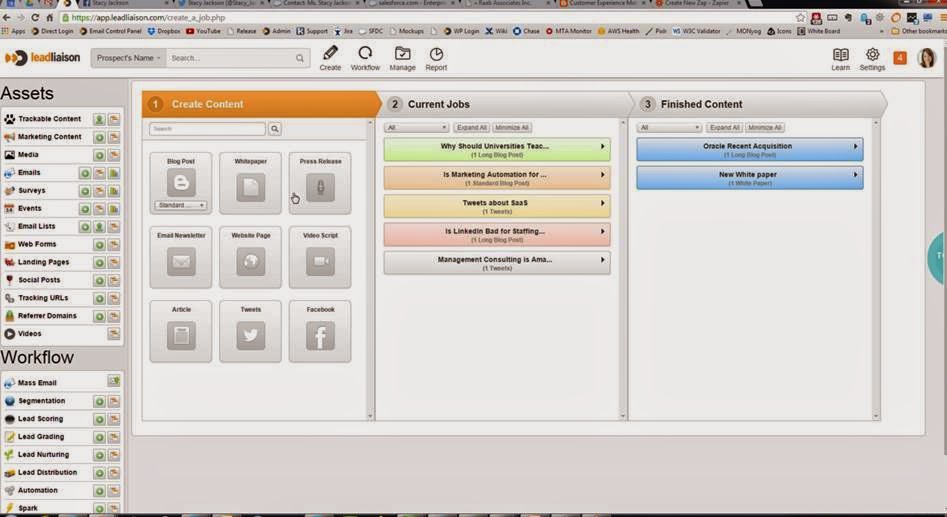
Lead Liaison content creation

Lead Liaison calls itself “revenue generation software” to indicate that it provides more than a standard B2B marketing automation product. Additional features include lead distribution and buying signal alerts, but don’t extend to full CRM or the other operational functions. With a $500 per month starting price, it is targeted at small to mid-size businesses but not at the most tiny. Pricing is based on the number of contacts in the database, with unlimited users, emails, and page views.  The company doesn’t publicly state how many contacts that $500 gets you.

The system offers advanced versions of the usual marketing automation functions: email, landing pages, Web forms and surveys, lead scoring, multi-step nurture flows, media hosting, and CRM integration with Salesforce.com, Microsoft Dynamics CRM, and Sugar CRM. It also goes beyond these in several directions, including:

- company-level Web visitor identification based on IP address, which can be tied to Data.com or LinkedIn to pull back the names of individual contacts at the identified companies (although these are not necessarily the actual visitors).

- matching of contacts against social networks to add their social identifiers to the Lead Liaison record

- phone dialer with scripts, call notes, and a payment widget

- option to send emails from LeadLiaison’s own servers or through third party services including Mandrill, SendGrid, and SMTP Inc.

- social media posting to Facebook, LinkedIn, and Twitter, including an option to store posts in a queue that will release them on a regular schedule

- a nifty Web page scanner that can copy an existing Web page or form from any source into a version that the marketing automation user can edit by, say, inserting a Lead Liasison form or link

- agency-friendly features including single log-in to multiple accounts.

Perhaps the most interesting feature of LeadLiaison is a content creation wizard that connects to a network of prequalified writers for blog posts, white papers, press releases, newsletters, Web pages, social media posts, and other materials. This is directly integrated with the system: users fill out a form specifying their requirements, which Lead Liaison submits to the network.  Once a writer (whose identity is hidden from the user) accepts the project, the system tracks the material through production states and eventually loads it into the Lead Liaison asset library.  Assets are automatically coded so users can track consumption.  The system can also limit distribution based on date range, number of downloads, and whether visitors are asked or required to provide an email address to receive it. Pricing is modest: a blog post costs $50 with five day turnaround. Although the writers are anonymous, LeadLiaison plans to let users favor authors of specific pieces for future assignments.

LeadLiasison was launched in 2013. It has under 200 clients and serves a mix of B2B and B2C marketers.

dbSignals workflow

dbSignals is brand new: the system was formally launched just last week. (Full disclosure: I’ve consulted for them.) The system straddles B2B and B2C marketing automation, using a flexible data structure typical of B2C products but also providing Salesforce.com integration, the B2B hallmark. It also includes its own lightweight CRM.

The marketing automation functions themselves are quite sophisticated: dynamic content, multi-step branching campaign flows, multivariate testing, fine-grained user rights management, option to use internal or external email services, and integration with external HTML templates. Supported channels include email, SMS, direct mail, surveys, landing pages, and social media. There are also options to support marketing agency users, including an ability to rebrand the system with the agency or client’s own identity. 

And, yes, the system also can look up the social profiles of individual contacts and add them to its database.  That feature has quickly become a new standard.

But what really distinguishes dbSignals are two features beyond the normal scope of marketing automation. The first is prospect data: the company has negotiated deals to let its clients access detailed files with 235 million consumer names and 60 million B2B names. These are selectable within the normal system interface, along with whatever names a client loads on its own.

The second feature is machine learning.  This is initially being deployed to identify the most responsive list segments within the prospect data. The process is wholly automated: the only choice users make is whether to turn it on.  Once they do, the system analyzes the client's customer list or past campaigns, builds a predictive model, runs test campaigns to validate and refine the model, and then runs a roll-out campaign once the model is stable. Models are further adjusted after later campaigns. dbSignals will soon add other uses for machine learning including churn prediction, lifetime value prediction, and attribution of the incremental impact of marketing programs.

Prospect data and machine learning are closely integrated.  Indeed, one of the reasons machine learning can be so fully automated is that the system can rely on the prospect data elements to be available -- including up to 2,000 variables on a consumer profile. Beyond that, dbSignals uses the machine learning results to “reserve” the best prospect names for each client in advance of campaign selection.  This is needed because dbSignals limits the number of promotions sent to any name within a specified time period.

Both the prospect data and machine learning are in turn made possible by dbSignals' underlying technology, which uses the Cassandra data store instead of a standard relational database.  Few marketers will care, but, trust me, it really matters for speed, scale, and flexibility.

dbSignals also offers an unusual pricing model, basing charges on the number of users and/or message volume rather than database size. This makes it easier for clients to take full use of the prospect data. Fees start as low as $500 per month.

The initial version of dbSignals was introduced in 2014. The company currently has about two dozen clients including a mix of B2B and B2C organizations.




Thursday, June 12, 2014

B2B Marketing Automation Vendor Strategies: What's Worked and What's Next

I recently did a study of the strategies of B2B marketing automation vendors. Of the two dozen or so companies in the sample, six were clearly successful (defined as achieving major share within their segment), seven had failed to survive as independent companies and sold for a low price, and the rest fell somewhere in between.

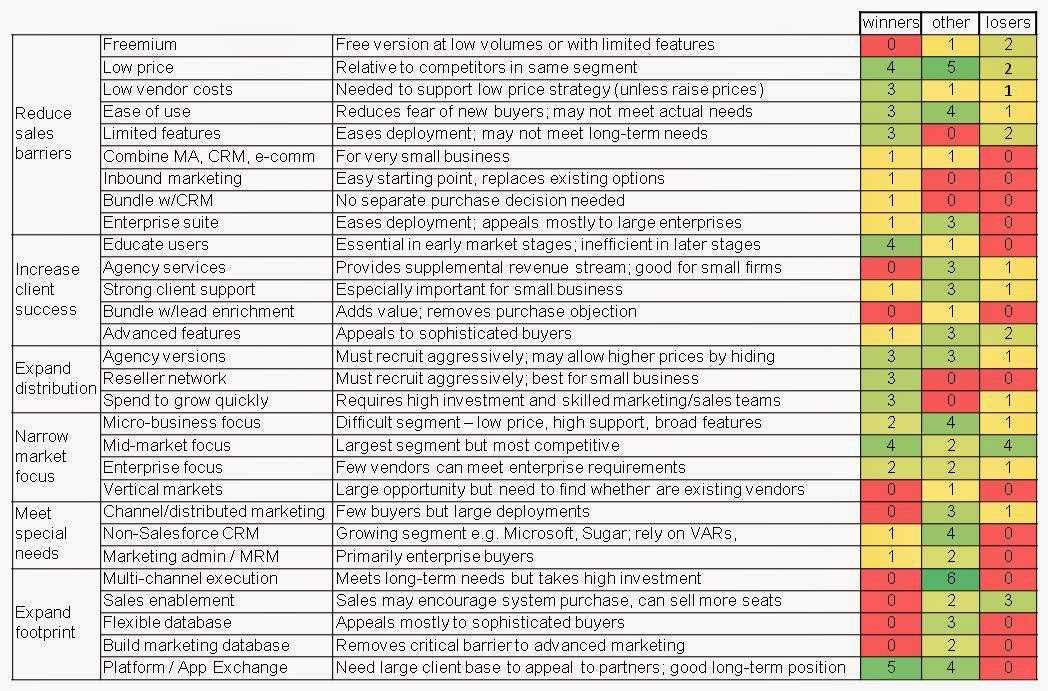
The research identified 28 different strategies which fell into six major groups. Some approaches definitely had better track records than others, but it’s important to recognize that the market has changed over time, so past performance doesn’t necessarily indicate future success. What I found most intriguing was the sheer diversity of the approaches, showing that vendors continue to explore  new paths to success.

The table below shows results for each strategy for each set of vendors, grouped by the major strategy categories. Most vendors used more than one strategy. Shading indicates the relative frequency of each strategy.


In general, the winners have focused on two of the major strategy groups: reducing sales barriers and expanding distribution. This made considerable sense in the early stages of a new market, when building awareness and market share was critical.

Within these categories, some strategies have worked better than others.  Freemium has been particularly unsuccessful, while low price, ease of use, limited features, and agency versions have been applied by vendors with all types of results. Winning vendors were most distinguished by user education, reseller networks, and heavy spending to grow quickly.  There is certainly some chicken-and-egg ambiguity about whether the companies were successful because of their strategies or were able to adopt those strategies after some initial success.  One thing that doesn't show up on the chart is that some successful vendors have shifted strategies over time, generally moving away from low prices to higher prices and from small businesses to mid-size and larger.

As the market matures, I’d expect different strategies to become more important. Established vendors will need to focus on increasing client success in order to retain the clients and will want to expand their footprint to leverage their installed base, especially through setting themselves up as platforms. Those two shifts are well under way.  Smaller vendors will find it harder to challenge the leaders, especially if they lack heavy financing.  But they may be able to thrive in niches by focusing on narrow market segments or meeting special client needs.

The chart below shows the same data as the table but in a more visual format, for all you right-brainers out there.

Monday, March 17, 2014

Marketing Automation Dissatisfaction: Are Users Buying the Wrong Systems?

I took a preliminary peek at the results of the marketing automation deployment survey that VentureBeat and I have been fielding for the past few weeks. There are some hints of really interesting insights, but we don’t have enough responses yet to publish. Like the sheriff in Blazing Saddles who held himself hostage, I'm writing this to encourage more people to complete the survey so we can release it.

First, some context. One of the rarely-spoken truths about B2B marketing automation is that a sizable minority of users – roughly one-third in most surveys – are not happy with their results. I wrote about last year in a pair of posts (here and here).  One purpose of the new survey was to probe for the reasons. We tested a number of possibilities: buyers are picking the wrong systems; they lack the skills to operate their systems; systems are too hard to use; marketing automation programs don’t deliver enough value to be worth the effort.

The results are open to interpretation but one figure jumped out at me: 25.9% of the respondents cited “missing needed features” as a top-three challenge in successfully using their systems. This wasn’t the most common answer but it still means that one-quarter of the users bought a system that didn’t meet their needs – that is, they bought the wrong system.


Answers about time spent on the search, number of systems considered, evaluation critieria, training, and staffing seem to consistent with this view. We’d gain some clarity if we could split the responders into groups: for example, were people who looked at more systems or searched for longer periods more happy with their selection?

This is where you come in, Dear Reader. We need more responses before we can publish the full results or do deeper analysis. If you’ve recently purchased a marketing automation system, please take the survey yourself and encourage others to do the same. Everyone who takes the survey will get a free copy of the report.

Friday, February 21, 2014

Bizo and DemandBase Lead B2B Marketing Automation to Web Advertising and Beyond

I had a fascinating chat earlier this week with a client who described his vision for using DemandBase to tailor messages to Web site visitors from target accounts, using Bizo to further tailor messages to individuals by title, using all this data to synch inbound and outbound campaigns in Eloqua, and eventually driving everything with predictive model scores from a tool like Lattice Engines. That could serve as a pretty complete summary of the state of the art for B2B marketing today, especially if you consider “content marketing” as implicitly included. Equally helpful to me personally, it reinforced my intention to write about Bizo and DemandBase, both of which have recently briefed me on their latest product extensions.

Let’s start with DemandBase. Astonishingly, four years have passed since I last wrote about them. In that time, they’ve continued to build applications that exploit their core technology for identifying Web site visitors by company based on their IP address. This started by providing visitor lists and real-time alerts to sales people who were interested in specific accounts. It later extended to returning visitor attributes in real time so companies could pre-fill forms and personalize Web pages to match visitor interests.  The most recent expansion went beyond a company’s own Web site to the much larger world of online advertising.

To reach that market, the company had to build its own version of “data management platform” (DMP) systems that manage lists of known entities, recognizes them when they appear on an external Web site, and delivers them an appropriate advertisement. The big difference is that DemandBase entities are companies identified by IP address, while traditional DMP entities are cookies attached to browsers (and assumed to relate to individual human beings). DemandBase had to build its own engines for real time bidding (RTB) and ad serving (Demand Side Platform or DSP) to support its approach. These can integrate with Demandbase’s own network of Web publishers that will accept its ads and with other ad exchanges that connect to their own, larger publisher networks.

Data in the DemandBase DMP comes from both DemandBase and clients. The DemandBase data are the company-level attributes that DemandBase has long assembled: company name, industry, revenue, employees, technologies used, etc. Some of this, such as DUNS Number, is purchased from external sources and requires extra payment. The client data, which of course is available only to the client who provided it, could be anything but is usually attributes such as account type, buying stage, and sales territory. The system doesn’t store any information about individuals. Marketing automation, Web analytics, and Web content management systems can all access this data via API calls for analytics and as inputs to their own selection and treatment rules. Outside the DMP itself, DemandBase can store content and decision rules to guide bidding and select which ad is displayed to each account.

So much for the mechanics. The business value is that DemandBase is allowing marketers to tailor messages to target accounts even before they engage directly with the company, thereby (hopefully) luring new prospects into the top of the funnel and engaging them if they don’t respond. This is a major extension beyond traditional marketing automation, which works mostly through email to known prospects.  It also goes beyond Web site personalization, which requires people to at least visit your Web site and in most cases actively provide information about themselves. As you might imagine, DemandBase offers many case studies to show how much this improves performance.

Bizo comes at Web advertising from the traditional route of building a pool of cookies and assembling them into audiences based on the attributes of the individuals they represent.  The pool was originally used to target display advertising and retarget site visitors by sending them ads on other sites. The company says it has pulled data from 4,200 publishers and other sources to identify about 120 million individuals worldwide, including 85 million within the U.S. The number of actual cookies is higher still.* Profiles contain titles and business demographics such as industry, but no personally identifiable information such as names or addresses.

Like DemandBase, Bizo has found many applications for its core data asset. These now extend beyond display ads to social media advertising through Facebook and LinkedIn, Web site personalization through Adobe, Web analytics through Google Analytics and Adobe, and integration with Salesforce.com CRM, BlueKai DMP, and Eloqua marketing automation. Other partners will be added over time.

I’ll assume the Eloqua integration is most interesting to readers of this blog. Basically, it lets Bizo read audience segments created by Eloqua.  Bizo then matches segment members to Bizo identities and delivers Web site, advertising or social messages tailored to each segment. Because Eloqua captures such detailed information about prospect behaviors, this allows highly tailored advertising that is tightly synchronized with prospects’ progress through buying stages and marketing automation campaigns. Since it’s driven by cookies, it can send messages to anonymous as well as identified prospects – a huge expansion in marketing automation’s reach. Bizo can even allocate advertising spend across the different media to achieve reach and frequency targets as efficiently as possible. To encourage this approach, its pricing is based on the number of unique individuals that marketers manage in its system, rather than impressions or ad budget.

The business value offered by Bizo is similar to DemandBase: reaching prospects that haven’t yet engaged with a company directly or retargeting them when they don’t respond. The different technical approaches have their own strengths and weaknesses: IP-based identification is relatively stable but works only at the company level and doesn’t identify small businesses that lack their own stable IP address; cookies identify individuals but are often deleted, miss some people, and result in multiple, fragmented identities for others. Like the client I mentioned at the start of this article, you can probably think of them as complementary rather than competing components of a complete B2B marketing solution.

________________________________________________________________________
* Given that the total employed U.S. workforce is about 145 million, I suspect that 85 million contains quite a few duplicates, meaning any one profile captures just a fragment of an individual’s activity. But that’s the nature of this sort of thing; the business question is how well the data works even in its imperfect state.

Tuesday, February 04, 2014

New Raab VEST Report: B2B Marketing Automation Will Reach $1.2 Billion in 2014


I’ve just published the latest edition of our B2B Marketing Automation Vendor Selection Tool (VEST), with updated entries on all your favorites and several new entries to boot. This is always a fun project because it gives me an overview of what all the vendors have been up to for the past six months. A few interesting trends stood out:

  • revenue growth is accelerating. My data are a little less comprehensive than previously because several of the big vendors are now part of public companies and don’t share detailed information. Those that did provide information showed great growth in 2013, in most cases over the 50% I had predicted for the industry as a whole. Even more interesting, nearly everyone reported faster growth in revenue than in clients: to take one vendor that does provide statistics, HubSpot recently reported  50% revenue growth vs. 25% growth in number of clients. In their case and others, the reason seems to be a combination of larger size deals on new customers and growth in billing to existing customers. Based on this data, I’m projecting a 60% increase in industry revenue for 2014, to $1.2 billion. You heard it here first.
  • the hot new feature is…SEO content rating. Yes, there’s continued growth in various aspects of social media marketing and in mobile-friendly content creation.  That’s old news. What I hadn’t realized before is that at least a half dozen vendors had added or improved features to help marketers build content that attracts search engine hits on selected keywords or concepts. I suppose that’s become increasingly important as marketing automation moves beyond its original role in lead management to help attract new leads at the top of the funnel. (Do I get SEO credit for using “top of the funnel”?)
  • lots of new vendors. I added four new vendors to the report, all of which have just begun to market their products aggressively. None is very large yet, except for SimplyCast, which won’t release precise data but did say it has 3,000 to 5,000 customers for its multi-channel customer management system (you may recall that I reviewed them briefly last week.) The new systems offer a broad range of configurations, from ultra-simple interfaces with limited functions to elaborate multi-channel workflows that are correspondingly complex.
  • agency systems are big. Two of the four new vendors are agency system specialists, and several other vendors have also launched special agency editions. This creates some weird feature combinations, since agencies to serve small businesses need administrative features, such as precise user rights management, that are otherwise only used by big enterprises, . Of course, the reliance on agencies is more evidence that many marketing departments still lack the skills needed to do advanced marketing automation on their own – but you knew that.
  • mid-market leadership may be up for grabs. Small but established mid-market firms including SalesFusion and eTrigue have been growing particularly quickly, as has Act-On. This may be because the current mid-market leaders, Marketo and Pardot in particular, have been focusing more on enterprise sales. I had thought that heavy funding would be necessary become a new market leader, which is the way Marketo, Act-On and HubSpot did it. SalesFusion did just take an $8.25 million investment but their revenue doubled last year without it. So perhaps having a good product and being focused will enough for someone new to elbow into a top-three position.  We'll see.
I could go on, but why should David Raab have all the fun? You, too, can uncover exciting industry trends and share them with the world. Just click here to purchase your very own copy of the VEST and analyze to your heart’s content.

Wednesday, October 09, 2013

Which B2B Marketing Automation Features Actually Get Used? Here's Some Data.

I’ve been writing a paper on the stages that marketers go through when deploying their marketing automation systems, the basic point being it’s important not to stop with just one feature. That much is indisputable, but the next question seemed to call for some empirical data: Which features are used most often? Here’s where things got interesting.

Searching through my trove of published reports, I found four recent surveys that asked this question. Of course they differed in the precise categories used and their audiences, but they generally covered the major B2B marketing automation features: email, Web behavior tracking, landing pages, nurture campaigns, lead scoring, analytics, and social media marketing. They differ considerably in their findings.

The table below shows a summary of the results, with values all normalized so the highest ranked answer in each survey equals 100. (I’ve shown the original results at the bottom of this post.)


As you see, the only answer that’s truly consistent is that the most commonly-used feature is email – although even that wasn’t quite true in Holger Schulze’s report. This is exactly what you’d expect; indeed, my paper was inspired by the lament that many companies use marketing automation as nothing more than a glorified email engine.

The remaining rankings are nowhere near as consistent, either with each other or my expectations. I’d guess that landing pages and Web tracking would be relatively common, since they’re basic features that yield clear value and are easy to deploy. Yet both ranked towards the bottom of the list. On the other hand, nurture campaigns are often considered the most complicated and least used feature of marketing automation but ranked closer to the top. (I'll rationalize that one by guessing that people included simple newsletters and drip sequences along with more complicated nurture programs.)  Lead scoring, another advanced application, was closer to its expected position near the bottom. Analytics ranked somewhere in the middle but that hides a broad variance between surveys, which suggests it meant different things to different people.

Social media, another very broad category, was only on two lists but did rank at the bottom of both. This also makes sense: it’s a relatively new application for marketing automation and many marketers don’t do it at all or use other tools.

The divergence of rankings leaves the results open to pretty much whatever interpretation you want.  Rather than sweating the details, it may be more useful to think of landing pages, Web tracking, nurture campaigns, and lead scoring as a single group of applications that are deployed after email but more-or-less simultaneously with each other. That’s how I do things in my own maturity model, which then adds two more layers: one for inbound marketing including social media and search marketing, and another for marketing management including planning, project management, and revenue attribution. Those don’t appear on my previous table because they’re not consistently included in the surveys, but you will find them in some of the individual surveys below.  They ranking towards the bottom in frequency, as you’d expect.


The paper I mentioned goes into the maturity model in more detail.  (I'll let you know when it's published).  It shows that each level involves new skills and organizational changes, so moving from one to the next takes a lot more than just turning on more system features. This is presumably why so many organizations get stuck at the first or second levels.
Here are details and links for the surveys I’ve summarized above:


Holger Schulze, B2B Lead Generation Marketing Trends, 2013 Survey Results.
More than 800 responses from the B2B Technology Marketing Community on LinkedIn.  Note that not everyone is a marketing automation user.


Aberdeen Group, Marketing Lead Management: From the Top of the Funnel to the Top Line, July 2012.  More than 160 respondents; the table below shows responses for “industry average” companies. One anomaly worth noting is that while the chart below shows lead nurturing as more common than lead scoring, the order is reversed among best-in-class and laggards.


Gleanster, Marketing Automation: Disrupting the Status Quo, August 2013.  Research from 1,396 B2B marketers. The table below shows consolidated results from top performers and others, kindly provided by study author Ian Michiels. The second table shows types of campaigns run by the same group of respondents.


Winsper, 2013 Marketing Automation Study.  132 responders who use a marketing automation system. Figures show “most utilized” features; total utilization is much higher – for example, 94% make some use of email automation.


Tuesday, August 06, 2013

How RightWave Solves the Marketing Automation Skill Shortage

One of the main reasons that marketing automation has not been adopted more quickly is that too few marketers know how to fully use it. For example, a recent Gleanster report found that 73% of top performers listed lack of skilled staff as one of the top challenges to success. Marketing automation vendors have adopted different strategies to deal with their problem, including making their systems easier to use, offering extensive training, and providing services to run the systems for their clients.

RightWave has taken that final option to an extreme: it doesn’t even give clients the option of running the system for themselves. Instead, RightWave offers what it calls “marketing automation as a service,” gives each client access to staff members who will set up and execute campaigns for them.  There’s nothing especially new about marketing service providers offering this type of service, but  RightWave does it at a price point – starting as low as $60,000 per year – that is comparable to what a good-sized company would pay for most marketing automation systems alone. Because RightWave charges are based on staff resources -- $5,000 per month buys one-half a full time equivalent person, and $8,000 buyers one full time equivalent, fees don't rise for bigger databases or higher message volume.  This means it could actually be cheaper than a self-service system for big companies.

It’s a little hard to review software that isn’t used by its buyers.  Still, the vendor comparison in our VEST report shows that RightWave’s core functionality – for lead generation, campaign management, scoring and distribution, and reporting – is on par with mid-tier leaders Pardot and Marketo.  Where it loses are usability and pricing, but only because it doesn't fit the scoring model: usability suffers from lack of training services which RightWave clients don’t need, and pricing is penalized by the high starting cost which doesn't take into account the lower cost at high volumes.


In other words, RightWave has the features to support pretty much any program marketers might want. More important, RightWave clients are more likely to actually run sophisticated programs because the RightWave staff will build them without the clients needing to learn how. RightWave staff also helps with data quality and analytics, two other areas where many marketing departments lack expertise.


RightWave actually does let marketers import files, create segmentations, and build emails, although few clients do these for themselves.  What clients do use are extensive reporting tools that show marketing calendars, campaign results, customer profiles, Web tracking reports, funnel analysis, return on investment, and other information. The system also gives sales users reports on new leads, activities of existing leads, and visits from target accounts.  Most of the sales information is presented within the Salesforce.com interface, although users can drill down into details held with RightWave.

The details of RightWave functionality are less important than the appeal of its fundamental business model. After seven years of development, the company has about twenty clients.  This sounds considerably short of setting the world on fire, but it really reflects intentionally slow growth as the product matured. Company founder Anurag Khemka, who also started an earlier generation B2C marketing automation system MarketFirst in 1996, said he’s found it relatively easy to sell the system to senior managers, but sometimes run into resistance from lower level staff who want to gain hands-on experience. The company is now starting to ramp up its sales efforts, so the true scope of its appeal will soon be clear. I’ll be watching with great interest.


Wednesday, October 10, 2012

SetLogik Offers B2B Marketers a Real Marketing Database

I’ve now done more detailed research into the SetLogik B2B data management system I mentioned in my Dreamforce post.  If anything, I’m even more impressed.

I originally saw SetLogik as a tool to associate marketing leads with sales opportunities, even when they are not connected directly within Salesforce.com. That’s important in itself, since those missing links are the greatest obstacle to showing the value of B2B marketing efforts through revenue attribution.

But the bigger story, which SetLogik itself recognizes clearly, is that they’re creating a real marketing database. This has been sadly lacking in most B2B marketing automation systems, which supplement the Salesforce.com database with barely-extensible lead profiles and contact histories. In fact, I’ve recently taken to citing the B2B systems' fixed, built-in database as the fundamental difference distinguishing them from B2C systems, which connect to externally-managed databases with any structure.

SetLogik doesn’t replace the database built into the B2B systems.  Rather, it creates a separate database that merges data from marketing automation, Salesforce.com (or, potentially, any other CRM system), and whatever other sources a company has available. The matching capabilities that initially caught my eye are just one part of a larger suite of functions to load, clean, standardize,  merge, and enhance B2B data, ultimately storing it within a database where it can be used with SetLogik tools for segmentation, selection, reporting (including attribution), and predictive model-based lead scoring. Cleansed data and results such as lead scores can be fed back into CRM and marketing automation systems for direct access by their users. SetLogik’s own diagram expresses this separation reasonably well, although I would have suggested they clarify that there’s an independent, persistent database within their cloud.


As consumer marketers learned long ago, building a serious marketing database is a big project. The challenge is even greater in B2B, which manages two data levels, companies and contacts, instead of just one level of consumers.  It’s no wonder that B2B marketing automation vendors avoided the issue by piggybacking on the Salesforce.com structure: otherwise, the cost and complexity of building a separate database would have severely limited their growth.

SetLogik’s addresses the problem directly, by creating a nearly-automated system to build the database. The company promises to deliver a completely functional database within 60 days, and to deliver the database plus predictive lead scoring models in 90 days. Compared with the many months or years needed to deploy a traditional marketing database, this is lightning quick.

I call the system “nearly-automated” because a SetLogik analyst works with each client to set up the data preparation steps, tweaking the standard rules and processes as necessary, and because the predictive models are also built by human analysts. These are advantages, not flaws, since a skilled user adds substantial value to both processes. The system still does most of the work, so the initial data quality set-up takes just a few hours of labor – although the full process typically takes several days because clients need time to make decisions. Similarly, modeling takes about two weeks – again, more wait time than work time.  In fact, the model building is so efficient that the company includes it for free in its Enterprise edition, which starts at $1,400 per month for up to 25,000 records.

None of this would matter if the quality of SetLogik’s results were poor. But, while I haven’t run a test, the company certainly describes the features I'd want. Standard inputs include leads, contacts, campaign members, accounts, and opportunities from Salesforce.com, plus leads and activities from marketing automation. Data preparation includes standardization and verification of addresses in the U.S., Canada, United Kingdom, Australia; phone numbers verification for North America; email format verification (but not sending test emails); table-based transformations and coding for elements like titles and sales territories; and enhancement with client-licensed external data such as D&B listings.

The matching engine uses multiple rule sets, supports both similar and exact matches, and can compare data across several fields (such as mobile vs. home vs office phone number). The system will match at individual and company levels and can link individuals to companies. It will choose the best value for each field and return a consistent best record to all source systems. Predictive modeling can include derived variables, such as number of emails received, as well as raw inputs. The system’s database stores snapshots of old data values so it can track changes and trends. New and changed records run through the system at user-determined intervals that can be frequent as hourly.

The system doesn’t provide an interface for end-users to set their own data processing rules, although one is planned. As SetLogik correctly argues, very few B2B marketers have the interest or skills to do this. In fact, the company’s larger problem is that so few marketers even recognize they need better data cleansing, let alone a separate marketing database. This will likely limit SetLogik's initial clients to the upper tier of sophisticated marketers who do see the problem.  We can hope that the importance of a serious marketing database will eventually become clear to everyone.

SetLogik is a Software-as-a-Service application, available directly from the company or through the Salesforce.com AppExchange. The system has an Eloqua connector today and a Marketo connector in the works. The company promises basic implementation in 60 days, although it is usually much less, and full implementation including predictive modeling in 90 days.

Pricing is based on the system edition and number of records (unique individuals and companies). The Express Edition, starting at $500 per month for 25,000 records, builds the database and feeds the cleansed, enhanced records back to Salesforce.com and marketing automation. Professional Edition, starting at $1,000 per month, adds segmentation, list building, attribution, and other reporting. Enterprise Edition, starting at $1,400 per month, offers all the other features plus predictive lead scores. The price tag gets more serious for large systems – Enterprise costs about $11,000 per month for one million-records – but is still much less than a conventional marketing database. In fact, SetLogik points out that some services built into the price, such as address and phone verification or access to lead profiles within Salesforce.com, would ordinarily cost nearly as much as the entire SetLogik fee if purchased separately.

SetLogik officially released its system in October 2011 and now has several large enterprise clients.

Friday, September 14, 2012

ClickDimensions Grows Quickly by Offering B2B Marketing Automation as a Microsoft Dynamics CRM Add-On

When I first wrote about ClickDimensions in a February, 2011 post, the concept was intriguing – a marketing automation add-on to Microsoft Dynamics CRM – but the product itself had been available for less than six months and claimed barely 50 clients. Since then, the company has grown its customer base more than ten-fold (it won’t release specific figures), won the Dynamics Marketplace Solution Excellence Partner of the Year award, signed up more than 250 channel partners around the world, and attracted outside funding. Sounds like the idea has legs.

The product has matured as well. The most important addition is a flow builder that supports branching campaigns. This is a bit limited – each node can only have yes/no branches – but it includes a reasonable set of actions including send an email, wait, notify user, add or remove from list, and run CRM workflow. It can also check for whether a contact has opened an email or clicked on a link. This is comparable to standard marketing automation products.


Other enhancements include an expanded survey builder that can skip questions or pages based on previous answers; a/b testing (two splits only) within emails; subscription management; and improved builders for email, landing pages, and forms. The system already provided dynamic email content, although users have to write the selection rules in a scripting language – something many marketers will find intimidating. Web behavior tracking, lead scoring, and social discovery (searching for and importing public data on LinkedIn) are also available.

None of this would make ClickDimensions stand out from other marketing automation systems if it weren’t for its fundamentally different architecture. ClickDimensions works directly from the Dynamics CRM data files, rather than creating a parallel, synchronized database like most marketing automation products. Additional tables needed by ClickDimensions are also custom objects within the Dynamics system. The result is direct connection between the two systems. ClickDimensions functions are also accessed within the Dynamics interface.

ClickDimensions isn’t the only vendor to take this approach. CoreMotives (purchased last March by Silverpop) has a similar architecture within the Microsoft Dynamics world and Predictive Response (which I haven’t looked at in detail) is a similar add-on to Salesforce.com. Still, as the shortness of this list suggests, the dominant approach to marketing automation remains separate, synchronized data files.

This could well change: as marketing automation becomes more widely understood, it will be purchased by less sophisticated companies. These buyers are already customers of CRM resellers who can easily offer ClickDimensions and similar CRM add-on products. That gives the add-on vendors efficient access to a huge market. The CRM vendors themselves would have the same advantage should they choose to add marketing automation  features. 

In practice, most buyers neither know nor care about the architectural differences between the two approaches. So long as the add-on architecture will work – and there’s no reason to doubt it does for all but the very largest implementations – success may well be determined by who reaches the most buyers first. As ClickDimensions’ fast growth already suggests, its reseller-based approach could be a decisive advantage as the marketing automation industry enters its next stage.  Only time will tell.

Tuesday, December 13, 2011

Marketing Automation Skills are Scarce: Vendor Strategies to Close the Gap

The marketing automation industry continues to grow quickly, with many vendors announcing their client bases have more than doubled in 2011. But there’s also a growing realization that many marketing automation systems are used for only simple tasks – often no more than email, landing pages, and CRM integration. For example, LoopFuse found that nearly twice as many used email and web landing pages as lead scoring.

Even more worrisome are increasing reports of user dissatisfaction – not enough to stop people from using the systems, but perhaps enough to prevent them from expanding their deployments or recommending marketing automation to their friends. Act-On Software recently reported that 40% of marketers are dissatisfied with their campaign management program.

Surveys, like this one from IBM, show many obstacles to successful deployment.  But the ultimate problem is staff skills: marketers who know how to use their systems and understand their benefits can make a compelling case for investments in programs, integration, technology, data, process change, and whatever else is required.


Marketing automation vendors are painfully aware of these issues. They've taken a range of approaches to addressing them. I've seen four distinct strategies:
  • training. This is the most direct approach: if users don’t have enough skills, then teach them. I’m using “training” in a broad sense to include all types of preparation before deployment: these include marketing planning, process change, content development, metrics definition, and organizational realignment as well as actual training in system use.  This is the traditional strategy for B2C marketing automation and at B2B firms large enough to afford substantial pre-deployment investments.  It’s also the preferred option of most industry consultants (myself included) because it provides the strongest platform for future success. Among B2B vendors, Eloqua is the poster child for this approach. (And I should note that many vendors are supporting the Marketing Automation Institute's training program too.)
But not everyone can afford through training and preparation for a marketing automation deployment. The remaining strategies are designed to help those who cannot.
  • ease of use. Simple systems let marketers get started with minimum preparation. This is by far the most popular strategy among vendors, presumably because it increases sales by placing the fewest demands on buyers.  It's applied by Marketo, Pardot, Act-On Software, Genius, Net-Results, and many others. It’s also the most popular strategy among buyers, judging by how many installations never grow past the basic functions. But the approach is also probably the reason for high dissatisfaction: marketers must find they face a much steeper learning curve than they expected to use their systems' fully. For long-term success, vendors who take this approach must ensure that their clients keep growing after the initial deployment.
  • automation. Instead of training marketers to do hard things or making those things easier, automation has the system do them instead. This is a much less common strategy, in part because it's technically demanding and expensive to execute.   It's also a partial solution at best, since no one thinks marketing can be fully automated.  Still, it's being applied to lead scoring (creating the actual scoring formulas automatically, instead of asking users to define them); to content selection (letting the system predict which content a visitor is likely to want); and to contact frequency (letting the system determine how often a lead should be contacted). HubSpot is following this approach most aggressively although others are also applying it in places.
  • full service. This strategy argues that it’s ultimately more efficient for the vendor to do complex marketing automation tasks than to teach marketers to do the tasks for themselves. That’s not as crazy as it sounds: marketing automation tasks like setting up a new program are often complex, rarely required, and quick for a well-practiced expert. So buying a couple of hours or days of service each month really does save time and money.  It also gives access to more expertise than a small marketing department could ever build internally. As you might expect, this approach is most common among at the small business end of the marketing automation spectrum: Genoo, MakesBridge, and OfficeAutoPilot are good examples. But it seems to be creeping upstream: LeadLife, Treehouse Interactive, and Manticore Technology apply it to larger customers.
Although I’ve associated specific vendors with each strategy, the reality is that most companies apply a mix of several. This violates the classic strategy rule to select one clear goal and focus all resources on reaching it.   But a mixed approach probably makes sense for marketing automation, where a tactical choice like making your system easier can support several strategies and where different buyers may need different treatments.

This doesn’t mean that vendors can get away with being sloppy.  The market is too competitive and marketing automation is too complex to succeed despite poor execution. It’s also likely that a dominant approach will emerge within each customer segment.

But even then, one size won’t fit everyone. Both vendors and buyers will still need to match the deployment strategy to the buyer’s situation.

Wednesday, December 07, 2011

LeadLife Bundles Services with Marketing Automation

LeadLife released a completely rebuild version of its marketing automation system last month.
The new system features a cleaner interface and revised capabilities that reflect what LeadLife has learned about the needs of small to mid-size companies since its original product launch in 2008. This involves a careful balance between complexity and power.

The best example of this balance, and the most notable change in the system, is campaign design.  LeadLife originally used a linear sequence of steps, while the new system uses a branching flow chart. This is a somewhat unusual choice for a small business-oriented system, whose clients tend to find flow charts difficult to work with. But LeadLife – like many other marketing automation vendors – found its clients tend to design campaigns as flow charts. It therefore chose to build the flow chart interface but to exclude the more confusion-inducing features, like the ability to send leads back to previous steps in the same flow or to start new flows in the middle.


On the other hand, the system does include some features not usually found in small business systems.  These include rule-driven, dynamic content blocks within emails, which LeadLife found many clients applied fairly easily. The system rule-builder also combines power with simplicity: for example, rules can reference specific links within an email (powerful) and the system automatically presents a list of links within the specified email (simple).

Probably more important, LeadLife has also bundled marketing services with its software. For example, vendor staff will design the campaign flows for the client, further reducing the risk that the flow chart will cause confusion.  Vendor staff will teach the client best practices such as building several small campaigns instead of a single complicated one.

Services are provided with every level of the product, including the lowest price of $750 per month. Specific options include marketing strategy, content creation, design, lead nurturing campaigns, lead process definition, and analytics. Most are performed by LeadLife’s internal staff although copywriting and design may be sent to subcontractors.

Bundled services are LeadLife’s solution to the skill gap that keeps so many companies from adopting marketing automation or using it fully. Other companies have taken a similar approach.  Still others have tried alternatives including keeping the system very simple, providing extensive training to use more complex systems, and using automation to handle complicated functions. Although most vendors apply them in combination, their emphases do vary.  It's not clear which choice will prove most effective -- but a lot of money is riding on the outcome.

Back to LeadLife. The scope of the new product includes typical marketing automation functions: campaigns, email, landing pages and forms, lead scoring, behavior tracking, CRM integration, sales alerts, segmentation, and reporting. Reports and some other features are still a work in progress but the basics are in place. LeadLife is migrating its existing 70 customers to the new system over the next few months. The system is sold on a month-to-month basis (no long-term contract) and prices are based on email volume and services.  Clients at all levels get the full set of system features.

Friday, September 02, 2011

Dreamforce 2011: Salesforce.com Will Leave Marketing Automation Alone. But Revenue Performance Management Might Be Another Story.

I spent most of this week at Salesforce.com’s Dreamforce conference. With 45,000 registrants, the company says that Dreamforce is now the largest technology industry gathering. I don’t know whether that’s true (as someone pointed out, the Consumer Electronics Show is much bigger, for starters). But I did notice about two years ago that pretty much everyone in the B2B marketing automation space was more or less assuming I’d attend. Peer pressure worked, and there I was.

If the big question on the mind of the marketing automation industry has been whether Salesforce would launch its own product, the show provided what I consider to be a definitive answer: No (at least for now; never say never). In both public announcements and private conversations, Salesforce leaders made clear their focus is on much bigger game: becoming a strategic enterprise technology supplier on par with IBM or HP. They plan to do this by becoming the platform for the “social enterprise”, which they see as the next major generation of computing.

More precisely, they are almost mechanically mimicking Facebook, which they see as the new center of online life. Their equivalent is Salesforce Chatter, the social network for company workers they see as connecting all company systems. Part of the strategy is to build enterprise applications on Salesforce platforms, and part of it is to access other enterprise applications from within Chatter. The still broader goal is to add customers and suppliers to each firm’s Chatter network, and to incorporate non-human objects such as orders and equipment. For better or worse, this is already happening today: the company demonstrated networks where an automobile can warn you that its tire pressure is low or a network switch can report on its status.

As someone who gets pretty darned annoyed when my printer tells me it wants an expensive new cartridge, I have mixed feelings about letting so many new and completely self-centered voices clamor for my attention. In fact, I’d say most people's biggest computer-related problem today is social media overload: people need better ways to structure and filter their social messages, not ways to get more of them. The Chatter group that Salesforce set up for Dreamforce itself struck me as a perfect example: it was filled with largely irrelevant noise that made it nearly impossible to see the useful information. If Salesforce hadn’t also sent nicely structured emails with schedules and contact information, I wouldn’t have known what to do when I got there.

Of course, any true believer would dismiss me as part of a pre-digital generation, and therefore both obsolete and irrelevant as a human being. Maybe so. I do recall that some (traditional, structured) research has shown that human brains physically adjust when they must process unstructured inputs. But even if people get better at filtering noise, that filtering still takes energy from other, more directly productive purposes. So unless the value of the nuggets captured by that filtering exceeds the effort consumed by the filtering, the result is a net loss.

Oh dear, I do sound pretty crotchety, don’t I? Blame lack of sleep from social networking of the old-fashioned, face-to-face kind. Cranky or not, I came away from Dreamforce very impressed how clearly Salesforce has defined their vision and aligned their actions to execute it. Although I heard some grumbling that there was nothing really new in the show’s announcements, I took that as evidence that Salesforce had previously decided what it wants to do and is now doing it. The specific announcements were all tied directly to the “social enterprise” strategy: things like adding Java support to the Heroku platform (making it easier to deploy applications on the Salesforce infrastructure) and adding presence and external parties to Chatter (making it easier to replace other collaboration systems).

That said, there’s a difference between a clear strategy and a successful strategy. I’d say that Salesforce has a pretty good chance of evolving Chatter into a ubiquitous enterprise social network. But whether that translates to becoming the core platform for all enterprise systems is another question. After all, there are other ubiquitous enterprise systems – for example, the telephone and email – that didn’t end up controlling everything else. But maybe I’m missing the point; perhaps all Salesforce wants or needs from this is continued revenue growth from processing on its platforms. “Social enterprise” offers a nice theme to make this possible by attracting application developers. Although Salesforce CEO Mark Benioff clearly has a more messianic vision than that, fulfilling the grander vision isn’t really necessary from a business standpoint.

All of which brings us back to B2B marketing automation. As a $2.1 billion company, Salesforce is looking where its next $2 billion in revenue will come from. Marketing automation is clearly too small to make a serious contribution to that goal. Existing B2B marketing automation systems already support Salesforce, so it has no particular strategic reason to replace them with its own applications.

On the other hand, Salesforce would probably like marketing automation to run on its own platforms, rather than simply synchronizing with Salesforce data and campaigns. So I wouldn’t be surprised to see Salesforce encourage third party developers to build marketing automation systems using Salesforce's Force.com and Heroku platforms and Database.com database, or to see them encourage existing vendors to migrate to the Salesforce.com infrastructure. This is pretty much the notion of “Salesforce add-ons” that I wrote about on August 16 (see "Can CRM Add-Ons Replace Marketing Automation?")

I also still expect that Salesforce will continue to enhance its core Sales application with features that make it better at specific marketing automation functions like complex campaign flows and Web tracking. Between native apps and organic product growth, today’s B2B marketing automation vendors definitely face some serious threats from Salesforce even if it doesn’t target them directly. It’s like sleeping with an elephant: it could roll over and crush you without even noticing.

Speaking of which, one thing you don’t do when sleeping next to an elephant is to poke it awake. There’s an element of that in Revenue Performance Management, which stakes a claim to a much larger territory than marketing automation by itself. I discussed RPM with both Eloqua and Marketo during Dreamforce. Both share a vision of combining marketing automation data with sales data, and ideally with data from other sources. This expanded database is really the core of RPM because it’s what gives the end-to-end view of the revenue cycle.

I agree with the goal, but Salesforce also has its eye on storing all that data. The bigger the pool of data the marketing automation vendors assemble, the more appealing it looks to Salesforce. And if you combine the data with a claim to managing strategic decisions about marketing and sales programs, you’re definitely poaching on their turf. At the moment, it’s a bit of a blind spot because analytics and business intelligence have not been Salesforce strengths. But that could well change – in fact, it must change if Salesforce is to provide a comprehensive alternative to existing enterprise platforms. When it does, they won’t just accidentally crush RPM vendors by rolling over: they’ll take aim with their giant feet and stomp them directly.

Or maybe I'm being naive. Perhaps RPM is a way for marketing automation vendors to attract Salesforce's attention as a potential strategic acquisition. In that case, poking the elephant is exactly the right approach.