Showing posts with label future of marketing automation. Show all posts

Wednesday, February 24, 2016

Why Designing Your Marketing Technology Stack is a Waste of Time

My post last week about machine intelligence sparked a Twitter comment from @Jetlore, “The term 'machine learning' is like the term 'mobile' 7-10 years ago. It's simply something that all good software will do.” On reflection, this is absolutely correct – it is why there are already so many different uses of machine learning across the marketing landscape. This got me thinking about whether we could learn something from other technologies that were once bleeding edge but later became commonplace.

The most obvious of those is electricity. Nicholas Carr has explored the analogy between electric power utilities and information technology utilities in his books, but I haven’t (yet) read them. Instead I did a bit of my own research into the early twentieth century transition from steam to electric power in factories, eventually finding the key information in a paper From Shafts to Wires: Historical Perspectives on Electrification by Warren D. Devine, Jr., (The Journal of Economic History, June 1983).


The story turned out to be quite interesting, at least to me. In 1898 electric motors provided less than 5% of factory power.  By 1929 they provided nearly 80%. That 30 year span means a generation of managers spent their entire careers dealing with the shift. More precisely, they dealt with many shifts: the first electric motors simply drove the same overhead shafts that had previously been powered by steam engines or water wheels (leather belts transferred power from the shafts to individual machines). Then the motors drove numerous small shafts instead of one big shaft; then separate motors were attached to individual machines; finally, the machines themselves were redesigned to take advantage of having a motor of their own. Once the machines had been optimized for electric motors and factories had been redesigned to make the best use of this new configuration, the pace of change slowed down.


The analogy with machine learning and with marketing technology in general is clear. Initial applications fit the new technology into the old process: that’s why I love this picture of a robot secretary, which was someone’s initial (presumably joking) idea of how computers could replace human secretaries.* Applications then evolve into something completely different as people uncover the best ways to use the new technology. Those changes create other changes in related systems: getting rid of the overhead power shafts let factories become bigger and more efficient because machines could be placed anywhere and the ceiling was now free for better lights. ventilation, and overhead cranes. One article quoted Henry Ford as saying that his moving assembly line would have been impossible without electrification.

The obvious lesson is that marketers should also expect continued flux as new technologies are invented and refined. But while the need to plan for such change is a commonplace among industry gurus, myself included, I haven’t seen much attention paid to the less-obvious conflict between planning for change and standard approach of defining requirements, designing an architecture to meet those requirements, and then buying components to flesh out that architecture. Just as the physical architecture of factories changed as electric motors were deployed in different and more effective ways, the architecture of marketing systems can be expected to change as the technologies mature.

This means managers need tools designed to deal with continuous change.  These include systematic ways to decide when to adopt a new technology and when to wait for further improvements, and ways to ensure that a technology you adopt doesn’t prevent you from taking advantage of future technology that is more important. Early twentieth century managers invented industrial engineering, standardized fittings, and return on investment analysis for precisely those reasons.  Todays’ marketing technology managers need similar tools but I don’t hear much discussion about how to create them.

The second less-obvious point, although I guess we can credit it to Carr, is that the reward for successfully managing these continuous changes is nothing more than survival. Like today’s marketing technology, electric motors were purchased from outside suppliers who made the same equipment available to everyone. Sound choices were essential and making the wrong choice could be fatal (literally, where electricity was involved). But being a smart, fast follower was good enough; being a pioneer or master user of the new technology didn't ultimately matter because your surviving competitors ended up with similar tools. The final success of firms depended on the quality of their products, distribution, and, yes, marketing, not in whether they used electric motors. This meant that electricians, who at one point were considered super-elite if not magical, ultimately became nothing more than valued but prosaic craftsmen. I suppose that will be the fate of marketing technologists as well: today we are river pilots navigating a wild rapids, an exhilarating task with life-or-death responsibility. But at some point we’ll reach calmer waters, and then we’ll seem, and be, less important.

___________________________________________________________________
* On the other hand, conspiracy theorists: why does the robot in this picture have a reflection while the lady does not?  Perhaps she is the true alien, sent to infiltrate our planet with her diabolically irresistible technology.

Thursday, April 30, 2015

Are 70% of Marketing Automation Users Unhappy? Well, Not Exactly

A recent piece in TechCrunch quoted me as saying that “almost 70 percent of marketers are either unhappy or only marginally happy with their marketing automation software.” The author included a link to the source of that quote, but unfortunately it was broken (it has since been fixed).  This lead to enough questions about the data that it now seems worth a blog post on the topic.

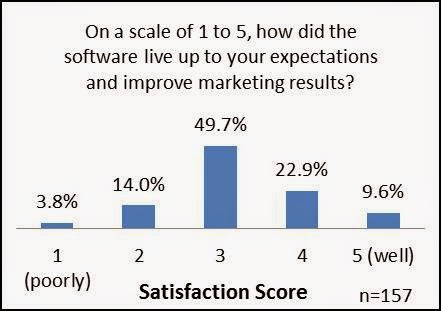
To resolve the original mystery: the quote references a survey I conducted with VentureBeat and released in June 2014. You can buy it here if you’re interested.  Answers came from 159 marketing automation users.  The quote refers to a question about how well marketing automation software met satisfaction and improved results, on a 1 to 5 scale. About 18% gave a score of 1 or 2, 50% gave a 3, and 32% gave a 4 or 5. The 1 and 2 scores are clearly unhappy and I’d consider a 3 to show neutral or marginally satisfied. Hence the “almost 70 percent” quote.

Source: Raab Associates, 2014


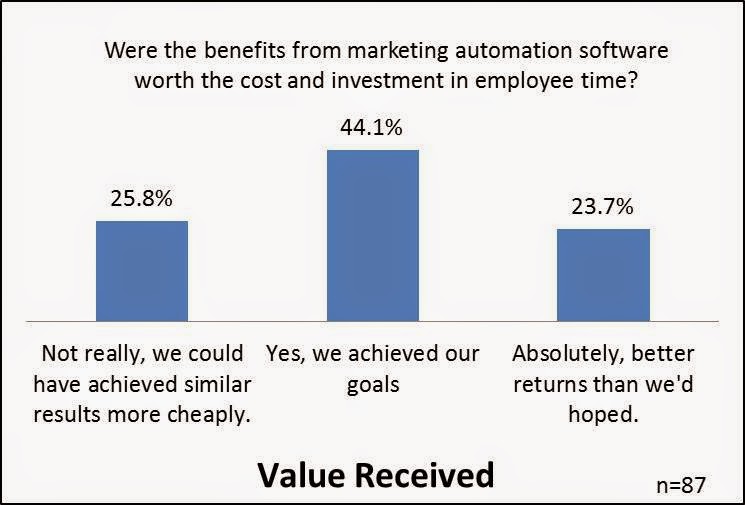
For what it’s worth, the survey also asked a second, more pointed question about whether marketing automation benefits were worth the investment. We received fewer responses (only 87) but the distribution was similar. In fact, the dissatisfied group was a higher percentage: 25.8% and there’s no question how they felt: “we could have achieved similar results more cheaply”. The middle group, 44.1% “achieved our goals” which still sounds to me like marginal satisfaction. Only 23.7% felt they exceeded expectations.

Source: Raab Associates, 2014


I've never considered these results particularly remarkable because they are consistent with other surveys on the topic.  See my posts for October 13, 2013  and October 22, 2013 for a several other surveys.

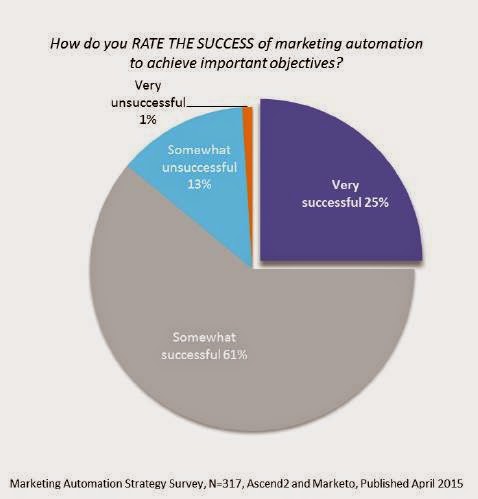
Of course, that's all old data and you may wonder whether anything has changed.  The short answer is no. For example, a recent survey from Marketo and Ascend2  found that 14% of buyers rated marketing automation as clearly unsuccessful and only 25% rated it as very successful: again, there was a big intermediate group of 61% who said is was only “somewhat successful”.


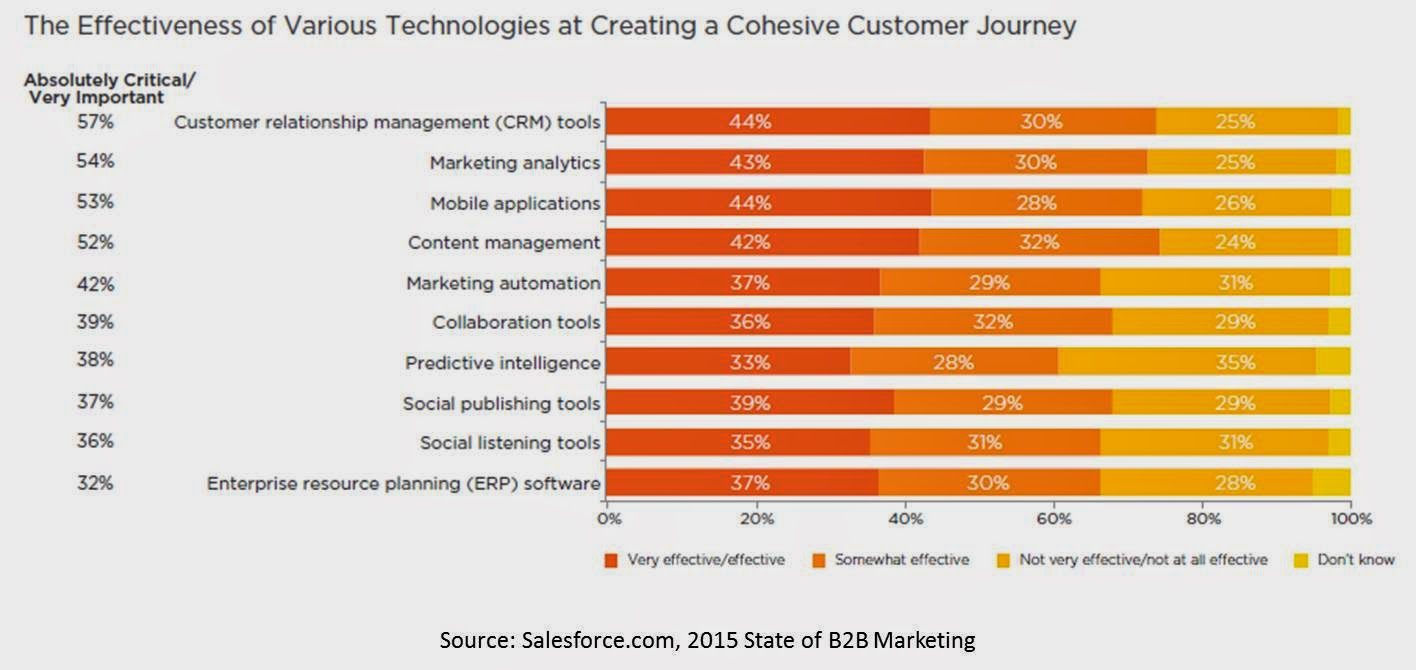
Another survey, this one from Salesforce.com, is generally more optimistic, showing 37% of users rating marketing automation as very effective or effective. But it also shows a relatively high 31% rating it as not very effective or not at all effective. The real difference is an unusually small middle group, 29% rating marketing automation as “somewhat effective”.  What’s probably more disconcerting about this survey is that it shows that marketing automation has relatively low satisfaction and importance compared with other technologies. This suggests that marketers who must prioritize their spending will make other investments first.
 
I must say that I don’t find this topic particularly engaging at the moment. The point of the original TechCrunch article was the growth of open, predictive-based platforms that unify sales and marketing, a direction I agree the industry will take. B2B marketing automation in its current form of systems that primarily use email, landing pages, and visitor tracking to nurture leads before sending them to CRM is a subset of this much larger vision. The challenges of using current marketing automation systems are well known but they will simply make it easier for newer, more effective approaches to replace them. It’s more important and more interesting to focus on that future.

Monday, March 09, 2015

Marketing Technology of the Future: Beyond the Customer Data Platform


The last three minutes of my MarTech Conference presentation are driving me crazy.

The preceding portions cover the current state of Customer Data Platforms. I have no trouble talking about that. But it somehow got into my head that the last section should look at how CDPs will fit into the long-term future of marketing technology. I have some fuzzy notions that this future martech will be radically different from today.  But to cover it succinctly I must first think it through in detail. That has been considerably harder than I expected. Here’s what I have so far.

Current Trends

These are developments happening now that will provide the context for industry changes. Some will be the topic of other MarTech presentations.

• Convergence of Adtech with Martech. These have until recently been largely separate: Adtech deals with messages to audiences whose members may share common characteristics but are not individually identified. Martech deals with known individuals. As anonymity becomes increasingly unavailable, marketers will know exactly who is receiving their advertising messages. Martech targeting techniques will therefore be used in adtech as well. Conversely, some adtech features will become standard martech practice.  More about that later.

• Contextual data. Social networks, mobile devices including phones and wearables, and the Internet of Things will provide ever-more details about the precise situation of each customer during each interaction.  Location is an obvious data point, but marketers will also know your local weather, your mood and physical condition, what you’re wearing, when and what you last ate, and whether your car needs gas. This may sound seriously creepy but the good news is you’ll get better-targeted messages.  I’d love to call this “contextual marketing” but that term is taken.

• Marketing to machines. I’m not talking about marketing with machine-generated data (e.g., your running shoes telling Nike how many miles you’ve logged) or marketing through messages on your machine (your washer suggesting you buy Tide-brand detergent).  I’m talking marketing to machines that are making purchase decisions on their own.  I discussed this last year in Do Self-Driving Cars Pick Their Own Gas Stations? and More on Marketing To Things.  Frankly, I've been surprised to see little else written on the topic. Trust me, this will be big: imagine convincing Siri to recommend your restaurant every time someone asks where they should go to lunch.

Implications for Martech

Given the trends I’ve just listed, I see martech changing significantly.

• Data synergy. I just made that term up but the idea is old: related bits of data are worth more when they’re combined. So knowing you just booked a trip to Alaska and knowing you just walked into a department store are each marginally useful by themselves, but together they let you offer me a great deal on a warm coat. It helps even more if I know you don’t already have one. The implication of this is that there’s a lot of value gained from combining data from different sources into shared repositories. It also implies there’s a lot of value in “identity association” technologies that link related data to the same person.  If you've been wondering why companies like Oracle, Acxiom, and Nielsen have been buying big data aggregators, you can stop.

• Everything is biddable. Another implication of data synergy is that each opportunity to communicate with an individual will be much more valuable to some people than others. Let’s stick with that Alaska trip: selling you a coat might be worth less than selling you a hotel room. So, when you walk into the store, the hotel chain might be willing to pay more for the chance to send you a message than the store itself. Having all the messaging devices connected to a central database and bidding system makes this possible – in fact, it already happens with real time bidding on Web ads. Now Martech platforms get to do the same. And oh, to make this work well, Martech has to hugely improve its ability to measure the actual impact of each message – so advanced, predictive attribution also plays a leading role in the martech world of the tomorrow.

• Campaigns are dead but the customer journey lives on. If each interaction is bid separately, then the notion of campaigns that lead the customer through a sequence of contacts on a flow chart is irrelevant. Honestly, I’m glad to see it go: the very first campaign management system I saw, more than twenty years ago, had exactly that sort of interface and it’s well past time for a change. But this doesn’t mean we can stop thinking about customer journeys. Any model that supports bidding on individual messages must understand where each customer is in her journey and how the message will influence the result.  Of course, different marketers will be tracking different journeys.

• Automation takes over. It’s obvious that mass data consolidation, real time bidding, optimized messaging, and omnichannel execution require near-total automation of the entire process. This has to be really intelligent automation that finds patterns, notices when they change, and optimizes treatments with minimal human guidance. And where will all that highly tailored content come from? You guessed it: automated content creation systems, which are more common and further advanced than you may realize. See Paul Roetzer’s recent post on artificial intelligence in marketing automation for an introduction to the topic  and watch Humans Need Not Apply if you want to get really scared.

• Machines buy martech. If the over-all trend is machines selling to other machines, why should  martech be left out? In fact, testing the huge number of new martech options (or even generating Scott Brinker's martech landscape supergraphic) is something machines could do really well. Once suitably open architectures are in place, it should be easy to plug in new components like a better predictive modeling system, new type of video promotion, or the latest social media app. Even if those components are less than fully automated, they could be identified, screened, integrated, and assessed with minimal human intervention.  Machines would almost surely assess results better than humans, since they’d be more objective and better able to look for subtle effects on customer behavior than human analysts.

• Humans keep things running. It’s possible that machines will eventually control every aspect of our marketing.  But I think humans will have a role to play at least for a while. This won’t necessarily be the traditional “creative” work such as copywriting and design, which machines already do better than we care to admit. But they’ll still need people to come up with non-incremental products, non-obvious insights, and deals with other organizations. Even things that machines could do better than people won’t be wholly machine-run for a while, just due to the normal lags in technology and organizational development. This may sound like a dark view of humanity’s future, but I’m more optimistic than it seems. Technology never works quite as well as promised, so I figure humans will still be needed to keep things running.

Implications for Marketers

If Martech moves in the directions I’m proposing, marketers need to do certain things to prepare.

• Expect imperfection. Sure we’ll have vastly more data than ever, but don’t assume it will be perfectly complete, accurate, or integrated. In fact, you can guarantee it won't.  Predictive models make mistakes as well. Look for systems that are designed to accommodate incomplete information, check for differences between actual and expected performance, and adapt gracefully to failures. Above all, demand transparency so you can see what the automated systems are doing and have some idea of why. This will probably require help from other systems, but make sure the monitors are as independent as possible so they’re not fooled by shared mistakes. If you’re really feeling clever, examine imperfections for opportunities – you may find bargains in bidding on messages to customers that other systems have rejected because their data is unavailable or contradictory.

• Plan for change. As anyone who has tried to modify a complex campaign workflow already knows, sophisticated systems can be brittle. High performance automated systems are likely to optimize themselves for specific conditions, which is great until those conditions change. Be sure you can easily introduce new data sources, components, objectives, and execution channels. And be sure you can always revert to a simpler, more manual mode of operation if things really go bad.

• Focus on the analytics layer.  One implication of data synergy is that the richest databases will live outside of your company’s own data center: they’ll be too big, too complicated, and updated too frequently to maintain a copy in-house. Similarly, if companies are bidding to deliver messages everywhere a customer appears, they won’t own the touchpoints. So the only piece the company can expect to own is the analytical layer – the bidding and content engines. Those engines should be freely swappable as well. What’s left to hold things together is a core of profile data shared by the analytical and content engines. This is connected to the external data store on one end and the touchpoint systems on the other. All told, it’s a rather wispy little framework, but it should be enough to provide the glue needed to link all the other components.

So, where does that leave us?  Gigantic external data pools linked to personal identities, real time bidding, messages delivered through paid channels: it's "adtech without the privacy" if you want to put it in a nutshell.  That isn't where I expected to end up, but that's exactly why I needed to write this. I can’t guarantee I won’t change my mind after further reflection, but for now I think this gives a reasonable picture of what martech might look like five or ten years from now.  In the shorter term, I still expect the central role will be played by Customer Data Platforms or (more likely) by Marketing Platforms that combine the data parts of a CDP with a multi-purpose analytical and decision layer.

Now all I have to do is figure out how to cram this into three minutes. 

...hmm...

On further reflection, it comes down to a hybrid of martech plus adtech, which is inevitably named madtech:


Tuesday, June 04, 2013

My Take: Salesforce Acquires ExactTarget, Continues Marketing Automation Industry Consolidation

I've been in meetings all day and just emerged to hear that Salesforce.com purchased ExactTarget.  Having a had a few moments to digest the news (and some lunch), here are some thoughts:

- Good move for Salesforce.  They have been lacking large-scale email capability, which all types of sales and marketing departments require.  So this fills a gap in their core product offerings.  They also get a toe-hold in B2C marketing and in marketing automation (via ExactTarget's Pardot technology).  I'd guess those were bonuses rather than primary drivers of the deal.  Frankly, of the two, entry into B2C marketing seems more important because it's such a large business and Salesforce.com needs to know where it will get its next several billion dollars in revenue.

- Price is reasonable by today's standards.  ExactTarget had $300 million revenue in 2012, so the $2.5 billion price is 8.3x trailing revenue.  Marketo's market cap is $800 million on $58 million 2012 revenue, or nearly 14x trailing revenue.  Oracle paid $800 million for Eloqua, which had around $100 million trailing revenue, another 8x ratio.  (Salesforce's press release projects a net revenue impact of $120-$125 million for 2014.  That includes just six months of revenue, but it's still a much lower annualized rate than the ExactTarget figures.  It seems the difference is largely due to adjustments in deferred and unbilled revenue.)

- Not so terrible for marketing automation in the short term.  Sure, Marketo's stock dropped 8% vs. yesterday's close, on a pretty quiet day in the market (S&P down 0.55%, Oracle down 0.67%).  And, yes, more companies will buy Pardot now that it's part of Salesforce than they would have otherwise.  But I doubt Salesforce will suddenly stop integrating with other marketing automation vendors.  Small, independent marketing automation firms already had a tough time selling against big competitors, so this only makes their lives marginally harder.  The smart ones (and that's most of them) already have a strategy in place to differentiate themselves from the big industry leaders.

- Tougher for marketing automation in the long term.  I've long argued that CRM and marketing automation should be part of the same system.  Like a broken clock, the time has come when I'm right.  Marketing automation sits between email and CRM, in the sense that it uses both heavily.  So Salesforce has effectively surrounded the marketing automation vendors with its purchase, even ignoring Pardot.  This means that Salesforce will be in the room with a solution when email and CRM users discuss expanding into marketing automation.  In many cases, clients will extend their Salesforce deployment without considering anyone else..

- Salesforce isn't done, or at least shouldn't be.  Email and CRM are two big customer-facing systems: you get absolutely no prize for knowing that your Web site is the third.  (Ok, social is in there someplace too, but it's still more smoke than fire.)  A truly complete customer-facing solution would encompass Web content management as well.  This is another idea I've long pushed, and its time will come too.  Indeed, I see many Web content management vendors already adding marketing automation-type features.  Salesforce itself might not move into this space quite yet, but it seems inevitable that they'll do it eventually.

- Adobe, where art thou?  Since I'm exercising all my favorite hobby horses, we might as well let this one out of the stable.  (Actually, someone else mentioned it to me earlier today, so at least I'm not alone in my obsessions.)  Of course, Adobe already has a strong presence in Web site management and it keeps making noises about having a "marketing cloud".  Um, excuse me guys, but you really need email and marketing automation for that.  Silverpop -- already a large Adobe partner -- is the obvious acquisition candidate to fill that gap.  Sadly, Adobe has shown no signs of moving in this direction -- but time moves on, whether or not my broken clock is ticking.  (I don't know what that last phrase means, either, but sooner or later Adobe will buy something.)

Addendum: I've now had time to listen to the analyst conference call from this morning (available at 800-585-8367 passcode 89103168).  It doesn't change my analysis above, but clarifies that Salesforce's main goal was finding a single system that would support sophisticated cross channel marketing campaigns, with particular stress on heavy automation and new devices such as mobile.  They do seem more interested in B2C than I would have thought.  

Another comment made twice was that it was a competitive acquisition.  As others have pointed out, this means there's at least one other big company looking to buy a similar integrated marketing system.  There aren't many of those available -- traditional B2B marketing automation vendors are too narrow to fit the bill.  I'll mention Silverpop again as an option, and maybe Responsys and other high-end email products.  B2C marketing automation vendors including Neolane, ClickSquared, and perhaps RedPoint could be candidates but may be too small to be of interest.

Tuesday, December 18, 2012

Future of Marketing Automation: Grow or Die

‘Tis the season for industry predictions. I’ve already fielded a couple of requests for my thoughts, which usually requires some pondering before I reply. But this time I was able to answer right away because I’ve just finished a white paper on the future of B2B marketing automation, sponsored by Leadformix and available here for free download.


The question answered by the paper is “What will marketing automation vendors do next?” This is different from the perhaps-more-important question of “What will marketers do next?” I don’t claim any particularly deep insights into the latter: they'll continue to adapt to new media and buying habits, I guess. Like everyone else, I’m seeing greater use of social, mobile, and video; more cross-channel campaigns; closer cooperation between marketing and sales; and expanded use of analytics. If I had to predict one thing that isn’t utterly obvious, it's that B2B marketers will be more involved with managing customer relationships after the initial sale. The reason is that post-sales interactions are increasingly automated and marketers have the best tools to manage automated interactions effectively. The task is really the same as a sophisticated lead nurturing campaign: to monitor customer behavior and respond appropriately.

While my vision of future marketing may be rather broad, I think I see the future of marketing automation in clearer detail. This is what’s covered in the white paper. To summarize the argument:

  • marketing automation vendors must grow or die. Today’s B2B marketing automation systems are used primarily for lead nurturing. This means they don’t help other marketers who do lead acquisition and marketing administration (planning, budgeting, project management, etc.). They also have limited interactions with sales and service departments, who own the post-sales customer relationship. Marketing automation vendors who want to expand their business need to service these other groups or risk some other system becoming the central platform for marketing management. If that happens, the other systems will slowly encroach on marketing automation functionality and eventually replace it.
  • marketing automation can expand in either direction along the customer path: backward to acquisition or forward to sales and service.  Most expansion to date has been towards sales, in the form of add-ons that give salespeople access to information about behavior of their leads. But CRM systems are deeply embedded in sales departments, so they block growth in that direction.  I therefore expect marketing automation vendors to instead shift toward features for acquisition marketers. These would include not just “inbound marketing” through social media and search engine optimization, but also purchasing media such as online and offline advertising.
  • marketing automation can also be divided into layers of delivery systems, campaign management, and platform functions.  Delivery systems manage touchpoints such as Web sites, email, and social media publishing.  Campaign management is the rules and models to select names for promotions.  Platform functions are supporting technologies such as the marketing database, planning and budgeting, content management, analytics, and security. Current marketing automation systems do all three to the degree needed for lead nurture campaigns.  Extending to other users will require more powerful platform functions in particular. Whoever controls the platform can best expand throughout the marketing department.
  • marketing automation vendors will increasingly fall into two groups: a handful of big platform vendors and larger number of small specialists. The platform vendors will offer a broad range of functions internally and further extend their range by exposing their platforms to third party developers through “app markets”. The specialists will have narrower scope but be very good at serving companies with specific needs such as low cost, marketing services, or  industry editions (for sports, investments, franchises, etc.)  Both types of companies can succeed although the platform vendors will tend to dominate over time.
  • new competition will come from outside the industry, especially from delivery systems. This seems counter-intuitive: delivery systems are by definition channel-specific and function-generic (a term I just invented to mean they serve all functions within marketing, sales and service). This means they are in the strategically weak position of selling commodity products without strong ties to any particular set of users. But the delivery vendors recognize this weakness and can afford to overcome it by investing in campaign engines and platform features. This is exactly what's happening when email vendor ExactTarget purchases Pardot or Web content management vendor SiteCore adds email campaigns and a database. It (almost) goes without saying that CRM vendors are also potential competitors: they already have the platform features; what they mostly lack are campaign engines.
These trends have specific implications for marketers who are selecting a marketing automation system.  You'll need to download the white paper to find out what they are.