I just finished the latest release of the B2B Marketing Automation Vendor Selection Tool, a.k.a. VEST Report. The new version includes a big technical change: instead of the interactive Flash document that was very cool but people often had trouble running, it’s now a combination of PDF for the core document and Excel spreadsheet for the detailed vendor scores. That’s a technical step backwards but will actually make it easier for buyers to access the detailed vendor information, and in particular to screen for vendors with particular capabilities. Less is more, I suppose. The good news is that this format lets me expand beyond 25 vendors, which was the maximum the old system allowed before running out of memory.
Of course, none of this is your concern, Dear Reader. What’s you'll find more interesting is that the VEST provides an opportunity to see new patterns emerging in the industry. Usually I do this by taking a close look at which features have become more common since the last report. But this time there were a few more obvious changes that stood out. Here’s what struck me.
- more micro-business vendors. All six of the vendors new to this report sell primarily to small businesses, and most are “all-in-one” systems that combine marketing automation with integrated CRM. They join another six vendors from previous editions who also serve this market. I'm also aware of several other vendors, not yet in the VEST, who also compete for this business. Many of these firms are new while others have been around for a few years but just hit my radar. What this says to me is that the all-in-one segment is more crowded and more mature than it has seemed. Of course, there’s still a huge opportunity – hundreds of thousands if not millions of potential clients have yet to buy their first system. But anyone planning to enter this business had better realize they will be fighting for new customers.*
- agency relationships. It seems that just about every vendor in the VEST now touts special features to support marketing agencies that resell the system to their clients or operate the system on the clients’ behalf. This isn’t exactly new but what once seemed like a niche strategy now looks more like a standard approach. It’s always been obvious that agencies were a sensible channel for marketing automation vendors to pursue, but I’m beginning to wonder whether agencies might turn out to be the primary channel for such systems, excepting only direct sales to large enterprises. If this happens, the reason will be that agencies provide the missing skills that have prevented so many companies from taking full advantage of marketing automation systems by themselves. Vendors have been knocking themselves out for the past five years trying to educate marketers to run their systems. Perhaps having agencies run them is the real solution instead.
- social data. Maybe my biggest surprise was finding that many if not most vendors have now added features to automatically look up new contacts in social networks and add that data to their marketing automation or CRM profile. This seemed like magic three years ago when I first saw John Ferrara's Nimble do it; but now it’s commonplace. In fact, any vendor that hasn’t developed their own technology can just integrate FullContact to do it for them. So the competitive advantage is now precisely zero. (Okay, not zero: some companies surely do it better than others. But that’s a much weaker selling point than being one of the few firms to do it at all.)
- ad tech integration. This one isn’t so common yet, although Oracle Eloqua, Marketo, HubSpot and some others have announced some ad retargeting partnerships. Google Adwords integration and advertising through Facebook, Twitter, and LinkedIn audiences are more widely available but I don’t include them here. But despite the slow growth, there’s no question that serious integration between Web display ads and marketing automation programs will become much more widely available. What I won't do is predict how quickly that will happen. But I’ll certainly add it to the list of VEST questions so I can track it more closely in the future.
- dogs that didn’t bark. That’s a Sherlock Holmes reference, not an insult to technologies that haven’t been as widely adopted as the industry seemed to expect. Okay, maybe it’s a bit of both. In any event, I didn’t commute to work today on my hoverboard, and you probably didn’t sit down to do advanced mobile marketing, predictive modeling or revenue analytics in your marketing automation system. Those three – mobile, predictive, and revenue analytics – are all technologies that should take off, but so far are not deeply integrated with most marketing automation platforms. Maybe mobile has become so ubiquitous that I don’t even notice it, but, so near as I can tell, few vendors have done more than make it easier to create emails and Web pages that look good on mobile devices. Surely mobile can do more than that. Predictive analytics are growing quickly but so far are still done by specialized vendors rather than built into the marketing automation platform. (Yes, there are a few exceptions like the machine learning features of dbSignals and RedPoint. But they’re exceptions.) Revenue analytics is only discussed by a couple of companies; although important, it doesn’t seem to have captured the industry’s imagination. I haven’t given up hope for any of these, but no longer expect them to quickly become part of the mainstream.
So those are my impressions while the VEST updates are fresh in mind. The report is well worth buying if you want do to your own industry analysis, or (its primary purpose) are searching for a new system. As I say, the new format does make finding vendors with specific features much easier. You can find more information or place an order at www.raabguide.com/vest. Let me know what you think.
__________________________________________________________________________________
*In fact, the micro-business segment is even more complicated than I’ve suggested. The real competitors are companies like ConstantContact who are providing a broad range of services, such as local advertising, that extend well beyond marketing automation and CRM. There are also many vendors with specialized services for vertical markets such as plumbers and funeral homes. Come to think of it, I recently noticed that one of my many plumbers (don’t ask) uses a system developed by a funeral home website firm. If there’s a logical connection between those businesses, I don’t want to know about it.
Showing posts with label Raab VEST report. Show all posts
Thursday, February 05, 2015
Saturday, January 24, 2015
New Marketing Automation Options for Small Business in the VEST Report
I’m revving up for the next edition of our B2B Marketing Automation Vendor Selection Tool (VEST) report, which will include six first-time entries. I’ve already written about two of those, Inbox25 and AutopilotHQ (formerly Bislr). Here are thumbnails of the others.
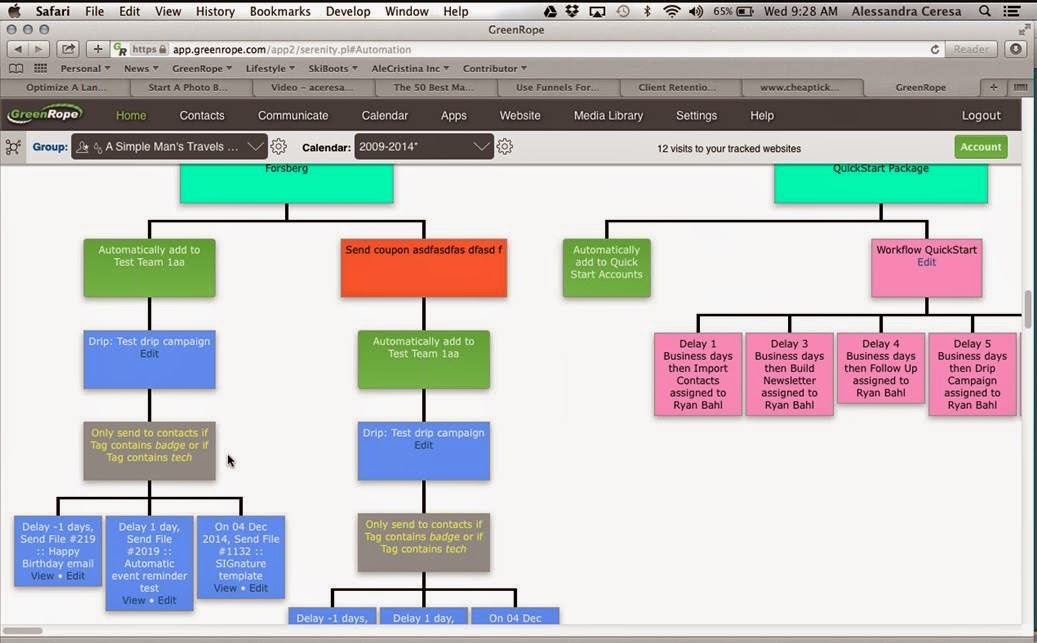
GreenRope is all-in-one software sold primarily to very small businesses such as lawyers, real estate agents, consultant, coaches and membership organizations. That puts it firmly in Infusionsoft territory, and perhaps even towards the lower end of that. The system has an impressively broad scope, adding full Web site creation to the usual all-in-one mix of email, lead scoring, landing pages, and CRM. The features within these functions are unusually sophisticated for a micro-business system: email includes dynamic content and a/b tests; Web pages also support a/b testing; Web forms allow progressive profiling; email and Web responses can automatically trigger a follow-up action. CRM includes opportunity tracking, unlimited user defined fields, and automatic search of Facebook and LinkedIn when new contacts are added; algorithms can automatically estimate the right number of points for different events to build a predictive lead score. The media library supports images, files, articles, and videos (through Vimeo integration); the calendar provides full event management; surveys can change questions based on previous answers and include automated follow-up actions.
The system also extends beyond sales and marketing functions to include customer forums, Wikis, support tickets, project schedules with tasks assigned to individuals, and coupons. Workflows can manage both marketing campaigns and internal projects. Additional functions are provided through integration with other systems, including Olark for chat, Twilio for voice and text messages, VoiceBase for transcription, Magento for ecommerce, Quickbooks for accounting, and Microsoft Outlook for email.
In other words, although GreenRope describes itself as “CRM and marketing automation,” it actually extends beyond those functions to manage activities throughout the business. This is very desirable for small organizations that want to automate their operations while running as few systems as possible.
GreenRope is also small-business-friendly, starting at $149 per month for up to 1,000 contacts and costing $199 per month for 5,000 contacts. All plans include unlimited users and unlimited emails, which isn’t always the case with small business systems.
While GreenRope is new to the VEST report, the company itself was founded in 2008. It currently has about 4,500 end users at a somewhat smaller number of companies.
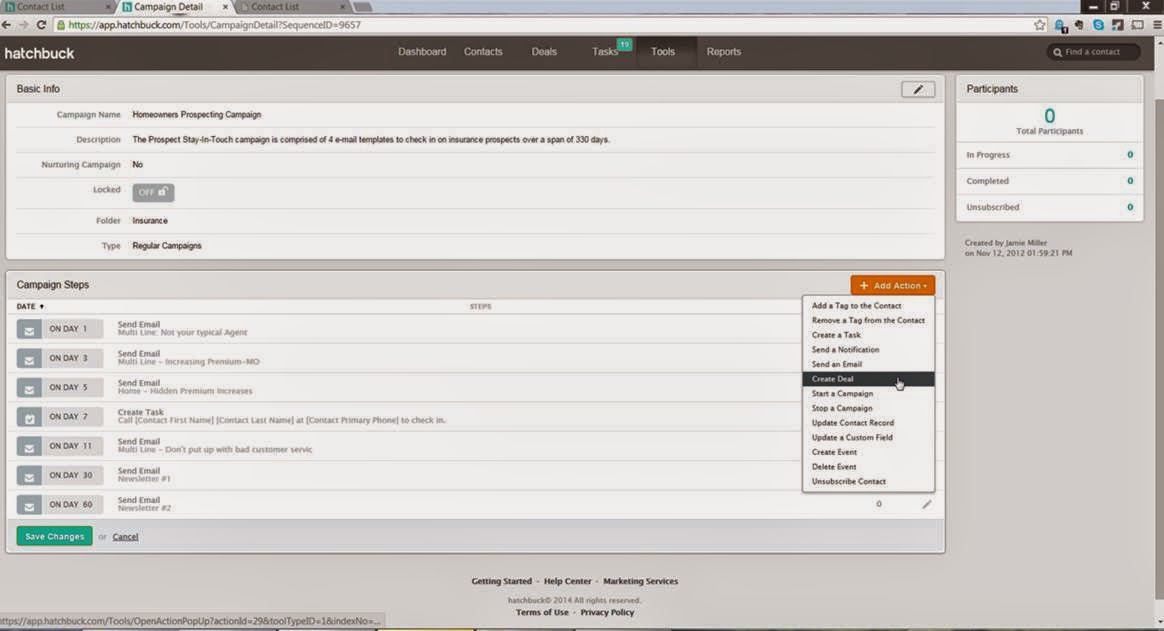
Hatchbuck is another all-in-one product for very small businesses. It has taken the approach of providing only core features and making them as easy to use as possible. This scope covers email, Web forms, multi-step campaign flows, and CRM. The system integrates via Zapier with ecommerce products. It recently added lead scoring and the ability to look up individuals on social networks. The company serves a mix of clients, with the largest segments including technology and manufacturing companies, travel, and professional services. Most clients have fewer than ten employees.
As the company’s strategy suggests, Hatchbuck provides basic capabilities for its core features but skips the more advanced options. It creates email templates with personalization and embedded links but no dynamic content. CRM captures activity history, tasks, deals, purchases and events but doesn’t integrate with a phone dialer. Forms can be associated with actions but there is no specialized survey builder. You get the idea. Instead of adding more features, Hatchbuck’s developers rigorously benchmark the number of clicks it takes to perform system functions in Hatchbuck and competitive products and track how customers use each feature to identify problems. The company also provides extensive training and support materials, including a required three hour Quickstart package to help new clients use the system effectively.
Hatchbuck was founded in 2011 and launched its product in 2013. It now has about 700 customers with over 2,000 end-users. Pricing starts at $99 per month for one user and 2,500 contacts and reaches $199 per month for three users and 10,000 contacts. All plans include unlimited emails. The Quickstart package costs $199 but the fee is waived for clients who sign a six month contract. The company also has special features for marketing agencies who use the system for their clients. Such agencies account for about one quarter of the Hatchbuck business.
Lead Liaison calls itself “revenue generation software” to indicate that it provides more than a standard B2B marketing automation product. Additional features include lead distribution and buying signal alerts, but don’t extend to full CRM or the other operational functions. With a $500 per month starting price, it is targeted at small to mid-size businesses but not at the most tiny. Pricing is based on the number of contacts in the database, with unlimited users, emails, and page views. The company doesn’t publicly state how many contacts that $500 gets you.
The system offers advanced versions of the usual marketing automation functions: email, landing pages, Web forms and surveys, lead scoring, multi-step nurture flows, media hosting, and CRM integration with Salesforce.com, Microsoft Dynamics CRM, and Sugar CRM. It also goes beyond these in several directions, including:
- company-level Web visitor identification based on IP address, which can be tied to Data.com or LinkedIn to pull back the names of individual contacts at the identified companies (although these are not necessarily the actual visitors).
- matching of contacts against social networks to add their social identifiers to the Lead Liaison record
- phone dialer with scripts, call notes, and a payment widget
- option to send emails from LeadLiaison’s own servers or through third party services including Mandrill, SendGrid, and SMTP Inc.
- social media posting to Facebook, LinkedIn, and Twitter, including an option to store posts in a queue that will release them on a regular schedule
- a nifty Web page scanner that can copy an existing Web page or form from any source into a version that the marketing automation user can edit by, say, inserting a Lead Liasison form or link
- agency-friendly features including single log-in to multiple accounts.
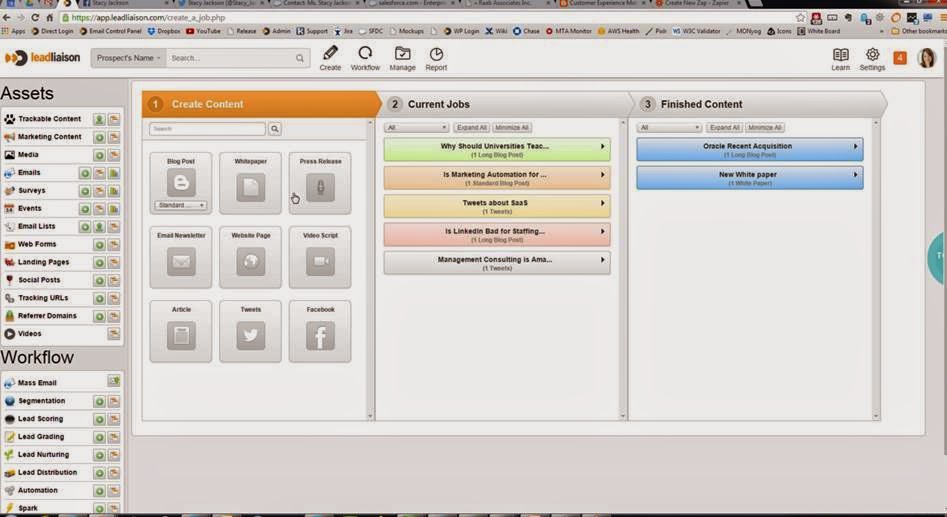
Perhaps the most interesting feature of LeadLiaison is a content creation wizard that connects to a network of prequalified writers for blog posts, white papers, press releases, newsletters, Web pages, social media posts, and other materials. This is directly integrated with the system: users fill out a form specifying their requirements, which Lead Liaison submits to the network. Once a writer (whose identity is hidden from the user) accepts the project, the system tracks the material through production states and eventually loads it into the Lead Liaison asset library. Assets are automatically coded so users can track consumption. The system can also limit distribution based on date range, number of downloads, and whether visitors are asked or required to provide an email address to receive it. Pricing is modest: a blog post costs $50 with five day turnaround. Although the writers are anonymous, LeadLiaison plans to let users favor authors of specific pieces for future assignments.
LeadLiasison was launched in 2013. It has under 200 clients and serves a mix of B2B and B2C marketers.
dbSignals is brand new: the system was formally launched just last week. (Full disclosure: I’ve consulted for them.) The system straddles B2B and B2C marketing automation, using a flexible data structure typical of B2C products but also providing Salesforce.com integration, the B2B hallmark. It also includes its own lightweight CRM.
The marketing automation functions themselves are quite sophisticated: dynamic content, multi-step branching campaign flows, multivariate testing, fine-grained user rights management, option to use internal or external email services, and integration with external HTML templates. Supported channels include email, SMS, direct mail, surveys, landing pages, and social media. There are also options to support marketing agency users, including an ability to rebrand the system with the agency or client’s own identity.
And, yes, the system also can look up the social profiles of individual contacts and add them to its database. That feature has quickly become a new standard.
But what really distinguishes dbSignals are two features beyond the normal scope of marketing automation. The first is prospect data: the company has negotiated deals to let its clients access detailed files with 235 million consumer names and 60 million B2B names. These are selectable within the normal system interface, along with whatever names a client loads on its own.
The second feature is machine learning. This is initially being deployed to identify the most responsive list segments within the prospect data. The process is wholly automated: the only choice users make is whether to turn it on. Once they do, the system analyzes the client's customer list or past campaigns, builds a predictive model, runs test campaigns to validate and refine the model, and then runs a roll-out campaign once the model is stable. Models are further adjusted after later campaigns. dbSignals will soon add other uses for machine learning including churn prediction, lifetime value prediction, and attribution of the incremental impact of marketing programs.
Prospect data and machine learning are closely integrated. Indeed, one of the reasons machine learning can be so fully automated is that the system can rely on the prospect data elements to be available -- including up to 2,000 variables on a consumer profile. Beyond that, dbSignals uses the machine learning results to “reserve” the best prospect names for each client in advance of campaign selection. This is needed because dbSignals limits the number of promotions sent to any name within a specified time period.
Both the prospect data and machine learning are in turn made possible by dbSignals' underlying technology, which uses the Cassandra data store instead of a standard relational database. Few marketers will care, but, trust me, it really matters for speed, scale, and flexibility.
dbSignals also offers an unusual pricing model, basing charges on the number of users and/or message volume rather than database size. This makes it easier for clients to take full use of the prospect data. Fees start as low as $500 per month.
The initial version of dbSignals was introduced in 2014. The company currently has about two dozen clients including a mix of B2B and B2C organizations.
![]() |
| GreenRope workflow |
GreenRope is all-in-one software sold primarily to very small businesses such as lawyers, real estate agents, consultant, coaches and membership organizations. That puts it firmly in Infusionsoft territory, and perhaps even towards the lower end of that. The system has an impressively broad scope, adding full Web site creation to the usual all-in-one mix of email, lead scoring, landing pages, and CRM. The features within these functions are unusually sophisticated for a micro-business system: email includes dynamic content and a/b tests; Web pages also support a/b testing; Web forms allow progressive profiling; email and Web responses can automatically trigger a follow-up action. CRM includes opportunity tracking, unlimited user defined fields, and automatic search of Facebook and LinkedIn when new contacts are added; algorithms can automatically estimate the right number of points for different events to build a predictive lead score. The media library supports images, files, articles, and videos (through Vimeo integration); the calendar provides full event management; surveys can change questions based on previous answers and include automated follow-up actions.
The system also extends beyond sales and marketing functions to include customer forums, Wikis, support tickets, project schedules with tasks assigned to individuals, and coupons. Workflows can manage both marketing campaigns and internal projects. Additional functions are provided through integration with other systems, including Olark for chat, Twilio for voice and text messages, VoiceBase for transcription, Magento for ecommerce, Quickbooks for accounting, and Microsoft Outlook for email.
In other words, although GreenRope describes itself as “CRM and marketing automation,” it actually extends beyond those functions to manage activities throughout the business. This is very desirable for small organizations that want to automate their operations while running as few systems as possible.
GreenRope is also small-business-friendly, starting at $149 per month for up to 1,000 contacts and costing $199 per month for 5,000 contacts. All plans include unlimited users and unlimited emails, which isn’t always the case with small business systems.
While GreenRope is new to the VEST report, the company itself was founded in 2008. It currently has about 4,500 end users at a somewhat smaller number of companies.
![]() |
| Hatchbuck workflow |
Hatchbuck is another all-in-one product for very small businesses. It has taken the approach of providing only core features and making them as easy to use as possible. This scope covers email, Web forms, multi-step campaign flows, and CRM. The system integrates via Zapier with ecommerce products. It recently added lead scoring and the ability to look up individuals on social networks. The company serves a mix of clients, with the largest segments including technology and manufacturing companies, travel, and professional services. Most clients have fewer than ten employees.
As the company’s strategy suggests, Hatchbuck provides basic capabilities for its core features but skips the more advanced options. It creates email templates with personalization and embedded links but no dynamic content. CRM captures activity history, tasks, deals, purchases and events but doesn’t integrate with a phone dialer. Forms can be associated with actions but there is no specialized survey builder. You get the idea. Instead of adding more features, Hatchbuck’s developers rigorously benchmark the number of clicks it takes to perform system functions in Hatchbuck and competitive products and track how customers use each feature to identify problems. The company also provides extensive training and support materials, including a required three hour Quickstart package to help new clients use the system effectively.
Hatchbuck was founded in 2011 and launched its product in 2013. It now has about 700 customers with over 2,000 end-users. Pricing starts at $99 per month for one user and 2,500 contacts and reaches $199 per month for three users and 10,000 contacts. All plans include unlimited emails. The Quickstart package costs $199 but the fee is waived for clients who sign a six month contract. The company also has special features for marketing agencies who use the system for their clients. Such agencies account for about one quarter of the Hatchbuck business.
![]() |
| Lead Liaison content creation |
Lead Liaison calls itself “revenue generation software” to indicate that it provides more than a standard B2B marketing automation product. Additional features include lead distribution and buying signal alerts, but don’t extend to full CRM or the other operational functions. With a $500 per month starting price, it is targeted at small to mid-size businesses but not at the most tiny. Pricing is based on the number of contacts in the database, with unlimited users, emails, and page views. The company doesn’t publicly state how many contacts that $500 gets you.
The system offers advanced versions of the usual marketing automation functions: email, landing pages, Web forms and surveys, lead scoring, multi-step nurture flows, media hosting, and CRM integration with Salesforce.com, Microsoft Dynamics CRM, and Sugar CRM. It also goes beyond these in several directions, including:
- company-level Web visitor identification based on IP address, which can be tied to Data.com or LinkedIn to pull back the names of individual contacts at the identified companies (although these are not necessarily the actual visitors).
- matching of contacts against social networks to add their social identifiers to the Lead Liaison record
- phone dialer with scripts, call notes, and a payment widget
- option to send emails from LeadLiaison’s own servers or through third party services including Mandrill, SendGrid, and SMTP Inc.
- social media posting to Facebook, LinkedIn, and Twitter, including an option to store posts in a queue that will release them on a regular schedule
- a nifty Web page scanner that can copy an existing Web page or form from any source into a version that the marketing automation user can edit by, say, inserting a Lead Liasison form or link
- agency-friendly features including single log-in to multiple accounts.
Perhaps the most interesting feature of LeadLiaison is a content creation wizard that connects to a network of prequalified writers for blog posts, white papers, press releases, newsletters, Web pages, social media posts, and other materials. This is directly integrated with the system: users fill out a form specifying their requirements, which Lead Liaison submits to the network. Once a writer (whose identity is hidden from the user) accepts the project, the system tracks the material through production states and eventually loads it into the Lead Liaison asset library. Assets are automatically coded so users can track consumption. The system can also limit distribution based on date range, number of downloads, and whether visitors are asked or required to provide an email address to receive it. Pricing is modest: a blog post costs $50 with five day turnaround. Although the writers are anonymous, LeadLiaison plans to let users favor authors of specific pieces for future assignments.
LeadLiasison was launched in 2013. It has under 200 clients and serves a mix of B2B and B2C marketers.
![]() |
| dbSignals workflow |
dbSignals is brand new: the system was formally launched just last week. (Full disclosure: I’ve consulted for them.) The system straddles B2B and B2C marketing automation, using a flexible data structure typical of B2C products but also providing Salesforce.com integration, the B2B hallmark. It also includes its own lightweight CRM.
The marketing automation functions themselves are quite sophisticated: dynamic content, multi-step branching campaign flows, multivariate testing, fine-grained user rights management, option to use internal or external email services, and integration with external HTML templates. Supported channels include email, SMS, direct mail, surveys, landing pages, and social media. There are also options to support marketing agency users, including an ability to rebrand the system with the agency or client’s own identity.
And, yes, the system also can look up the social profiles of individual contacts and add them to its database. That feature has quickly become a new standard.
But what really distinguishes dbSignals are two features beyond the normal scope of marketing automation. The first is prospect data: the company has negotiated deals to let its clients access detailed files with 235 million consumer names and 60 million B2B names. These are selectable within the normal system interface, along with whatever names a client loads on its own.
The second feature is machine learning. This is initially being deployed to identify the most responsive list segments within the prospect data. The process is wholly automated: the only choice users make is whether to turn it on. Once they do, the system analyzes the client's customer list or past campaigns, builds a predictive model, runs test campaigns to validate and refine the model, and then runs a roll-out campaign once the model is stable. Models are further adjusted after later campaigns. dbSignals will soon add other uses for machine learning including churn prediction, lifetime value prediction, and attribution of the incremental impact of marketing programs.
Prospect data and machine learning are closely integrated. Indeed, one of the reasons machine learning can be so fully automated is that the system can rely on the prospect data elements to be available -- including up to 2,000 variables on a consumer profile. Beyond that, dbSignals uses the machine learning results to “reserve” the best prospect names for each client in advance of campaign selection. This is needed because dbSignals limits the number of promotions sent to any name within a specified time period.
Both the prospect data and machine learning are in turn made possible by dbSignals' underlying technology, which uses the Cassandra data store instead of a standard relational database. Few marketers will care, but, trust me, it really matters for speed, scale, and flexibility.
dbSignals also offers an unusual pricing model, basing charges on the number of users and/or message volume rather than database size. This makes it easier for clients to take full use of the prospect data. Fees start as low as $500 per month.
The initial version of dbSignals was introduced in 2014. The company currently has about two dozen clients including a mix of B2B and B2C organizations.
Tuesday, August 05, 2014
VEST Report: Analytics Tops List of Upgraded Marketing Automation Features
I finished the latest release of the B2B Marketing Automation Vendor Selection Tool (VEST) yesterday, which is always a great relief. But the elation lasted about two minutes, since I then had to write a press release announcing it. The challenge with that is you need a “news hook”, meaning something that gives reporters a reason to write about your story. For the January release, that’s always easy, since I have a new estimate of industry revenues and the press loves that sort of thing. But I can’t repeat that for the mid-year release. That meant I had to dive back into the VEST data and find something interesting to say about it.Of course, that isn’t all bad, since rolling around in industry data makes me as happy as a pig in mud.* But finding clever insights on demand is still tough. Happily, I did find something intriguing, at least to my obviously-biased eyes. You can read the headline in the press release or – lucky you – get even more details below.
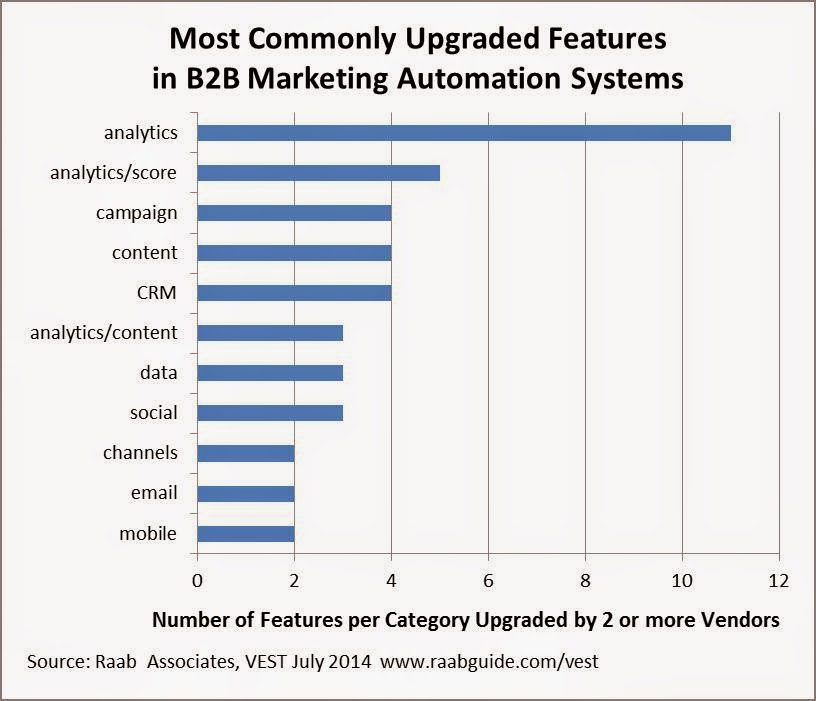
What I did for my analysis was look at changes in vendor scores for the 200 items that go into the VEST data. That gives an interesting view of where vendors are improving their products. I had no particular expectation of what I’d find. But when I looked at the most common items (those which had been upgraded by three or more vendors), it immediately became clear that changes related to analytics were heavily represented. In fact, if you count lead scoring and content testing as part of analytics, seven of the dozen items fell into that category. Who knew?
Looking deeper, I expanded my analysis to include items upgraded by two or more vendors, which included 43 of the 200 total. By golly, the results were similar – 19 of the items fell into analytics, compared with just four each in the next most common groups (campaign management, content marketing, and CRM integration). Houston, we have a pattern.
As I say, this result was totally unexpected, but it can still be explained with 20/20 hindsight. I might have expected more development of features for social, mobile, and content marketing, which are top-of-mind for many marketers today. But social and content marketing are mostly managed outside of marketing automation and mobile is mostly limited to ensuring messages are viewable on mobile devices. By contrast, analytics is something most marketers do want from their marketing automation system and an area where great improvements are still possible. So a clear-eyed understanding of how marketing automation is actually used, as opposed to what people are talking about, would have predicted analytics as the focus of vendor attention.
Needless to say, this analysis is really just a byproduct of the primary purpose of the VEST, which is to assemble apples-to-apples comparisons of B2B marketing automation vendors so that buyers have an easier time finding the right system. I’ll probably circle back and write a bit more about the latest data in another post. In the meantime, if you’re actually in the process of making a purchase, or just want to understand the industry better, you can buy your very own copy at the Raab Guide Web site.
_______________________________________________________________________________
* Does anyone know whether pigs really like to roll in mud? It’s a great cliché and all, but I am not a farm boy.
Tuesday, July 30, 2013
Acquisitions Reshape the Marketing Automation Industry: Growth at the Bottom, Room in the Middle, Fog at the Top
Raab Associates officially released the new edition of our B2B Marketing Automation Vendor Selection Tool (VEST) yesterday. This is our flagship report on the industry, with nearly 200 data points on 23 vendors and separate ratings for micro-business, small to mid-size companies, and enterprise marketing departments. There are quite a few vendor comparisons out there, but none come close to the level of detail in the VEST – and details are what you really need to select a system. I personally suggest that anyone interested in the industry buy a copy for themselves and another for someone they love. See www.raabguide.com/vest for details.
I genuinely enjoy catching up with the vendors while preparing the VEST, but must admit that my favorite part of the process is analyzing the data once it’s assembled. Sadly, the wave of acquisitions that swept the industry in the past year has made this harder: many major vendors are now part of a public company, which severely restricts the information they can share. We’ve probably passed a tipping point where so much information is hidden that I can’t draw a clear picture of industry growth rates or competitive positions.
The table below shows the data available and highlights the holes. I’ve grouped the vendors into three buckets based on the market sectors they serve: micro-business (under $5 million revenue), small to mid-size business ($5 to $500 million), and large enterprises (over $500 million).
You’ll immediately see that the “not reported” information is concentrated among companies serving mid-size and enterprise clients, which is where all the acquisitions to date have taken place. Neolane is an exception but only because they provided the VEST information just before Adobe acquired them in June. I doubt we’ll see new numbers from them in the future. Marketo was mostly missing until they provided key figures in their earnings call this afternoon. Thanks, guys.
I've summarize my thoughts on this data with three oh-so-catchy phrases: growth at the bottom, opportunity in the middle, and fog at the top.
Growth at the Bottom: the green shading in the client growth column highlights companies reporting a year-on-year increase of 60% or more. What jumps out is the concentration at the top of the chart, in the micro-business sector. Four of the five micro-business vendors grew more than 60% and the fifth (Venntive) grew at a far-from-shabby 54%. There’s too much missing data in the other sectors to say for certain that the micro-business vendors are growing the fastest, but it sure looks that way. My interpretation is that the micro-business sector is the least mature and still presents the greatest untapped opportunity – even if buyers are still limited to the small proportion of business owners who are “tech geeks”.
Room in the Middle: Marketo's client count increased just 36% from mid-2012 to mid-2013 (although they’re projecting 54% revenue growth for 2013 vs. 2012). We can no longer see the growth rates for mid-market heavy weights Pardot and Eloqua, but I’d be surprised if they beat Marketo. They're certainly not close to the 67% to 90% rates reported by LeadFormix, Act-On, and eTrigue. I suspect Pardot, Eloqua and Marketo will increasingly focus on selling to enterprises, and in Marketo’s case on expanding footprint within existing clients. If so, this might open the way to faster growth by the next tier of mid-market vendors, who are mostly still private. (LeadFormix is the exception, but seems to be pretty much left alone by its corporate parent). The clear winner in this scenario is Act-On, which has ample venture funding and has indeed been growing very rapidly. They are already the first vendor since Pardot to break the 150-employee barrier (blue shading). Silverpop and HubSpot might also benefit but neither is fully focused on standard B2B marketing automation. Other vendors would need outside funding to squeeze through what will probably be a briefly open window.
Fog at the Top: My visibility into enterprise B2B marketing automation was always clouded because of cross-over by B2C vendors including IBM, SAS, Teradata, and Neolane. It is now completely obscured except for sporadic glimpses of details that vendors choose to reveal. But even if everyone shared all their data with me, the enterprise picture would remain foggy because enterprises are increasingly integrating marketing automation with advertising , sales, service, and Web management. This makes it increasingly meaningless to treat marketing automation as a distinct category. Of course, that integration is exactly why the enterprise vendors purchased all those marketing automation systems in the first place.
If integration really happens at the top then we'll end up with a bizarre symmetry, since the enterprise market will be mirroring the integrated sales / CRM / Web / ecommerce products already bought by micro-businesses. This would leave stand-alone marketing automation as a niche product for mid-tier companies. It would be a very large niche, but squeezed between broader suites from above and below and, eventually, challenged from within by integrated suites built for mid-market companies. The obvious response from marketing automation vendors is to build those broad suites themselves or to create platforms that are the foundation of such suites. That’s exactly what the larger mid-tier companies are doing, but it’s an expensive proposition. Any small mid-market companies who want to play must grab whatever fleeting opportunity the market offers today for growth, before they are locked out for good.
I genuinely enjoy catching up with the vendors while preparing the VEST, but must admit that my favorite part of the process is analyzing the data once it’s assembled. Sadly, the wave of acquisitions that swept the industry in the past year has made this harder: many major vendors are now part of a public company, which severely restricts the information they can share. We’ve probably passed a tipping point where so much information is hidden that I can’t draw a clear picture of industry growth rates or competitive positions.
The table below shows the data available and highlights the holes. I’ve grouped the vendors into three buckets based on the market sectors they serve: micro-business (under $5 million revenue), small to mid-size business ($5 to $500 million), and large enterprises (over $500 million).
You’ll immediately see that the “not reported” information is concentrated among companies serving mid-size and enterprise clients, which is where all the acquisitions to date have taken place. Neolane is an exception but only because they provided the VEST information just before Adobe acquired them in June. I doubt we’ll see new numbers from them in the future. Marketo was mostly missing until they provided key figures in their earnings call this afternoon. Thanks, guys.
I've summarize my thoughts on this data with three oh-so-catchy phrases: growth at the bottom, opportunity in the middle, and fog at the top.
Growth at the Bottom: the green shading in the client growth column highlights companies reporting a year-on-year increase of 60% or more. What jumps out is the concentration at the top of the chart, in the micro-business sector. Four of the five micro-business vendors grew more than 60% and the fifth (Venntive) grew at a far-from-shabby 54%. There’s too much missing data in the other sectors to say for certain that the micro-business vendors are growing the fastest, but it sure looks that way. My interpretation is that the micro-business sector is the least mature and still presents the greatest untapped opportunity – even if buyers are still limited to the small proportion of business owners who are “tech geeks”.
Room in the Middle: Marketo's client count increased just 36% from mid-2012 to mid-2013 (although they’re projecting 54% revenue growth for 2013 vs. 2012). We can no longer see the growth rates for mid-market heavy weights Pardot and Eloqua, but I’d be surprised if they beat Marketo. They're certainly not close to the 67% to 90% rates reported by LeadFormix, Act-On, and eTrigue. I suspect Pardot, Eloqua and Marketo will increasingly focus on selling to enterprises, and in Marketo’s case on expanding footprint within existing clients. If so, this might open the way to faster growth by the next tier of mid-market vendors, who are mostly still private. (LeadFormix is the exception, but seems to be pretty much left alone by its corporate parent). The clear winner in this scenario is Act-On, which has ample venture funding and has indeed been growing very rapidly. They are already the first vendor since Pardot to break the 150-employee barrier (blue shading). Silverpop and HubSpot might also benefit but neither is fully focused on standard B2B marketing automation. Other vendors would need outside funding to squeeze through what will probably be a briefly open window.
Fog at the Top: My visibility into enterprise B2B marketing automation was always clouded because of cross-over by B2C vendors including IBM, SAS, Teradata, and Neolane. It is now completely obscured except for sporadic glimpses of details that vendors choose to reveal. But even if everyone shared all their data with me, the enterprise picture would remain foggy because enterprises are increasingly integrating marketing automation with advertising , sales, service, and Web management. This makes it increasingly meaningless to treat marketing automation as a distinct category. Of course, that integration is exactly why the enterprise vendors purchased all those marketing automation systems in the first place.
If integration really happens at the top then we'll end up with a bizarre symmetry, since the enterprise market will be mirroring the integrated sales / CRM / Web / ecommerce products already bought by micro-businesses. This would leave stand-alone marketing automation as a niche product for mid-tier companies. It would be a very large niche, but squeezed between broader suites from above and below and, eventually, challenged from within by integrated suites built for mid-market companies. The obvious response from marketing automation vendors is to build those broad suites themselves or to create platforms that are the foundation of such suites. That’s exactly what the larger mid-tier companies are doing, but it’s an expensive proposition. Any small mid-market companies who want to play must grab whatever fleeting opportunity the market offers today for growth, before they are locked out for good.
Thursday, August 23, 2012
Raab Report: Act-On, Eloqua, Pardot, and Marketo Vie to Lead in Mid-Size B2B Marketing Automation Segment
Today I’ll present the third and (mercifully?) final installment in my series of posts on leaders in the different B2B marketing automation sectors, as determined by the ratings in our VEST report. I’ve saved the best for last, in the sense that the small to mid-size sector is the heart of the industry and its most complicated arena.
We define small to mid-size business as companies with $5 million to $500 million revenue. This covers a broad range of marketing users with widely varied needs. Most require the full set of marketing automation functions but apply these in simple ways. They have one to fifteen marketing automation users. This sector generates nearly 60% of 2012 revenue ($200 million) from 33% of the installations (9,400 as of mid-2012). The VEST report provides separate client counts for small business ($5 million to $20 million revenue) and mid-size business ($20 million to $500 million). These account for 16% and 41% of revenue and 16% and 17% of installations, respectively. Although small businesses generally buy lower-priced systems, they have largely the same requirements as mid-size companies.
The leaders quadrant in this sector is quite crowded, with Act-On, Eloqua, Pardot, and Marketo all jostling for position. Silverpop, Neolane, and Genius are all lurking nearby. In case you haven’t caught on to my color coding, blue type indicates that Eloqua and Neolane are leaders in the large company segment, while red type shows the others have their strongest position in this sector.
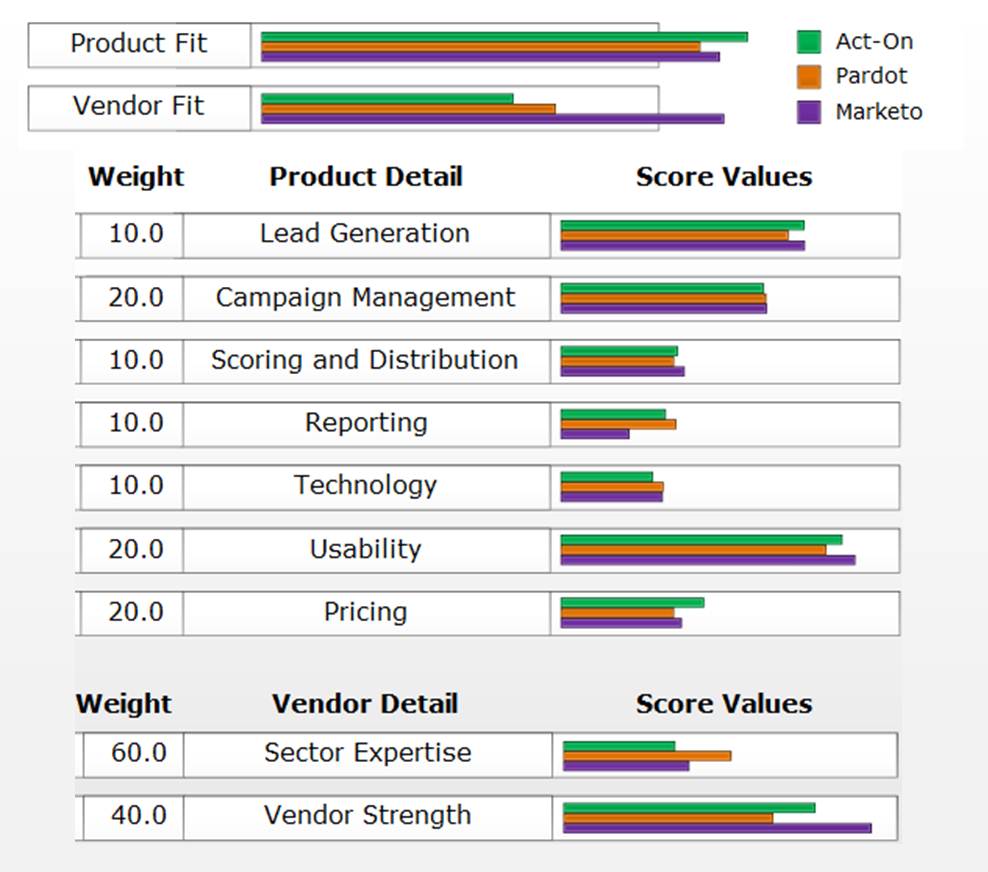
The variety of users within this segment is reflected by the differences among the leaders. Act-On, Pardot, and Genius specialize in smaller companies than Marketo or Silverpop, which in turn serve generally smaller clients than Eloqua or Neolane. Act-On’s position on top of the product fit range is a bit misleading: when you look at the components of that score (see below; this comparison chart is another VEST feature), the vendors are all very close. In fact, the only category where Act-On scores higher than everyone else is pricing.
This isn’t at all to say that the products are equivalent. Rather, it means they each have different strengths and weaknesses that balance each other out when measured with generic scoring weights. For actual buyers with clear priorities, the difference among these vendors’ scores will almost always be much larger.
As with the other sector charts, the vendors in the upper left are also worth considering: they have strong product fit but relatively low market position. SalesFusion appears here as it did in the micro- and large-business charts: what can I say, they have rich features at a good price. (And, no, they’re not my client.) eTrigue is the other noteworthy contender; it and LeadFormix are both close to the leader quadrant based on their vendor fit.
If there’s any one lesson from all these charts, it’s that picking the “leading” vendor is no guarantee of making a good choice. Our three sets of weights yield different sets of leaders, and even those vendors have different strengths and weaknesses. I’ve said it a million times but I’ll say it again: there’s no substitute for understanding your own needs and finding out which vendors match them best.
We define small to mid-size business as companies with $5 million to $500 million revenue. This covers a broad range of marketing users with widely varied needs. Most require the full set of marketing automation functions but apply these in simple ways. They have one to fifteen marketing automation users. This sector generates nearly 60% of 2012 revenue ($200 million) from 33% of the installations (9,400 as of mid-2012). The VEST report provides separate client counts for small business ($5 million to $20 million revenue) and mid-size business ($20 million to $500 million). These account for 16% and 41% of revenue and 16% and 17% of installations, respectively. Although small businesses generally buy lower-priced systems, they have largely the same requirements as mid-size companies.
The leaders quadrant in this sector is quite crowded, with Act-On, Eloqua, Pardot, and Marketo all jostling for position. Silverpop, Neolane, and Genius are all lurking nearby. In case you haven’t caught on to my color coding, blue type indicates that Eloqua and Neolane are leaders in the large company segment, while red type shows the others have their strongest position in this sector.
The variety of users within this segment is reflected by the differences among the leaders. Act-On, Pardot, and Genius specialize in smaller companies than Marketo or Silverpop, which in turn serve generally smaller clients than Eloqua or Neolane. Act-On’s position on top of the product fit range is a bit misleading: when you look at the components of that score (see below; this comparison chart is another VEST feature), the vendors are all very close. In fact, the only category where Act-On scores higher than everyone else is pricing.
This isn’t at all to say that the products are equivalent. Rather, it means they each have different strengths and weaknesses that balance each other out when measured with generic scoring weights. For actual buyers with clear priorities, the difference among these vendors’ scores will almost always be much larger.
As with the other sector charts, the vendors in the upper left are also worth considering: they have strong product fit but relatively low market position. SalesFusion appears here as it did in the micro- and large-business charts: what can I say, they have rich features at a good price. (And, no, they’re not my client.) eTrigue is the other noteworthy contender; it and LeadFormix are both close to the leader quadrant based on their vendor fit.
If there’s any one lesson from all these charts, it’s that picking the “leading” vendor is no guarantee of making a good choice. Our three sets of weights yield different sets of leaders, and even those vendors have different strengths and weaknesses. I’ve said it a million times but I’ll say it again: there’s no substitute for understanding your own needs and finding out which vendors match them best.
Raab Report: Neolane, Aprimo, and Eloqua Rate Highest for Large Company B2B Marketing Automation
Tuesday’s post looked at the micro-business sector leaders according to our VEST report and gave a bit of background on how the ratings are created. Today let's take a look at the same diagram for large businesses, which we define as companies with $500 million revenue or more.
These companies have large marketing departments that may manage hundreds of campaigns for different products in different locations. Our scoring reflects their need for special features for automated content selection, project management, complex lead scores, and tight control over the rights granted to individual users. This group had about 1,400 clients in mid-2012, generating an estimated $85 million in revenue. This is 5% of industry installations and 25% of industry revenue. Many of these were small departmental implementations; there are probably fewer than 500 true enterprise-wide deployments. The non-specialist vendors such as IBM Unica and SAS, are not included in these figures but also have significant revenue in this segment.
As before, vendors closer to the top have the most appropriate features for this segment, and those further to the right have the most similar customer base and company resources. The chart shows Neolane and Aprimo (owned by Teradata) as the clear leaders, with Eloqua also very strong. Marketo and Oracle (specifically, Oracle CRM On Demand Marketing) are considerably further back in the leader quadrant.
It’s important to recognize that Neolane and Aprimo are fundamentally different from the others. Both are general purpose marketing automation systems that serve large numbers of B2C as well as B2B clients. The clearest technical distinction is the marketing database: Neolane and Aprimo are designed to connect with custom-built, external marketing databases, whereas B2B marketing automation products like Eloqua, Marketo, and Oracle are based on an integrated database using a CRM data model (usually Salesforce.com, although Oracle is tied to Oracle's own CRM). This doesn’t mean that every client actually connects them to CRM system. But it does mean that the standard data models match the CRM data models and, in many cases, that abilities to expand the data model with custom tables are limited. One reason that Neolane and Aprimo rank so high in this sector is, precisely, that large businesses often want more database flexibility than the CRM-based approach allows.
As with Tuesday’s chart, the other important place to look on the chart is the upper left, which captures companies that have suitable features for this segment but are too small to rate as leaders. SalesFusion (which also ranked highly in the micro business segment; a good trick) and TreeHouse Interactive stand out in that region. So does MarketingPilot, a newcomer to the VEST that is more like Neolane and Aprimo in serving a mix of B2C and B2C clients. See my 2011 MarketingPilot review for more details, bearing in mind that they’ve added capabilities since then.
These companies have large marketing departments that may manage hundreds of campaigns for different products in different locations. Our scoring reflects their need for special features for automated content selection, project management, complex lead scores, and tight control over the rights granted to individual users. This group had about 1,400 clients in mid-2012, generating an estimated $85 million in revenue. This is 5% of industry installations and 25% of industry revenue. Many of these were small departmental implementations; there are probably fewer than 500 true enterprise-wide deployments. The non-specialist vendors such as IBM Unica and SAS, are not included in these figures but also have significant revenue in this segment.
As before, vendors closer to the top have the most appropriate features for this segment, and those further to the right have the most similar customer base and company resources. The chart shows Neolane and Aprimo (owned by Teradata) as the clear leaders, with Eloqua also very strong. Marketo and Oracle (specifically, Oracle CRM On Demand Marketing) are considerably further back in the leader quadrant.
It’s important to recognize that Neolane and Aprimo are fundamentally different from the others. Both are general purpose marketing automation systems that serve large numbers of B2C as well as B2B clients. The clearest technical distinction is the marketing database: Neolane and Aprimo are designed to connect with custom-built, external marketing databases, whereas B2B marketing automation products like Eloqua, Marketo, and Oracle are based on an integrated database using a CRM data model (usually Salesforce.com, although Oracle is tied to Oracle's own CRM). This doesn’t mean that every client actually connects them to CRM system. But it does mean that the standard data models match the CRM data models and, in many cases, that abilities to expand the data model with custom tables are limited. One reason that Neolane and Aprimo rank so high in this sector is, precisely, that large businesses often want more database flexibility than the CRM-based approach allows.
As with Tuesday’s chart, the other important place to look on the chart is the upper left, which captures companies that have suitable features for this segment but are too small to rate as leaders. SalesFusion (which also ranked highly in the micro business segment; a good trick) and TreeHouse Interactive stand out in that region. So does MarketingPilot, a newcomer to the VEST that is more like Neolane and Aprimo in serving a mix of B2C and B2C clients. See my 2011 MarketingPilot review for more details, bearing in mind that they’ve added capabilities since then.
Tuesday, August 21, 2012
Raab Report: OfficeAutoPilot, Infusionsoft and HubSpot Rate Highest in Marketing Automation for Very Small Business
One of the most important features of our VEST report on B2B marketing automation systems is that it divides marketing automation users into distinct segments, each having a different set of needs. This matters because the systems all do roughly the same things, making it hard for inexperienced buyers to tell them apart. Many vendors – especially those who target the middle sector – also try to serve all types of companies, adding to the confusion. Where the vendors differ is in the details of how they implement the common features, applying approaches that are generally best suited to one type of marketing organization.
The VEST segmentation is based on company size, as measured by revenue. I'm painfully aware that this isn’t the ideal way to group users, since companies of the same size can still vary greatly in their needs and marketing sophistication. But revenue is objectively measureable and most marketing automation vendors can provide reasonably accurate client counts by revenue group. So we use it as a proxy for the other client differences.
The primary way we report on the different segments is by applying different weights to the same feature in our vendor scoring for each segment. This lets us rank vendors based on how their features and company strengths match against each sector’s needs. A key part of the approach is to penalize vendors with negative weights for features that are too advanced for a particular customer group. So far as I know, no other analysts do this in their scoring. It avoids a common problem with scoring systems, that systems with the most features always win.
The chart above shows our ratings for the micro business sector, defined as companies with under $5 million in revenue. These are very small companies, typically run personally by an owner. They rarely have a full-time professional marketer on staff. Primary marketing interests are group emails, landing pages, and simple lead nurturing through email auto-responders. Before marketing automation, they typically use an email system (which also provides landing pages and simple nurture campaigns) or sales automation product for their marketing. They often do not integrate marketing automation with a separate sales automation system, either because they don’t use one at all or because they rely on CRM features within marketing automation itself. As of July 2012, marketing automation vendors reported more than 17,000 micro-business installations, just over 60% of the industry total. But, because prices are lower than other segments, the segment generates only an estimated 18% of industry revenue, or $65 million for full-year 2012.
Companies in this sector have very limited marketing and technical resources. As a result, their overriding needs are ease of use and a broad range of features within a single product. What they don’t need are very complex campaigns, extensive planning and budgeting, and custom database designs. Our scoring reflects those priorities.
As the chart shows, the leaders in this segment are OfficeAutoPilot, Infusionsoft, and HubSpot. The first two are micro-business specialists; in particular, they have built-in CRM and order processing. HubSpot isn’t quite as highly tailored to this segment, which is why it is a little further from the top than the other two. (The vertical dimension is product fit, which basically means features.) But HubSpot has a very large number of clients in this segment, so it is still quite far to the right. (The horizontal dimension is vendor fit, a combination of customer count, segment concentration, and vendor resources.) Act-On and Marketo also have strong positions in this sector, even though their features – especially in Marketo’s case – are not necessarily the best fit. Again, bear in mind that revenue is a very crude segmentation, so many Act-On and Marketo clients in this group probably have requirements closer to those I’ve assigned to the middle tier.
The other important set of vendors are those at the upper left of the chart: companies with a strong feature fit even though they are smaller than the leaders. SalesFUSION and MakesBridge stand out especially in this group for micro-business users. Oracle’s presence is, frankly, pretty odd: it’s due to a low per seat price and the vendor’s position that it has a built-in CRM module. In fact, nine of the 22 vendors say they provide a CRM option, which may be technically correct but in most cases probably isn’t realistic. This is even more proof – as if it were needed – that buyers need to explore the products in detail before making a purchase.
Wednesday, August 01, 2012
Raab Report: B2B Marketing Automation Revenues to Hit $525 Million in 2012
I’ve just released the latest edition of my B2B Marketing Automation Vendor Selection Tool (VEST), which contains detailed analysis of all 22 B2B marketing automation systems. Serious marketing of the new edition is yet to begin, but anyone considering purchase of a marketing automation system can buy the VEST now at the www.raabguide.com Web site.
The new report contains a rich trove of industry information. The one item that people usually find most interesting is the size of the industry. I put this at $325 million for 2011, a 50% increase from 2010. With 2012 half finished, I can now make a reasonably solid estimate for this year. I find the growth rate has actually accelerated to 60%, for a total of about $525 million.
I come at these figures in two ways.
Installations by industry sector. Vendors in the VEST are asked for estimates of their client counts by company size. We distinguish four segments: micro-business with under $5 million revenue; small business with $5 to $20 million revenue, mid-size business with $20 to $500 million revenue, and large business with over $500 million revenue. Most vendors do provide the sector breakdown, although some are pretty rough estimates. For a couple of vendors, I’ve used my own estimate based on past data.
Using the sector counts plus estimated revenue per client for each sector, I can calculate the revenue by sector and for the industry as a whole. Since the client counts are mid-year figures, they should roughly equal the full-year average. I’ve only included figures for vendors who specialize in B2B systems; none of the other vendors (Neolane, Oracle, Silverpop, Aprimo, MarketingPilot) are provided estimates of the B2B portion of their client base. The table below shows my calculations:
The total comes to $362 million estimated 2012 revenue. I estimate the non-B2B specialists and other marketing automation vendors (IBM, SAS, SAP, etc.) who are not listed in the VEST will have another $165 million in B2B revenue, for a total of $527 million.
Revenue estimates for individual vendors. The second approach starts with the four largest B2B specialists: Infusionsoft, HubSpot, Marketo, and Eloqua. Each has announced revenue for 2011 (formally or in press interviews) and two, Infusionsoft* and Marketo**, have made forecasts for 2012. I estimated 2012 revenues for HubSpot and Eloqua based on their client counts and revenue per client. I then estimated revenue for the other specialist vendors by combining results from two methods: estimated revenue per employee and estimated revenue per client. Finally, I’ve added figures for the non-specialist vendors, using the same assumptions as before. The table below shows the results.
As you see – and I swear I didn’t cook these numbers – this gives $525 million, almost exactly matching the other method.
Of course, there's more to these figures than just the industry size. One interesting point is that the “other specialist” vendors are actually growing faster than the big four vendors. This is a bit of a surprise, since we’d expect the industry to consolidate and squeeze out the smaller players. Still, remember that the big four control 75% of the revenue.
The difference is client growth actually larger than the revenue estimates suggest. The table below shows that the client base of the “other specialists” grew by 80%, which is faster than any of the big four.
One caveat is that a number of the smaller vendors didn’t provide updated client counts, and they may be vendors who were not growing much. But the reality is that the next three largest vendors (Pardot, Act-On, and Net-Results) did provide data, and each grew by well over 100%. So the missing vendors don't have enough volume to affect the big picture.
I’ll share one final set of data that also points to industry strength. The table below shows revenue per client for the big four vendors over the past two years. These are actuals except for the 2012 figures for HubSpot and Eloqua, and I consider those to be educated, conservative guesses.
This table shows a consistent increase in revenue per customer across all vendors and all years. Given the intense competition within the industry, that’s pretty impressive: it shows that the big four vendors are managing to increase their revenue per client, which all must do to become profitable. I suspect the increase is less the result of firmer pricing than of broader product lines that let the vendors sell more to each customer. Nor does this mean that industry prices are rising: it’s possible – in fact, likely – that the smaller vendors are selling for less than their larger competitors, and that the average price in the industry is still dropping.
All told, this paints the picture of a healthy industry: still growing rapidly, still open to competition, and supporting sustainable prices. It's a cheery bit of news.
_____________________________________________________________
*Infusionsoft "expected revenue of $40 million in 2012" (Customer Experience Matrix, April 14, 2012)
**Marketo "revenues last year grew 140% over the year to $35 million. Management expects revenues to double during this year" (Sramana Mitra blog interview with Phil Fernandez, July 21, 2012)
The new report contains a rich trove of industry information. The one item that people usually find most interesting is the size of the industry. I put this at $325 million for 2011, a 50% increase from 2010. With 2012 half finished, I can now make a reasonably solid estimate for this year. I find the growth rate has actually accelerated to 60%, for a total of about $525 million.
I come at these figures in two ways.
Installations by industry sector. Vendors in the VEST are asked for estimates of their client counts by company size. We distinguish four segments: micro-business with under $5 million revenue; small business with $5 to $20 million revenue, mid-size business with $20 to $500 million revenue, and large business with over $500 million revenue. Most vendors do provide the sector breakdown, although some are pretty rough estimates. For a couple of vendors, I’ve used my own estimate based on past data.
Using the sector counts plus estimated revenue per client for each sector, I can calculate the revenue by sector and for the industry as a whole. Since the client counts are mid-year figures, they should roughly equal the full-year average. I’ve only included figures for vendors who specialize in B2B systems; none of the other vendors (Neolane, Oracle, Silverpop, Aprimo, MarketingPilot) are provided estimates of the B2B portion of their client base. The table below shows my calculations:
The total comes to $362 million estimated 2012 revenue. I estimate the non-B2B specialists and other marketing automation vendors (IBM, SAS, SAP, etc.) who are not listed in the VEST will have another $165 million in B2B revenue, for a total of $527 million.
Revenue estimates for individual vendors. The second approach starts with the four largest B2B specialists: Infusionsoft, HubSpot, Marketo, and Eloqua. Each has announced revenue for 2011 (formally or in press interviews) and two, Infusionsoft* and Marketo**, have made forecasts for 2012. I estimated 2012 revenues for HubSpot and Eloqua based on their client counts and revenue per client. I then estimated revenue for the other specialist vendors by combining results from two methods: estimated revenue per employee and estimated revenue per client. Finally, I’ve added figures for the non-specialist vendors, using the same assumptions as before. The table below shows the results.
As you see – and I swear I didn’t cook these numbers – this gives $525 million, almost exactly matching the other method.
Of course, there's more to these figures than just the industry size. One interesting point is that the “other specialist” vendors are actually growing faster than the big four vendors. This is a bit of a surprise, since we’d expect the industry to consolidate and squeeze out the smaller players. Still, remember that the big four control 75% of the revenue.
The difference is client growth actually larger than the revenue estimates suggest. The table below shows that the client base of the “other specialists” grew by 80%, which is faster than any of the big four.
One caveat is that a number of the smaller vendors didn’t provide updated client counts, and they may be vendors who were not growing much. But the reality is that the next three largest vendors (Pardot, Act-On, and Net-Results) did provide data, and each grew by well over 100%. So the missing vendors don't have enough volume to affect the big picture.
I’ll share one final set of data that also points to industry strength. The table below shows revenue per client for the big four vendors over the past two years. These are actuals except for the 2012 figures for HubSpot and Eloqua, and I consider those to be educated, conservative guesses.
This table shows a consistent increase in revenue per customer across all vendors and all years. Given the intense competition within the industry, that’s pretty impressive: it shows that the big four vendors are managing to increase their revenue per client, which all must do to become profitable. I suspect the increase is less the result of firmer pricing than of broader product lines that let the vendors sell more to each customer. Nor does this mean that industry prices are rising: it’s possible – in fact, likely – that the smaller vendors are selling for less than their larger competitors, and that the average price in the industry is still dropping.
All told, this paints the picture of a healthy industry: still growing rapidly, still open to competition, and supporting sustainable prices. It's a cheery bit of news.
_____________________________________________________________
*Infusionsoft "expected revenue of $40 million in 2012" (Customer Experience Matrix, April 14, 2012)
**Marketo "revenues last year grew 140% over the year to $35 million. Management expects revenues to double during this year" (Sramana Mitra blog interview with Phil Fernandez, July 21, 2012)
Subscribe to:
Posts (Atom)