I’ve been gearing up for the next edition of our VEST report on B2B marketing automation systems, which involves catching up with established vendors and chasing down some new ones. The new entrants are clustered towards the small business end of the market, where they see an opportunity for simpler systems at lower prices than existing market leaders. I always wonder whether newcomers can find substantially simpler approaches than the older firms, which are already focused on ease of use and typically gone through several redesigns as they learn from experience. But it’s still worth scanning the new entrants to see how they’ve departed from older approaches. It’s also interesting to see how the new systems are similar, which gives some insight into what are apparently perceived as common problems in the older approaches.
Before jumping into the new systems, it helps to define a set of standard features to measure them against. I’ve written about this extensively in the past, so I won’t go into great detail here. Briefly, a standard B2B marketing automation system can send bulk emails to segmented lists, capture email responses on landing pages and forms, track email and Web site behaviors, score leads based on behaviors and profile attributes, execute multi-step workflows (i.e., nurture campaigns), and share leads with a CRM system like Salesforce.com. Not quite standard but increasingly common features include social media sharing and tracking, Webinar integration, visitor identification via reverse IP lookup, and capturing campaign information from Google AdWords. A system can be useful even if it lacks some of the standard features, but buyers should know what they’re missing so they can decide whether it’s something they really want.
Here are highlights of several vendors I’ve looked at recently. I’ll write about some others next week and then offer some general observations.
Leadsberry is among the oldest of these systems, launched in July 2012. It basic versions of the standard marketing automation features: lists are not updated automatically, workflows only branch on email behavior (opens, clicks, or nothing), and lead scoring is largely limited to profile attributes. On the other hand, it adds a powerful survey tool, easy conversion of emails to Facebook, Twitter, and LinkedIn messages, and easily created “instant offers”. Looking beyond technology, the vendor provides access to a 15 million name email database, a telephone lead generation team, and other services that can supplement or even replace an in-house marketing department. System pricing starts at $99 per month for up to 1,000 contacts; a system with 15,000 contacts costs $499 per month. There are additional fees for survey responses, list rental, and other services.
Leadsius launched its first paid version around July 2013. Like several of the new vendors, it is based in Europe (Sweden), although the user interface is in English. The system includes email, landing pages and forms, and Web behavior tracking. Workflows are currently limited: triggers are based only on email and Web activities, segments are defined only with profile attributes, and the only actions are emails. The next release will support list-based triggers and additional actions. Workflows can execute multiple steps but only branch on whether the previous email was opened. Synchronization with Salesforce.com and SugarCRM are due by mid-2014. Lead scoring is not available and probably won’t be added any time soon, because the developer feels it is dangerous without validating that scores are accurate. Among its strengths, the system provides detailed control over the rights assigned to different users; premium clients can have their own domain for landing pages and IP address for emails; and lists can be dynamic (i.e., continuously updated) as well as static. Leadsius comes in several versions including a free edition with a good set of basic features. New pricing in mid-February will retain the free version and introduce several other levels, most under $1,000 per month.
Salesformics is designed primarily to give sales people a pleasant-to-use CRM system, while offering marketing automation and dashboards to everyone in the organization. The system was developed by a UK-based marketing services firm and is still in public beta, which should end in mid-February. In a relatively radical departure from standard interfaces, it replaces traditional menus with a search box that lets users type commands or contact information (name, address, phone, etc.) and have the system return the best matching results. The system is also unusually reliant on third-party applications – dare we say “platform”? – using external systems to trigger promotions (for example, executing targeted searches in Twitter or LinkedIn to find contact-related events), to capture data (via externally-built web forms), and to deliver messages (email via Constant Contact or SMS via Twilio). Data from those sources, as well as the built-in CRM functions, can be used to create campaign segments. Indeed, the only traditional marketing automation functions provided by Salesformics itself are workflow and basic (untracked) email. Otherwise, trackable email and forms are provided via integration, there is no cookie-based Web behavior tracking, and lead scoring is not yet available (though planned). There is no synchronization to any external CRM system since Salesformics includes its own. The workflow uses a conventional diagram of triggers linked to actions; the triggers and actions are based on both internal and external data. A workflow can include multiple steps but branching won’t be supported until mid-2014. Pricing is based on number of users and starts at $79 per user per month.
Target360 was also developed by a UK-based service firm, in this case CRM consultants specializing in Microsoft Dynamics. The system adds email marketing and campaign tracking to Dynamics, working with Dynamics files directly rather than synching to a separate database. Among U.S-based firms, CoreMotives and ClickDimensions take a similar approach. Of the standard marketing automation functions, Target360 provides email, Web behavior tracking, lead scoring, and workflows. There is no form builder but the vendor provides a tool to map existing forms to the Dynamics database. Campaign workflows can only react to an email result, with separate branches for opens, clicks, and no response, although standard Dynamics workflows could support other actions as well. The system’s particular strength is tracking customer activities across different channels by assigning them campaign codes; this covers emails, Web visits, social media responses, and CRM interactions. These are connected with revenue captured in CRM to create return on investment reports. Revenue can be attributed in these reports to either the first or last campaign to reach a customer. The system was released in mid-2012 and starts at $1,050 per month including a Dynamics license.
Wednesday, January 22, 2014
Monday, January 13, 2014
Understanding Relationships Within the Marketing Technology Landscape
Scott Brinker, a.k.a. chiefmartec*, last week published a terrific Marketing Technology Landscape Supergraphic organizing nearly 1,000 vendors into 43 categories and six major classes. As Scott modestly writes, his classes present “a semblance of meaningful structure” with Internet and Infrastructure providing the foundations, Marketing Backbone platforms (major channel systems) managing most interactions, Marketing Middleware (including Customer Data Platforms) providing a connective layer, and Marketing Experiences and Marketing Operations systems offering specialized capabilities. Here is his diagram:
I’m delighted that Scott has found the CDP concept useful† and am in turn happy to adopt his distinction between Backbone Platforms and the other types of marketing applications. The Backbone Platforms are, indeed, platforms that support most Experience and Operations systems, enabling those systems to focus on particular tasks without creating complete customer management environments of their own. That's a difference worth noting.
Scott never claimed that his diagram illustrates a precise relationship among the components, so it's no criticism to point out that it doesn't. Experience and Operations systems sometimes connect with Backbone Platforms through a Middleware system, but more often they connect with the Backbone Platforms directly. In fact, some of the Experience and Operations systems connect with multiple Platforms, serving as sort of do-it-yourself Middleware. The challenge of illustrating this becomes clear when you try adding lines to show how the classes of systems interact with each other – it’s not as simple as connecting the adjacent layers on Scott’s diagram.
Being a visual thinker, I found this ambiguity to be endlessly disturbing.** Try as I might, I couldn’t rearrange the boxes to show the relationships correctly.
Then, I had a dream about a snake rolling downhill with its tail in its mouth, and discovered the answer: the systems could all be arranged in a circle graph, allowing any two to be connected directly.††
I must admit that I am ridiculously pleased with this approach. I know there’s nothing especially brilliant about circle graphs per se, but I’ve never seen one used in an architecture diagram. The pictures below illustrate, at least to my satisfaction, how much more clearly the circle graph shows relationships among systems than the traditional boxes and layers. Each diagram shows the same relationships among a small set of systems. The top left picture uses the traditional approach of showing only the links between categories – as you see, this hides any connections between non-adjacent components or individual systems. The top right picture shows the direct connections between systems, but it’s hard to read because lines cross behind the boxes. True, you could use curved lines to avoid this, but that quickly becomes impractical. The bottom picture shows the circle approach: here, the lines themselves might cross but no connections are hidden. The relative clarity of the circle graph grows as more systems are introduced.
Showing the actual connections between system pairs has another advantage: it lets you represent the architecture as a formal graph, meaning you can compare architectures using standard graph analysis techniques. Even just counting the connections gives a useful measure of relative complexity.
The diagrams below illustrate this nicely: the top picture shows the same architecture as before, which has 14 system-to-system connections (out of 28 possible pairs, another useful metric, even though some wouldn't make much sense). The bottom picture shows the same systems with everything connecting through a central database: now there are only eight connections and several missing system-to-system links have been provided automatically. If you want a crude approximation of how much a central database reduces complexity (and hence cost), this is good place to start.
The circle approach has other advantages, such as making it easier to see missing connections between systems. I'm working on it as part of a larger methodology to help marketers assess the value of a Customer Data Platform and plan for deployment. I expect to be describing the full approach over the next couple of months...stay tuned for details.
______________________________________________________________________________________
*a name that virtually demands a sidekick. Obvious choice is “Data Boy” but I’m sure my readers can think of something more clever.
† and appreciate the credit has he given me.
** Yes, I do recognize how fortunate I am that this is of my major problems in life.
†† Not really. The snake dream is how KekulĂ© discovered the structure of benzene. But it makes a good story, eh?
I’m delighted that Scott has found the CDP concept useful† and am in turn happy to adopt his distinction between Backbone Platforms and the other types of marketing applications. The Backbone Platforms are, indeed, platforms that support most Experience and Operations systems, enabling those systems to focus on particular tasks without creating complete customer management environments of their own. That's a difference worth noting.
Scott never claimed that his diagram illustrates a precise relationship among the components, so it's no criticism to point out that it doesn't. Experience and Operations systems sometimes connect with Backbone Platforms through a Middleware system, but more often they connect with the Backbone Platforms directly. In fact, some of the Experience and Operations systems connect with multiple Platforms, serving as sort of do-it-yourself Middleware. The challenge of illustrating this becomes clear when you try adding lines to show how the classes of systems interact with each other – it’s not as simple as connecting the adjacent layers on Scott’s diagram.
Being a visual thinker, I found this ambiguity to be endlessly disturbing.** Try as I might, I couldn’t rearrange the boxes to show the relationships correctly.
Then, I had a dream about a snake rolling downhill with its tail in its mouth, and discovered the answer: the systems could all be arranged in a circle graph, allowing any two to be connected directly.††
I must admit that I am ridiculously pleased with this approach. I know there’s nothing especially brilliant about circle graphs per se, but I’ve never seen one used in an architecture diagram. The pictures below illustrate, at least to my satisfaction, how much more clearly the circle graph shows relationships among systems than the traditional boxes and layers. Each diagram shows the same relationships among a small set of systems. The top left picture uses the traditional approach of showing only the links between categories – as you see, this hides any connections between non-adjacent components or individual systems. The top right picture shows the direct connections between systems, but it’s hard to read because lines cross behind the boxes. True, you could use curved lines to avoid this, but that quickly becomes impractical. The bottom picture shows the circle approach: here, the lines themselves might cross but no connections are hidden. The relative clarity of the circle graph grows as more systems are introduced.
Showing the actual connections between system pairs has another advantage: it lets you represent the architecture as a formal graph, meaning you can compare architectures using standard graph analysis techniques. Even just counting the connections gives a useful measure of relative complexity.
The diagrams below illustrate this nicely: the top picture shows the same architecture as before, which has 14 system-to-system connections (out of 28 possible pairs, another useful metric, even though some wouldn't make much sense). The bottom picture shows the same systems with everything connecting through a central database: now there are only eight connections and several missing system-to-system links have been provided automatically. If you want a crude approximation of how much a central database reduces complexity (and hence cost), this is good place to start.
The circle approach has other advantages, such as making it easier to see missing connections between systems. I'm working on it as part of a larger methodology to help marketers assess the value of a Customer Data Platform and plan for deployment. I expect to be describing the full approach over the next couple of months...stay tuned for details.
______________________________________________________________________________________
*a name that virtually demands a sidekick. Obvious choice is “Data Boy” but I’m sure my readers can think of something more clever.
† and appreciate the credit has he given me.
** Yes, I do recognize how fortunate I am that this is of my major problems in life.
†† Not really. The snake dream is how KekulĂ© discovered the structure of benzene. But it makes a good story, eh?
Monday, January 06, 2014
BrightInfo: Content Recommendations Made Simple
I spent much of last year writing about Customer Data Platform systems and have reviews on tap for a half dozen more. But I thought I’d start out 2014 with something different, just to show I’m not totally obsessed. Although, as you’ll see shortly, there’s a CDP angle to this story as well.
Today's topic is BrightInfo, which uses semantic technology to automatically recommend the most relevant content to Web site and blog visitors. Specifically, the system crawls the client’s Web site and blog to find and classify existing content, and then tracks visitor behavior to offer new content relevant to what the visitor has already selected. The recommendations can be presented on a fixed area of a page or as a pop-up. They can appear continuously or only when a visitor indicates they are about to leave by moving their mouse towards the browser’s URL bar. BrightInfo uses Javascript tags and cookies to track visitors over time, allowing it to base recommendations on individual behavior as well as content similarity and popularity. Behaviors across Web sites, landing pages, and blogs are all tracked by the same cookie, so each recommendation reflects a consolidated history. However, the system does not incorporate other information sources – meaning it can’t use the central customer data a CDP would provide. Nor, at present, does the system support mobile, which doesn't use cookies and requires different display methods. But this is coming soon.
It should be fairly easy for BrightInfo to access external data sources, since the necessary changes are unrelated to its core technologies of semantic analysis and recommendations. Most companies today could probably use the system as it stands, since they lack a centralized customer database or policies to coordinate customer treatments across channels. BrightInfo already lets users override the purely algorithmic recommendations by specifying that some content will be shown in all circumstances, that other content will never be shown, and that recommendations will appear only on specified pages. Sophisticated marketers might want more refined controls, such as limits on how often the same content is offered or recommendations based on expected response value rather than the simple click rate. But BrightInfo is targeted at small and mid-size businesses, which are less concerned with such refinements.
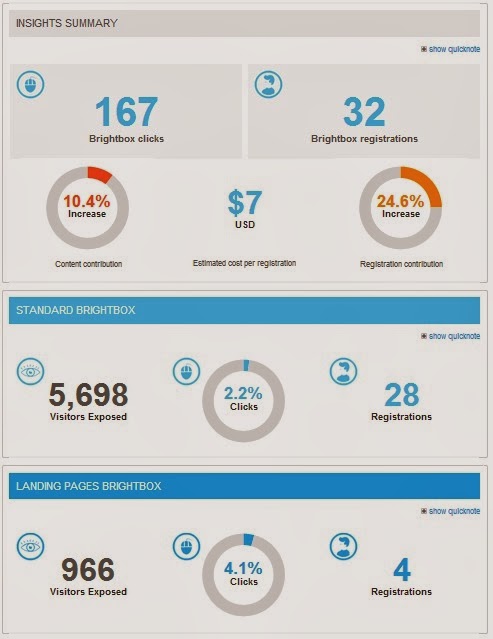
What those businesses do care about are easy deployment and low cost. BrightInfo provides those by automating the content discovery and classification, running as a service rather than installed software, and pricing based on visitor volume. Javascript tags, cookies, and isolation from other data sources also simplify deployment, whatever their other drawbacks. Measurement is similarly simplified by providing reports that compare how many clicks were made on native content and system-recommended content. Clicks on system-recommended content are a rough measure of system-added activity, although presumably some visitors would have chosen other content had the recommendations not been available. BrightInfo considered setting up formal a/b tests to measure true incremental value, but found that most small and mid-size businesses have too little volume to support this. The company has recently integrated its reporting with Marketo, HubSpot, and Google Analytics.
BrightInfo officially released its product last September, after about a year of development. The underlying semantic and recommendation technologies came from sister company Softlib Software, which uses them for automated service and knowledge management and was founded in 2004. Pricing is published on the BrightInfo Web site and is free up to 1,000 visitors per month, $89 per month up to 5,000 visitors, and $224 per month up to 15,000 visitors. The system has several dozen clients.
To summarize, then: BrightInfo provides a very simple, very low cost way to increase engagement with Web visitors by making targeted content recommendations. It's worth knowing about because traditional recommendation engines are often harder to deploy and more expensive.
But what’s the CDP angle? It’s not simply that BrightInfo is an example of an application that could use the customer data in a CDP to make more accurate recommendations. It’s actually a somewhat deeper question of where the recommendation functions belong in a CDP-based architecture. I’d argue that recommendations should be part of the central platform, so they can be used to coordinate treatments across all touchpoints. In other words, it’s probably wrong to imagine BrightInfo as an application that attaches to a CDP and uses its data to improve Web and blog results. Rather, in an ideal world, BrightInfo’s technology would be used within the CDP to generate recommendation that the CDP itself feeds to all applications. This is pretty theoretical and largely irrelevant to BrightInfo itself, which is targeted at companies that don’t have a CDP in the first place. But as marketing technology continues to evolve and more companies have CDPs, or centralized customer databases by any other name, it’s important to understand how the pieces should fit together.
Today's topic is BrightInfo, which uses semantic technology to automatically recommend the most relevant content to Web site and blog visitors. Specifically, the system crawls the client’s Web site and blog to find and classify existing content, and then tracks visitor behavior to offer new content relevant to what the visitor has already selected. The recommendations can be presented on a fixed area of a page or as a pop-up. They can appear continuously or only when a visitor indicates they are about to leave by moving their mouse towards the browser’s URL bar. BrightInfo uses Javascript tags and cookies to track visitors over time, allowing it to base recommendations on individual behavior as well as content similarity and popularity. Behaviors across Web sites, landing pages, and blogs are all tracked by the same cookie, so each recommendation reflects a consolidated history. However, the system does not incorporate other information sources – meaning it can’t use the central customer data a CDP would provide. Nor, at present, does the system support mobile, which doesn't use cookies and requires different display methods. But this is coming soon.
It should be fairly easy for BrightInfo to access external data sources, since the necessary changes are unrelated to its core technologies of semantic analysis and recommendations. Most companies today could probably use the system as it stands, since they lack a centralized customer database or policies to coordinate customer treatments across channels. BrightInfo already lets users override the purely algorithmic recommendations by specifying that some content will be shown in all circumstances, that other content will never be shown, and that recommendations will appear only on specified pages. Sophisticated marketers might want more refined controls, such as limits on how often the same content is offered or recommendations based on expected response value rather than the simple click rate. But BrightInfo is targeted at small and mid-size businesses, which are less concerned with such refinements.
What those businesses do care about are easy deployment and low cost. BrightInfo provides those by automating the content discovery and classification, running as a service rather than installed software, and pricing based on visitor volume. Javascript tags, cookies, and isolation from other data sources also simplify deployment, whatever their other drawbacks. Measurement is similarly simplified by providing reports that compare how many clicks were made on native content and system-recommended content. Clicks on system-recommended content are a rough measure of system-added activity, although presumably some visitors would have chosen other content had the recommendations not been available. BrightInfo considered setting up formal a/b tests to measure true incremental value, but found that most small and mid-size businesses have too little volume to support this. The company has recently integrated its reporting with Marketo, HubSpot, and Google Analytics.
BrightInfo officially released its product last September, after about a year of development. The underlying semantic and recommendation technologies came from sister company Softlib Software, which uses them for automated service and knowledge management and was founded in 2004. Pricing is published on the BrightInfo Web site and is free up to 1,000 visitors per month, $89 per month up to 5,000 visitors, and $224 per month up to 15,000 visitors. The system has several dozen clients.
To summarize, then: BrightInfo provides a very simple, very low cost way to increase engagement with Web visitors by making targeted content recommendations. It's worth knowing about because traditional recommendation engines are often harder to deploy and more expensive.
But what’s the CDP angle? It’s not simply that BrightInfo is an example of an application that could use the customer data in a CDP to make more accurate recommendations. It’s actually a somewhat deeper question of where the recommendation functions belong in a CDP-based architecture. I’d argue that recommendations should be part of the central platform, so they can be used to coordinate treatments across all touchpoints. In other words, it’s probably wrong to imagine BrightInfo as an application that attaches to a CDP and uses its data to improve Web and blog results. Rather, in an ideal world, BrightInfo’s technology would be used within the CDP to generate recommendation that the CDP itself feeds to all applications. This is pretty theoretical and largely irrelevant to BrightInfo itself, which is targeted at companies that don’t have a CDP in the first place. But as marketing technology continues to evolve and more companies have CDPs, or centralized customer databases by any other name, it’s important to understand how the pieces should fit together.
Monday, December 16, 2013
4 Marketing Tech Trends To Watch in 2014
I'm not a big fan of year-end summaries and forecasts, mostly because I produce summaries and forecasts all year round. But I pulled together a few thoughts last week in response to a request, only to discover I had misunderstood what was wanted. Rather than let my precious wisdom go to waste*, I'll share below what I think will be most important marketing technology trends of 2014.
Customer Data Platforms mature. Marketers will have an increasing number of ways to build consolidated, multi-source customer databases without waiting for help from their IT departments. Systems that build such databases for specialized purposes such as lead enhancement, cross-channel campaign management, retention programs, and advertising audience management will increasingly provide more value to their clients by exposing the databases to other execution systems. As a result, the distinction between the customer database and execution systems will become more evident and companies will be able to succeed by offering either data or execution exclusively.
Digital advertising and customer marketing converge. Data management platforms, which store semi-anonymous cookies for online ad networks, will converge with conventional customer databases, which store profiles tied to actual identities. The advantage will be marketing programs that span both channels, delivering personally targeted information via display advertising and simplifying personalized marketing on mobile platforms that don’t support conventional cookies. The unification of these previously separate data sets will allow more careful orchestration of customer treatments across all channels, increasing the effectiveness of all marketing contacts.
Predictive analytics finally take center stage. More accessible customer data and broader opportunities to deliver personalized messages will support the long-expected mass deployment of automated predictive analytics tools. These will be part of a centralized customer management architecture that uses them to deliver the best message to each customer during each interaction in every channel where a customer can be recognized. Increasingly automated testing will allow incremental optimization despite constant changes in customer interests, product availability, creative executions, and offers.
The privacy dog won’t bark. Consumers will continue to allow marketers to track their behaviors, even if they become slightly more discreet about the personal information they post directly on social networks like Facebook, Instagram, and Twitter. Efforts to limit such tracking through government regulations will not result in significant limitations, at least in the United States.
------------------------------------------------------------------------------------------------------------------
*Yes, that's a Dr. Strangelove reference.
Customer Data Platforms mature. Marketers will have an increasing number of ways to build consolidated, multi-source customer databases without waiting for help from their IT departments. Systems that build such databases for specialized purposes such as lead enhancement, cross-channel campaign management, retention programs, and advertising audience management will increasingly provide more value to their clients by exposing the databases to other execution systems. As a result, the distinction between the customer database and execution systems will become more evident and companies will be able to succeed by offering either data or execution exclusively.
Digital advertising and customer marketing converge. Data management platforms, which store semi-anonymous cookies for online ad networks, will converge with conventional customer databases, which store profiles tied to actual identities. The advantage will be marketing programs that span both channels, delivering personally targeted information via display advertising and simplifying personalized marketing on mobile platforms that don’t support conventional cookies. The unification of these previously separate data sets will allow more careful orchestration of customer treatments across all channels, increasing the effectiveness of all marketing contacts.
Predictive analytics finally take center stage. More accessible customer data and broader opportunities to deliver personalized messages will support the long-expected mass deployment of automated predictive analytics tools. These will be part of a centralized customer management architecture that uses them to deliver the best message to each customer during each interaction in every channel where a customer can be recognized. Increasingly automated testing will allow incremental optimization despite constant changes in customer interests, product availability, creative executions, and offers.
The privacy dog won’t bark. Consumers will continue to allow marketers to track their behaviors, even if they become slightly more discreet about the personal information they post directly on social networks like Facebook, Instagram, and Twitter. Efforts to limit such tracking through government regulations will not result in significant limitations, at least in the United States.
------------------------------------------------------------------------------------------------------------------
*Yes, that's a Dr. Strangelove reference.
Friday, December 13, 2013
Webinar, December 18: How Marketers Can (Finally) Get Good Customer Data
Let’s face it: no real work will get done next week, what with all the holiday parties and caroling and so forth. So you might as well set aside 2:00 to 3:00 p.m. Eastern time on Wednesday, December 18 and register for the Webinar I’m co-presenting with RedPoint Global on Customer Data Platforms.
In addition to uncovering the secret relationship between cuneiform and Justin Bieber,
you’ll learn about our latest discovery: a new species of Customer Data Platform, bringing the known total to four. We’ll even provide a handy field guide to identifying which is which. Join us, and gain enough new information to fuel your party conversations for the rest of the holiday season!
In addition to uncovering the secret relationship between cuneiform and Justin Bieber,
you’ll learn about our latest discovery: a new species of Customer Data Platform, bringing the known total to four. We’ll even provide a handy field guide to identifying which is which. Join us, and gain enough new information to fuel your party conversations for the rest of the holiday season!
Tuesday, December 10, 2013
Woopra Grows from Web Analytics to Multi-Source Customer Data, Insights and Actions
I stumbled over Woopra in their tiny booth during last month’s Dreamforce conference, where I was intrigued enough to let them scan my badge and promptly forgot why. Fortunately, a diligent sales rep followed up by email and I remembered it was worth a closer look. If you’ve been reading my recent posts, you won’t be surprised that I’ve decided they are yet another Customer Data Platform.
In fact, the people most surprised by this news will probably be the folks at Woopra itself, which positions itself as “an insight company” and has deep roots in traditional Web analytics. On the other hand, Woopra does distinguish itself from conventional Web analytics vendors by stressing the fact that it tracks individuals, not Web pages. In fact, one of its tag lines is “easily track, analyze, and take action on live customer data”, which is a pretty decent statement of the CDP value proposition.
Tag lines notwithstanding, Woopra wouldn’t qualify as a CDP if it only tracked Web behavior. But Woopra offers the core CDP function of building a multi-source database. It does this by directly capturing behaviors from Web site visits and mobile app interactions (via Javascript tags and API calls from iOS or Android) and by loading operational data such as purchases and customer service interactions. As its Dreamforce presence suggests, Woopra can integrate with Salesforce.com to both import CRM data and to display the information it has consolidated from multiple sources. The system can combine data with different identifiers, such as a cookie ID, mobile device ID, and Web session ID, although – like many CDPs – it relies on the client to figure out which identifiers belong to the same person.
Woopra stores its data as a combination of customer attributes and time-stamped individual events. The event data lets it report on individual movement through funnel stages, performance of start-date cohorts, and paths through a Web site or app, in addition to the usual profile reports. It stores the information using proprietary technology that allows continuous real-time updates and ad hoc segmentations, so users can run any report against a subset of the customer universe. Users can also design their own custom reports.
Woopra provides an API that lets external systems access its database, although it places some limits on volume to avoid performance issues. This access meets the minimum requirement for a CDP. The system can also continuously scan for user-specified events or conditions and execute user-specified actions when these occur. The actions can run Javascript on the client Web site, add tags to a customer record, send an email or push notification, or a call an external system via a Webhook. This allows marketers to manage some basic customer treatments within Woopra itself. But the system doesn’t have any predictive modeling or recommendation engines, so more advanced approaches would require external assistance.
Woopra was founded six years ago and relaunched in 2012. It has more than 3,000 paying customers in a wide range of industries, including many small businesses and several large ones. The system is offered in three editions with different sets of features, including a free version for simple visitor tracking. Pricing is based on activity volume and starts at $80 per month for the mid-level edition.
In fact, the people most surprised by this news will probably be the folks at Woopra itself, which positions itself as “an insight company” and has deep roots in traditional Web analytics. On the other hand, Woopra does distinguish itself from conventional Web analytics vendors by stressing the fact that it tracks individuals, not Web pages. In fact, one of its tag lines is “easily track, analyze, and take action on live customer data”, which is a pretty decent statement of the CDP value proposition.
Tag lines notwithstanding, Woopra wouldn’t qualify as a CDP if it only tracked Web behavior. But Woopra offers the core CDP function of building a multi-source database. It does this by directly capturing behaviors from Web site visits and mobile app interactions (via Javascript tags and API calls from iOS or Android) and by loading operational data such as purchases and customer service interactions. As its Dreamforce presence suggests, Woopra can integrate with Salesforce.com to both import CRM data and to display the information it has consolidated from multiple sources. The system can combine data with different identifiers, such as a cookie ID, mobile device ID, and Web session ID, although – like many CDPs – it relies on the client to figure out which identifiers belong to the same person.
Woopra stores its data as a combination of customer attributes and time-stamped individual events. The event data lets it report on individual movement through funnel stages, performance of start-date cohorts, and paths through a Web site or app, in addition to the usual profile reports. It stores the information using proprietary technology that allows continuous real-time updates and ad hoc segmentations, so users can run any report against a subset of the customer universe. Users can also design their own custom reports.
Woopra provides an API that lets external systems access its database, although it places some limits on volume to avoid performance issues. This access meets the minimum requirement for a CDP. The system can also continuously scan for user-specified events or conditions and execute user-specified actions when these occur. The actions can run Javascript on the client Web site, add tags to a customer record, send an email or push notification, or a call an external system via a Webhook. This allows marketers to manage some basic customer treatments within Woopra itself. But the system doesn’t have any predictive modeling or recommendation engines, so more advanced approaches would require external assistance.
Woopra was founded six years ago and relaunched in 2012. It has more than 3,000 paying customers in a wide range of industries, including many small businesses and several large ones. The system is offered in three editions with different sets of features, including a free version for simple visitor tracking. Pricing is based on activity volume and starts at $80 per month for the mid-level edition.
Friday, December 06, 2013
Optimove Helps Optimize Customer Retention (And, Yes, It's a Customer Data Platform)
As I wrote last week, it sometimes seems that every system I look at these days is a Customer Data Platform. Of course, this is partly because I’m choosing to look at that type of system, and partly because CDP vendors are reaching out to me. But I do believe another reason is that CDPs are an idea whose time has come: I’ve recently seen at least three CDPs that are just emerging from stealth or beta mode. All were developed because someone else recognized the huge unmet need for getting better customer data to marketers.
One of the vendors that contacted me was Optimove, a Tel Aviv-based firm that calls itself a “retention automation platform” but definitely fits the CDP criteria. This means that Optimove is a marketer-controlled system that loads data from multiple source systems, puts it in a marketing-friendly format, and makes it available to external marketing execution systems.
Like many CPDs, Optimove also includes a campaign engine that pushes specific marketing actions to the external systems. Optimove’s approach is unusual in basing its campaign interface on a calendar that lays out the campaign schedule for each user-defined customer segment. This makes it easier for marketers to build a comprehensive contact strategy from multiple campaigns.
The campaigns themselves each have their own schedule, allowing them to run once, daily, weekly, or monthly. Users can also limit the number of messages sent to each customer by assigning an exclusion period to each campaign. Other campaigns can be instructed to respect or ignore these exclusion periods, ensuring that high priority messages are delivered in all circumstances. Each campaign triggers a single action, which can be directed to email, banner ads, direct mail, Facebook custom audiences, in-app pop-ups, SMS, app message boards, call centers, or other channels. The connections may be through file transfers or APIs.
Optimove's campaign interface is unusual, but the system is even more unusual in taking performance measurement very seriously. Its standard campaign setup requires users to assign a success measure and to either set aside a control group or set up a multi-way split of alternative treatments. This enables standard reports, including the campaign calendar itself, to show the incremental value provided by each campaign – the critical information needed for long-term optimization. By contrast, most marketing systems make success targets and testing optional if they support them at all. Users can also see a history of all campaign results for a given segment, making it even easier to identify the most productive programs.
The campaign segments themselves, which Optimove calls target groups, are built by accessing data that Optimove has loaded from the client’s data warehouse and operational systems. Optimove has standard data models for different industries, reflecting its current customer base: online gaming (bingo, casinos, poker, sports betting, etc.), foreign exchange trading, and ecommerce. The system assumes the data has already been coded with customer IDs, which something that makes reasonable sense given the focus on retention rather than acquisition.
Data is typically loaded daily or weekly. After each load, customers are assigned to life stages (typically, new customers, active customers, and churned customers) and to multiple segments based on behaviors and attributes, such as location, product preferences, and spending levels. The system then uses the life stages and segment attributes to assign customers to "microsegments" that cluster analysis has found will behave similarly. It’s important to understand microsegments represent a current customer state that will change over time: that is, each customer belongs to different microsegments at different stages in her life cycle.
Optimove calculates the probability of moving from one microsegment to the next and uses this to predict how a given group of customers will behave in the future. This is the basis for its lifetime value and churn predictions – key metrics in system reports. This type of forecasting is something else that really should be done by every marketing system, but rarely is. Optimove also provides cohort analysis reports, comparing performance of customers who joined during different time periods. This is yet another important type of information that is not always available.
Optimove does have some limitations. I was surprised there are no standard reports to highlight attributes that separate responders from non-responders within a promotion audience: this is pretty common information that helps marketers to refine their segmentations and better understand what is driving results. Nor does the system current recommend the best action to take with individual or a group. Both features are being worked on for future release.
Optimove was founded in 2009 and currently has about 70 clients, mostly in Europe. It has a few U.S. customers and is looking to expand in this market. Pricing is usually based on the number of customers and begins around $2,500 per month.
One of the vendors that contacted me was Optimove, a Tel Aviv-based firm that calls itself a “retention automation platform” but definitely fits the CDP criteria. This means that Optimove is a marketer-controlled system that loads data from multiple source systems, puts it in a marketing-friendly format, and makes it available to external marketing execution systems.
Like many CPDs, Optimove also includes a campaign engine that pushes specific marketing actions to the external systems. Optimove’s approach is unusual in basing its campaign interface on a calendar that lays out the campaign schedule for each user-defined customer segment. This makes it easier for marketers to build a comprehensive contact strategy from multiple campaigns.
The campaigns themselves each have their own schedule, allowing them to run once, daily, weekly, or monthly. Users can also limit the number of messages sent to each customer by assigning an exclusion period to each campaign. Other campaigns can be instructed to respect or ignore these exclusion periods, ensuring that high priority messages are delivered in all circumstances. Each campaign triggers a single action, which can be directed to email, banner ads, direct mail, Facebook custom audiences, in-app pop-ups, SMS, app message boards, call centers, or other channels. The connections may be through file transfers or APIs.
Optimove's campaign interface is unusual, but the system is even more unusual in taking performance measurement very seriously. Its standard campaign setup requires users to assign a success measure and to either set aside a control group or set up a multi-way split of alternative treatments. This enables standard reports, including the campaign calendar itself, to show the incremental value provided by each campaign – the critical information needed for long-term optimization. By contrast, most marketing systems make success targets and testing optional if they support them at all. Users can also see a history of all campaign results for a given segment, making it even easier to identify the most productive programs.
The campaign segments themselves, which Optimove calls target groups, are built by accessing data that Optimove has loaded from the client’s data warehouse and operational systems. Optimove has standard data models for different industries, reflecting its current customer base: online gaming (bingo, casinos, poker, sports betting, etc.), foreign exchange trading, and ecommerce. The system assumes the data has already been coded with customer IDs, which something that makes reasonable sense given the focus on retention rather than acquisition.
Data is typically loaded daily or weekly. After each load, customers are assigned to life stages (typically, new customers, active customers, and churned customers) and to multiple segments based on behaviors and attributes, such as location, product preferences, and spending levels. The system then uses the life stages and segment attributes to assign customers to "microsegments" that cluster analysis has found will behave similarly. It’s important to understand microsegments represent a current customer state that will change over time: that is, each customer belongs to different microsegments at different stages in her life cycle.
Optimove calculates the probability of moving from one microsegment to the next and uses this to predict how a given group of customers will behave in the future. This is the basis for its lifetime value and churn predictions – key metrics in system reports. This type of forecasting is something else that really should be done by every marketing system, but rarely is. Optimove also provides cohort analysis reports, comparing performance of customers who joined during different time periods. This is yet another important type of information that is not always available.
Optimove does have some limitations. I was surprised there are no standard reports to highlight attributes that separate responders from non-responders within a promotion audience: this is pretty common information that helps marketers to refine their segmentations and better understand what is driving results. Nor does the system current recommend the best action to take with individual or a group. Both features are being worked on for future release.
Optimove was founded in 2009 and currently has about 70 clients, mostly in Europe. It has a few U.S. customers and is looking to expand in this market. Pricing is usually based on the number of customers and begins around $2,500 per month.
Wednesday, November 27, 2013
Aginity Puts a Customer Data Platform on an Analytical Appliance
When your only tool is a hammer, everything looks like a nail. I’ve been illustrating the point recently by asking whether every system I see is really a Customer Data Platform (CDP). The question comes up because nearly every customer management system builds its own customer database, which is one core function of a CDP. What distinguishes CDPs is that they make their database accessible to other execution systems and add some type of customer management intelligence. This intelligence ranges from behavior flags, segment codes, or predictive model scores to treatment recommendations to full-blown campaign management. Sometimes the enriched data is all that’s exposed to the execution systems, although usually the underlying customer profiles are available as well. Often the CDPs support just one stage of the customer life cycle, such as acquisition or retention: this in itself doesn’t disqualify a system, since I expect that they’ll expand in the future. The other key feature is that CDPs are designed to be run by marketers, not IT staff, even though IT will usually play a role in connecting to company-managed data sources.
I bring all this up partly to clarify that I'm actually being more selective than you might think in deciding what to call a CDP and partly because I’m writing today about Aginity, which refers to itself as a “customer insight appliance” but I think can rightly be classified as a CDP. This in turn matters because CDPs solve a critical problem – marketers’ need for better customer databases – so identifying the widest possible range of CDP vendors increases the chances of each marketer finding a solution that fits her requirements.
On to Aginity itself. Functionally, the system is organized into layers for data loading, database management and analytics, and data consumption, which is exactly the model you’d expect from a CDP. Where it differs from most CDPs is the underlying technology. Aginity runs on a Netezza or similar "massively parallel processing" (MPP) data appliance that would typically run on-premise at the client, rather than being accessed remotely in a “Software as a Service” (SaaS) model.
Of course, most marketers couldn’t care less about this difference. They might care more if Aginity was a tool for IT departments, but in fact marketers can control most Aginity functions beyond the initial connections with source systems, and those connections require IT help even for SaaS systems.
Digging a bit deeper into the technical details (and feel free to skip the rest of this paragraph; it will not be on the final exam), Aginity uses a combination of relational and Hadoop data stores, which lets it add new data sources without formal data modeling. It uses a simple wizard that lets non-technical users add new data elements and expose them on a metadata layer. The system automatically generates scripts to load new data and distribute it appropriately on the data appliance. The system doesn't do the type of "fuzzy matching" needed to associate customer identities across different platforms when no direct link is available; it relies on the client or external partners to make those connections.
Once loaded, the data can be queried directly via SQL, typically using Aginity’s free Query Workbench, which is widely used for MPP databases throughout the industry. Or the data can be published using other Aginity tools that create data marts for external analysis and execution systems. The publishing tools can be run by a marketing analyst, although Aginity says most clients let IT staff use them so IT can enforce quality standards, governance rules, backup management, and similar best practices.
The net result is that Aginity can have a new customer database available to marketing in 90 days or less (often much less), compared with the six to twelve months this typically requires. It’s this speed and flexibility that make me consider Aginity a tool for marketers – and thus a CDP – rather than a tool for IT departments.
Aginity also provides some analytical and customer management features of its own. These include ability to add derived attributes such as lifetime value calculations and segment codes to customer records. These attributes can call on any data gathered by the system, a critical advantage of a CDP. Customer lists can be fed to external systems for direct execution, such as sending an email, or can be loaded into data marts that external systems access with their own segmentation and campaign management tools. Aginity currently provides a range of analysis features including dashboards, profile reports, and segment migration over time. It relies on external systems for advanced analytics such as predictive modeling and plans tighter integration with such systems to allow more precise control over customer treatments.
Aginity was founded in 2006 as a service firm to assemble data for analytics and marketing execution. Its current product, first released in January 2012, is based on tools it developed as a service agency. The company’s clients are concentrated among large retailers but include some ecommerce, manufacturing, and other industries that handle large amounts of customer data.
I bring all this up partly to clarify that I'm actually being more selective than you might think in deciding what to call a CDP and partly because I’m writing today about Aginity, which refers to itself as a “customer insight appliance” but I think can rightly be classified as a CDP. This in turn matters because CDPs solve a critical problem – marketers’ need for better customer databases – so identifying the widest possible range of CDP vendors increases the chances of each marketer finding a solution that fits her requirements.
On to Aginity itself. Functionally, the system is organized into layers for data loading, database management and analytics, and data consumption, which is exactly the model you’d expect from a CDP. Where it differs from most CDPs is the underlying technology. Aginity runs on a Netezza or similar "massively parallel processing" (MPP) data appliance that would typically run on-premise at the client, rather than being accessed remotely in a “Software as a Service” (SaaS) model.
Of course, most marketers couldn’t care less about this difference. They might care more if Aginity was a tool for IT departments, but in fact marketers can control most Aginity functions beyond the initial connections with source systems, and those connections require IT help even for SaaS systems.
Digging a bit deeper into the technical details (and feel free to skip the rest of this paragraph; it will not be on the final exam), Aginity uses a combination of relational and Hadoop data stores, which lets it add new data sources without formal data modeling. It uses a simple wizard that lets non-technical users add new data elements and expose them on a metadata layer. The system automatically generates scripts to load new data and distribute it appropriately on the data appliance. The system doesn't do the type of "fuzzy matching" needed to associate customer identities across different platforms when no direct link is available; it relies on the client or external partners to make those connections.
Once loaded, the data can be queried directly via SQL, typically using Aginity’s free Query Workbench, which is widely used for MPP databases throughout the industry. Or the data can be published using other Aginity tools that create data marts for external analysis and execution systems. The publishing tools can be run by a marketing analyst, although Aginity says most clients let IT staff use them so IT can enforce quality standards, governance rules, backup management, and similar best practices.
The net result is that Aginity can have a new customer database available to marketing in 90 days or less (often much less), compared with the six to twelve months this typically requires. It’s this speed and flexibility that make me consider Aginity a tool for marketers – and thus a CDP – rather than a tool for IT departments.
Aginity also provides some analytical and customer management features of its own. These include ability to add derived attributes such as lifetime value calculations and segment codes to customer records. These attributes can call on any data gathered by the system, a critical advantage of a CDP. Customer lists can be fed to external systems for direct execution, such as sending an email, or can be loaded into data marts that external systems access with their own segmentation and campaign management tools. Aginity currently provides a range of analysis features including dashboards, profile reports, and segment migration over time. It relies on external systems for advanced analytics such as predictive modeling and plans tighter integration with such systems to allow more precise control over customer treatments.
Aginity was founded in 2006 as a service firm to assemble data for analytics and marketing execution. Its current product, first released in January 2012, is based on tools it developed as a service agency. The company’s clients are concentrated among large retailers but include some ecommerce, manufacturing, and other industries that handle large amounts of customer data.
Friday, November 22, 2013
Marketing Automation News from Dreamforce: B2B More Integrated, B2C Stays Separate
I spent the early part of this week at Salesforce.com’s annual Dreamforce conference. Here are my observations.
The big news was for geeks. The main theme of the conference was Salesforce1, a new set of technologies that make it vastly easier to deliver and integrate mobile versions of Salesforce-based applications. It is apparently a major technical accomplishment and at least one of my technical friends was hugely impressed. But I can’t say I personally found it all that exciting. Perhaps we’ve reached the point where we expect technology to do pretty much everything, so the line between what's already available and what's new is only visible to experts. Any way you slice it, focusing on platform technology is much less exciting than last year's vision of "social enterprise".
The bad news was for B2B marketing automation. Conference presentations confirmed that Pardot, the B2B marketing automation system that Salesforce acquired as part of its ExactTarget acquisition, has been separated from the rest of ExactTarget and made part of the Sales cloud. There, Pardot is described only as providing lead scoring and nurture programs, which ignores landing pages, behavior tracking, and other features that B2B marketing automation usually provides (and Pardot includes). In terms of infrastructure, Pardot will eventually work directly from the CRM data objects, rather than maintaining its own synchronized database. (Data outside the CRM structure, such as detailed Web behaviors, will remain separate.)
What this means is that Salesforce sees B2B marketing automation as just an appendage of sales automation. This is pretty much the same constricted view of marketing automation that Salesforce management has held all along. The logical consequence is to make lead scoring and nurture campaigns standard features within the Sales offering and discard Pardot as a separate product. I should stress that no one at Salesforce said this was their plan, but it seems inevitable. If and when that does happen, only the most demanding companies will purchase a separate B2B marketing automation product.
To put a more optimistic spin on the same news: Salesforce will continue to let independent B2B marketing automation apps synch with Sales. If Salesforce does merge Pardot features into its core Sales product, then marketers who have a more expansive view of B2B marketing automation functions (or who simply want a system of their own) will be forced to buy from someone else.
The interesting news was that B2C marketing automation remains separate. Salesforce’s list of business groups includes the Sales Cloud, Service Cloud, and ExactTarget Marketing Cloud. Did you notice that just one of these has its own brand? As this suggests, and conference presentations confirm, Salesforce has kept B2C marketing distinct from its Sales and Service businesses, most importantly at the data and platform levels. The ExactTarget Marketing Cloud does now include Salesforce’s previously-purchased social marketing components, Radian6 social monitoring and Social.com social advertising. It also includes the iGoDigital predictive personalization technology that came along with the ExactTarget acquisition.
Salesforce did announce some plans to integrate the Marketing cloud with Sales and Service, but they are pretty much arm’s length: Marketing can receive alerts about changes in Sales (and I assume Service) data, even though that data remains separate; Sales and Service can send emails through the ExactTarget engine; Sales and Service can receive content recommendations from the Marketing predictive modeling tool. As near as I can tell, this is the same type of API-level integration available with any third-party system. For what it’s worth, the ExactTarget Marketing Cloud APIs are also part of Salesforce1, but don’t confuse that with sharing the same underlying platform.They don't.
The good news is the B2C marketing vision. It’s not really surprising that Salesforce kept its B2C platform separate, since Salesforce's core technology isn’t engineered for the massive data volumes and analytical processing needed for B2C in general and consumer Web marketing in particular. Happily, this technical necessity is accompanied by what strikes me as a sound vision for customer management. ExactTarget framed this around three goals: single view of the customer; managing the customer journey; and personalized content across all channels and devices. It described major features for each of these: a unified metadata layer to access (and optionally import) data from all sources; a “customer journey” engine to manage multi-step, branching flows; and predictive modeling to select the best offers and contents across email and Web messages.
This felt like a more coherent approach than Salesforce described for the Sales cloud, where external data and predictive modeling in particular were barely mentioned (or, more precisely, are still being left to App Exchange partners). The ExactTarget cloud still lacks tools to associate customer identities across email, phone, postal, social, and other systems, although there are plenty of partners to provide them. I didn’t get a close look at the details of the ExactTarget functions, which will really determine how well it competes with other customer management platforms. But the general approach makes sense.
News of the revolution may be exaggerated. Salesforce argued during the AppExchange Partner keynote that the AppExchange and Salesforce platform have created a “golden age of enterprise apps” by enabling small software developers to sell to big enterprises. One part of the argument is that the platform itself lets small vendors break through the credibility and scalability barriers that have historically protected large enterprise software vendors. The other is that end-users can purchase and deploy apps without involving the traditional gatekeepers in enterprise IT departments. A corollary to this is that end-users have different priorities than IT buyers – in particular, end users care more about ease of use – so successful software will be different.
Of course, this is exactly what the AppExchange partners wanted to hear and exactly the strategy behind Salesforce’s platform approach in the first place. But that doesn’t necessarily make it untrue: and, if correct, it would indeed be a revolution in the enterprise software industry.
But some revolutions are bigger than others. Even in an app-based world, individual users won't be making personal decisions about how to run core business processes. Rather, systems will be chosen at the department level because companies can more or less safely assume that whatever the department chooses will integrate smoothly with the corporate backbone. That's certainly a change but bear in mind that departmental buyers will have the same preference as corporate IT groups for working with the smallest possible number of vendors. This means there will still be the familiar tendency for individual vendors to add more functions over time. So industry dynamics may change less than you’d expect.
The big news was for geeks. The main theme of the conference was Salesforce1, a new set of technologies that make it vastly easier to deliver and integrate mobile versions of Salesforce-based applications. It is apparently a major technical accomplishment and at least one of my technical friends was hugely impressed. But I can’t say I personally found it all that exciting. Perhaps we’ve reached the point where we expect technology to do pretty much everything, so the line between what's already available and what's new is only visible to experts. Any way you slice it, focusing on platform technology is much less exciting than last year's vision of "social enterprise".
The bad news was for B2B marketing automation. Conference presentations confirmed that Pardot, the B2B marketing automation system that Salesforce acquired as part of its ExactTarget acquisition, has been separated from the rest of ExactTarget and made part of the Sales cloud. There, Pardot is described only as providing lead scoring and nurture programs, which ignores landing pages, behavior tracking, and other features that B2B marketing automation usually provides (and Pardot includes). In terms of infrastructure, Pardot will eventually work directly from the CRM data objects, rather than maintaining its own synchronized database. (Data outside the CRM structure, such as detailed Web behaviors, will remain separate.)
What this means is that Salesforce sees B2B marketing automation as just an appendage of sales automation. This is pretty much the same constricted view of marketing automation that Salesforce management has held all along. The logical consequence is to make lead scoring and nurture campaigns standard features within the Sales offering and discard Pardot as a separate product. I should stress that no one at Salesforce said this was their plan, but it seems inevitable. If and when that does happen, only the most demanding companies will purchase a separate B2B marketing automation product.
To put a more optimistic spin on the same news: Salesforce will continue to let independent B2B marketing automation apps synch with Sales. If Salesforce does merge Pardot features into its core Sales product, then marketers who have a more expansive view of B2B marketing automation functions (or who simply want a system of their own) will be forced to buy from someone else.
The interesting news was that B2C marketing automation remains separate. Salesforce’s list of business groups includes the Sales Cloud, Service Cloud, and ExactTarget Marketing Cloud. Did you notice that just one of these has its own brand? As this suggests, and conference presentations confirm, Salesforce has kept B2C marketing distinct from its Sales and Service businesses, most importantly at the data and platform levels. The ExactTarget Marketing Cloud does now include Salesforce’s previously-purchased social marketing components, Radian6 social monitoring and Social.com social advertising. It also includes the iGoDigital predictive personalization technology that came along with the ExactTarget acquisition.
Salesforce did announce some plans to integrate the Marketing cloud with Sales and Service, but they are pretty much arm’s length: Marketing can receive alerts about changes in Sales (and I assume Service) data, even though that data remains separate; Sales and Service can send emails through the ExactTarget engine; Sales and Service can receive content recommendations from the Marketing predictive modeling tool. As near as I can tell, this is the same type of API-level integration available with any third-party system. For what it’s worth, the ExactTarget Marketing Cloud APIs are also part of Salesforce1, but don’t confuse that with sharing the same underlying platform.They don't.
The good news is the B2C marketing vision. It’s not really surprising that Salesforce kept its B2C platform separate, since Salesforce's core technology isn’t engineered for the massive data volumes and analytical processing needed for B2C in general and consumer Web marketing in particular. Happily, this technical necessity is accompanied by what strikes me as a sound vision for customer management. ExactTarget framed this around three goals: single view of the customer; managing the customer journey; and personalized content across all channels and devices. It described major features for each of these: a unified metadata layer to access (and optionally import) data from all sources; a “customer journey” engine to manage multi-step, branching flows; and predictive modeling to select the best offers and contents across email and Web messages.
This felt like a more coherent approach than Salesforce described for the Sales cloud, where external data and predictive modeling in particular were barely mentioned (or, more precisely, are still being left to App Exchange partners). The ExactTarget cloud still lacks tools to associate customer identities across email, phone, postal, social, and other systems, although there are plenty of partners to provide them. I didn’t get a close look at the details of the ExactTarget functions, which will really determine how well it competes with other customer management platforms. But the general approach makes sense.
News of the revolution may be exaggerated. Salesforce argued during the AppExchange Partner keynote that the AppExchange and Salesforce platform have created a “golden age of enterprise apps” by enabling small software developers to sell to big enterprises. One part of the argument is that the platform itself lets small vendors break through the credibility and scalability barriers that have historically protected large enterprise software vendors. The other is that end-users can purchase and deploy apps without involving the traditional gatekeepers in enterprise IT departments. A corollary to this is that end-users have different priorities than IT buyers – in particular, end users care more about ease of use – so successful software will be different.
Of course, this is exactly what the AppExchange partners wanted to hear and exactly the strategy behind Salesforce’s platform approach in the first place. But that doesn’t necessarily make it untrue: and, if correct, it would indeed be a revolution in the enterprise software industry.
But some revolutions are bigger than others. Even in an app-based world, individual users won't be making personal decisions about how to run core business processes. Rather, systems will be chosen at the department level because companies can more or less safely assume that whatever the department chooses will integrate smoothly with the corporate backbone. That's certainly a change but bear in mind that departmental buyers will have the same preference as corporate IT groups for working with the smallest possible number of vendors. This means there will still be the familiar tendency for individual vendors to add more functions over time. So industry dynamics may change less than you’d expect.
Friday, November 15, 2013
ReachLocal Provides Turn-Key Lead Management for Small Business
There are about 3 million companies with revenue between $1 million and $5 million in the U.S., according to Manta. This is an enticingly huge market for marketing automation vendors, and one that seems largely untapped. The largest marketing automation vendor in the segment, Infusionsoft, has under 20,000 clients. This is barely scratching the surface.
But this perspective is misleading. Many small businesses do their marketing through CRM, email, and search advertising. Search marketing is particularly important as online searches replace newspapers and telephone directories. Companies that provide small businesses with online directories and ratings, search engine optimization, Web sites, and paid search marketing all have client bases that dwarf the small business marketing automation industry.
Those other vendors could easily see marketing automation as a natural line extension, since it would help their clients make better use of the traffic those vendors generate. Last month ReachLocal – a $450 million public company that purchases online ads for more than 23,000 local businesses -- moved in exactly this direction.
ReachLocal’s new service, called ReachEdge, provides clients with a custom Web site, contact database, automated email streams to leads and customers, and automated alerts to company staff. All the Web and advertising design is done for the client. There’s no automated lead scoring or branching campaign flows: when a new lead enters the system via a Web form or phone call, the user receives an alert, reviews whatever information was provided on the form or voice mail message, and manually classifies the lead as active, long term, new customer, or existing customer. Each category kicks off its own stream of messages (to the leads) and alerts (to company users), which can be spaced over time. Messages are sent by email; alerts can be sent by text, email, or a mobile app. Users can enter notes, add tags, and record revenue on contact records, providing a very light CRM option, or they can manually export the contact list to an external CRM system. Revenue can be used in campaign Return on Investment reports.
And that’s it, features-wise. If you’re used to looking at all-in-one small business marketing automation systems like Infusionsoft, Ontraport, or Venntive, the list may seem laughably primitive. But it’s a safe bet that many ReachLocal advertising clients have no interest in anything more complicated. The stumbling block facing all of marketing automation – that it takes more training, skills, and effort than most potential users can invest – is higher for very small businesses than anyone else. ReachLocal has reduced its clients' preparation to a minimum, and then left it up to them to pursue each new lead individually.

When a vendor does this much of the work, the key questions are less about the system than quality of the marketing. ReachLocal said that each Web site is custom designed, based on interviews with each client by U.S.-based industry specialists. I looked at a samples for three different plumbers (here, here, and here) and found they were indeed different and detailed enough to be effective. I’ll assume that advertising and email are similar. ReachLocal’s service includes one hour of customization per month and a completely new Web site every two years. The price is $299 per month, which is comparable to low-end marketing automation systems although higher than simple auto-responders.
Let me be clear: ReachEdge doesn’t provide the process automation or even email segmentation of a conventional marketing automation system, let alone serious CRM, ecommerce, or external integration. So small businesses that want to market aggressively will probably find it insufficient. But small businesses that just want to generate a stream of new leads while they focus their energies elsewhere may well find ReachEdge an appealing alternative.
But this perspective is misleading. Many small businesses do their marketing through CRM, email, and search advertising. Search marketing is particularly important as online searches replace newspapers and telephone directories. Companies that provide small businesses with online directories and ratings, search engine optimization, Web sites, and paid search marketing all have client bases that dwarf the small business marketing automation industry.
Those other vendors could easily see marketing automation as a natural line extension, since it would help their clients make better use of the traffic those vendors generate. Last month ReachLocal – a $450 million public company that purchases online ads for more than 23,000 local businesses -- moved in exactly this direction.
ReachLocal’s new service, called ReachEdge, provides clients with a custom Web site, contact database, automated email streams to leads and customers, and automated alerts to company staff. All the Web and advertising design is done for the client. There’s no automated lead scoring or branching campaign flows: when a new lead enters the system via a Web form or phone call, the user receives an alert, reviews whatever information was provided on the form or voice mail message, and manually classifies the lead as active, long term, new customer, or existing customer. Each category kicks off its own stream of messages (to the leads) and alerts (to company users), which can be spaced over time. Messages are sent by email; alerts can be sent by text, email, or a mobile app. Users can enter notes, add tags, and record revenue on contact records, providing a very light CRM option, or they can manually export the contact list to an external CRM system. Revenue can be used in campaign Return on Investment reports.
And that’s it, features-wise. If you’re used to looking at all-in-one small business marketing automation systems like Infusionsoft, Ontraport, or Venntive, the list may seem laughably primitive. But it’s a safe bet that many ReachLocal advertising clients have no interest in anything more complicated. The stumbling block facing all of marketing automation – that it takes more training, skills, and effort than most potential users can invest – is higher for very small businesses than anyone else. ReachLocal has reduced its clients' preparation to a minimum, and then left it up to them to pursue each new lead individually.
When a vendor does this much of the work, the key questions are less about the system than quality of the marketing. ReachLocal said that each Web site is custom designed, based on interviews with each client by U.S.-based industry specialists. I looked at a samples for three different plumbers (here, here, and here) and found they were indeed different and detailed enough to be effective. I’ll assume that advertising and email are similar. ReachLocal’s service includes one hour of customization per month and a completely new Web site every two years. The price is $299 per month, which is comparable to low-end marketing automation systems although higher than simple auto-responders.
Let me be clear: ReachEdge doesn’t provide the process automation or even email segmentation of a conventional marketing automation system, let alone serious CRM, ecommerce, or external integration. So small businesses that want to market aggressively will probably find it insufficient. But small businesses that just want to generate a stream of new leads while they focus their energies elsewhere may well find ReachEdge an appealing alternative.
Friday, November 08, 2013
Gainsight Gives Customer Success Managers a Database of Their Own
I had a conversation last week with a vendor whose pitch was all about providing execution systems with a shared database that contains a unified view of customer information from all sources. Sadly, they were unfamiliar with the concept of a Customer Data Platform as I’ve been developing it over the past few months and didn’t realize that they fit the definition.
This post is not about that company.
Instead, it will be about another company I also spoke with last week, which I had originally considered a CDP but then decided wasn’t. After hearing their latest news, I still place them outside the border, but think they’re creeping closer and – for reasons I’ll explain later -- will some day reach the other side.
The company is Gainsight (formerly JBara), whose Web site positions it as ”a complete customer success platform”. That could easily be pure fluff – doesn’t every company contribute to its customers’ success? – but Gainsight actually means something concrete: it helps customer success managers identify churn risks and sales opportunities among their clients. As Gainsight sees it, this makes them the post-sales analogue to marketing automation systems (which manage acquisition) and CRM systems (which manage sales)*. This trichotomy** ignores customer service systems, which I'd consider the major post-sales management tools. But Gainsight is genuinely different from customer service, and in fact uses those systems as data sources. So even though Gainsight may not have created the third great category of customer-facing systems, it does do something important.
Specifically, Gainsight gathers information from online products, CRM, customer service, accounting, and customer surveys to create a complete view of how existing customers are using the products they own, whether they’re renewing or expanding their usage, what they’re paying, what sorts of service issues they’re having, and what attitudes they’ve expressed. It tracks this over time and uses the information in a variety of ways: to profile and summarize the health of each account; to send alerts about problems or opportunities; to display trends in usage, satisfaction, and other measures; and to analyze the customer base by relationship stage, revenue range, and other factors. The information is presented through Gainsight’s own interface, which runs on Salesforce.com’s Force.com platform, making it easy to integrate with Salesforce itself.
Gainsight originally stored all its data within Force.com, but it has recently started using MongoDB and Hadoop, which will allow it store details such as clickstreams and product usage history. The company has also expanded its "big data science" resources to identify the attributes of customers likely to churn or to purchase new services. This will help users define the rules that drive alerts. So far, there is no automated predictive modeling to build such rules, although that’s planned for the future. Data is typically loaded weekly, which Gainsight says is the most often that customers have requested.
Of course, once all that juicy customer data has been assembled in one place, companies could use it for more than customer success management. This is part of Gainsight’s master plan, which is to expand beyond customer success teams to account management, sales, and other departments.
This brings us (or me, at least) back to the question of whether Gainsight is a Customer Data Platform. It does build a multi-source customer database, which is the core CDP function. Although the data sources are largely limited to the client’s own systems, external sources are not essential for a CDP. In any event, Gainsight could probably add external sources fairly easily if a client wanted – especially now that it isn’t bound by the limits of Force.com. Gainsight isn’t yet doing predictive modeling or decision management beyond rule-based alerts, but those common CDP features are also optional, and Gainsight is moving in those directions. Gainsight clearly meets the CDP requirement of building a database controlled by users outside of IT, even though in this case the users are not marketers.
Where Gainsight gets disqualified is that a CDP by definition makes its data available to other systems to guide customer treatments. The Gainsight database is technically exposed already: users could query the Force.com data via the Salesforce API or write direct SQL queries against the new Mongo / Hadoop back-end. But so far Gainsight’s direction has been to use its data in its own applications and user interface. If Gainsight opened itself up as a data source, it would clearly be a Customer Data Platform.
Even as Gainsight stands today, it’s still more evidence supporting the CDP proposition that companies need a multi-source database – and a warning that multi-source databases themselves could proliferate into a new forest of single-purpose data silos if companies don't adopt a shared CDP instead. As this danger becomes clearer, Gainsight and other companies will need to either become general-purpose CDPs themselves or become applications that plug into a CDP built by someone else.
Gainsight was founded in 2009 and started taking paying customers in 2012. It now has about 20 clients, mostly large enterprises running an online service or Web site. Pricing is based on the number of modules used plus number of users, and averages around $50,000 to $60,000 per year for 20 to 50 users.
_____________________________________________________________________________________________
* Okay, CRM really is more than sales force automation, but that’s the term that Gainsight used and CRM is increasingly used in that narrower sense, mostly because that’s how Salesforce.com describes itself. Get over it.
** Yes, that’s a word.
This post is not about that company.
Instead, it will be about another company I also spoke with last week, which I had originally considered a CDP but then decided wasn’t. After hearing their latest news, I still place them outside the border, but think they’re creeping closer and – for reasons I’ll explain later -- will some day reach the other side.
The company is Gainsight (formerly JBara), whose Web site positions it as ”a complete customer success platform”. That could easily be pure fluff – doesn’t every company contribute to its customers’ success? – but Gainsight actually means something concrete: it helps customer success managers identify churn risks and sales opportunities among their clients. As Gainsight sees it, this makes them the post-sales analogue to marketing automation systems (which manage acquisition) and CRM systems (which manage sales)*. This trichotomy** ignores customer service systems, which I'd consider the major post-sales management tools. But Gainsight is genuinely different from customer service, and in fact uses those systems as data sources. So even though Gainsight may not have created the third great category of customer-facing systems, it does do something important.
Specifically, Gainsight gathers information from online products, CRM, customer service, accounting, and customer surveys to create a complete view of how existing customers are using the products they own, whether they’re renewing or expanding their usage, what they’re paying, what sorts of service issues they’re having, and what attitudes they’ve expressed. It tracks this over time and uses the information in a variety of ways: to profile and summarize the health of each account; to send alerts about problems or opportunities; to display trends in usage, satisfaction, and other measures; and to analyze the customer base by relationship stage, revenue range, and other factors. The information is presented through Gainsight’s own interface, which runs on Salesforce.com’s Force.com platform, making it easy to integrate with Salesforce itself.
Gainsight originally stored all its data within Force.com, but it has recently started using MongoDB and Hadoop, which will allow it store details such as clickstreams and product usage history. The company has also expanded its "big data science" resources to identify the attributes of customers likely to churn or to purchase new services. This will help users define the rules that drive alerts. So far, there is no automated predictive modeling to build such rules, although that’s planned for the future. Data is typically loaded weekly, which Gainsight says is the most often that customers have requested.
Of course, once all that juicy customer data has been assembled in one place, companies could use it for more than customer success management. This is part of Gainsight’s master plan, which is to expand beyond customer success teams to account management, sales, and other departments.
This brings us (or me, at least) back to the question of whether Gainsight is a Customer Data Platform. It does build a multi-source customer database, which is the core CDP function. Although the data sources are largely limited to the client’s own systems, external sources are not essential for a CDP. In any event, Gainsight could probably add external sources fairly easily if a client wanted – especially now that it isn’t bound by the limits of Force.com. Gainsight isn’t yet doing predictive modeling or decision management beyond rule-based alerts, but those common CDP features are also optional, and Gainsight is moving in those directions. Gainsight clearly meets the CDP requirement of building a database controlled by users outside of IT, even though in this case the users are not marketers.
Where Gainsight gets disqualified is that a CDP by definition makes its data available to other systems to guide customer treatments. The Gainsight database is technically exposed already: users could query the Force.com data via the Salesforce API or write direct SQL queries against the new Mongo / Hadoop back-end. But so far Gainsight’s direction has been to use its data in its own applications and user interface. If Gainsight opened itself up as a data source, it would clearly be a Customer Data Platform.
Even as Gainsight stands today, it’s still more evidence supporting the CDP proposition that companies need a multi-source database – and a warning that multi-source databases themselves could proliferate into a new forest of single-purpose data silos if companies don't adopt a shared CDP instead. As this danger becomes clearer, Gainsight and other companies will need to either become general-purpose CDPs themselves or become applications that plug into a CDP built by someone else.
Gainsight was founded in 2009 and started taking paying customers in 2012. It now has about 20 clients, mostly large enterprises running an online service or Web site. Pricing is based on the number of modules used plus number of users, and averages around $50,000 to $60,000 per year for 20 to 50 users.
_____________________________________________________________________________________________
* Okay, CRM really is more than sales force automation, but that’s the term that Gainsight used and CRM is increasingly used in that narrower sense, mostly because that’s how Salesforce.com describes itself. Get over it.
** Yes, that’s a word.
Friday, November 01, 2013
Bislr: A "Marketing Operating System" That Includes Marketing Automation As An App
There was a really interesting discussion this week over on Scott Brinker’s ChiefMartec blog about the evolution of marketing automation systems into “platforms” that each support a swarm of satellite applications connected through open APIs. This is something I’ve already thought and written about quite a bit, but the discussion did advance my understanding of whether any marketing automation vendor gains a business advantage if third party applications can connect to all of them. I think the answer is: probably not. This means the platform strategy provides less value than many vendors and investors assume, although it may be needed for competitive parity.
The other issue that just started to surface as the discussion petered out was the nature of platform integrations. Part of this had to do with the scope of the integration available (that is, which functions are accessible via the API). Another aspect was whether it matters how hard it is to create the integrated applications. Traditionally, marketer automation users have needed just a little technical skill to connect an existing application through an API, but the developers themselves have needed considerably more skill to create the connectors.
I had a related discussion on Wednesday with Act-On Software, which just announced its own open API and expanded partner exchange Act-On's technical lead said part of this project involving reworking its APIs from SOAP to RESTful protocols precisely because REST connectors are easier for partners to create. A separate talk with Bislr, which calls itself a “marketing operating system” and considers marketing automation itself just another app, offered an even more extreme contrast, describing Bislr’s goal of making app development something that even “semi-professional developers” can do.
It's debatable whether Bislr’s approach is significantly different from being a marketing automation “platform”, but Bislr itself is clearly part of a new generation. The current marketing automation leaders – Oracle Eloqua, Marketo, Salesforce Pardot, Silverpop, Act-On, etc. – date from the mid-2000s and were originally built to feed leads to Salesforce.com. The newer products, including Leadsius, Salesformics, Leadsberry, Target360, and Inbox25 as well Bislr, were all launched after 2010 and some are barely out of beta. Their function lists closely resemble the older marketing automation products, but they differ in other ways including primary integration with CRM systems other than Salesforce, lower pricing, focus on ease of use at the expense of advanced features, more native social media integration, and, presumably, more modern technology under the hood. Apologies if that description seems a bit vague: the only one of vendors I’ve looked at in any detail in Bislr. So let’s talk a little more about them.
As previously mentioned, Bislr presents itself as a “marketing operating system” that hosts user-selected apps in the same way as a smartphone or tablet. Conceptually, this allows greater flexibility than traditional marketing automation systems, because users could load the app of their choice for a particular purpose and could only add functions they really want. This truly is different from the current marketing automation "platforms", which provide a core of standard marketing automation functions before any external products are added. But so far, all of Bislr's apps come from Bislr itself, so Bislr does effectively provide its own set of core functions and users can't substitute another app for those functions if they prefer. The closest Bislr comes to the vision is in content creation, where basic functions are built into its email, landing page, and form design apps, but users can also employ a separate app called BislrFX for much more elaborate HTML5 “responsive design”.
Bear in mind that Bislr’s intention is precisely to allow such third-party applications, and indeed to make it easier to build them for Bislr than other products. The system is built on a cloud-based non-SQL database, which should help. But, ironically, the more different Bislr is from other marketing automation products, the more third-party vendors will need to change their standard integrations to connect with it. To me, this is a big problem with the platform strategy: even though third party vendors would like to connect with as many platforms as possible, there’s at least some cost in adding each new partner. At a minimum, the vendors will connect with the most popular systems first. More worrisome, if the industry becomes so concentrated that a few marketing automation vendors have most of the clients, the third party vendors may never bother to build connectors for the other systems. So, even though the platform strategy theoretically allows smaller marketing automation vendors to compete by giving them features they didn’t build themselves, it might not really play out that way. We can expect the larger marketing automation vendors to gently push things in that direction by letting third party products offer advanced functions that are unique to one marketing automation system – making the third party products less attractive on other platforms. At least, that’s what I’d do if I were in their shoes.
But I digress. Until Bislr adds outside apps, buyers should look at Bislr's existing apps in comparison with corresponding features of conventional marketing automation systems.
The list is includes all standard marketing automation features:workflows, email, attribute- and behavior-based lead scoring (separate apps for each), social sharing and listening, landing pages, Web forms, calls to action, a/b testing, real time reporting, CRM integration with Salesforce.com and NetSuite, Webinar integration with GoToWebinar (due soon), campaign tracking, and “Web hooks” to integrate via external systems. It also adds some that are less common, including social data appending, blogging, and Web content management.
The quality of the apps was also impressive. Bislr says its goal is to provide easy-to-use versions of the most important functions, not to offer every possible feature. But the workflow engine provided a wide range of prebuilt actions, triggers, and conditions. The email, landing page, form, and call to action options all seemed reasonably complete. Social data appending can search 27 sources, will automatically identify potential matches, and adds social activity to each customer profile. Users can create dynamic lists and see a detailed history of an individual’s interactions.
On the other hand, Bislr said it doesn’t synchronize with custom objects from Salesforce.com and it doesn’t directly control which users can edit specific marketing campaigns or assets. It does let clients control access by creating multiple accounts within a single implementation, for example allowing a global enterprise to have different accounts for different regions or product groups plus a global account to share materials, contacts, and reporting.
Bottom line: Bislr is worth a look based on what it delivers today, whether or not it fulfills its broader vision tomorrow. Pricing starts at $1,000 per month and is based on a combination of contact count and features available. The system was launched in February 2013 and has about 100 current clients, including 40 mid-size or larger enterprises.
The other issue that just started to surface as the discussion petered out was the nature of platform integrations. Part of this had to do with the scope of the integration available (that is, which functions are accessible via the API). Another aspect was whether it matters how hard it is to create the integrated applications. Traditionally, marketer automation users have needed just a little technical skill to connect an existing application through an API, but the developers themselves have needed considerably more skill to create the connectors.
I had a related discussion on Wednesday with Act-On Software, which just announced its own open API and expanded partner exchange Act-On's technical lead said part of this project involving reworking its APIs from SOAP to RESTful protocols precisely because REST connectors are easier for partners to create. A separate talk with Bislr, which calls itself a “marketing operating system” and considers marketing automation itself just another app, offered an even more extreme contrast, describing Bislr’s goal of making app development something that even “semi-professional developers” can do.
It's debatable whether Bislr’s approach is significantly different from being a marketing automation “platform”, but Bislr itself is clearly part of a new generation. The current marketing automation leaders – Oracle Eloqua, Marketo, Salesforce Pardot, Silverpop, Act-On, etc. – date from the mid-2000s and were originally built to feed leads to Salesforce.com. The newer products, including Leadsius, Salesformics, Leadsberry, Target360, and Inbox25 as well Bislr, were all launched after 2010 and some are barely out of beta. Their function lists closely resemble the older marketing automation products, but they differ in other ways including primary integration with CRM systems other than Salesforce, lower pricing, focus on ease of use at the expense of advanced features, more native social media integration, and, presumably, more modern technology under the hood. Apologies if that description seems a bit vague: the only one of vendors I’ve looked at in any detail in Bislr. So let’s talk a little more about them.
As previously mentioned, Bislr presents itself as a “marketing operating system” that hosts user-selected apps in the same way as a smartphone or tablet. Conceptually, this allows greater flexibility than traditional marketing automation systems, because users could load the app of their choice for a particular purpose and could only add functions they really want. This truly is different from the current marketing automation "platforms", which provide a core of standard marketing automation functions before any external products are added. But so far, all of Bislr's apps come from Bislr itself, so Bislr does effectively provide its own set of core functions and users can't substitute another app for those functions if they prefer. The closest Bislr comes to the vision is in content creation, where basic functions are built into its email, landing page, and form design apps, but users can also employ a separate app called BislrFX for much more elaborate HTML5 “responsive design”.
Bear in mind that Bislr’s intention is precisely to allow such third-party applications, and indeed to make it easier to build them for Bislr than other products. The system is built on a cloud-based non-SQL database, which should help. But, ironically, the more different Bislr is from other marketing automation products, the more third-party vendors will need to change their standard integrations to connect with it. To me, this is a big problem with the platform strategy: even though third party vendors would like to connect with as many platforms as possible, there’s at least some cost in adding each new partner. At a minimum, the vendors will connect with the most popular systems first. More worrisome, if the industry becomes so concentrated that a few marketing automation vendors have most of the clients, the third party vendors may never bother to build connectors for the other systems. So, even though the platform strategy theoretically allows smaller marketing automation vendors to compete by giving them features they didn’t build themselves, it might not really play out that way. We can expect the larger marketing automation vendors to gently push things in that direction by letting third party products offer advanced functions that are unique to one marketing automation system – making the third party products less attractive on other platforms. At least, that’s what I’d do if I were in their shoes.
But I digress. Until Bislr adds outside apps, buyers should look at Bislr's existing apps in comparison with corresponding features of conventional marketing automation systems.
The list is includes all standard marketing automation features:workflows, email, attribute- and behavior-based lead scoring (separate apps for each), social sharing and listening, landing pages, Web forms, calls to action, a/b testing, real time reporting, CRM integration with Salesforce.com and NetSuite, Webinar integration with GoToWebinar (due soon), campaign tracking, and “Web hooks” to integrate via external systems. It also adds some that are less common, including social data appending, blogging, and Web content management.
The quality of the apps was also impressive. Bislr says its goal is to provide easy-to-use versions of the most important functions, not to offer every possible feature. But the workflow engine provided a wide range of prebuilt actions, triggers, and conditions. The email, landing page, form, and call to action options all seemed reasonably complete. Social data appending can search 27 sources, will automatically identify potential matches, and adds social activity to each customer profile. Users can create dynamic lists and see a detailed history of an individual’s interactions.
On the other hand, Bislr said it doesn’t synchronize with custom objects from Salesforce.com and it doesn’t directly control which users can edit specific marketing campaigns or assets. It does let clients control access by creating multiple accounts within a single implementation, for example allowing a global enterprise to have different accounts for different regions or product groups plus a global account to share materials, contacts, and reporting.
Bottom line: Bislr is worth a look based on what it delivers today, whether or not it fulfills its broader vision tomorrow. Pricing starts at $1,000 per month and is based on a combination of contact count and features available. The system was launched in February 2013 and has about 100 current clients, including 40 mid-size or larger enterprises.
Tuesday, October 22, 2013
Marketing Automation User Satisfaction: Clearly, There's Room for Improvement (and maybe a little vodka)
Last week’s post on marketing automation and its discontents prompted several questions about whether the level of dissatisfaction is any higher with marketing automation than other systems. To some extent, this is asking whether the glass is half empty or half full; and, as the illustration suggests, the answer matters less than the fact that there’s room for improvement. But I do have some data to share on the question of relative dissatisfaction.
The first insights come from G2 Crowd, a research firm that ranks software based on user ratings and social data. I have my doubts about comparing software this way* but users certainly know whether or not they're happy. The folks at G2 were kind enough to reformat some of their data for me.**
According to the G2 figures, marketing automation users are in fact more enthusiastic about their choices than almost anyone else. CRM in particular has a vastly worse rating, but even email, Web analytics, and Web content management show more detractors and fewer promoters. I’m not sure how to interpret this – is the average marketing automation system really easier and better than those other types of software? Or is something else going on: maybe satisfaction is lowest in the most mature categories, like human resources, enterprise resource management, and accounting, because experienced users are the most demanding?
A second set of insights comes from Ascend2 and Research Partners, which asked its panel which inbound marketing tactics they considered most effective and most difficult to execute. Here we see a very different story: marketing automation and lead nurturing (listed separately) are clear outliers in a bad way: among the less effective tactics and the hardest to execute. In fact, they are the only two tactics where the difficulty score was significantly higher than the effectiveness score (i.e., above the diagonal line in the chart below).***
The Ascend2 study also found that 18% of respondents used marketing automation extensively, while 43% made limited use of it, and 39% didn’t use at all. This is similar to the BtoB study I cited last week, which found that just 26% of marketing automation users had fully adopted their system. I believe those effectiveness vs. difficulty ratings hint at the reason for those results: most marketers don’t fully deploy marketing automation because they find it too much work compared with the benefit they’d gain. In other words, the hurdle to marketing automation adoption is not laziness, but a rational evaluation of the return from investments in marketing automation vs. other activities.
That rational judgment could still be wrong. After all, marketers who haven’t fully deployed marketing automation don’t know how effective it really is. Ascend2 addressed this by asking marketers to rate their performance and comparing answers of the 12% self-rated “very successful” with the 20% who rated themselves “not successful”.
Those answers contain some positive news: of the very successful group, 45% were extensive users of marketing automation, compared with just 9% of the not successful.
But even the very successful marketers gave marketing automation only the fifth-highest effectiveness rating, which doesn’t differ much from the sixth-highest rating in the not successful group.
Similarly, the very successful marketers rated marketing automation as sixth most difficult (actually, tied for fifth) while the not successful marketers ranked it as fourth-hardest. In other words, marketing automation is indeed a bit easier than it seems before you start, but even the most experienced and most successful marketing automation users consider it pretty darn hard and just modestly effective.
So what we have here is a mixed message: marketing automation does correlate with success and its users might even be relatively satisfied, but it's still a lot of work for limited results. You read that as good news or bad, but, either way, it shows the need for more work before marketing automation can reach its full potential.
________________________________________________________________________
* My basic objection is that users have different needs, so a system that satisfies one user may not be good for another.
** G2’s explanation: “The data for this chart comes from the over 7,400 enterprise software surveys users have completed on G2 Crowd as of Friday 10/18/13. For every product review we ask "How likely is it that you would recommend this product to a friend or colleague?" on a 0-10 scale. We segment reviewers that rate a product 9-10 as Promoters, 7-8 as Passives, and 0-6 as Detractors. The product segmentation data is aggregated to determine Net Promoter Score at a category level.”
***It's barely possible that the answers would be different if the Ascend2 study had asked about marketing in general rather than "inbound marketing purposes". But I doubt it.
Tuesday, October 15, 2013
Marketing Automation's Unhappy Users: Trouble in Paradise?
As I mentioned in last week's post, I’m writing a paper on stages of marketing automation deployment. Key findings will be presented in a Webinar next Thursday, sponsored by TreeHouse Interactive; you can register here. The paper itself will be available to Webinar attendees.
The premise of the paper and Webinar is marketing automation has a problem: clients who don’t move beyond basic email functions are unhappy. Last week’s post provided statistics that show how many marketers fail to make this transition, but it didn’t actually show why this matters. So let’s look at some more data that illustrates the trouble in marketing automation paradise.
First we’ll start with the paradise itself: B2B marketing automation has indeed been growing quickly, at about 50% per year over the past few years according to my estimates. I do expect that to slow somewhat in 2014 as the core market of tech companies approaches saturation and adoption in other industries remains spotty. The great hope is that acquisitions by Oracle, Salesforce.com, Adobe, and other big software vendors finally push the industry across this classic Geoffrey Moore chasm from the beachhead niche to mainstream users, but that’s by no means certain to happen.
If and when that growth does occur, it will be fueled by positive experiences of previous users. But the news on that front is mixed: a survey by one of the industry’s best analysts, Jim Lenskold, found 60% of marketing automation users reporting increases in the key value measures of lead quantity and quality. That’s a happy majority, but it also means that about 30% found no improvement or even a decline.
Questions about satisfaction give a similarly ambiguous result: just over two-thirds of users in a Winsper Group survey reported themselves satisfied with the business value of their system, again meaning that nearly one-third were neutral or actively dissatisfied.
Even more scary (and just in time for Halloween, if you're still looking for a costume): yet another survey, this by Holger Schulze, found that 31% of current marketing automation users anticipate changing their system within the next two years, nearly always because they want better or different capabilities.
Although these figures come from different sources, they all point to the same conclusion: about 30% of marketing automation users are not happy with their systems. The Schulze survey suggests that most believe a different system will give them better results, so they’re not yet ready to give up on marketing automation entirely.
But will those users really do any better with a different product? I’d be the last person to say that all marketing automation systems are the same, but it's also true that the vast majority of systems purchased have all the functions needed to run a successful marketing program. Some fraction of users really did buy the wrong product, but I’ve no doubt that most have problems due to flawed deployment.
One final survey reinforces this point. This one, from BtoB Online, found that just 26% of users had fully deployed their system – and nearly 40% had only some or moderate adoption.
I’d guess that the dissatisfied users in the earlier surveys are concentrated in the low deployment groups in this survey. But if that’s true, those marketers are abandoning their systems before giving them a real chance. The BtoB survey does show that strong and complete adoption have increased considerably from 2012 to 2013, which is good news. It also shows that full adoption will double next year, which would be even better news if it happened – but those figures probably reflect aspirations more than reality.
All of this brings us back to where we started: rather than blaming their tools, marketers need to work harder at ensuring full deployment of the systems they’re already purchased. Join me at next week’s Webinar for a roadmap to making this happen.
The premise of the paper and Webinar is marketing automation has a problem: clients who don’t move beyond basic email functions are unhappy. Last week’s post provided statistics that show how many marketers fail to make this transition, but it didn’t actually show why this matters. So let’s look at some more data that illustrates the trouble in marketing automation paradise.
First we’ll start with the paradise itself: B2B marketing automation has indeed been growing quickly, at about 50% per year over the past few years according to my estimates. I do expect that to slow somewhat in 2014 as the core market of tech companies approaches saturation and adoption in other industries remains spotty. The great hope is that acquisitions by Oracle, Salesforce.com, Adobe, and other big software vendors finally push the industry across this classic Geoffrey Moore chasm from the beachhead niche to mainstream users, but that’s by no means certain to happen.
If and when that growth does occur, it will be fueled by positive experiences of previous users. But the news on that front is mixed: a survey by one of the industry’s best analysts, Jim Lenskold, found 60% of marketing automation users reporting increases in the key value measures of lead quantity and quality. That’s a happy majority, but it also means that about 30% found no improvement or even a decline.
Questions about satisfaction give a similarly ambiguous result: just over two-thirds of users in a Winsper Group survey reported themselves satisfied with the business value of their system, again meaning that nearly one-third were neutral or actively dissatisfied.
Even more scary (and just in time for Halloween, if you're still looking for a costume): yet another survey, this by Holger Schulze, found that 31% of current marketing automation users anticipate changing their system within the next two years, nearly always because they want better or different capabilities.
Although these figures come from different sources, they all point to the same conclusion: about 30% of marketing automation users are not happy with their systems. The Schulze survey suggests that most believe a different system will give them better results, so they’re not yet ready to give up on marketing automation entirely.
But will those users really do any better with a different product? I’d be the last person to say that all marketing automation systems are the same, but it's also true that the vast majority of systems purchased have all the functions needed to run a successful marketing program. Some fraction of users really did buy the wrong product, but I’ve no doubt that most have problems due to flawed deployment.
One final survey reinforces this point. This one, from BtoB Online, found that just 26% of users had fully deployed their system – and nearly 40% had only some or moderate adoption.
I’d guess that the dissatisfied users in the earlier surveys are concentrated in the low deployment groups in this survey. But if that’s true, those marketers are abandoning their systems before giving them a real chance. The BtoB survey does show that strong and complete adoption have increased considerably from 2012 to 2013, which is good news. It also shows that full adoption will double next year, which would be even better news if it happened – but those figures probably reflect aspirations more than reality.
All of this brings us back to where we started: rather than blaming their tools, marketers need to work harder at ensuring full deployment of the systems they’re already purchased. Join me at next week’s Webinar for a roadmap to making this happen.
Wednesday, October 09, 2013
Which B2B Marketing Automation Features Actually Get Used? Here's Some Data.
I’ve been writing a paper on the stages that marketers go through when deploying their marketing automation systems, the basic point being it’s important not to stop with just one feature. That much is indisputable, but the next question seemed to call for some empirical data: Which features are used most often? Here’s where things got interesting.
Searching through my trove of published reports, I found four recent surveys that asked this question. Of course they differed in the precise categories used and their audiences, but they generally covered the major B2B marketing automation features: email, Web behavior tracking, landing pages, nurture campaigns, lead scoring, analytics, and social media marketing. They differ considerably in their findings.
The table below shows a summary of the results, with values all normalized so the highest ranked answer in each survey equals 100. (I’ve shown the original results at the bottom of this post.)
As you see, the only answer that’s truly consistent is that the most commonly-used feature is email – although even that wasn’t quite true in Holger Schulze’s report. This is exactly what you’d expect; indeed, my paper was inspired by the lament that many companies use marketing automation as nothing more than a glorified email engine.
The remaining rankings are nowhere near as consistent, either with each other or my expectations. I’d guess that landing pages and Web tracking would be relatively common, since they’re basic features that yield clear value and are easy to deploy. Yet both ranked towards the bottom of the list. On the other hand, nurture campaigns are often considered the most complicated and least used feature of marketing automation but ranked closer to the top. (I'll rationalize that one by guessing that people included simple newsletters and drip sequences along with more complicated nurture programs.) Lead scoring, another advanced application, was closer to its expected position near the bottom. Analytics ranked somewhere in the middle but that hides a broad variance between surveys, which suggests it meant different things to different people.
Social media, another very broad category, was only on two lists but did rank at the bottom of both. This also makes sense: it’s a relatively new application for marketing automation and many marketers don’t do it at all or use other tools.
The divergence of rankings leaves the results open to pretty much whatever interpretation you want. Rather than sweating the details, it may be more useful to think of landing pages, Web tracking, nurture campaigns, and lead scoring as a single group of applications that are deployed after email but more-or-less simultaneously with each other. That’s how I do things in my own maturity model, which then adds two more layers: one for inbound marketing including social media and search marketing, and another for marketing management including planning, project management, and revenue attribution. Those don’t appear on my previous table because they’re not consistently included in the surveys, but you will find them in some of the individual surveys below. They ranking towards the bottom in frequency, as you’d expect.
The paper I mentioned goes into the maturity model in more detail. (I'll let you know when it's published). It shows that each level involves new skills and organizational changes, so moving from one to the next takes a lot more than just turning on more system features. This is presumably why so many organizations get stuck at the first or second levels.
Here are details and links for the surveys I’ve summarized above:
Holger Schulze, B2B Lead Generation Marketing Trends, 2013 Survey Results.
More than 800 responses from the B2B Technology Marketing Community on LinkedIn. Note that not everyone is a marketing automation user.
Aberdeen Group, Marketing Lead Management: From the Top of the Funnel to the Top Line, July 2012. More than 160 respondents; the table below shows responses for “industry average” companies. One anomaly worth noting is that while the chart below shows lead nurturing as more common than lead scoring, the order is reversed among best-in-class and laggards.
Gleanster, Marketing Automation: Disrupting the Status Quo, August 2013. Research from 1,396 B2B marketers. The table below shows consolidated results from top performers and others, kindly provided by study author Ian Michiels. The second table shows types of campaigns run by the same group of respondents.
Winsper, 2013 Marketing Automation Study. 132 responders who use a marketing automation system. Figures show “most utilized” features; total utilization is much higher – for example, 94% make some use of email automation.
Searching through my trove of published reports, I found four recent surveys that asked this question. Of course they differed in the precise categories used and their audiences, but they generally covered the major B2B marketing automation features: email, Web behavior tracking, landing pages, nurture campaigns, lead scoring, analytics, and social media marketing. They differ considerably in their findings.
The table below shows a summary of the results, with values all normalized so the highest ranked answer in each survey equals 100. (I’ve shown the original results at the bottom of this post.)
As you see, the only answer that’s truly consistent is that the most commonly-used feature is email – although even that wasn’t quite true in Holger Schulze’s report. This is exactly what you’d expect; indeed, my paper was inspired by the lament that many companies use marketing automation as nothing more than a glorified email engine.
The remaining rankings are nowhere near as consistent, either with each other or my expectations. I’d guess that landing pages and Web tracking would be relatively common, since they’re basic features that yield clear value and are easy to deploy. Yet both ranked towards the bottom of the list. On the other hand, nurture campaigns are often considered the most complicated and least used feature of marketing automation but ranked closer to the top. (I'll rationalize that one by guessing that people included simple newsletters and drip sequences along with more complicated nurture programs.) Lead scoring, another advanced application, was closer to its expected position near the bottom. Analytics ranked somewhere in the middle but that hides a broad variance between surveys, which suggests it meant different things to different people.
Social media, another very broad category, was only on two lists but did rank at the bottom of both. This also makes sense: it’s a relatively new application for marketing automation and many marketers don’t do it at all or use other tools.
The divergence of rankings leaves the results open to pretty much whatever interpretation you want. Rather than sweating the details, it may be more useful to think of landing pages, Web tracking, nurture campaigns, and lead scoring as a single group of applications that are deployed after email but more-or-less simultaneously with each other. That’s how I do things in my own maturity model, which then adds two more layers: one for inbound marketing including social media and search marketing, and another for marketing management including planning, project management, and revenue attribution. Those don’t appear on my previous table because they’re not consistently included in the surveys, but you will find them in some of the individual surveys below. They ranking towards the bottom in frequency, as you’d expect.
The paper I mentioned goes into the maturity model in more detail. (I'll let you know when it's published). It shows that each level involves new skills and organizational changes, so moving from one to the next takes a lot more than just turning on more system features. This is presumably why so many organizations get stuck at the first or second levels.
Here are details and links for the surveys I’ve summarized above:
Holger Schulze, B2B Lead Generation Marketing Trends, 2013 Survey Results.
More than 800 responses from the B2B Technology Marketing Community on LinkedIn. Note that not everyone is a marketing automation user.
Aberdeen Group, Marketing Lead Management: From the Top of the Funnel to the Top Line, July 2012. More than 160 respondents; the table below shows responses for “industry average” companies. One anomaly worth noting is that while the chart below shows lead nurturing as more common than lead scoring, the order is reversed among best-in-class and laggards.
Gleanster, Marketing Automation: Disrupting the Status Quo, August 2013. Research from 1,396 B2B marketers. The table below shows consolidated results from top performers and others, kindly provided by study author Ian Michiels. The second table shows types of campaigns run by the same group of respondents.
Winsper, 2013 Marketing Automation Study. 132 responders who use a marketing automation system. Figures show “most utilized” features; total utilization is much higher – for example, 94% make some use of email automation.
Subscribe to:
Posts (Atom)