Showing posts with label marketing database management. Show all posts

Thursday, October 29, 2015

Openprise Gives Marketers Easy(ish) Tool to Manage Their Data

When I first described Customer Data Platforms two and half years ago,  all the vendors offered an application such as predictive analytics or campaign management in addition to the "pure" CDP function of building the customer database.  Since then, some "pure" CDPs have emerged, notably among vendors with roots in Web page tag management – Tealium, Signal, and Ensighten (which just raised $53 million). Other data collection specialists include Segment.com, Aginity, Umbel, Lytics, NGData, and Woopra, although some of these do supplement database building with predictive model scores, segmentation, and/or event-based triggers.

Openprise falls roughly into this second category. It’s primarily used to set up data processing flows for data cleaning, matching, and lead routing. But it can also apply segment tags and send out alerts when specified conditions are met. What it doesn’t do is maintain a permanent customer database accessible to other systems for campaigns and execution. This means Openprise doesn’t meet the technical definition of a CDP. But Openprise could post data to such a database.  And since the essence of the CDP concept is letting marketers build the customer database for themselves, Openprise arguably provides the most important part of a CDP solution.

Current clients use Openprise in more modest ways, however.  Most are marketing and sales operations staff supporting Salesforce.com and Marketo who use Openprise to supplement the limited data management capabilities native to those systems. Openprise also integrates today with Google Apps and the Amazon Redshift database. Integrations with Oracle Eloqua, HubSpot and Salesforce Pardot are planned by end of this year. The Marketo integration reads only the lead object, although the activities object is being added.  The Salesforce integration reads leads, contacts, opportunities, campaigns and accounts and will add custom objects.


Openprise works by connecting data sources, which are typically lists but sometimes API feeds, to “pipelines” that contain a sequence of if/then rules. Each rule checks whether a record meets a set of conditions (the “if”) and executes specified actions on those that qualify (the “then”). The interface lets users set up the flows, rules, and actions without writing programming code or scripts, usually by completing templates made up of forms with drop-down lists of possible answers. For example, a complex condition such as “sum exceeds threshold” would have form with blanks where the user specifies the variable to sum, variable to group by, the comparison operator, threshold value, and time period. This still takes some highly structured thinking – it’s far from writing an English language sentence – but is well within the capabilities of anyone likely to be in charge of operating a marketing automation or CRM system.

Of course, the value of such a system depends on the actual actions it makes available. The two basic actions in Openprise are sending alerts and setting attribute values. Alerts can be based on complex rules and delivered via email or text message. Attribute values can be used to set segment tags, assign lead owners for routing, and cleanse data. Cleansing features include normalization to apply rules, standardize formats, and match against reference tables.  The system can also fill in missing values based on relationships such as inferring city and state from Zip code. Matching can apply fuzzy methods, use rules to handle near-matches, and set priorities when several possible matches are available. Parsing can scan a text block for keywords and extract them.

Openprise already has special features to standardize job titles and roles and is working on company name clean up. It plans to add connectors for Dun and Bradsteet, Zoominfo and Data.com to verify and enhance customer information.

Updated records can be returned to the original source or sent to a different destination.  The Amazon Redshift connector means Openprise could feed a data warehouse or CDP available to other analytic and execution systems. Users can assign access rights to different data sets and to different elements within a set. They can then have the system send file extracts of the appropriate data to different recipients, a feature often used to share data with channel partners. Most pipelines execute as batch processes, either on demand or on a user-specified schedule. Some can run in real time through API calls.

The system also provides some data analysis capabilities, including time series, ranking, pie charts, word frequency, calendars, time of day, and trend reports. These are used mostly to help assess data quality and to profile new inputs.

Openprise says new customers usually get about two hours of training, during which they map a couple of data sources and build a sample pipeline.  The vendor also provides training videos and “cookbooks” that show how to set up common processes such as lead cleansing and merging two lists.

Pricing of Openprise is based on data volume processed, not number of records. Users can run 50 MB per month without charge. Running 100 MB per month costs $100 and running 1 GB per month costs $1,000. There also a free trial.

Openprise was released in late September and had accrued more than 30 users by mid-October. It is available on Marketo LaunchPoint and will eventually be added to Salesforce AppExchange.

Monday, February 24, 2014

Oracle Buys BlueKai and Puts Marketing Databases In the Spotlight

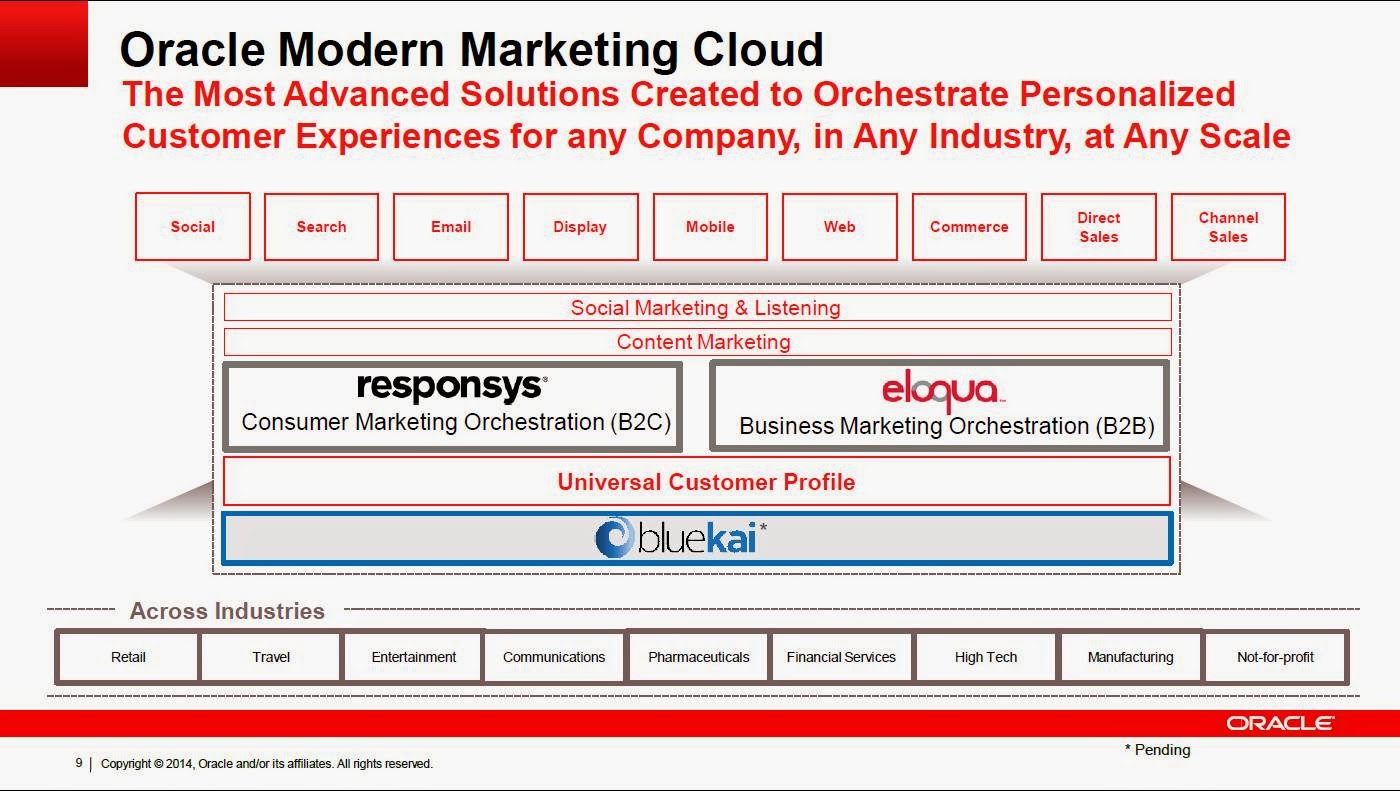
Oracle announced this morning  that it is buying BlueKai, a leading Data Management Platform (DMP) technology vendor and operator of one of the largest data marketplaces. Since I just wrote last Friday about how DMPs integrate with marketing automation to unify customer treatments in Web advertising and direct channels, I’m tempted to just point you to that post for an explanation of how this works and why it matters. I’m also tempted to remind you that I predicted this convergence as an industry trend back in December.  But instead I’ll expand a bit on the fundamental significance of this deal – which is that it promises a serious step toward solving the fundamental problem that increasingly hobbles advanced marketing technology: lack of a solid underlying customer database.


If you look at Oracle’s diagram of their newly expanded Marketing Cloud, you’ll see BlueKai sitting beneath Responsys and Eloqua, providing a “universal customer profile” that allows them to act as “marketing orchestration” systems which, in turn, support programs across all channels – social, search, email, display, mobile, web, commerce, direct sales, and channel sales.

“Marketing orchestration” is a considerable jump beyond the traditional role of “marketing automation”, but I’ll save that analysis for another day. What matters right now is that Oracle places BlueKai exactly where I’ve been placing the Customer Data Platform: as a multi-source database that feeds unified customer data to marketing applications.

This is the first time we’ve seen a major enterprise software vendor draw that picture quite so clearly. More typically, they just do some hand waving around the customer database without explaining how it magically appears. Deep in their hearts, what they really hope is that the database for their core application – CRM, email, Web site management, whatever – will be that central, shared database.  They hope this even though their application doesn’t really provide the database management tools needed to make it happen, and their database itself is often tailored too narrowly to the specific application to support the full range of other uses.

BlueKai, on the other hand, is all about the data. Like other DMPs, it is still mostly organized around cookies and advertising audiences, but it does offer the ability to import other types of data and can certainly track identified individuals if the user wants. The fact that it can combine anonymous and identified profiles is extremely important if marketers are to build a single unified customer data repository and use it to support all contact channels, including Web advertising. The fact that it’s a distinct, named product gives that central customer database the prominence that it deserves.

In short – and I don’t use this term loosely – the BlueKai acquisition could truly be a “game changer” that forces other enterprise software vendors to also give marketers the CDP-style database building tools they’ve needed so desperately. As of this morning, Oracle’s competitors have a new gap in their product lines. It will be interesting to see how they fill it.


Monday, January 13, 2014

Understanding Relationships Within the Marketing Technology Landscape

Scott Brinker, a.k.a. chiefmartec*, last week published a terrific Marketing Technology Landscape Supergraphic organizing nearly 1,000 vendors into 43 categories and six major classes. As Scott modestly writes, his classes present “a semblance of meaningful structure” with Internet and Infrastructure providing the foundations, Marketing Backbone platforms (major channel systems) managing most interactions, Marketing Middleware (including Customer Data Platforms) providing a connective layer, and Marketing Experiences and Marketing Operations systems offering specialized capabilities. Here is his diagram:


I’m delighted that Scott has found the CDP concept useful† and am in turn happy to adopt his distinction between Backbone Platforms and the other types of marketing applications. The Backbone Platforms are, indeed, platforms that support most Experience and Operations systems, enabling those systems to focus on particular tasks without creating complete customer management environments of their own. That's a difference worth noting.

Scott never claimed that his diagram illustrates a precise relationship among the components, so it's no criticism to point out that it doesn't.  Experience and Operations systems sometimes connect with Backbone Platforms through a Middleware system, but more often they connect with the Backbone Platforms directly.  In fact, some of the Experience and Operations systems connect with multiple Platforms, serving as sort of do-it-yourself Middleware.  The challenge of illustrating this becomes clear when you try adding lines to show how the classes of systems interact with each other – it’s not as simple as connecting the adjacent layers on Scott’s diagram.

Being a visual thinker, I found this ambiguity to be endlessly disturbing.** Try as I might, I couldn’t rearrange the boxes to show the relationships correctly.

Then, I had a dream about a snake rolling downhill with its tail in its mouth, and discovered the answer: the systems could all be arranged in a circle graph, allowing any two to be connected directly.††

I must admit that I am ridiculously pleased with this approach. I know there’s nothing especially brilliant about circle graphs per se, but I’ve never seen one used in an architecture diagram. The pictures below illustrate, at least to my satisfaction, how much more clearly the circle graph shows relationships among systems than the traditional boxes and layers. Each diagram shows the same relationships among a small set of systems.  The top left picture uses the traditional approach of showing only the links between categories – as you see, this hides any connections between non-adjacent components or individual systems. The top right picture shows the direct connections between systems, but it’s hard to read because lines cross behind the boxes. True, you could use curved lines to avoid this, but that quickly becomes impractical. The bottom picture shows the circle approach: here, the lines themselves might cross but no connections are hidden. The relative clarity of the circle graph grows as more systems are introduced.  


Showing the actual connections between system pairs has another advantage: it lets you represent the architecture as a formal graph, meaning you can compare architectures using standard graph analysis techniques. Even just counting the connections gives a useful measure of relative complexity.

The diagrams below illustrate this nicely: the top picture shows the same architecture as before, which has 14 system-to-system connections (out of 28 possible pairs, another useful metric, even though some wouldn't make much sense). The bottom picture shows the same systems with everything connecting through a central database: now there are only eight connections and several missing system-to-system links have been provided automatically. If you want a crude approximation of how much a central database reduces complexity (and hence cost), this is good place to start.


The circle approach has other advantages, such as making it easier to see missing connections between systems.  I'm working on it as part of a larger methodology to help marketers assess the value of a Customer Data Platform and plan for deployment.  I expect to be describing the full approach over the next couple of months...stay tuned for details.

______________________________________________________________________________________

*a name that virtually demands a sidekick. Obvious choice is “Data Boy” but I’m sure my readers can think of something more clever.

† and appreciate the credit has he given me.

** Yes, I do recognize how fortunate I am that this is of my major problems in life.

†† Not really. The snake dream is how KekulĂ© discovered the structure of benzene. But it makes a good story, eh?


Wednesday, April 03, 2013

ReachForce Buys SetLogik: One-Stop-Shopping for B2B Marketing Data Plus Database

B2B marketing data vendor ReachForce today announced its purchase  of SetLogik, which provides technology to build cloud-based marketing databases and do predictive modeling against them. (See my post from last October for more on SetLogik.)

There’s an obvious peanut butter-meets-jelly type of logic to this match. Reachforce’s core business is assembling data on marketing prospects, which it then sells for as many uses as possible: appending to Web leads, enhancing existing databases, and buying as lists. The SetLogik acquisition takes this a step further by letting them build databases to hold their data, thereby expanding the market beyond people with a database already in place. Conversely, having a readily-available data source encourages marketers to build their own database. SetLogik’s predictive modeling features make it even easier for marketers to get a return on their investment once the database is in place. Everybody wins!

The two products will be combined in what ReachForce calls the “Connected Marketing Data Hub”. The name is frightfully generic, but the key points are:
  • cloud-based system, making it easy to deploy
  • comprehensive customer view including data from marketing automation, CRM, transaction systems, and ReachForce’s own sources
  • continuously updated and cleansed
  • connectors available for Salesforce.com, Eloqua, and Marketo  

In other words, the ReachForce solution supplements rather than replaces your marketing automation or CRM database. As I wrote in my earlier SetLogik review, one particularly attractive result is the ability to match sales revenues with marketing leads, always a challenge in measuring the value of marketing programs.

ReachForce has just begun to offer the combined system, which is currently deployed at one pilot client. Pricing is based on data volume, whether the client wants a one-time append or continuous cleaning, and on the data sources included. Minimum is $625 per month for continuous cleaning on 50,000 records.