Monday, February 15, 2016

Landscape of Machine Intelligence Systems for Marketing

I’ll be speaking next month at the MarTech conference on How Machine Intelligence Will Really Change Marketing. This required assembling a list of marketing systems using machine intelligence, which pretty much inevitably led to the logoscape below.

I wasn’t initially enthusiastic about the idea – could there by anything less original?—but have found the result surprisingly useful. In particular, it illustrates several points that would otherwise have been hidden or much harder to convey. These include:

  • Lots of systems. You may think that machine intelligence is still a pretty rare thing. Not so. I found 23 categories with 140 systems, and know there are dozens of other products I could have included.
  • Some categories are already crowded. Boxes with a lot of logos have a lot of competitors. This doesn’t make them mature in the sense of having a widely accepted standard approach. But it does mean that many people have recognized they are a successful use for machine intelligence. Conversely, categories with few competitors are more speculative – although a few strike me as pretty sure to succeed in the end.
  • Few systems for marketing strategy. Some research I’ll cite at MarTech suggests that marketers split their time roughly equally between strategy and planning, program design and content creation, and data management and analytics. I’ve classified vendors into those categories. I then make a further distinction between systems that help marketers with decisions and systems that make decisions without marketer involvement. This distinction is very loose, but that’s a topic for another day.  What’s immediately obvious is there are very few systems to do strategy and planning, and none of those are actually deciders. My take on this is that CMOs aren’t ready to delegate strategic decisions to machines, although another explanation is that CEOs aren’t ready to delegate marketing strategy to the CMOs.
  • Decider systems for design. The design category is crowded with systems for the established applications of personalization and programmatic ad bidding. Perhaps more surprising, there is also a rapidly growing number of products to create contents such as copy, email dialogs, and even Web pages. Nearly all of these are deciders – perhaps because they work with volumes of choices so huge that only computers can handle them. Helper systems aren’t much use in those situations.
  • All kinds of systems for data. This is the most populated area, with roughly half the categories and half the total vendors. It's also the group with the most vendors I didn’t include – for example, there are probably 100 social media monitoring systems alone, most of which use at least some basic machine intelligence for language processing. This group is about evenly split between helpers and deciders, reflecting the variety and complexity of data-related tasks.  One reason this group is so large is that many of the applications, such as data extraction and predictive model building, are also used for purposes outside of marketing.

I’ll draw some other lessons from this chart in my MarTech talk. You can still join us by registering here. In the meantime, I hope this chart helps you realize the scope of machine intelligence applications in marketing today and inspires you to explore more deeply how they can help in your own work.

Sunday, February 07, 2016

Marketing attribution systems: a quick look at the options

I’ve seen a lot of attribution vendors recently. If you're a regular reader here, you saw my reviews of Claritix (last week) and BrightFunnel (in December).  Last week caught up with Jeff Winsper of Black Ink, which I'll hopefully review before too long.  Bizible also popped up recently although I don’t recall the occasion; possibly something related to their interesting survey on “pipeline marketing” and attribution methods.

My rational brain knows that there’s probably no reason for this flurry of sightings beyond pure coincidence. But it’s human to see patterns where they don’t exist, so I did find myself wondering if attribution is becoming a hot topic. I can easily come up with a good story to explain it: marketing technology has reached a new maturity stage where the data needed for good attribution is now readily available, the cost of processing that data has fallen far enough to make it practical, and the need has reached a tipping point as the complexity of marketing has grown. So, clearly, 2016 will be The Year of Attribution (as Anna Bager and Joe Laszlo of the Internet Advertising Bureau have already suggested).

Or not. Sometimes random is just random. But now that this is on my mind, I've taken a look at the larger attribution landscape.  Quick searches for "attribution" on G2 Crowd and TrustRadius turned up lists of 29 and 17 vendors, respectively – neither including Brightfunnel or Claritix, incidentally.  A closer look found that 13 appeared on both sites, that each site listed several relevant vendors that the other missed, and that both sites listed multiple vendors that were not really relevant. For what it's worth, eight vendors of the 13 vendors listed on both sites were all bona fide attribution systems -- which I loosely define to mean they assign fractions of revenue to different marketing campaigns.  I wouldn't draw any grand conclusions from the differences in coverage on G2 Crowd and TrustRadius, except to offer the obvious advice to check both (and probably some of the other review sites or vendor landscapes) to assemble a reasonably complete set of options.

I've presented the vendors listed in the two review sites below, grouping them based on which site included them and whether I qualified them as relevant to a quest for an attribution vendor.  I've also added a few notes based on the closer look I took at each system in order to classify it.  The main questions I asked were:
  • Does the system capture individual-level data, not just results by channel or campaign?  You need the individual data to know who saw which messages and who ended up making a purchase.  Those are the raw inputs needed for any attempt at estimating the impact of individual messages on the final result.  
  • Does the system capture offline as well as online messages?  You need both to understand all influences on results.  This question disqualified a few vendors that look only at online interactions.  In practice, most vendors can incorporate whatever data you provide them, so if you have offline data, they can use it.  TV is a special case because marketers don't usually know whether a specific individual saw a particular TV message, so TV is incorporated into attribution models using more general correlations.
  • How does the vendor do the attribution calculations?  Nearly all the vendors use what I've labeled an "algorithmic" approach, meaning they perform some sort of statistical analysis to estimate the attributed values.  The main alternative is a "fractional" method that applies user-assigned weights, typically based on position in the buying sequence and/or the channel that delivered the message.  The algorithmic approach is certainly preferred by most marketers, since it is based in actual data rather than marketers' (often inaccurate) assumptions.  But algorithmic methods need a lot of data, so B2B marketers often use fractional methods as a more practical alternative.  It's no accident that the only B2B specialist listed here, Bizible, is the only company that uses a fractional method, as do B2B specialists BrightFunnel and Claritix.  It's also important to note that the technical details of the algorithmic methods differ greatly from vendor to vendor, and of course each vendor is convinced that their method is by far the best approach.
  • Does the vendor provide marketing mix models?  These resemble attribution except they work at the channel level and are not based on individual data.  Classic marketing mix models instead look at promotion expense by channel by market (usually a geographic region, sometimes a demographic or other segment) and find correlations over time between spending levels and sales.  Although mix models and algorithmic attribution use different techniques and data, several vendors do both and have connected them in some fashion.
  • Does the vendor create optimal media plans? I'm defining these broadly to include any type of recommendation that uses the attribution model to suggest how users should reallocate their marketing spend at the channel or campaign level.  Systems may do this at different levels of detail, with different levels of sophistication in the optimization, and with different degrees of integration to media buying systems. 
Of course, there are plenty of other points that differentiate these systems.  But this list should be a useful starting point if you're considering a new attribution system -- as well as a reminder of the need to define your requirements and drill into the details before you make a final selection.

Attribution Systems

G2 Crowd and TrustRadius
  • Abakus: individual data; online and offline; algorithmic; optimal media plans
  • Bizible: individual data; online and offline; fractional; merges marketing automation plus CRM data; B2B
  • C3 Metrics: individual data; online and TV; algorithmic; optimal media plans 
  • Conversion Logic: individual data; online and TV; algorithmic;optimal media plans
  • Convertro: individual data; online and offline; algorithmic; mix model; optimal media plans; owned by AOL
  • MarketShare DecisionCloud: individual data; online and offline; algorithmic; mix models; optimal media plans; owned by Neustar
  • Rakuten Attribution: individual data; online only; algorithmic; optimal media plans; formerly DC Storm, acquired by Rakuten marketing services agency in 2014
  • Visual IQ: individual data; online and offline; algorithmic; optimal media plans
G2 Crowd only
  • BlackInk: individual data; online and offline; algorithmic; provides customer, marketing & sales analytics 
  • Kvantum Inc.: individual data; online and offline; algorithmic; mix models; optimal media plans
  • Marketing Evolution:  individual data; online and offline; algorithmic; mix model; optimal media plans
  • OptimaHub MediaAttribution  individual data; online and offline; attribution method not clear; data analytics agency with tag management, data collection, and analytics solutions
    TrustRadius only
    • Adometry: individual data; online and offline; algorithmic; mix models; optimal media plans; owned by Google
    • ThinkVine: individual data; online and offline; algorithmic; mix models; optimal media plans; uses agent-based and other models
    • Optimine:  individual data; online and offline; algorithmic; optimal media plans
    Other Systems

    G2 Crowd and TrustRadius

    G2 Crowd only
    • Adinton: Adwords bid optimization and attribution; uses Google Analytics for fractional attribution
    • Blueshift Labs: real-time segmentation and content recommendations; individual data but apparently no attribution
    • IBM Digital Analytics Impression Attribution: individual data; online only; shows influence (not clear has fractional or algorithmic attribution); based on Coremetrics
    • LIVE: for clients of WPP group; does algorithmic attribution and optimization
    • Marchex: tracks inbound phone calls
    • Pathmatics: digital ad intelligence; apparently no attribution
    • Sizmek: online ad management; provides attribution through alliance with Abakus
    • Sparkfly: retail specialist; individual data; focus on connecting digital and POS data; campaign-level attribution but apparently not fractional or algorithmic
    • Sylvan: financial services software; no marketing attribution 
    • TagCommander: tag managemenet system; real-time marketing hub with individual profiles and cross-channel data; custom fractional attribution formulas
    • TradeTracker: affiliate marketing network
    • Zeta Interative ZX: digital marketing agency offering DMP, database, engagement and related attribution; mix of tech and services

    Tuesday, February 02, 2016

    Claritix Assembles Marketing Data for Analysis: Maybe That's Enough

    Most of the work in any marketing analytics project is integrating data from multiple systems. Claritix carries this insight to one logical conclusion by offering a system that does data assembly, basic reporting, and little else.  No fancy attribution methodologies or custom journey maps here (although they’re on the way). I’m not fully convinced this is enough to justify using Claritix but am open to the possibility. Here’s a deeper look.
     

    As I just said, Claritix’s chief function is assembling customer data from multiple sources. The system has prebuilt connectors to import data from popular vendors including Salesforce.com, Marketo, Hubspot, SAP, SugarCRM, and Facebook. It can connect with others through standard APIs. The imported data is loaded into MongoDB, a NoSQL database that offers great flexibility and ease of deployment. Claritix applies sophisticated algorithms to cleans the data and match contacts based on similarity.  It also uses matches created elsewhere such as lead IDs used to synchronize CRM and marketing automation data or cookie IDs imported from Google Analytics. The matching happens at both the contact and account level. Imported data includes contacts, funnel stages, campaigns, channels, revenue, and content.


    Users can access this data through dashboards, charts, and views. There are different dashboards for the main data types (campaigns, funnel stages, channels, etc.). These provide basic information such as impressions, engagements, visits, deals and revenue by campaign, or sources, stages, conversion rates, and average duration by funnel stage. The specific measures depend on the data type. Users can drill into details down to the contact level. Views can show results for user-defined segments.

    Claritix also lets users assemble information into binders, which are contain pages that are snapshots of dashboards, charts, and notes. These can be exported to PDF or slides or viewed directly within Claritix. Binders can update themselves at regular intervals. Collaboration features let users attach virtual “sticky notes” to screen images and share these via Slack or Claritix’s own communication channels.

    So far as I know, that’s pretty much all that the system does. There is no capability, for example, to write the assembled data back to source systems for their own use.  Claritix tells me this has been quite sufficient for their initial clients, who have liked the fact that set-up is virtually all automated or handled by the vendor.  This has let them assemble data across multiple systems in ways that would otherwise have been impossible or hugely expensive. Certainly price is an advantage: Claritix starts at $1,000 per month for up to 10,000 contacts in the database, with the cost per contact decreasing for higher volumes. A system with more advanced reporting, such as Brightfunnel (which I reviewed in December and has been a consulting client) starts at $3,000 per month or higher. Still, you have to decide whether you’ll need the features that Claritix is missing; if so, you’ll end up missing many of the beneifts that good marketing measurement provides.   As Captain Planet used to say, the power is yours.

    Thursday, January 28, 2016

    Real Magnet Offers Complex Campaigns Without the Flow Charts

    I recently saw a useful distinction between AI – artificial intelligence, which is machines replacing people – and IA – intelligent assistance, which is machines helping people. Real Magnet, an email service provider turned marketing automation vendor with over 1,000 clients, doesn’t position itself as either. But its flagship feature is letting marketers create sophisticated, multi-step campaigns by answering handful of questions in a template. The remaining work to implement the marketers’ choices is done by the system. That sounds like Intelligent Assistance to me.

    This piques my interest because I’ve long argued that the chief roadblock to wider use of marketing automation is the difficulty of setting up campaigns, and have offered Artificial Intelligence as the solution. That is, I have been looking for systems that automatically design campaigns (or deliver optimal customer treatments without campaigns), thereby removing the roadblock by doing the work on the marketers' behalf. This has always felt a bit optimistic, but, then, so do self-driving cars. An Intelligence Assistance approach seems like a more plausible near-term alternative – analogous to the “driver assist” features already finding their way into automobiles.

    Of course, many marketing automation systems use templates as part of their campaign set-up. What sets Real Magnet apart is the entire set-up is done through the templates. The system does offer a conventional workflow builder (which is quite nice, in fact) but it's not needed for campaigns that fit the standard templates.  Users do have the ability to convert template campaigns to the workflow format for customization. .
    Campaign Steps

    To make things a bit more concrete: the Real Magnet campaign picker starts out by asking the user to select their industry from a list. The system then presents a choice of industry-appropriate campaign types such as subscription renewals, webinar promotions, birthday and anniversary messages, and welcome kits. Once a campaign is chosen, the system presents three or four steps with a few questions per step: for example, steps for a standard email campaign are select the audience, select the messages and intervals, and schedule the execution. Most of these selections are themselves made by picking from predefined options or templates, with the ability for users to set up new options as needed.  Real Magnet support staff is also available to set up options when clients need help.

    Campaign Workflow
    Campaign templates can include multiple steps and branching flows, such as follow-up messages to people don’t complete a registration process. Campaign steps can include many types of actions, from sending messages to assigning group membership, setting field values, managing point totals, suppressing further communications, or directing the flow to another branch or block within a branch. Over-all, these options make Real Magnet a very powerful system.

    Campaigns can also run processes such as a/b tests, lead scoring, landing pages, segmentation, or suppression lists. In other words, pretty much any task that would ordinarily require complex set-up can be created through a template. Not surprisingly, Real Magnet reports its users – typically small marketing departments with limited resources – find this very appealing. Those are exactly the kinds of users who struggle to deploy advanced features in most marketing automation systems.

    Real Magnet also provides several levels of campaign reporting, from a dashboard with summary statistics to performance by individual messages within a campaign to lists of campaign participants. Reports vary based on the campaign details.  They often include engagement rates and achievement of user-specified goals. Reports can also consolidate results for groups of campaigns.

    The Real Magnet database is largely limited to a single record per customer, although the system does track promotion history and related events such as form files and survey completions. Users can add custom fields to the customer record but not custom tables. The system integrates with major CRM and association management systems, and can access their contents to some degree. It also stores social media handles for Facebook and Twitter, can send messages through those systems, and can create scores based on social media behaviors such as retweets and likes.

    Real Magnet started business in 2000 as an email service provider. More than half of the company's 1000-plus clients are trade and professional associations, with additional concentrations in education and publishing. Pricing of the Real Magnet system is based on number of emails sent. Packages start around $200 to $300 per month.

    Monday, January 25, 2016

    Avention DataVision Gives Sales and Marketing Systems Unified Access to B2B Customer Data Quality and Alerts

    My look last week at True Influence’s InsightBASE, a relatively new-fangled approach to intent data, was karmically balanced by a conversation with Avention, a old-line data aggregator that traces its roots to CD-ROM business lists from Lotus OneSource. The folks at Avention had reached out to discuss their latest product, DataVision, which extends Avention’s reach from sales enablement to marketing systems.  The goal is giving clients a single data source to support both departments.

    DataVision lets clients upload customer lists to be cleaned and enhanced by matching against Avention’s own master file, which is itself compiled from some seventy sources. Sales and marketing systems can then access the results in an online database, providing all departments with a single, consistent view of their consolidated data. The information includes both companies and contacts and supplements standard profile information with event-based "signals" derived from news reports, company Web sites, and social media postings. Clients can set up alerts based on signals and can acquire new names that are similar to their current customers.

    If this sounds familiar, it’s because Reachforce, InsideView, SalesLoft and other data vendors offer similar services. Predictive modeling vendors including Leadspace, Lattice Engines, Mintigo, and Everstring also provide enhancement and signal-based alerts, although usually with less depth of detail. The biggest difference is those vendors usually send the enhanced information back to client systems rather than keeping it in an external database which sales and marketing systems access directly.

    But different isn’t necessarily better. No one will discard their CRM or marketing automation database and use the DataVision file instead. There’s simply too much other information within the sales and marketing systems. So, in practice, DataVision will be used to update a company’s existing databases, pretty much the same as its competitors. The data may be a bit fresher, since any query to DataVision will return the latest information available to Avention. DataVision also provides some nice tools to visualize the distribution of a client’s customers across geography, industry, company size, and other dimensions, and to compare those distributions with the entire Avention universe of known firms. Again, these features are useful even if they are not necessarily unique.

    In short, Avention DataVision is a solid option when you’re looking to clean and enhance your company’s customer and prospect data – something every firm needs to do. Intent data and predictive modeling are not part of the mix yet, but it’s easy to imagine those being added in the future. Whether Avention is your best choice will depend on your specific situation.  The only way to know is to define your exact requirements, test several sources, and evaluate the results. The good news is you have lots of vendors to choose from, so you have a good chance of finding one that fits your needs.

    Wednesday, January 20, 2016

    True Influence InsightBASE Simplifies Use of B2B Intent Data

    Intent data is one of hottest topics in marketing today – see, for example, Oracle’s recent purchase of AddThis. But while the promise of intent data is irresistible – “reach prospects with demonstrated interest in your product!” – the reality has been less appealing. Even setting aside issues of accuracy and coverage, there are problems with both advertising and email, the two primary applications for intent data.  Advertising can reach large numbers of people but just a tiny fraction will click on an ad and a tiny fraction of those will provide contact information. Intent-based email lists are obviously contactable but volumes are often quite low.

    B2B lead generation vendor True Influence  today announced a new product to help fill these gaps. InsightBASE monitors intent signals – in the form of visits to Web pages with relevant content – and notifies clients when there is surge in activity for companies on a target list. The notifications can be loaded as lists into a marketing automation or CRM system, where they can trigger advertising, sales calls, or other actions. Clients also receive contact names, email addresses, and phone numbers at those companies. The contact data is drawn from True Influence’s master list of 30 million business contacts, which are continuously verified to ensure deliverability. Although the names are not tied directly to Web visits, they are selected by job title and level, so they should be appropriate. Visits are tied to companies based on the user’s Web domain – a typical approach although one that can’t misses many sessions from home offices and mobile devices.

    So, what distinguishes InsightBASE from other intent-based products? The main difference is that users get the company and contact lists. This contrasts with many intent-based advertising vendors, who serve ads to qualified audiences but don't tell clients exactly whom they’re reaching.  InsightBASE also differs from predictive marketing vendors who use intent data as inputs to their scoring systems and in some cases also provide lead lists: although predictive models almost surely do a better job of isolating the best prospects than InsightBASE’s simple profiles plus surge tracking, the models add considerable cost and complexity.

    True Influence also says its partner network gives it access to more intent data than anyone else.  That's possible but I haven’t done the research to confirm it. Nor is it necessarily important, since activities on some Web sites are less significant than others. The value of data from True Influence, or anyone else, can only be resolved through tests, which will probably give different results for different purposes.

    The mechanics of InsightBASE are straightforward. Users set up a campaign by either uploading their own list of target companies or making selections from True Influence’s own database of more than three million Web domains. Selections can use standard filters such as industry, location, number of employees, or domain type (such as .edu or .gov). They can also be based on use of specific technologies, allowing marketers to target competitors’ customers. The next step is to specify keywords to use as indicators of intent. True Influence has its own list of about 5,000 keywords and uses them to do its own classification of Web pages.  It can add new keywords as needed.  Finally, InsightBASE runs a report showing how many of the target companies visited pages with the specified keywords over the past thirty days, and whether their activity increased, decreased, or remained the same compared with previous periods. This gives a good indication of the potential volume of future activity.

    Once the campaign begins, users can extract lists of domains that exceeded a specified activity level or had change in activity. They can export the domains, contacts associated with the domains, or both. InsightBASE has standard integrations with Marketo, Oracle Eloqua, and Salesforce.com. Once the lists are loaded into those systems, they can be used for email, advertising, sales calls, or other purposes.

    Pricing for InsightBASE is based on the number of domains monitored, starting at $2,500 per month for 2,500 domains with discounts for higher volumes. There are no separate fees for additional campaigns, contact names, or supporting services. True Influence reports that its initial tests showed companies with activity surges responded to promotion emails at four times the rate of non-targeted companies.

    Tuesday, January 19, 2016

    OneSpot Offers Automated Content Selection Targeted at Long Term Results

    As you know from previous blog posts, I’ve been borderline obsessed recently with systems that automatically create multi-step campaign flows. So when I saw that OneSpot calls its product a “content sequencing engine” you can bet they had my attention. When I read that “OneSpot’s machine learning technology serially delivers multiple pieces of content to your users based on their interests and digital journey stage,” I thought I might have found the Holy Grail itself.

    OneSpot was already on my list of interesting companies because they automatically reformat content to use in different channels. This is a good example of applying artificial intelligence to reduce the workload on marketing departments so they can deliver more targeted messages at lower cost. The company had been doing this and programmatic ad buying since its start in 2012.

    The content sequencing engine is a more recent addition. According to OneSpot Chief Marketing Officer Adam Weinroth, one of the things that make the engine special is that it finds the best content to generate repeat engagement rather than immediate response. Another is that it delivers the content through advertising on external Web sites as well as in email, a company’s own Web site, mobile and social. In other words, OneSpot's “sequencing” is about coordinating messages in different channels, not delivering groups of messages in a fixed order. Since my own quest has been automated creation of ordered messages, OneSpot isn't the Grail I seek.  But it's still quite special: as Weinroth points out, there are many systems to select offers for ecommerce but few for content marketing. Even fewer support advertising along with other channels.

    OneSpot deploys several major pieces of technology to make this happen. A content analytics engine automatically classifies existing content without manual tagging. The classification categories (a.k.a. taxonomy) are themselves created automatically. This automation removes one of the largest bottlenecks in deploying high volumes of content. The reformatting engine then prepares the content to be distributed across multiple channels, again without manual labor. The automated recommendations are based on a profile that includes results from all the channels supported by OneSpot. This cross-channel perspective is what lets OneSpot base recommendations on repeat engagement rather than immediate response. It also lets the system bid on advertising to non-customers as well as messages to current customers. OneSpot also has its own real-time bidding engine. It is integrated with major Web ad exchanges, which Weinroth said allows it to potentially bid on 36 million impressions per minute.

    Other aspects of OneSpot are more conventional. The system uses a Javascript tag to integrate with company Web sites and third party ad sites. Email is personalized through API connections with email service providers. Advertising audiences are selected by defining targeting criteria against standard Web audiences. Customers and prospects are identified through Web cookies, hashed (anonymized) email addresses linked to cookies, and third party services for device targeting.

    OneSpot continues to extend its technology. Weinroth showed me a beta version of a report that compares demand for each topic with the number of existing content pieces for that topic and the impact of content with that topic on reengagement. While OneSpot won’t actually create the additional content, this is still another step towards replacing manual tasks with automation.

    Pricing for OneSpot starts north of $100,000 for an annual contract. The actual fees are based on traffic volumes and channels supported. Weinroth said most clients use the system in at least two channels, typically Web site messages and Web ad retargeting.

    Tuesday, January 05, 2016

    Rating the Crowd-Sourced Marketing Software Review Sites

    What began as a whimsical “landscape of landscapes” led to the serious realization that crowd-sourced review sites are the most common type of vendor directory.  Fifteen of the 23 sources listed in my original graphic fell into that category. This begged for a deeper look at the review sites to understand how they differ and which, if any, could replace the work of professional reviewers (like me) and software guides (like my VEST report).

    The first question was which sites draw a big enough crowd to be useful. I used Alexa traffic rankings, which are far from perfect but good enough for this sort of project. (Compete.com gave similar rankings except that TrustRadius came in lower, although still in the top 10.)  After adding two review sites that I learned about after the original post, I had 17 to consider. In order of their Alexa rankings, they were:


    Since crowd wisdom without a crowd can’t be terribly effective, I limited further analysis to the top 10 sites. Of these, AlternativeTo.net, SocialCompare, and Cloudswave were different enough from the standard model that it made sense to exclude them. This left seven sites worth a closer look.

    The next question was coverage by the sites of marketing technology. Every site except TrustRadius covered a broad range of business software from accounting to human resources to supply chain as well as CRM and marketing. TrustRadius was more focused on customer-related systems although it still had business intelligence and accounting. The numbers of categories, subcategories, and marketing subcategories all differed widely but didn’t seem terribly significant, apart from SoftwareInsider and DiscoverCloud looking a bit thin. Differences in the numbers of products in the main marketing categories also didn't seem meaningful  – although they do illustrate how many products there are, in case anyone needs reminding.


    What did look interesting was the number of ratings and/or reviews for specific products. I sampled leading marketing automation vendors for different sized companies. It turns out that G2Crowd and TrustRadius had consistently huge leads over the others. I didn’t check similar statistics for other software categories, but this is probably the one that counts for most marketers.


    Of course, quality matters as well as quantity. In fact, it probably matters more: my primary objection to crowd-sourced software reviews has always been that users’ needs for software are so varied that simple voting based on user satisfaction isn't a useful indication of how a system will for any particular buyer.  This is different from things like restaurants, hotels, and plumbers, where most buyers want roughly the same thing.

    Software review sites address this problem by gathering more detail about both the products and the reviewers. Detailed product information includes separate numeric ratings on topics such as ease of use, value for money, and customer support; detailed ratings on specific features; and open-ended questions about what reviewers liked most and least, how they used the system, and what they’re recommend to others. Reviewer information on all sites except Software Advice starts with verifying that the user is a real person through requiring a LinkedIn log-in. This lets the review site check the reviewer’s name, title, company, and industry, although these are not always fully displayed. Some sites verify that the reviewer actually uses the product. Some provide other background about the reviewer’s activities on the review site and how their work has been rated.

    I can't show how each vendor handles each of those items without going into excruciating detail. But the following table gives a sense of how much information each site collects. Of course, reviewers don’t necessarily answer all these questions. (Caution: this information is based on a relatively quick scan of each site, so I’ve probably missed some details. If you spot any errors, let me know and I’ll correct them.)  When it comes to depth, TrustRadius and DiscoverCloud stand out, although I was also impressed by the feature details and actual pricing information in G2Crowd.


    The number and depth of reviews are clearly the most important attributes of review sites.  But they also differ in other ways.  Selection tools to identify suitable vendors are remarkably varied – in fact, the only filter shared by all sites is users' company size. Industry is a close second (missing only in DiscoverCloud), while even selections based on ratings are found in just four of the seven sites. Only three sites let users select based on the presence of specific features, an option I believe is extremely important.


     Looking beyond selection tools: most sites supplement the reviews with industry reports, buyer guides, comparison grids, and similar information to help users make choices. Several sites let users ask questions to other members.

    So, back to my original question: can crowd-sourced review sites replace professional software reviews? I still don’t think so: the coherent evaluation of a practiced reviewer isn’t available in the brief comments provided by users, even if those comments are accompanied by information about specific product features. This may sound like self-serving mumbo-jumbo, but I do think a professional reviewer can articulate the essence of many products more effectively than users who report only on their personal experience. (Yes, I really just wrote "articulate the essence".)

    But whether sites can replace professional reviewers is really the wrong question.  What matters is the value the review sites offer on their own. I’d say that is considerable: given enough volume, they indicate the rough market share of different products, the types of users who buy each system, and what worked well or poorly for different user types. User comments give a sense of what each writer found important and how they reached their judgements.  This in turn lets readers assess whether that reviewer’s needs were similar to their own. Buyers still need to understand their own requirements, but that’s something that no type of review can replace.


    Tuesday, December 22, 2015

    Brightfunnel Gives B2B Marketers Self-Service Revenue Attribution

    Marketing without revenue attribution is like playing golf without keeping score: it might be fun but you can’t tell whether you’re doing a good job. But while keeping score in golf is simple, figuring out the impact of marketing programs is quite tough. In fact, B2B marketers face several challenges on the road to perfect attribution.  The simplest is just connecting marketing leads to closed sales, which is an issue because the data in sales systems is often incomplete.  A higher level ties specific marketing programs to individual leads, and through them to accounts and deals. The most advanced efforts estimate the relative impact of different marketing programs on the final result.  The problems must be solved in sequence: you must connect leads to revenue before you can connect marketing programs to revenue, and must connect all programs to revenue before you can start to allocate credit among them.

    Brightfunnel compares results of different attribution methods


    Most marketers struggle to get past the first level. There wouldn’t be a problem if sales people religiously associated every lead with the right account. But this doesn’t always happen for many reasons. So marketers must either accept that they’ll miss some connections, do laborious manual research to make the right matches, or rely on specialized software to do the work.

    This is where Brightfunnel comes in. Brightfunnel reads lead, account, and opportunity data from Salesforce.com and supplies missing connections based on things like company name. Since Salesforce.com can also capture lead source (i.e., original marketing program), Brightfunnel can build a complete chain linking marketing programs to leads to accounts to opportunities. The system also has connectors to bring in data from Oracle Eloqua and Marketo, marketing automation, which will often include marketing programs and leads that never made it into Salesforce. But Brightfunnel says that most clients work with Salesforc data alone.

    Making connections is certainly important, but Brightfunnel also provides tools to use the resulting information. Marketers can analyze results by marketing program, time period, customer segment, or other variables. They can compare performance over time, compare specific programs against an average, and see top campaigns by lead source. Because the imported opportunity data includes sales stage, reports can also track movement through the sales funnel, calculating conversion rates and velocity (time to move from one stage to the next). The system can use this to forecast the value and timing of future sales from deals currently in the pipeline.

    What about that third level of attribution, splitting revenue from a single sale among different marketing programs? Brightfunnel offers two varieties of multitouch attribution: one where credit is shared evenly among all programs that touched a lead, and one where credit is split according to a fixed formula of 40% to the first touch, 20% to middle touches, and 40% to the final touch. Brightfunnel can also show first-touch and last-touch attribution, which attribute all revenue to the first or last touch, respectively.

    Attribution aficionados will recognize that none of these is a fully satisfactory approach. The gold standard in attribution is advanced statistical methods that estimate the true incremental impact of each program on each lead. Brightfunnel is working on such a method but hasn’t released it yet. In the meantime, the simpler approaches give some useful insights – so long as you don’t forget they are not wholly accurate.

    The value of Brightfunnel is less in advanced analytics than in the fact that it does the basic data assembly and lets marketers analyze data for themselves.  Without a tool like Brightfunnel, detailed analysis often requires technical skill and tools that few marketers have available.  .

    Brightfunnel was introduced in 2014 and has something under 100 clients. Pricing runs from $35,000 to $80,000 per year based on system modules and number of users. The amount of data doesn’t matter. Clients are mostly mid-sized tech companies – the usual early adopters for this sort of thing. The company raised $6 million in Series A funding in October 2015.

    Wednesday, December 16, 2015

    Future Marketing: Will Machines Take Over Half the Consumer Economy?

    ‘Tis the season for predictions. I’m not going to plague you with any new ones right now, but did want to expand a bit on the long-term vision I’ve been talking about in speeches and described briefly last July as “robotech”. The gist of this is that people will increasingly delegate day-to-day decisions to computers, meaning that most purchases will be based on machines selling to other machines.  (If you want a real-world example, think how search engine optimization already boils down to “selling” content to the Google ranking algorithms).  In this world, consumers still have choices but what they’re deciding is which machine to trust – in exactly the same way that you decide whether to let Google or Bing or something else be your primary search engine.

    The key word in that sentence is “trust”.  People won’t want to double-check each action by the agents they delegate to buy their groceries, pick their restaurants, book their hotel rooms, arrange their transportation, and do other boring daily tasks. The chart below shows in more detail how I think current trends lead to this conclusion; I won’t bore you by walking through it step-by-step.


    One question worth asking is, how much of the economy is likely to be affected by this change? After all, nearly all B2B purchases are already part of a larger relationship rather than isolated transactions. On the consumer side, large sectors like banking, insurance, health care, and housing are also governed by long-term contracts.

    The table below shows a crude attempt to find an answer.  Using Census data, classified each industry as B2B or B2C, and then split B2C between sectors that are already purchased through long-term relationships and those that will move to such relationships in the future. (I did actually have a category for those that will remain transactional, but that column ended up blank.) Industries that sell to both business and consumers were split 50/50.  I told you this was crude.


    As you see, I decided that about 55% of the U.S. economy is B2B. The remaining portion is split evenly between sectors that are already sold through long-term contracts and those that will make that transition in the future. The bulk of the change will happen in the retail sector, where I think nearly every purchase will be based either on a direct subscription – such as contracting with a dealer to service your car rather than buying each repair individually – or an indirect subscription – such as having an automated travel agent pick the best airline, hotel, rental car, and restaurants for each trip. You might question some of my choices, but let me point out that even the clothing industry – where people theoretically want to make individual choices – is already seeing subscription business models where companies send products they think the consumer might like and the consumer can then keep what she wants. 

    These figures are intended to give some weight to my otherwise vague assertion about the shift from transactional to relationship buying. If literally half the consumer economy is at stake (and the other half has already made the transition), that is surely worth paying attention.

    Wednesday, December 02, 2015

    Automated Marketing Campaigns: An Immodest Proposal

    I wrote last June about replacing traditional multi-step campaigns with a system that tracks customers through journey stages and executes short sequences of actions, called “plays”, at each stage.  The goal was to approach the perfect campaign design of “do the right thing, wait, and do the right thing again”.

    I still think approach makes sense but it suffers from a major flaw: someone has to define all those stages and all those plays. This limits the number of actions available since it takes considerable human time, effort, and insight to create each stage and play. Ideally, you’d let machines evolve the stages and plays autonomously. But while it’s easy for conventional predictive models to find the “next best action” in a particular situation, it’s much harder to find the best sequence of actions. This is why you can find dozens of automated products to personalize Web sites but none to automate multi-step campaign design.

    The problem with multi-step campaigns is the number of options to test.  These have to cover all possible actions in all possible sequences at all possible time intervals. Few companies have enough customer activity to test all the possibilities, and, even if they did, it would take unacceptably long to stumble upon the best combinations and cost unacceptable amounts of lost revenue from customers in losing test cells.  In any case, available actions and customer behaviors are constantly changing, so the best approach will change over time – meaning the system would need to be constantly retesting, with all the resulting costs.

    I’ve recently begun to imagine what I think is a solution. Let’s start with the problem that’s already solved, of finding the single next best action. You can conceive of my perfect campaign as a collection of next best actions. But a solution that merely executed the next best action for each customer every day would almost surely produce too many messages. One solution is a model that predicts the value* of each potential action, rather than simply ranking the actions against each other. This lets you set a minimum value for outbound messages. On days when no action meets this threshold, the system would simply do nothing. A still better approach is to explicitly consider “no action” as an option to test and build a model that gives it a value – presumably, the value being higher response to future promotions. Now you have a system that is organically evolving the timing of multi-step campaigns – and, better still, adapting that timing to behavior of each individual.

    But what about sequences of related actions (i.e.,“plays”)? Let’s assume for a moment that the action sequences already exist, even if humans had to create them. This turns out to be a non-issue: if the best action to take with a customer is the second step in a sequence, the system should find that and choose it.  If some other action would be more productive, we’d want to system to pick that anyway. The only caveat is the predictions must take into account previous actions, so any benefit from being part of a sequence is properly reflected in the value calculations. But a good model should consider previous actions anyway, whether or not they’re part of a formal sequence. At most, marketers might want to stop customers from receiving messages out of order.  This is easy enough to design – it just becomes part of the eligibility rules that limit the actions available for a given customer.  Such rules must exist for any number of reasons, such as location, products owned, or credit limit, so adding sequence constraints is little additional work.  In practice, the optimal sequence for different customers is likely to be different, so imposing a fixed sequence is often actively harmful.

    So far so good, but we haven’t really solved the problem of too many combinations. This requires another level of abstraction to reduce the number of options that need to be tested. When it comes to timing, initial tests of waiting for random intervals between actions should pretty quickly uncover when it’s too soon for any new action and when it’s too long to wait. This can be abstracted from results across all actions, so the learning should come quite quickly. Once reliable estimates are available, they can be used in prediction models for all possible actions. Future tests can be then limited to refining the timing within the standard range, with only a few tests outside the range to make sure nothing has changed.

    The same approach could reduce other types of testing to keep the number of combinations within reason. For example, actions can be classified by broad types (cross sell, upsell, retention, winback, price level, product line, customer support, education, etc.) to quickly understand which types of actions are most productive in given situations. Testing can then focus on the top-ranked alternatives. This is relatively straightforward once actions are properly tagged with such attributes – or machine learning discovers the relevant attributes without tagging. Again, the system will still test some occasional outliers to find any new patterns that might appear.

    Incidentally, this approach also helps to solve the problem of sequence creation. Category-level predictions would show when a customer is likely to respond to another action within a given category. If the system is consistently running out of fresh actions in one category, that’s a strong hint that more should be created. Thus, a sequence (or play) is born.

    So – we’ve found a way for machines to design multi-step sequences and to reduce testing to a reasonable number of combinations. You might be thinking this is interesting but impractical because it requires running hundreds or thousands of models against each customer every day or possibly more often. But it turns out that’s not necessary. If we return to our concept of a value threshold and assume that time plays a role in every model score, then it’s possible to calculate in advance when the value of each action for each customer will reach the threshold. The system can then find whichever action will reach the threshold first and schedule that action to execute at that time. No further calculations are needed unless the model changes or you get new information about the customer – most likely because they did something. Of course, you’d want to recalculate the scores at that time anyway. In most businesses, such changes happen relatively rarely, so the number of customers with recalculated scores on any given day is a tiny fraction of the full base.

    None of the concepts I’ve introduced here – value thresholds, explicitly testing “no action”, sharing attributes across models, and precalculating future model scores – is especially advanced. I’d be shocked if many developers hadn’t already started to use them. But I’ve yet to see a vendor pull them together into a single product or even hint they were moving in this direction. So this post is my little holiday gift – and challenge – to you, Martech Industry: it’s time to use these ideas, or better ones of your own, to reinvent campaign management as an automated system that lets marketers focus again on customers, not technology.

    _______________________________________________________________________
    * Value calculation is its own challenge.  But marketers need to pick some value measure no matter how they build their campaigns, so lack of a perfect value measure isn't a reason to reject the rest of this argument.

    Saturday, November 28, 2015

    Model Factory from Modern Analytics Offers High Scale Predictive Modeling for Marketers

    Remember when I asked two weeks ago whether predictive models are becoming a commodity? Here’s another log for that fire: Model Factory from Modern Analytics, which promises as many models as you want for a flat fee starting at $5,000 per month. You heard that right: an all-you-can eat, fixed-price buffet for predictive models. Can free toasters* and a loyalty card be far behind?

    Of course, some buffets sell better food than others. So far as I can tell, the models produced by Model Factory are quite good. But buffets also imply eating more than you should. As Model Factory’s developers correctly point out, many organizations could healthily consume a nearly unlimited number of models. Model Factory is targeted at firms whose large needs can’t be met at an acceptable cost by traditional modeling technologies. So the better analogy might be Green Revolution scientists increasing food production to feed the starving masses.

    In any case, the real questions are what Model Factory does and how. The "what" is pretty simple: it builds a large number of models in a fully automated fashion. The "how" is more complicated.  Model Factory starts by importing data in known structures, so users still need to set up the initial inputs and do things like associate customer identities from different systems. Modern Analytics has staff to help with that, but it can still be a substantial task. The good news is that set-up is done only when you’re defining the modeling process or adding new sources, so the manual work isn't repeated each time a model is built or records are scored. Better still, Modern Analytics has experience connecting to APIs of common data sources such as Salesforce.com, so a new feed from a familiar source usually takes just a few hours to set up.  Model Factory stores the loaded data in its own database. This means models can use historical data without reloading all data from scratch before each update.

    Once the data flow is established, users specify the file segments to model against and the types of predictions.  The predictions usually describe likelihood of actions such as purchasing a specific product but they could be something else. Again there’s some initial skilled work to define the model parameters but the process then runs automatically. During a typical run, Model Factory evaluates the input data, does data prep such as treating outliers and transforming variables, builds new models, checks each model for usable results, and scores customer records for models that pass.

    The quality check is arguably the most important part of the process, because that’s what prevents Model Factory from blindly producing bad scores due to inadequate data, quality problems, or other unanticipated issues. Model Factory flags bad models – measured by traditional statistical methods like the c-score – and gives users some information their results. It’s then up to the human experts to dig further and either accept the model as is or make whatever fixes are required. Scores from passing models are pushed to client systems in files, API calls, or whatever else has been set up during implementation.

    If you’ve been around the predictive modeling industry for a while, you know that automated model development has been available in different forms for long time. Indeed, Model Factory's own core engine was introduced five years ago. What made Model Factory special, then and now, is automating the end-to-end process at high scale.  How high?  There's no simple answer because the company can adjust the hardware to provide whatever performance a client requires.  In addition to hardware, performance is driven by types of models, number of records, and size of each record.  A six-processor machine working with 100,000 large records might take 2 to 40 minutes to build each model and score all records in 30 seconds per model.**

    Model Factor now runs as a cloud based service, which lets users easily upgrade hardware to meet larger loads. A new interface, now in beta, lets end-users manage the modeling process and view the results.  Even with the interface, tasks such as exploring poorly performing models take serious data science skills.So it would still be wrong to think of Model Factory as a tool for the unsophisticated. Instead, consider Model Factory as a force multiplier for companies that know what they’re doing and how to do it, but can’t execute the volumes required.

    Pricing for Model Factory starts at $5,000 per month for modest hardware (4 vCPU/8Gb RAM machine with 500 Gb fast storage).  Set-up tasks are covered by an implementation fee, typically around $10,000 to $20,000. Not every company will have the appetite for this sort of system, but those that do may fine Model Factory a welcome addition to their marketing technology smorgasbord.

    _____________________________________________________________________________

    * For the youngsters: banks used to give away free toasters to attract new customers. This was back, oh, during the 1960’s. I wasn’t there but have heard the stories.

    ** The exact example provided by the company was: On a 6 vCPU, 64Gb RAM machine, building 500 models on between 20K and 178K records with up to 20,000 variables per record takes an average between 2 and 40 minutes to build each model and 30 seconds per model to score all records.  This hardware configuration would cost $12,750 per month.

    Thursday, November 19, 2015

    The Big Willow Links Intent Data to Devices to Companies...Another Flavor of Account Based Marketing

    With interest in account based marketing (ABM) skyrocketing past even hot topics like intent data and predictive marketing, it’s no surprise to find debates over the true meaning of the term. I recently had a discussion along those lines with Charlie Tarzian and Neil Passero of The Big Willow, who argued that account based marketing must extend beyond reaching target accounts to include messages based on location and intent. As you might suspect, that is exactly what The Big Willow does.

    What The Big Willow does with intent data is interesting whether it’s the One True ABM or not. The company tracks which devices are consuming what content, associates the content with intent, and then associates the devices - as much as it can - to companies.

    The Big Willow uses data from media it serves directly and from the nightly feeds that ad networks and publishers send to media buyers.  This tells it which devices saw which content.  The system relates the content to intent by parsing it for keywords and phrases related to The Big Willow clients' products and services.  Devices are associated with companies using reverse IP lookup for IP addresses registered directly to a specific business.  If the IP address belongs to a service provider like Verizon or Comcast, The Big Willow applies a proprietary method that finds the device location based on IP address and infers a match with businesses near that location. That’s far from perfect but can work if there is just one business in a particular industry near that location. What makes this worth the trouble is it can double the number of devices linked to target companies.

    The location-based approach clearly has its limits.  But it’s important to put those aside and go back to the fact that The Big Willow is tracking consumption by devices, not cookies.  This matters because cookies are increasingly ineffective in an era of mobile devices and frequent cookie deletion.  It’s also important to bear in mind that The Big Willow is storing consumption of all content for all devices it sees, meaning it can analyze past behavior without advance preparation. This lets it immediately identify prospects who have shown interest in a new client’s industry.

    The Big Willow uses this historical data to examine a client’s current marketing automation and CRM databases, distinguishing companies showing intent from those that are inactive, and also finding active companies that are not already in the corporate database. This analysis takes about two weeks to complete. The Big Willow can then target advertising at those audiences, including Web display ads to companies that have not yet visited the client’s own Web site. This extends beyond the usual ABM retargeting of site visitors. Of course, since The Big Willow is capturing intent, it can tailor the ads to the buying stage of each company.

    As a final trick, The Big Willow can also track which devices have seen the client’s ads and then use a pixel on the client’s Web site to find which of those devices eventually make a visit. This captures many more connections than the traditional approach of tracking visitors who have clicked on a company ad – which the vast majority of visitors do not.

    In short, The Big Willow provides an interesting option for business marketers who want to do intent-based account targeting. It probably won’t be the only tool anyone uses, but it is worth considering it as something to add to your mix. Pricing ranges from $10,000 to $20,000 per month based on specific deliverables and services. The company was founded in 2011 and has dozens of clients.

    Monday, November 09, 2015

    Predictive Marketing Vendors Look Beyond Lead Scores

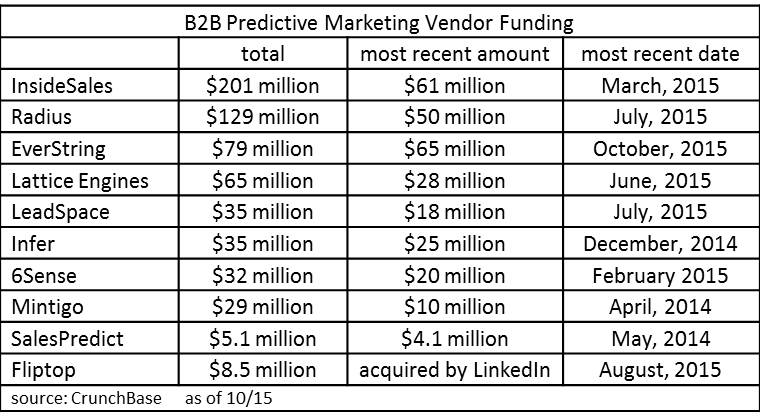
    It’s clear that 2015 has been the breakout year for predictive analytics in marketing, with at least $242 million in new funding, compared with $376 million in all prior years combined.


    But is it possible that predictive is already approaching commodity status? You might think so based on the emergence of open source machine learning like H20 and Google’s announcement today that is it releasing a open source version of its TensorFlow artificial intelligence engine.

    Maybe I shouldn't be surprised that predictive marketing vendors seem to have anticipated this.  They are, after all, experts at seeing the future. At least, recent announcements make clear that they’re all looking to move past simple model building.  I wrote last month about Everstring’s expansion to the world of intent data and account based marketing. The past week brought three more announcements about predictive vendors expanding beyond lead scoring.

    Radius kicked off the sequence on November 3 with its announcement of Performance, a dashboard that gives conversion reports on performance of Radius-sourced prospects. What’s significant here is less the reporting than that Radius is moving beyond analytics to give clients lists of potential customers. In particular, its finding new market segments that clients might enter – something different from simply scoring leads that clients present to it or even from finding individual prospects that look like current customers. This isn’t a new service for Radius but it’s one that only some of the other predictive modeling vendors provide.


    Radius also recently announced a very nice free offering, the CMO Insights Report.  Companies willing to share their Salesforce CRM data can get a report assessing the quality of their CRM records, listing the top five data elements that identify high-value prospects, and suggesting five market segments they might pursue. This is based on combining the CRM data with Radius’ own massive database of information about businesses. It takes zero effort on the marketer’s part and the answer comes back in 24 hours. Needless to say, it’s a great way for Radius to show off its highly automated model building and the extent of its data. I imagine that some companies will be reluctant to sign into Salesforce via the Radius Web site, but if you can get over that hurdle, it’s worth a look.

    Infer upped the ante on November 5 with its Prospect Management Platform. This also extends beyond lead scoring to provide access to Infer’s own data about businesses (which it had previously kept to itself) and do several types of artificial intelligence-based recommendations. Like Radius, Infer works by importing the client's CRM data and enhancing it with Infer's information.  The system also has connectors to import data from marketing automation and Google Analytics.  It then finds prospect segments with above-average sales results, segments that are receiving too much or too little attention from the sales team, and segments with significant changes in other key performance indicators.


    Like the Pirate Code, Infer's recommendations are more guidelines than actual rules: it’s up to users to review the findings and decide what, if anything, to do with them. Users who create segments can then have the system automatically track movement of individuals into and out of segments and define actions to take when this occurs. The actions can include sending an alert or creating a task in the CRM system, assigning the lead to a nurture campaign in marketing automation, or using an API to trigger another external action. Infer plans to also recommend the best offer for each group, although this is not in the last week’s release – which is available today to current clients and will be opened to non-customers in early 2016. That last option is an interesting extension in itself, meaning Infer could be used by marketers who have no interest in lead scoring.

    Mintigo’s news came today. It included some nice enhancements including a new user interface, account-based lead scores, and lists of high-potential net new accounts. But the really exciting bit was preannouncement of Predictive Campaigns, which is just entering private beta.  This is Mintigo’s attempt to build an automated campaign engine that picks the best treatment for each customer in each situation.

    I've written about this sort of thing many times, as recently as this July and as far back as 2013. Mintigo’s approach is to first instrument the client’s marketing efforts across all channels to track promotion response; then run automated a/b tests to see how each offer performs in different channels for different prospects; use the results to build automated, self-adjusting predictive response models; and then set up a process to automatically select the best offer, channel, and message timing for each customer, execute it, wait for response, and repeat the cycle. Execution happens by setting up separate marketing automation campaigns for the different offers.  These campaigns execute Mintigo’s instructions for the right channel and timing for each prospect, capture the response, and alert Mintigo to start again. The initial deployment is limited to Oracle Eloqua, which had the best APIs for the purpose, although Mintigo plans to add other marketing automation partners in the future.


    Conceptually, this is exactly the model I have proposed of “do the right thing, wait, and do the right thing again”. Mintigo’s actual implementation is considerably messier than that, but such is the price of working in the real world. There are still nuances to work out, such as optimizing for long-term value rather than immediate response, incorporating multi-step campaigns, finding efficient testing strategies, automating offer creation. And of course this is just a pre-beta announcement. But, it’s still exciting to see progress past the traditional limits of predefined campaign flows. And, like the other developments this week, it’s a move well beyond basic lead scoring.

    Thursday, November 05, 2015

    Teradata Plans to Sell Its $200 Million Marketing Application Business. Any Takers?

    Teradata today announced it plans to sell its Marketing Applications business.  I’ll drop the usual analyst pose of omniscience to admit I didn’t see this coming. It’s only three weeks since Teradata expanded its marketing suite by buying a new Data Management Platform – a move I felt made great sense. They also briefed me at that time on a slew of updates to their other marketing products, demonstrating continued forward movement. There was no clue of a pending sale, although I strongly suspect the people briefing me had no idea it was coming.

    According to financial statements within the Teradata announcement, Marketing Applications revenue was down about 9% this year, which is surprising in a generally strong martech market but in line with the rest of Teradata’s business. Teradata told me separately that their marketing cloud business grew 22% year-on-year this quarter, suggesting that the decline came in the older, on-premise products and/or related services. As you may know, Teradata’s marketing applications business was a mashup of Teradata's original, on-premise marketing product, based on the Ceres purchase made 15 years ago and now called Customer Interaction Manger (CIM); the Aprimo cloud-based systems acquired for $525 million in 2010; and several more recent cloud-based acquisitions, notably eCircle email. The Aprimo group was dominant in the years immediately following the acquisition but control shifted back to the older Teradata team more recently. One bit of evidence: the Aprimo brand was dropped in 2013. 

    Since the original version of this post was written, I've been told by unofficial but reliable sources that Teradata management has said it intends to keep the on-premise CIM business and sell everything else.  This makes sense to some degree, since CIM is one of very few enterprise-scale on-premise marketing automation systems.  IBM and SAS are really the only other major competitors here, although Oracle and SAP are also contenders. I don’t know how much of Teradata’s revenue comes from CIM or how many new licenses it has sold recently.  Based on the information presented above, the business may be shrinking.  But there’s definitely strong preference for on-premise marketing automation at many of the large enterprises who are Teradata's primary customers for its database and analytics products (which account for more than 90% of its revenue).  So keeping CIM may make sense just as a way to block competitors like IBM and SAS from using their own on-premise marketing automation systems to gain a foothold at Teradata accounts.  But it's really hard to imagine any new customers choosing CIM when Teradata has made clear it wants out of the marketing applications business.  Even current customers will have to wonder whether Teradata can be relied upon to keep CIM up to date.

    So what happens now? Well, Marketing Applications is a $200 million business.  Even if CIM generates $50 million of that, which I doubt,  the remaining pieces make Teradata a major player in B2C marketing automation. (Point of reference: Salesforce.com reported $505 million revenue for its B2C marketing cloud in 2015.)   This suggests that someone will purchase the Teradata systems and continue to sell them. 

    The question is who that buyer might be.  The big enterprise software companies already have their own systems, and CIM would probably the only piece any of them might want (if they wanted to add a stronger on-premise product).  It’s conceivable that a private equity firm will purchase the systems and run them more or less independently or combine them with other products – look at HGGC’s recent combination of StrongView and Selligent (in the mid-market) or Zeta Interactive’s purchase of eBay’s CRM systems. If CIM were part of the package, I'd argue that Marketo should buy it and gain true enterprise scale B2C technology while nearly doubling its revenue.  But without CIM, that doesn't make much sense.

    Iterable Offers Mid-Size B2C Marketers Powerful Campaigns in Outbound Channels

    As William Shakespeare never wrote, some systems are born with data, some achieve data, and some have data thrust upon them. What the Bard would have meant is that some systems are designed around a marketing database, some add a database later in their development, and some attach to external data. The difference matters because marketers are increasingly required to pick a collection of components that somehow work together to deliver integrated customer experiences. This means that marketers must first determine whether they're looking for a system to provide their primary marketing database (since you only need one of those), and then figure out which products fall into the right category.


    Whether you need a system with its own database ultimately depends on whether you have an adequate database in place. Obviously the key word in that sentence is "adequate".  How that's defined depends on the situation: key variables include the number and types of data you need available, how quickly new data must be processed, whether source data is already coded with a common customer ID, and how you want other systems to access the data.

    As I wrote last week, there are a handful of Customer Data Platforms (CDPs) that do nothing but build a database. Many more systems build a database as part of a larger package that also includes an operational function such as predictive modeling or campaign management. This offers an immediate benefit but it complicates the system choice since you have to judge both the database and the operational features. It’s also trickier in a more subtle way because some systems build a great database but don’t make it fully available to other products. That’s spelled s-i-l-o.

    These musings are prompted by my attempt to come to assess Iterable, a product I generally like but find as slippery as one of Shakespeare’s cross-dressing heroines. Iterable definitely builds its own database, using the JSON API and Elasticsearch data store to manage pretty much any kind of data you might throw at it. This can happen in real time (yay!) or via batch file imports. The system even provides its own Javascript tag to post directly from Web pages and emails. It organizes the information into customer profiles that can include both static attributes and events such as transactions.  That’s pretty much what you want in your marketing database. Elasticsearch lets the system scale very nicely, returning queries on 100 million+ profiles in seconds. Yay again!

    On the other hand, Iterable doesn’t let other systems query the data directly. Users can do analytics and build segments using Iterable’s own tools or export selected elements to other systems in a file.  They can also push data to other systems through integration with the Segment data hub.  So while Segment might be the core database supporting other marketing systems, Iterable will not.  Nor does Iterable do much in the way of identity association: new data must be coded with a customer ID to add it to a profile. This is a pretty common approach so it's not something to hold against Iterable in particular.  Just be aware that if you need to solve the association problem, you’ll have to look outside of Iterable for the answer.  Fortunately, there are plenty of other specialized systems to do this.

    Perhaps Iterable provides so many operational functions that there's no need for other systems to access its data?  The answer depends on exactly what functions you need.  Iterable provides a flexible segmentation tool that can build static lists and can update dynamic lists in real time as new data is posted. This can be combined with exceptionally powerful multi-step workflows, including rarely-seen features such as converging paths (two nodes can point to the same destination) and parallel streams (the same customer can follow two paths out of the same node). It also supports more common, but still important, functions including filters, splits, a/b tests, waiting periods, API calls to external systems, and sending email, SMS, and push messages. One notably missing feature is predictive modeling to drive personalized messages, but Iterable recently set up an integration with BoomTrain to do this. Iterable still doesn’t offer Web site personalization although it might be able to support that indirectly through BoomTrain, Web hooks, or Segment.

    Iterable includes content creation tools for its messaging channels – again, that's email, SMS, and push.  This means users must rely on third party software to create forms and landing pages.  Nearly all B2B marketing automation systems do have form and page builders, but Iterable is targeted primarily at mid-tier B2C marketers, who are less likely to expect them.  Iterable’s B2C focus is further clarified by its prebuilt integration with Magento for ecommerce and with Mixpanel and Google Analytics for mobile and Web analytics. The system also provides a preference center to capture customer permissions to receive messages in different channels – a feature that is essential in B2C, although certainly helpful in B2B as well.

    So where does this leave us? Iterable is more powerful than a basic email system but not quite as rich as full-blown marketing automation, let alone an integrated marketing suite or cloud. Page tags, JSON feeds, and Webhooks make it especially good at collecting information, although it will need help with identity association to make full use of this data.  It builds powerful outbound campaigns in email, SMS, and mobile apps.  Ultimately, this makes it a good choice for mid-size B2C marketers who want to orchestrate outbound messages  but are less concerned about Web pages or other inbound channels. Marketers could also use Iterable as the outbound component of a more comprehensive solution with Segment or something similar at the core.

    Iterable was founded in 2013 and first released its product about a year ago. It currently has more than 30 clients paying an average around $3,000 per month. List prices start much lower and some clients are much larger.