Showing posts with label dmp. Show all posts

Monday, March 09, 2020

Reflections on the CDP Revolution in France (and the Rest of Europe)

The CDP Institute just published a report on the CDP Industry in Europe (download here). This was based primarily on the global Industry Update released last month. This showed especially fast growth in Europe, with a year-on-year increase of 74% in the number of European vendors and 80% in European CDP employment, compared with growth outside of Europe of 38% in vendors and 59% in employment.

We spent quite a bit of time in Europe last year, so I certainly have my own ideas of the reasons behind these sharp increases. But it always seems best to get information from people who live in the region. So as part of the report we collected comments from several European CDP vendors and consultants on what they saw happening in their markets. Their complete comments are included in the report. They are largely consistent with each other, so I think it’s fair to give a summary. Here’s my interpretation:

• The European market is divided into several zones, each at a different stage of the development. The UK market is closest to the U.S. and most mature. Growth there began in 2017, paused as companies worked to meet the GDPR deadline of May 2018, and then resumed. The Netherlands and Germany are next in line, with growth taking off after mid-2018. Southern Europe, Eastern Europe and the Nordics the least mature, with limited deployment to date. Maturity can be measured by understanding of CDP, adoption levels, and the speed of sales cycles.

• Each market is served by native national vendors. These are often affiliated with marketing agencies or consultancies and usually provide a combination of data assembly and campaign management. Large U.S-based vendors have a substantial presence in the UK and Netherlands/Germany regions but little activity elsewhere. These vendors are primarily focused on data assembly. Some of the European vendors also sell throughout the UK/Netherlands/Germany markets. Few non-local vendors have much presence in Southern Europe, Eastern Europe, or the Nordic.

• France is a market of its own.  Most CDP sales in France are made by French vendors, who sell little outside of France.  U.S. and non-French European vendors do continue to try to penetrate the French market, so far with limited success.  Unlike other markets, the French vendors generally started as Data Management Platforms (DMPs) although they took a broad approach that included some CDP features from the start. They have now further evolved to towards CDP although their DMP roots still show.

• GDPR was an early impetus to CDP adoption but that momentum is now largely spent. Current interest in CDP is based on the core use cases of data unification and campaign management. In the more mature markets, where CDPs are better understood, this interest is most likely to result in buying a packaged CDP system. In the less mature markets, this interest is more likely to result in buying a solution from an agency or in building a solution in-house.

These observations largely parallel my own impressions of the region. One difference is that none of the commenters mentioned the several European CDPs that compete globally as specialists in travel, telecommunications, financial services, or retail. The reason may simply be that only one the vendors who contributed to the report is in this category.  Also, none mentioned the limited funding available to European CDP vendors, an extremely sharp contrast to heavily-funded U.S.-based firms.

There’s much more in the report, both in the vendors’ comments and in the industry data.  Again you can download it here.  Enjoy.

Monday, December 30, 2019

Explaining Martech to a Five Year Old

One piece of paper stands between me and ending the year with a clean desk: a list scribbled on hotel stationery that compares different customer data systems to different types of motor vehicles. Richard Scarry  meets CDP Institute, you might say.

So, just in case your New Year’s plan includes explaining marketing technology to a five year old, here we go:

  • Data Warehouse = School Bus. The seats in a bus are lined up in nice neat rows, designed to carry one type of cargo very efficiently. Similarly, a data warehouse is highly structured environment that is very efficient at dealing with specified data types. (See how this works?)

  • Data Lake = Moving Van. A moving van is a big box that can hold pretty much anything, although it might be jumbled together in no particular order. A data lake can store any type of data but doesn’t do much to organize it.
  • Integration Platform = Delivery Motorcycle. A motorcycle carries small items quickly from one place to another, but doesn’t have any place to store them. An integration platform moves bits of data between systems but doesn’t have its own storage, either.
  • Data Management Platform = Fire Truck. A fire truck is a highly specialized vehicle designed to move very quickly and pour out huge volumes of water. A DMP is a highly specialized system that quickly moves huge volumes of data.
  • CRM System = Taxi. A taxi carries one person and their baggage directly to a specific destination. A CRM system delivers one customer and their history to a single sales person or call center agent.
  • Cloud Platform = Car Carrier. A car carrier is a frame that can hold many unconnected vehicles. A Cloud Platform supports many unrelated systems in the same rack.
Believe it or not, my original list didn’t include an entry for Customer Data Platforms. So let’s give that a moment’s thought and go with…Ice Cream Truck!  They make a lot of noise and everybody loves them.  No, wait, better still...Food Truck!  A food truck collects ingredients from various sources, converts them into delicious meals, and distributes the results to many happy customers.  A CDP combines customer data into profiles that it shares with different systems.  

You’re welcome.

Happy New Year!

Sunday, March 04, 2018

State of Customer Data Platforms in Europe


The Customer Data Platform Institute will be launching its European branch later this month with a series of presentations in London, Amsterdam and Hamburg. We’ve seen considerable CDP activity in Europe – nearly one quarter of the CDPs in the Institute's latest industry update are Europe-based, several others with European roots have added a U.S. headquarters, and some of U.S.-based CDPs  have significant European business. A recent analysis of CDP Institute membership also found that one quarter of our individual members are in Europe. So what, exactly, is the state of CDP in Europe?

 It’s long been an article of faith on both sides of the Atlantic that the U.S. market is ahead of Europeans on marketing technology in general and customer data management in particular. That (plus the larger size of the U.S. market) is why so many European vendors have relocated to the U.S. This study from Econsultancy suggests the difference is overstated if it exists at all: 9% of European countries reported a highly integrated tech stack, barely under the 10% figure for North American companies. North American firms were actually more likely to report a fragmented approach (48% vs 42%), although that was only because European countries were more concentrated in the least advanced category (“little or no cloud based technology”) by 20% vs 13%.


 The assumption that cloud-based technology is synonymous with advanced martech is debatable but, then again, the survey was sponsored by Adobe.  What is clear is that European firms have generally lagged the U.S. in cloud adoption -- see, for example, this report from BARC Research.


Lower cloud use probably hasn’t directly impeded CDP deployment: although nearly all CDPs are cloud-based, a substantial number offer an on-premises option. (The ratio was seven out of 24 in the CDP Institute’s recent vendor comparison report, including nearly all of the Europe-based CDPs.) But the slower cloud adoption may be a hint of the generally slower pace of change among European IT departments, which could itself reduce deployment of CDPs.

A Salesforce survey of IT professionals supports this view. Answers to questions about leading digital transformation, being driven by customer expectations, and working closely with business units all found that U.S. IT workers are slightly but distinctly more business-oriented than their European counterparts. Interestingly, there’s a split within the European respondents: UK and Netherlands are more similar to the U.S. answers than France and Germany. I should also point out that I’ve highlighted questions where the U.S. and European answers were significantly different – there were quite a few other questions where the answers were pretty much the same.


Organizational silos outside of IT are another barrier to CDP adoption. A different Salesforce survey, this one of advertising managers, also found that North American firms are generally more integrated than their European counterparts. The critical result from a martech perspective is North American marketing and advertising departments were much more likely to collaborate on buying technology.


Then again, a Marketo survey found that European respondents (from a mix of IT, marketing, sales, and service departments) were generally more satisfied with their tools and performance, even though they lagged North Americas in slightly innovation and more clearly in strategic alignment with corporate objectives. This isn’t necessarily inconsistent with the previous results: being less integrated with other departments may free the Europeans to pursue their departmental goals more effectively, even if they’re less fully aligned with corporate objectives. Other surveys have given similar results: people are generally happier with technology when they buy it for themselves.


Not surprisingly, one area where the Europeans are clearly ahead in preparation for GDPR: a Spiceworks survey at the start of this year found that 56% of European companies had allocated funds for compliance compared with just 31% of U.S. companies. (Almost half the U.S. respondents believe GDPR wouldn’t affect them, even though GDPR applies globally.) While the result clearly relates to the fact that GDPR is a European Union regulation, it may also reflect a generally higher interest in privacy among European consumers: to take one example, ad blocking is much more common in Europe than the U.S. That’s good news for CDP vendors, since GDPR has emerged as one of the primary use cases.


On the other hand, a survey from Aspect found that U.S. consumers are generally more demanding than Europeans about customer service: they care more about having a choice of service channels, are more willing to pay extra for good service and are quicker to stop buying after a poor experience. This is probably bad news for European CDP vendors, since unified customer data is a foundation for modern customer service.


In sum, things really are a bit different in Europe. Integration, the primary CDP use case, is lagging compared to the U.S. So it makes sense that CDP adoption is also lagging.  But GDPR may be changing the equation and consumer attitudes are certainly adding external pressure.  The need for CDP is growing and we hope the CDP Institute’s European operations will make it a little easier for European companies find right solutions.


Tuesday, December 19, 2017

Surprising Results in Customer Data Platform Survey

The Customer Data Platform Institute (CDPI) recently surveyed its members about their customer-facing systems and CDP deployment plans.  (Click here to download the full report.)  While CDP Institute members are obviously not typical marketers (being smarter, richer, and better looking), the answers still provide some intriguing insights into the marketplace.

Let’s start with the general state of customer facing systems. One-third reported they had many disconnected systems, just over one-third reported (37%) they had many systems connected to a central platform of some sort (9% unified customer database, 9% unified database and orchestration system, or 19% marketing automation or CRM platform), 6% said one system does almost everything, and the remaining 23% said they had some other configuration or didn’t know.


I’ve compared these results below with several other surveys that asked similar questions.

The one thing that immediately jumps out in this comparison is the CDPI Member survey showed a much lower percentage of replies for “one primary system”. Otherwise, the answers across all surveys are very roughly similar, showing about 30% to 50% of companies having many connected systems and many disconnected systems. This suggests more integration than I’d expect, but it depends on how much integration those “many connected” systems really represent.

The CDPI Member survey also asked about plans regarding Customer Data Platforms. Nineteen percent had a CDP already deployed, 18% had deployment in progress, and 26% planned to start deployment within the next 12 months. The remaining 38% either planned to start after 12 months (4%), had no plans to deploy (19%) or didn’t know (14%). I haven’t seen any other survey that asks this question but have no doubt that CDP deployment and plans are much higher for CDPI members than the rest of the industry average.


Where things get really interesting is when we explore how the same people answered these two questions. At first blush, you’d assume the 19% with a deployed CDP would be the same 18% who said they had many systems connected to a unified customer platform, either by itself or with an orchestration engine attached. Not so much. Here’s the actual cross tab of the results.


What you see (in the yellow cells) is just 42% of the people who said they had a deployed CDP also said they had many systems connected to a unified database. If we allow that a deployed CDP could be present in companies where one customer-facing system does almost everything or the customer facing systems are connected to marketing automation or CRM, then 74% of the deployed CDPs are covered.

I take the remaining 26% as a healthy reminder that just having a CDP doesn’t guarantee all your systems will connect to that CDP, either by feeding data into it or reading data from it. In fact, we know that many CDPs support analytics without being connected to delivery systems, so this really shouldn’t come as a surprise.

On a more encouraging note, as the green cells highlight, a good majority of in-process and planned CDP deployments are at companies with many disconnected systems or many systems connected to a marketing automation or CRM.  Those are the companies most in need of data unification. So it does appear that the CDP message is reaching its target audience and CDPs are being used as intended.

The survey also asked about company revenue, business type (B2B vs B2C), and region. Comparing those with current systems and CDP deployment also gave some interesting and unexpected results. But there's no point in repeating them here since you can download the full report and see for yourself.  Enjoy!

Thursday, September 28, 2017

Customer Data Platforms Spread Their Wings

I escaped from my cave this week to present at two conferences: the first-ever “Customer Data Platform Summit” hosted by AgilOne in Los Angeles, preceding Shop.org, and the Technology for Marketing conference in London, where BlueVenn sponsored me. I listened as much as could along the way to find what’s new with the vendors and their clients. There were some interesting developments.
  • Broader awareness of CDP. The AgilOne event was invitation-only while the London presentation was open to any conference attendee, although BlueVenn did personally invite companies it wanted to attend. Both sets of listeners were already aware of CDPs, which isn’t something I’d expect to have seen a year or two ago. Both also had a reasonable notion of what a CDP does. But they still seemed to need help distinguishing CDPs from other types of systems, so we still have plenty more work to do in educating the market.

  • Use of CDPs beyond marketing. People in both cities described CDPs being bought and used throughout client organizations, sometimes after marketing was the original purchaser and sometimes as a corporate project from the start. That was always a potential but it’s delightful to hear about it actually happening. The widely a CDP is used in a company, the more value the buyer gets – and the more benefit to the company’s customers. So hooray for that.

  • CDPs in vertical markets. The AgilOne audience were all retailers, not surprisingly given AgilOne’s focus and the relation of the event to Shop.org. But I heard in London about CDPs in financial services, publishing, telecommunications, and several other industries where CDP hasn’t previously been used much. More evidence of the broader awareness and the widespread need for the solution that CDP provides.

  • CDP for attribution. While in London I also stopped by the office of Fospha, another CDP vendor which has just become a Sponsor of the CDP Institute. They are unusual in having a focus on multi-touch attribution, something we’ve seen in a couple other CDPs but definitely less common than campaign management or personalization. That caught my attention because I just finished an analysis of artificial intelligence in journey orchestration, in which one major conclusion was that multi-touch attribution will be a key enabling technology. That needs a blog post of its own to explain, but the basic reason is AI needs attribution (specifically, estimating the incremental value of each marketing action) as a goal to optimize against when it's comparing investments in different marketing tasks  (content, media, segmentation, product, etc.)

If there's a common thread here, it's that CDPs are spreading beyond their initial buyers and applications.  I’ll be presenting next week at yet another CDP-focused event, this one sponsored by BlueConic in advance of the Boston Martech Conference. Who knows what new things we'll see there?

Thursday, March 23, 2017

Wondering How Customer Data Platforms Relate to Other Marketing Systems? Here's a Picture


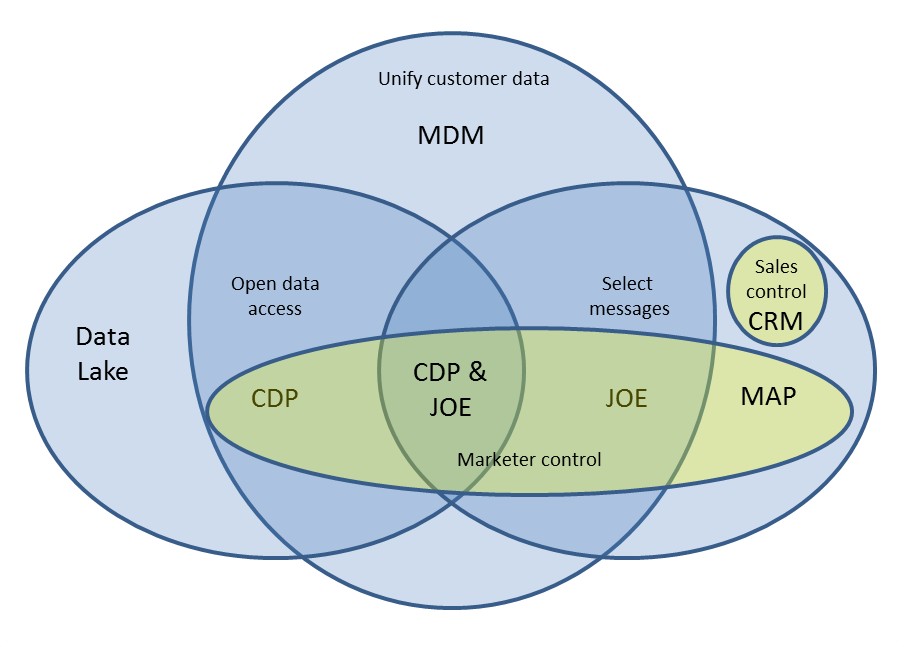
I was asked the other day about the distinction between Customer Data Platforms and Journey Orchestration Engines. My immediate answer was “Some CDPs are JOEs and some JOEs are CDPs. A CDP is a JOE if has journey orchestration. A JOE is a CDP if its data is accessible to other systems. Think Venn diagram with two intersecting circles.”  It's not clear the answer helped, but it did get me thinking about clarifying with a Venn diagram.  The diagram I originally had in mind was this one, showing that CDPs unify customer data and make it available, while JOEs unify customer data and select messages. Systems that do all three are both a CDP and a JOE.


On reflection, that’s not the right way to draw a Venn diagram. Each circle should represent one set of traits. So the picture should really look like this:


That's fine, but it seems odd that “unify customer data” has no system associated with it. Is there a type of system that just unifies customer data without making it accessible or selecting messages? Come to think of it, there is.  Systems that just do customer matching used to be called Customer Data Integration but I don’t hear that much any more.  Sometimes people talk about Identity Resolution but mostly it seems that Customer Data Integration has been absorbed by the larger category of Master Data Management (MDM) systems, which integrate all kinds of data. So let’s add MDM as the label for that.    
But why stop there?  Let's see how other systems would fit into the diagram. First to come to mind was marketing automation platforms (MAPs), which also select messages (like a JOE) but don’t build a unified customer database or offer open data access. The diagram with MAPs included looks like this:
The next is a Data Lake. It provides open data access like a CDP, but doesn’t build a unified view of the data.  Adding that to the diagram gives us:


Hmm, what about CRM? In many ways its out there with MAP: another system that selects messages but doesn’t build a unified database. So we need to introduce a new split, of marketer-controlled vs. sales controlled. I'll give control a different color for clarity.  Apologies to CRM people that your circle is so tiny; I'm not suggesting anything about the importance of your systems.

Still thinking about control, Data Management Platforms (DMPs) look a lot like Marketing Automation Platforms: they’re marketer-controlled systems that select messages (sort of) but don’t unify data from all sources or provide open access. So unless we want to further subdivide the marketer controlled space, they share the same location as MAPs.
Since control has its own color, Data Lake and MDM jump out as not having an owner. In fact, they’re both typically owned by corporate IT, so we can easily add that circle.
This raises one more question: is there an IT-controlled equivalent of a CDP?  That would be a system that unifies customer data and provides open access but is owned by IT not marketing.  You betcha.  It might be an Enterprise Data Warehouse (EDW) if that has all the access features of a CDP (high speed, flexibility, etc.). But most EDWs don’t meet that standard. So let’s just call it an Enterprise-controlled CDP, or ECDP, if you’re wild and crazy enough to accept a four letter acronym. You’ll remember there’s some debate about whether marketing or IT should really own the CDP.  This doesn't provide an answer but it does give a clearer picture of the question.
I've summarized this information in a table below.  Still confused?  We just posted a answers to Frequently Asked CDP Questions on the CDP Institute blog.  Maybe that will help.  


Friday, October 23, 2015

Teradata Adds a Data Management Platform To Its Marketing Cloud...Who Will Be Next?

Teradata on Tuesday announced it is adding a data management platform (DMP) to its marketing cloud through the acquisition of Netherlands-based FLXone.  This is interesting on several levels, including:

- It makes Teradata the third of the big marketing cloud vendors to add a DMP, joining Oracle DMP (BlueKai) and Adobe Audience Manager. I already expected the other cloud vendors to do this eventually; now I expect that will happen even sooner. I’m looking at you, Salesforce.com.

- Unlike Oracle and Adobe, Teradata has stated (in a briefing about the announcement) that it intends to use the DMP as the primary data store for all components of its suite. I see this as a huge difference from the other vendors, who maintain separate databases for each of their suite components and integrate them largely by swapping audience files with a few data elements on specified customers. (In fact, Adobe just last week briefed analysts on a new batch integration that pushes Campaign data into Audience Manager to build display advertising lookalike audiences. The process takes 24 hours.)

Of course, we’ll see what Teradata actually delivers in this regard.  It's also important to recognize that performance needs will almost surely require intermediate layers between the DMP's primary data store and the actual execution systems. This means the distinction between a single database and multiple databases isn’t as clear as I may be seeming to suggest. But I still think it’s an important difference in mindset.  In case it isn’t obvious, I think real integration does ultimately require running all systems on the same primary database.

- It is still more evidence of the merger between ad tech and martech. I know I wrote last week that this is old news, but there’s still plenty of work to be done to make it a reality. One consequence of "madtech" is complete solutions are even larger than before, making them even harder for non-giant firms to produce. That’s the primary lesson I took away from last week’s news that StrongView had been merged into Selligent: although StrongView’s vision of omni-channel “contextual marketing” made tons of sense, they didn’t have the resources to make it happen. (See J-P De Clerck's excellent piece for in-depth analysis of the StrongView/Selligent deal.)  I’m not sure the combined Selligent/StrongView is big enough either, or that Sellingent owner HGGC will make the other investments needed to fill all the gaps.

To be clear: I'm not saying small martech/adtech/madtech firms can't do well.  I think they can plug into a larger architecture that sits on top of a customer data platform and perhaps a shared decision platform. But I very much doubt that a mid-size software firm can build or buy a complete solution of its own.  If you're wondering just who I have in mind...well, Mom always told me that if I couldn’t say something nice, I shouldn’t say anything at all.  So I won’t name names.


Thursday, September 19, 2013

New Study: Three Types of Customer Data Platform Address Cross-Channel Marketing Needs

My detailed study of Customer Data Platforms should be released next week. Now that the information is assembled, I can at last pull back and get a good overview of what I’ve found.

Perhaps the most interesting discovery has been that the CDP vendors cluster into three main groups.

• B2B data enhancement. These build a large reference database of companies and employees, which they match against records imported from their clients. They generally return corrected and enhanced data and lead scores based on models built from the client’s customer files. Their reference databases are built from multiple public, commercial, and proprietary sources, and are assembled using sophisticated matching engines. Most also perform their own scans of Web sites and social networks to extract sales-relevant information such as technology use and changes that suggest buying opportunities. These vendors vary considerably in the data they return, ranging from lead scores only to recommended marketing treatments to full customer profiles. Some also provide prospect lists of companies that are not already in the client’s own database. CDP vendors in this group include Infer, Lattice Engines, Mintigo, and ReachForce.

These systems compete with non-CDP products which also add or enhance prospect records but do not maintain a database with their clients’ customers. These include Web scanning systems such as InsideView, LeadSpace, and SalesLoft, and general data compilers including NetProspex, Demandbase, Data.com, ZoomInfo, and OneSource. The predictive modeling features also compete to some degree with end-user-oriented marketing analytics and modeling software such as Birst, GoodData, Cloud9 Analytics, AutoBox, and Predixion Software. Data cleansing competitors include services from firms such as D&B, as well as data management software for technical users such as Informatica, Experian QAS, and FullContact.

• Campaigns. These systems build a multi-source marketing database from the client’s own data and either recommend marketing treatments to execution systems or execute marketing campaigns directly. These are primarily used for consumer marketing although they also have B2B clients. Most have sophisticated matching capabilities. This group includes Silverpop with its Universal Behavior feature, NICE’s Causata, AgilOne, and RedPoint.

This group competes with conventional consumer marketing automation products, which provide similar campaign management abilities but lack the CDPs' database flexibility, database management, and customer matching features.

• Audience management. These systems build a database of customers and their responses to online display advertisements. They then build models that predict the customers’ probability of responding to future advertisements and provide recommendations for how much to bid and which content to display. These systems perform the same basic functions as standard online audience management systems (Data Management Platforms, or DMPs) and provide the same very quick responses needed for real time bidding (usually under 100 milliseconds). The major difference is that they also recommend messages in other channels, such as Web site personalization or email campaigns. Like DMPs, they work primarily at the Web cookie level, can link cookies known to relate to the same customer, and can be linked to actual customer names and addresses in external systems. This group includes IgnitionOne, [x+1], and Knotice.

This group overlaps with recommendation and ad targeting engines and DMP systems. Those products provide similar functions but do not track identified individuals and are often limited to single channel executions.

Given that each group addresses a different business need, you might wonder why I think they should all be lumped together under the CDP label. Quite simply, it’s because they are all addressing a portion of the same larger problem, which is how marketers can get a complete view of their customers and use that view to coordinate treatments across channels. What marketers truly need is a combination of the features from each group: data enhancement from external sources, for consumers as well as B2B; sophisticated customer matching and treatment selection; and integration of online advertising audiences with traditional customer databases. Each of these systems has the potential to grow into a complete solution, and the normal dynamics of software industry growth will push them towards pursuing that potential. So I expect the categories to overlap increasingly over the next few years and eventually merge into complete Customer Data Platforms as I envision them.

Incidentally and tangentially related: I'll be giving a Webinar with ReachForce on October 2 on Data Quality for Hipsters, a name that started as a joke but does make the point that data quality is essential for cutting-edge marketing.  YOLO, so you might as well attend.  I'm already working on the mustache.