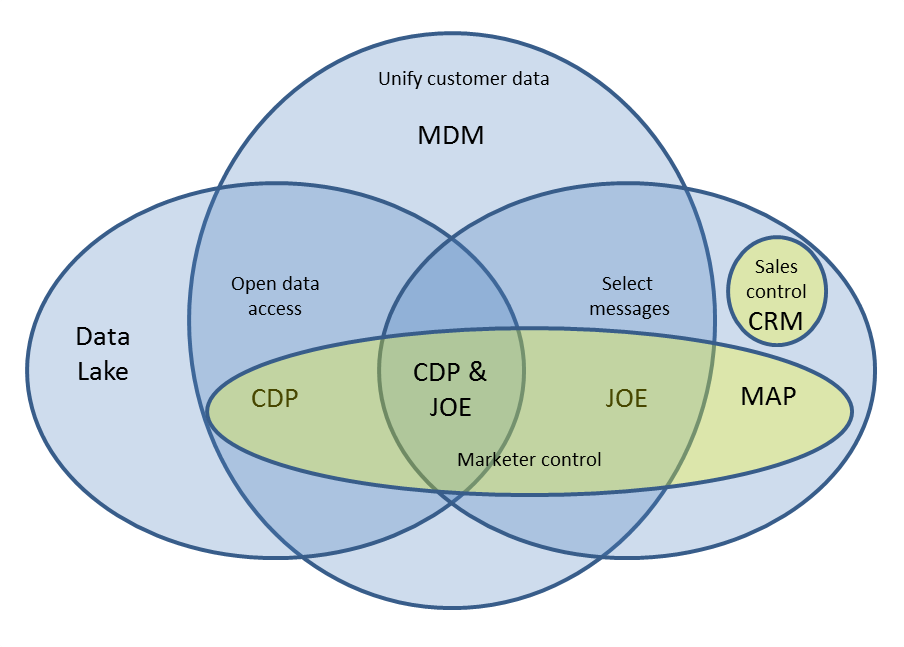
Master Data Management can be loosely defined as maintaining and distributing consistent information about core business entities such as people, products, and locations. (Start here
if you’d like to explore more formal definitions.) Since customers are one of the most important core entities, it clearly overlaps with CDP.
Specifically, MDM and CDP both require identity resolution (linking all identifiers that apply to a particular individual), which enables CDPs to bring together customer data into a comprehensive unified profile. In fact some CDPs rely on MDM products to perform this function.
MDM and (some) CDP systems also create a “golden record” containing the business’s best guess at customer attributes such as name and address. That’s the “master” part of MDM. It often requires choosing between conflicting information captured by different systems or by the same system at different times. CDP and MDM both share that golden record with other systems to ensure consistency.
So how do CDP and MDM differ? The obvious answer is that CDP manages a lot more than just master data: it captures all the details of transactions and behaviors that are not themselves customer attributes. But many MDM products are components of larger data integration suites from IBM, SAP, Oracle, SAS, Informatica, Talend and others. These also manage more than the identifying attributes of core data objects. You could argue that this is a bit of a bait-and-switch: the CDP-like features in these suites are not part of their MDM products. But it does mean that the vendors may be able to meet CDP data requirements, even if you need more than their MDM module to do it.
Another likely differentiator is that MDM systems run on SQL databases and work with structured data. This is the best way to manage standardized entity attributes. By contrast, CDPs work with structured, semi-structured and unstructured data which requires a NoSQL file system like Hadoop. But, again, the larger integration suites often support semi-structured and unstructured data and NoSQL databases. So the boundary remains blurry.
On the practical level, MDMs are primarily tools that IT departments buy to improve data quality and consistency. Business user interfaces are typically limited to specialized data governance and workflow functions. CDPs are designed to be managed by business users although deploying them does take some technical work. Marketing departments are the main CDP buyers and users while MDM is clearly owned by IT.
One CDP vendor recently told me the main distinction they saw was that MDM takes a very rigid approach to identity data, creating a master ID that all connected systems are required to use as the primary customer ID. He contrasted this with the CDP approach that lets each application work with its own IDs and only unifies the data within the CDP itself. He also argued that some CDPs (including his, of course) let users apply different matching rules for different purposes, applying more stringent matches in some cases and looser matches in others. I’m not sure that all MDM systems are really this rigid. But it’s something to explore if you’re assessing how an MDM might work in your environment.
Going back to practical differences, most CDPs have standard connectors for common marketing data sources, analysis tools, and execution systems. Those connectors are tuned to ingest complete data streams, not the handful of entity attributes needed for master data management. There are certainly exceptions to this among CDPs: indeed, CDPs that focus on analytics and personalization are frequently used in combination with other CDPs that specialize in data collection. MDM vendors are less marketing-centric than CDPs so you’ll find fewer marketing-specific connectors and data models. Similarly, most MDMs are not designed to store, expose, reformat, or deliver complete data sets. But, again, MDMs are often part of larger integration suites that do offer these capabilities.
So, where does this leave a weary explorer of the CDP jungle? On one hand, MDM in itself is very different from CDP: it provides identity resolution and shares standard (“golden”) customer attributes, but doesn’t ingest, store or expose full details for all data types. On the other hand, many MDM products are part of larger suites that do have these capabilities.
The real differentiator is focus: CDPs are built exclusively for customer data, are packaged software built for business users (mostly marketers), and have standard connectors for customer-related systems. MDM is a general-purpose tool designed as a component in systems built and run by IT departments.
Those differences won’t necessarily show up on paper, where both types of systems will check the boxes on most capabilities lists. But they’ll be clear enough as you work through the details of use cases and deployment plans.
As any good explorer will tell you, there’s no substitute for seeing the ground on foot.