Tuesday, September 29, 2015

How Many Ads Do You See Each Day? Fewer Than It Seems (I Think)

My cliché detector starts chirping as soon as anyone says today’s marketers face more competition than ever before. Sepia-toned glasses notwithstanding, marketers have had competitors at least since the railroads (or maybe canals) made it practical for customers to shop outside the local village – and for even longer if you lived in a city. So competition has been tough for as long as anyone now living can remember.

I thought I’d found a legitimate exception when writing a recent paper for QuickPivot (available here) about the continued value of direct mail marketing. My core argument was that direct mail is needed to cut through the clutter created by the increase in advertising messages. Surely it’s self-evident that people get more advertising today than ever before, right?

Well, I certainly thought so when I wrote the paper. But I recently searched for some validation of the claim about more clutter.  Turns out that shockingly little research has been published on the question of how many ads people actually receive. The most authoritative-looking study I found was from Media Dynamics in 2014, which found almost no change since 1945 in ads people were exposed to, despite a near-doubling in the time spent with media (defined as TV, radio, Internet, newspapers and magazines).


Really? Just 362 ads per day? That certainly seemed low to me, even after recognizing that the study reports on paid advertising, as opposed to the brand logos you see on everything from football stadiums to a biker’s tattoo. The 362 is nowhere near the widely cited figure of 5,000 per day, although the origins of that are mysterious at best.

I looked further but couldn’t find any better data. Now I was really frustrated and pondered what it would take to make a crude estimate of my own as a simple sanity check. This ultimately led to the bright idea of using total ad spending and cost per thousand impressions to calculate total ad impressions per year. Once you have that number, it can easily be converted to ad impressions per person per day. What I like about this method is avoids any need to estimate how many ads an individual sees per minute of media time or how many ads are theoretically available to be viewed. On the other hand, it assumes that advertisers get exactly the impressions they pay for, neither more nor less.  This is certainly not true in an absolute sense, but I'm willing to trust that the correlation between actual and purchased impressions is close enough to give an answer that's approximately correct.

The table below shows my results. Figures for advertising are easy: eMarketer publishes them all the time.  CPMs are harder to find.  I ended up using figures from sources including INFOACRS (which itself quotes eMarketer, although from 2008) and MonetizePros. There’s a bit of body English in there as well.  I do think the results are either reasonable or low – another widely quoted authority, Augustine Fou, shows generally higher CPM figures than the ones I used, which would result in estimating even fewer impressions from the same spending.


Bottom line, my numbers show 264 impressions per person per day.  That's a little lower than Media Dynamics, but in the same ballpark. Interesting.

I will admit that I’m inordinately pleased with this methodology, which I suspect is roughly correct despite many flaws in the details. One virtue is it sheds some light on the original question of whether people are seeing more ads: since we know that total media spending is rising slightly and the mix is shifting towards the low-CPM digital channel, the number of impressions is almost certainly on the rise. You'd have to adjust any trend calculations for changes in population and in channel CPMs to know for sure. 

On the other hand, the shifts are fairly gradual so it's probably wrong to claim that we're facing a sudden flood of increased advertising.  I don't have the necessary data readily available to do more detailed calculations, but if anyone out there does have the data and the time to do the math, I’d love to see your results.

(And if you're wondering: there will be about 80 billion pieces of advertising mail delivered this year, which comes to about 0.7 per person per day.)


Thursday, September 10, 2015

Data Plus MarTech: HubSpot and Demandbase Join the Race

There were two industry announcements this week that were unexpectedly related. The first was HubSpot’s announcement yesterday that its CRM offerings would now include access to a 19 million account prospecting database. The second was Demandbase’s acquisition of data-as-a-service vendor WhoToo, which offers its own set of 250 million profiles relating to 70 million business professionals.

The WhoToo acquisition marks a big step in the continued evolution of Demandbase, since it's a change from targeting companies to targeting individuals (although DemandBase still won’t sell you their names). More precisely, WhoToo aggregates audience data from multiple sources and makes it available for selections based on company and individual attributes. The company does know the identity of some individuals and will use these to target email and Web advertising to names you provide. It will also let you market to audiences in those channels without providing their names. This is a nice extension of Demandbase’s existing account-based marketing capabilities. What makes WhoToo really special is it has the technology to access its data with the split-second speed needed to purchase display and mobile ads in real time.

The addition of individual-level targeting puts Demandbase on a more even plane with LinkedIn, which of course already sells advertising to its own huge database of more than 350 million profiles. The WhoToo deal won’t fully close that gap, but it does help to keep Demandbase competitive. (I’m sure Demandbase would argue it has its own advantages over LinkedIn.)

In this context, the HubSpot announcement is interesting mostly because it too recognizes the importance of giving marketers audience lists without acquiring the names for themselves. You could argue this makes HubSpot a player in the super-hot Account Based Marketing category, although they didn't use the term.  If they are, it's ABM-lite, in the sense that HubSpot will give CRM users basic profile information, usually including a phone number, but doesn't offer contact names or email addresses. It also pulls recent news stories.  This is pretty consistent with HubSpot's historic aversion to unsolicited outbound contacts.  The company does approach the line by giving enterprise users an option to find other people in their company who have a contact at target accounts and ask for a warm introduction.


On the other hand, HubSpot also announced integration with LinkedIn for paid ad campaigns and said a Google AdWords integration is in beta, which are definitely in outbound territory. Naturally, HubSpot says its LinkedIn and Google campaigns will be giving potential buyers information they want, so they are not at all like that bad old interruptive advertising that HubSpot has always opposed. No, not one bit.

Anyway, the point here is that both HubSpot and Demandbase are adding data to their marketing technology, something we’ve seen in other deals like Oracle buying Datalogix. There are still plenty of stand-alone data vendors, especially when it comes to B2B prospecting lists. And there are plenty of vendors who combine prospect data with predictive – including LinkedIn itself since its recent FlipTop acquisition. But I think we can add “data plus tech” to the tote board of martech horse races.

Thursday, August 27, 2015

LinkedIn Buys Fliptop: Why Account Based Marketing and Predictive Analytics Are a Natural Fit

Predictive analytics vendor Fliptop today announced its acquisition by B2B social network LinkedIn.  It's an interesting piece of news but I'm personally disappointed at the timing because I have been planning all week to write a post about the relationship between predictive analytics and account-based marketing (ABM).  I would have looked so much more prescient had they announced the acquisition after I had published this post!

The original inspiration for the planned post was a set of three back-to-back conversations I had last Friday with one ABM vendor and two predictive analytics companies (none of which were Fliptop or LinkedIn).  The juxtaposition highlighted just how much predictive and ABM complement each other.  In fact, the relationship is so obvious that it almost seems unnecessary to lay it out: predictive vendors help marketers find accounts to target; ABM helps marketers reach target accounts.  You can safely assume that both sets of vendors have noticed the relationship and that many are working to combine the two techniques.  The Fliptop/LinkedIn deal is just more evidence of the connection.

To move past the very obvious, ABM vendors – whose basic business is selling ads targeted to specific companies – could also use predictive analytics to refine their ad targeting.  This could mean selecting the best people to reach within targeted accounts or selecting the most effective ad placements to reach those accounts.  This requires integration of predictive analytics within the ABM product, not just using predictive before ABM begins.  I expect LinkedIn will use Fliptop's capabilities in these ways among others.

But, getting back to last week's conversations, what really struck me was a less obvious connection of ABM and predictive to content.  Two of the vendors described using their systems to select which content to send to specific accounts or individuals.  These selections are based on previous behavior, something that certainly makes sense.  But I don't generally recall hearing ABM or predictive vendors discussing as one of their applications.  It's an important idea because it promises to improve results by delivering more relevant content for the same price.  The same data gives marketers insights into broader trends in the types of content that buyers find interesting.

Content analysis requires the ABM or predictive system to be aware of the topics of the content being consumed.  This is only possible if someone specifically goes to the trouble of tagging the content and capturing the tags.  So content analysis is not quite a natural byproduct of the ABM or predictive analytics: it takes some intentional effort.  A corollary is that not all ABM and predictive systems can deliver this benefit.  So it's something to specifically ask prospective vendors about if you think you'll want it.

To put things in a still broader perspective, targeting content with ABM and predictive systems is part of a broader trend of using advanced technology to help marketers create, manage, and optimize content.  This is something that vendors like Captora, Persado, and Olapic do in terms of content creation, and Jivox, OneSpot, Triblio, and BloomReach do in terms of personalized content creation.  I've been looking at a lot of those systems recently although I haven't written much about them here.  New targeting technologies create unprecedented demands for more content, which only new content technologies can meet.  So you can expect to hear more about technology-based content creation, whether I write about it or not.

Friday, August 21, 2015

Landscape of MarTech Vendor Directories

I'm making a presentation on marketing technology selection at B2BLeadsCon in New York next week, and had thought to start with the usual Oh-My-God-There-Are-So-Many-Vendors slide to get everybody's attention.  This would ordinarily be Scott Brinker's popular Chief MarTech Landscape but I've recently seen so many variations on the theme that I put together a composite slide instead.  This includes Scott's slide plus versions from Luma Partners, Gartner, MarTech Advisor, Terminus/FlipMyFunnel, and Growthverse.


I considered labeling this a "landscape of landscapes" but quickly realized that (a) it's not all that witty and (b) six vendors isn't enough.  But on further reflection, I recognized that these landscapes are really a type of directory that helps marketers find available products.  This led me to consider other types of online directories, of which there are many.  So I did end up producing a landscape that still isn't as crowded as Scott's but does show the number of information sources available.


As you see, this contains four sets of products: the original six landscapes, divided between the static images and the two interactive options (both very cool).  In addition, there are two directories with analyst ratings, from Gleanster and TopAlternatives.  But the biggest category is the community review sites, of which the best known among marketers are probably G2 Crowd, TrustRadius, and Software Advice.  Because the purpose here is to list tools that help marketers find systems to purchase, I didn't extend the landscape to business directories like Crunchbase, VentureBeat's VB Profiles and Owler.

I did look at every vendor shown in the graphic and can affirm that each includes at least some marketing systems.  There are some interesting differences in approach but, like any good landscape creator, I'll simply give you a set of logos and let you research from there. Again following the tradition of landscape publishers, I make no claims about the completeness of my list or the quality of any of the companies listed.  But I will make your life a bit easier by listing all the links below.  Enjoy!

AlternativeTo
AppAppeal
BestVendor
Chief MarTech
Cloudswave
Credii
DiscoverCloud
GetApp
G2 Crowd
Gartner
Gleanster
Growthverse
Luma Partners 
MarTech Advisor
Osalt
IT Central Station
Serchen
Social Compare
Software Advice
Software Insider (formerly FindTheBest)
Terminus
TopAlternatives
TrustRadius

Sunday, August 16, 2015

New Paper -- Which Social Media Marketing Methods Are Best For You?

I’ve long been intrigued by the notion that complex business decisions can be reduced to relatively simple rules of thumb.   Perhaps I shouldn’t admit this, at least when it comes to decisions I might be paid to make as a consultant. But I think I may safely say that simple rules can often provide a default decision that still needs confirmation by an expert. This gives people a clearer picture of the factors that go into making a choice without anyone getting hurt.

The good people at CommuniGator, a UK-based marketing automation system, were kind enough to sponsor a paper along those lines.  It's a do-it-yourself guide to picking social media marketing methods. You can download the actual paper here.  In this post, I’ll just outline the general approach – something I think can be applied to other situations as well.

The approach is built around three factors: the marketing methods available; the marketer's goals; and the marketer’s "situation", an umbrella term that includes resources, technology, and industry. It’s balancing  goals against the situation that's tricky: if resources were not a problem, you’d just use whatever methods fit your goals, and if goals didn’t matter, you’d just pick whatever methods fit your situation. No doubt plenty of companies have made exactly these errors. One virtue of a systematic approach is that it forces marketers to consider both dimensions.

For the social media marketing paper, we defined eight goals: attract attention, build brand reputation, generate qualified traffic, generate qualified leads, nurture relationships with leads, retain and grow existing customers, provide customer support, and gather market intelligence. You’ll notice these map nicely to the usual customer lifecycle stages.

We considered seven social media methods: monitoring social behavior, generating publicity, pushing content, making content sharable, promoting content on social bookmarking sites like StumbleUpon and Reddit, working with influencers, and managing reviews on sites like Yelp! and TrustRadius.

Finally, we have the situation. Resources include ability to generate large volumes of content, ability to generate high quality content, existing social media traffic, available support staff, and budget. Technology includes available execution tools and measurement tools. Industry considers whether customers are highly engaged in the products, how easily they can find product information, and whether the product is a locally-created service such as a restaurant or home repairs.

The actual mechanics of relating these factors are something you’ll best understand by downloading the paper. Suffice it to say that we assigned points to show which goals were more or less suited to each method, which let us identified the most appropriate methods for the marketer's goals.  We then used another set of points to find which resources, technologies, and industry characteristics are most important for each method’s success. This let us judge which of the previously selected methods were most likely to be executed successfully.  And that's what we wanted to know.

I felt the results were pretty reasonable, but then I’m biased. Please take a look and let me know what you think.


Saturday, August 08, 2015

Intent Data Basics: Where It Comes From, What It's Good For, What To Test


Intent data is a marketer’s dream come true: rather than advertising to mass audiences in the hope of getting a handful of active buyers to identify themselves, just buy a list of those buyers and talk to them directly. It lops a whole layer off the top of the funnel and finally lets you discard the wasted half of your advertising.

But intent data is a complicated topic. It comes from different places, has different degrees of accuracy and coverage, and can be used in many different ways. Here’s a little primer on the topic.

What is intent data? It’s data that tells you an addressable individual is interested in your product. Ideally, that individual will be identifiable, meaning you have an email address, postal address, device ID, mobile app registration, phone number, or other piece of information that tells you who they are and lets you communicate with them directly. But sometimes you may only have an anonymous cookie or segment identifier that lets you reach them through only one channel and not by name.

Where does it come from? Lots of places. Behavior your company captures by itself is first-party intent data.  This is probably the most reliable but only applies to people you already know. Behavior captured by others is third-party intent data.  It's the most interesting because it provides new names or new information about names already in your database. Search queries are an obvious indicator of intent, but search engine vendors don’t sell lists based on query terms because they’d rather sell you ads based on those terms. So most third-party intent data is based on visits to Web pages whose content attracts prospective buyers of specific products. A smaller portion comes from other behaviors such as downloads, email clicks, or social media posts.

How is it sold? There are two primary formats. The first is ads served to people who have shown intent; this is generally called retargeting. The people are identified by cookies or device IDs and can be shown ads on any Web site that is part of the retargeter’s network. The original action could happen on your own Web site – the classic example is an abandoned shopping cart – or on some other site. Intent-based ads on social networks work roughly the same way, although the users are known individuals because they had to sign in. Retargeting is arguably a form of advertising and therefore not intent “data” at all. But I’m including it here because so many retargeting vendors describe their products in terms of intent. The second format is lists of email addresses. These are clearly data.  The addresses are usually gathered through user registration with the Web site.  Alternatively, the email can be derived from the cookie or device through matching services like Acxiom LiveRamp.

How reliable is it? Good question. Hopefully everyone reading knows that data isn’t perfect. But intent data is especially dicey because it comes from many different sources, some of which may be stronger indicators of intent than others. Users generally can’t see the original source. In addition, the data is aggregated by assigning the original Web content to standardized categories.  These may not precisely match your own products, or they may be grouped together so that some highly relevant intent is mixed with a lot of less relevant intent.  These problems are especially acute for B2B marketers, whose products may have a very narrow focus.  There’s also an issue of freshness: intent can change rapidly, either because someone already made their purchase or because their interests have shifted. So behavior that isn’t gathered and processed quickly may be obsolete by the time it reaches the marketer.

How complete is it? It’s worth distinguishing completeness from reliability because completeness is a big problem on its own. Intent vendors won’t necessarily capture every person in market for a particular product. In fact, depending on the situation, they may capture just a small fraction. Some people may not visit any site in the aggregator’s network; some may not visit often enough to register the required level of interest; some may decline to provide their identity or delete their cookies. In some businesses, reaching only a small fraction of interested buyers is still very useful; in others – especially where there are relatively few buyers to begin with – the marketer may be forced to run her own outreach programs to capture as many as possible.  In that case, the intent vendor's list would probably not include enough additional new names to be worth buying. 

How do you use it? More ways than you might think. It’s tempting just treat intent-based lists as sales leads.  But often the quality isn't high enough for that.  So the intent lists are often considered prospects to be touched through email, targeted advertising, and other low-cost media. Similarly, retargeting ads can be used to make hard sales offers or to more gently present brand messages and name-capturing content. Other applications include using presence on an intent list as a data point in a lead score, reaching out to dormant leads or current customers who suddenly register on intent lists, and tailoring messages based on the which topics the intent vendor finds an individual is consuming.

How do you test it? On the simplest level, you just apply the intent data to whatever type of program you’re testing (sales qualification, prospecting, lead scoring, reactivation, personalization, etc.) and read the results. Where things get a little tricky is figuring out which of the names would have registered as leads through some other channel, since they should be excluded from the analysis.  Similarly, you need to carefully test how new programs like lead scoring, reactivation, or topic selection programs would have performed without the intent data – it may be the good idea was the program itself. As a general rule of thumb, expect your own data to gain power as you build a longer history, so intent data is most likely to prove valuable on names early in the buying process.

Who sells it? Consumer marketers have a wide variety of intent sources, including Nielsen eXelate, Oracle Datalogix, and Neustar for lists and AdRoll, Retargeter, Fetchback, Chango and Magnetic for retargeting. B2B marketers can work with Bombora, The Big Willow, TechTarget, IDG, and Demandbase.


Friday, July 31, 2015

VEST Report: Competition in B2B Marketing Automation Isn't About Features

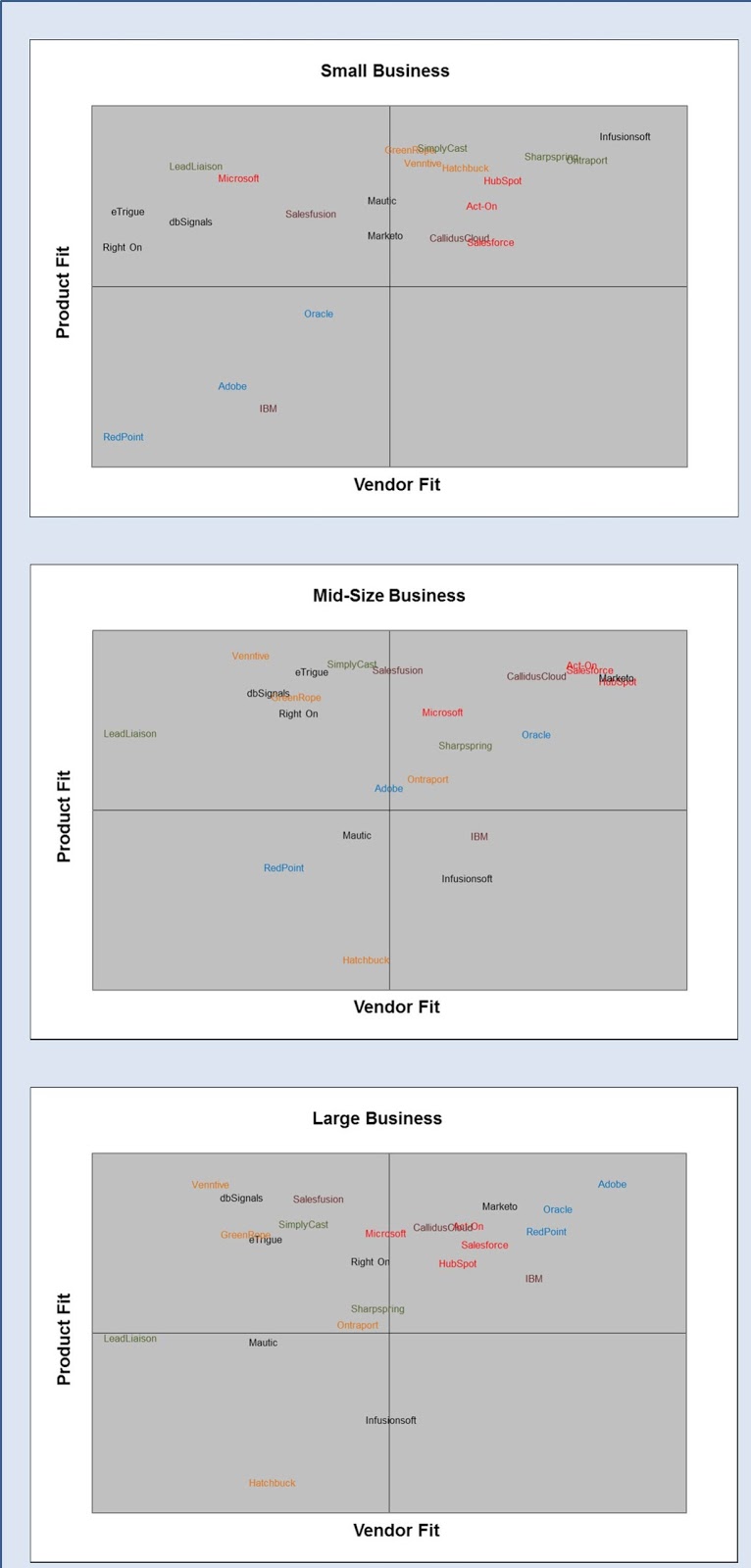
Yesterday I released the mid-year edition of the VEST Report on B2B marketing automation vendors, thereby meeting my self-imposed deadline of July 31. Look here for more information or to make a purchase.

Updating the report gives a nice overview of recent industry developments. Here are some observations:

- market positions are pretty stable. The only new vendor to make a splash recently has been SharpSpring, which went from zero to 500 agency clients in the past year. This puts them among the top 3 leaders in the small business sector. Otherwise, the top players have remained the same: Infusionsoft, HubSpot, Act-On, Salesforce Pardot, Marketo, Oracle Eloqua, and Adobe. Maybe RedPoint has crept up to a leader position, but they don’t share enough business information for me to know. Open source vendor Mautic has some interesting potential but it’s too soon to see any actual impact.

- products are pretty stable, too. The VEST entries showed very little change in the features reported by the various vendors since the last report. This isn't bad: it's simply that the standard features are now widely understood and vendors have had time to add them. The only major changes captured in the new report are the custom table abilities added by Marketo and Ontraport.

- the real action is outside the products. Probably the most interesting trend is integration of marketing automation with retargeting and display ad vendors, which has been announced in various forms by Marketo, Oracle, and Adobe. That, of course, relates to the convergence of martech and ad tech into “madtech” that I've written about before. The other big trends are systems for marketing agencies (either focused products like SharpSpring or added features and partner programs by the major vendors) and education programs for users (something that major vendors have long done but that others like Autopilot* and Mautic are also expanding). Both agencies and education are ways to support industry growth by overcoming the lack of marketers who can effectively use marketing automation systems.

- the really real action is elsewhere. Lest you think I’m just plain cranky, be assured that I see lots of exciting things happening in predictive analytics, data aggregation and enrichment, automated intelligence, and other areas. Even B2C marketing automation is showing some interesting new life. But even though B2B marketing automation revenues are still growing nicely**, the industry itself is looking pretty stable these days.


__________________________________________________________________________
*Not in the VEST by their choice.
** I'm estimating 40% in 2015, although it’s now harder to know because so much revenue is hidden inside companies like Oracle, Salesforce, and IBM that don’t report it separately.

Thursday, July 23, 2015

Design Your Best Marketing Technology Stack and Plan the Transition: Sneak Peek at FlipMyFunnel Conference

Picture posted by Terminus

I can’t decide which is more exciting about next month’s FlipMyFunnel conference in Atlanta (register here and use the code DR50 for a 50% discount): the opportunity to interact with a great collection of speakers and attendees or seeing what the conference organizers at Terminus do with the notion of MarTech Stack Jenga. Based on one cryptic Twitter picture, they’re up to something big.

My own contribution will be a presentation on designing your marketing stack. This is something I’ve done for years as a consultant but it’s now an especially hot topic. Here are some of the key points I’ll be making:

- the stack is based on your business and marketing strategies. I’ve described the importance of strategy before but have now refined my explanation to show how marketing programs, business requirements, and functional requirements connect over-all marketing strategy with martech. The picture below also highlights the importance of planning for future business, marketing, and martech developments.


And I’ve provided a sample template for organizing your requirements by system.

- a winning stack is efficient as well as functional. I'll present a checklist for evaluating your stack design along those dimensions.

- how you draw the stack makes a difference. I’ll argue that a diagram which shows relationships between systems is more helpful than one that simply lists the different components. In the example below, the flow highlights the isolation of sales and service from the rest of the stack – a critical weakness that isn’t apparent when you look at the systems only.


- transition planning must be systematic as well. Companies struggle with transition planning even more than they struggle with stack design.  The goal is to sequence the stack changes so that each new system adds the greatest value with the least disruption. This requires understanding which system changes support each improvement.  This lets you figure out which improvements would be supported by changing any one system, what would then be possible after changing a second system, what is possible after changing a third system, and so on.  The worksheet lets you explore different sequences so you can pick the best one.

This will be easier to understand in person than in writing. Don't take my word for it: join us in Atlanta and see for yourself.

Friday, July 17, 2015

Predictive Analytics: Should Automated Content Selection Work by Segment or Individual?

Two vendors made the same point with me this week, which is reason enough for a blog post in mid-July. The point was the difference between basing content selection on individuals and on segments. I have never considered the distinction to be especially important, since segment membership is determined by individual behaviors and individual-level decisions are guided by behavior patterns of groups. But the two vendors in question (Evergage and Jetlore) and another I spoke with earlier (Sailthru) were downright religious about the superiority of their approach (individual-level selections in every case). So I thought it worth some discussion.

First, let’s clarify the topic. The distinction these vendors were making is between selecting content separately for each individual and selecting the same content for all members of a segment. Of course, customers are assigned to segments based on their individual behavior and other attributes, but once someone is in a segment, the segment-based system ignores individual differences. Among segment-based systems, collaborative filtering uses product selections almost exclusively: this is the classic “customers who looked at this product also considered these products” approach, which doesn’t take into account other aspects of the customer’s history. Other methods build segments based on customer life stage, demographics, and similar broad attributes. It’s possible to build segments based on very detailed behavioral differences, but that’s likely to create too many segments to be practical.

At an operational level, the individual-level systems use automated analytics to rank all possible content choices for each individual using that individual’s data. Segment-based systems either use rules to select content for each segment or use automated analytics to rank content choices for the segment as a whole. The individual-level approach makes the most sense when there are many content choices to consider, as with retail merchandise or entertainment (books, music, movies, etc.). Those are cases where getting precisely the right content in front of the customer is much more effective than offering everyone the most commonly-selected items. Retail and entertainment marketers also usually have detailed history which supports accurate predictions of what the customer will want. Segment-based systems work best when only a few choices are available.  This means a separate segment can be created for each item or, more realistically, segments come first and items are created to serve them.

So does the entire debate really come down to using individual-level systems when there are lots of choices and segment-based systems when there are only a few? Not really: collaborative filtering can also handle massive numbers of options with great accuracy. The difference is that collaborative filtering doesn’t really consider much beyond a particular product choice, while a sophisticated individual-level system will consider other factors including the current context and the customer’s history. Done correctly, this should yield more appropriate selections. On the other hand, individual-level approaches require more data and more complex analytics, so there will be cases where a segment-based method is ultimately more appropriate.

Moreover, the two approaches are as much complementary as competitive. A segment can indicate customer state, such as just-acquired, satisfied, or churn-risk, which constrains the contents considered for offer by the individual-level system.* Or a segment-level system could chose the type of message to send but let the individual-level system pick the specific contents. Dynamic content within email campaigns often works exactly this way.

In fact, I’d argue that state-based segmentation is essential for individual-level optimization because states provide a framework to organize the masses of detailed customer data. Without tagging the customer’s current state during each event, it would be very difficult for even the most sophisticated analytical system to see the larger arc of the customer life cycle or to understand the relationship between specific offers and long-term outcomes.

All this has practical implications for marketers considering these systems.

- for individual-level systems, make sure they can look beyond predicting the highest immediate response rate to measuring impact on long-term objectives such as conversion or lifetime value.

- for segment-level systems, make sure they can take into account the customer’s past behaviors and attributes, not just the products they have recently purchased or considered

- for all types of systems, assess how they track and guide the customer through the stages of her long-term journey

You'll want to consider other differences between content selection systems, such as number of items they can manage, how quickly they return selections, how they incorporate items without a sales history, and what data they consider in their analysis. Just remember that making selections isn’t an end in itself: you want to make choices that will create the greatest long-term value. To do that, it’s not a choice between individual and segment level analysis. You need both.

____________________________________________________________________________
* See my June 25 post for a more detailed discussion of state-based campaigns.

Tuesday, July 07, 2015

Does Future Marketing Technology Require Perfect Data?


I mentioned in my last post that I’ve started to think in terms of three realities: today (the next two years), tomorrow (two to five years out), and later (after five years). Like the famous New Yorker magazine cover that showed a detailed knowledge of Manhattan and increasingly vague view of more distant regions, our picture of the immediate future is much more nuanced than what happens farther out. One result is an apparent assumption that future technology will work much better than today’s technology – not because anyone really thinks that future technology will be perfect, but because we can’t see where its imperfections will appear.

I’ve been thinking about this because so my own predictions are premised on increasingly detailed knowledge about customers and prospects. Both the “madtech” vision of broad access to third-party data and the “robotech” vision of delegating decisions to machines assume that effectively complete data will be available about each customer. But a quick look at today’s data shows that is far from true. Here are some factoids I’ve been gathering to illustrate the point:


- 37% of mobile ad locations are accurate to within 100 meters (Thinknear)

- 30-55% match rates for B2C individual-level onboarding (LiveRamp)

- 16-29% match rates for B2B individual-level data enrichment: (Raab Associates client tests)

- 14% match rates and low predictive value for B2B account-level intent data: (Infer)

And this doesn’t even begin to address predictive modeling, where even a 10x lift vs average still implies many errors at the individual level.

Contemplating these results does give me pause. At some point, poor data means that theoretically possible approaches are not practical because of low coverage or insufficient performance. Those constraints won’t magically vanish in the future, even though they’re not visible at this distance.

Being a technology optimist, I assume that data will get better over time. But I can’t cite much evidence to support my optimism.  If anything, the number of new data sources is outstripping improvements in existing sources. The true core challenge is identity resolution, which means associating data from different sources with the right individual profile. Cross-device matching is the current focus of this discussion but covers just part of the problem.

It’s a safe bet that perfect data won’t be available in two years or five years or probably ever. But the real question is whether enough good data will be available to support the futures I’ve been forecasting.

I think a realistic view is that some data will be more available than other data, and, as a result, some portions of the visions will happen while others do not. Customer data is likely to be richer than prospect data, since customers will grant permission to link with external data sources (or take actions that make linking easier even without their permission). Sharing among complementary companies – for example, airlines and hotels – will be easier to negotiate than sharing with anyone through public exchanges. Data about objects, such as cars or groceries or homes, should be less sensitive than data about individuals (even though there’s obviously a close relationship between objects and their owners). Data about public behaviors, such as travel and store visits, is less sensitive than data about private matters such as health care.  (See this recent Altimeter Group report for more information on consumer attitudes to privacy.)

In short, the future will remain unevenly distributed, as William Gibson observed. Marketers and the technologists who support them need both the ideal vision of how things would work in a world of perfect data (which isn’t the same as a perfect world!) and the realistic understanding of what’s likely to be practical within their planning horizon. They can then aggressively pursue opportunities revealed by the vision without chasing chimeras that will never appear. This pursuit is essential: tomorrow always comes, but the future won’t happen by itself.


Wednesday, July 01, 2015

Marketing Beyond MadTech: What Happens When The Robots Take Over?

I’ve recently found myself bouncing between three worlds:

- today’s world, where I spend my time reviewing software and helping marketers choose martech products. Since most of that discussion is currently phrased in terms of building a marketing stack, let’s call it the world of “stacktech”.

- tomorrow’s world, about two to five years in the future.  This is dominated by the merger between martech and adtech, a.k.a. “madtech”. The trends shaping this world are well known and many people agree on the broad outlines of what it will look like. I spend my time filling in the details since details will determine which tools and skills marketers need for success.

- the future world, out five years and beyond.* There’s much less agreement on how this will look and it’s arguably too far away for most marketers to worry about. But I do have a vision which I think may be useful to vendors and managers making long term plans. Since the dominant feature of this world will be an expanded role for machines, I’ll call it “robotech”.

Each of these worlds is very different from the others. Today’s marketing stack is still largely about tools to manage direct interactions between customers and the company. It works with the company’s own data and primarily through company-owned media like email and Web sites. Customer activities with anyone other than the company are largely invisible to the company.

By contrast, advertising and social messages in the "madtech" world are tightly integrated with company-owned channels and all customer behaviors are visible (for a price). The technical symbol of this transition is the change I wrote about last week from linear, company-driven campaign flows to customer-triggered experience plays.

The "robotech" world brings yet another radical shift.  In this future, humans have delegated increasing numbers of day-to-day decisions to their machines. My recent speeches have illustrated this with a vignette about a person in headed home in her self-driving car: she works quietly in her virtual office while her devices debate whether to stop for fuel, buy her coffee, avoid donuts, and get milk for breakfast. Only once the machines have reached a consensus do they inform her of the decision.

The example is trivial but the implications are profound. When machines buy on behalf of their owners, then marketers will sell to the machines. Since the machines will decide on the basis of algorithms, marketing becomes a matter of understanding and appealing to those algorithms. We already do this today in specialized areas like search engine optimization (“selling” to Google for a higher ranking) and programmatic media buying (providing more data about impressions so they earn higher bids). This sort of marketing is fundamentally different from both stacktech and madtech. My rough calculations show that nearly half of all consumer expenditures could eventually shift to machine control.

Humans still play an important role in the robotech world. It’s not just that they’re paying the bills for purchases by autonomous agents – a relationship familiar to any parent of a teenager. It’s also that humans are choosing the agents themselves. This is essentially a subscription: people will pay for a service that manages individual purchases. Since the details of each agent’s algorithm will be too hard to evaluate directly, the subscriptions will ultimately be purchased on the basis of trust.  This is a classic goal for traditioinal brand marketing but quite a change from the madtech focus on optimizing shorter-term metrics such as response or immediate revenue.

I don’t think the rebirth of brand marketing will mean a return to the simple-minded glories of the Mad Men era – we’ll still have all that data and all those channels to work with. But it might just possibly mean a less frantic urge to respond to every twist in the customer journey, replaced by broader, more stable messages aimed at building brand trust and a long-term relationship. In a world where customers increasingly filter out marketing messages and rely on machines to manage many steps in their customer journey, marketing approaches that deliver a few general messages may ultimately be the best use marketers can make of the limited customer attention they have available.

In sum, the transition madtech to robotech will be just as wrenching as the transition from stacktech to madtech.  Marketers should recognize that both are coming, even if it's too soon to prepare for the robotech world.  The time for that will come very quickly and it's always good to have at least thought about it in advance.

_____________________________________________________________________
* Serious planners think much further out, in terms of decades. But I don’t think anything usefully concrete can be predicted that far in advance.

Sunday, June 28, 2015

MarTech Stack Jenga: Official Rules

I spent some time in Atlanta last week, including a Friday afternoon visit with Sangram Vajre at Terminus to discuss his upcoming FlipMyFunnel conference. I’ll be keynoting the part of the conference devoted to technology stacks. Our conversation naturally turned to MarTech Jenga, my recent random thought of using the popular stacking game to illustrate how marketers assemble their technologies. Lacking adult supervision, Sangram and I spent too much time on the actual game design and came up with a seemingly workable idea. We're still debating the details – Sangram favors simplicity and my style is more complex* – but here are the official rules for MarTech Jenga** at the moment. Public comment is welcome:

Object of the game: assemble the most complete marketing stack before everything collapses.

Equipment: standard set of Jenga blocks, divided into nine groups of six. Groups are numbered 1-9 and (optionally) assigned a color and type of marketing system. Blocks are marked on each end with their group number and color. Individual blocks can also be marked with the logo of a specific vendor*** although this has no effect on the game play. Numbers 1-4 are marked with an asterisk to indicate that those groups are required for a complete stack.****

Setup: blocks are stacked three-across in alternating directions, as in standard Jenga. 

Game play: each player in turn may remove one block from the stack or pass. Players retain all blocks they remove in their own stack, whose contents must remain visible to other players. Play continues until the stack falls or all players have passed in sequence.

Scoring: the player who causes the stack to collapse loses. If at least one player has acquired all the required blocks, then players who have not acquired all the required blocks lose (if this rule is adopted). Remaining players are given one point for each group that is present in their stack. There are no points for additional blocks within the same group. Player with the most points wins.

Sangram promises me that he’ll have some version of the game available at FlipMyFunnel, but I’m not holding him to it. On the other hand, this seems the perfect thing to have at a vendor booth. The opportunities for customization are self-evident, as are things like a leaderboard for high scores through the conference.  I'll leave the drinking game versions up to the Internet.


____________________________________________________________________________
*No surprise there: he's a practitioner and I'm a consultant.

**The name Jenga is actually trademarked so we’ll have to pick something else if this ever gets beyond the blogging stage.

***a sponsorship opportunity.

**** Whether to have required blocks is a particular point of debate. It originally reflected the reality that certain types of systems are essential in a marketing stack. But from a game design point of view, it adds strategy considerations such as picking the required blocks sooner and blocking other opponents from completing their stack. That makes the game considerably more interesting.  The question is whether that takes too much thinking for a casual game. The only real way to resolve this is through play testing, where we could fiddle with a number of variables such as number of groups in total, number of required groups if any, and whether to play topless (i.e., allowing players to remove blocks from the top of the stack).

Thursday, June 25, 2015

Campaign Management Is Dead. Here's What Next-Generation Marketing Automation Looks Like.

Scientists tell us that the attention span of the average human is now shorter than the attention span of a goldfish.(1)  In such a world, the chances of anyone reading this 2,000 word blog post are pretty much nil. But I think the topic is extraordinarily important, so here is a summary in sushi-sized bites:

- the conventional flow-chart model of marketing campaigns can’t capture the complexity of today’s  disjointed customer journeys.

- a new approach is emerging that identifies stages in the customer journey and picks “plays” (small, highly targeted sets of treatments) to execute in specific situations within each stage

- this approach is easier for marketers to manage because it lets them think in smaller, more comprehensible units

- it will eventually lend itself to greater automation as machines take over more of the marketer's job in a “madtech” world

You can stop here if you need to watch an important cat video.  But if you want to understand my thinking in more detail, please read on.

The first modern campaign manager, Third Wave Network’s MIND, was released in 1991. What made it modern was a standard relational database(2) and multi-step campaigns that that sent users down different paths depending on their actions during the campaign. The system displayed each campaign as a set of boxes connected with lines to represent movement of customers from one step to the next. This flow chart interface has been fundamentally unchanged ever since and remains the gold standard of marketing automation(3).

The significance of the flow chart is what it replaced. The previous standard was a list of segments, each described on one row of a (paper) spreadsheet, with characteristics including selection criteria, description, key code, promotion materials, and quantity. Marketers filled out these sheets and handed them to programmers to execute. This was how direct mail marketers worked for decades, and often still do: it’s an efficient way to manage dozens or hundreds of cells within a large outbound campaign. It supports multiple contacts, such as mailing a second catalog to high-performing segments several weeks after the initial drop. But the list for the second mailing is pulled at the same time as the first, so it doesn’t allow changes in treatment based on subsequent customer behavior. This adjustment is what branching flow charts provide.

A quarter century after its introduction, the flow chart is now ripe for replacement. Flow charts assume that customers will follow a small number of predefined paths. This was realistic when interactions were limited to a few company-controlled touchpoints.  But it doesn’t describe today’s self-directed, random-walk journeys through an ever-shifting media landscape. In this environment, the best a company can do is react intelligently wherever a customer appears, taking into account both the current situation and whatever it knows about the customer’s past. Even company-initiated messages, while not wholly reactive, must be consistent with other treatments.


The basic features of a better approach have been obvious for years. I’ve long described it as “do the right thing, wait, and do the right thing again.” What’s changed is visibility: marketers now can see vastly more data about their customers and can interact with them through vastly more channels. In the “madtech” vision I’ve been articulating recently, this translates to assuming that all data about each customer’s demographics, interests, behaviors, locations, intentions, and other attributes is available to everyone. This includes both data a company gathers through direct interactions and data aggregated by third parties and offered for sale. Indeed, third party data is essential for building a complete picture of each customer’s experience.(4)

The vision similarly assumes that messages can be delivered through channels the company does not own directly. These extend beyond conventional advertising to private channels that other companies have opened to external messages. A concrete example would be third party offers delivered through a company’s Web site. My shorthand for this is “everything is biddable”: meaning that marketers can pay to embed a message within every interaction the customer has with anyone. Since all marketers have the same opportunity to bid on all impressions, a corollary is that buying the right messages at the right price is the key to success – or, in another catchphrase, “the smartest bidder wins”.

Sadly, neither you nor I can make a living by repeating clever phrases. Someone has to do the hard work of figuring out what treatments to deliver in each situation. A flow chart can’t come close because the situations are far too varied for any one chart to capture all the alternatives. What’s needed is a system that will assess each situation as it arises and come up with a custom-tailored solution.

If the only goal were maximizing immediate response, this would be pretty simple. Existing recommendation engines and predictive models can easily tell you which content a person is most likely to pick or which product they are most likely to buy. Today's products often do this with limited information about the individual being targeted, but that’s just a reflection of what data is currently available: at least some current systems could incorporate individual details and history without a major revision. There are practical details of speed, scope, and accuracy but the broad design of such a system is straightforward.  It connects with every touchpoint (including exchanges that deliver external opportunities up for bidding), receives information about each interaction, and returns an optimal message along with the value to bid for the right to deliver it.

But immediate response isn’t the only goal. Each interaction is embedded in the context of a customer’s relationship with the company. The best message is the one that maximizes the long-term value of that relationship. This won’t necessarily be the message with the highest response rate or greatest immediate financial value. Automated systems can incorporate long-term value in their recommendations but only if they are tracking long-term outcomes and analyzing what changes them. I believe – and this is the main point of this entire post – that automated analysis can only optimize for long-term outcomes if customer data is classified by stages in the customer journey. In other words, you can’t just randomly test all possible treatments in all situations and let the best approaches bubble to the top. There are simply too many variables for that to work. Rather, marketers must assign customers to journey stages and use those stages as inputs when selecting treatments and evaluating results. The stages themselves can be adjusted over time in the light of experience. But without a journey map as a starting point, marketers and their machines will flounder endlessly in a sea of big data.

Maybe you're unimpressed.  Maybe that cat video beckons.  Maybe you're thinking, "All you've done is change the labels.  A map of journey stages looks a lot like a campaign flow, and for that matter an old-style campaign funnel."  I understand your doubts. But there are significant differences:

- journey stages are not associated with specific messages, while campaign steps are.  In fact, the whole purpose of campaign steps is to define which messages are delivered when. So a journey stage is a significantly higher level of abstraction. Put another way, journey stages are just one factor in deciding how to treat a customer, while campaign steps are the only factor.

- journey stages are inherently random, while campaign flows and funnel stages are relentlessly linear. The goal of a campaign or funnel is push customers from one stage to the next as quickly as possible. Journey stages do track a funnel-type motion but they’re more intended to capture a set of customer needs and interests. In conformance with the general notion that customers will control their own movement, journey stages are more descriptive than directional. It’s no problem for a journey map if customers move back to an earlier stage or if they stay in one stage indefinitely.  For stages such as “satisfied customer”, that’s actually a good thing.

I do recognize that “journey stage” implies motion, which means it's probably not the best term for what I have in mind.  A more neutral term like "state" would be better.  But I’ll stick with journey for now because it will intuitively make more sense to most people.

So let’s assume, at least for sake of argument, that you’re convinced marketing systems should consider  journey stage when they’re picking the best message for a specific customer in a specific situation. Does that mean campaign flows can be replaced by any recommendation engine that adds journey stage to its list of customer attributes?

I think not. The system needs an intermediate level between broad journey stages such as “interested prospect”, “active buyer”, “satisfied customer”, and “advocate”, and actual treatments during single interactions. That level is needed because marketers have to create the content that the machines will choose from during those treatments. Marketers will decide what content to create by envisioning experiences that span multiple interactions and then creating content for a complete experience. The best analogy I’ve found is “plays” in a sport like football: tightly choreographed sets of actions that serve a narrow purpose. Teams prepare plays in advance and pick the right play for the moment but they don’t try to set the sequence of plays before the game begins. They know that games, like customers, follow their own unpredictable course and all the team can do is react appropriately in each situation. It’s true that each play is directed towards a long-term goal, but execution of the play is really a self-contained project. What’s critical is that the marketing play can incorporate multiple interactions over time; this allows a more coherent, richer customer experience than treating each interaction as wholly independent.

Good marketers and sales people already think this way, although they usually describe it in terms of tactics to handle different types of buyers, personas, or situations. I’ve also recently heard several innovative marketing system vendors describe approaches that I believe are fundamentally similar to this concept, again in different terminology. I’ll tentatively adopt the term “plays” precisely because it’s vendor-neutral and because I think most people are familiar enough with sports plays for the analogy to be helpful.

To clarify, then, I believe that marketers of the future will think in terms of broad customer journey stages (i.e., states), such as “active buyer” or “satisfied customer”. Each stage has strategic objectives, which might be to move an active buyer closer to purchase or to strengthen the relationship with a satisfied customer. Marketers will pursue those objectives through “plays” that are appropriate in specific situations, such as “active buyer requests a demonstration” or “satisfied customer has a service problem” and take into account other context such as location, device, and recent behaviors. They will create content and process flows to execute those plays.  These plays will resemble current multi-step campaigns but on a smaller scale and with narrower goals. This limited scale is exactly what makes plays so useful, because marketers can easily visualize each play as a whole. This lets them construct coherent sets of messages, rules and metrics to execute each play from start to finish, measure its impact, and make changes to optimize its effectiveness. Today’s massive nurture campaigns are too large and complicated to do the same.

Marketing systems of the future will also be designed to support this model. It may even happen that systems designed on this model come first and marketers adopt the model as they come to appreciate the systems. Or, because the stage/play model is especially well suited to automated campaign design and the general “madtech” world, perhaps it will be embedded in automated systems and grow as such systems are adopted.

Whatever the mechanism, the traditional campaign flow model has reached the end of its useful life.  I believe the stage/play model will be its successor.

______________________________________________________________________________

(1) The study actually measured the attention span of average Canadians.  It didn’t specify the nationality of the goldfish.

(2) The preceding generation of campaign managers, called MCIF systems, used proprietary columnar databases to wring adequate performance from the PC hardware available at the time. The first of these, MPI Max$ell, was introduced in 1984; other major products included OKRA Marketing (1986), Customer Insight (1987), and Harte-Hanks P/CIS (1988). Interestingly, the height of sophistication among these products was a feature called “matrix marketing”, which identified the best offer to make each customer after each (monthly) update. Sound familiar?

(3) click here for my 1994 review of MIND and a couple significant contemporaries. If you add a reference to digital media, I could be describing any of today’s cutting-edge marketing automation products:

“At the core is a very powerful campaign management function that allows a marketer to define sequences of marketing events–each including a mix of direct mail, telephone contacts and personal sales efforts–to be followed in different circumstances, and then to automatically execute these sequences.

“The system uses an efficient graphical interface to lay out the alternate sequences that can be followed within each campaign, the tasks associated with each step in each sequence, and even the specific promotional materials used with each task. As a result, the marketer gains extremely precise control over the marketing approach used with each customer–including the ability to switch the customer to a different sequence depending on actions during the campaign.”

(4) I'm perfectly aware that reality will be messier than the vision implies.  Coverage will be incomplete, people won’t always be recognized across devices, and some predictions will be wrong. But perfection isn’t necessary for success: systems using this data only have to be more effective on average than systems that don’t.


Monday, June 22, 2015

Tealium Grows from Tag Manager to Customer Data Platform

It took me an embarrassingly long time to recognize why Tealium’s AudienceStream is just a bit odd. The oddity itself I saw immediately: while most marketing systems focus on sending messages to customers, AudienceStream is organized around overwriting data and sending it to other systems. The reason took longer to grasp: eventually I recalled that Tealium started as a tag management system and passing updated attributes to other systems is what tag managers do. So it’s perfectly natural for AudienceStream to offer precise control over which attributes are sent to which systems in which situations.

To some degree, the difference is just a matter of presentation. The data that Tealium sends to other systems can trigger customer messages from those systems.  So Tealium does support customer messaging.  But AudienceStream's heritage does give useful insights into what might otherwise seem a random set of strengths and weaknesses.

Let’s step back a bit. Like other tag management vendors, Tealium recognized several years ago that its core competency at capturing customer behavior could be applied to build unified customer profiles. This meant it could serve as a Customer Data Platform to support many other marketing applications. In fact, Tealium explicitly calls its product a CDP, using the tagline “build your own marketing cloud” to stress that it can connect systems from any vendor, not just components within a single vendor’s suite. That is indeed the essence of the CDP value proposition.


That doesn’t mean the Tealium is merely offering a relabeled tag manager. The company’s own diagram illustrates this clearly: the tag manager, Tealium iQ TMS (circled in red) is just one component of its CDP.  Here are key points to understand:

- scope is beyond Web channels. Conventional tags go on Web pages.  Tealium now offers connectors to gather data in other ways including APIs, batch file transfers, and system development kits (SDKs) for mobile apps.

- speed is real-time when possible. This is one benefit of the company’s tag management legacy, where real-time execution is required. It’s an important differentiator compared with other Customer Data Platforms, which often don’t support true real-time interactions.

- data storage is extensive. As the Tealium diagram implicitly indicates, a pure tag manager doesn’t need to permanently store much data. But Tealium incorporates several layers of persistent data, including semi-structured raw data in AudienceStore and EventStore (using Amazon Redshift), structured data in EventDB and AudienceDB, and an access layer in the AudienceStream iDMP (Data Management Platform).

- the system tracks individuals. The “i” in “iDMP” stands for individual, which pretty much says it all. Traditional DMPs are based on cookies, which are theoretically anonymous although they can often traced to specific individuals in practice. Tealium’s iDMP stores both cookies and personal identifiers such email addresses. It builds profiles by linking people to devices they have used for identity-revealing tasks such as opening an email or logging into an account. Devices used by the same person are then linked to each other. The system does not apply “probabilistic” or “fuzzy” matching to infer linkages using other data, such as simultaneous activities, shared locations, or similar names.  Users who want such links can import them from external services such as LiveRamp.  Tealium does link its cookies with major ad networks through other DMPs, although it won’t pass on individual identifiers.

- sophisticated rules support enhancement, segmentation, and triggers. This is another outgrowth of tag management, which sends different information to different partners. Derived attributes can be calculated with complex formulas including current data, time periods, ratios, rolling averages, random splits, and other functions. Similarly complex rules can assign people to audiences or segments and can set up triggers that change data values and send messages to external systems. Users can give higher priority to more important actions and can limit how many times an action is executed for the same person (for example, to avoid sending too many messages or repeating the same message). Again, this all happens in real time as data flows into the system.

- lots of connectors. Tealium cites integration with nearly 1,000 other systems. Most of these are for tag management but about 20 are to message delivery systems including ecommerce, email, marketing automation, CRM, and advertising vendors. Users can connect with additional systems through Webhooks, SDKs, or APIs. Reporting and analytical systems can query the underlying data directly, receive file extracts, or subscribe to a live stream from the collection server.

- it doesn’t do everything. Tealium offers a remarkably powerful data-layer CDP.  It extends a bit into decisions by applying segments, creating derived variables, setting up triggers, and sending audiences to execution systems. But it doesn’t do multi-step campaigns, predictive analytics, offer tracking, and supporting functions like content management. So, although AudienceStream can connect directly with message delivery systems to manage some types of campaigns, most users will combine it with a more robust decision system to properly manage relationships. It probably makes the most sense to view system’s segmentation, enhancement and (to a lesser degree) trigger capabilities as part of creating a rich customer database, not as directly managing customer relationships. This is perfectly consistent with Tealium’s own “do it yourself marketing cloud” goal of letting its clients work with whatever decision and delivery tools they wish.

Tealium introduced AudienceStream in late 2013.  It is currently used by about 100 of its 550 clients.  Pricing is based on events processed and starts around $12,000 for a small implementation. Mid-size and bigger customers can expect to pay more..

Friday, June 19, 2015

Mautic Offers Free, Open Source Marketing Automation

The only real question about free, open source marketing automation from Mautic is what took so long. The core features of B2B marketing automation have been well understood for nearly ten years and prices have been dropping steadily for about the same time. Open source has been successful in related applications including analytics (R, Jaspersoft, Pentaho), CRM (SugarCRM, vTiger) and Web content management (WordPress, Joomla, Drupal). Small businesses constantly cite cost as a major roadblock to adoption. So the opportunity seems obvious.

Mautic campaign builder

The reason for the delay may be as simple as the generous funding available to marketing automation start-ups.  This made commercial products more financially attractive to potential developers and probably scared off others who couldn’t compete for attention on an open-source shoestring. Or perhaps people felt that the real barriers to adoption were lack of time and skills, so even a free product would not unlock a large new segment of customers. The failure of freemium (though not open source) offerings from LoopFuse and Genius are strong evidence that being free is not enough. (See this post for more on that.)

Or maybe it’s just a matter of timing. David Hurley, the open source industry veteran behind Mautic, argues that marketing automation has just now become widely enough understood for many marketers to purchase it without a lengthy sales cycle.  I suspect that’s true but still wonder whether those buyers will know how to use a system effectively once they get it. Hurley's hope is that the user community will largely support itself through public forums and that service professionals such as consultants, agencies, and Web developers will fill the rest of the gap. Mautic certainly has an appeal for service vendors, since it removes the cost of payments to a HubSpot or Infusionsoft. Mautic will encourage such support by building a marketplace for users to sell or share resources such as workflows and templates. It is also putting together its own set of templates and workflows to help users get started.

What about the product itself? I promise I’ll get to that in a minute. But first let me cover one more business issue, which is that there are two ways to get Mautic. You can download the source code for free at Mautic.org, install it on your own server, and modify it as you please. Hurley said this has appealed to some large firms and government agencies who want to modify source code for themselves and to run an on-premise deployment. Or, you can sign up at Mautic.com, which will host a system with up to 2,500 contact names, one user, and three integrations for free. Mautic.com runs an enhanced version of the system called AllydeMautic, provided by Allyde, a for-profit business also run by Hurley. Starting this week, users can also buy a Pro version of AllydeMautic for $12 per month. This gets them further enhancements including unlimited database size, custom domains, additional integrations, and a second user. Allyde will eventually add other packages with more features. But pricing will remain well below standard marketing automation products.

None of this would matter if the actual Mautic product were no good. After all, the real cost of marketing automation is the time spent running the system and creating content and the real value comes from improved business results. In other words, a free system that wasted users’ time or produced substandard results would be a very costly investment. To judge whether Mautic is really a good deal, I set up a free account at Mautic.com and tested it for a bit.

My general impression was positive.  The interface is straightforward and intuitive, using tabs to make advanced features available without intimidating clutter. I do have some quibbles – most annoyingly, objects like emails and contact records open in a “view” rather than “edit” mode, so an extra mouse click is almost always needed to get real work done. But, for the most part, things worked efficiently and about as I expected.

The functions cover all the marketing automation bases: you can import contacts or enter them manually; assign them to lists; create emails, Web pages, and Web forms; upload other assets; assign points for lead scoring; build multi-step, branching campaign flows; and integrate with CRM systems.  I started with the lead import feature, which was rather barebones.  You can import a CSV file but not an Excel spreadsheet or other format; map the input file to database fields but not see a sample of the results; create custom fields but not custom tables; apply tags during the import but not link people within the same organization using a company field.  On the other hand, the system automatically imported pictures of people on my test list, presumably from public social media profiles. It apparently could have imported more social data if I had connected with my own Facebook, Twitter, or LinkedIn accounts.

Content building was more impressive. Users are presented with a free-form canvas to build emails or Web pages, with the usual controls for fonts, colors, inserted images, URL links, etc. Emails can include personalization tokens such as {first name}. Predesigned email templates give more structure in the form of blocks for headlines, body text, footers, unsubscribe messages, and viewing the email as a Web page. Template-based emails can also be linked to a landing page. Advanced tabs for emails let users specify the sender name, sender address, reply address, BCC address, and attachments. Emails and other content can be assigned to categories and given dates when they are published and unpublished. Forms can be attached to campaigns and users can specify where to send the visitor after a form is submitted. Forms support a variety of input types including fancier options such as radio buttons , checkboxes, and Captcha validation. There are some other features too: the set is pretty complete.

The campaign builder was better still. It offers a real drag-and-drop interface to build a flow chart with a modest list of actions (send email, update lead, push lead to integration, add or remove lead from a list, change campaigns, and adjust lead points).  The flow can branch on a few lead behaviors (downloads asset, opens email, submits form, visits page). Movement can be triggered by user behavior, happen after a specified number of days, or be scheduled for a specific date and time. The real power will come from pushing leads to external integrations with CRM, email, social media, and cloud storage. There are about twenty of these, including major vendors in each category. More will be added over time.

Lead scoring is also fairly powerful.  Scores can be adjusted by actions or triggers. The actions can be generic or specific: that is, being sent any email or being sent a specific email.  That’s better than some commercial systems, but doesn’t include advanced lead scoring features like limiting the number of points that generated by repeating an action or reducing points for past behaviors over time.  Triggers can be linked to reaching a specified point total.

All told, these features are enough to run a reasonable marketing automation program.  Unfortunately, my experience was marred by considerable bugginess: features to select a list and upload an image weren’t working when I tried them, although a note to tech support received prompt human response – under 15 minutes – and the issues were resolved within an hour. I might have been testing on a particularly bad day, but it still seemed odd that such basic features could be broken without anyone else noticing. Hurley said that Mautic has accrued 9,000 users since its first stable release in January 2015, but apparently few of them were active that evening.

Despite my positive impression, I have mixed feelings about Mautic.  I love the idea of open source marketing automation and think its time may finally have come. I generally liked the product, which combines simplicity with considerable power under the hood. The bugginess worries me a little but I assume it will be straightened out over time – and know that commercial products have bugs too.

My problem is two-fold. I missed the richness of commercial marketing automation products – even though I can’t identify a particular missing feature missing that Mautic needed to be effective. The glaring omissions such as CRM, ecommerce, and social are provided through integrations. But, even though I know that, the basic nature of Mautic leaves me uncomfortable.

The other issue is more concrete. I think new marketing automation users will need more hand holding than Mautic or Allyde can afford to provide or that the community will offer for free. The product should definitely help service vendors by reducing costs for their clients, assuming the service vendors decide it’s powerful enough for their purposes.  But I worry that unassisted small business users won’t know what to do with Mautic and won’t take the time to figure it out.  Remember that screening out uncommitted users is exactly why firms like Infusionsoft charge a substantial implementation fee – although the economics of Mautic are different because Allyed will invest almost nothing in acquiring or supporting new customers.

Then again, there are an awful lot of small businesses out there. Even a small fraction could be enough to support Mautic until it adds the features needed to serve a broader audience. So while I won’t necessarily recommend Mautic to many of my own friends and clients, I’m glad to have it as an option and will root for its success.