I recently tripped over an intriguing article on Extinction of the Expert by Denise Gershbein, a creative director at frog design. To be honest, I couldn’t quite follow her argument, but the gist seemed to be that true experts in the future will be people who can integrate information from multiple domains by leading teams of people who are themselves experts in different fields. I sense an infinite recursion here – are the “experts in different fields” themselves people who integrate other experts, or are they domain experts in the conventional sense? But as someone who makes a living based on my own claims of expertise, I’m less interested in Gershbein’s answer than her original question of whether experts will soon be obsolete.
My short answer, you won’t be surprised to learn, is no. Maybe I'm biased by self-interest, but it seems perfectly clear that there are many situations when the collective wisdom of the Internet won’t suffice. If I need a plumber or surgeon or marketing consultant, I need someone who can solve my individual problem, not provide generic advice or spend days researching the issue. In most cases, experts won't provide that kind of personal attention for free. (The exceptions, where experts will provide individual help as a hobby or public service or for glory or because someone else is funding them, are just that – exceptions.) Perhaps my personal expert will be able to call on a crowd of other experts for assistance. But each expert must start with a high level of personal knowledge to be effective. QED.
Even though I expect experts to survive in pretty much their current form, there are certainly changes in their surroundings. In particular, two major trends are well under way:
- information is much more accessible. I know you knew that, but have you considered the kind of information we’re talking about? What’s more accessible is basic information, such as “who are the major vendors in a given market”? Back in the day, just knowing the answer to that qualified you as an expert. Now, anyone can find it in an hour. But the critical point is that once you get beyond basic information, the important details – strengths and weaknesses, specific features, industry reputation – are not easily accessible, and you need to be an expert to even know which questions to ask. So even though experts need deeper knowledge than previously to add real value, people with specific questions still need experts to get the answers.
- experts are much more accessible. This is true in several senses: it’s easier to find an expert; there are more experts to find; and it’s easier to be recognized as an expert. The ease of publishing in blogs and other online venues has removed the bottleneck previously created by traditional media, allowing many more people to display their expertise and making them easier to find. That the number of true experts has expanded may seem debatable, but I believe the greater availability of information means that more people can learn what an expert needs to know. In practical terms, greater accessibility also means that more people can sell their expertise: thus, even if the total number of people with deep knowledge hasn’t expanded, the proportion of those people who are offering their services as experts has certainly grown. This means the net supply has definitely increased.
Of course, the loss of the filters provided by traditional media also means it’s easier for people to appear to be experts when they are not. This matters more in some fields than others: if a credentialing system is still in place, such as government-sanctioned licensing or industry certifications, then experts still must pass the traditional hurdles. But in fields like journalism and marketing, pretty much anybody can peddle their wares to whomever will buy them. This means that the success as a professional expert now requires a new set of self-promotion skills, although it would be naive to believe that success didn’t always require some type of self-promotion. I’d guess it’s easier today for a less-than-fully-competent expert to make a living, if only because it’s easier to attract potential clients. In fields where performance is highly subjective, it’s probably even possible for someone who gives objectively bad advice to build a base of happy reference clients. Although I’m not quite ready to concede that there is no ultimate objective measure of expertise, I do think it’s harder than ever for clients to assess the true competence of experts they are considering for hire.
Back to the original question: if there’s more competition from both competent and less-competent experts, are “true” experts are in danger of extinction? I still don’t think so, but do think they’ll find it harder to make a living, which may ultimately reduce the level of expertise available in the market. Advanced expertise involves considerable investment in training and research, which only well-established, profitable experts can afford. Those experts will continue to prosper by charging premium rates to discriminating clients, but there will be fewer of them and they'll be less likely to share what they know for free over the Internet.
Less knowledgeable clients will settle for less knowledgeable experts, who will be both cheaper and more accessible. Maybe that’s still a net gain compared to a world with a few experts whose rates are so high that many companies can’t afford them. A health care analogy would be a system where more patients get care, but they see a nurse-practitioner instead of a doctor. Since some care is better than none, the average level of care rises, despite the occasional catastrophic error because a more skilled expert was not consulted. (In actual health care, this doesn't happen because nurse-practitioners are trained to call a physician when appropriate. But in other fields, such safeguards don’t exist.)
The economics of being an expert are my problem, since that’s how I make my living. What you, Dear Reader, presumably must worry about is how to get the best value from the experts you employ while avoiding catastrophic results. At this point all I can advise is greater care than ever in selecting your experts – look beyond the persuasive blog posts for concrete experience and proven results. Perhaps community rating mechanisms will eventually make the selection easier, but at the moment you need to question whether the crowd truly knows best.
Wednesday, April 21, 2010


Tuesday, April 20, 2010
OneSource Survey: Salespeople Accept Value of Leads from Marketing
Summary: A survey of business-to-business salespeople finds they (still) consider themselves their best source of qualified leads. But marketing-generated leads are gaining increasing respect and salespeople are increasingly looking for help from outside data vendors. Marketers should work closely with salespeople to reinforce these trends, which promise to lower the overall cost per sale.
Most of my interactions are with marketers, so it was interesting to see the opinions of 136 salespeople reported in a recent survey from data vendor OneSource.
The most interesting information was what respondents saw as their largest source of qualified opportunities. By far the leader was “outbound prospecting”, which is a bit frightening given the high cost of such leads. For example, the State of Inbound Marketing 2010 survey from Hubspot found that outbound leads (from telemarketing, trade shows and direct mail) cost an average of $332, compared with $134 per inbound lead (from social media and Web sites).
I suspect that sales people have always felt they must rely on their own outbound prospecting to be successful. What’s probably more significant is that the three next-ranking sources in the OneSource survey come from marketing: Website, inbound calls and email campaigns. Events and trade shows actually rank below all of these. Bringing up the rear are social networking and direct mail, which are rated equal – a pretty impressive showing for social media if you think about it – and Webinars. All together, I see this as a perhaps-grudging recognition by sales people that marketing plays a critical and growing role in generating qualified leads.

Other survey answers were largely consistent with the theme of salesperson self-reliance. The most valuable types of information were targeted contact lists and new CRM contacts; the most useful external data was email address, direct phone numbers and segmented; and the most useful company information was the basics of location and size. These draw a picture of salespeople saying, “Hand me the leads and let me do the rest.” There’s no hint of a role for marketing in nurturing unqualified leads or building brand awareness, although those questions were not exactly asked.
One anomaly in this data is sharply increasing reliance on external business information services. Twelve percent of respondents said they had recently started using these services and a whopping 37% said they were relying on them more heavily. Just seven percent were relying on them less and only 24% are not using them at all. I see this as an acknowledgment by salespeople that outside resources can indeed make them more efficient, even if they still do the actual outbound prospecting themselves.

For what it’s worth, the survey (taken in December 2009) also found some optimism about future sales: 55% said their pipeline was significantly or somewhat better than last year, compared with 33% who said it was significantly or somewhat worse. But sales cycles are still growing: 59% said they were longer than last year vs. 16% saying they were shorter. Although I wouldn’t read too much into such a small survey, this is at least consistent with the hypothesis that there’s a long-term trend towards lengthier, more complicated sales cycles that will continue even once the economy recovers.
Altogether, the results reinforce the conventional wisdom that marketers need to work closely with sales departments to ensure they are delivering qualified leads and that sales people recognize this. Longer-term projects such as lead nurturing and branding are harder to tie to specific sales revenues, but marketers must trace this connection to justify their funding.
Most of my interactions are with marketers, so it was interesting to see the opinions of 136 salespeople reported in a recent survey from data vendor OneSource.
The most interesting information was what respondents saw as their largest source of qualified opportunities. By far the leader was “outbound prospecting”, which is a bit frightening given the high cost of such leads. For example, the State of Inbound Marketing 2010 survey from Hubspot found that outbound leads (from telemarketing, trade shows and direct mail) cost an average of $332, compared with $134 per inbound lead (from social media and Web sites).
I suspect that sales people have always felt they must rely on their own outbound prospecting to be successful. What’s probably more significant is that the three next-ranking sources in the OneSource survey come from marketing: Website, inbound calls and email campaigns. Events and trade shows actually rank below all of these. Bringing up the rear are social networking and direct mail, which are rated equal – a pretty impressive showing for social media if you think about it – and Webinars. All together, I see this as a perhaps-grudging recognition by sales people that marketing plays a critical and growing role in generating qualified leads.

Other survey answers were largely consistent with the theme of salesperson self-reliance. The most valuable types of information were targeted contact lists and new CRM contacts; the most useful external data was email address, direct phone numbers and segmented; and the most useful company information was the basics of location and size. These draw a picture of salespeople saying, “Hand me the leads and let me do the rest.” There’s no hint of a role for marketing in nurturing unqualified leads or building brand awareness, although those questions were not exactly asked.
One anomaly in this data is sharply increasing reliance on external business information services. Twelve percent of respondents said they had recently started using these services and a whopping 37% said they were relying on them more heavily. Just seven percent were relying on them less and only 24% are not using them at all. I see this as an acknowledgment by salespeople that outside resources can indeed make them more efficient, even if they still do the actual outbound prospecting themselves.

For what it’s worth, the survey (taken in December 2009) also found some optimism about future sales: 55% said their pipeline was significantly or somewhat better than last year, compared with 33% who said it was significantly or somewhat worse. But sales cycles are still growing: 59% said they were longer than last year vs. 16% saying they were shorter. Although I wouldn’t read too much into such a small survey, this is at least consistent with the hypothesis that there’s a long-term trend towards lengthier, more complicated sales cycles that will continue even once the economy recovers.
Altogether, the results reinforce the conventional wisdom that marketers need to work closely with sales departments to ensure they are delivering qualified leads and that sales people recognize this. Longer-term projects such as lead nurturing and branding are harder to tie to specific sales revenues, but marketers must trace this connection to justify their funding.
Wednesday, April 14, 2010
SAS, Unica and smartFocus Add Social Media Features
Summary: major consumer-oriented marketing automation vendors have all added some type of social media capabilities. But some focus on monitoring conversations while others help marketers send more messages. Be sure you know which you're getting.
On Monday, marketing automation vendors SAS and Unica both announced new social media capabilities. SAS provided quite a bit of detail while Unica did not, so I can’t compare the two announcements in depth. [Unica provided additional detail after this post was written.] But combined with a social network marketing announcement in February from smartFocus and Alterian's acquisition of social media monitoring system Techrigy last July, all major consumer-oriented marketing automation vendors have now added some flavor of social media marketing to their systems.
What’s really interesting is how widely those flavors vary.
- Techrigy lets marketers and service departments monitor, analyze and respond to comments in social media. See my discussion last July for details.
- SAS's new solution has analytical functions similar to Techrigy, including conversation monitoring and capture, content classification by topic and sentiment, drill-down to individual documents, influence measurement, and dashboards. But it doesn’t seem to include the case management features that a publicity or service department would use to interact with individuals.
- smartFocus aims not to monitor general social media activity but to measure the influence of individuals. Although the press release is short on details, the company told me that what it's really providing is a “share to social” option for system-generated emails. This lets smartFocus track how each recipient shares the item, identify Web visitors who clicked on the shared item, and collect the behaviors of those visitors. This data is linked back to the original recipient, so smartFocus can measure the activity each recipient has generated and profile that recipient's responders. Although the approach is far from comprehensive – it only tracks items that the smartFocus sent and the recipient shared – it does tie those activities to hard metrics such as purchases. It is quite different from calculating influence by counting followers or content reuse, which are the more conventional approaches to social media measurement.
- Unica announced several enhancements to its flagship Enterprise system, of which three had no particular social media focus: adding data capture forms to emails; adding personalization to Web sites via page tags; and a new graphical interface for its event-detection system. A fourth item, incorporating data from social media Web sites in the Web analytics solution, is useful but not ground-breaking. The only substantial new social media addition is Unica’s own “share to social” option, which the company confirms does not link shared items back to the original sharer as does smartFocus.
If there’s a lesson in all this, it’s that “social media solution” is far from a simple check box on your requirements list. Vendor solutions differ widely and will continue to vary for quite some time. SAS and Alterian chose to start with monitoring and measurement, while Unica and smartFocus jumped right into messaging. This nicely illustrates a similar split among marketers in choosing which to do first. Many recognize the need for measurement but can't resist the lure of sending messages that will generate immediate response. But even if you start with a messaging solution, be sure to add monitoring as quickly as possible. I suspect that most firms will find that the information they gather from social media is ultimately more valuable than the relatively small amount of business they gain from social media directly.
On Monday, marketing automation vendors SAS and Unica both announced new social media capabilities. SAS provided quite a bit of detail while Unica did not, so I can’t compare the two announcements in depth. [Unica provided additional detail after this post was written.] But combined with a social network marketing announcement in February from smartFocus and Alterian's acquisition of social media monitoring system Techrigy last July, all major consumer-oriented marketing automation vendors have now added some flavor of social media marketing to their systems.
What’s really interesting is how widely those flavors vary.
- Techrigy lets marketers and service departments monitor, analyze and respond to comments in social media. See my discussion last July for details.
- SAS's new solution has analytical functions similar to Techrigy, including conversation monitoring and capture, content classification by topic and sentiment, drill-down to individual documents, influence measurement, and dashboards. But it doesn’t seem to include the case management features that a publicity or service department would use to interact with individuals.
- smartFocus aims not to monitor general social media activity but to measure the influence of individuals. Although the press release is short on details, the company told me that what it's really providing is a “share to social” option for system-generated emails. This lets smartFocus track how each recipient shares the item, identify Web visitors who clicked on the shared item, and collect the behaviors of those visitors. This data is linked back to the original recipient, so smartFocus can measure the activity each recipient has generated and profile that recipient's responders. Although the approach is far from comprehensive – it only tracks items that the smartFocus sent and the recipient shared – it does tie those activities to hard metrics such as purchases. It is quite different from calculating influence by counting followers or content reuse, which are the more conventional approaches to social media measurement.
- Unica announced several enhancements to its flagship Enterprise system, of which three had no particular social media focus: adding data capture forms to emails; adding personalization to Web sites via page tags; and a new graphical interface for its event-detection system. A fourth item, incorporating data from social media Web sites in the Web analytics solution, is useful but not ground-breaking. The only substantial new social media addition is Unica’s own “share to social” option, which the company confirms does not link shared items back to the original sharer as does smartFocus.
If there’s a lesson in all this, it’s that “social media solution” is far from a simple check box on your requirements list. Vendor solutions differ widely and will continue to vary for quite some time. SAS and Alterian chose to start with monitoring and measurement, while Unica and smartFocus jumped right into messaging. This nicely illustrates a similar split among marketers in choosing which to do first. Many recognize the need for measurement but can't resist the lure of sending messages that will generate immediate response. But even if you start with a messaging solution, be sure to add monitoring as quickly as possible. I suspect that most firms will find that the information they gather from social media is ultimately more valuable than the relatively small amount of business they gain from social media directly.
Monday, April 05, 2010
VisualIQ Measures Marketing Impacts Across All Channels
Summary: VisualIQ combines customer-level transactions and contact history with traditional aggregate data to produce better marketing performance measurement. It hasn't solved the problem of identifying the same customer across channels, but it's trying.
I was going to start this post by writing that last-click attribution has recently come under fire, but the first Google hit on the topic brings up a study from 2007. So maybe the criticism isn’t particularly new. But the fact remains that, now more than ever, marketers are trying to measure the impact of all contacts on customer behavior.
Broadly speaking, the problem is attacked in two ways. One, most common among consumer goods manufacturers and others who do not sell directly to their customers, uses aggregated data in marketing mix models to find correlations between marketing efforts and total sales. The other, favored by banks, retailers, communications providers and others who do sell directly to known buyers, assesses the impact of each contact with specific individuals. Last-click attribution is a particular challenge for online marketers because they fall between these two situations: they can often identify their buyers but not trace their full contact history.
VisualIQ, founded in 2005 as Connexion.a, proposes to straddle these worlds by combining aggregate-level models with customer-specific contact history. They haven’t found a magic bullet: like everyone else, VisualIQ tracks online customers through cookies, with all the limits that implies. But VisualIQ strives to make the best use of what’s available by unifying data from as many online campaigns as possible, linking cookies with online transactions, and then linking online transactions to offline identities.
This approach offers some general advantages and two specific capabilities. The general advantages come from assembling all advertising and customer transaction information in one database. This allows VisualIQ to analyze campaign results, do whatever identity matching is possible, and to isolate the impact of source, contact frequency, demographics, location and other variables. VisualIQ, a hosted service, has invested heavily in technology to analyze massive data sets along such dimensions.
The first specific capability is relating pre-purchase contacts to actual purchases for individual customers, thus moving beyond last-click attribution. Although this is subject to the limits of cookie-based tracking, VisualIQ does what it can to build a unified identity by sharing the same cookie IDs across as many online channels as possible. The second capability is building mix models with data from actual customer contacts instead of market-level estimates or surveys. VisualIQ says it has found this yields more accurate results than traditional information.
This is all good stuff and VisualIQ has packaged it nicely in a tiered set of offerings. These range from campaign-level reporting to customer-based insights to predictive modeling and simulation, with prices for the simplest system starting as low as $5,000 to $10,000 per month. The company has had considerable success, counting major banks, retailers, and communications firms as clients. Note that these are all industries that sell to their customers directly.
But VisualIQ’s specific offerings are just part of the story. What’s really important is setting explicit goals of linking identities across channels and measuring cross-channel marketing impacts. These are arguably the core challenges in marketing measurement today. This focus has led VisualIQ to look for alternatives to cookies and to use existing methods to combine online and offline information for the same person.
The company is also seeking to make it easier to apply its results. Today, it basically generates reports that suggest better media allocations and advertising contents. But it is working to automatically feed those findings as rules into execution systems such as ad servers and ad exchanges. This brings marketers closer to the ultimate goal of self-optimizing programs. Other vendors are also pursuing self-optimization, but VisualIQ promises the advantage of decisions based on data from all channels rather than a single channel or, heaven forbid, just the last click.
I was going to start this post by writing that last-click attribution has recently come under fire, but the first Google hit on the topic brings up a study from 2007. So maybe the criticism isn’t particularly new. But the fact remains that, now more than ever, marketers are trying to measure the impact of all contacts on customer behavior.
Broadly speaking, the problem is attacked in two ways. One, most common among consumer goods manufacturers and others who do not sell directly to their customers, uses aggregated data in marketing mix models to find correlations between marketing efforts and total sales. The other, favored by banks, retailers, communications providers and others who do sell directly to known buyers, assesses the impact of each contact with specific individuals. Last-click attribution is a particular challenge for online marketers because they fall between these two situations: they can often identify their buyers but not trace their full contact history.
VisualIQ, founded in 2005 as Connexion.a, proposes to straddle these worlds by combining aggregate-level models with customer-specific contact history. They haven’t found a magic bullet: like everyone else, VisualIQ tracks online customers through cookies, with all the limits that implies. But VisualIQ strives to make the best use of what’s available by unifying data from as many online campaigns as possible, linking cookies with online transactions, and then linking online transactions to offline identities.
This approach offers some general advantages and two specific capabilities. The general advantages come from assembling all advertising and customer transaction information in one database. This allows VisualIQ to analyze campaign results, do whatever identity matching is possible, and to isolate the impact of source, contact frequency, demographics, location and other variables. VisualIQ, a hosted service, has invested heavily in technology to analyze massive data sets along such dimensions.
The first specific capability is relating pre-purchase contacts to actual purchases for individual customers, thus moving beyond last-click attribution. Although this is subject to the limits of cookie-based tracking, VisualIQ does what it can to build a unified identity by sharing the same cookie IDs across as many online channels as possible. The second capability is building mix models with data from actual customer contacts instead of market-level estimates or surveys. VisualIQ says it has found this yields more accurate results than traditional information.
This is all good stuff and VisualIQ has packaged it nicely in a tiered set of offerings. These range from campaign-level reporting to customer-based insights to predictive modeling and simulation, with prices for the simplest system starting as low as $5,000 to $10,000 per month. The company has had considerable success, counting major banks, retailers, and communications firms as clients. Note that these are all industries that sell to their customers directly.
But VisualIQ’s specific offerings are just part of the story. What’s really important is setting explicit goals of linking identities across channels and measuring cross-channel marketing impacts. These are arguably the core challenges in marketing measurement today. This focus has led VisualIQ to look for alternatives to cookies and to use existing methods to combine online and offline information for the same person.
The company is also seeking to make it easier to apply its results. Today, it basically generates reports that suggest better media allocations and advertising contents. But it is working to automatically feed those findings as rules into execution systems such as ad servers and ad exchanges. This brings marketers closer to the ultimate goal of self-optimizing programs. Other vendors are also pursuing self-optimization, but VisualIQ promises the advantage of decisions based on data from all channels rather than a single channel or, heaven forbid, just the last click.
Monday, March 29, 2010
thinkAnalytics Helps Marketers Optimize Customer Treatments
Summary: thinkAnalytics provides a robust decision engine to help make optimal recommendations across channels. Too bad more people don't use it.
As I mentioned in my post on PegaSystems’ acquisition of Chordiant, I’ve been planning for months to write about the thinkAnalytics recommendation system. The delay had nothing to do with any reservations about the product, which I find extremely impressive. It was more because I've been giving the topic low priority because the market for such systems seems to be moving slowly despite the clear benefits they provide.
The history of thinkAnalytics itself illustrates my point nicely. The company was founded in 1996 to offer K.wiz data mining software and had reached pretty much its current form by the early 2000’s. Indeed, the briefing slides the company showed me in mid-2009 were nearly identical its slides from 2007. The company also reported about twenty installations in both sessions. This isn’t to say that product itself has not evolved: it’s now up to version 8.0 and release notes on the company Web site show a steady stream of enhancements. But the fundamental approach has not changed.
This approach uses an “Intelligent Enterprise Server” to connect company touchpoints and data sources to thinkAnalytics’ data mining, recommendations and business rules engines. That is, thinkAnalytics sits outside of the individual touchpoint systems, allowing it to deliver consistent recommendations across all channels. These recommendations in turn are based information from on all data sources, not only those captured within a particular touchpoint system.
The advantages of consistent treatment and access to all company are self-evident. Of course, they do require identifying individuals across channels, so that, say, behavior during Web visits is linked to behavior at a call center. thinkAnalytics doesn’t directly solve this problem, but can make use of whatever linkages the company has built elsewhere. Its most common applications, churn reduction for telecommuncations companies and content recommendations for video-on-demand services, are in situations where customers explicitly identify themselves, so this is not an issue.
The technical hub of thinkAnalytics is the enterprise server, which needs to handle traffic among touchpoints, data sources, and the analytical components. The main issues with such servers are flexibility and scalability. thinkAnalytics addresses these by deploying a component-based architecture that lets it connect with virtually any external systems and can easily be distributed across platforms and servers to scale as necessary. The company says existing installations have scaled to thousands of decisions per second. Its client list is weighted towards very large firms – Vodafone, Virgin Media, Sky, orange, Lloyds TSB, and Alcatel-Lucent among them – who require this sort of volume.
But while the server may be the technical hub of the system, its heart is the analytic components: data mining, recommendations and rules engines. Data mining includes a wide variety of predictive modeling and data visualization capabilities, some fully automated, which feed into the recommendations themselves. The system can also import external predictive models from vendors such as SAS and SPSS. The system includes several specialized capabilities related to video content selection, including automated text analysis to create metadata and classify new content; capture of user preference ratings; handling of social recommendations; maintenance of personal profiles; and user-initiated search. The component-based architecture makes it relatively easy for thinkAnalytics to add specialized features in general, so the system could be adopted to other applications fairly easily.
The rules engine complements the recommendation rankings by letting managers apply constraints such as limiting the number of recommendations within any particular category. However, the system doesn’t provide sophisticated optimization tools, so it’s still up to marketers to manually discover the most effective rule sets.
Although the multi-channel capability of thinkAnalytics is highly impressive, the vendor says that most clients start using it in a single channel and add others a year or two later. This suggests that clients are primarily interested in the quality of the recommendations, and just secondarily in the cross-channel treatment coordination. thinkAnalytics reports that its telecommuncations clients have seen churn rates of 20% drop to 12%, while video-on-demand clients have increased sales between 30% and 55%.
Pricing for thinkAnalytics real-time components depends on the nature of the application. Factors can include the channels and applications, number of data mining users, and customer volume. A minimum installation for the recommendation engine starts around $250,000. The system is licensed for on-premise operation by the client.
The four components of thinkAnalytics (predictive modeling, recommendations, rules and a server to connect with the outside world) make it the very model of what is sometimes called a “decision engine”. As I noted in the Chordiant post mentioned earlier, most companies use the decisioning capabilities built into their touchpoint systems rather than buying a stand-alone product. But it’s still worth keeping the model in mind when assessing whether your touchpoint systems’ capabilities are truly adequate.
As I mentioned in my post on PegaSystems’ acquisition of Chordiant, I’ve been planning for months to write about the thinkAnalytics recommendation system. The delay had nothing to do with any reservations about the product, which I find extremely impressive. It was more because I've been giving the topic low priority because the market for such systems seems to be moving slowly despite the clear benefits they provide.
The history of thinkAnalytics itself illustrates my point nicely. The company was founded in 1996 to offer K.wiz data mining software and had reached pretty much its current form by the early 2000’s. Indeed, the briefing slides the company showed me in mid-2009 were nearly identical its slides from 2007. The company also reported about twenty installations in both sessions. This isn’t to say that product itself has not evolved: it’s now up to version 8.0 and release notes on the company Web site show a steady stream of enhancements. But the fundamental approach has not changed.
This approach uses an “Intelligent Enterprise Server” to connect company touchpoints and data sources to thinkAnalytics’ data mining, recommendations and business rules engines. That is, thinkAnalytics sits outside of the individual touchpoint systems, allowing it to deliver consistent recommendations across all channels. These recommendations in turn are based information from on all data sources, not only those captured within a particular touchpoint system.
The advantages of consistent treatment and access to all company are self-evident. Of course, they do require identifying individuals across channels, so that, say, behavior during Web visits is linked to behavior at a call center. thinkAnalytics doesn’t directly solve this problem, but can make use of whatever linkages the company has built elsewhere. Its most common applications, churn reduction for telecommuncations companies and content recommendations for video-on-demand services, are in situations where customers explicitly identify themselves, so this is not an issue.
The technical hub of thinkAnalytics is the enterprise server, which needs to handle traffic among touchpoints, data sources, and the analytical components. The main issues with such servers are flexibility and scalability. thinkAnalytics addresses these by deploying a component-based architecture that lets it connect with virtually any external systems and can easily be distributed across platforms and servers to scale as necessary. The company says existing installations have scaled to thousands of decisions per second. Its client list is weighted towards very large firms – Vodafone, Virgin Media, Sky, orange, Lloyds TSB, and Alcatel-Lucent among them – who require this sort of volume.
But while the server may be the technical hub of the system, its heart is the analytic components: data mining, recommendations and rules engines. Data mining includes a wide variety of predictive modeling and data visualization capabilities, some fully automated, which feed into the recommendations themselves. The system can also import external predictive models from vendors such as SAS and SPSS. The system includes several specialized capabilities related to video content selection, including automated text analysis to create metadata and classify new content; capture of user preference ratings; handling of social recommendations; maintenance of personal profiles; and user-initiated search. The component-based architecture makes it relatively easy for thinkAnalytics to add specialized features in general, so the system could be adopted to other applications fairly easily.
The rules engine complements the recommendation rankings by letting managers apply constraints such as limiting the number of recommendations within any particular category. However, the system doesn’t provide sophisticated optimization tools, so it’s still up to marketers to manually discover the most effective rule sets.
Although the multi-channel capability of thinkAnalytics is highly impressive, the vendor says that most clients start using it in a single channel and add others a year or two later. This suggests that clients are primarily interested in the quality of the recommendations, and just secondarily in the cross-channel treatment coordination. thinkAnalytics reports that its telecommuncations clients have seen churn rates of 20% drop to 12%, while video-on-demand clients have increased sales between 30% and 55%.
Pricing for thinkAnalytics real-time components depends on the nature of the application. Factors can include the channels and applications, number of data mining users, and customer volume. A minimum installation for the recommendation engine starts around $250,000. The system is licensed for on-premise operation by the client.
The four components of thinkAnalytics (predictive modeling, recommendations, rules and a server to connect with the outside world) make it the very model of what is sometimes called a “decision engine”. As I noted in the Chordiant post mentioned earlier, most companies use the decisioning capabilities built into their touchpoint systems rather than buying a stand-alone product. But it’s still worth keeping the model in mind when assessing whether your touchpoint systems’ capabilities are truly adequate.
Monday, March 22, 2010
ClickSquared System Combines Marketing Database, Campaign Management and Multi-Channel Message Delivery
Summary: ClickSquared is marketing services agency that, unlike most of its peers, has built its own marketing automation system. The main advantage is tight integration of database build, campaign management and message delivery. The vendor has just officially launched its system, which should meet the needs of most mid-tier consumer marketers.
In a post last week, I casually described ClickSquared as a vendor delivering multi-channel messages for external campaign management systems. This was not wholly accurate. Although integrated multi-channel delivery is indeed a key differentiator for ClickSquared, the firm also offers its own campaign management system, called “Click 3G”. In fact, Click 3G was officially launched last week, although the company has been migrating clients to the platform since Fall 2008.
The more important clarification is that ClickSquared is a marketing services agency, offering database management, campaign development, creative, execution and analysis. The company got its start in 1999 as a direct mail house specializing in overnight execution of trigger marketing programs. Since then it has added email and other services through acquisitions and internal expansion. It now offers a relationships relationships ranging from full-service to self-service, with a particular focus on full-service solutions for mid-tier businesses and on special programs for very large enterprises. It sends emails for about 85% of its 150 clients and maintains marketing databases for about half of them.
In other words, ClickSquared competes with firms like Epsilon, Merkle and Acxiom for enterprise clients, and with a host of smaller firms for mid-tier clients. It also competes to some degree with email providers like Responsys, ExactTarget and InfoGroup YesMail, which are themselves expanding into other channels. (Apologies to all for over-simplification. Properly identifying the overlapping spheres of industry competitors would take a post of its own.)
One feature that stands out about ClickSquared is its choice to build its own campaign management system. This contrasts with the vast majority of marketing services agencies, which rely on industry-standard products such as Unica and Alterian. The fundamental argument for using industry-standard software is that continuously updating a home-grown system costs too much for most marketing services vendors, who can’t spread the expense across as many clients as a dedicated software company. Nor is software development a core competency of many marketing services agencies. Ultimately, this line of reasoning concludes, marketing services agencies compete on database management, analytics, marketing strategy and client service, so software is a poor investment for their necessarily limited resources.
To put matters in historical perspective, most big marketing services agencies did create their own campaign management systems when the category first developed in the 1990’s. But once satisfactory third-party products became widely available, the big firms largely dropped their in-house products. So it’s intriguing that ClickSquared (and a few other firms including Entiera , which I reviewed last July) have again chosen to build their own.
It’s much too soon to consider this a trend, but perhaps the cost/value relationship has shifted back in favor of in-house systems. The logic would be something like this: the prices of commercial systems haven't change, while the cost of building in-house systems has fallen because the requirements are well understood and developers can take advantage of third-party components and agile development methods. Thus, in-house development is relatively more attractive.
But in talking with ClickSquared (and Entiera, for that matter), I hear slightly a different story. It’s true that they avoid hefty license fees by using their own software. But main savings seems to come from integrating several capabilities, including customer data integration, message delivery and reporting, in addition to campaign management itself. This reduces both the total software cost and the labor needed to combine the separate systems. For example, ClickSquared says it can deliver a new marketing database in one to three months, compared with six months or more using third party systems.
Of course, an in-house system must still meet business needs for the savings to be worthwhile. Part of the reason that ClickSquared targets Click 3G at mid-tier companies is that their needs are somewhat less complex than enterprise marketers. That said, the system offers a respectable set of capabilities.
- Customer data can be loaded via API posts or self-service file uploads. The system provides automated data cleansing and customer matching capabilities. It can also gather data with an advanced email survey tool that supports for dynamic questions (i.e., questions change based on previous responses) and complex question types such as rankings and allocations. Marketing content can be uploaded and edited within the system and then shared across campaigns.
- Analytics are largely handled outside the system. These is no built-in predictive modeling, although scores can be imported and used as variables into segment definitions and business rules. The system does provide its own Web analytics module, or it can import data from Omniture or Coremetrics. ClickSquared captures online response using standard link tracking and can generate heat map reports showing how often different links were clicked within an email or Web form. Users can execute custom attribution rules during their database build.
- Campaigns are based on business rules. These can be executed in batch or triggered by events posted to the system API in real time. The rules can consider file segmentation, offer selection, channel preferences and limits on contact frequency when selecting messages. Click 3G also supports “distributed marketing” campaigns that allow users such as branch offices to execute predefined programs by setting a limited number of parameters. Campaign outputs can include dynamically-customized content for direct mail, email, and mobile (SMS) messages, as well as messages sent to CRM systems via an API.
- Message delivery for email is handled directly by ClickSquared, which helps to manage ISP relationships, ensures compliance with anti-spam regulations, and can spread large blasts over time. The system provides similar services for wireless (SMS) messages, although (like most marketing service vendors) it works with a third party to integrate with carriers. For direct mail, ClickSquared can handle preprocessing such as NCOA and then deliver a file of printer-ready personalized PDFs. Although campaign manager-to-email integration is more common today than when ClickSquared began, its multi-channel integration is still an advantage.
- The system also provides several “Web 2.0” options. Most notable is “clickShare”, which lets users register and then upload, share and comment on materials in an online forum. Other applications support referrals, mapping mash-ups and product ratings. Activities in these applications are fed into the marketing database, where they can be used for segmentation and triggers.
Click 3G lacks some refinements of the main commercial campaign management products, such as embedded predictive modeling and detailed project management. The vendor argues that its mid-tier clients don’t necessarily need such features, or at least need them less than tightly integrated database building and message delivery. Click 3G’s largest installations are currently in 15 to 20 million customer range, firmly within mid-tier territory.
Pricing for ClickSquared is based on the combination of professional and technical services used by each client. For Click 3G, factors include database size, channels used, message volume and system modules. A self-service client with 50,000 customers and 100,000 emails per month would pay $1,500 per month for the system. A client with two million customers and a proportionate mix of email, direct mail, text messages, surveys and social content would pay $15,000 per month. Clients commit to a contract of one year or longer.
In a post last week, I casually described ClickSquared as a vendor delivering multi-channel messages for external campaign management systems. This was not wholly accurate. Although integrated multi-channel delivery is indeed a key differentiator for ClickSquared, the firm also offers its own campaign management system, called “Click 3G”. In fact, Click 3G was officially launched last week, although the company has been migrating clients to the platform since Fall 2008.
The more important clarification is that ClickSquared is a marketing services agency, offering database management, campaign development, creative, execution and analysis. The company got its start in 1999 as a direct mail house specializing in overnight execution of trigger marketing programs. Since then it has added email and other services through acquisitions and internal expansion. It now offers a relationships relationships ranging from full-service to self-service, with a particular focus on full-service solutions for mid-tier businesses and on special programs for very large enterprises. It sends emails for about 85% of its 150 clients and maintains marketing databases for about half of them.
In other words, ClickSquared competes with firms like Epsilon, Merkle and Acxiom for enterprise clients, and with a host of smaller firms for mid-tier clients. It also competes to some degree with email providers like Responsys, ExactTarget and InfoGroup YesMail, which are themselves expanding into other channels. (Apologies to all for over-simplification. Properly identifying the overlapping spheres of industry competitors would take a post of its own.)
One feature that stands out about ClickSquared is its choice to build its own campaign management system. This contrasts with the vast majority of marketing services agencies, which rely on industry-standard products such as Unica and Alterian. The fundamental argument for using industry-standard software is that continuously updating a home-grown system costs too much for most marketing services vendors, who can’t spread the expense across as many clients as a dedicated software company. Nor is software development a core competency of many marketing services agencies. Ultimately, this line of reasoning concludes, marketing services agencies compete on database management, analytics, marketing strategy and client service, so software is a poor investment for their necessarily limited resources.
To put matters in historical perspective, most big marketing services agencies did create their own campaign management systems when the category first developed in the 1990’s. But once satisfactory third-party products became widely available, the big firms largely dropped their in-house products. So it’s intriguing that ClickSquared (and a few other firms including Entiera , which I reviewed last July) have again chosen to build their own.
It’s much too soon to consider this a trend, but perhaps the cost/value relationship has shifted back in favor of in-house systems. The logic would be something like this: the prices of commercial systems haven't change, while the cost of building in-house systems has fallen because the requirements are well understood and developers can take advantage of third-party components and agile development methods. Thus, in-house development is relatively more attractive.
But in talking with ClickSquared (and Entiera, for that matter), I hear slightly a different story. It’s true that they avoid hefty license fees by using their own software. But main savings seems to come from integrating several capabilities, including customer data integration, message delivery and reporting, in addition to campaign management itself. This reduces both the total software cost and the labor needed to combine the separate systems. For example, ClickSquared says it can deliver a new marketing database in one to three months, compared with six months or more using third party systems.
Of course, an in-house system must still meet business needs for the savings to be worthwhile. Part of the reason that ClickSquared targets Click 3G at mid-tier companies is that their needs are somewhat less complex than enterprise marketers. That said, the system offers a respectable set of capabilities.
- Customer data can be loaded via API posts or self-service file uploads. The system provides automated data cleansing and customer matching capabilities. It can also gather data with an advanced email survey tool that supports for dynamic questions (i.e., questions change based on previous responses) and complex question types such as rankings and allocations. Marketing content can be uploaded and edited within the system and then shared across campaigns.
- Analytics are largely handled outside the system. These is no built-in predictive modeling, although scores can be imported and used as variables into segment definitions and business rules. The system does provide its own Web analytics module, or it can import data from Omniture or Coremetrics. ClickSquared captures online response using standard link tracking and can generate heat map reports showing how often different links were clicked within an email or Web form. Users can execute custom attribution rules during their database build.
- Campaigns are based on business rules. These can be executed in batch or triggered by events posted to the system API in real time. The rules can consider file segmentation, offer selection, channel preferences and limits on contact frequency when selecting messages. Click 3G also supports “distributed marketing” campaigns that allow users such as branch offices to execute predefined programs by setting a limited number of parameters. Campaign outputs can include dynamically-customized content for direct mail, email, and mobile (SMS) messages, as well as messages sent to CRM systems via an API.
- Message delivery for email is handled directly by ClickSquared, which helps to manage ISP relationships, ensures compliance with anti-spam regulations, and can spread large blasts over time. The system provides similar services for wireless (SMS) messages, although (like most marketing service vendors) it works with a third party to integrate with carriers. For direct mail, ClickSquared can handle preprocessing such as NCOA and then deliver a file of printer-ready personalized PDFs. Although campaign manager-to-email integration is more common today than when ClickSquared began, its multi-channel integration is still an advantage.
- The system also provides several “Web 2.0” options. Most notable is “clickShare”, which lets users register and then upload, share and comment on materials in an online forum. Other applications support referrals, mapping mash-ups and product ratings. Activities in these applications are fed into the marketing database, where they can be used for segmentation and triggers.
Click 3G lacks some refinements of the main commercial campaign management products, such as embedded predictive modeling and detailed project management. The vendor argues that its mid-tier clients don’t necessarily need such features, or at least need them less than tightly integrated database building and message delivery. Click 3G’s largest installations are currently in 15 to 20 million customer range, firmly within mid-tier territory.
Pricing for ClickSquared is based on the combination of professional and technical services used by each client. For Click 3G, factors include database size, channels used, message volume and system modules. A self-service client with 50,000 customers and 100,000 emails per month would pay $1,500 per month for the system. A client with two million customers and a proportionate mix of email, direct mail, text messages, surveys and social content would pay $15,000 per month. Clients commit to a contract of one year or longer.
Friday, March 19, 2010
Real Examples of Social Media ROI
Summary: some published examples of "hard" ROI from social media.
As part of the preparation for next Tuesday’s Webinar with 1to1 Media and Neolane (register here), I poked around for some concrete examples of ROI from social media. Here’s what I found.
Socialnomics blog by Erik Qualman offers a dynamic video with 33 “salient examples and data points” about social media ROI. Some are pretty vague but the concrete ones include:
- Wine TV Library gained 1,800 new customers from Twitter
- Lenovo attributed a 20% reduction in call center activity to use of a community website for answers
- Burger King received 32 million media impressions from a Facebook app promotion costing less than $50,000
- Genius.com reports that 24% of its social media leads convert to sales opportunities
- Moonfruit sales of its Web hosting service increased 20% on a $15,000 social media investment
Jacob Morgan cites a Computerworld article describing how online community platform vendor Reality Digital generated 72 leads over the first three months of its social media project, at a cost of roughly $9,000. The company expected this to yield at least one sale which would cover the entire annual cost of the program.
ReadWriteWeb reports “a Cisco study in 2004 found that 43% of visits to online support forum are in lieu of opening up a support case through standard methods.”
Socialtext corporate blog cites an estimate by TransUnion CTO John Parkinson that his $50,000 investment in Socialtext has avoided $2.5 million in tech spending by helping users share ideas on how to solve their problems more cheaply.
10e20 corporate blog gives three examples of social media conversion:
- response to a LinkedIn group query became a 10e20 client
- a "couple of hours per week" spent social bookmarking the contents of an online magazine at StumbleUpon and other sites drove “10’s of thousands of visitors as opposed to hundreds”, resulting in much higher ad pay-per-click ad revenue
- major national fashion brand invested the equivalent of "one mid-level employee’s salary" to run a dedicated social media presence, yielding 75,000 fans and followers and “several hundred thousand dollars in new sales in three months of marketing” as well as reaching a new audience, improving public relations and customer service, and gaining feedback for product development
HubSpot's The State of Inbound Marketing 2010 survey found that 41% to 46% of the companies using Twitter, LinkedIn, Facebook or a company blog had acquired a customer from that channel.
Predictive Marketing Blog by Bob Hodgson reported that eight Tweets by a high tech conference with 350 followers generated 10 completed registrations worth $15,000.
I also found plenty of insightful content that doesn’t include specific numbers. In general, there are two schools of thought on social media ROI: some think it really must be tied to revenue and profits to be meaningful; others argue just as passionately that different measures are appropriate depending on the program objective.
Truth be told, my heart is with the “revenue and profits” school. But I suspect it may be too simplistic, so I do accept alternative measures as a valid alternative. The problem with tying social media to "hard" ROI is this often relies on complex intermediate calculations, which are subjective in themselves. That being the case, alternative measures are not necessarily less valid; it depends on the details. (Fallacy alert: just because neither is perfect, it doesn’t follow that both are equally bad).
In any case, here are a few discussions I found particularly worthwhile:
A SlideShare presentation from Peashoot (a social media campaign manager) listing different metrics for different campaigns. These are good examples even though there are no actual results.
An eConsultancy blog post sharing comments on social media ROI from a collection of British experts.
Another eConsultancy post listing ten specific ways to measure social media success.
As part of the preparation for next Tuesday’s Webinar with 1to1 Media and Neolane (register here), I poked around for some concrete examples of ROI from social media. Here’s what I found.
Socialnomics blog by Erik Qualman offers a dynamic video with 33 “salient examples and data points” about social media ROI. Some are pretty vague but the concrete ones include:
- Wine TV Library gained 1,800 new customers from Twitter
- Lenovo attributed a 20% reduction in call center activity to use of a community website for answers
- Burger King received 32 million media impressions from a Facebook app promotion costing less than $50,000
- Genius.com reports that 24% of its social media leads convert to sales opportunities
- Moonfruit sales of its Web hosting service increased 20% on a $15,000 social media investment
Jacob Morgan cites a Computerworld article describing how online community platform vendor Reality Digital generated 72 leads over the first three months of its social media project, at a cost of roughly $9,000. The company expected this to yield at least one sale which would cover the entire annual cost of the program.
ReadWriteWeb reports “a Cisco study in 2004 found that 43% of visits to online support forum are in lieu of opening up a support case through standard methods.”
Socialtext corporate blog cites an estimate by TransUnion CTO John Parkinson that his $50,000 investment in Socialtext has avoided $2.5 million in tech spending by helping users share ideas on how to solve their problems more cheaply.
10e20 corporate blog gives three examples of social media conversion:
- response to a LinkedIn group query became a 10e20 client
- a "couple of hours per week" spent social bookmarking the contents of an online magazine at StumbleUpon and other sites drove “10’s of thousands of visitors as opposed to hundreds”, resulting in much higher ad pay-per-click ad revenue
- major national fashion brand invested the equivalent of "one mid-level employee’s salary" to run a dedicated social media presence, yielding 75,000 fans and followers and “several hundred thousand dollars in new sales in three months of marketing” as well as reaching a new audience, improving public relations and customer service, and gaining feedback for product development
HubSpot's The State of Inbound Marketing 2010 survey found that 41% to 46% of the companies using Twitter, LinkedIn, Facebook or a company blog had acquired a customer from that channel.
Predictive Marketing Blog by Bob Hodgson reported that eight Tweets by a high tech conference with 350 followers generated 10 completed registrations worth $15,000.
I also found plenty of insightful content that doesn’t include specific numbers. In general, there are two schools of thought on social media ROI: some think it really must be tied to revenue and profits to be meaningful; others argue just as passionately that different measures are appropriate depending on the program objective.
Truth be told, my heart is with the “revenue and profits” school. But I suspect it may be too simplistic, so I do accept alternative measures as a valid alternative. The problem with tying social media to "hard" ROI is this often relies on complex intermediate calculations, which are subjective in themselves. That being the case, alternative measures are not necessarily less valid; it depends on the details. (Fallacy alert: just because neither is perfect, it doesn’t follow that both are equally bad).
In any case, here are a few discussions I found particularly worthwhile:
A SlideShare presentation from Peashoot (a social media campaign manager) listing different metrics for different campaigns. These are good examples even though there are no actual results.
An eConsultancy blog post sharing comments on social media ROI from a collection of British experts.
Another eConsultancy post listing ten specific ways to measure social media success.
Thursday, March 18, 2010
Pegasystems Buys Chordiant to Help Coordinate Customer Treatment Decisions
Summary: Pegasystems purchased Chordiant last week, adding a sophisticated cross-channel decision engine to its stable. It's been hard for independent decision engines to survive, even though it seems an independent product should make it easier for marketers to unify their customer treatments.
Business process technology vendor Pegasystems announced on Monday that it was purchasing Chordiant, which offers a central decision engine for customer interactions. Although the news is interesting in its own right, it also triggered a twinge of personal regret because I’ve been meaning to write about Chordiant for nearly a year. At that time, they had just added some slick simulation capabilities that estimated outcomes if a different set of rules had been applied to historical interactions.
This type of simulation allows business managers, rather than technicians, to directly assess the impact of alternative business rules. It's an important sign of maturity, showing that the vendor has shifted resources from primary system functions (making things work) to supporting functions (making things work better).
If you’re not familiar with the Chordiant decision engine, its primary function is to apply business rules that guide real-time customer treatments. It has been deployed primarily in call centers, although it is designed to work across multiple touchpoints. To accomplish this, the system must accept inputs from each touchpoint about a current interaction, apply rules to select an offer, and feed the selection back to the touchpoint. Tracking results also requires a second loop for the touchpoint to report whether the offer was actually delivered and whether it was accepted.
The business rules can use both data provided by the touchpoint and data from other systems such as transaction and marketing databases. The rules frequently include predictive models that can either be built within Chordiant or imported from other systems such as SAS or SPSS. Chordiant also supports self-adjusting models that monitor outcomes and modify future recommendations based on the results of different offers.
The appeal of a stand-alone decision engine like Chordiant is that companies can coordinate treatments without using a single vendor for all their touchpoint systems. This makes perfect sense, since in practice most firms do use different products for different touchpoints. In particular, Web interactions are often managed outside of the CRM system.
Yet it’s still been difficult for stand-alone decision engines to survive. Most firms use whatever interaction management features are built into the separate touchpoint engines and coordinate the rules administratively (if at all). Or they rely on interaction management features provided by their marketing automation system.
A few independent decision engine vendors remain, notably thinkAnalytics (another product I’ve been meaning to write about for months) and eGlue (which I wrote about here [update: a week after this post was written, eGlue was apparently purchased by interaction management vendor NICE Systems, although I've yet to see a formal announcement]). But it’s ultimately not surprising that Chordiant should end up as part of Pegasystems, with which Chordiant had already been integrated. The new relationship will let Pegasystems offer added value to its clients and better compete with CRM vendors.
As an aside, it's interesting to compare the position of decision management vendors with execution vendors like Conversen (which I wrote about last month) and ClickSquared (yet another vendor I hope to review shortly). Both sets of products unify a single function that is otherwise spread across multiple systems: offer selection for decision engines and message delivery for execution engines.
The challenges faced by independent decision engines may suggest that the execution engines will face similar problems. But the execution engines sit at the end of the messaging sequence, rather than in its middle: that is, they process outputs from marketing systems and send them elsewhere, rather than feeding them back into the same systems for delivery. This may make it easier for them to survive.
Business process technology vendor Pegasystems announced on Monday that it was purchasing Chordiant, which offers a central decision engine for customer interactions. Although the news is interesting in its own right, it also triggered a twinge of personal regret because I’ve been meaning to write about Chordiant for nearly a year. At that time, they had just added some slick simulation capabilities that estimated outcomes if a different set of rules had been applied to historical interactions.
This type of simulation allows business managers, rather than technicians, to directly assess the impact of alternative business rules. It's an important sign of maturity, showing that the vendor has shifted resources from primary system functions (making things work) to supporting functions (making things work better).
If you’re not familiar with the Chordiant decision engine, its primary function is to apply business rules that guide real-time customer treatments. It has been deployed primarily in call centers, although it is designed to work across multiple touchpoints. To accomplish this, the system must accept inputs from each touchpoint about a current interaction, apply rules to select an offer, and feed the selection back to the touchpoint. Tracking results also requires a second loop for the touchpoint to report whether the offer was actually delivered and whether it was accepted.
The business rules can use both data provided by the touchpoint and data from other systems such as transaction and marketing databases. The rules frequently include predictive models that can either be built within Chordiant or imported from other systems such as SAS or SPSS. Chordiant also supports self-adjusting models that monitor outcomes and modify future recommendations based on the results of different offers.
The appeal of a stand-alone decision engine like Chordiant is that companies can coordinate treatments without using a single vendor for all their touchpoint systems. This makes perfect sense, since in practice most firms do use different products for different touchpoints. In particular, Web interactions are often managed outside of the CRM system.
Yet it’s still been difficult for stand-alone decision engines to survive. Most firms use whatever interaction management features are built into the separate touchpoint engines and coordinate the rules administratively (if at all). Or they rely on interaction management features provided by their marketing automation system.
A few independent decision engine vendors remain, notably thinkAnalytics (another product I’ve been meaning to write about for months) and eGlue (which I wrote about here [update: a week after this post was written, eGlue was apparently purchased by interaction management vendor NICE Systems, although I've yet to see a formal announcement]). But it’s ultimately not surprising that Chordiant should end up as part of Pegasystems, with which Chordiant had already been integrated. The new relationship will let Pegasystems offer added value to its clients and better compete with CRM vendors.
As an aside, it's interesting to compare the position of decision management vendors with execution vendors like Conversen (which I wrote about last month) and ClickSquared (yet another vendor I hope to review shortly). Both sets of products unify a single function that is otherwise spread across multiple systems: offer selection for decision engines and message delivery for execution engines.
The challenges faced by independent decision engines may suggest that the execution engines will face similar problems. But the execution engines sit at the end of the messaging sequence, rather than in its middle: that is, they process outputs from marketing systems and send them elsewhere, rather than feeding them back into the same systems for delivery. This may make it easier for them to survive.
Friday, March 12, 2010
Matching Social Media to Your Needs and Resources
Summary: Marketers face so many choices that just deciding what to test is a major challenge in itself. Here are some ways to match social media to your business objectives and resources.
 I’ll be giving a Webinar on March 23 (register here) with Neolane about cross channel marketing. At least that’s the official topic. In my mind, it’s really about helping marketers choose among the ever-increasing media options available today and in the future.
I won’t go into the details of the presentation, but thought I’d share this chart for selecting among social media.
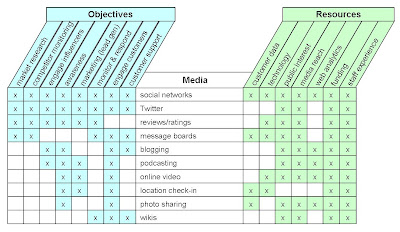 The chart makes two major points:
- different social media meet different business objectives. I suppose this is self-evident, but it still helps to think about this systematically when you’re trying to decide which to explore. As the chart indicates, most social media can in fact serve more than one objective. Incidentally, the chart lists the objectives in roughly the sequence of the customer life cycle, starting with market preparation activities at the left and moving through purchase and post-purchase support, which further helps you visualize where a particular project fits into your larger customer treatment strategy. You may disagree with particular details on this chart, but that’s less the point than thinking about putting each medium into a larger context.
- media must be matched to your resources. This is also pretty obvious, but, again, it’s easy to ignore it when considering your options. It's also worth pointing out that resources include more than data, technology and experience. My list also includes public interest in your topic and media reach (i.e., your firm’s ability to attract attention to its program, largely by paid advertising). Both make possible social programs that would otherwise fail because no one would participate. It's worth noting that funding can make up for shortfalls in other areas and that strengths in other areas reduce the need for funds.
An Example
The table below gives a simple example of these ideas in action. It analyzes the situation of a hypothetical company facing a major product recall. Objectives in this case are “monitor and respond” to public opinion and provide “customer support” to previous buyers. Highlighting these shows that social networks, Twitter, message boards and Wikis are appropriate options. But let’s assume it’s a small company, with limited media reach and funding, and that it also lacks technology and experience for social networks and Wikis. This leaves Twitter and message boards as the best candidates -- Twitter because there's very little technology involved, and message boards because we assume that company has the necessary resources in place.
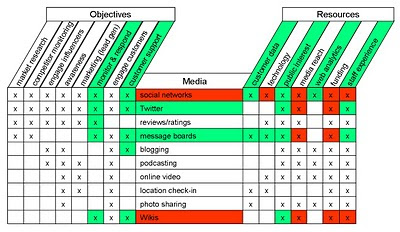
Although this example is limited to social media, the same approach can be applied to other media as well. Tune into the Webinar for more details.
 I’ll be giving a Webinar on March 23 (register here) with Neolane about cross channel marketing. At least that’s the official topic. In my mind, it’s really about helping marketers choose among the ever-increasing media options available today and in the future.
I won’t go into the details of the presentation, but thought I’d share this chart for selecting among social media.
 The chart makes two major points:
- different social media meet different business objectives. I suppose this is self-evident, but it still helps to think about this systematically when you’re trying to decide which to explore. As the chart indicates, most social media can in fact serve more than one objective. Incidentally, the chart lists the objectives in roughly the sequence of the customer life cycle, starting with market preparation activities at the left and moving through purchase and post-purchase support, which further helps you visualize where a particular project fits into your larger customer treatment strategy. You may disagree with particular details on this chart, but that’s less the point than thinking about putting each medium into a larger context.
- media must be matched to your resources. This is also pretty obvious, but, again, it’s easy to ignore it when considering your options. It's also worth pointing out that resources include more than data, technology and experience. My list also includes public interest in your topic and media reach (i.e., your firm’s ability to attract attention to its program, largely by paid advertising). Both make possible social programs that would otherwise fail because no one would participate. It's worth noting that funding can make up for shortfalls in other areas and that strengths in other areas reduce the need for funds.
An Example
The table below gives a simple example of these ideas in action. It analyzes the situation of a hypothetical company facing a major product recall. Objectives in this case are “monitor and respond” to public opinion and provide “customer support” to previous buyers. Highlighting these shows that social networks, Twitter, message boards and Wikis are appropriate options. But let’s assume it’s a small company, with limited media reach and funding, and that it also lacks technology and experience for social networks and Wikis. This leaves Twitter and message boards as the best candidates -- Twitter because there's very little technology involved, and message boards because we assume that company has the necessary resources in place.

Although this example is limited to social media, the same approach can be applied to other media as well. Tune into the Webinar for more details.
Tuesday, March 02, 2010
Eloqua SmartStart Speeds Marketing Automation Deployment, But It's Still Work
Summary: Eloqua's SmartStart gets marketers rolling in less than one week. It does require extensive preparation, but Eloqua leads you through that too. Let's face it, folks: putting a good demand generation program in place is real work.
Eloqua last week announced a money-back satisfaction guarantee for clients who participate in its SmartStart deployment program. Skeptical creature that I am, I wanted to hear the details before writing about it. By happy coincidence (OR WAS IT?), Eloqua Director of Key Accounts Jill Rowley scheduled a talk with me a few days later and filled me in.
SmartStart is a two-to-five day paid consulting engagement that helps new Eloqua clients fully deploy their systems. It’s not to be confused with the free QuickStart program (which I wrote about last May) which provides a smaller set of services. More than 150 Eloqua clients have now completed the SmartStart process, which is delivered by both Eloqua’s own professional services group and certified consulting partners.
The scope of SmartStart is indeed impressive. By the end of the program, marketers have initial email, forms, landing pages, Website tracking, CRM integration, reporting, and either lead scoring or nurturing programs. One key is preparation – the on-site sessions are preceded by extensive information gathering and technical groundwork, guided by Eloqua templates. This covers CRM integration, adding Web tracking scripts to company Web pages, assembling images and email formats, data cleansing, landing page subdomain set-up, specifying forms content and designing the lead scoring matrix. The process also includes a marketing maturity assessment that helps to define long term plans for improving the client’s marketing operations.
Rowley said most small companies can assemble the necessary information in a few days, although larger organizations take longer. Similarly, the SmartStart process itself works best for firms with relatively simple marketing operations, which Rowley said has less to do with size than numbers of regional offices and lead scoring programs, CRM integration, and existing automation. The single biggest challenge is the complexity of rules that govern CRM data synchronization, which can get very detailed when companies want different treatments in different situations.
The other key to the program is concentration during the SmartStart execution itself. The primary system administrator must devote full time to the project, while other users are brought in as needed. Because most policy decisions are made in advance, the company’s chief marketer doesn’t need to be constantly present.
The price of SmartStart varies from $4,000 to $19,000 depending on the version of Eloqua and type of CRM integration. Although that particular bit of information isn’t published, Rowley did point out to me that Eloqua’s Web site now shows basic price data, which used to be a closely-guarded secret. Pricing rules have also been vastly simplified.
That money-back guarantee? It’s good for six months and applies only to future portions of a subscription: so if you pay for a year and cancel after four months, you get refunded for the remaining eight months. That’s not quite a full refund, but it puts Eloqua on par with competitors who allow month-to-month agreements without an annual contract.
Eloqua last week announced a money-back satisfaction guarantee for clients who participate in its SmartStart deployment program. Skeptical creature that I am, I wanted to hear the details before writing about it. By happy coincidence (OR WAS IT?), Eloqua Director of Key Accounts Jill Rowley scheduled a talk with me a few days later and filled me in.
SmartStart is a two-to-five day paid consulting engagement that helps new Eloqua clients fully deploy their systems. It’s not to be confused with the free QuickStart program (which I wrote about last May) which provides a smaller set of services. More than 150 Eloqua clients have now completed the SmartStart process, which is delivered by both Eloqua’s own professional services group and certified consulting partners.
The scope of SmartStart is indeed impressive. By the end of the program, marketers have initial email, forms, landing pages, Website tracking, CRM integration, reporting, and either lead scoring or nurturing programs. One key is preparation – the on-site sessions are preceded by extensive information gathering and technical groundwork, guided by Eloqua templates. This covers CRM integration, adding Web tracking scripts to company Web pages, assembling images and email formats, data cleansing, landing page subdomain set-up, specifying forms content and designing the lead scoring matrix. The process also includes a marketing maturity assessment that helps to define long term plans for improving the client’s marketing operations.
Rowley said most small companies can assemble the necessary information in a few days, although larger organizations take longer. Similarly, the SmartStart process itself works best for firms with relatively simple marketing operations, which Rowley said has less to do with size than numbers of regional offices and lead scoring programs, CRM integration, and existing automation. The single biggest challenge is the complexity of rules that govern CRM data synchronization, which can get very detailed when companies want different treatments in different situations.
The other key to the program is concentration during the SmartStart execution itself. The primary system administrator must devote full time to the project, while other users are brought in as needed. Because most policy decisions are made in advance, the company’s chief marketer doesn’t need to be constantly present.
The price of SmartStart varies from $4,000 to $19,000 depending on the version of Eloqua and type of CRM integration. Although that particular bit of information isn’t published, Rowley did point out to me that Eloqua’s Web site now shows basic price data, which used to be a closely-guarded secret. Pricing rules have also been vastly simplified.
That money-back guarantee? It’s good for six months and applies only to future portions of a subscription: so if you pay for a year and cancel after four months, you get refunded for the remaining eight months. That’s not quite a full refund, but it puts Eloqua on par with competitors who allow month-to-month agreements without an annual contract.
Thursday, February 25, 2010
Conversen Simplifies Complex Messages Through Multi-Channel Dynamic Content
Summary: Conversen makes it easy to generate dynamic messages across multiple channels. It's more a supplement than a replacement for conventional campaign management but should save a lot of work for marketers and their agencies.
One of the fundamental challenges in database marketing is that a seriously sophisticated campaign may send different messages to hundreds or even thousands of customer segments. The traditional approach has been to define these segments during the selection process, creating a tree with one end-point for each segment, and then to assign the appropriate message to each end-point. The problem is that this requires creating hundreds of versions of the messages and making sure that each is matched to the correct end-point. This is both labor-intensive and error-prone.
An alternative is to create "dynamic content" the messages that select the appropriate contents for each individual. In essence, this is moving some of the segmentation logic from the selection process to inside the message. Even though this ultimately produces the same number of variations, it lets marketers create fewer messages and segments, reducing manual effort.
Let’s take a concrete example. Suppose you’re sending offers for winter vacation travel. People in New York will be sent offers for Florida and people in Los Angeles will get offers for Mexico. In addition, people in high-income zip codes will be offered a deluxe package while those in middle-income zip codes get an economy offer. A segmentation-based approach would use three segmentation rules (New York or Los Angeles; if New York, high or middle income; if Los Angeles, high or middle income) to create four segments, each tied to a separate message. A dynamic content approach would require just two decisions (New York or Los Angeles, high or middle income) that are each tied to a specific content block.
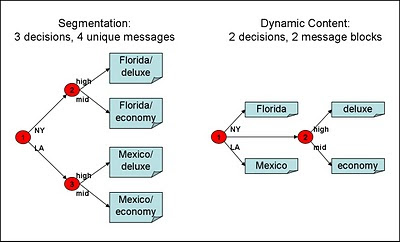
It’s still possible to make a mistake: you could accidentally link the Mexico offer to New York. But each assignment is made only once so it’s easier to be sure it’s correct.
Note that the advantage of dynamic content increases as you add complexity: a three city-pair, three level program would require four segmentation rules (one for city, three for city/level combination) and nine unique messages, while dynamic content still needs only two rules (one for city, one for level) and six message blocks (three destination cities, three luxury levels).
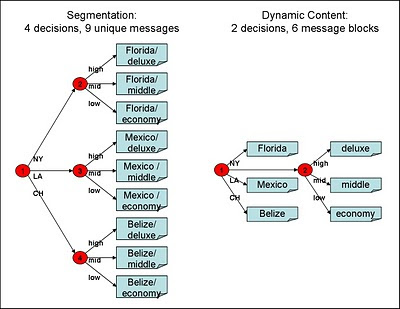
So where’s the catch? Well, dynamic content requires the marketing automation vendor to work inside the message itself, using different technologies for each medium. This is significantly trickier than just pointing each segment to a message created elsewhere.
One way to avoid this complexity is to generate a file containing the customer records and segmentation variables and let channel-specific output systems generate the customized messages. But this adds its own costs and risks, since the external systems must be configured separately for each project. As a practical matter, most high-end marketing automation vendors have compromised by providing dynamic customization for email and Web pages, and letting external systems handle the other channels.
Conversen has taken a different approach, building a specialized system to support dynamic content across as many channels as possible. This puts it in a somewhat confusing business position, since it can sometimes replace a traditional campaign management system but more often receives output from one. Resolving this confusion is largely Conversen's own problem, however, since it sells to marketing service providers rather than end-users.
Conversen is organized primarily around campaigns. These include filters to select an audience, processing steps and content. The key here is consistency: the rules used in filters, steps and dynamic content are exactly the same. It's not just that they're built with the same interface and run against the same data structures: the same rule can actually be used for any purpose. Rules can also be shared across multiple campaigns and referenced within other rules. This reuse substantially reduces the number of rules needed, and thus both the effort and opportunity for error.
The rules themselves are quite powerful, extending beyond the usual selections on field values to include advanced features such as if/then/else loops. One gap is missing support for a/b testing, which Conversen decided to omit because it added too much complexity. The system doesn’t maintain an audit trail of changes to each rule, but does provide reports listing everywhere each rule is used. This helps to avoid unintentional consequences when a rule is changed.
Rules connect with data gathered from source systems through batch processes or a real-time API. The resulting database is stored in Microsoft SQL Server and hosted by Conversen. This is important point, since it means that Conversen doesn’t simply attach to an existing marketing database. Although moving data into a separate database does add some cost, it also provides options to maintain persistent customer histories, combine data from multiple sources, and directly capture events such as campaign responses.
The system includes basic features to define data structures and map data from external sources into those structures. Load maps can include basic rules for whether to update or append matching records, but more advanced processes such as name/address matching have to be done externally.
Users who don’t need any of these functions could simply send Conversen the output files from a conventional campaign manager. This costs no more than loading files into any other message delivery system.
The heart of Conversen are the marketing messages. Conversen defines each message as an XML template. This holds any static elements plus the rules used to select content blocks.
The blocks themselves are created outside of Conversen and stored in a content library. This is another example of Conversen drawing the line between its core functionality and supporting functions to be handled elsewhere. It also probably reflects the reality that content will be created by external vendors, such as ad agencies, who will want to use their own tools in any event. Lack of an integrated content-builder does mean that personalization tokens such as [First Name] must be manually embedded within the content block. This can be done in the original content creation system, requiring a relatively inconvenient cut-and-paste from a list provided by Conversen, or be added after the content is loaded into Conversen.
Each Conversen content block currently supports a single medium. Thus, there would be separate content blocks for 10% discount in email, Web, direct mail, mobile and other types of messages. Conversen is working on multi-media content blocks that could be inserted into any medium. This would further simplify marketers’ lives.
One Conversen campaign can deliver multiple messages over time, based on dates such as a contract expiration or recent activity, or on events such as promotion responses. The system can react to qualifying events at regular intervals or in near-real-time as they are posted.
Clients can also build custom interfaces by direct access to the Conversen API. This lets them create branded systems and offer specialized portals with limited functionality. These might give designers access to the content-management features of the system, or make predefined campaigns to available to field offices.
Conversen supports email, mobile (SMS), RSS feeds such as blog posts, print, call center and Web. The system provides specialized services for each channel, such as rendering to preview emails and postal sorting for direct mail. Print output is integrated with Bitstream PageFlex, which supports direct output to high-speed printers. Conversen sends the digital messages itself and ships print and call center files to third parties for execution.
The system also provides operational reporting on campaign volume and responses. The reports are designed to provide activity information rather than detailed marketing analysis.
Conversen was introduced in 2007. The company now has about 25 marketing agencies as customers, serving more than 125 end clients. The system is offered only as a Conversen-hosted service. Pricing includes a $15,000 setup fee plus $1 to $20 per thousand messages based on volume and type.
One of the fundamental challenges in database marketing is that a seriously sophisticated campaign may send different messages to hundreds or even thousands of customer segments. The traditional approach has been to define these segments during the selection process, creating a tree with one end-point for each segment, and then to assign the appropriate message to each end-point. The problem is that this requires creating hundreds of versions of the messages and making sure that each is matched to the correct end-point. This is both labor-intensive and error-prone.
An alternative is to create "dynamic content" the messages that select the appropriate contents for each individual. In essence, this is moving some of the segmentation logic from the selection process to inside the message. Even though this ultimately produces the same number of variations, it lets marketers create fewer messages and segments, reducing manual effort.
Let’s take a concrete example. Suppose you’re sending offers for winter vacation travel. People in New York will be sent offers for Florida and people in Los Angeles will get offers for Mexico. In addition, people in high-income zip codes will be offered a deluxe package while those in middle-income zip codes get an economy offer. A segmentation-based approach would use three segmentation rules (New York or Los Angeles; if New York, high or middle income; if Los Angeles, high or middle income) to create four segments, each tied to a separate message. A dynamic content approach would require just two decisions (New York or Los Angeles, high or middle income) that are each tied to a specific content block.

It’s still possible to make a mistake: you could accidentally link the Mexico offer to New York. But each assignment is made only once so it’s easier to be sure it’s correct.
Note that the advantage of dynamic content increases as you add complexity: a three city-pair, three level program would require four segmentation rules (one for city, three for city/level combination) and nine unique messages, while dynamic content still needs only two rules (one for city, one for level) and six message blocks (three destination cities, three luxury levels).

So where’s the catch? Well, dynamic content requires the marketing automation vendor to work inside the message itself, using different technologies for each medium. This is significantly trickier than just pointing each segment to a message created elsewhere.
One way to avoid this complexity is to generate a file containing the customer records and segmentation variables and let channel-specific output systems generate the customized messages. But this adds its own costs and risks, since the external systems must be configured separately for each project. As a practical matter, most high-end marketing automation vendors have compromised by providing dynamic customization for email and Web pages, and letting external systems handle the other channels.
Conversen has taken a different approach, building a specialized system to support dynamic content across as many channels as possible. This puts it in a somewhat confusing business position, since it can sometimes replace a traditional campaign management system but more often receives output from one. Resolving this confusion is largely Conversen's own problem, however, since it sells to marketing service providers rather than end-users.
Conversen is organized primarily around campaigns. These include filters to select an audience, processing steps and content. The key here is consistency: the rules used in filters, steps and dynamic content are exactly the same. It's not just that they're built with the same interface and run against the same data structures: the same rule can actually be used for any purpose. Rules can also be shared across multiple campaigns and referenced within other rules. This reuse substantially reduces the number of rules needed, and thus both the effort and opportunity for error.
The rules themselves are quite powerful, extending beyond the usual selections on field values to include advanced features such as if/then/else loops. One gap is missing support for a/b testing, which Conversen decided to omit because it added too much complexity. The system doesn’t maintain an audit trail of changes to each rule, but does provide reports listing everywhere each rule is used. This helps to avoid unintentional consequences when a rule is changed.
Rules connect with data gathered from source systems through batch processes or a real-time API. The resulting database is stored in Microsoft SQL Server and hosted by Conversen. This is important point, since it means that Conversen doesn’t simply attach to an existing marketing database. Although moving data into a separate database does add some cost, it also provides options to maintain persistent customer histories, combine data from multiple sources, and directly capture events such as campaign responses.
The system includes basic features to define data structures and map data from external sources into those structures. Load maps can include basic rules for whether to update or append matching records, but more advanced processes such as name/address matching have to be done externally.
Users who don’t need any of these functions could simply send Conversen the output files from a conventional campaign manager. This costs no more than loading files into any other message delivery system.
The heart of Conversen are the marketing messages. Conversen defines each message as an XML template. This holds any static elements plus the rules used to select content blocks.
The blocks themselves are created outside of Conversen and stored in a content library. This is another example of Conversen drawing the line between its core functionality and supporting functions to be handled elsewhere. It also probably reflects the reality that content will be created by external vendors, such as ad agencies, who will want to use their own tools in any event. Lack of an integrated content-builder does mean that personalization tokens such as [First Name] must be manually embedded within the content block. This can be done in the original content creation system, requiring a relatively inconvenient cut-and-paste from a list provided by Conversen, or be added after the content is loaded into Conversen.
Each Conversen content block currently supports a single medium. Thus, there would be separate content blocks for 10% discount in email, Web, direct mail, mobile and other types of messages. Conversen is working on multi-media content blocks that could be inserted into any medium. This would further simplify marketers’ lives.
One Conversen campaign can deliver multiple messages over time, based on dates such as a contract expiration or recent activity, or on events such as promotion responses. The system can react to qualifying events at regular intervals or in near-real-time as they are posted.
Clients can also build custom interfaces by direct access to the Conversen API. This lets them create branded systems and offer specialized portals with limited functionality. These might give designers access to the content-management features of the system, or make predefined campaigns to available to field offices.
Conversen supports email, mobile (SMS), RSS feeds such as blog posts, print, call center and Web. The system provides specialized services for each channel, such as rendering to preview emails and postal sorting for direct mail. Print output is integrated with Bitstream PageFlex, which supports direct output to high-speed printers. Conversen sends the digital messages itself and ships print and call center files to third parties for execution.
The system also provides operational reporting on campaign volume and responses. The reports are designed to provide activity information rather than detailed marketing analysis.
Conversen was introduced in 2007. The company now has about 25 marketing agencies as customers, serving more than 125 end clients. The system is offered only as a Conversen-hosted service. Pricing includes a $15,000 setup fee plus $1 to $20 per thousand messages based on volume and type.
Monday, February 08, 2010
ExactTarget Survey: Lack of Skills Slows Growth of Digital Marketing
Summary: a new survey from ExactTarget shows that digital marketing is growing faster than database marketing or mass media, and that agencies have a harder time adding digital capabilities than their clients. It also suggests that marketers are moving into digital channels even when they can’t measure their value very well. No surprises in any of this, but good to see confirmation of previous research.
I really and truly was going to drop the topic of moving from database to digital marketing, but then I saw a survey last week from email vendor ExactTarget which reinforced several of my key points. (You can buy the complete survey from Econsultancy. A detailed slide show is available here for free, at least as I write this.) Key findings include:
- digital marketing budgets are growing faster than marketing in general (66% plan to increase their digital budget in 2010, vs 46% planning to increase their total marketing budget). Database marketing channels (email, direct mail and telephone) are growing at lower rates (54%, 27% and 26% plan to increase, respectively), while mass media (television, newspapers/magazines and radio) are lagging the most (20%, 17% and 15%).
Note that these are just the percentage of companies planning a budget increase; the actual average increase in digital budget was 17%. The average proportion of budget spent on digital was 24%, which is higher than other figures I’ve seen, suggesting the respondents were more digitally oriented than the industry as a whole.
- lack of skills is the key impediment to digital growth: lack of staff, company culture and lack of digital understanding were three of top four problems (after lack of budget, which was number 1). Inability to measure ROI and lack of business case ranked only ahead of “other”.
What is preventing your company from investing more money in digital marketing?
40% restricted budget for all types of marketing
35% lack of staff to make most of any digital investment
32% company culture
25% lack of understanding about digital
20% reliance on traditional marketing
16% inability to measure return on investment
9% lack of business case / case studies around digital
7% other
- agencies are more constrained than marketers by lack of skills. “Lack of understanding about digital” was cited by 45% of agency respondents, compared with about 13% of client-side marketers.* My interpretation is that clients can always go and hire a digital agency if they need to add the expertise, while the agencies themselves find it much harder to expand their offerings.

In fact, although 35% of both groups apparently cited “lack of staff” as a problem, they may mean different things. Agencies are probably referring to lack of staff with digital marketing skills. Client-side marketers probably mean lack of staff to oversee digital programs executed by an outside agency.
- The fastest-growing digital channels (social media and mobile) are the least measurable. In fact, there’s an almost inverted relationship between growth rates and measurability. This probably reflects that fact the fastest-growing channels are the newest, with least-established measurement methods, rather than a perverse hostility to measurability.
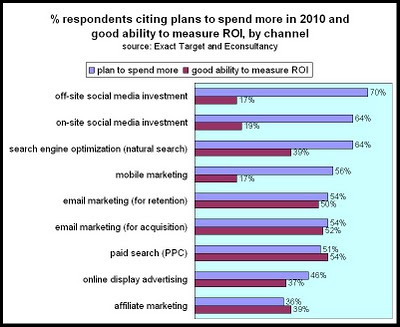
In this context, it’s also worth noting that agencies felt much more hobbled by lack of ROI and business cases than client-side marketers, and that a very-hard-to-believe 65% said their company measures marketing effectiveness based on ROI. These further reinforce the view that marketing measurement isn’t a top priority when moving into new digital channels.
__________________________________________________________________
* The published materials show total and agency figures. I've estimated values for client-side marketers based on the numbers of respondents reported for the two groups: 648 client-side, 385 agency/supplier-side. This won’t be precisely correct, since everybody didn’t answer every question. Hence that -3% response to "lack of business case" for client-side.
I really and truly was going to drop the topic of moving from database to digital marketing, but then I saw a survey last week from email vendor ExactTarget which reinforced several of my key points. (You can buy the complete survey from Econsultancy. A detailed slide show is available here for free, at least as I write this.) Key findings include:
- digital marketing budgets are growing faster than marketing in general (66% plan to increase their digital budget in 2010, vs 46% planning to increase their total marketing budget). Database marketing channels (email, direct mail and telephone) are growing at lower rates (54%, 27% and 26% plan to increase, respectively), while mass media (television, newspapers/magazines and radio) are lagging the most (20%, 17% and 15%).
Note that these are just the percentage of companies planning a budget increase; the actual average increase in digital budget was 17%. The average proportion of budget spent on digital was 24%, which is higher than other figures I’ve seen, suggesting the respondents were more digitally oriented than the industry as a whole.
- lack of skills is the key impediment to digital growth: lack of staff, company culture and lack of digital understanding were three of top four problems (after lack of budget, which was number 1). Inability to measure ROI and lack of business case ranked only ahead of “other”.
What is preventing your company from investing more money in digital marketing?
40% restricted budget for all types of marketing
35% lack of staff to make most of any digital investment
32% company culture
25% lack of understanding about digital
20% reliance on traditional marketing
16% inability to measure return on investment
9% lack of business case / case studies around digital
7% other
- agencies are more constrained than marketers by lack of skills. “Lack of understanding about digital” was cited by 45% of agency respondents, compared with about 13% of client-side marketers.* My interpretation is that clients can always go and hire a digital agency if they need to add the expertise, while the agencies themselves find it much harder to expand their offerings.

In fact, although 35% of both groups apparently cited “lack of staff” as a problem, they may mean different things. Agencies are probably referring to lack of staff with digital marketing skills. Client-side marketers probably mean lack of staff to oversee digital programs executed by an outside agency.
- The fastest-growing digital channels (social media and mobile) are the least measurable. In fact, there’s an almost inverted relationship between growth rates and measurability. This probably reflects that fact the fastest-growing channels are the newest, with least-established measurement methods, rather than a perverse hostility to measurability.

In this context, it’s also worth noting that agencies felt much more hobbled by lack of ROI and business cases than client-side marketers, and that a very-hard-to-believe 65% said their company measures marketing effectiveness based on ROI. These further reinforce the view that marketing measurement isn’t a top priority when moving into new digital channels.
__________________________________________________________________
* The published materials show total and agency figures. I've estimated values for client-side marketers based on the numbers of respondents reported for the two groups: 648 client-side, 385 agency/supplier-side. This won’t be precisely correct, since everybody didn’t answer every question. Hence that -3% response to "lack of business case" for client-side.
Thursday, February 04, 2010
Coremetrics Survey: Online Marketers Eager to Consolidate Data Across Channels
Summary: a survey sponsored by Coremetrics shows that online marketers are eager to merge data from multiple sources. This is the long-term solution to closing the gap between database and digital marketers.
I was debating yet another post on database vs digital marketing when I saw a Direct Newsline headline that said “Online Marketers Talk The Talk, But Don't Walk The Walk”. The accompanying article suggested the online marketers don’t give personalization a high priority, which supports the theme of my last few posts. Sweet.
But reality proves a bit more complex.
The article referred to a survey of online marketers sponsored by Web analytics vendor Coremetrics. As the headline suggests, about three-quarters of the marketers listed personalized email, display advertising and onsite pages as a high priority, but just under half are actually using them. So, yes, there’s more talking than walking.

But a closer look* shows that the “future priority” numbers are also related to current deployment: items like basic email marketing have low future priority scores because they’re already in widespread use. So the apparent discrepancy in the personalization rankings is less because online marketers don’t really care about it, than because they’ve had other, more fundamental things to do first.
If I were feeling particularly tendentious, I could argue other data in survey supports my claim that digital marketers are relatively disinterested in personalization. For example, “manual onsite cross-selling promotions and product recommendations” has a higher deployment rate (63%) than “manual onsite personalized content and recommendations” (49%). But a simpler explanation is that personalized recommendations are just technically harder. Indeed, the two “technology-driven” options, recommendations based on individual behavior and on “wisdom of the clouds”, have the lowest of all current deployment rates.
That said, it’s still interesting that the survey shows personalized email (52% deployed) as not significantly more common than personalized advertising (50%) or personalized site content (49%). This seems to contradict my position: if email is run by personalization-oriented database marketers, while Web advertising and (perhaps) site content are run by behavioral-targeting-oriented digital marketers, then email personalization should be more common.
But the actual question asks about email, display advertising and onsite content which are personalized "based on individual online behavior”. This adds the additional constraint of whether marketers have been able to tie (mostly anonymous) online behavior to other channels. That constraint applies across all the delivery channels, and is likely why the deployment rates are so similar. Surely the vast majority marketers are personalizing their email using information in their databases, particularly if you extend the definition of "personalization" to include segmentation that determines which messages are sent to whom.
A separate question asked marketers to rate the importance of automating different marketing tools.
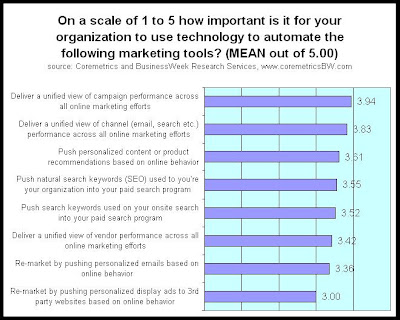
What's interesting about those answers is that five of the top six didn't involve individual-level data: three are about campaign, channel and vendor performance, and the other two are about search keywords in aggregate. The only exception, "personalized content or product recommendations based on online behavior" is based on reusing data within a single channel, which means that individuals need not be personally identified. (The survey makes clear that its definition of "personalization" includes treatments based on anonymous behavior tracking.) Actually, the two applications that do rely on consolidating personal data across channels are the lowest ranked of all the options presented. I'd say this supports my fundamental contention that digital marketers are mostly concerned about non-personal, channel-specific applications.
On the other hand, respondents did rate “obtaining an integrated view of customers across online marketing touch points” as their highest challenge, or at least as a tie with measuring marketing impact. Since it was only listed by 45% of the respondents, I could speculate that those might have been the database (email) marketers in the group, while the digital (Web) marketers could have all ignored it.
But I’m not inclined to bother: I have no problem believing that digital marketers are perfectly willing, even eager, to consolidate data across channels when it’s possible. My main point is consolidation is generally not possible because most digital touchpoints do not collect identifiable, addressable information. (See yesterdays’ post for my definitions of those terms.) And, because consolidated data is often not available, the digital marketers have learned to work without it.
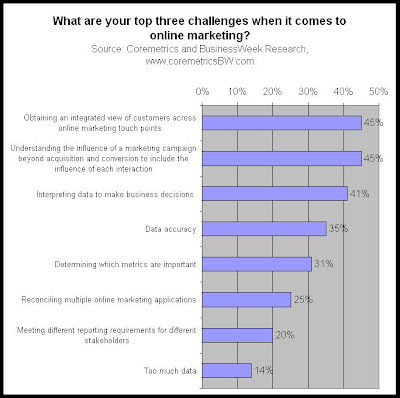
By contrast, Coremetrics is focused on a future (or, perhaps, imaginary) world where data-gathering techniques have improved. Coremetrics is arguing, and I fully agree, that consolidating data across channels does add value and that marketers should be willing to invest in making it happen.
In fact, if I hadn’t seen the survey this morning, my intent was to write about the convergence of database and digital marketing, precisely because digital marketers are increasingly aware of the value and possibilities of working from a consolidated database. So even though I’ve been arguing that database and digital marketing today are quite different, I do think they’ll become more similar over time as each group learns from the other. The marketers themselves are already leading in that direction, and vendors who want to survive will surely follow.
______________________________________________
* very close indeed. Sorry for the small print in the charts. It's the best I could do. The actual data is available in the surveys.
I was debating yet another post on database vs digital marketing when I saw a Direct Newsline headline that said “Online Marketers Talk The Talk, But Don't Walk The Walk”. The accompanying article suggested the online marketers don’t give personalization a high priority, which supports the theme of my last few posts. Sweet.
But reality proves a bit more complex.
The article referred to a survey of online marketers sponsored by Web analytics vendor Coremetrics. As the headline suggests, about three-quarters of the marketers listed personalized email, display advertising and onsite pages as a high priority, but just under half are actually using them. So, yes, there’s more talking than walking.

But a closer look* shows that the “future priority” numbers are also related to current deployment: items like basic email marketing have low future priority scores because they’re already in widespread use. So the apparent discrepancy in the personalization rankings is less because online marketers don’t really care about it, than because they’ve had other, more fundamental things to do first.
If I were feeling particularly tendentious, I could argue other data in survey supports my claim that digital marketers are relatively disinterested in personalization. For example, “manual onsite cross-selling promotions and product recommendations” has a higher deployment rate (63%) than “manual onsite personalized content and recommendations” (49%). But a simpler explanation is that personalized recommendations are just technically harder. Indeed, the two “technology-driven” options, recommendations based on individual behavior and on “wisdom of the clouds”, have the lowest of all current deployment rates.
That said, it’s still interesting that the survey shows personalized email (52% deployed) as not significantly more common than personalized advertising (50%) or personalized site content (49%). This seems to contradict my position: if email is run by personalization-oriented database marketers, while Web advertising and (perhaps) site content are run by behavioral-targeting-oriented digital marketers, then email personalization should be more common.
But the actual question asks about email, display advertising and onsite content which are personalized "based on individual online behavior”. This adds the additional constraint of whether marketers have been able to tie (mostly anonymous) online behavior to other channels. That constraint applies across all the delivery channels, and is likely why the deployment rates are so similar. Surely the vast majority marketers are personalizing their email using information in their databases, particularly if you extend the definition of "personalization" to include segmentation that determines which messages are sent to whom.
A separate question asked marketers to rate the importance of automating different marketing tools.

What's interesting about those answers is that five of the top six didn't involve individual-level data: three are about campaign, channel and vendor performance, and the other two are about search keywords in aggregate. The only exception, "personalized content or product recommendations based on online behavior" is based on reusing data within a single channel, which means that individuals need not be personally identified. (The survey makes clear that its definition of "personalization" includes treatments based on anonymous behavior tracking.) Actually, the two applications that do rely on consolidating personal data across channels are the lowest ranked of all the options presented. I'd say this supports my fundamental contention that digital marketers are mostly concerned about non-personal, channel-specific applications.
On the other hand, respondents did rate “obtaining an integrated view of customers across online marketing touch points” as their highest challenge, or at least as a tie with measuring marketing impact. Since it was only listed by 45% of the respondents, I could speculate that those might have been the database (email) marketers in the group, while the digital (Web) marketers could have all ignored it.
But I’m not inclined to bother: I have no problem believing that digital marketers are perfectly willing, even eager, to consolidate data across channels when it’s possible. My main point is consolidation is generally not possible because most digital touchpoints do not collect identifiable, addressable information. (See yesterdays’ post for my definitions of those terms.) And, because consolidated data is often not available, the digital marketers have learned to work without it.

By contrast, Coremetrics is focused on a future (or, perhaps, imaginary) world where data-gathering techniques have improved. Coremetrics is arguing, and I fully agree, that consolidating data across channels does add value and that marketers should be willing to invest in making it happen.
In fact, if I hadn’t seen the survey this morning, my intent was to write about the convergence of database and digital marketing, precisely because digital marketers are increasingly aware of the value and possibilities of working from a consolidated database. So even though I’ve been arguing that database and digital marketing today are quite different, I do think they’ll become more similar over time as each group learns from the other. The marketers themselves are already leading in that direction, and vendors who want to survive will surely follow.
______________________________________________
* very close indeed. Sorry for the small print in the charts. It's the best I could do. The actual data is available in the surveys.
Wednesday, February 03, 2010
Clarifying the Differences Between Database and Digital Marketing
Summary: Database and digital marketing are both data-driven. But they differ in plenty of other ways that make it hard for specialists in one to adapt smoothly to the other. Here's a detailed look at the differences.
Yesterday’s long (or merely long-winded?) post described the different mindsets of database and digital marketers but it was pretty short on differences between the two marketing methods themselves. Today I’ll try to be more concrete.
DB or Not DB
Database marketing is built around a marketing database that contains addressable, identifiable individuals. By “addressable”, I mean there is information such as a mailing address or phone number that lets the marketer contact the individual. By “identifiable”, I mean information is available to link data about the same individual from multiple sources. Addresses are the most common identifiable information, although there are also non-address identifiers such as Social Security Number. Addresses and identifiers are both required: a database without addresses couldn’t be used for most marketing, and a set of records that can’t be linked to other sources is just a list.
The consolidated database is the heart of the database marketing concept. Data from multiple sources lets database marketers make more effective predictions about the best treatments for each individual, and treatments across multiple channels are more effective when they are coordinated centrally. The marketing database contains attributes (age, income, location, etc.) and behaviors (promotion responses, purchases, customer service interactions, etc.). It can certainly include digital activities such as Web page views and social media comments, so long as these can be linked back to a known individual.
Digital marketing does not use a database of addressable, identifiable individuals. It may gather information from one source and even track it over time for the same entity. (Example: Web site behavior tied to a browser cookie.) But unless the entity can be linked to other sources through an identifier, the digital marketer can only make treatment decisions based on information captured in the source channel itself. This is far from useless – behavioral and contextual targeting can be quite powerful. But from a database marketing perspective, the data is frustratingly incomplete.
Addressable Media
Database marketing only works in addressable media: that is, where a message can sent to a specific individual. Addressable media include direct mail, email, outbound telemarketing, and customer service interactions. They can also include digital channels such as Web pages, mobile messages, kiosks and ATM machines, but ONLY where the recipient is known before a message is sent. Thus, a Web page that has identified me because I’ve registered and logged in (manually or via a cookie) is addressable; a Web page that I visit anonymously, even if it recognizes me as a previous visitor from a cookie, is not addressable.
Digital marketing includes many non-addressable media, including paid and organic search, Web banner advertising, social media, and anonymous forms of Web sites, kiosks, mobile (e.g., location-based messages), and the rest. These generate plenty of useful data, such as click through rates, search rankings, sentiment analysis, and page views. But this data and related analysis are quite different from what database marketers are used to.
Prediction vs Reaction
Database marketers have the rich information needed to accurately predict which offers are most appropriate for each customer. Combined with their access to customer addresses, this allows them to initiate effective outbound marketing campaigns and to define static rules for interactive dialogs. Note that in most addressable media (mail, email, outbound telemarketing), the offer must be selected before the customer is actually contacted, and making multiple offers often reduces response. So database marketers have strong reasons to work on making highly accurate predictions.
By definition, digital marketers cannot target outbound campaigns at individuals. They do have opportunities to manage interactions, but often know only what has happened during the current interaction itself. This greatly reduces their ability to make predictions. Instead, they present multiple options and react as people respond. Happily, most digital media are inherently interactive, so this is a practical approach. Since rule-based decision flows are less viable as the number of options increases, digital marketers lean more heavily on self-adjusting automated decision engines.
Message Control
Database marketers directly control the messages they send to each customer. This is yet another factor that helps to justify the costs of building a comprehensive database, running sophisticated predictive models and precisely customizing each message.
Digital marketers have vastly less control over who sees what. Much of their messaging is blind to the audience who will see it, or can only be targeted on limited information about behavior or context. Indeed, some of the most effective and intriguing digital marketing techniques, such as viral campaigns and shareable widgets, rely on distribution that's totally beyond the marketer's control. Social media provide even less control, since the messages themselves are composed outside the company. The net result of all this is to reduce the degree of individual targeting that digital marketers can execute.
Response Measurement
Database marketers can typically capture response to a promotion directly, with a coupon, telephone call or Web click. Even when they can’t, their database still ultimately tells them who bought what, so they can correlate the promotions they’ve addressed to an individual with that individual’s subsequent behavior. The ability to do precise response measurement is yet another factor that lets database marketers fine-tune their programs.
Digital marketers can also measure who clicks on a Web ad, and sometimes can track that person further into the buying cycle. But they don’t know what other promotions or social media that person saw, what else they purchased, who else saw the same promotion but didn’t respond, or who responded through some other channel. All these uncertainties leave digital marketers reliant on indirect measures, such as consumer panels and surveys, which are more typical of conventional mass media. These are approaches that most database marketers would find almost laughably imprecise.
What’s It All Mean?
Database marketers and digital marketers both have plenty of data and the good ones are highly analytical. Both can apply advanced statistical techniques and rigorous testing methods. Both can work to integrate their data and their customer strategies across channels. To some extent, they even work with the same media: in particular, a Web site can support both digital (anonymous) and database-driven (addressable) marketing programs.
Yet despite these similarities and interactions, the two groups work in largely different media, use different techniques and have different priorities. Database marketing is inherently more controlled and precise; digital marketing is more fluid. Good marketers will learn to apply both. But individuals who have specialized in any one area will find it hard to adjust to the other. At a minimum, they’ll need to be conscious that the old rules don’t apply.
Adjustment is even harder for organizations, who will have invested in specialized systems, processes and people to support one technique or the other. This, in my opinion, is why the leading database marketing vendors have not been the leading digital marketing vendors. Which, if you’ll recall, was where I started this discussion.
One final point: there's no reason the same organization or individual can't master both database and digital marketing. That is, although there are major differences between the two, there is no fundamental conflict. My point in these articles is simply that it will take conscious effort to address the differences and fill the gaps that they imply.
Yesterday’s long (or merely long-winded?) post described the different mindsets of database and digital marketers but it was pretty short on differences between the two marketing methods themselves. Today I’ll try to be more concrete.
DB or Not DB
Database marketing is built around a marketing database that contains addressable, identifiable individuals. By “addressable”, I mean there is information such as a mailing address or phone number that lets the marketer contact the individual. By “identifiable”, I mean information is available to link data about the same individual from multiple sources. Addresses are the most common identifiable information, although there are also non-address identifiers such as Social Security Number. Addresses and identifiers are both required: a database without addresses couldn’t be used for most marketing, and a set of records that can’t be linked to other sources is just a list.
The consolidated database is the heart of the database marketing concept. Data from multiple sources lets database marketers make more effective predictions about the best treatments for each individual, and treatments across multiple channels are more effective when they are coordinated centrally. The marketing database contains attributes (age, income, location, etc.) and behaviors (promotion responses, purchases, customer service interactions, etc.). It can certainly include digital activities such as Web page views and social media comments, so long as these can be linked back to a known individual.
Digital marketing does not use a database of addressable, identifiable individuals. It may gather information from one source and even track it over time for the same entity. (Example: Web site behavior tied to a browser cookie.) But unless the entity can be linked to other sources through an identifier, the digital marketer can only make treatment decisions based on information captured in the source channel itself. This is far from useless – behavioral and contextual targeting can be quite powerful. But from a database marketing perspective, the data is frustratingly incomplete.
Addressable Media
Database marketing only works in addressable media: that is, where a message can sent to a specific individual. Addressable media include direct mail, email, outbound telemarketing, and customer service interactions. They can also include digital channels such as Web pages, mobile messages, kiosks and ATM machines, but ONLY where the recipient is known before a message is sent. Thus, a Web page that has identified me because I’ve registered and logged in (manually or via a cookie) is addressable; a Web page that I visit anonymously, even if it recognizes me as a previous visitor from a cookie, is not addressable.
Digital marketing includes many non-addressable media, including paid and organic search, Web banner advertising, social media, and anonymous forms of Web sites, kiosks, mobile (e.g., location-based messages), and the rest. These generate plenty of useful data, such as click through rates, search rankings, sentiment analysis, and page views. But this data and related analysis are quite different from what database marketers are used to.
Prediction vs Reaction
Database marketers have the rich information needed to accurately predict which offers are most appropriate for each customer. Combined with their access to customer addresses, this allows them to initiate effective outbound marketing campaigns and to define static rules for interactive dialogs. Note that in most addressable media (mail, email, outbound telemarketing), the offer must be selected before the customer is actually contacted, and making multiple offers often reduces response. So database marketers have strong reasons to work on making highly accurate predictions.
By definition, digital marketers cannot target outbound campaigns at individuals. They do have opportunities to manage interactions, but often know only what has happened during the current interaction itself. This greatly reduces their ability to make predictions. Instead, they present multiple options and react as people respond. Happily, most digital media are inherently interactive, so this is a practical approach. Since rule-based decision flows are less viable as the number of options increases, digital marketers lean more heavily on self-adjusting automated decision engines.
Message Control
Database marketers directly control the messages they send to each customer. This is yet another factor that helps to justify the costs of building a comprehensive database, running sophisticated predictive models and precisely customizing each message.
Digital marketers have vastly less control over who sees what. Much of their messaging is blind to the audience who will see it, or can only be targeted on limited information about behavior or context. Indeed, some of the most effective and intriguing digital marketing techniques, such as viral campaigns and shareable widgets, rely on distribution that's totally beyond the marketer's control. Social media provide even less control, since the messages themselves are composed outside the company. The net result of all this is to reduce the degree of individual targeting that digital marketers can execute.
Response Measurement
Database marketers can typically capture response to a promotion directly, with a coupon, telephone call or Web click. Even when they can’t, their database still ultimately tells them who bought what, so they can correlate the promotions they’ve addressed to an individual with that individual’s subsequent behavior. The ability to do precise response measurement is yet another factor that lets database marketers fine-tune their programs.
Digital marketers can also measure who clicks on a Web ad, and sometimes can track that person further into the buying cycle. But they don’t know what other promotions or social media that person saw, what else they purchased, who else saw the same promotion but didn’t respond, or who responded through some other channel. All these uncertainties leave digital marketers reliant on indirect measures, such as consumer panels and surveys, which are more typical of conventional mass media. These are approaches that most database marketers would find almost laughably imprecise.
What’s It All Mean?
Database marketers and digital marketers both have plenty of data and the good ones are highly analytical. Both can apply advanced statistical techniques and rigorous testing methods. Both can work to integrate their data and their customer strategies across channels. To some extent, they even work with the same media: in particular, a Web site can support both digital (anonymous) and database-driven (addressable) marketing programs.
Yet despite these similarities and interactions, the two groups work in largely different media, use different techniques and have different priorities. Database marketing is inherently more controlled and precise; digital marketing is more fluid. Good marketers will learn to apply both. But individuals who have specialized in any one area will find it hard to adjust to the other. At a minimum, they’ll need to be conscious that the old rules don’t apply.
Adjustment is even harder for organizations, who will have invested in specialized systems, processes and people to support one technique or the other. This, in my opinion, is why the leading database marketing vendors have not been the leading digital marketing vendors. Which, if you’ll recall, was where I started this discussion.
One final point: there's no reason the same organization or individual can't master both database and digital marketing. That is, although there are major differences between the two, there is no fundamental conflict. My point in these articles is simply that it will take conscious effort to address the differences and fill the gaps that they imply.
Tuesday, February 02, 2010
Can Database Marketers Learn Digital Tricks?
Summary: Database marketing and digital marketing are more different than it seems. It's hard for experts in one to adjust to the other.
Yesterday’s post touched briefly on what I see as a fundamental transition between database marketing and digital marketing, and in particular on the changes that marketers and their supporting vendors must make to navigate the change successfully. This is an important topic, so I thought I’d return for a closer look.
It’s self-evident that digital marketing (mostly on the Internet, but also mobile, in-game, and eventually interactive TV) is a major change from both traditional mass media and more recent database marketing (mail, email, telemarketing, CRM). What’s less obvious is that the skills and attitudes that have served database marketers well for the past twenty or more years – an entire career for many – don’t transfer to the digital world. It’s true that database and digital marketing are both technology-enabled and thus seem as if they should draw on similar talents. But the similarities are superficial while the differences are profound.
Let’s cut to the core of the matter: the first rule of database marketing is that whoever has the biggest database, wins. Database marketers strive to gather ever-more information about their customers and (to a lesser extent, because less data is available) about their prospects. Their Holy Grail is the ever-receding “360 degree view of the customer,” a phrase I’ve always disliked because (a) it treats the customer as an object and (b) no one can possibly know everything about their customers. Today, at least to my mind, it also conjures up a full-body scan X-ray, an image I hope enough people find so offensive that it will finally put the phrase to rest.
Sorry for the rant. My point is that database marketers’ ideal is a perfectly detailed customer database, which would allow them to target precisely the “right offer to the right customer at the right time.” This attitude leads to highly structured, finely segmented campaigns and carefully-plotted, rules-driven interaction flows which make the best possible use of whatever data is actually available.
Digital marketers have no such illusions about the completeness of the data they could ever hope to assemble. I’m not saying many of them wouldn’t like to identify each person they interact with, just that this is obviously impossible in most situations. Thus, digital marketers start from a premise that they’ll be interacting with people cloaked by varying degrees of anonymity, and look for ways to make the best use of the limited information available. In one case this might a search term they used to reach a Web site; in another it might be a history of movies they and others have rented; in yet another it might be their current physical location. Most innovations in digital marketing involve improving the value extracted from such limited data, rather than attempting to link the data to an identity that can then be enhanced with large volumes of personal information from other sources.
(Caveat: yes, there are some major efforts aimed precisely at providing digital marketers with individual identities. But these run up against both the fundamental difficulty of identifying people in most digital media. Even more important, their value is limited because immediate past data about behavior and context is usually more powerful at predicting immediate future behavior than static personal information from external sources.)
A corollary to the limited and contextual nature of most digital customer data is that marketing programs don’t have enough information to make reliable predictions about the most appropriate treatments. Thus, multi-step marketing campaigns or highly structured interaction dialogs are less useful than simply giving people a variety of choices and letting them guide the process for themselves. Again, this is a matter of degree: deciding which choices to present itself requires predictions about which items the customers will prefer. But presenting multiple choices is quite different from trying to guess in advance which one is best.
In other words, we’re talking about a loss of control over the marketing process. This is still more obvious at the start of the marketing cycle, when companies are first attracting customers into a relationship. Database marketers spend lots of effort acquiring and enhancing prospect lists so they can decide whom to approach and which offers to send them. By contrast, most digital marketing contacts are initiated by the prospects themselves in response to an advertisement or social media message. Certainly digital marketers can select their advertising audiences, but this resembles traditional media buying more than an outbound direct marketing campaign. Even (or, perhaps, especially) with social media interactions, the marketer has very little control over what is communicated to whom.
Indeed, even though database marketers do plenty of acquisition, I think it’s fair to say that they find it relatively frustrating because the available data is generally so limited. Most would probably prefer to work on customer management – cross sell, upsell and retention – where richer data is available. By contrast, digital marketers have happily embraced the notion of “inbound marketing”, which is precisely the art of attracting new people to their products. To speculate still further, the reason that business marketers are adopting marketing automation much more enthusiastically than they ever adopted traditional database marketing may be that business marketing automation is largely being used in acquisition-friendly digital media, and business marketers are more acquisition-oriented (i.e., focused on lead generation) than their consumer marketing brethren.
Control is also a major differentiator when it comes to marketing measurement. Perhaps the proudest claim of database marketers is that all their efforts are highly and precisely measurable. Reality is a bit more messy, but it’s true that database marketing does support proper champion/challenger testing for companies willing to make the investment. Digital marketing also supports such testing. But many digital efforts involve display advertising where at least some of the value comes from exposures that do not prompt immediate, measurable activity. This is another area where digital marketing more closely resembles traditional mass media advertising than anything else. In fact, digital marketers increasingly base their measurements on consumer panels and surveys, almost precisely duplicating the conventional mass media approach. Again, the fundamental point is a difference in attitude: database marketers treat precise measurement as their ideal, even though they realize it isn’t fully attainable. Digital marketing doesn’t permit that illusion, so its practitioners can more easily accept less exact approaches.
By now I’ve probably annoyed many of my friends in both the database and digital marketing industries. Let me make clear that I’m not arguing that database marketing is obsolete or somehow inferior to digital marketing. They do different things and will coexist, just as mass media survived when database marketing appeared. In fact, good marketers will learn to integrate them effectively, letting each do what it does best. Actually, I’d argue that rule- and data-driven Website personalization has more in common with classic database marketing than with most digital marketing methods. In that case, integration between the two types of marketing happens within the Web site itself.
Nor am I arguing that database and digital marketing have nothing in common. Both are, obviously, dependent on technology and both are measurable in their own ways. Both work with customer databases – in fact, as digital marketers get better at capturing and integrating customer data, they will find themselves increasingly reliant on database marketing techniques. And, of course, both ultimately perform the basic marketing tasks of understanding their customers and using that knowledge effectively.
Rather, I’m trying to show that different skills and assumptions are needed for success in the two areas, and to suggest that this makes it difficult for people and organizations to transition from one to the other. This, in my opinion, is why the direct marketing agencies, marketing service providers and marketing software vendors who dominate the database marketing industry have not transferred their leadership to the digital marketing channels. The only new medium they easily adopted was email, but that was essentially database marketing to begin with.
This doesn’t mean that database marketing vendors are inevitably doomed or trapped in a shrinking specialty. But it does mean that those firms must recognize the fundamental differences between their old industry and the new one. They cannot make the easy but false assumption that digital marketing is a natural extension of database marketing techniques. Only the marketers and vendors who aggressively embrace digital marketing in its own terms will be able to lead the new industry.
Yesterday’s post touched briefly on what I see as a fundamental transition between database marketing and digital marketing, and in particular on the changes that marketers and their supporting vendors must make to navigate the change successfully. This is an important topic, so I thought I’d return for a closer look.
It’s self-evident that digital marketing (mostly on the Internet, but also mobile, in-game, and eventually interactive TV) is a major change from both traditional mass media and more recent database marketing (mail, email, telemarketing, CRM). What’s less obvious is that the skills and attitudes that have served database marketers well for the past twenty or more years – an entire career for many – don’t transfer to the digital world. It’s true that database and digital marketing are both technology-enabled and thus seem as if they should draw on similar talents. But the similarities are superficial while the differences are profound.
Let’s cut to the core of the matter: the first rule of database marketing is that whoever has the biggest database, wins. Database marketers strive to gather ever-more information about their customers and (to a lesser extent, because less data is available) about their prospects. Their Holy Grail is the ever-receding “360 degree view of the customer,” a phrase I’ve always disliked because (a) it treats the customer as an object and (b) no one can possibly know everything about their customers. Today, at least to my mind, it also conjures up a full-body scan X-ray, an image I hope enough people find so offensive that it will finally put the phrase to rest.
Sorry for the rant. My point is that database marketers’ ideal is a perfectly detailed customer database, which would allow them to target precisely the “right offer to the right customer at the right time.” This attitude leads to highly structured, finely segmented campaigns and carefully-plotted, rules-driven interaction flows which make the best possible use of whatever data is actually available.
Digital marketers have no such illusions about the completeness of the data they could ever hope to assemble. I’m not saying many of them wouldn’t like to identify each person they interact with, just that this is obviously impossible in most situations. Thus, digital marketers start from a premise that they’ll be interacting with people cloaked by varying degrees of anonymity, and look for ways to make the best use of the limited information available. In one case this might a search term they used to reach a Web site; in another it might be a history of movies they and others have rented; in yet another it might be their current physical location. Most innovations in digital marketing involve improving the value extracted from such limited data, rather than attempting to link the data to an identity that can then be enhanced with large volumes of personal information from other sources.
(Caveat: yes, there are some major efforts aimed precisely at providing digital marketers with individual identities. But these run up against both the fundamental difficulty of identifying people in most digital media. Even more important, their value is limited because immediate past data about behavior and context is usually more powerful at predicting immediate future behavior than static personal information from external sources.)
A corollary to the limited and contextual nature of most digital customer data is that marketing programs don’t have enough information to make reliable predictions about the most appropriate treatments. Thus, multi-step marketing campaigns or highly structured interaction dialogs are less useful than simply giving people a variety of choices and letting them guide the process for themselves. Again, this is a matter of degree: deciding which choices to present itself requires predictions about which items the customers will prefer. But presenting multiple choices is quite different from trying to guess in advance which one is best.
In other words, we’re talking about a loss of control over the marketing process. This is still more obvious at the start of the marketing cycle, when companies are first attracting customers into a relationship. Database marketers spend lots of effort acquiring and enhancing prospect lists so they can decide whom to approach and which offers to send them. By contrast, most digital marketing contacts are initiated by the prospects themselves in response to an advertisement or social media message. Certainly digital marketers can select their advertising audiences, but this resembles traditional media buying more than an outbound direct marketing campaign. Even (or, perhaps, especially) with social media interactions, the marketer has very little control over what is communicated to whom.
Indeed, even though database marketers do plenty of acquisition, I think it’s fair to say that they find it relatively frustrating because the available data is generally so limited. Most would probably prefer to work on customer management – cross sell, upsell and retention – where richer data is available. By contrast, digital marketers have happily embraced the notion of “inbound marketing”, which is precisely the art of attracting new people to their products. To speculate still further, the reason that business marketers are adopting marketing automation much more enthusiastically than they ever adopted traditional database marketing may be that business marketing automation is largely being used in acquisition-friendly digital media, and business marketers are more acquisition-oriented (i.e., focused on lead generation) than their consumer marketing brethren.
Control is also a major differentiator when it comes to marketing measurement. Perhaps the proudest claim of database marketers is that all their efforts are highly and precisely measurable. Reality is a bit more messy, but it’s true that database marketing does support proper champion/challenger testing for companies willing to make the investment. Digital marketing also supports such testing. But many digital efforts involve display advertising where at least some of the value comes from exposures that do not prompt immediate, measurable activity. This is another area where digital marketing more closely resembles traditional mass media advertising than anything else. In fact, digital marketers increasingly base their measurements on consumer panels and surveys, almost precisely duplicating the conventional mass media approach. Again, the fundamental point is a difference in attitude: database marketers treat precise measurement as their ideal, even though they realize it isn’t fully attainable. Digital marketing doesn’t permit that illusion, so its practitioners can more easily accept less exact approaches.
By now I’ve probably annoyed many of my friends in both the database and digital marketing industries. Let me make clear that I’m not arguing that database marketing is obsolete or somehow inferior to digital marketing. They do different things and will coexist, just as mass media survived when database marketing appeared. In fact, good marketers will learn to integrate them effectively, letting each do what it does best. Actually, I’d argue that rule- and data-driven Website personalization has more in common with classic database marketing than with most digital marketing methods. In that case, integration between the two types of marketing happens within the Web site itself.
Nor am I arguing that database and digital marketing have nothing in common. Both are, obviously, dependent on technology and both are measurable in their own ways. Both work with customer databases – in fact, as digital marketers get better at capturing and integrating customer data, they will find themselves increasingly reliant on database marketing techniques. And, of course, both ultimately perform the basic marketing tasks of understanding their customers and using that knowledge effectively.
Rather, I’m trying to show that different skills and assumptions are needed for success in the two areas, and to suggest that this makes it difficult for people and organizations to transition from one to the other. This, in my opinion, is why the direct marketing agencies, marketing service providers and marketing software vendors who dominate the database marketing industry have not transferred their leadership to the digital marketing channels. The only new medium they easily adopted was email, but that was essentially database marketing to begin with.
This doesn’t mean that database marketing vendors are inevitably doomed or trapped in a shrinking specialty. But it does mean that those firms must recognize the fundamental differences between their old industry and the new one. They cannot make the easy but false assumption that digital marketing is a natural extension of database marketing techniques. Only the marketers and vendors who aggressively embrace digital marketing in its own terms will be able to lead the new industry.
Monday, February 01, 2010
Unica and Alterian Lead Database Marketers to the Digital Promised Land
Here are some quick thoughts on two items: Unica’s acquisition of paid search bid management system MakeMeTop (now mercifully renamed Unica Search) and Alterian’s recently-released and excellent annual marketing survey.
The connection is that these both support my feeling that many members of the old-line database marketing community have failed to adapt to the new world of digital marketing. I’ve been talking about this a lot with consulting clients but don’t think I’ve written about it at length in this blog.
The gist of the argument is that traditional direct marketing agencies, marketing automation software vendors and marketing services providers have mostly remained focused on outbound campaigns. They did move from direct mail to email, but those are pretty much the same thing. The really cool digital marketing stuff, including Web site development, Web advertising and most recently social media, has been executed by a different set of digital marketing agencies, specialist software vendors, and, ironically, media buyers at traditional ad agencies.
The fundamental reason is that the main skill of database marketers is building a customer database, while the core of digital marketing is responding to the behaviors of anonymous individuals. Of course I’m oversimplifying – much digital marketing does deal with people who have identified themselves – but there’s still a fundamental shift from targeting outbound campaigns at known individuals to managing interactions with anyone willing to engage.
Both Unica and Alterian have been exceptionally forward-thinking among marketing automation vendors in preparing for this transition. Unica’s latest acquisition is particularly interesting because search bid management has almost nothing to do with reaching known individuals. (I say “almost” only because Unica seems to intend to link search click-throughs to a traditional marketing database.) It follows Unica’s acquisition last month of email deliverability expert Pivotal Veracity, which I found less impressive because email is part of the old database marketing world.
Alterian has already made big bets in social media and Web content management, which are also well beyond the scope of traditional database marketing. Its survey provides strong support for the notion that marketers are “moving from a campaign-centric direct marketing model towards multi-channel customer engagement”: in fact, 51% said they were expending a fair or significant amount of effort on exactly that. Related factoids include:
- 61% of marketers do not integrate Web analytics with other customer data.
- 66% of respondents (which included quite a few agencies and marketing services providers, in addition to marketers) plan to invest in social media marketing in 2010
- 36% of respondents plan to invest in social media monitoring in 2010 (a discrepancy that Alterian finds “worrying”, although I’ve previously seen similar data. My take is that many marketers see social media as a way to generate business directly, and look at monitoring as a secondary aim.)
- 38% said coordinating digital and direct marketing agencies was somewhat or very difficult. No surprise there, although I don't necessarily agree with Alterian's contention that this will lead to a unification between the two sets of agencies.
- 35% of marketers expect to move more than 20% of their direct marketing budget into digital channels next year.
In short, the Alterian survey shows that marketers are eagerly moving from classic direct marketing to digital, interactive and social marketing, but still lack the skills and resources to do it effectively. Industry vendors who support them will thrive. Those who don't will quickly be left behind.
The connection is that these both support my feeling that many members of the old-line database marketing community have failed to adapt to the new world of digital marketing. I’ve been talking about this a lot with consulting clients but don’t think I’ve written about it at length in this blog.
The gist of the argument is that traditional direct marketing agencies, marketing automation software vendors and marketing services providers have mostly remained focused on outbound campaigns. They did move from direct mail to email, but those are pretty much the same thing. The really cool digital marketing stuff, including Web site development, Web advertising and most recently social media, has been executed by a different set of digital marketing agencies, specialist software vendors, and, ironically, media buyers at traditional ad agencies.
The fundamental reason is that the main skill of database marketers is building a customer database, while the core of digital marketing is responding to the behaviors of anonymous individuals. Of course I’m oversimplifying – much digital marketing does deal with people who have identified themselves – but there’s still a fundamental shift from targeting outbound campaigns at known individuals to managing interactions with anyone willing to engage.
Both Unica and Alterian have been exceptionally forward-thinking among marketing automation vendors in preparing for this transition. Unica’s latest acquisition is particularly interesting because search bid management has almost nothing to do with reaching known individuals. (I say “almost” only because Unica seems to intend to link search click-throughs to a traditional marketing database.) It follows Unica’s acquisition last month of email deliverability expert Pivotal Veracity, which I found less impressive because email is part of the old database marketing world.
Alterian has already made big bets in social media and Web content management, which are also well beyond the scope of traditional database marketing. Its survey provides strong support for the notion that marketers are “moving from a campaign-centric direct marketing model towards multi-channel customer engagement”: in fact, 51% said they were expending a fair or significant amount of effort on exactly that. Related factoids include:
- 61% of marketers do not integrate Web analytics with other customer data.
- 66% of respondents (which included quite a few agencies and marketing services providers, in addition to marketers) plan to invest in social media marketing in 2010
- 36% of respondents plan to invest in social media monitoring in 2010 (a discrepancy that Alterian finds “worrying”, although I’ve previously seen similar data. My take is that many marketers see social media as a way to generate business directly, and look at monitoring as a secondary aim.)
- 38% said coordinating digital and direct marketing agencies was somewhat or very difficult. No surprise there, although I don't necessarily agree with Alterian's contention that this will lead to a unification between the two sets of agencies.
- 35% of marketers expect to move more than 20% of their direct marketing budget into digital channels next year.
In short, the Alterian survey shows that marketers are eagerly moving from classic direct marketing to digital, interactive and social marketing, but still lack the skills and resources to do it effectively. Industry vendors who support them will thrive. Those who don't will quickly be left behind.
Subscribe to:
Posts (Atom)